All posts by John Hughes

Keeping Odaimoku

KANJIN HONZON SHO

All the good deeds and virtues of the Buddha Sakyamuni are manifested in the title of the Lotus Sutra, that is, in the five letters: “Myo Ho Ren Ge Kyo.” However sinful we may be, we shall be naturally endowed with all the deeds and virtues of the Buddha if we adhere to these five letters.

(Background : April 25, 1273, 51 years old, at Sado, Showa Teihcn, p.711)

Explanatory note

Upon a meritorious accomplishment, we often fail to appreciate other people’s helping hands and are apt to think that it was due solely to our own abilities and efforts. We may say, “I accomplished this because I chanted Odaimoku so many times,” or “My job is successful because I have chanted Buddhist scriptures with a sincere mind.” If these words represent your beliefs, you have yet to attain the stage of awareness.

Let us think on the word “given.” Our bodies and minds are given to us. Even our wills to accomplish something are inherited from our ancestors.

Our achievements do not come to us by our own abilities and efforts alone. We must be aware of important environmental influences in our daily lives. This awareness will affect many changes in our lives.

After studying the teaching of the Buddha for many years, Nichiren Daishonin reached the conclusion that salvation in the Latter Age of the Declining Law was only possible through upholding Odaimoku with firm conviction. Because of his methodical and careful study of Buddhism, he realized a profound comprehension and conviction of Buddhism. Nevertheless, he taught us not to be overly concerned with theory alone, but to have faith and to practice the chanting of Odaimoku.

Nichiren revealed that the five characters of Odaimoku, “Myo Ho Ren Ge Kyo,” embody the following : All virtues of the Buddha Sakyamuni’s practices, of His enlightenment, and of His salvation.

The Buddha Sakyamuni attained enlightenment in the remote past, but before His Enlightenment, He had practiced the Bodhisattva austerities for countless times in His previous lives. His experiences of these practices are detailed in the Jataka Tales.

His practices and enlightenment are all embodied within Odaimoku. However, salvation by Odaimoku is promised in the Lotus Sutra which declares that it will be performed by Bodhisattva Jogyo in the Latter Age of the Declining Law. As a matter of fact, Nichiren Daishonin appeared in the Latter Age to prove this promise and taught us the importance of the chanting of Odaimoku.

When we uphold Odaimoku, we will be given all the virtues of the Buddha Sakyamuni and will be embraced in his realm of enlightenment. This is Buddha’s salvation.

Rev. Matsuda

Phrase A Day

Daily Dharma – Jan. 9, 2023

Anyone who rejoices at hearing this sūtra,
And who receives it respectfully,
Know this, has already reached
The stage of not-returning.

The Buddha sings these verses in Chapter Three of the Lotus Sūtra. The state of non-returning means having the certainty of reaching enlightenment. As Bodhisattvas, when we go into any realm, whether higher or lower, it is to benefit the beings there. It is easy to become discouraged by the difficulties we face in this world of conflict, and to forget that we are not alone in our efforts to help others. When we return to the joy of the Lotus Sūtra, the Buddha reminds us of who we are, what we are doing, and where we are going, no matter what obstacles we may find.

The Daily Dharma is produced by the Lexington Nichiren Buddhist Community. To subscribe to the daily emails, visit zenzaizenzai.com

The Value of Online Services

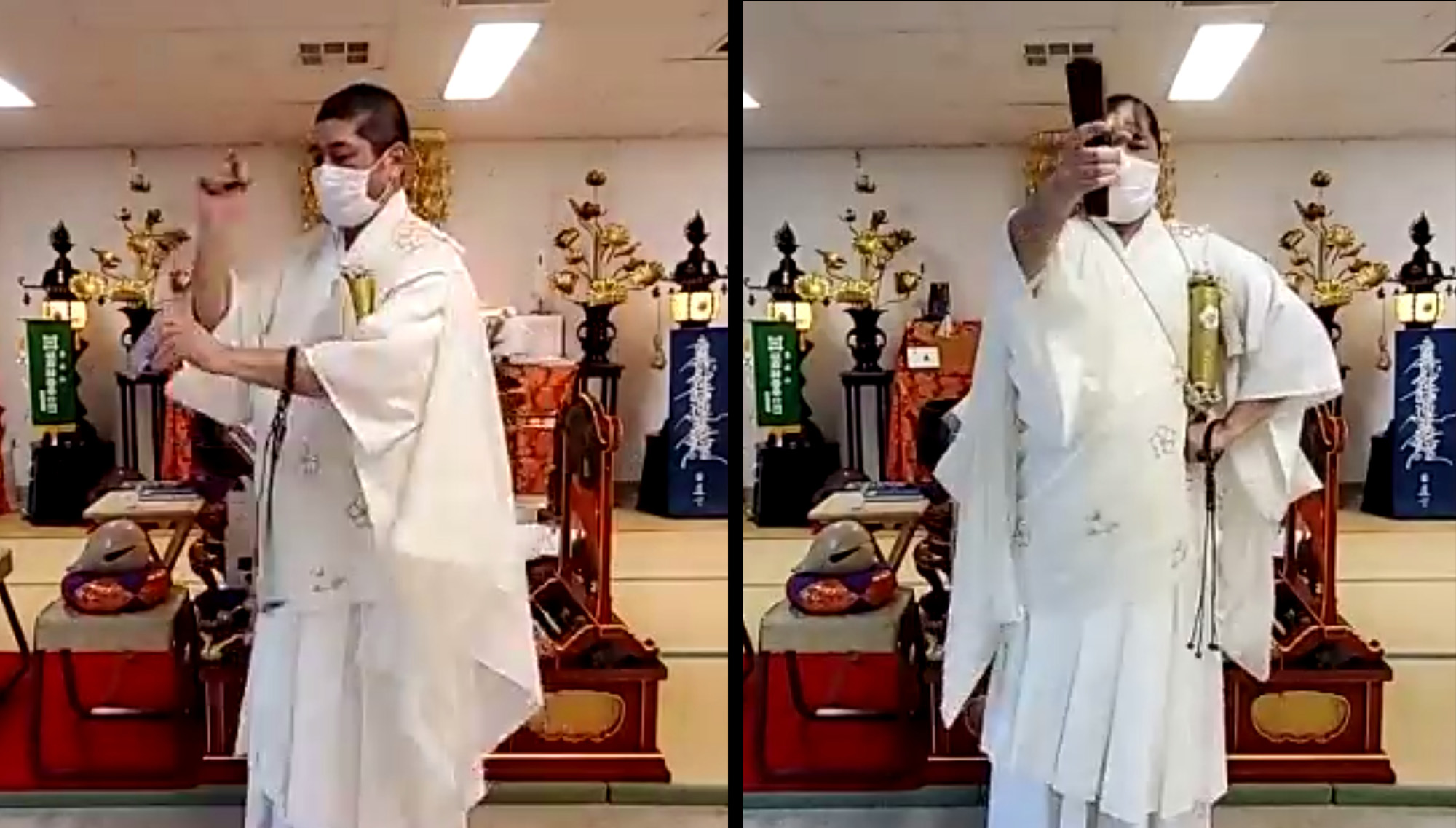
Rev. Shoda Kanai performs purification ceremony

Today, while there were no services at the Sacramento Nichiren Buddhist Church, I was able to attend the monthly purification service held by Rev. Shoda Kanai from the Nichiren Buddhist Kannon Temple of Nevada.

Yes, attending a service in person is better, but I’m truly grateful that I live in a time when we can use technology to transport ourselves to distant places. (And someday that won’t just be a Zoom session but real physical transport.)

This value was underscored by Rev. Kanai’s bestowal of Mandela Gohonzons to three people as part of the service. One person was able to attend the service and take jukai vows to join Nichiren Shu and two others took those vows online and will receive their eye-opened Gohonzons in the mail.

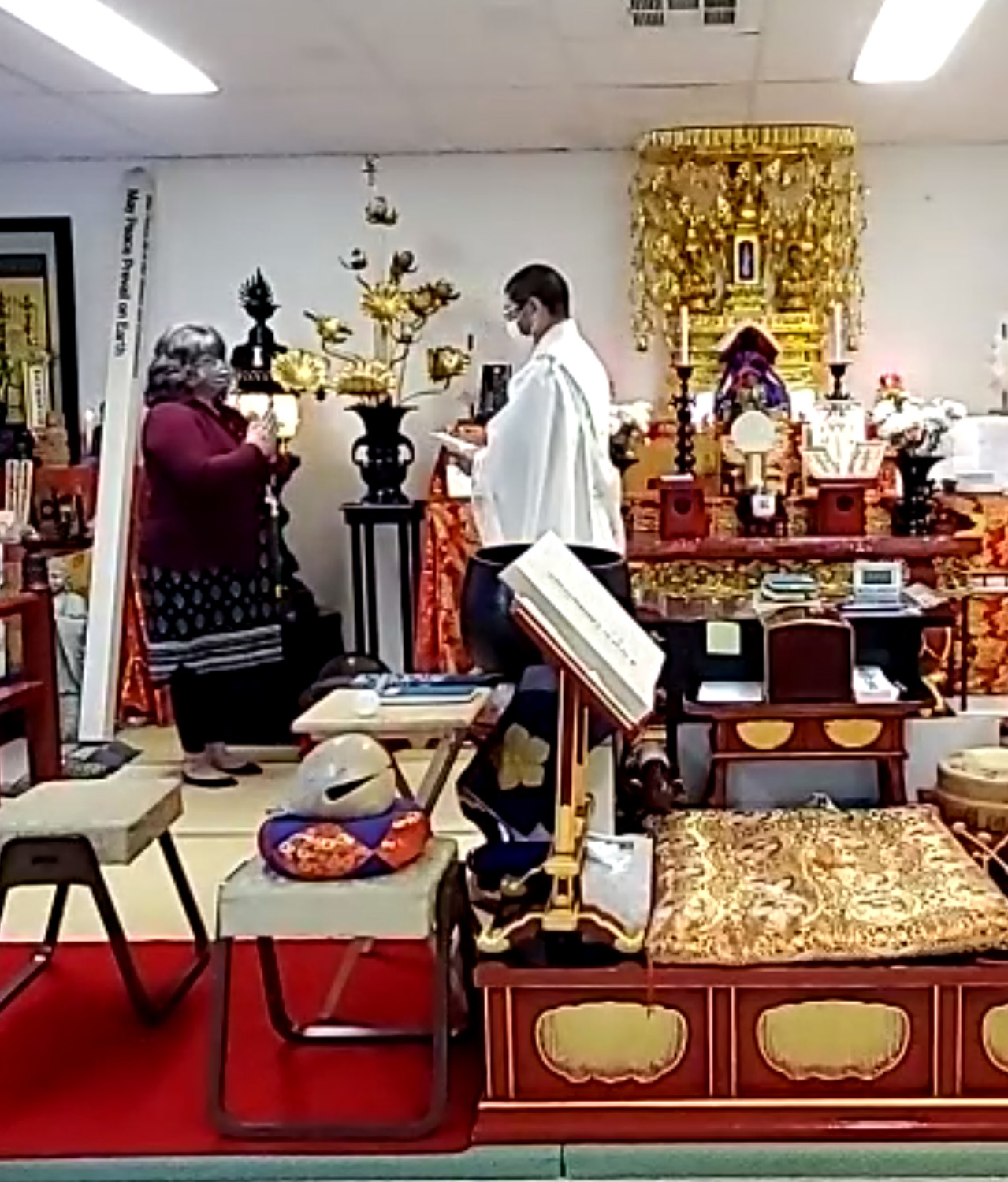
Jukai ceremony and Mandela Gohonzon bestowal

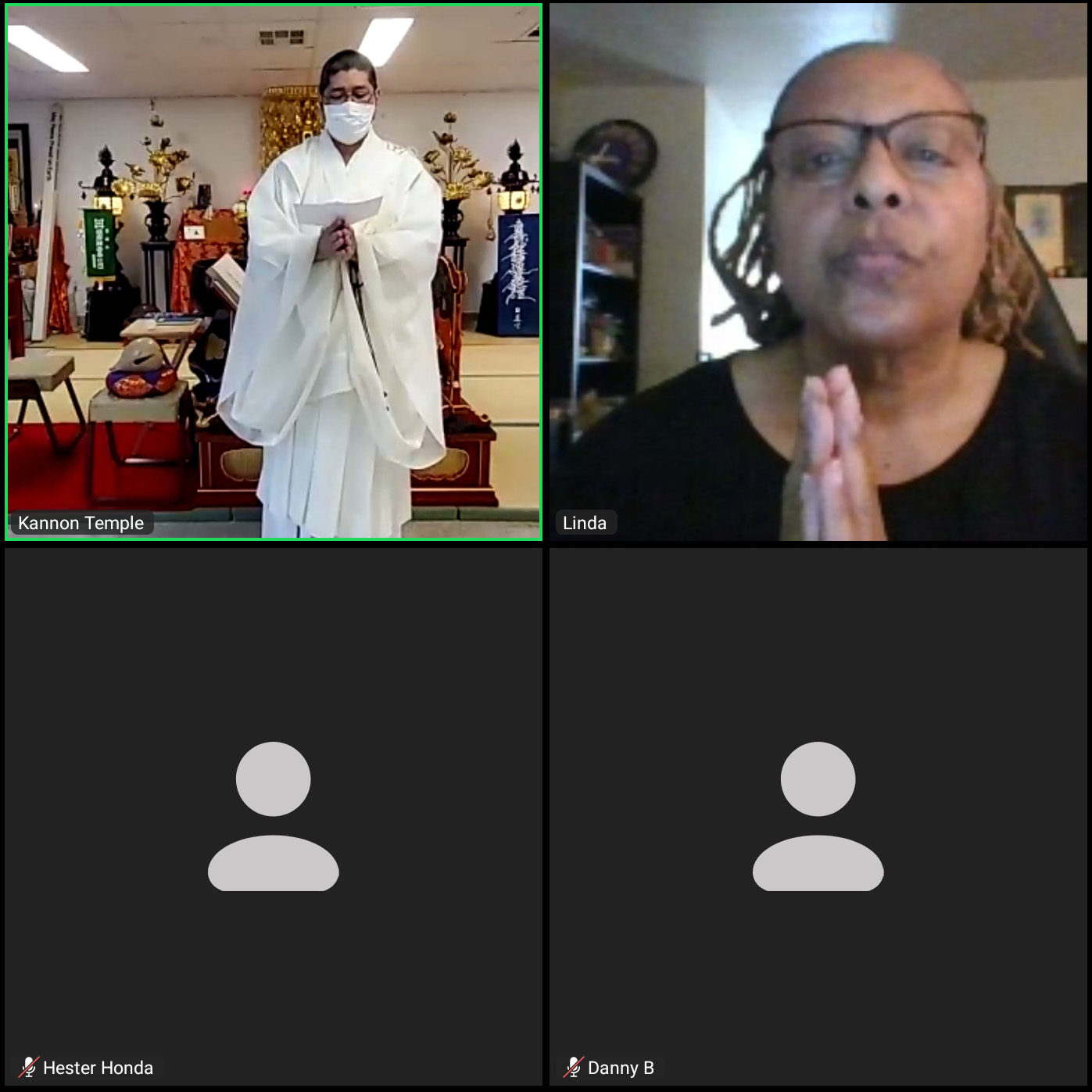
Jukai ceremony online

Day 6

Day 6 continues Chapter 3, A Parable


Having last month considered why the Buddha used an expedient to save his children, we compare the children’s toys with the Śrāvakas, Pratyekabuddhas and Bodhisattvas.

“Śāriputra! Those who have intelligence, who receive the Dharma by faith after hearing it from the Buddha, from the World Honored One, and who seek Nirvāṇa with strenuous efforts in order to get out of the triple world, are called Śrāvakas. They may be likened to the children who left the burning house in order to get the sheep-carts. Those who receive the Dharma by faith after hearing it from the Buddha, from the World-Honored One, who seek the self-originating wisdom with strenuous efforts, who wish to have good tranquility in seclusion, and who perfectly understand the causes of all things, are called Pratyekabuddhas. They may be likened to the children who left the burning house in order to get the deer-carts. Those who receive the Dharma by faith after hearing it from the Buddha, from the World-Honored One, who strenuously seek the knowledge of all things, the wisdom of the Buddha, the self-originating wisdom, the wisdom to be obtained without teachers, and the insight and powers and fearlessness of the Tathāgata, who give peace to innumerable living beings out of their compassion towards them, and who benefit gods and men, that is to say, who save all living beings, are called men of the Great Vehicle. Bodhisattvas are called Mahasattvas because they seek this vehicle. They may be likened to the children who left the burning house in order to get the bullock-carts.

See Riding in Smaller Vehicles

We Common Mortals

In our own Sahā world, it is we – the common mortals, full of defilements, discursive thoughts, fleeting attention spans – who are tasked with spreading the Dharma. Gods or deities aren’t spreading it. It is you and I, with all our imperfections, who are the most qualified to teach the Dharma to others, showing with our lives that there is a way to end suffering and attain enlightenment, as promised in the Lotus Sutra.

Important Matters, p 22

Great Compassion of the Buddha

KANJIN HONZON SHO

When the sun shines bright in the sky, everything is made clearly visible on the earth. In the same manner, when one knows the teachings of the Lotus Sutra, he will understand the meaning of the occurrences in the world. For the sake of those who live in the Latter Age of the Declining Law, who are too infantile to understand the Lotus or the Perfect Truth, and who are ignorant of the treasure of the truth of the “Three Thousand Existences in One Thought ” the Eternal Buddha will hang the treasure of the five characters (Myo-Ho-Ren-Ge-Kyo) around people’s necks. The four great Bodhisattvas who are apostles will protect the keepers of the five letters, as T’ai Kung-wang and Duke of Chou supported the young ruler Chen-wang, or as the four elders attended Emperor Hui-ti in China.

(Background : April 25, 1273, 51 years old, at Sado, Showa Teihon, p.720)

Explanatory note

The Buddha Sakyamuni directs His great compassion to us who live in the Latter Age of the Declining Law.

T’ien-t’ai of China discovered the truth of the “Three Thousand Existences in One Thought.” Thus he clarified the value of the Lotus Sutra. But it is difficult for us as novices to understand the principle of the “Three Thousand Existences in One Thought.”

Nichiren Daishonin sought the answer for us. It is to keep Odaimoku, “Namu Myoho Renge Kyo,” which contains the treasure of the “Three Thousand Existences in One Thought.” When we believe in it, we will be enveloped by the protection of all Buddhas, all Bodhisattvas, and all deities. We are warmly bundled with such compassion. We just accept frankly and seriously the unlimited salvation in the Lotus Sutra.

Let us appreciate the great compassion of the Buddha Sakyamuni and believe in Odaimoku and chant it for His great salvation. Thus, we become one with the Buddha’s Enlightenment, the Lotus Sutra.

Rev. Kanai

Phrase A Day

Daily Dharma – Jan. 8, 2023

Those who believe in the Lotus Sutra are like the winter season, for many hardships come incessantly. Winter is surely followed by spring. We have never heard or seen that winter returns to fall. We have never heard that the believers in the Lotus Sutra go back to become ordinary men. The Lotus Sutra says, “All people who listen to this Sutra will attain Buddhahood.”

Nichiren wrote this in his Letter to the Nun Myoichi (Myoichi Ama Gozen Gohenji). Nichiren suffered through many hardships in his life, including exile, banishment from his family and home province, being placed on the execution mat, and having his home at Matsubagayatsu burned by members of the Pure Land sect. Through all these difficulties, Nichiren kept his faith in the Buddha’s wisdom and fulfilled his mission to benefit all beings in this world of conflict by leading them with the Wonderful Dharma of the Lotus Sūtra. Nichiren’s faith and practice inspire our faith and practice. Whatever obstacles we may face, we progress towards enlightenment under the guidance of the Ever-Present Buddha.

The Daily Dharma is produced by the Lexington Nichiren Buddhist Community. To subscribe to the daily emails, visit zenzaizenzai.com

Day 5

Day 5 begins Chapter 3, A Parable


Having last month considered in gāthās the Buddha’s prediction for Śāriputra, we consider the reaction of the four kinds of devotees; and gods, dragons, yakṣas, gandharvas, asuras, garuḍas, kiṃnaras and mahoragas.

At that time the great multitude included bhikṣus, bhikṣunīs, upāsakās and upāsikās, that is, the four kinds of devotees; and gods, dragons, yakṣas, gandharvas, asuras, garuḍas, kiṃnaras and mahoragas. When they saw that Śāriputra was assured of his future attainment of Anuttara-samyak-saṃbodhi by the Buddha, they danced with great joy. They took off their garments and offered them to the Buddha. Śakra-Devanam-Indra, the Brahman Heavenly-King, and innumerable other gods also offered their wonderful heavenly garments and the heavenly flowers of mandāravas and mahā-mandāravas to the Buddha. The heavenly garments, which had been released from the hands of the gods, whirled in the sky. The gods simultaneously made many thousands of millions of kinds of music in the sky, and caused many heavenly flowers to rain down.

They said, “The Buddha turned the first wheel of the Dharma at Varanasi a long time ago. Now he turns the wheel of the unsurpassed and greatest Dharma.”

Thereupon the gods, wishing to repeat what they had said, sang in gāthās:

The Buddha turned the wheel of the teaching of the Four Truths
At Varanasi a long time ago.
He taught that all things are composed of the five aggregates
And that they are subject to rise and extinction.

Now he turns the wheel of the Dharma,
The most wonderful, unsurpassed, and greatest.
The Dharma is profound.
Few believe it.
So far we have heard
Many teachings of the World-Honored One.
But we have never heard
Such a profound, wonderful, and excellent teaching as this.
We are very glad to hear this
From the World-Honored One.

Śāriputra, a man of great wisdom,
Was assured of his future Buddhahood.
We also shall be able
To become Buddhas,
And to receive
The highest and unsurpassed honor in the world.

The Buddha expounds his enlightenment, difficult to understand,
With expedients according to the capacities of all living beings.
We obtained merits by the good karmas which we did
In this life of ours and in our previous existence.
We also obtained merits by seeing the Buddha.
May we attain the enlightenment of the Buddha by these merits!

See Offering of Robes

What’s On Your Mind

Not sure about your mind, but if it is anything like mine, it is at times full of all kinds of stuff. There’s good stuff and bad stuff and stuff I don’t know quite what to do with, though I’m hoping I figure it out soon. When I’ve taught folks in detox to meditate almost to a person the common plea is: “I can’t get my mind to stop thinking. How can I make it stop?” For all those thoughts, there is one truth underlying it all: Our minds contain the Three Jewels of Buddha, Dharma, and Sangha. In any single thought moment your mind encompasses all Dharma qualities and pervades all realms.

That’s a powerful statement worthy of deep reflection. What kind of Dharma qualities are in our thoughts? Yes, that’s the rub. What kind of Dharma qualities are we manifesting in our thinking? The good, the bad, and the ugly all reflect our Dharma quality. The ten worlds are always present, and the ten worlds always have each of the ten worlds present in some form. So even your bad stuff is Dharma, and so is your good stuff. The key to our practice is not to suppress or hide from those less-than-admirable thoughts but to see where they come from, examine them, and then manifest our actions from the mind of the Buddha, from the heart of the Buddha.

Important Matters, p 21

Michael Carrithers’ The Buddha

Michael Carrithers’ book, The Buddha, was first published in 1983 as part of the Oxford University Press series Past Masters. The goal of the series was to offer brief introductions to the ideas of important thinkers. The book was eventually reprinted in the 1990s as part of the Oxford Very Short Introductions series.

At just 100 pages in length, Carrithers’ book is indeed a very short introduction covering Śākyamuni’s early life and renunciation, the way to awakening, the awakening itself and the mission and the death of the Buddha.

Carrithers offers an academic’s anthropological and historical view of the Buddha, but one that is supportive. An early example of this comes when Carrithers is discussing why Śākyamuni rejected the teachings of Āḷāra Kālāma and Uddaka Rāmaputta.

“They fall short because, whatever view of the spiritual cosmos clothed their meditative techniques, it was the techniques themselves which were inadequate. On the one hand this signals that the Buddha was to move towards creating his own special forms of meditation, forms beside which methods such as the Absorptions were to take a subsidiary place. On the other hand it betokens the formation of an abiding attitude which must have marked the man as it deeply marked his teaching, an attitude which might be called a stubbornly disciplined pragmatism. Whatever teachings or practices the well-stocked market-place of ancient Indian thought offered him, they had to be shown to be useful in his own experience for him to accept them. …

The consequences of this attitude appear throughout the Buddha’s mature teaching. ‘Know not by hearsay, nor by tradition … nor by indulgence in speculation…nor because you honor [the word of] an ascetic; but know for yourselves.’ (Anguttara Nikāya, Vol. 1, p189)”

Carrithers The Buddha, p37-38

Another example comes when Carrithers is explaining the variations on the meaning of transmigration.

In other teachings the doctrine of transmigration went with an elaborate view of the spiritual cosmos within which transmigration occurs. One moves up and down, becoming now an animal, now a god, now the denizen of some hell, and again a Warrior or Brahman, a slave or a king (Buddhism itself was later to be prolific in the production of such views). But for the Buddha the specific details of transmigration were never so important as the principle underlying it: human action has moral consequences, consequences which are inescapable, returning upon one whether in this life or another. There is a fundamental moral order. One cannot steal, lie, commit adultery or ‘go along the banks of the Ganges striking, slaying, mutilating and commanding others to mutilate, oppressing and commanding others to oppress’ (Dīgha Nikāya, Vol. 1, p52), without reaping the consequences. There is an impersonal moral causation to which all are subjected. Misdeeds lead to misery in this life or in later lives. The Buddha’s teaching was devoted to the apparently selfish purpose of self-liberation, being directed to sentient beings in so far as they are capable of misery and final liberation from misery. But the teaching also touched sentient beings as moral agents, as agents capable of affecting the welfare not only of themselves but of others as well. Some of his teachings seem to treat only personal liberation, others morality, but for the Buddha the two matters were always intimately and necessarily connected.

Carrithers The Buddha, p54

Worth keeping for future use are his discussions of basic elements of Buddhist thought

The Five Aggregates

In this view, objects of experience, the organs of experience such as the eye, and the consequent consciousness of experience, ‘the mind’, are indissolubly linked. None of the three is conceivable without the other: they lean upon each other as one sheaf of reeds leans upon another, to use a canonical simile.

Furthermore, those features of experience which might be said to lie within the ‘mind’ itself, such as perception, feeling and consciousness, are themselves ‘conjoined, not disjoined, and it is impossible to separate them in order to specify their individual characteristics’ (Majjhima Nikāya, Vol. 1, p293). So right from the objects of perception, through the physical organs of perception, to feeling, consciousness, thought and volition, there is one dynamic, interdependent, ever-changing complex, which might be called an ‘individual’ or a ‘self, but which has nothing lasting in it.

Indeed the very term which I have translated as ‘all aspects of experience in the mind and body’ is one of the analytic descriptions of this process, a description in which the impersonal, dynamic and interdependent nature of the process is already implicit. This term is the ‘five aggregates’ (pañcakkhanda). The first ‘aggregate’ is materiality, which includes physical objects, the body, and sense organs. The other four ‘aggregates’ are feeling, perceptions, impulses and consciousness. Within these ‘aggregates’, this process, are included all that pertains to an individual and his experience. Feeling is but one face of this process, a face available to insight meditation. The mutability and inadequacy of feeling are characteristic of the whole process: ‘all aspects of experience in the mind and body are suffering’. Or, as the Buddha said elsewhere, ‘as the aggregates arise, decay, and die, O monk, so from moment to moment you are born, decay, and die’ (Paramatthajotikā, Vol. 1, p78).

Carrithers The Buddha, p59-60

The Lust for Rebirth

Rebirth may be rebirth from moment to moment of experience, or it may be rebirth in another life, but in either case it is the consequence of this lust to be something else.

Carrithers The Buddha, p64

Intentions

[I]in the legal system developed for the Buddhist order, only intentional actions are regarded as transgressions, and unintentional acts — such as those committed while asleep, or mad, or under duress — are not culpable.

This has great implications. It means that intentions are not negligible, that they have consequences. They do work, are in themselves actions. This is the sense of the term ‘karma’, whose primary meaning is just ‘work’ or ‘deed’, but in this Buddhist sense ‘mental action’. (Karma does not refer to the results of action, as we now assume in ordinary usage in the West.) ‘It is choice or intention that I call karma — mental work — ‘for having chosen a man acts by body, speech and mind’ (Anguttara Nikāya, Vol. 3, p415). Intentions make one’s world; it is they that do the work whose consequences we must reap in suffering. They form the subsequent history of our psychic life as surely as wars or treaties, plagues or prosperity form the subsequent history of a nation.

Carrithers The Buddha, p67

Choosing Pain

Hence from a radically moral standpoint it is by choosing badly, by being greedy and hateful, that we bring upon ourselves the suffering we meet in birth after birth. The ill that we cause ourselves and the ill that we cause others are of a piece, stemming from the same roots. The Noble Truth of the Arising of Suffering could be rephrased thus: ‘inflamed by greed, incensed by hate, confused by delusion, overcome by them, obsessed in mind, a man chooses for his own affliction, for others’ affliction, for the affliction of both, and experiences pain and grief’ (Anguttara Nikāya, Vol. 3, p55).

Carrithers The Buddha, p68

Rebirth Without Self

The moral cause in transmigration is equivalent to the cause of suffering. But this raises a fundamental question: how exactly does this cause work? For a doctrine of a Self or soul it is easy enough. The Self acts, causes consequences to itself, and is reborn again according to its deserts. The basic structure is in its own terms plausible, so the details are not so important. But what if there is no Self?

The answer (as it appears at Dīgha Nikāya, Vol.2, no.15) works backwards from the appearance of a new body and mind, a new psychophysical entity. How did this appear? It appeared through the descent of consciousness into a mother’s womb. On the face of it this is primitive, going back to earlier Indian ideas of an homunculus descending into the womb; and it is speculative, going beyond the Buddha’s brief of attending only to what he could witness himself. But later Buddhist commentators are clear that this descent is metaphorical, as we might say ‘darkness descended on him’ if someone fell unconscious. Moreover this enlivening consciousness is not an independent entity, a disguised Self, but is composed of causes and conditions.

So what in turn were these preceding conditions? One was the act of physical generation, but more important was a previous impulse. Here impulse is to be understood as intention or mental action, bearing a moral quality and informing by that quality the nature of the new psychophysical entity. If the impulse was good the new body and mind will be well endowed and fortunately placed, if not it will be poorly endowed and unfortunate.

And now comes the key question: what is this mysterious impulse? It is in fact nothing other than the final impulse, the dying thought, of the previous mind and body. It is nothing like a Self, but is merely a last energy which leaps the gap from life to life rather like — as a later Buddhist source puts it – a flame leaping from one candle wick to another. Nor is it free of preceding conditions, for it is the product of the dispositions formed by habitual mental actions conducted under the veil of ignorance and desire within the previous life. And thus one can trace the process back — to beginningless time, in fact.

In this account there is no underlying entity, but there is a stream of events which has its own history. This history is borne forward, not by a Self or soul, but by the complex interaction of the causes, conditions and effects summarized under craving and suffering. To understand this interaction is to understand the nature and origins of the human condition.

Carrithers The Buddha, p68-70

I am going to end this collection with a prayer taken from the Saṃyutta Nikāya:

Whatever beings may exist — weak or strong, tall, broad, medium or short, fine-material or gross, seen or unseen, those born and those pressing to be born — may they all without exception be happy in heart!

Let no one deceive anyone else, nor despise anyone anywhere. May no one wish harm to another in anger or ill-will!

Let one’s thoughts of boundless loving-kindness pervade the whole world, above, below, across, without obstruction, without hatred, without enmity!