All posts by John Hughes

Shouldering the Buddha

This is another in a series of weekly blog posts comparing and contrasting the Sanskrit and Chinese Lotus Sutra translations.


In Chapter 10, The Teacher of the Dharma – or as H. Kern entitles it simply “The Preacher” – we get an interesting example of Kumārajīva’s brevity vs. the 11th century Sanskrit’s clarity.

Senchu Murano’s translation of Kumārajīva offers this at the conclusion of the initial prose section of Chapter 10:

“Medicine-King! An evil man who speaks ill of me in my presence with evil intent for as long as a kalpa is not as sinful as the person who reproaches laymen or monks with even a single word of abuse for their reading and reciting the Sūtra of the Lotus Flower of the Wonderful Dharma.

“Medicine-King! Anyone who reads and recites the Sūtra of the Lotus Flower of the Wonderful Dharma, know this, will be adorned just as I am. I will shoulder him. Wherever he may be, bow to him! Join your hands together towards him with all your heart, respect him, make offerings to him, honor him, and praise him! Offer him flowers, incense, necklaces, incense powder, incense applicable to the skin, incense to burn, canopies, banners, streamers, garments, food and various kinds of music! Make him the best offerings that you can obtain in the world of men! Strew the treasures of heaven to him! Offer him heaps of the treasures of heaven! Why is that? It is because, while he is expounding the Dharma with joy, if you hear it even for a moment, you will immediately be able to attain Anuttara-samyak-saṃbodhi.”

Note that there is no specific explanation of why it is worse to slander the preacher of the Dharma than the Buddha. It simply is.

Kern’s translation of the Sanskrit, however, is very specific about this:

Again, Bhaiṣajyarāja, if some creature vicious, wicked, and cruel-minded should in the (current) Age speak something injurious in the face of the Tathāgata, and if some should utter a single harsh word, founded or unfounded, to those irreproachable preachers of the law and keepers of this Sūtrānta, whether lay devotees or clergymen, I declare that the latter sin is the graver. For, Bhaiṣajyarāja, such a young man or young lady of good family must be held to be adorned with the apparel of the Tathāgata. He carries the Tathāgata on his shoulder, Bhaiṣajyarāja, who after having copied this Dharmaparyāya and made a volume of it, carries it on his shoulder. Such a one, wherever he goes, must be saluted by all beings with joined hands, must be honored, respected, worshipped, venerated, revered by gods and men with flowers, incense, perfumed garlands, ointment, powder, clothes, umbrellas, flags, banners, musical instruments, with food, soft and hard, with nourishment and drink, with vehicles, with heaps of choice and gorgeous jewels. That preacher of the law must be honored by heaps of gorgeous jewels being presented to that preacher of the law. For it may be that by his expounding this Dharmaparyāya, were it only once, innumerable, incalculable beings who hear it shall soon become accomplished in supreme and perfect enlightenment.

Also note who carries whom? Kumārajīva has the Buddha supporting the preacher; “I will shoulder him.” Kern’s translation has the preacher carrying the Buddha because he carries the Lotus Sutra. Kern’s translation actually sets the stage for when we learn later in the chapter that the sutra, not the śarīras of the Buddha, should be enshrined in a stupa and honored.

Here’s Murano:

“Medicine-King! Erect a stupa of the seven treasures in any place where this sūtra is expounded, read, recited or copied, or in any place where a copy of this sūtra exists! The stupa should be tall, spacious and adorned. You need not enshrine my śarīras in the stupa. Why not? It is because it will contain my perfect body.

Kern offers:

Again, Bhaiṣajyarāja, on any spot of the earth where this Dharmaparyāya is expounded, preached, written, studied, or recited in chorus, on that spot, Bhaiṣajyarāja, one should build a Tathāgata shrine, magnificent, consisting of precious substances, high, and spacious; but it is not necessary to depose in it relics of the Tathāgata. For the body of the Tathāgata is, so to say, collectively deposited there.

The awkwardness of Kern’s translation underscores why Kumārajīva is so beloved, even if it lacks some of Kern’s details.

Next: Digging Into A Story
Shutei Hoyo Shiki History

The first publication of this book, which presents the standards and protocols, was accomplished in 1951. The effort to produce this book began much earlier. In response to a wartime government decree, three Nichiren schools — Nichiren Shu, Honmon Shu, and Kempon Hokke Shu merged into today’s Nichiren Shu on April 3, 1941.

Included in the first Shutei Hoyo Shiki were documents and letters providing important background on the motivations for the merger and the creation of this book. It is in the spirit of understanding and clarification that I present a summary of this important information here.

Important Matters, p 3

Learn About Last Moments in Life

MYOHO AMA GOZEN GOHENJI

I, Nichiren, have learned Buddhism since I was a child. One’s life is uncertain. Even if you exhale, you are not sure that you can inhale next. One dies quicker than the dew vanishes in the wind. The wise and the fool, the young and the old, are under the law of the transient life. Therefore, one should always know death comes to everyone and should accept it solemnly and spend the valuable life meaningfully.

(Background : July 14, 1278, 56 years old, at Minobu, Showa Teihon, p.1535)

Explanatory note

Nichiren Daishonin said, “One should always know death comes to everyone and should accept it solemnly and spend the valuable life meaningfully.” He meant that we should accept transiency of life and strive for positive works, and that the value of one’s life will be confirmed at the moment of his or her death.

The above quotation was the response of Nichiren Daishonin to a letter from Myoho Ama. According to her letter, her husband was sick but still chanted the Lotus Sutra day and night. Just before his death, he chanted “Namu Myoho Renge Kyo” twice loudly.

Nichiren assured her that the last chanting of Odaimoku by her husband changed his wrong karma not only In this life but also in his previous lives to Buddhahood. Moreover, Nichiren assured her that since Myoho Ama’s husband carried through his faith in the Lotus Sutra, he was able to go calmly to Mt. Sacred Eagle, where the Buddha Sakyamuni is continuously preaching the Lotus Sutra.

To accept “death” solemnly helps us to resist our temptation to commit evil acts. This earnest attitude is the first step in becoming Buddhists.

Rev. Kanai

Phrase A Day

Daily Dharma – Jan. 2, 2023

Those who have much lust will be saved from lust if they constantly think of World-Voice-Perceiver Bodhisattva and respect him. Those who have much anger will be saved from anger if they constantly think of World-Voice-Perceiver Bodhisattva and respect him. Those who have much stupidity will be saved from stupidity if they constantly think of World-Voice-Perceiver Bodhisattva and respect him.

The Buddha gives this description of World-Voice-Perceiver Bodhisattva (Kannon, Kanzeon, Avalokitesvara) to Endless-Intent Bodhisattva in Chapter Twenty-Five of the Lotus Sūtra. World-Voice-Perceiver is the embodiment of compassion for all beings, the wish that all beings be freed from suffering and realize the enlightenment of the Buddha. This compassion is the antidote to the three poisons of lust, anger and stupidity. By aspiring to the example of World-Voice-Perceiver and awakening our own compassion, we can overcome these poisons and bring benefits to all beings.

The Daily Dharma is produced by the Lexington Nichiren Buddhist Community. To subscribe to the daily emails, visit zenzaizenzai.com

Between Day 32 and Day 1: Emerging from the Specialized Focus of Mind

Having last month considered envisioning Śākyamuni Buddha at Mount Vulture Peak, we consider the instructions for the purification of the six sense faculties.

At this time Universal Sage Bodhisattva will also emit a beam of light from between his eyebrows – the sign of a great person – and send it into the practitioner’s mind. After the light has entered his or her mind, the practitioner will remember that he or she accepted, kept faith with, recited, and internalized the Great Vehicle sutras in the presence of countless hundreds of thousands of buddhas in the past. As if possessing the wondrous faculty of remembrance of former states of existence, the practitioner clearly and completely perceives his or her former selves. Experiencing a sudden flash of great awakening, he or she attains a Dharma-grasping empowerment of interaction and exchange and access to a hundred thousand myriad koṭis of other Dharma-grasping empowerments.

Emerging from the specialized focus of mind, the practitioner will perceive, in front of him- or herself, all the emanated buddhas sitting on lion seats beneath numerous jewel trees. He or she will also perceive soil of lapis lazuli, resembling clusters of lotus flowers, springing up from the space below the ground. Between each flower are untold countless numbers of bodhisattvas sitting in the lotus posture. The practitioner will also discern bodhisattvas emanated from Universal Sage giving praise to the Great Vehicle within their own assemblies.

Then, with one voice, the bodhisattvas will instruct the practitioner on the purification of the six sense faculties.

One instruction says: Be steadfastly mindful of the Buddha!
Another instruction says: Be steadfastly mindful of the Dharma!
Another says: Be steadfastly mindful of the Sangha!
Another says: Be steadfastly mindful of your attitude toward the behavioral principles!
Another says: Be steadfastly mindful to have consideration for others!
Another instruction says: Be steadfastly mindful that blissful conditions exist!

Becoming mindful in these six ways constitutes the aspiration for enlightenment and gives birth to bodhisattvas! Now, therefore, face the buddhas, avow your past wrongdoings, and sincerely undertake self-amendment!

See Little Gems of Stories

Online and IRL: Welcoming 2023

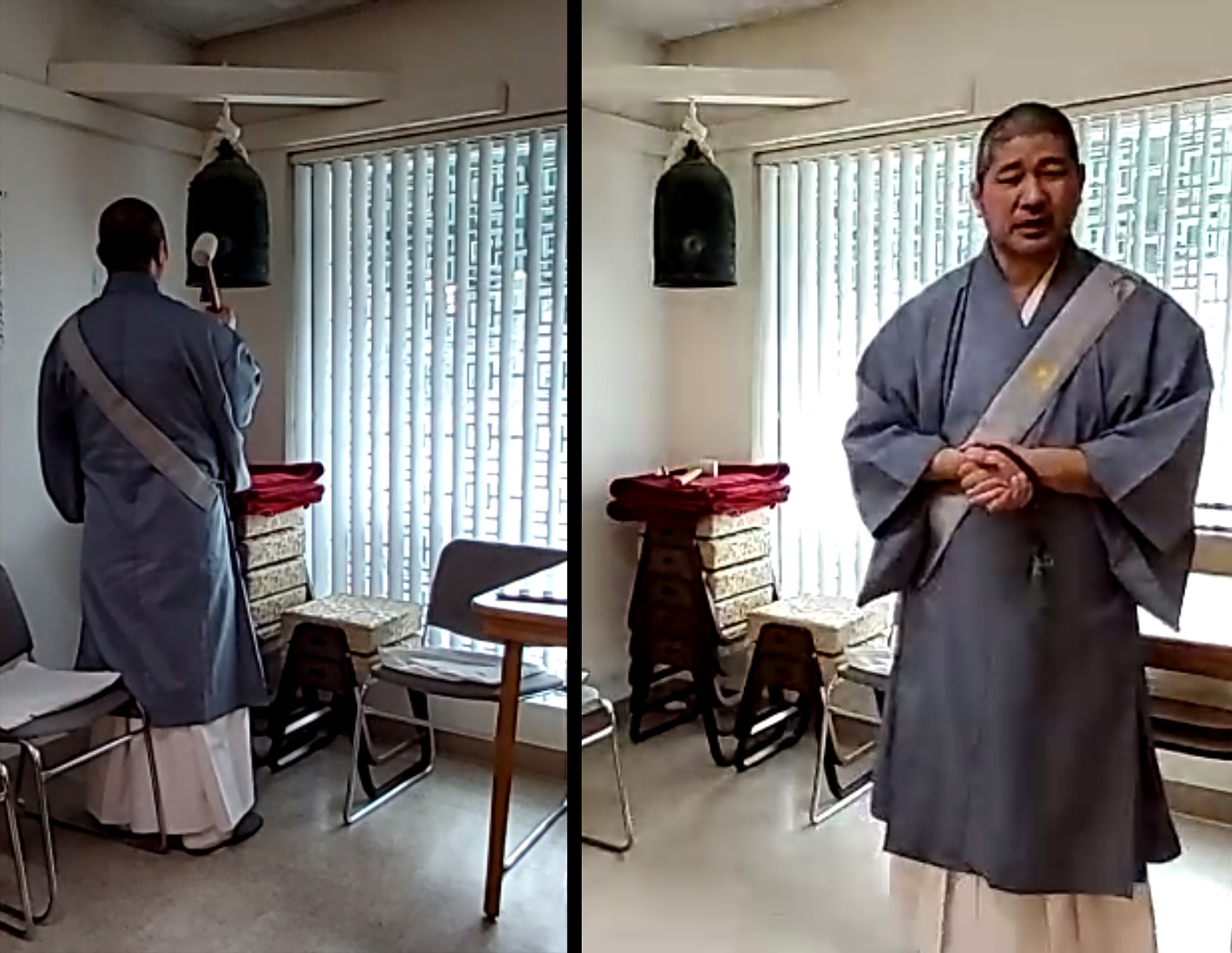
Bell Ringing in Las Vegas
Shoda Kanai Shonin of the Nichiren Buddhist Kannon Temple of Nevada

In 2020 everything shut down and Zoom was all that allowed the sangha to meet and celebrate the Dharma. Now, as I begin 2023, I am grateful for the merger of the two worlds – online and IRL.

New Year’s Eve morning I celebrated the end of the year with Rev. Shoda Kanai’s Zoom service from the Nichiren Buddhist Kannon Temple of Nevada. The services ends with the ringing of the temple bell 108 times.

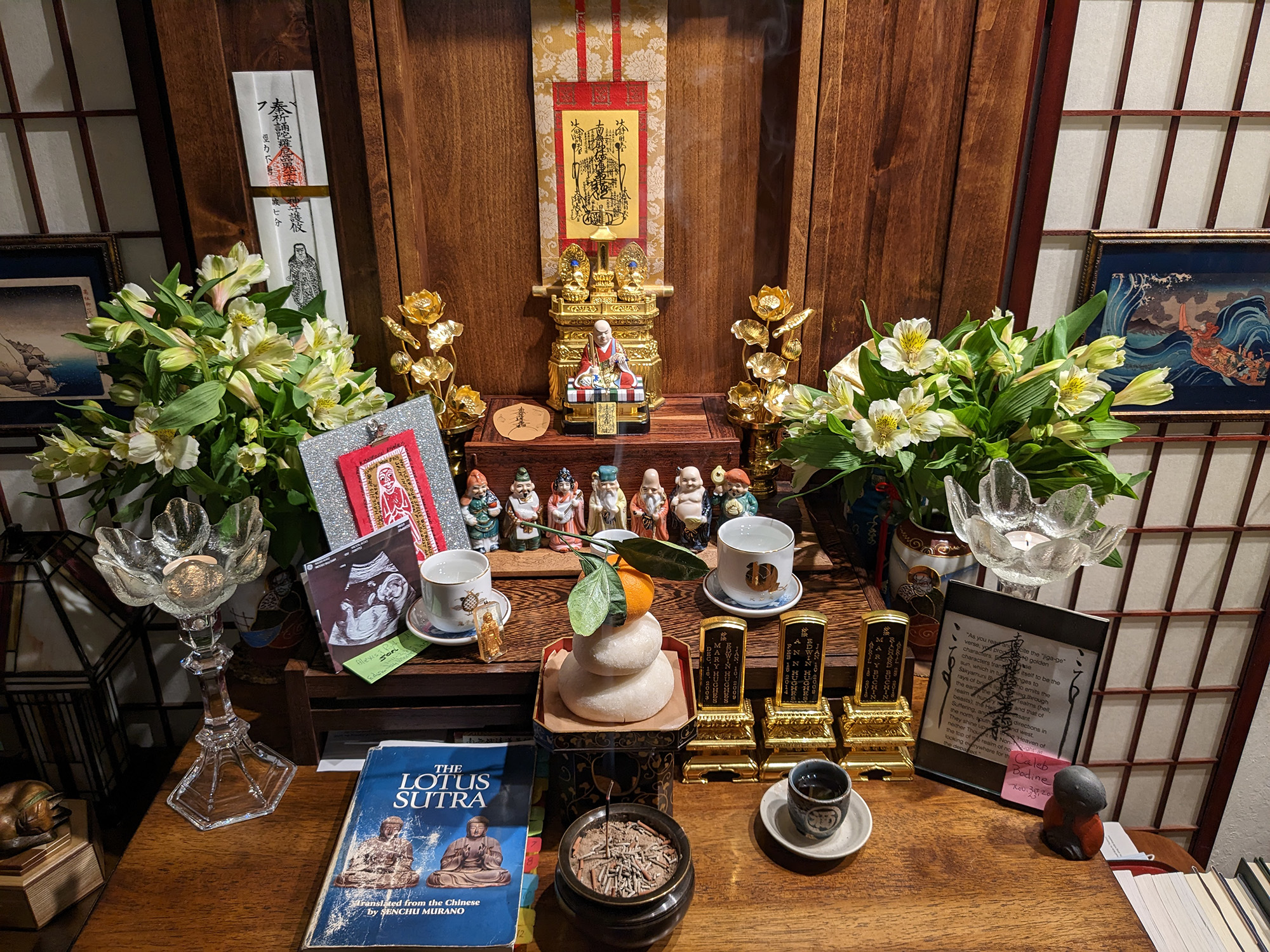
Then at 11 pm New Year’s Eve I attended the Sacramento Nichiren Buddhist Church‘s end of year service with my wife, Mary, and son, Richard, and his fiancée, Alexis. After the service we had cookies and tea while we waited for the New Year to arrive.

At midnight everyone gathered outside to ring the church bell 108 times. We each rang the bell 12 times and Alexis, who will deliver my first grandchild in early January, rang the bell 24 times.

After the New Year service we toasted the arrival of 2023 with a sip of sake.

New Year Purification
Shoda Kanai Shonin performing New Year blessing

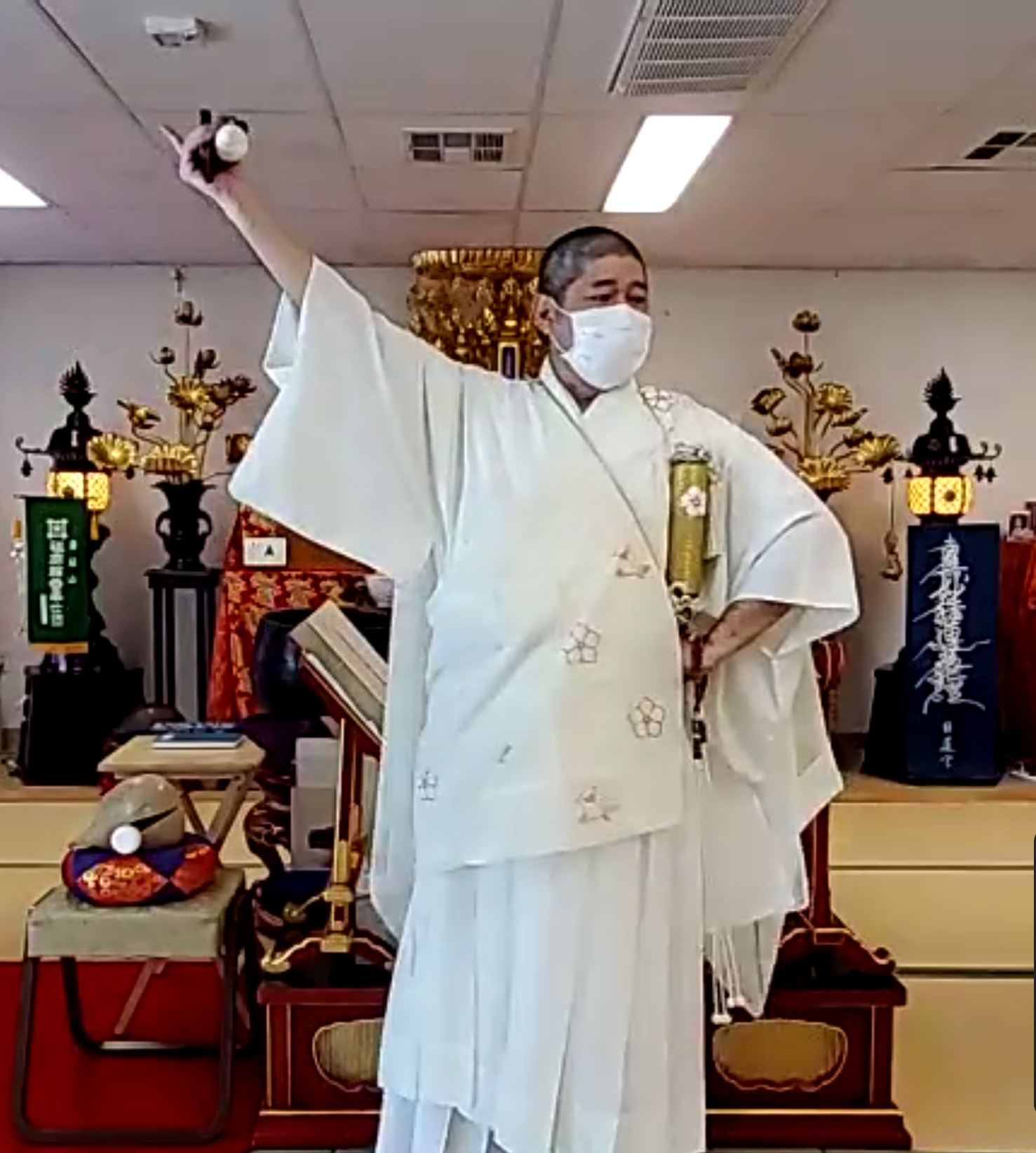
On New Year’s morning I attended Rev. Shoda Kanai’s Zoom service from the Nichiren Buddhist Kannon Temple of Nevada, which includes his recitation of members’ New Year’s prayers and a purification ceremony for the New Year.

A fine start to a New Year.

The Best You Are

The best you are able to do today may not be the best you were able to do yesterday or could do tomorrow, it is however the best you are able to do now. So it is with everyone.
I leave you with this quote from the Shutei Hoyo Shiki.

“The way we are and the state of our mind in any moment is the relationship we experience with the Three Treasures. There is no distinction. We are either constantly bowing, or not bowing but always manifesting our relationship.”

Important Matters, p 2

Awakening as Buddha’s Children

HOKKE SHUYO SHO

Since the time immemorial all the people on the earth have been the Buddha Sakyamuni’s beloved children. We had not realized the relationship, because we had been undutiful children. It is a unique relationship. As the moon reflects on calm water, the Buddha appears in our calm mind.

(Background : 1274, 52 years old, at Minobu, Showa Teihon, p.812)

Explanatory note

Although people think that the Buddha Sakyamuni was born in India (today’s Nepal) about 2,500 years ago, He has been stretching His hands to save us from the eternal past. According to chapter 16 of the Lotus Sutra, it was five hundred dust-particle kalpa ago that the Buddha Sakyamuni became the Buddha. Suppose a person —smashes a world into dust particles and deposits one of the particles in a world which he comes across after he passes many worlds. By putting one of the particles in another world at the same distance, he passes countless worlds until the dust particles are exhausted. The five hundred dust-particle kalpa means much longer time than the number of dust-particles are distributed in this way.

Thus, the Buddha has been trying to have us attain Buddhahood since that many kalpa ago, and even now He is preaching to us on Mt. Sacred Eagle. But we have not listened to His words and have not realized the compassion of the Buddha.

Nichiren Daishonin said that all beings originate from the Eternal Buddha, and that if the people do not realize the relationship of the Eternal Buddha and His children, they are undutiful children of the Buddha. We must appreciate the great compassion of the Buddha.

Rev. Kanai

Phrase A Day

Recalling A Phrase A Day

Today I take a break from my daily publishing of quotes from Nichiren’s writings in order to reprint the Phrase a Day, which was first published here in January 2018. The Phrase a Day booklet, first published in 1986, will appear daily during January.

Gratitude

Welcoming 2023 with gratitude

I’m dedicating 2023 to gratitude. The idea came to me last year after attending a Chicago Rissho Kōsei-kai talk led by Kyohei Kevin Mikawa.

Expecting a discussion of the Lotus Sutra, I instead found myself reading aloud from a Rissho Kōsei-kai magazine article written by a member in Oklahoma. His was a story of woe not unlike many “experiences” I heard over the years when I was a member of Soka Gakkai. What struck a chord in me, however, was the “lesson” taken from this personal history of abandonment and neglect: gratitude – gratitude for meeting the Lotus Sutra; gratitude for the promise embodied in Namu Myoho Renge Kyo.

I don’t recall the exact words Kyohei Mikawa used, but he explained that in our journey to become a Buddha all of these trials and tribulations become the celebrated obstacles and hardships we overcame on our way to enlightenment. Hearing this, I was reminded of the songs warriors sing after great battles. This adversity we face today is the stuff of legends tomorrow.

Yesterday I concluded my 800 Years of Faith project with a lengthy quote from Ryusho Jeffus Shonin. Today and daily through Feb. 24, I’ll be publishing quotes from Ryusho’s book, Important Matters, which features quotes from Shute Hoyo Shiki, the manual used to train Nichiren Shu priests. Here’s an example that plays into my theme of gratitude:

The Shute Hoyo Shiki says:

“Our own bowing and the Buddhas who are bowed to are all originally within one mind in which there is no bowing and no one to receive it. Although there is no bowing and no one to receive it there is certainly the response of the Buddhas and the receptivity of the ordinary people.”

Shute Hoyo Shiki – Udana-in Nichiki, page 391

For me, bowing when there is no bowing means that all my life is both an expression of gratitude and an attempt to repay the favors I have received. Bowing when there is no one to bow to means that, when I succeed in living according to the principle that all beings possess Buddha nature, then even if people do not seem to respond, their lives are forever impacted and the Buddha within them bows. Their receptivity is not dependent upon their knowledge or awareness; the Buddha is always receptive. The one mind of self always abiding in the Lotus Sutra is far reaching and encompassing. The one mind abiding in the Lotus Sutra speaks to the one mind of every being in the universe and so the universe abides in us and bows to us.

Important Matters, p 27-28

Gratitude, of course, is not a Buddhist concept. The beneficial effects of a grateful attitude are widely cited in many fields. But gratitude is an important element of our Buddhist practice.

Nichiren wrote early on in his Essay on Gratitude:

What is the best way for Buddhists to express their gratitude for the unfathomable kindness that they have received? The way is by mastering Buddhism completely and being sagacious. How can anyone guide blind persons across a bridge, if he himself is blind? How can a captain, who does not know the direction of the wind, sail his ship to transport many merchants to a mountain of treasure?

Hōon-jō, Essay on Gratitude, Writings of Nichiren Shōnin, Second Edition, Doctrine 3, Page 1

Bishop Shokai Kanai explains in “Phrase A Day“:

Most people see Nichiren’s vigorous actions which have appeared externally, but they do not try to see his religious point which has come from within his inner self.

For Nichiren Daishonin, “Ho-on” or gratitude was the nucleus of his religion. “Ho-on” means to show appreciation that you are living because of others. Any society is formed with each individual depending on others, so that we must show appreciation of all people. But if the appreciation is referred to only in our daily living, it is not real gratitude, or “Ho-on”.

According to Nichiren Daishonin, the real gratitude is to lead all people to the faith in the teachings of the Lotus Sutra, which was revealed by the Buddha Śākyamuni.

Nichiren might have received all sorts of earthly kindness from many people. But he never tried to return their kindness with worldly matters. Rather, in order to have real salvation for them, Daishonin preached Buddha’s teachings by sacrificing his own life. He cast away all attachments, even his own life. Daishonin’s four major persecutions and many other minor persecutions proved his willingness to sacrifice his own life. We, as his followers, should not be afraid of any obstacles to living in truth; then, we will be given power to overcome such obstacles.

Gratitude is a recurring theme in the Daily Dharma lessons distributed by the Lexington Nichiren Buddhist Community. The Daily Dharma published Dec. 10, 2022, offers this:

When we who are living in this latter age of Degeneration keep and practice this [Lotus] Sūtra, we change the focus of our own existence. We lose our dependence on the things we thought we needed to make us happy, and thus learn to appreciate them for what they are. We set aside our fear of losing these things and gain the courage to handle situations we previously thought were impossible. We stop focusing on what we need to live and find gratitude for what sustains our lives.

Our gratitude should be boundless. That’s my goal for 2023.