
All posts by John Hughes

Day 20

Day 20 completes Chapter 15, The Appearance of Bodhisattvas from Underground, and concludes the Fifth Volume of the Sutra of the Lotus Flower of the Wonderful Dharma.


Having last month considered Śākyamuni’s response to Maitreya, we consider the Buddha’s explanation of he taught these Bodhisattvas.

Thereupon the World-Honored One, having sung these gāthās, said to Maitreya Bodhisattva:

Now I will tell all of you in this great multitude, Ajita! [I know that] you have never seen these great, innumerable, asaṃkhya Bodhisattva-mahāsattvas who sprang up from underground. After I attained Anuttara-samyak-saṃbodhi in this Sahā-World, I taught these Bodhisattvas, led them, trained them, and caused them to aspire for enlightenment. They lived in the sky below this Sahā-World. When they were there, they read many sūtras, recited them, understood them, thought them over, evaluated them, and remembered them correctly. Ajita! These good men did not wish to talk much with others [about things other than the Dharma] but to live in a quiet place. They practiced the way strenuously without a rest. They did not live among gods and men. They had no hindrance in seeking profound wisdom. They always sought the teaching of the Buddha. They sought unsurpassed wisdom strenuously with all their hearts.”

Thereupon the World-Honored One, wishing to repeat what he had said, sang in gāthās:

Ajita, know this, these great Bodhisattvas
Have studied and practiced
The wisdom of the Buddha
For the past innumerable kalpas.

They are my sons because I taught them
And caused them to aspire for great enlightenment.
They have been living in this world
[For the past innumerable kalpas].

They always practiced the dhuta.
They wished to live in a quiet place.
They kept away from bustling crowds.
They did not wish to talk much.

These sons of mine studied my teachings
Strenuously day and night
In order to attain
The enlightenment of the Buddha.
They lived in the sky
Below this Sahā-World.

Resolute in mind,
They always sought wisdom,
And expounded
Various wonderful teachings without fear.

I once sat under the Bodhi-tree
In the City of Gaya,
Attained perfect enlightenment,
And turned the wheel of the unsurpassed Dharma.

Then I taught them,
And caused them to aspire £or enlightenment.
Now they do not falter [in seeking enlightenment].
They will be able to become Buddhas.

My words are true.
Believe me with all your hearts!
I have been teaching them
Since the remotest past.

The Daily Dharma from Oct. 24, 2022, offers this:

My words are true.
Believe me with all your hearts!
I have been teaching them
Since the remotest past.

The Buddha sings these verses to Maitreya Bodhisattva and others gathered to hear him teach in Chapter Fifteen of the Lotus Sūtra. Maitreya had never seen any of the other Bodhisattvas who sprang up from underground in this chapter, despite his memory of previous lives and other worlds. The Buddha explains that the beings who had just appeared are also his disciples and have come to spread this Wonderful Dharma in our world. Nichiren teaches that when he realized that he was an incarnation of Superior-Practice, the leader of the Bodhisattvas from underground, then all of us who follow Nichiren and continue to keep the Lotus Sūtra are the followers of Superior-Practice. We do not need to wait for someone to come to our world and lead us. The world does not need anyone other than those already here to teach the Dharma. We are the Bodhisattvas from underground.

The Daily Dharma is produced by the Lexington Nichiren Buddhist Community. To subscribe to the daily emails, visit zenzaizenzai.com
The Buddha as Father and Procreator

This is another in a series of weekly blog posts comparing and contrasting the Sanskrit and Chinese Lotus Sutra translations.


When I first read H. Kern’s 1884 English translation from Sanskrit of Chapter 9, the prediction for Ānanda and Rāhula, I was struck by something inserted here that is not found in translations from Kumārajīva’s Chinese. Kern has Ānanda and Rāhula say, “The Lord is our father and procreator, our refuge and protection.” Is this 19th century Christian bias sneaking in?

The full quote reads:

‘Let it be our turn also, O Lord; let it be our turn also, O Sugata. The Lord is our father and procreator, our refuge and protection. For in this world, including men, gods, and demons, O Lord, we are particularly distinguished, as people say: These are the Lord’s sons, the Lord’s attendants; these are the keepers of the law-treasure of the Lord. Therefore, Lord, it would seem meet, were the Lord ere long to predict our destiny to supreme and perfect enlightenment.’

Murano’s translation of Kumārajīva offers:

“World-Honored One! We think that we also are qualified to be assured [of our future Buddhahood]. Only you, the Tathāgata, are our refuge. We are known to all gods, men and asuras of the world. Ānanda always protects the store of the Dharma as your attendant. Rāhula is your son. If you assure us of our future attainment of Anuttara-samyak-saṃbodhi, the wishes not only of us but also of others will be fulfilled.”

The other English translations of Kumārajīva all lack the idea that the Buddha is “our father and procreator,” and all separate Ānanda’s aspect of protecting the teachings and Rāhula’s position as the Buddha’s son rather than saying, “These are the Lord’s sons, the Lord’s attendants; these are the keepers of the law-treasure of the Lord.”

Leon Hurvitz’s English translation of the Lotus Sutra, which merges both Kumārajīva’s Chinese and a composite Sanskrit text, sticks with the language of Kumārajīva and places the Sanskrit version in an endnote:

1. “Then indeed the long-lived Ānanda at that time thought: ‘Truly, may we also receive such a prophecy as this!’ Then thinking, reflecting, and praying in this way, rising from his seat and bowing down to the feet of the Blessed One, and the long-lived Rāhula also thinking, reflecting, and praying in this way, and bowing down to the feet of the Blessed One, [they] spoke as follows: (If the English of this does not parse as a sentence, it is because the Sanskrit, too, is not grammatically coherent.) ‘May our turn also come in the same way, O Blessed One! May our turn also come in the same way, O Well Gone One! For the Blessed One is our father, our progenitor, our refuge, our salvation. For we, O Blessed One, in this world with its gods, men, and asuras, have been variously depicted in such words as these: “These are the sons of the Blessed One, as well as the attendants of the Blessed One, and they carry the storehouse of the dharma of the Blessed One.” Now, O Blessed One, let that [prophecy] be right quickly matched [by you], in that the Blessed One shall prophesy to us concerning unexcelled, right, perfect, enlightened intuition.’ “

Again the Sanskrit inserts the Buddha’s position as not only the “father” but also the “progenitor,” or in the word used by Kern, “procreator.”

Why does that bother me? Śākyamuni, himself, declares in the Lotus Sutra that he is the father of all living beings. Why am I so sensitive to extending to the father a role as “progenitor”? Perhaps this is just a continuation of whatever prompts my uneasiness about Nikkyō Niwano‘s assertion that we are “caused to live by Śākyamuni.”

In any event, one can easily make the argument that this is another place that illustrates the superiority of Kumārajīva’s translation, both in content and style.

Next: Ananda’s Vow

2023 Pilgrimage to Japan

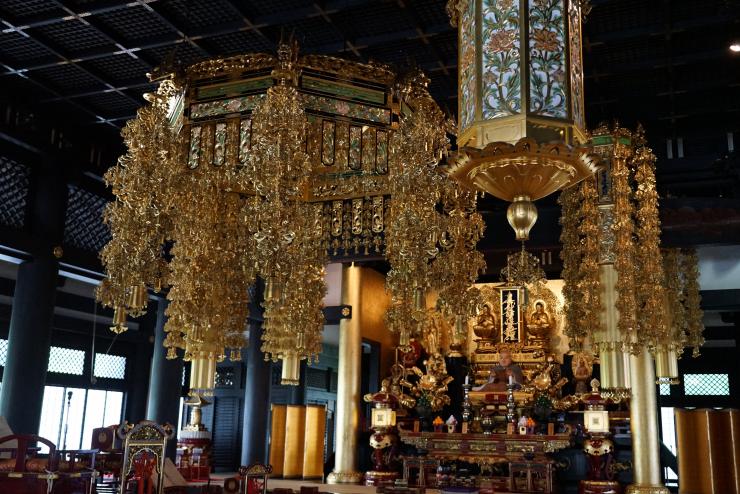
Altar in Kuonji at Minobu

Rev. Kenjo Igarashi will be leading a pilgrimage to Japan in late October 2023. The trip is sure to include a visit to Mt. Minobu but details of the full itinerary and the cost will be dependent on how many attend. If you are interested in receiving updates on the trip, please contact the Sacramento Nichiren Buddhist Church at [email protected].

Updates on the trip will be posted on the Sacramento Nichiren Buddhist Church website here.

800 Years: Those Who Uphold the Daimoku

The Lotus School … is based on the most truthful words of all teachings of the Buddha. Not only does the Lotus Sūtra consist of true words but also provisional sūtras preached by the Buddha during His lifetime, upon flowing into the great ocean of the Lotus Sūtra, are all converted to the sūtra of the true words by the power of the Lotus Sūtra. Let alone the daimoku of the Lotus Sūtra. This is like the power of face powder which makes lacquer as white as snow or Mt. Sumeru, which makes the color of the various birds approaching it all golden. Likewise, those who uphold the daimoku of the Lotus Sūtra can change the black (evil) karma, which they committed in this life or during the numerous kalpa (aeons) in the past, into white (good) great karma, not to speak of the meritorious good acts performed in the past since the eternal past, which will all be changed to golden-colored.

Myōhō-ama Gozen Gohenji, A Reply to My Lady, the Nun Myōhō, Writings of Nichiren Shōnin, Faith and Practice, Volume 4, Page 142

Daily Dharma – Dec. 19, 2022

I am saving all living beings from suffering.
Because they are perverted,
I say that I pass away even though I shall not.
If they always see me,
They will become arrogant and licentious,
And cling to the five desires
So much that they will fall into the evil regions.

The Buddha sings these verses in Chapter Sixteen of the Lotus Sūtra. Sometimes we wonder why the Buddha’s presence in this world is not more obvious. We think if only we could find a living example of an enlightened being living among us then we would be happy and the world would be a better place to live. We forget that even during the Buddha’s lifetime, not everyone sought him out for his teaching, and some actively opposed him. In this explanation, the Buddha points out that our not seeing him is due to our limitations rather than his, and by not taking our lives and this world for granted, we open ourselves to his presence.

The Daily Dharma is produced by the Lexington Nichiren Buddhist Community. To subscribe to the daily emails, visit zenzaizenzai.com

Day 19

Day 19 concludes Chapter 14, Peaceful Practices, and begins Chapter 15, The Appearance of Bodhisattvas from Underground.


Having last month considered the benefits of the peaceful practices, we conclude Chapter 14, Peaceful Practices.

He will see only wonderful things in his dream.
He will dream:
‘Surrounded by bhikṣus,
The Tathāgatas are sitting
On the lion-like seats,
And expounding the Dharma.’

He also will dream:
‘As many living beings, including dragons and asuras,
As there are sands in the River Ganges
Are joining their hands together
Towards me respectfully,
And I am expounding the Dharma to them.’

He also will dream:
‘The bodies of the Buddhas are golden-colored.
They are emitting innumerable ray of light,
And illumining all things.
The Buddhas are expounding all teachings
With their brahma voices.
I am among the four kinds of devotees
To whom a Buddha is expounding
The unsurpassed Dharma.
I praised the Buddha
With my hands joined together.
I heard the Dharma from him with joy.
I made offerings to him, and obtained dharanis.
I also obtained irrevocable wisdom.
The Buddha knew
That I entered deep into the Way to Buddhahood.
So he assured me of my future attainment
Of perfect enlightenment, saying:
‘Good man, in your future life,
You will be able to attain immeasurable wisdom,
That is, the great enlightenment: of the Buddha.
Your world will be pure and large
Without a parallel.
There will be the four kinds of devotees there.
They will hear the Dharma from you
With their hands joined together.’

He also will dream:
‘I am now in the forest of a mountain.
[ studied and practiced good teachings.
[ attained the truth of the reality of all things.
I am now in deep dhyāna-concentration.
I see the Buddhas of the worlds of the ten quarters.’

He also will have a good dream:
‘The bodies of the Buddhas are golden-colored.
They are adorned with a hundred marks of merits.
Having heard the Dharma from them,
I am now expounding it to others.’

He also will dream:
‘Although I was a king,
I gave up the five desires
And the most wonderful pleasures.
I left my palace and attendants,
And reached the place of enlightenment.
I sat on the lion-like seat under the Bodhi-tree,
And sought enlightenment.
After seven days, I obtained the wisdom of the Buddhas
And attained unsurpassed enlightenment.
I emerged [from dhyāna] and turned the wheel of the Dharma.
I expounded the Dharma to the four kinds of devotees
For a thousand billion kalpas.
I expounded the Wonderful Dharma-without-āsravas
And saved innumerable living beings.
Then I entered into Nirvana
Just as a flame dies when smoke is gone.’

Anyone who expounds
This supreme teaching
In the evil world after [my extinction]
Will obtain great benefits as previously stated.

The Daily Dharma from Aug. 21, 2022, offers this:

He will see only wonderful things in his dream.
He will dream:
‘Surrounded by bhikṣus,
The Tathāgatas are sitting
On the lion-like seats,
And expounding the Dharma.’

The Buddha sings these verses in Chapter Fourteen of the Lotus Sūtra, speaking of those who keep and practice the Wonderful Dharma. Dreams for many of us can be frightening places. They can be where we relive bad situations in our past or develop fantastic scenarios for disasters in the future. When we accept our nature as Bodhisattvas, and live assured of our future enlightenment, we find that even the thoughts over which we have no control begin to harmonize with the world around us. When we learn to recognize the Buddha in our everyday lives, our old traumas become vehicles for compassion.

The Daily Dharma is produced by the Lexington Nichiren Buddhist Community. To subscribe to the daily emails, visit zenzaizenzai.com

800 Years: Viewing the Ocean from the Shore

My morning practice includes recitation of a daily quote from Nichiren. These 31 daily quotes are taken from Raihai Seiten, a Nichiren Shu Service Book Companion compiled by the Los Angeles Nichiren Buddhist Temple’s Nichiren Shu Beikoku Sangha Association in 2001. On Day 4, I read this quote:

“Chanting ‘Namu Myō hōRenge Kyō’ swallows up the functions of ‘Namu Amida Butsu,’ ‘Namu Dainichi shingon,’ and ‘Namu Kanzeon bosatsu’ as well as all the Buddhas, sutras, and bodhisattvas. All these will be of no use without the functions of the Lotus Sutra. This can be seen by everyone, for it has been realized in front of everyone. When I, Nichiren recite ‘Namu Myō hōRenge Kyō’ the function of ‘Namu Amida Butsu’ disappears just as the moon wanes, the tide ebbs, grasses in autumn and winter wither and ice melts under the sun.”

More than once in this 800 Years of Faith project I have pointed out that Nichiren’s method of propagation – actively rebuking attachment to false views – is not necessarily the best practice for today, that leading others gradually without criticizing their present stance is a better fit in this age. But in our effort to accommodate the views of others we must not lose sight of the Lotus Sutra and its position.

All of the rivers of Buddhist thought – the thousands upon thousands of expedient teachings – all flow into the ocean of the Lotus Sutra. As Nichiren writes in Shoshū Mondō-shō, Questions and Answers Regarding Other Schools:

“All the sūtras entering the ocean of the Lotus Sūtra take up the one flavor of Namu Myōhō Renge Kyō because of the wonderful merit of the ocean of the Lotus Sūtra. There is no reason why they have to be referred to by other names such as nembutsu, Ritsu, Shingon, or Zen. Consequently, Grand Master T’ien-t’ai said in his Profound Meaning of the Lotus Sūtra, ‘Just as water becomes salty when it flows into the sea, any wisdom ceases to exist in itself after it is taken in the True Wisdom.’ ”

Writings of Nichiren Shōnin, Doctrine 3, p179-181

We are called on to have faith in the teachings of the Buddha from the perspective of the wide ocean of the Lotus Sutra. Viewing the Lotus Sutra shoreside, from the mouth of one of the many rivers flowing into the ocean, is not the same. This is, in part, why not every book about the Lotus Sutra is equal. I first ran into to this problem in Thich Nhat Hanh’s Peaceful Action, Open Heart. On several occasions, the venerable Vietnamese Zen priest views the Lotus Sutra through the prism of the Avataṃsaka Sutra [the Flower Garland Sutra].

This is not unlike, as Nichiren said, attempting “to put the water of the ocean into a puddle made by a hoof of a cattle.” [Writings of Nichiren Shōnin, Doctrine 3, Page 180-181]

Chanting ‘Namu Myō hōRenge Kyō’ swallows up the functions of all the other teachings. It does not eliminate them. It makes them better.


Table of Contents Next Essay

Daily Dharma – Dec. 18, 2022

Medicine-King! I will tell you.
The Sūtra of the Lotus Flower of the Wonderful Dharma
Is the most excellent sūtra
That I have ever expounded.

The Buddha sings these verses to Medicine-King Bodhisattva in Chapter Ten of the Lotus Sūtra. Our founder Nichiren explained that the superiority of the Lotus Sūtra lay not in its being more powerful than other Sūtras, but that it leads all beings, without exception, to the Buddha’s own enlightenment. Other teachings distinguish between those who can follow the Buddha Dharma and those who cannot. But this teaching assures everyone who hears it that they will become enlightened.

The Daily Dharma is produced by the Lexington Nichiren Buddhist Community. To subscribe to the daily emails, visit zenzaizenzai.com

Day 18

Day 18 concludes Chapter 13, Encouragement for Keeping this Sutra, and begins Chapter 14, Peaceful Practices.


Having last month considered Mañjuśrī’s question at the start of Chapter 14, Peaceful Practices, we consider the proper practices the Bodhisattva-mahāsattvas should perform and the the proper things the Bodhisattva should approach.

“First, he should perform proper practices, approach proper things, and then expound this sūtra to all living beings.

“Mañjuśrī! What are the proper practices the Bodhisattva-mahāsattvas should perform? He should be patient, mild and meek. He should not be rash, timorous, or attached to anything. He should see things as they are. He should not be attached to his nonattachment to anything. Nor should he be attached to his seeing thing as they are. These are the proper practices the Bodhisattva-mahāsattvas should perform.

“What are the proper things the Bodhisattva-mahāsattvas should approach? He should not approach kings, princes, ministers or other government directors. He should not approach heretics, aspirants for the teaching of Brahman, Nirgraṇṭhas, writer of worldly literature, writers of non-Buddhist songs of praise, Lokāyatas or Anti-Lokāyatas. He should not approach players of dangerous sports such as boxers or wrestlers. He should not approach naṭas or other various amusement-makers. He should not approach caṇḍālas, boar-keepers, shepherds, poulterers, dog-keepers, hunters, fishermen, or other people who do evils for their livelihood. When they come to him, he should expound the Dharma to them, but should not wish [to receive anything from them]. He should not approach those who seek Śrāvakahood, be they bhikṣus, bhikṣunīs, upāsakās or upāsikās. He should not exchange greeting with them. He should not stay with them in the same monastery, promenade or lecture-hall. When they come to him, he should expound the Dharma to them according to their capacities, but should not wish [to receive anything from them]. Mañjuśrī! The Bodhisattva-mahāsattvas should not expound the Dharma to a woman with a desire for her. He should not wish to look at her. When he enters the house of others, he should not talk with a little girl, an unmarried woman or a widow. He should not approach or make friend with anyone of the five kinds of eunuchs. He should not enter the house of others alone. If he must enter it alone for some rea on, he should think of the Buddha with all his heart. When he expounds the Dharma to a woman, he should not laugh with his teeth visible to her. He should not expose his breast to her. He should not be friendly with her even for the purpose of expounding the Dharma to her. Needless to say, he should not be so for other purposes. He should not wish to keep young disciples, śramaṇeras or children. He should not wish to have the same teacher with them.

The Daily Dharma from Oct. 25, 2022, offers this:

Mañjuśrī! What are the proper practices the Bodhisattva-mahāsattva should perform? He should be patient, mild and meek. He should not be rash, timorous, or attached to anything. He should see things as they are. He should not be attached to his non-attachment to anything. Nor should he be attached to his seeing things as they are. These are the proper practices the Bodhisattva-mahāsattva should perform.

The Buddha makes this explanation to Mañjuśrī in Chapter Fourteen of the Lotus Sūtra in which he describes the peaceful practices of a Bodhisattva. When we learn to see things differently, we act differently. Conversely, when we act in ways that are not beneficial, either to ourselves or to others, it is an indication that we are not seeing things as they are. At the same time, not being attached to non-attachment helps us realize that becoming enlightened is a process, and that becoming proud of our achievements is another indication of being stuck and not seeing things as they are.

The Daily Dharma is produced by the Lexington Nichiren Buddhist Community. To subscribe to the daily emails, visit zenzaizenzai.com

800 Years: Repentant Faith

When I began this project I didn’t know I would include a chapter-by-chapter review of what the Threefold Lotus Sutra teaches about faith. But now, as I finish that review, I can’t imagine having done this any other way. The Lotus Sutra is the great encouragement for today. As Nikkyō Niwano explains in Buddhism for Today:

“It is not known when and by whom this sutra, the so-called closing sutra of the Lotus Sutra, was first recited. The first man to do so, however, was surely a great person. This is because the Sutra of Meditation on the Bodhisattva Universal Virtue is so profound that it is considered to be the continuation of the Buddha’s preaching of the Lotus Sutra, and because it teaches us how we should actually apply the Lotus Sutra in our daily lives. This method is repentance. The Sutra of Meditation on the Bodhisattva Universal Virtue teaches us the true meaning and method of repentance so thoroughly that it is commonly called ‘the Sutra of Repentance.’ ”

Buddhism for Today, p423

In his Introduction to Buddhism for Today, Nikkyō Niwano explains that people who study the Lotus Sutra can feel that there is a great divide between the ideal taught and the reality of our daily lives.

“We are greatly encouraged when we read the Lotus Sutra, grasp the true meaning of the sermons that Sakyamuni preached during his lifetime, and realize that we can attain the same state of mind as the Buddha through practicing his teachings. However, the fact is that in our daily lives we are continually troubled with suffering and distress, and we are continually seized by desires of one kind or another. For this reason, we are apt to become disheartened and forget the valuable lessons of the sutra.

“Although we understand theoretically that we can become buddhas, we do not know how to rid ourselves of our illusions; our minds are liable to be covered with a dark cloud of illusion. Repentance means the sweeping away of such dark clouds, and the Sutra of Meditation on the Bodhisattva Universal Virtue teaches the way to do this.

Buddhism for Today, pxxvii

It is important to keep in mind that what Nikkyō Niwano and Universal Sage say about repentance is not the repentance of remorse or contrition or self-condemnation common in other religions. As Nikkyō Niwano explains in Buddhism for Today:

“[R]epentance is to learn the teaching of the Great-vehicle and to practice it. Repentance means not compromising with oneself, not having a lukewarm or equivocal attitude, but polishing one’s buddha-nature by gradually removing illusions and defilements from one’s mind. The practice of repentance consists in the bodhisattva practice, through which one not only polishes his buddha-nature but also renders service to others. Repentance is an indispensable requisite of religious life. It is to be hoped that all people will repeatedly read and recite this sutra on repentance, realize its essence, and put it into practice in their daily lives.”

Buddhism for Today, p459-460

Repentant faith carries us to the ultimate, supreme enlightenment.


Table of Contents Next Essay