All posts by John Hughes

Daily Dharma – Aug. 13, 2022

This sūtra is
The most excellent.
To keep this sūtra
Is to keep me.

The Buddha sings these verses in Chapter Eleven of the Lotus Sūtra. We may believe that before we can practice we need to find a Buddha or another enlightened being alive in our world to guide us. These verses remind us of the ever-present Buddha Śākaymuni who was revealed in the Lotus Sūtra. Whether or not we see him as another human in our presence, he is always guiding us to enlightenment. The Buddha also reminds us that by living as he has shown us in the Lotus Sūtra, as Bodhisattvas who exist for the benefit of all beings, we show our respect for him and bring his wisdom to life.

The Daily Dharma is produced by the Lexington Nichiren Buddhist Community. To subscribe to the daily emails, visit zenzaizenzai.com

Day 27

Day 27 concludes Chapter 23, The Previous Life of Medicine-King Bodhisattva.


Having last month considered Sun-Moon-Pure-Bright-Virtue Buddha’s extinction, we consider Gladly-Seen-By-All-Beings Bodhisattva’s burning of his arms.

“Thereupon Gladly-Seen-By-All-Beings Bodhisattva thought again, ‘I have now made these offerings, yet I do not think that they are enough. I will make another offering to the śarīras.’

“He said to the Bodhisattvas, to the great disciples, and also to all the other living beings in the great multitude including gods, dragons and yakṣas, ‘Look with one mind! Now I will make another offering to the śarīras of Sun-Moon-Pure-Bright-Virtue Buddha.’

“Having said this, he burned his arms adorned with the marks of one hundred merits, and offered the light of the flame to the eighty-four thousand stupas for seventy-two thousand years. [By doing so,] he caused innumerable seekers of Śrāvakahood and many other asaṃkhyas of people to aspire for Anuttara-samyak-saṃbodhi, and obtain the samadhi by which they could transform themselves into the other living beings.

“Having seen him deprived of his arms, the Bodhisattvas, gods, men, asuras and others were overcome with sorrow. They said, ‘This Gladly-Seen-By-All-Beings Bodhisattva is our teacher. He is leading us. Now he has burned off his arms. He is deformed.’

“Thereupon Gladly-Seen-By-All-Beings Bodhisattva vowed to the great multitude, saying, ‘I shall be able to obtain the golden body of the Buddha because I gave up my arms. If my words are true and not false, I shall be able to have my arms restored.’

“When he had made this vow, his arms were restored because his merits, virtues and wisdom were abundant. Thereupon the one thousand million Sumeru-worlds quaked in the six ways, and the gods rained down jeweled flowers. All the gods and men had the greatest joy that they had ever had.”

See The Practice of Devotion, Dedication and Love

800 Years: The Milk of Faith

QUESTION: If someone chanted Namu Myōhō Renge Kyō without understanding its meaning will the benefit of understanding still be received?

ANSWER: When a baby nurses, it does not comprehend the taste; nevertheless, it receives the benefits of the milk naturally. Did anyone know the ingredients or formula for Jīvaka’s wondrous medicines? Water is without intent but it can extinguish fire; and even though fire consumes many things, can we say it does this deliberately? This is Nāgārjuna and T’ien-t’ai’s idea! I am merely repeating it.

Shishin Gohon-shō, The Four Depths of Faith and Five Stages of Practice, Writings of Nichiren Shōnin, Faith and Practice, Volume 4, Page 106-107

Daily Dharma – Aug. 12, 2022

Ajita, know this, these great Bodhisattvas
Have studied and practiced
The wisdom of the Buddha
For the past innumerable kalpas.

They are my sons because I taught them
And caused them to aspire for great enlightenment.

The Buddha sings these verses to his disciple Maitreya, also known as Invincible (Ajita) in Chapter Fifteen of the Lotus Sutra. In the story, great Bodhisattvas have just appeared from under the ground of this world of conflict after the Buddha asks who will continue to teach and practice this Lotus Sūtra after the extinction of the Buddha. None of those gathered to hear the Buddha teach, including other great Bodhisattvas such as Maitreya, had ever seen them before. Late in his life Nichiren realized that he was a reincarnation of Superior-Practice, the leader of the Bodhisattvas from underground, and that we who practice the Lotus Sūtra are his followers. Our lives are much greater than we realize, as are our capacities, our patience, our wisdom and our merit. It is through the Wonderful Dharma that we awaken to all these and clarify the Buddha Land we live in now.

The Daily Dharma is produced by the Lexington Nichiren Buddhist Community. To subscribe to the daily emails, visit zenzaizenzai.com

Day 26

Day 26 concludes Chapter 21, The Supernatural Powers of the Tathāgatas, includes Chapter 22, Transmission, and introduces Chapter 23, The Previous Life of Medicine-King Bodhisattva.


Having last month considered the first half of Chapter 22, Transmission, we conclude Chapter 22, Transmission.

Having heard these words of the Buddha, the Bodhisattva-mahāsattvas were filled with great joy. With more respect than ever, they bent forward, bowed, joined their hands together towards him, and said simultaneously. “We will do as you command. Certainly, World-Honored One! Do not worry!”

The Bodhisattva-mahāsattvas said simultaneously twice more, “We will do as you command. Certainly, World-Honored One! Do not worry!”

Thereupon Śākyamuni Buddha, wishing to send back to their home worlds [Many-Treasures Buddha and] the Buddhas of his replicas, who had come from the worlds of the ten quarters, said, “May the Buddhas be where they wish to be! May the stupa of Many-Treasures Buddha be where it was!”

Having heard these words of the Buddha, not only the innumerable Buddhas of his replicas, who had come from the worlds of the ten quarters and were sitting on the lion-like seats under the jeweled trees, Many-Treasures Buddha, and the great multitude of the innumerable, asaṃkhya Bodhisattvas, including Superior-Practice, but also the four kinds of devotees including Śāriputra and other Śrāvakas, and the gods, men and asuras of the world, had great joy.

See The Specific Transmission and the General Transmission

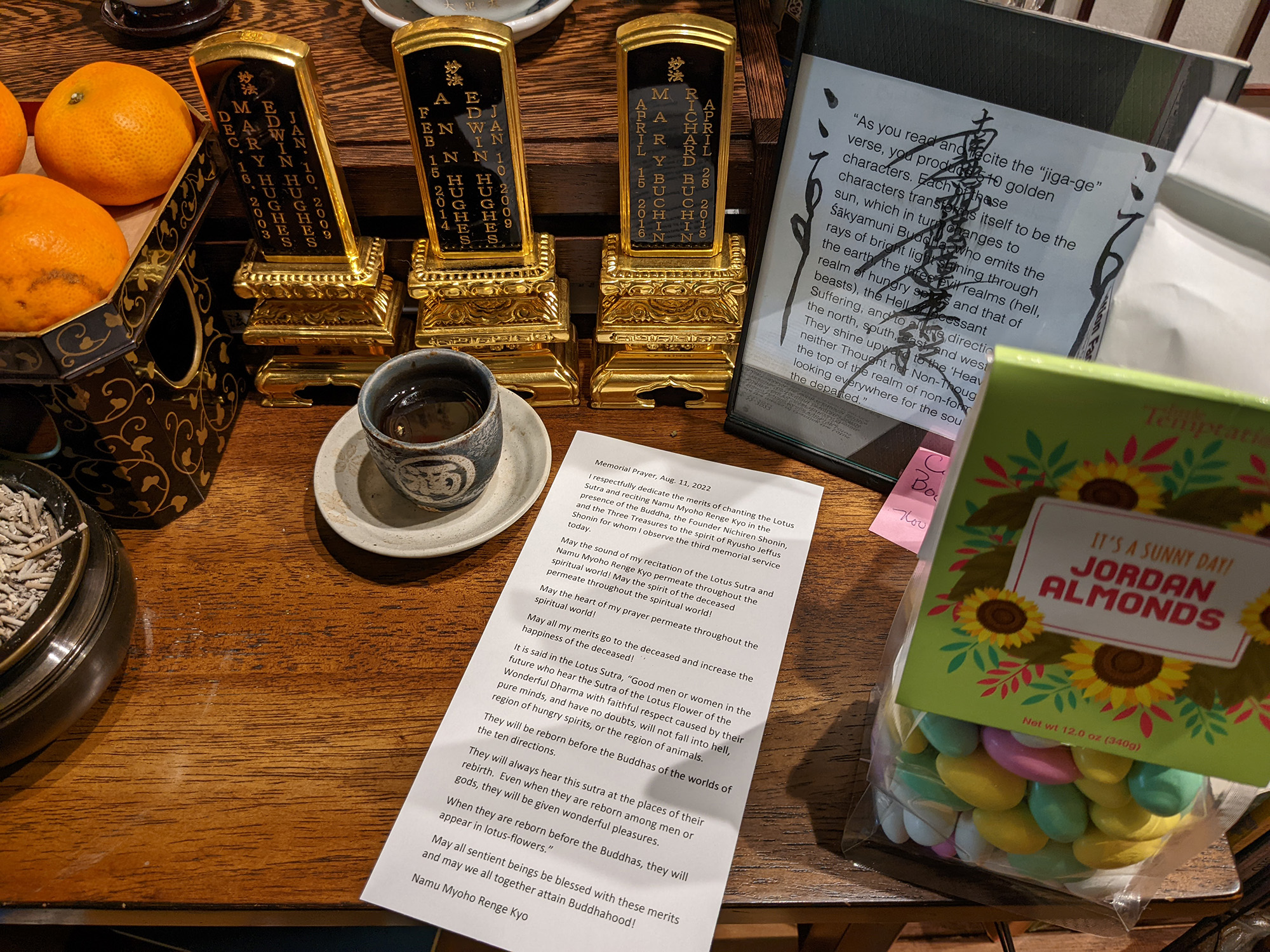
The Third Memorial

Memorial section
For each memorial I create a prayer sheet to read. After the evening service I place the sheet of paper with material to be sent to Rev. Shoda Kanai in Las Vegas to be ritually burned.

Memorial Prayer, Aug. 11, 2022

Ryusho Jeffus
Ryusho Jeffus Shonin
I respectfully dedicate the merits of chanting the Lotus Sutra and reciting Namu Myoho Renge Kyo in the presence of the Buddha, the Founder Nichiren Shonin, and the Three Treasures to the spirit of Ryusho Jeffus Shonin for whom I observe the third memorial service today.

May the sound of my recitation of the Lotus Sutra and Namu Myoho Renge Kyo permeate throughout the spiritual world! May the spirit of the deceased permeate throughout the spiritual world!

May the heart of my prayer permeate throughout the spiritual world!

May all my merits go to the deceased and increase the happiness of the deceased!

It is said in the Lotus Sutra, “Good men or women in the future who hear the Sutra of the Lotus Flower of the Wonderful Dharma with faithful respect caused by their pure minds, and have no doubts, will not fall into hell, region of hungry spirits, or the region of animals.

“They will be reborn before the Buddhas of the worlds of the ten directions.

“They will always hear this sutra at the places of their rebirth. Even when they are reborn among men or gods, they will be given wonderful pleasures.

“When they are reborn before the Buddhas, they will appear in lotus-flowers.”

May all sentient beings be blessed with these merits and may we all together attain Buddhahood!

Namu Myoho Renge Kyo

800 Years: The Wisdom of Faith

Of the many śrāvakas, Śāriputra is said to be the wisest. The Buddha tells Śāriputra that the wisdom of the Buddhas is something beyond his understanding. That means that for all the śrāvakas and the pratyekabuddhas, the wisdom of the Buddhas is also beyond their understanding. The wisdom of the Buddhas attains the reality of all things, which cannot be put into words. This is because at the beginning of Chapter Two the Buddha says of all things, their appearances as such, their natures as such, their entities as such, etc. He only says, “as such,” because the reality of all things can be attained only by the buddhas.

Although the Buddha says this, buddhas do not monopolize the wisdom of the Buddhas. As Śākyamuni Buddha says at the beginning of Chapter Two, to convey to others the wisdom of the buddhas, which cannot be expressed in words, he has taught many things by mixing words, metaphors, similes, and tales of origin and fate. On the other hand, he emphasizes strongly that the various teachings which comprise the so-called “gate” to the wisdom of the buddhas are extremely difficult to understand, and therefore, the gate is difficult to enter.

History and Teachings of Nichiren Buddhism, p 67

Daily Dharma – Aug. 11, 2022

Truly, truly good men! I am peaceful. I am in good health. The living beings are ready to be saved. They do not fatigue me because I already taught them in their consecutive previous existences, and also because they have already honored the past Buddhas respectfully and planted the roots of good.

The Buddha makes this proclamation to the leaders of the Bodhisattvas from Underground in Chapter Fifteen of the Lotus Sūtra. These Bodhisattvas appeared when the Buddha asked who would teach the Lotus Sūtra after the Buddha’s death, and asked about the Buddha’s health and whether those he was teaching could keep what he provided for them. The Buddha assures us not only of the certainty of our future enlightenment, but that for us to receive his teaching, there was an earlier time, which we may have forgotten, when we met him. This awareness of our future and our past helps us to see our place in the world and maintain our determination to benefit all beings.

The Daily Dharma is produced by the Lexington Nichiren Buddhist Community. To subscribe to the daily emails, visit zenzaizenzai.com

Day 25

Day 25 covers all of Chapter 20, Never-Despising Bodhisattva, and opens Chapter 21, The Supernatural Powers of the Tathāgatas.


Having last month considered the supernatural powers displayed by the Buddha and his replicas, we conclude today’s portion of Chapter 21, The Supernatural Powers of the Tathāgatas.

At that time the gods in the skies [of the worlds of the ten quarters] said loudly:

“There is a world called Sahā beyond a distance of many hundreds of thousands of billions of asaṃkhyas of worlds. In that world lives a Buddha called Śākyamuni. He is now expounding to Bodhisattva-mahāsattvas a sūtra of the Great Vehicle, called the ‘Lotus Flower of the Wonderful Dharma, the Dharma for Bodhisattvas, the Dharma Upheld by the Buddhas.’ Rejoice from the bottom of your hearts! Bow and make offerings to Śākyamuni Buddha!”

Having heard their voice from the skies, the living beings of those worlds joined their hands together towards the Sahā World, and said, “Namah Sakyamunaye Buddhaya, namah Sakyamunaye Buddhaya.” Then they strewed various flowers, various kinds of incense, various necklaces, streamers, canopies, personal ornaments, treasures, and other wonderful things to the Sahā-World from afar.

The strewn things came from the worlds of the ten quarters like gathering clouds and changed into a jeweled awning over the Sahā-World. The awning extended over the Buddhas staying in this world. At that time the worlds of the ten quarters became passable through each other without hindrance as if they had been a single Buddha-world.

See Sharing in the Tathagata’s Limitless Lifespan and Great Spiritual Power

800 Years: Communion in Faith

Thus, faith means the communion of our soul with the Buddha-soul in its triune nature, our participation in his dignity and work. In other words, communion in faith presupposes a basic unity existing between the worshipper and the worshipped. One who realizes this fundamental oneness of our being with that of Buddha cannot but proceed to save others by leading them along the same pathway of Buddhist enlightenment. This exertion is moral life, the life of the Bodhisattva, the Buddha-to-be. Faith is perfected by moral life, as morality is based on faith.

History of Japanese Religion