
Buddha Seed: Understanding the OdaimokuNamu and the five characters became the seven characters of the Odaimoku, Na Mu Myo Ho Ren Ge Kyo. Namu, derived from the Sanskrit “Namas,” which means “to pay respect to, to revere.” It is generally used with regard to the Buddha or the three treasures (Buddha, Dharma, Sangha). It can be interpreted as a vow to the Buddha or as taking refuge. Namu means faith in the Buddha and oneness with the Buddha. Namu Myoho Renge Kyo means that faith in the Lotus Sūtra is equal to the Eternal Buddha and becoming one with the Buddha. It is also a vow that one will strive to become one with the Buddha. By taking refuge in the Lotus Sutra, one can enter the infinite life of the Buddha. One’s life merges into the Buddha’s life which is the Odaimoku, Namu Myoho Renge Kyo.
All posts by John Hughes
Daily Dharma – July 20, 2022
Having heard from you
Of the duration of your life,
Living beings as many as the particles of earth
Of eight Sumeru-worlds
Aspired for unsurpassed [enlightenment].
The Bodhisattva Maitreya sings these verses in Chapter Seventeen of the Lotus Sutra. He describes the effect on all beings of the Buddha’s revealing his existence as the Ever-Present Śākyamuni. If we believed that the Buddha was just a man who lived 2500 years ago, we might think that we had to wait until another being became enlightened before we could follow them on the path to our own awakening. But with this understanding that the Buddha is always helping us, here and now, then we awaken our capacity to see things as they are and work confidently for the benefit of all beings.
The Daily Dharma is produced by the Lexington Nichiren Buddhist Community. To subscribe to the daily emails, visit zenzaizenzai.com
Day 3
Day 3 covers the first half of Chapter 2, Expedients.

Having last month conclude today’s portion of Chapter 2, Expedients, we begin again with the World-Honored One emerging quietly from his samādhi.
Thereupon the World-Honored One emerged quietly from his samādhi, and said to Śāriputra:
“The wisdom of the [present] Buddhas is profound and immeasurable. The gate to it is difficult to understand and difficult to enter. [Their wisdom] cannot be understood by any Śrāvaka or Pratyekabuddha because the [present] Buddhas attended on many hundreds of thousands of billions of [past] Buddhas, and practiced the innumerable teachings of those Buddhas bravely and strenuously to their far-flung fame until they attained the profound Dharma which you have never heard before, [and became Buddhas,] and also because [since they became Buddhas] they have been expounding the Dharma according to the capacities of all living beings in such various ways that the true purpose of their [various] teachings is difficult to understand.
“Śāriputra! Since I became a Buddha, I [also] have been expounding various teachings with various stories of previous lives, with various parables, and with various similes. I have been leading all living beings with innumerable expedients in order to save them from various attachments, because I have the power to employ expedients and the power to perform the pāramitā of insight.
Retreating to the Intersection of Practice and Mental Wellness
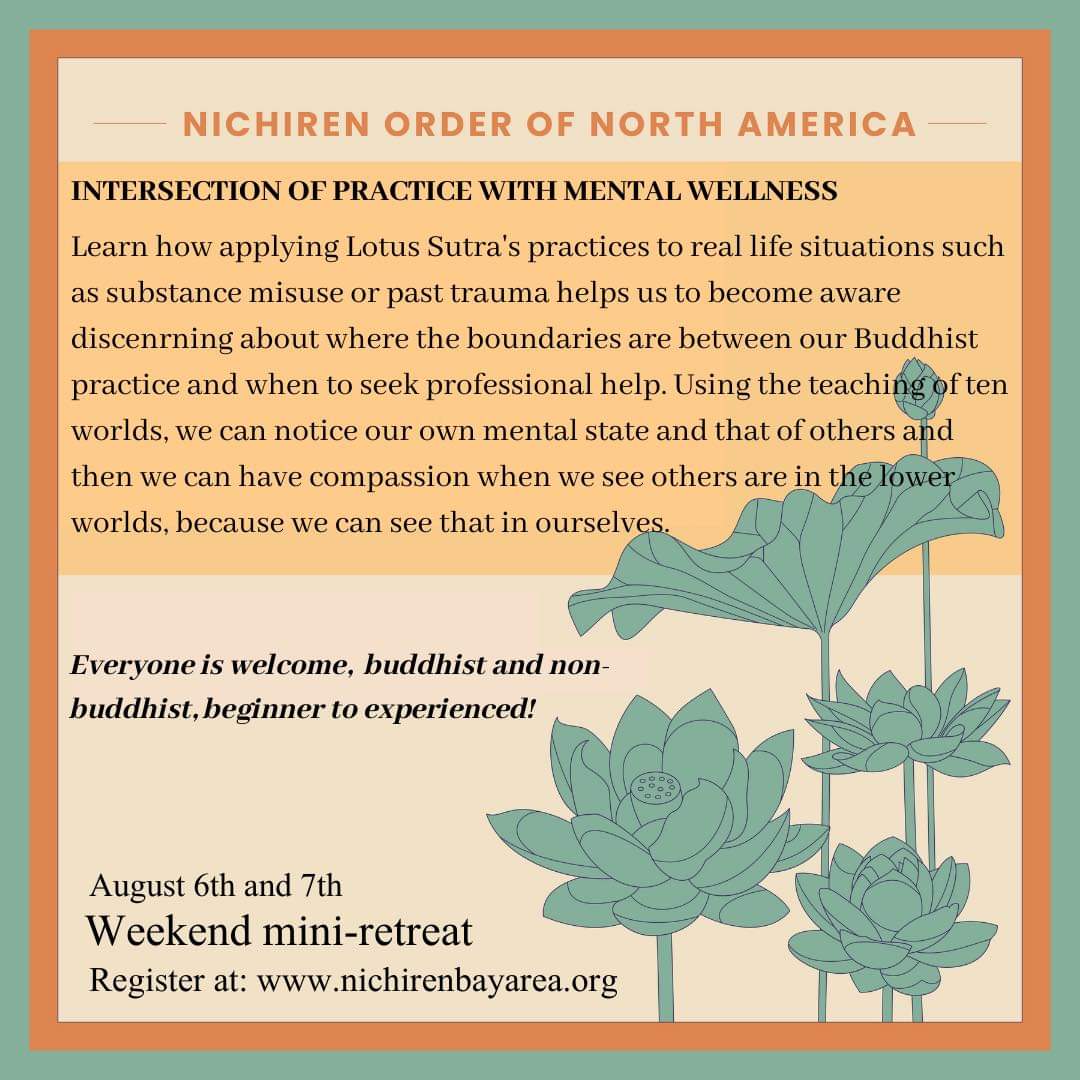
Another reminder that the Nichiren Order of North America two-day retreat is coming up.
800 Years: Taking Myoho Renge Kyo through Namu
Physician's Good MedicineNichiren teaches that as we take Myoho Renge Kyo by mouth as needed we need to manifest this through Namu, our devotion. Namu isn’t in name only. It also must be manifest in action and behavior. As we continue to take Myoho Renge Kyo through Namu, as needed, we begin to see results, the poisons of false teachings and unskillful previous causes begins to be cured. We see results in our lives. This ideally will motivate us to even deeper faith, even more devotion and actions based in devotion and the cycle continues.
Daily Dharma – July 19, 2022
World-Honored One, do not worry! We will keep, read, recite and expound this sūtra after your extinction. The living beings in the evil world after [your extinction] will have less roots of good, more arrogance, more greed for offerings of worldly things, and more roots of evil. It will be difficult to teach them because they will go away from emancipation. But we will patiently read, recite, keep, expound and copy this sūtra, and make various offerings to it. We will not spare even our lives [in doing all this].
Medicine-King Bodhisattva, his attendants and other Bodhisattvas make this vow to the Buddha in Chapter Thirteen of the Lotus Sūtra. Once we awaken to our Bodhisattva nature and resolve to benefit all beings, we may still hold on to the belief that those beings should gratefully receive the teaching and and keep progressing towards enlightenment. We may even become discouraged in our practice of the Wonderful Dharma when these beings do not live up to our expectations. The vow of these great Bodhisattvas reminds us of how difficult is is for us ordinary beings to keep the Lotus Sūtra, and of the determination it takes to create benefit in the world.
The Daily Dharma is produced by the Lexington Nichiren Buddhist Community. To subscribe to the daily emails, visit zenzaizenzai.com
Day 2
Chapter 1, Introductory (Conclusion)
Having last month considered the ray of light illumined by Sun-Moon-Light Buddha and his preaching of the Lotus Sutra, we consider the extinction of Sun-Moon-Light Buddha and the reaction of the eight princes.
Having heard that the Buddha would enter into Nirvāṇa,
Those sons of the World-Honored One
Were filled with sorrow.
They said, “How quickly the Buddha is gone!”The Saintly Master, the King of the Dharma,
Consoled the countless living beings, saying:
“Although I shall pass away,
You must not worry.
This Virtue-Store Bodhisattva has already understood
The truth of the reality [of all things]
[To be attained by the wisdom] without asravas.
He will become a Buddha immediately after me.
He will be called Pure-Body.
He will save innumerable living beings.”The Buddha passed away that night
Just as fire dies out when wood is gone.
His śarīras were distributed.
Countless stupas were erected to enshrine them.As many bhikṣus and bhikṣunīs
As there are sands in the River Ganges
Redoubled their endeavors
In order to attain unsurpassed enlightenment.Wonderful-Light, the Teacher of the Dharma,
Kept the store of the Dharma of the Buddha, and expounded
The Sūtra of the Lotus Flower of the Wonderful Dharma
For eighty small kalpas.Led by Wonderful-Light, those eight princes resolved
To attain unsurpassed enlightenment.
[Wonderful-Light said to them:]
“You will be able to see countless Buddhas.”Having made offerings to [countless] Buddhas,
Those princes followed them, practiced the Great Way,
And became Buddhas in succession.
Each of them assured another of his future Buddhahood.The last God of Gods
Was called Burning-Light Buddha.
As the leader of seers,
He saved innumerable living beings.
Comparing H. Kern’s translation of the Lotus Sutra to Senchu Murano’s
As readers of this blog will no doubt recognize, I am a big fan of Senchu Murano’s translation of the Lotus Sutra. As of July 2022, I’ve now read it aloud as part of my daily practice more than 65 times. There are differences in style and phrasing when compared with the other English translations that I’ve used in my 32 Days of the Lotus Sutra practice – two Rissho Kosei-Kai translations, Soka Gakkai’s translation, Gene Reeves’ translation and the BDK English Tripiṭaka translation – but the substance is the same since all are based on Kumārajīva’s fifth-century Chinese translation of the original Sanskrit.
But that’s not what I find when I compare Senchu Murano’s translation to that of Jan Hendrik Kern, known simply as H. Kern, who published the first English-language translation of the Lotus Sutra in 1884. Kern’s translation is based upon a Nepalese Sanskrit manuscript written on palm leaves and dated C.E. 1039.
I’ve taken Kern’s translation and made the full text available here. As I did with Masaharu Anesaki’s Nichiren: The Buddhist Prophet, I’ve made some style changes – converting British English to American English – and made some other changes I felt helpful. For example, Kern spells words with the letter g that today would be spelled with the letter j. For example, raga for raja. He also uses Gina for Jina, a Sanskrit word that means “conqueror” or “victor,” one of the epithets of a buddha. These have been changed in the text here. I’m eventually going to substitute Murano’s names for Buddhas in place of the Sanskrit names Kern uses. Who wouldn’t prefer to read Cloud-Thunderpeal-Star-King-Flower-Wisdom rather than Jaladharagarjitaghoṣhasusvaranakṣhatrarājasaṃkusumitābhijña? In essence, I’ve made the text available here my version in order to make comparisons more accessible. For people who prefer the unaltered text, a full PDF copy of the book is available for download and also copies of individual chapters. I should also point out that I’ve somewhat abbreviated Kern’s introduction. Ellipses mark where material has been dropped. Again, the original is available for download.
The purpose here is to compare and contrast Kern’s and Murano’s translation and, more to the point, the Nepalese Sanskrit with Kumārajīva’s presentation of the Lotus Sutra. In a series of weekly blog posts I will explore some of the differences I’ve noticed. My ambition is to examine how my view of the sutra and its practice might have changed if I had relied on Kern’s English translation.
Kumārajīva vs. Kern Organization
Blog Topics
- What’s up, Doc?
- The Arhats Present at the Beginning
- Where is Upali?
- Ānanda’s Status when the Lotus Sutra Was Taught
- Rock and Roll in the Time of Śākyamuni
- The Sutra Taught Before the Lotus Sutra
- A Lotus Without 10 Suchnesses
- Kern’s Sanskrit and Hurvitz’s Sanskrit
- The Problem with Arhats and Pratyekabuddhas
- Kumārajīva’s Value
- Senchu Murano’s Insight
- Śāriputra’s Future
- Variations to Puzzle Over
- Comparing and Contrasting a Parable
- Disposition to Understanding
- Kern’s Simile of the Herbs Sucks
- The Plight of the Famished
- Different and Yet Consistent
- Offering Clarity and Avoiding Errors
- Imagining Buddha Lands
- The Buddha as Father and Procreator
- Ānanda’s Vow
- Shouldering the Buddha
- Digging Into A Story
- The Details of the Stūpa of Treasures
- Lessons of Devadatta and the Dragon King’s Daughter
- Encouragement
- The Plight of an Ordinary Bodhisattva
- The Message Beyond the Details
- Ether and the Sky
- The Color, Smell and Taste of the Dharma
- Piety and Merits
- A Very Complete Organ of Manhood
- The Uniform Scent of the Lotus Sutra
- Expiating Sins
- Differing Views of Supernatural Scenes
- Dedication to the Lotus Sutra
- The Advanced Transmission of the Lotus Sutra
- Differing Details of Previous Lives
- The Translator’s Touch
- The Odd Praise of Amitābha in Kern’s Lotus Sutra
- Talismanic Words for Guard, Defense, and Protection
- The Request of Pure-Store and Pure-Eyes
- A Patriarchal Worldview Shared by Women
- The Dedicated Work of a Buddhist Priest
800 Years: As Few as the Amount of Dirt Piled on a Fingernail
Look at the world around us. There are many who say they have deep faith, but there is not one person in 10,000,000 who is sincere. The Nirvana Sūtra says: “Those who do not have faith in the Buddha Dharma and fall into evil paths are as many as the dirt on the earth; those who have faith in the Buddha Dharma and become Buddhas are as few as the amount of dirt piled on a fingernail.”
Minobu-san Gosho, Mt. Minobu Letter, Writings of Nichiren Shōnin, Volume 5, Page 129
Daily Dharma – July 18, 2022
Śāriputra! Some disciples of mine, who think that they are Arhats or Pratyekabuddhas, will not be my disciples or Arhats or Pratyekabuddhas if they do not hear or know that the Buddhas, the Tathāgatas, teach only Bodhisattvas.
The Buddha makes this declaration to his disciple Śāriputra in Chapter Two of the Lotus Sutra. When the Buddha says he only teaches Bodhisattvas, he does not mean that he excludes anyone from his teaching. It is only when we realize and develop our capacities as Bodhisattvas, beings who exist to benefit all beings, rather than being preoccupied with our own suffering, can we hear, practice and appreciate the Buddha Dharma.
The Daily Dharma is produced by the Lexington Nichiren Buddhist Community. To subscribe to the daily emails, visit zenzaizenzai.com