
All posts by John Hughes

Day 9

Day 9 covers Chapter 5, The Simile of Herbs, and introduces Chapter 6, Assurance of Future Buddhahood.


Having last month considered how the Buddha is like the cloud that nourished all of the plants, we consider the Buddha’s various teachings.

“The various teachings I expound are of the same content, of the same taste. Those who emancipate themselves [from the bonds of existence,] from illusions, and from birth and death, will finally obtain the knowledge of the equality and differences of all things. But those who hear or keep my teachings or read or recite the sutras in which my teachings are expounded, or act according to my teachings, do not know the merits that they will be able to obtain by these practices. Why is that? It is because only I know their capacities, appearances, entities and natures. Only I know what teachings they have in memory, what teachings they have in mind, what teachings they practice, how they memorize the teachings, how they think of the teachings, how they practice the teachings, for what purpose they memorize the teachings, for what purpose they think of the teachings, for what purpose they practice the teachings, and for what purpose they keep what teachings. Only I see clearly and without hindrance that they are at various stages [of enlightenment]. I know this, but they do not know just as the trees and grasses including herbs in the thickets and forests do not know whether they are superior or middle or inferior. My teachings are of the same content, of the same taste. Those who emancipate themselves [from the bonds of existence,] from illusions, and from birth and death, will finally attain Nirvana, that is, eternal tranquility or extinction. They will be able to return to the state of the Void.

“Although I knew the equality and differences of all things, I refrained from expounding it to them in order to protect them because I saw their [various] desires.

“Kāśyapa, and all of you present here! It is an extraordinarily rare thing to see that you have understood, believed and received the Dharma which I expounded variously according to the capacities of all living beings because it is difficult to understand the Dharma which the Buddhas, the World-Honored Ones, expound according to the capacities of all living beings.”

The Daily Dharma from Feb. 17, 2022, offers this:

Only I see clearly and without hindrance that they are at various stages [of enlightenment]. I know this, but they do not know just as the trees and grasses including herbs in the thickets and forests do not know whether they are superior or middle or inferior.

The Buddha makes this declaration in Chapter Five of the Lotus Sūtra, as he explains the simile of herbs. This is a good reminder for us on the Bodhisattva path of how important it is to have respect for all beings. We can believe we know whether someone else is less enlightened than we are, or even more enlightened than we are. But for Bodhisattvas, this belief is irrelevant. Only the Buddha knows who is where on the path. We do not need to know. We just need to find ways to benefit others, no matter how close they may be to enlightenment.

The Daily Dharma is produced by the Lexington Nichiren Buddhist Community. To subscribe to the daily emails, visit zenzaizenzai.com
800 Years: Seeing the Truth of the Lotus Sutra for Ourselves

In the [Lotus] sutra, the Buddha said, “They will be able to understand [this sutra] by faith.” The transfer of merit from the Odaimoku is based simply on faith, not on intellectual understanding. Note that this is not “blind faith” as it is sometimes understood in Western culture; instead, it is initial trust that allows us to move to a point at which we see the truth of the Lotus Sutra for ourselves.

Awakening to the Lotus

Daily Dharma – May 18, 2022

Anyone who wishes to expound this sūtra
Should give up jealousy, anger, arrogance,
Flattery, deception and dishonesty.
He should always be upright.

The Buddha sings these verses to Mañjuśrī in Chapter Fourteen of the Lotus Sūtra in which he describes the peaceful practices of a Bodhisattva. The way we live our lives can either reinforce our delusions or help us gain more clarity about how things really are. In these verses, the Buddha advises against these actions not because he will think less of us when we do them, but because when we find ourselves behaving these ways it is because we are not seeing things for what they are.

The Daily Dharma is produced by the Lexington Nichiren Buddhist Community. To subscribe to the daily emails, visit zenzaizenzai.com

Day 8

Day 8 concludes Chapter 4, Understanding by Faith, and closes the second volume of the Sutra of the Lotus Flower of the Wonderful Dharma.


Having last month considered how the Buddha taught according to the capacity of the śrāvakas, we consider the Śrāvakas’ understanding.

We are Śrāvakas in this sense of the word.
We will cause all living beings
To hear the voice telling
Of the enlightenment of the Buddha.

We are Arhats
In the true sense of the word.
All gods and men,
All Maras and Brahmans
In the worlds
Should make offerings to us.

You, the World-Honored One, are the great benefactor.
By doing this rare thing,
You taught and benefited us
Out of your compassion towards us.

No one will be able to repay your favors
Even if he tries to do so
For many hundreds of millions of kalpas.
No one will be able to repay your favors
Even if he bows to you respectfully,
And offers you his hands, feet or anything else.

No one will be able to repay your favors
Even if he carries you on his head or shoulders
And respects you from the bottom of his heart
For as many kalpas
As there are sands in the River Ganges,
Or even if he offers you
Delicious food, innumerable garments of treasures,
Many beddings, and various medicines,
Or even if he erects a stupa-mausoleum
Made of the cow-head candana,
And adorns it with treasures,
Or even if he covers the ground
With garments of treasures
And offers them to the Buddha
For as many kalpas
As there are sands in the River Ganges.

See Under the Guidance of our Father

800 Years: Casting the Odaimoku Upon the Ocean of Our Suffering

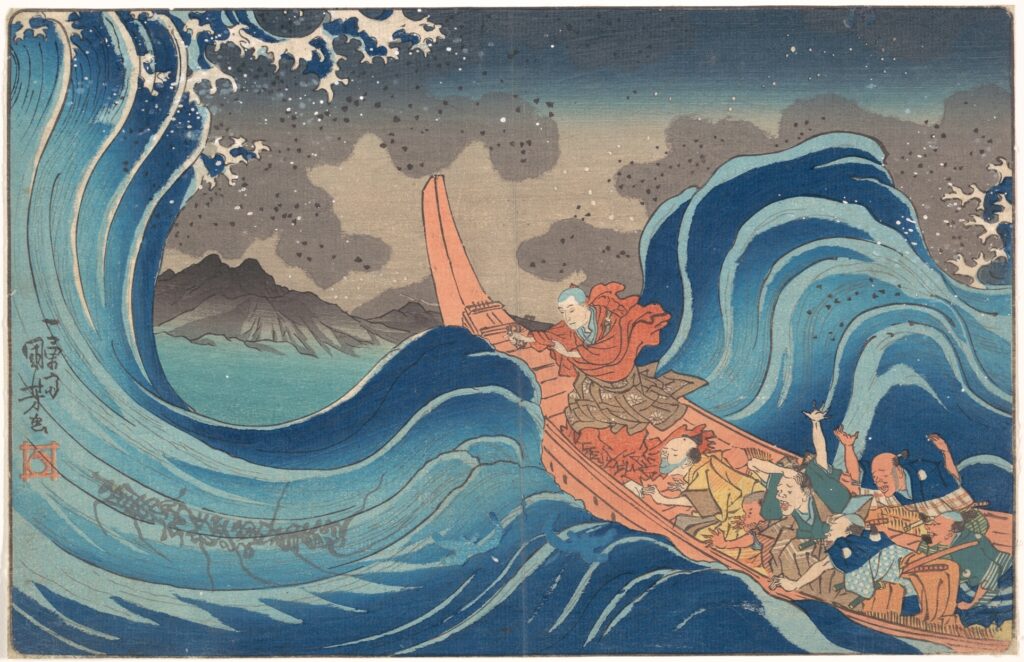
metmuseum-nichiren-sado-ocean-daimoku
Monk Nichiren Calming the Stormy Sea by Utagawa Kuniyoshi, 1835

There is a story told of Nichiren on his way to his second exile, his trip to Sado Island. It is said that the water was so rough that all those on board the boat feared for their lives. According to the story, Nichiren took one of the oars and with the blade wrote the Odaimoku onto the surface of the water in order to calm the sea.

Whether or not you believe this happened exactly as it is told, there is certain documentary support for believing that he actually did attempt to do this. Still, the fact of the matter is that Nichiren placed all of his faith in the power of the Lotus Sutra. We too can cast the Odaimoku upon the ocean of our suffering, and with our practice we can calm the waters. We can change ourselves so that we can safely and confidently navigate the rough seas in which we may find ourselves.

Lotus Path: Practicing the Lotus Sutra Volume 1

Daily Dharma – May 17, 2022

Thereupon a loud voice of praise was heard from within the stūpa of treasures: “Excellent, excellent! You, Śākyamuni, the World-Honored One, have expounded to this great multitude the Sūtra of the Lotus Flower of the Wonderful Dharma, the Teaching of Equality, the Great Wisdom, the Dharma for Bodhisattvas, the Dharma Upheld by the Buddhas. So it is, so it is. What you, Śākyamuni, the World-Honored One, have expounded is all true.”

This declaration comes from Many-Treasures Buddha (Tahō, Prabhutaratna) at the beginning of Chapter Eleven of the Lotus Sūtra. In the story, Many-Treasures came from a world far away from this world of conflict when he heard the Buddha giving his highest teaching and appeared in a tower (stūpa) of wonderful treasures to confirm the truth of this teaching. By the Teaching of Equality, he means that all beings can become enlightened through this teaching. By the Great Wisdom, he means that the teaching is the same as the Buddha’s own mind. By the Dharma for Bodhisattvas, he means that to receive this teaching we awaken to our natures to benefit all beings. And by the Dharma Upheld by the Buddhas, he means that all Buddhas in all worlds encourage and help those who practice this sūtra.

The Daily Dharma is produced by the Lexington Nichiren Buddhist Community. To subscribe to the daily emails, visit zenzaizenzai.com

Day 7

Day 7 concludes Chapter 3, A Parable, and begins Chapter 4, Understanding by Faith.


Having last month considered the rich man and his poor son, we consider the poor son’s reaction to seeing wealth and prestige of the rich man.

“World-Honored One! At that time the poor son, who had worked at various places as a day worker, happened to come to the house of his father. Standing by the gate of the house, he saw his father in the distance. His father was sitting on a lion-like seat, putting his feet on a jeweled footstool. Brāhmaṇas, kṣatriyas, and householders surrounded him respectfully. He was adorned with a necklace of pearls worth ten million. The secretaries and servants were standing on either side of him, holding insect-sweepers made of white hairs. Above him was a jeweled awning, from which streamers of flowers were hanging down. Perfume was sprayed and beautiful flowers were strewn on the ground. He was exhibiting treasures and engaging in trade. Adorned with these various things, he looked extraordinarily powerful and virtuous.

“Seeing the exceedingly powerful father, the poor son was frightened. He regretted that he had come there. He thought, ‘Is he a king or someone like a king? This is not the place where I can get something by labor. I had better go to a village of the poor, where I can work to get food and clothing easily. If I stay here any longer, I shall be forced to work.’

“Having thought this, the poor son ran away.

See Being Led to the Buddha

800 Years: Offering of a Rice Cake

Once upon a time, a man who had offered a “rice cake” made from mud to a Buddha ascended the throne in a kingdom due to this virtuous act. As the Lotus Sūtra is the dharma superior to a Buddha, those who make donations to the sūtra will inevitably gain blessings in this life and attain Buddhahood in the future lives, will they not?

Kurōtarō-dono Gohenji, A Reply to Lord Kurōtarō, Writings of Nichiren Shōnin, Faith and Practice, Volume 4, Page 153

Daily Dharma – May 16, 2022

The good men or women who keep, read, recite, expound or copy this Sūtra of the Lotus Flower of the Wonderful Dharma, will be able to obtain eight hundred merits of the eye, twelve hundred merits of the ear, eight hundred merits of the nose, twelve hundred merits of the tongue, eight hundred merits of the body, and twelve hundred merits of the mind.

The Buddha gives this teaching in Chapter Nineteen of the Lotus Sūtra. This is another reminder that the practice of the Wonderful Dharma does not take us out of the world of conflict we live in. Instead, it helps us to use the senses we have, in ways we did not think were possible, to see the world for what it is. Merits in this sense are not status symbols. They are an indication of clarity, of our faculties not being impeded by anything that blocks their capacity.

The Daily Dharma is produced by the Lexington Nichiren Buddhist Community. To subscribe to the daily emails, visit zenzaizenzai.com

Day 6

Day 6 continues Chapter 3, A Parable


Having last month considered why the rich man gave his children the largest and most comfortable carts, we repeat in gāthās the Parable of the Burning House.

Thereupon the Buddha, wishing to repeat what he had said, sang in gāthās:

I will tell you a parable.
A rich man had a manor house.
It was old, rotten,
Broken and ruined.
The house was about to collapse.
The lower parts of the pillars were rotten;
The beams and ridge-poles, tilting and slanted;
The foundation and steps, broken;
The fences and walls, corrupt;
The plaster of the walls, peeling;
The rush thatched on the roof, falling;
The rafters and eaves, slipping out of each other;
The hedges around the house, bent;
And refuse and debris, scattered all over.

In this house lived
Five hundred people.
Kites, owls, crested eagles,
Eagles, crows,
Magpies, doves, pigeons,
Lizards, snakes, vipers, scorpions,
Millipedes, wall lizards, centipedes,
Weasels, badgers, mice, rats,
And poisonous vermin
Were moving about.

Maggots and other vermin
Assembled on the excretions
Scattered all over
In the house.

Foxes, wolves, and small foxes
Were crawling on corpses,
Biting them, chewing them,
And dismembering them.

Many dogs were scrambling for their prey.
Weak and nervous from hunger,
They were seeking food here and there.
They were fighting with each other,
Snapping at each other,
And barking at each other.
The house was
So dreadful, so extraordinary.

Mountain spirits, water spirits,
Yakṣas and other demons
Lived here and there.
They fed on people and poisonous vermin.

Wild birds and beasts
Hatched their eggs,
Suckled or bred.
They protected their offspring.
Yakṣas scrambled for their young,
Took them, and ate them.
Having eaten to their hearts’ content,
They became more violent.
They fought with each other.
Their shrieks were dreadful.

The demons called kumbhandas
Crouched on the ground
Or jumped a foot or two above the ground.
They walked to and fro
And played at their will.
They seized dogs by the legs,
Or hit them
Until they lost their voices,
And held their feet against their necks.
They enjoyed seeing them frightened.

Some demons,
Tall, large,
Naked, black, and thin,
Lived in the house.
They were crying for food
With loud and evil voices.

The necks of some demons
Were as slender as needles.
The heads of some demons
Were like that of a cow.
They ate people or dogs.
Their hair was disheveled
Like mugworts.
They were cruel and dangerous.
Always hungry and thirsty,
They were running about, shrieking.

Yakṣas, hungry spirits,
And wild birds and beasts
Were unbearably hungry.
They were looking out of the windows
In all directions for food.
The house was so dangerous, so dreadful.

See Leaving Our Burning House