
Lecture on the Lotus SutraAs people take faith in the Lotus Sutra initially there is limited capacity for understanding. As time goes on and our capacity for understanding and incorporating the teachings in our lives increases, then we are able to see even deeper into the Dharma.
All posts by John Hughes
Daily Dharma – Feb. 1, 2022
Truly, truly good men! I am peaceful. I am in good health. The living beings are ready to be saved. They do not fatigue me because I already taught them in their consecutive previous existences, and also because they have already honored the past Buddhas respectfully and planted the roots of good.
The Buddha makes this proclamation to the leaders of the Bodhisattvas from Underground in Chapter Fifteen of the Lotus Sūtra. These Bodhisattvas appeared when the Buddha asked who would teach the Lotus Sūtra after the Buddha’s death, and asked about the Buddha’s health and whether those he was teaching could keep what he provided for them. The Buddha assures us not only of the certainty of our future enlightenment, but that for us to receive his teaching, there was an earlier time, which we may have forgotten, when we met him. This awareness of our future and our past helps us to see our place in the world and maintain our determination to benefit all beings.
The Daily Dharma is produced by the Lexington Nichiren Buddhist Community. To subscribe to the daily emails, visit zenzaizenzai.com
Day 4
Day 4 concludes Chapter 2, Expedients, and completes the first volume of the Sūtra of the Lotus flower of the Wonderful Dharma.

All things are from the outset
In the state of tranquil extinction.
The Buddhas’ sons who complete the practice of the Way
Will become Buddhas in their future lives.I expounded the teaching of the Three Vehicles
Only as an expedient.
All the other World-Honored Ones also
Expound the teaching of the One Vehicle [with expedients].The great multitude present here
Shall remove their doubts.
The Buddhas do not speak differently.
There is only one vehicle, not a second.The number of the Buddhas who passed away
During the past innumerable kalpas was
Hundreds of thousands of billions,
Uncountable.All those World-Honored Ones expounded
The truth of the reality of all things
With various stories of previous lives, parables and similes,
That is to say, with innumerable expedients.All those World-Honored Ones expounded
The teaching of the One Vehicle,
And led innumerable living beings [with expedients]
Into the Way to Buddhahood.All those Great Saintly Masters
Who knew the deep desires
Of the gods, men, and other living beings
Of all the worlds,
Revealed the Highest Truth
With various expedients.
800 Years: Even the Slightest Belief in the Lotus Sūtra
QUESTION: Suppose ordinary people, priests or lay persons, uphold, read and write or let others read and write the entire Lotus Sūtra without understanding its meaning. Or perhaps they focus on just one of its fascicles, or the four important chapters (chapters 2, 14, 16 and 25), or even just the verse at the end of the “Life Span of the Buddha” chapter without fully appreciating the depth of the sūtra. Suppose there are people who, though they do not read and write the sūtra themselves, show respect by pressing their palms together in the form of gasshō, bow in front of it, offer incense and flowers to it. Or suppose there are people who, though they do not practice these things themselves, are happy seeing others perform such practices, and rejoice that this sūtra is spreading all over the country. Can such people, due to their own merit of having practiced a little, avoid committing worldly sins and be reborn in the realms of human and heavenly beings just as Hinayana sages on the first stage of sainthood are always reborn in the realms of humans and gods without falling into the three evil realms (hell, realm of hungry souls and that of beasts and birds)? Can they in the end perceive the Lotus Sūtra or be reborn in the Pure Lands all over the universe or become Buddhas with their present bodies? I would like to hear about this in detail.
ANSWER: Though my understanding of the sūtra is not profound, as I contemplate the spirit of the Lotus Sūtra and the Nirvana Sūtra, as well as their interpretations by T’ien-t’ai and Miao-lê, it seems to me that those who possess even the slightest belief in the Lotus Sūtra without holding any enmity against its teaching will not fall into the evil realms even if they commit evil deeds.
Shō Hokke Daimoku-shō, Treastise on Chanting the Daimoku of the Lotus Sūtra, Writings of Nichiren Shōnin, Faith and Practice, Volume 4, Page 1-2
Daily Dharma – Jan. 31, 2022
“Who will expound the Sūtra of the Lotus Flower of the Wonderful Dharma in this Sahā-World? Now is the time to do this. I shall enter into Nirvāṇa before long. I wish to transmit this Sūtra of the Lotus Flower of the Wonderful Dharma to someone so that this sūtra may be preserved.”
The Buddha asks this of those gathered to hear him teach in Chapter Eleven of the Lotus Sūtra. If there had been no one among those listening who was able to expound the Sūtra, he would not have asked this question. Our ability to benefit others with the Buddha Dharma is not based on our eloquence, our intelligence or our position in life. It is based only on our faith in the Buddha’s teachings and our determination to benefit others. When we read, recite, and copy the Lotus Sūtra, the Buddha is transmitting it to us. We preserve the Sūtra through our practice.
The Daily Dharma is produced by the Lexington Nichiren Buddhist Community. To subscribe to the daily emails, visit zenzaizenzai.com
Day 3
Day 3 covers the first half of Chapter 2, Expedients.
Thereupon the Buddha said to him,
“No, no, I will not. If I do, all the gods and men in the world will be frightened and perplexed.”Śāriputra said to him again:
“World-Honored One! Explain it, explain it! The many hundreds of thousands of billions of asaṃkhyas of living beings in this congregation have active functions of mind and clear wisdom because they have seen the [past] Buddhas in their previous existence. If they hear you, they will respect and believe you.”
Thereupon Śāriputra, wishing to repeat what he had said, sang in a gāthā:
King of the Dharma, Most Honorable One!
Explain it! Do not worry!
The innumerable living beings in this congregation
Will respect and believe you.The Buddha checked him again, saying, “No. If I do, all the gods, men and asuras in the world will be frightened and perplexed, and arrogant bhikṣus will fall into a great pit.”
Thereupon the Buddha repeated this in a gāthā:
No, no, I will not say any more.
My teaching is wonderful and inconceivable.
If arrogant people hear me,
They will not respect or believe me.Thereupon Śāriputra said to him again:
“World-Honored One! Expound the Dharma, expound the Dharma! The hundreds of thousands of billions of living beings in this congregation like me followed the [past] Buddhas and received their teachings in their consecutive previous existences. They will respect and believe you. They will be able to have peace after the long night and obtain many benefits.”
Thereupon Śāriputra, wishing to repeat what he had said, sang in gāthās:
Most Honorable Biped!
Expound the Highest Truth!
I am your eldest son.
Expound the Dharma!The innumerable living beings in this congregation
Will respect and believe the Dharma.
They have been taught by the [past] Buddhas
In their consecutive previous existences.
They are joining their hands together [towards you],
Wishing with all their hearts to hear and receive your words.Expound the Dharma
To us twelve hundred men,
And also to the other people
Who are seeking Buddhahood!
We shall be very glad to hear the Dharma.
The other people will also.
The Daily Dharma from Nov. 24, 2021, offers this:
My teaching is wonderful and inconceivable.
If arrogant people hear me,
They will not respect or believe me.
The Buddha sings these verses to Śāriputra in Chapter Two of the Lotus Sūtra. We sometimes think of arrogance as acting as if we know something that we really do not. These verses contrast arrogance with respect and faith. Faith does not mean blind belief. It is still important to ask questions when we don’t understand. Respect does not mean blind obedience, but it does mean that we have confidence in what the Buddha teaches, no matter how difficult it may seem. Arrogance blocks our ability to hear the Buddha. Respect and Faith open our hearts to his enlightenment.
The Daily Dharma is produced by the Lexington Nichiren Buddhist Community. To subscribe to the daily emails, visit zenzaizenzai.com
800 Years: The Third Jewel
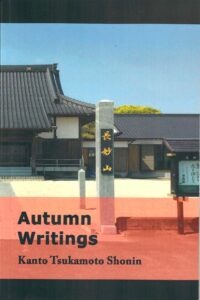
Autumn Writings is the third volume of essays by Kanto Tuskamoto Shonin, the founder of Enkyoji Buddhist Network. Rev. Kanjin Cederman Shonin writes in the Forward:
“The most powerful reason that I wish to share these lectures with everyone is because of their simplicity and the easy-to-grasp explanations that Tsukamoto Sensei uses to share many very profound teachings.”
I’ve previously published quotes from Spring Writings and Summer Writings, and I will be publishing several quotes from Autumn Writings that relate to faith in the coming weeks.
What I want to do now is consider Rev. Tsukamoto’s guidance on the third jewel, the Sangha.
“At a Conversion Ceremony we, as Buddhists, vow to devote ourselves to the Three Treasures. Are you still devoted to the Three Treasures now? People who consider themselves Buddhists may have no problem with two of the Treasures – Buddha and Dharma. How about the third one, the Sangha/Temple? Actually, Sangha is very difficult. While the first two Treasures are to assist you in prayer and understanding, the third one, Sangha, is not only for prayer and understanding, but you also have to show your faith through your practical behavior and your commitment to the Sangha voluntarily.” [page 44]
For Rev. Tsukamoto, faith can’t exist without the sangha.
“If you were to lose your Sangha/Temple, what would happen to your faith? Some say, ‘I will continue my faith by myself’ or ‘I am okay because I do Gongyō every day on my own.’ However, it is not easy to maintain the Faith by yourself without the Sangha, because a Nichiren Shū Sangha/Temple is the best place to develop and practice your faith. This influence will appear in your Gongyō or prayer. If you continue to perform Gongyō alone every day, naturally you will fall into a habit of doing everything your own way. This will materialize in your chanting pronunciation and service manner. What is worse is that there will be no specialist like a Minister to correct what is wrong. You will not notice the errors by yourself and therefore will continue to do everything improperly and think that your way is correct.” [page 45]
In today’s interconnected world, I would argue that there is no place outside the sangha of believers. For me, Sanghas are like Italian restaurants. Each has its own flavor and focus, dictated by the chef’s tastes. We have an opportunity to find our sangha anywhere or everywhere in the world. Our task is to find the one we enjoy the most.
I do, however, agree with Rev. Tsukamoto’s point about Gohonzons and sangha membership:
“I often wonder why there are so many people who want to have a ‘Gohonzon,’ but no one wants a Sangha/Temple. This is very strange. Sangha/Temple should be a ‘top priority’ over a private Gohonzon because the Temple is ‘Kaidan’ – the precept dais – it is the only place able to offer a Gohonzon. Therefore, if you don’t have a Temple, you cannot receive a private Gohonzon.” [page 47]
Table of Contents Next Essay
Daily Dharma – Jan. 30, 2022
Mañjuśrī! A Bodhisattva-mahāsattva who keeps this Sūtra of the Lotus Flower of the Wonderful Dharma in the latter days after [my extinction] when the teachings are about to be destroyed, should have great loving-kindness towards laymen and monks, and great compassion towards those who are not Bodhisattvas. He should think: ‘They do not know that the Tathāgata expounded expedient teachings according to the capacities of all living beings. They do not hear, know or notice it, or ask a question about it or believe or understand it. Although they do not ask a question about this sūtra, or believe or understand it, I will lead them and cause them, wherever they may be, to understand the Dharma by my supernatural powers and by the power of my wisdom when I attain Anuttara-samyak-saṃbodhi.
The Buddha gives this explanation to Mañjuśrī Bodhisattva in Chapter Fourteen of the Lotus Sūtra. Until we reach enlightenment, we may not be able to reach all beings. Rather than blaming them for not having the capacity to learn from us, or blaming ourselves for not being skillful enough to reach them, the Buddha reminds us to be patient and realize there is no hurry to being free from our delusions.
The Daily Dharma is produced by the Lexington Nichiren Buddhist Community. To subscribe to the daily emails, visit zenzaizenzai.com
Day 2
Chapter 1, Introductory (Conclusion).
“Thereupon the last Sun-Moon-Light Buddha expounded a Sūtra of the Great Vehicle called the ‘Innumerable Teachings, the Dharma for Bodhisattvas, the Dharma Upheld by the Buddhas.’ Having expounded this sūtra, he sat cross-legged [facing the east] in the midst of the great multitude, and entered into the samādhi for the purport of the innumerable teachings. His body and mind became motionless.
“Thereupon the gods rained mandarava-flowers, maha-mandarava-flowers, manjusaka-flowers, and maha-manjusakaflowers upon the Buddha and the great multitude. The world of the Buddha quaked in the six ways. The great multitude of the congregation, which included bhikṣus, bhikṣunīs, upāsakās, upāsikās, gods, dragons, yakṣas, gandharvas, asuras, garuḍas, kiṃnaras, mahoragas, men, nonhuman beings, the kings of small countries, and the wheel turning-holy kings, were astonished. They rejoiced, joined their hands together [towards the Buddha], and looked up at him with one mind.
‘Thereupon the Tathagata emitted a ray of light from the white curls between his eyebrows, and illumined all the corners of eighteen thousand Buddha-worlds in the east just as this Buddha is illumining the Buddha-worlds as we see now.
“Maitreya, know this! There were two thousand million Bodhisattvas in that congregation. They wished to hear the Dharma. They were astonished at seeing the Buddha-worlds illumined by this ray of light. They wished to know why the Buddha was emitting this ray of light.
Following the Example of the Buddha
Buddhism for Today, p24This chapter is called “Introductory” because it forms the introduction of the Lotus Sutra. The circumstances of its preaching are explained first: when Śākyamuni Buddha finished preaching the Sutra of Innumerable Meanings on Mount Gṛdhrakūṭa (Vulture Peak) for the sake of all the bodhisattvas, he sat cross-legged and entered contemplation, in which his body and mind were motionless.
This is a very important description. The Buddha always entered contemplation in this way before and after preaching. During his contemplation, he considered how he should preach in order to make his teaching sink deeply into the minds of his audience, and he also prayed that the teaching preached by him might be rightly received and spread by the hearers. It is said that Śākyamuni Buddha was lost in such contemplation for five hours a day. Following the example of the Buddha, it is desirable for us to close our eyes for a few minutes before and after listening to the Buddha’s teaching so as to keep it constantly in our minds, to purify our minds with it, and to pray to be united with the Buddha.