All posts by John Hughes

Daily Dharma – Jan. 24, 2022

Join your hands together and bow
To the person who keeps this sūtra
In the evil world after my extinction,
Just as you do to me!

The Buddha sings these verses to Medicine-King Bodhisattva at the beginning of Chapter Ten of the Lotus Sūtra. By extension he is giving this instruction to all Bodhisattvas and great beings of the universe, and explaining to them that those who keep the Lotus Sūtra are as precious in this world of conflict at the Buddha himself. If we hear these verses with a mind of ego and attachment, we could conclude that we deserve respect and begin to demand it from others. Those who demand respect only generate fear. The Buddha gained respect by respecting all beings. When we treat others as Buddhas, we are certain to have that treatment reflected back towards us.

The Daily Dharma is produced by the Lexington Nichiren Buddhist Community. To subscribe to the daily emails, visit zenzaizenzai.com

Day 30

Day 30 covers all of Chapter 26, Dhāraṇīs

Having last month considered the 10 rākṣasas daughters’ vow to protect those who practice the Lotus Sutra, we conclude Chapter 26, Dhāraṇīs.

The Buddha said to the rākṣasas:

“Excellent, excellent! Your merits will be immeasurable even when you protect the person who keeps only the name of the Sūtra of the Lotus Flower of the Wonderful Dharma. Needless to say, so will be your merits when you protect the person who keeps the sūtra itself, and makes to a copy of this sūtra hundreds of thousands of offerings such as flowers, incense, necklaces, powdered incense, incense applicable to the skin, incense to burn, streamers, canopies, music, and various lamps like lamps of butter oil, oil lamps, lamps of perfumed oil, lamps of sumanas-flower oil, lamps of campaka flower oil, lamps of vārṣika-flower oil, and lamps of utpala-flower oil. Kunti! You [rākṣasas] and your attendants should protect this teacher of the Dharma.”

When the Buddha expounded this chapter of Dhārānis, sixty-eight thousand people obtained the truth of birthlessness.

The Daily Dharma from July 4, 2020, offers this:

The Buddha said to the rākṣasīs: “Excellent, excellent! Your merits will be immeasurable even when you protect the person who keeps only the name of the Sūtra of the Lotus Flower of the Wonderful Dharma.”

The Buddha declares these lines in Chapter Twenty-Six of the Lotus Sūtra. The rākṣasīs are violent, bloodthirsty demons whose nature is to satisfy their own cravings at the expense of beings weaker than themselves. In the Lotus Sūtra, they learn of their capacity to use their strength to protect others and vow to the Buddha to defend anyone who keeps this sūtra. They understand that when they dedicate their strength to caring for other beings rather than destroying them, they gain the merit which will bring them closer to enlightenment. We learn from this example about our own natures, and that of the beings we share this world with.

The Daily Dharma is produced by the Lexington Nichiren Buddhist Community. To subscribe to the daily emails, visit zenzaizenzai.com

800 Years: The Ebb and Flow of Faith

It’s not uncommon for faith to ebb and flow. Certainly that’s to be expected at the start. This can be likened to the divisions of the Ages of the Dharma.

In sutras other than the Lotus Sutra, there is an expectation that the efficacy of the Buddha’s teaching will decline over time. Commonly these phases are referred to as the Age of True Dharma, the Age of Semblance Dharma and the Latter Age of the Dharma. These can also be referred to as the true Dharma, when the teaching is still fresh and has real potency; the merely formal Dharma, when the teachings have devolved into mere rituals; and the end of the Dharma, when the teachings lose all impact.

In Stories of the Lotus Sutra, Gene Reeves offers an explanation of how these same divisions can be applied to our faith and practice “not as an inevitable sequence of periods of time, but as existential phases of our own lives.”

“There will be times when the Dharma can be said to be truly alive in us, times when our practice is more like putting on a show and has little depth, and times when the life of the Dharma in us is in serious decline. But there is no inevitable sequence here. There is no reason, for example, why a period of true Dharma cannot follow a period of merely formal Dharma. And there is no reason to assume that a period has to be completed once it has been entered. We might lapse into a period of decline, but with the proper influences and circumstances we could emerge from it into a more vital phase of true Dharma. A coming evil age is mentioned several times in the Dharma Flower Sutra, but while living in an evil age, or an evil period of our own lives, makes teaching the Dharma difficult, even extremely difficult, nowhere does the Dharma Flower Sutra suggest that it is impossible to teach or practice true Dharma.” [p214]

We should keep in mind that settling into what feels like merely formal practice isn’t without benefit. As Reeves explains:

“The relation between sincere respect and its expressions in gestures and words is something like the relation between true Dharma and merely formal Dharma. And yet expressions of respect even when respect is not sincerely felt can still be good. What we can think of as ritual politeness – saying ‘Thank you’ when receiving something, even if we do not feel grateful; … saying ‘I’m sorry’ when we do not really feel sorry – can all contribute to smoother social relations. Just as true Dharma is greater than merely formal Dharma, being truly grateful is greater than expressing gratitude in a merely formal way, and heartfelt sincerity is greater than merely conventional politeness, but even social conventions and polite expressions can be an important ingredient in relations between people and can contribute to mutual harmony and respect.” [p217]

Mutual harmony and respect is a worthy goal of Buddhist practice.


Table of Contents Next Essay

Daily Dharma – Jan. 23, 2022

To enter the room of the Tathāgata means to have great compassion towards all living beings. To wear the robe of the Tathāgata means to be gentle and patient. To sit on the seat of the Tathāgata means to see the voidness of all things. They should do these [three] things and then without indolence expound this Sūtra of the Lotus Flower of the Wonderful Dharma to Bodhisattvas and the four kinds of devotees.

The Buddha, the Tathāgata, gives this description to Medicine-King Bodhisattva in Chapter Ten of the Lotus Sūtra. When we awaken to our nature as Bodhisattvas and resolve to benefit other beings, we often find we do not know how to accomplish this. In the Lotus Sūtra, the Buddha gives instructions for reaching others and helping them let go of their delusions. By voidness the Buddha does not mean that nothing exists, rather that nothing has an inherent existence. Nobody is innately ignorant or innately wise. When we maintain our resolve to improve the world, maintain our patience and increase our capacities, and see the possibility of enlightenment for everyone, then are we truly living the Buddha’s teachings.

The Daily Dharma is produced by the Lexington Nichiren Buddhist Community. To subscribe to the daily emails, visit zenzaizenzai.com

Day 29

Day 29 covers all of Chapter 25, The Universal Gate of World-Voice-Perceiver Bodhisattva.

Having last month considered some of the ways World-Voice-Perceiver Bodhisattva helps those in distress, we consider the merits to be earned by making offerings to World-Voice-Perceiver.

“Those who have much lust will be saved from lust if they constantly think of World-Voice-Perceiver Bodhisattva and respect him. Those who have much anger will be saved from anger if they constantly think of World-Voice-Perceiver Bodhisattva and respect him. Those who have much stupidity will be saved from stupidity if they constantly think of World-Voice-Perceiver Bodhisattva and respect him. Endless-Intent! World-Voice-Perceiver Bodhisattva has these great supernatural powers. He gives many benefits to all living beings. Therefore, they should constantly think of him.

“A woman who, wishing to have a boy, bows and makes offerings to World-Voice-Perceiver Bodhisattva, will be able to give birth to a boy endowed with merits, virtues and wisdom. [A woman] who, wishing to have a girl, [does the same,] will be able to give birth to a beautiful girl who will be loved and respected by many people because of the roots of virtue which the [newly-born] girl planted in her previous existence. Endless-Intent! Because World-Voice-Perceiver Bodhisattva has these powers, the merits of those who respect him and bow to him will not be fruitless. Therefore, all living beings should keep the name of World-Voice-Perceiver Bodhisattva.

“Endless-Intent! Suppose a good man or woman keeps the names of six thousand and two hundred million Bodhisattvas, that is, of as many Bodhisattvas as there are sands in the River Ganges, and offers drink, food, clothing, bedding and medicine to them throughout his or her life. What do you think of this? Are his or her merits many or not?”

Endless-Intent said, “Very many. World-Honored One!”

The Buddha said:

“Anyone who keeps the name of World-Voice-Perceiver Bodhisattva and bows and makes offerings to him even for a moment, will be given as many merits as to be given to the good man or woman as previously stated. The merits will not be exhausted even after hundreds of thousands of billions of kalpas. Endless-Intent! Anyone who keeps the name of World-Voice-Perceiver Bodhisattva will be given these benefits of innumerable merits and virtues.”

The Daily Dharma from Dec. 14, 2021, offers this:

Those who have much lust will be saved from lust if they constantly think of World-Voice-Perceiver Bodhisattva and respect him. Those who have much anger will be saved from anger if they constantly think of World-Voice-Perceiver Bodhisattva and respect him. Those who have much stupidity will be saved from stupidity if they constantly think of World-Voice-Perceiver Bodhisattva and respect him.

The Buddha gives this description of World-Voice-Perceiver Bodhisattva (Kannon, Kanzeon, Avalokitesvara) to Endless-Intent Bodhisattva in Chapter Twenty-Five of the Lotus Sūtra. World-Voice-Perceiver is the embodiment of compassion for all beings, the wish that all beings be freed from suffering and realize the enlightenment of the Buddha. This compassion is the antidote to the three poisons of lust, anger and stupidity. By aspiring to the example of World-Voice-Perceiver and awakening our own compassion, we can overcome these poisons and bring benefits to all beings.

The Daily Dharma is produced by the Lexington Nichiren Buddhist Community. To subscribe to the daily emails, visit zenzaizenzai.com

800 Years: The Faith Frame

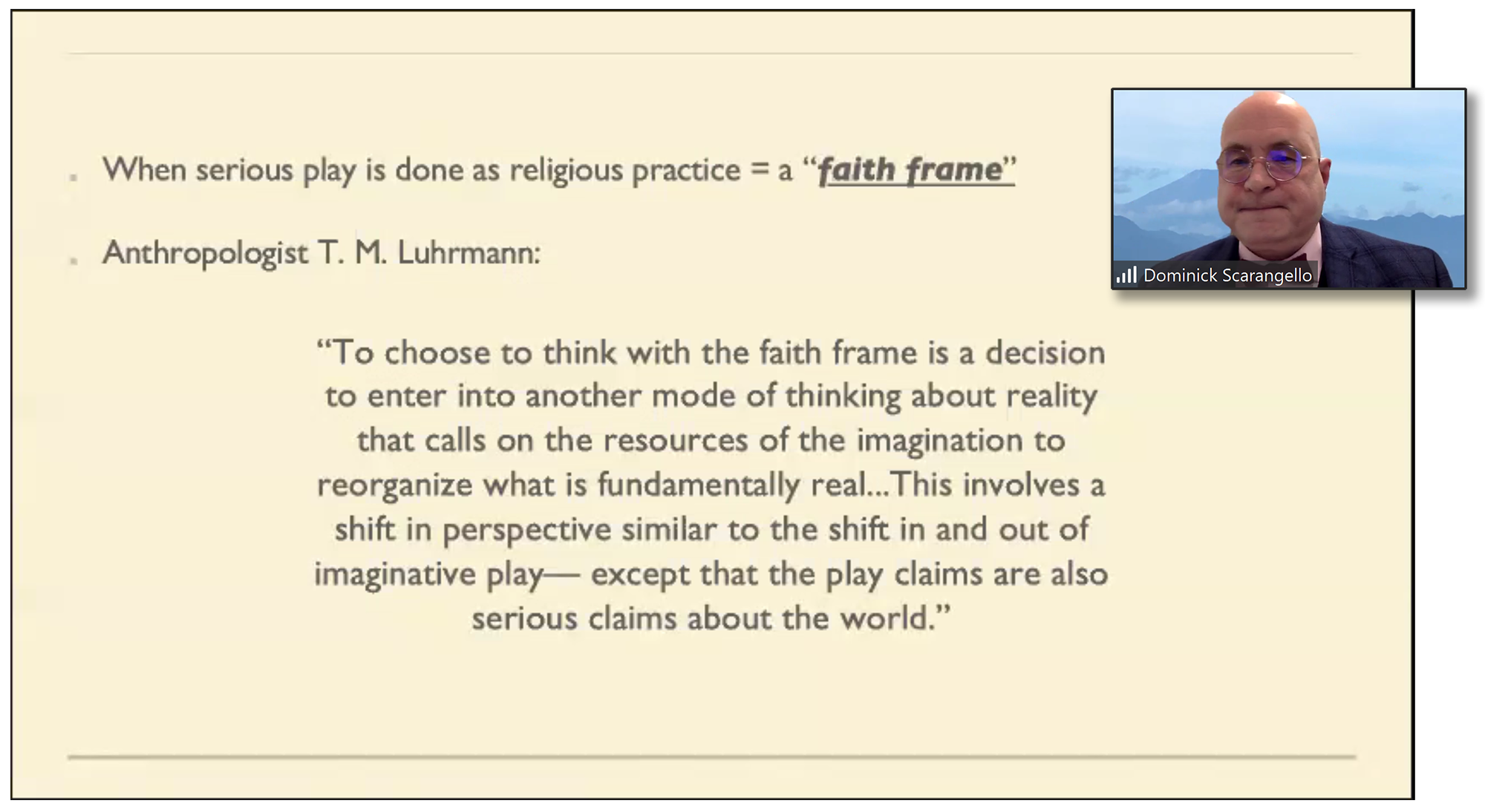
In December of last year, I attended an online lecture by Dominick Scarangello, PhD, international advisor to Rissho Kosei-kai. The subject of the lecture was “Actualize Your Inner Potential By Modeling the Lotus Sutra’s Bodhisattvas,” but that was not the focus. Instead, he offered a discussion on how the rise of western scientific thought destroyed faith in the west, and how we might restore faith without giving up science. (A recording of the lecture is available here.)

For me, the takeaway was something described as the “faith frame,” a frame of reference adopted by the faithful that coexists with our perceived real world and within which we enrich and strengthen ourselves.

Dr. Scarangello introduced the “faith frame” by first discussing the importance of play among bear cubs.

“Play allows for the permanent extension of competence and confidence through pretense. … Play creates a world in ‘rule-governed’ fantasy – in episodic or imagistic representation – in which behavior can be rehearsed and mastered, prior to its expression in the real world, with real-word consequences. Play is another form of ‘as-if’ behavior, that allows for experimentation with fictional narrative – pretended descriptions of the current and desired future states of the world, with plans of action appended, designed to change the former into the latter.” [Psychologist Jordan Peterson]

That “play frame,” Dr. Scarangello explained, is essential to the development of the cubs. Without it, they would not survive on their own.

When done as religious practice, Dr. Scarangello said, such serious play is accomplished within the “faith frame.” Quoting from Stanford University anthropologist T.M. Luhrmann:

“To choose to think with the faith frame is a decision to enter into another mode of thinking about reality that calls on the resources of the imagination to reorganize what is fundamentally real. … This involves a shift in perspective similar to the shift in and out of imaginative play – except that the play claims are also serious claims about the world.”

This “imaginative play” is not fanciful as much as it is “imaginal” – “as if…” As Scarangello explained:

“Founder Niwano was convinced that Buddhism is rational and compatible with modernity, but there is very much of the imaginal in his approach to practice, and I think it’s those aspects of his teachings and guidance that prove difficult for people in other cultures today.”

As Luhrmann explains in her 2018 article “The Faith Frame: Or, Belief is Easy, Faith is Hard”:

“People of faith want to live as if the faith frame is really true, and it is hard, because faith is always under assault by the small (and large) unfairnesses and brutalities of life.”

For me, this “faith frame” is the domain of our Buddhist practice, an essential environment necessary to our development as Buddhists. Within this “faith frame” we can actualize our inner potential by modeling the Lotus Sutra’s Bodhisattvas and by so doing surmount the small and large unfairnesses and brutalities of life.

Without the “faith frame” we would not survive on our own.


Table of Contents Next Essay

Daily Dharma – Jan. 22, 2022

Anyone who wishes to expound this sūtra
Should give up jealousy, anger, arrogance,
Flattery, deception and dishonesty.
He should always be upright.

The Buddha sings these verses to Mañjuśrī in Chapter Fourteen of the Lotus Sūtra in which he describes the peaceful practices of a Bodhisattva. The way we live our lives can either reinforce our delusions or help us gain more clarity about how things really are. In these verses, the Buddha advises against these actions not because he will think less of us when we do them, but because when we find ourselves behaving these ways it is because we are not seeing things for what they are.

The Daily Dharma is produced by the Lexington Nichiren Buddhist Community. To subscribe to the daily emails, visit zenzaizenzai.com

Day 28

Day 28 covers all of Chapter 24, Wonderful-Voice Bodhisattva, and concludes the Seventh Volume of the Sutra of the Lotus Flower of the Wonderful Dharma.

Having last month witnessed the arrival of Wonderful-Voice Bodhisattva, we consider Wonderful-Voice Bodhisattva’s previous life under Cloud-Thunder-Sound-King Buddha.

Thereupon Śākyamuni Buddha said to Many-Treasure Buddha, “This Wonderful-Voice Bodhisattva wishes to see you.”

Thereupon Many-Treasures Buddha said to Wonderful-Voice Bodhisattva:

Excellent, excellent! You have come here to make offerings to Śākyamuni Buddha, hear the Sūtra of the Lotus Flower of the Wonderful Dharma, and see Mañjuśrī and others.”

Thereupon Flower-Virtue Bodhisattva said to Śākyamuni Buddha:

“World-Honored One! What root of good did this Wonderful-Voice Bodhisattva plant and what kind of meritorious deeds did he do in order to obtain this supernatural power?”

Śākyamuni Buddha said to Flower-Virtue Bodhisattva:

“There was once a Buddha called Cloud-Thunder-Sound-King, the Tathāgata, the Arhat, the Samyak-sambuddha. His world was called Appearance-Of-All-Worlds; and the kalpa in which he lived, Gladly-Seen. [There lived] a Bodhisattva called Wonderful-Voice [under that Buddha. The Bodhisattva] offered hundreds of thousands of kinds of music and eighty-four thousand patras of the seven treasures to Cloud-Thunder-Sound-King Buddha for twelve thousand years. Because of this, he was able to appear in the world of Pure-Flower-Star-King-Wisdom Buddha, and obtain supernatural power such as this.

“Flower-Virtue! What do you think of this? Wonderful-Voice Bodhisattva who had offered the music and the jeweled bowls to Cloud-Thunder-Sound-King Buddha [at that time] was no one but this Wonderful-Voice Bodhisattva-mahāsattva [whom you see here now].

“Flower-Virtue! This Wonderful-Voice Bodhisattva already made offerings to innumerable Buddhas, attended on them, and planted the roots of virtue a long time ago. He also already saw hundreds of thousands of billions of nayutas of Buddhas, that is, as many Buddhas as there are sands in the River Ganges.

See The True Pure Land

800 Years: Learning, Practicing and Faith

The Lotus Sutra is called, “A wonderful medicine for enlightenment.” Everything necessary is included in it: believing in the Lotus Sutra is learning; chanting the Lotus Sutra is practicing; keeping the Lotus Sutra is having faith. We can absorb all the nutrition that we need naturally from the Lotus Sutra. When you make these practices part of your daily life, true spiritual peace in the mind and heart will sprout. Having faith in this teaching is an ideal practice both mentally and physically.

Spring Writings

Daily Dharma – Jan. 21, 2022

If they hear the Dharma, some will attain enlightenment;
Others will be reborn in heaven.
The living beings in the evil regions will decrease;
And those who do good patiently will increase.

The Brahma-Heavenly-Kings of the Southwest sing these verses to Great-Universal-Wisdom-Excellence Buddha in Chapter Seven of the Lotus Sūtra. They are imploring that Buddha to share his highest teaching with them, and demonstrating that they are ready to receive it. Those living in evil regions are in great difficulty, because they do not know how to keep from reinforcing their delusions and truly benefit themselves. When a Buddha appears to show all beings the world as it is, he helps us to shed our delusions. But we must still come to him and show through our respect for him that we are ready for his teaching.

The Daily Dharma is produced by the Lexington Nichiren Buddhist Community. To subscribe to the daily emails, visit zenzaizenzai.com