All posts by John Hughes

Daily Dharma – Jan. 4, 2022

Anyone who keeps, reads and recites this sūtra, memorizes it correctly, understands the meanings of it, and acts according to it, know this, does the same practices that I do. He should be considered to have already planted deeply the roots of good under innumerable Buddhas [in his previous existence].

Universal-Sage (Fugen, Samantabhadra) Bodhisattva makes this declaration to the Buddha in Chapter Twenty-Eight of the Lotus Sūtra. In our mundane practice of the Wonderful Dharma, it is easy to overlook our place in the world and the benefits we bring to all beings. The magnificent character of Universal-Sage reminds us that despite our feelings of insignificance, we are the result of countless lives of practice and equal in our merits to this great Bodhisattva.

The Daily Dharma is produced by the Lexington Nichiren Buddhist Community. To subscribe to the daily emails, visit zenzaizenzai.com

Day 10

Day 10 concludes Chapter 6, Assurance of Future Buddhahood, and opens Chapter 7, The Parable of a Magic City.

Having last month considered the prediction for Great Kātyāyana, we consider the prediction for Great Maudgalyāyana.

Thereupon the World-Honored One said again to the great multitude:

“Now I will tell you. This Great Maudgalyāyana will make various offerings to eight thousand Buddhas, respect them, and honor them. After the extinction of each of those Buddhas, he will erect a stūpa-mausoleum a thousand yojanas high, and five hundred yojanas wide and deep. He will make it of the seven treasures: gold, silver, lapis lazuli, shell, agate, pearl and ruby. He will offer flowers, necklaces, incense applicable to the skin, incense powder, incense to burn, canopies, banners and streamers to the stūpa-mausoleum. After that he will make the same offerings to two hundred billions of Buddhas. Then he will become a Buddha called Tamālapattra-candana-Fragrance, the Tathāgata, the Deserver of Offerings, the Perfectly Enlightened One, the Man of Wisdom and Practice, the Well-Gone, the Knower of the World, the Unsurpassed Man, the Controller of Men, the Teacher of Gods and Men, the Buddha, the World-Honored One. The kalpa in which he will become that Buddha will be called Joyfulness; and his world, Mind­Happiness. The ground [of his world] will be even, made of crystal, adorned with jeweled trees, and purified with strewn flowers of pearls. Anyone will rejoice at seeing it. Innumerable gods, men, Bodhisattvas and Śrāvakas will live there. The duration of the life of that Buddha will be twenty-four small kalpas. His right teachings will be preserved for forty small kalpas, and the counterfeit of his right teachings also will be preserved for forty small kalpas.”

Thereupon the World-Honored One, wishing to repeat what he had said, sang in gāthās:

After he gives up his present existence,
This Great Maudgalyāyana, a disciple of mine,
Will see many Buddhas,
Many World-Honored Ones.
He will see eight thousand of them,
And then two hundred billions of them.

In order to attain
The enlightenment of the Buddha,
He will make offerings to them, and respect them.
He will perform brahma practices under those Buddhas,
And keep the teachings of those Buddhas
For innumerable kalpas.

After the extinction of each of those Buddhas,
He will erect a stūpa of the seven treasures.
There will be a long golden yasti
On the top of the stūpa.
He will offer flowers, incense and music
To the stūpa-mausoleum of the Buddha.

He will finally complete
The Way of Bodhisattvas,
And become a Buddha
Called Tamala [pattral-candana-Fragrance
In a world called
Mind-Happiness.

The duration of the life of that Buddha
Will be twenty-four [small] kalpas.
He will expound to gods and men
The enlightenment of the Buddha.

As many Śrāvakas as there are sands in the River Ganges
Will have the six supernatural powers,
Including the three major supernatural powers.
They will be exceedingly powerful and virtuous.

Innumerable Bodhisattvas also will live there.
They will be resolute in mind, and strenuous.
They will never falter
In seeking the wisdom of the Buddha.

After the extinction of that Buddha,
His right teachings
Will be preserved for forty small kalpas.
So will the counterfeit of them.

See One’s Own Practice Affects Others

800 Years: Fire and Water and Faith

Of the people who put faith in the Lotus Sūtra today, some have faith like fire while others have it like water. Those who have faith like fire refer to those who become enthusiastic upon listening to the preaching but their passion cools down as times goes by, and eventually forget the teaching. On the other hand, those whose faith is like water mean those whose faith is like a ceaselessly flowing water, namely those who retain their faith without retreating.

Ueno-dono Gohenji, A Reply to Lord Ueno, Writings of Nichiren Shōnin, Faith and Practice, Volume 4, Page 126

Daily Dharma – Jan. 3, 2022

His precepts out of his loving-kindness brace us up as thunderbolts.
His wishes out of his compassion are as wonderful as large clouds.
He pours the rain of the Dharma as sweet as nectar,
And extinguishes the fire of illusions.

The Buddha gives this description of World-Voice-Perceiver Bodhisattva (Kannon, Kanzeon, Kuan Yin, Avalokitesvara) to Endless-Intent Bodhisattva in Chapter Twenty-Five of the Lotus Sūtra. This Bodhisattva is the embodiment of compassion. As we cultivate our own nature as Bodhisattvas, we find that the only thing that separates us from the happiness of others is our attachment and delusion. When we allow our compassion to grow, we come to see the world as it is.

The Daily Dharma is produced by the Lexington Nichiren Buddhist Community. To subscribe to the daily emails, visit zenzaizenzai.com

Day 9

Day 9 covers Chapter 5, The Simile of Herbs, and introduces Chapter 6, Assurance of Future Buddhahood.

Having last month concluded Chapter 5, The Simile of Herbs, we begin Chapter 6, Assurance of Future Buddhahood, with the prediction for Mahā-Kāśyapa.

Thereupon the World-Honored One, having sung these gāthās, said to the great multitude [of bhikṣus]:

“This Mahā-Kāśyapa, a disciple of mine, will see three hundred billions of Buddhas, of World-Honored Ones, make offerings to them, respect them, honor them, praise them, and expound an innumerable number of their great teachings in his future life. After that, on the final stage of his physical existence, he will become a Buddha, called Light, the Tathāgata, the Deserver of Offerings, the Perfectly Enlightened One, the Man of Wisdom and Practice, the Well-Gone, the Knower of the World, the Unsurpassed Man, the Controller of Men, the Teacher of Gods and Men, the Buddha, the World-Honored One. His world will be called Light-Virtue; and the kalpa in which he will become that Buddha, Great-Adornment. The duration of the life of that Buddha will be twelve small kalpas. His right teachings will be preserved for twenty small kalpas, and the counterfeit of his right teachings will be preserved also for twenty small kalpas. His world will be adorned, and not be defiled with tile-pieces, rubble, thorns or dirt. The ground [of his world] will be even, and devoid of pits and mounds. It will be made of lapis lazuli. Jeweled trees will stand in lines, and the roads will be marked off by ropes of gold. Jeweled flowers will be strewn all over the ground, and the ground will be purified. Many hundreds of thousands of millions of Bodhisattvas and innumerable Śrāvakas will live in that world. Although Mara and his followers also will live there, they will not do any evil but protect the teachings of the Buddha.”

Thereupon the World-Honored One, wishing to repeat what he had said, sang in gāthās:

I will tell you, bhikṣus.
I see this Kāśyapa
With the eyes of the Buddha.
He will become a Buddha
In his future life
After innumerable’ kalpas from now.

He will see in his future life
Three hundred billions
Of Buddhas, of World-Honored Ones.
He will make offerings to them,
And perform brahma practices
To obtain the wisdom of the Buddha.
Having made offerings
To the Most Honorable Bipeds,
He will study and practice
Unsurpassed wisdom,
And become a Buddha on the final stage
Of his physical existence.

The ground [of his world] will be pure.
It will be made of lapis lazuli.
Many jeweled trees
Will stand on the roadsides.
The roads will be marked off by ropes of gold.
Anyone will rejoice at seeing them.

Fragrance will be sent forth from the trees;
And beautiful flowers will be strewn
On the ground, which will be adorned
With various wonderful things.
The ground will be even,
And devoid of mounds and pits.

The number of the Bodhisattvas
Will be beyond calculation.
They will be gentle.
They will have great supernatural powers.
They will keep the sutras of the Great Vehicle
Expounded by the Buddhas.

The Śrāvakas will have already eliminated āsravas,
And reached the final stage of their physical existence.
They will become sons of the King of the Dharma.
Their number also will be beyond calculation.
Even those who have heavenly eyes
Will not be able to count them.

The duration of the life of that Buddha
Will be twelve small kalpas.
His right teachings will be preserved
For twenty small kalpas.
The counterfeit of his right teachings
Will be preserved also for twenty small kalpas.
All this is my prophecy
About the World-Honored One called Light.

See Devils and Devilish Deeds

800 Years: Faith in the Taste of the Dharma

Before I go further in this yearlong journey of faith I want to explain why that initial discussion of faith during the Tea Time with the Priest led me to devote an entire year to this topic.

I began my 32 Days of the Lotus Sutra practice in March 2015 and have continued to cycle through the 28 chapters of the Lotus Sutra daily without interruption. In 2019 I added the Sutra of Innumerable Meanings and The Sutra of Contemplation of the Dharma Practice of Universal Sage Bodhisattva to the cycle. In all that time nothing has surprised me more than the definition of faith revealed in the Parable of the Skillful Physician and His Sick Children. T’ien T’ai is said to have attained awakening through a phrase of the “Medicine King Chapter” of the Lotus Sūtra1. I consider this to be my equivalent.

In the Parable of the Skillful Physician and His Sick Children in Chapter 16, The Duration of the Life of the Tathāgata, the physician’s children drink poison while he is away from home on business. When the physician returns home, he finds his children writhing in agony on the ground and pleading to be cured. The physician concocts a medicine that has a good color and smell and tastes good and offers it to his sick children.

“The sons who had not lost their right minds saw that this good medicine had a good color and smell, took it at once, and were cured completely. But the sons who had already lost their right minds did not consent to take the medicine given to them, although they rejoiced at seeing their father come home and asked him to cure them, because they were so perverted that they did not believe that this medicine having a good color and smell had a good taste.”

In reading this, I realized that the sons who had “lost their right minds” lacked faith. All of the sons could see the good color of the medicine. They could even check and confirm the good smell. But taste required faith. They could not know how the medicine tasted without taking it.

I remember being very excited about this realization. I even made a point of sharing my understanding with Rev. Igarashi at the Sacramento Nichiren Buddhist Church. This was early in my practice with Nichiren Shu, and I was hesitant then to discuss doctrine with Rev. Igarashi. That’s one measure of how special this was to me.

Throughout the Lotus Sutra we are told to understand by faith. Chapter 16 famously begins, “Good men! Understand my sincere and infallible words by faith!” Through the remainder of this year, I hope to illustrate and reinforce my understanding of faith and invite readers of 500yojanas.org to consider their faith.

1
T’ien T’ai’s special phrase: “The Buddhas of those worlds praised him, saying simultaneously, ‘Excellent, excellent, good man! All you did was a true endeavor. You made an offering to us according to the true Dharma.’ ” return

Table of Contents Next Essay

Daily Dharma – Jan. 2, 2022

Hearing this truthful voice of yours, I feel like dancing [with joy]. I have never felt like this before. Why is that? We [Śrāvakas and the Bodhisattvas] heard this Dharma before. [At that time] we saw that the Bodhisattvas were assured of their future Buddhahood, but not that we were. We deeply regretted that we were not given the immeasurable insight of the Tathāgata.

The Buddha’s disciple Śāriputra makes this proclamation to the Buddha in Chapter Three of the Lotus Sūtra. The Buddha had just explained that everything he taught before the Lotus Sūtra was not his true enlightenment; it was preparation for receiving his highest teaching. Śāriputra, the wisest of the Buddha’s disciples, understood immediately that he would be able to do far more than end his own suffering. He would eventually become a Buddha himself. Those gathered were also overjoyed, knowing that Śākyamuni was not the only Buddha they would meet. This ties together the Buddha’s insight that when we are assured of our enlightenment, we are able to meet innumerable enlightened beings.

The Daily Dharma is produced by the Lexington Nichiren Buddhist Community. To subscribe to the daily emails, visit zenzaizenzai.com

Day 8

Day 8 concludes Chapter 4, Understanding by Faith, and closes the second volume of the Sutra of the Lotus Flower of the Wonderful Dharma.

Having last month considered the arrival of the poor son and his father’s reaction, we consider the father’s expedient.

He thought of an expedient.
He called
Some squint-eyed, short, ugly, powerless and virtueless men,
And said to them:
“Go and tell him:
‘You will be employed
To clear away dirt and dust.
You can get a double day’s pay.”‘

Hearing this from them,
The poor son came joyfully with them.
He cleared away dirt and dust,
And cleaned the buildings.

The rich man saw him from the window.
He thought:
“He is ignorant.
He willingly does mean work.”
Thereupon the rich man
Put on old and dirty clothes,
Picked up a dirt-utensil,
And walked towards his son.
With this expedient he came to his son,
And told him to work on, saying:
“I will pay you more.
You can use twice as much oil for your feet.
You can take food and drink as you like.
You can use more matting to warm yourself with.”

Sometimes he chided him, saying:
“Work hard!”
At other times he coaxed him, saying:
“I will treat you as my son.”

By his wisdom the rich man succeeded
In leading his son into his household.
Twenty years after that
He had his son manage his house.

The son was entrusted
With the keeping of the accounts
Of gold and silver,
And of pearl, crystal, and so on.
But he still lodged
In the hut outside the gate, thinking:
“I am poor.
None of these treasures are mine.”

Seeing the mind of his son
Becoming less mean and more noble,
The father called in
His relatives, the king, ministers,
Kṣatriyas, and householders,
In order to give his treasures to his son.

He said to the great multitude:
“This is my son.
He was gone
For fifty years.
I found him Twenty years ago.
I missed him
When I was in a certain city.
I wandered, looking for him,
And came here.
Now I will give him
All my houses and men.
He can use them
As he likes.”

The son thought:
“I was poor, base and mean.
Now I have obtained
The treasures, houses,
And all the other things From my father.
Never before
Have I been so happy.”

The Daily Dharma from Sept. 2, 2020, offers this:

The son thought: “I was poor, base and mean.
Now I have obtained
The treasures, houses,
And all the other things
From my father.
Never before
Have I been so happy.”

These verses are part of the story of the Wayward Son told by Subhūti, Mahā-Kātyāyana, Mahā-Kāśyapa, and Mahā-Maudgalyāyana in Chapter Four of the Lotus Sūtra. The son in the story has come into his inheritance after years of training and preparation by his father. The story explains the disciples’ understanding of how the Buddha uses expedients over time to prepare us for enlightenment. When we are not ready for the Buddha’s wisdom, he teaches to the capacity of our own minds. Now that we are ready for his highest teaching, he reveals his own mind in the Lotus Sutra.

The Daily Dharma is produced by the Lexington Nichiren Buddhist Community. To subscribe to the daily emails, visit zenzaizenzai.com

Ringing in the New Year

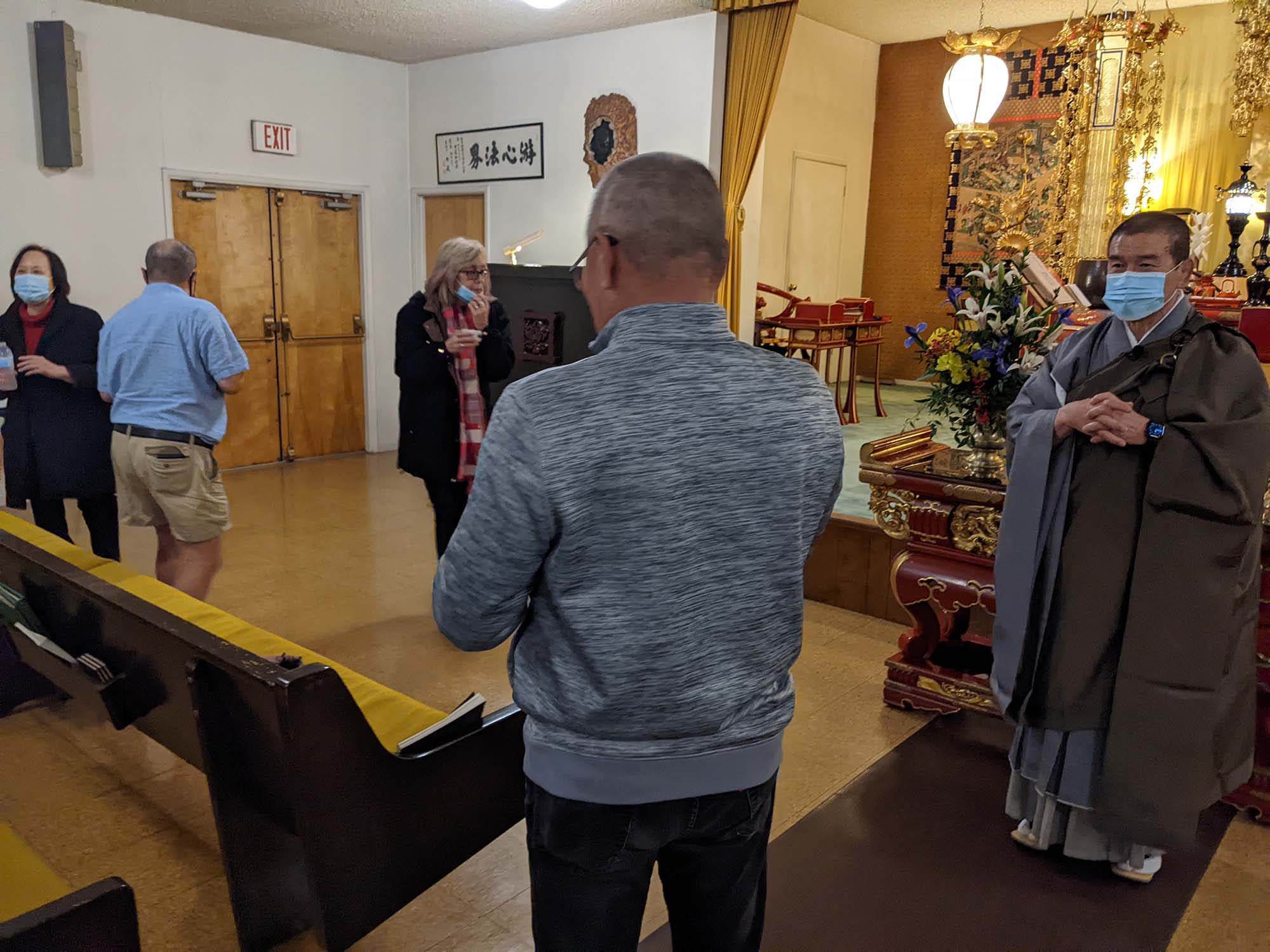
My son thinks I’m odd, but I really enjoy saying goodbye to the closing year and hello to the new year with back-to-back services at the Sacramento Nichiren Buddhist Church.

The evening begins at 11pm with a standard Nichiren Shu service of chanting Hoben Pon and Ji Ga Ge followed by chanting Daimoku. The priest says special prayers.

Following the service is a snack break. Traditionally brown noodles are served, but this year the priest’s wife provided tea and Japanese pastries.

Socially distant snacking before the ringing of the church bell.

At midnight everyone gathers outside to ring the church bell 108 times. Where does 108 come from? These are the 108 worldly desires. Starting with sight, sound, smell, taste, touch and consciousness you have positive, negative and indifferent. That’s 18. Those are all either attached to pleasure, detached from pleasure. That’s 36. These span all time – past, present, future – which totals 108.

Following the bell ringing a New Year service is held. During this service Rev. Igarashi performs a special purification ceremony for the members’ home altars.

The evening ends with a saki toast to the New Year.

800 Years: A Discussion of Faith

Last year on Aug. 3, I attended Rev. Shoda Kanai’s Tea Time with a Priest, an informal weekly Zoom gathering from the Nichiren Buddhist Kannon Temple of Nevada in Las Vegas. The meeting is open to anyone with a question. On that day someone asked about faith, and here I am today starting what I call my 800 Years of Faith Project. I am dedicating this work to the 800th Anniversary of the birth of Nichiren Shonin in 1222.

Before I begin I want to put this project in perspective with a quote from the opening verses of Śāntideva’s “A Guide to the Buddhist Path to Awakening,” The Bodhicaryāvatāra:

“Nothing new will be said here, nor have I any skill in composition. Therefore I do not imagine that I can benefit others. I have done this to perfume my own mind.

“While doing this, the surge of my inspiration to cultivate what is skillful increases. Moreover, should another, of the very same humours as me, also look at this, then he too may benefit from it.”  [From Kate Crosby and Andrew Skilton’s 2002 translation published by Windhorse Publications.]

I should pin that quote at the top of 500yojanas.org for it speaks directly to why I’m here. This is especially important today.

When I formulated this project last August, I decided to  limit my blog posts on the topic of faith to 500 words. As a former newspaper editor steeped in the heritage of inverted pyramids, I have a deep-seated fear of TL;DR. I originally envisioned writing one 500-word blog post each month, but after studying the Lotus Sutra during my 32 Days of the Lotus Sutra practice and reviewing the quotes on this website, I decided to fill all 53 Saturdays in 2022. Then after weeks of gathering quotes and drafting essays on each of the chapters of the Threefold Lotus Sutra, I revised my goal once again.  Now I plan to write 106 essays, filling every Saturday and Sunday.

Monday through Friday I will repost quotes on the topic of faith that I’ve gathered over the years from books I’ve read on Buddhism in general and books specifically related to Nichiren Buddhism and its foundations in T’ian T’ai and Tendai thought.

It occurred to me early on that others might want to participate as part of a celebration of the 800th anniversary of Nichiren’s birth. Last year, I invited a number of Nichiren Shu priests and shamis and other individuals to contribute essays on the topic of faith with the same 500-word limit. As of today I’ve had some expressions of interest in participating, but I have received no essays. If I do get any essays, I will post them during the week in place of the quotes I have set aside.

Whether or not I am able to fill all 365 days with content related to the topic of faith is of no concern. What matters is that I have faith and faith is all that is necessary to take the first step along this yearlong journey.


Table of Contents Next Essay