
All posts by John Hughes

500 Yojanas Ago

Ryusho Jeffus
Ryusho Jeffus

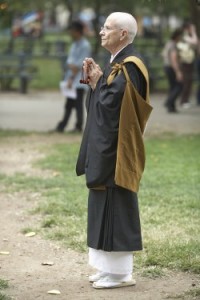
At 8:27 am on Aug. 11, 2020, I received word that Ryusho Jeffus Shonin had died at the Syracuse, New York, VA Medical Center. It has now been 500 days since.

In Ryusho’s book, The Parable of the Magic City, he explains that a yojana is both a measure of distance – the distance an oxcart can travel in a day – and a measure of time – one day for each yojana. And as used here, it is a measure of endurance.

As Ryusho put it in his book, “I wonder what you could accomplish in your life if you made a commitment from today for 500 days to practice on a regular consistent basis towards the achievement of some change in your life? Would you be able to travel the entire 500 days without giving up or abandoning or forgetting your goal and effort?”

Currently I am working on what I call my 800 Years of Faith project. I am marking the 800th anniversary of the birth of Nichiren in 1222 with a yearlong discussion of the topic of faith. On weekdays I will re-publish quotes from Nichiren and other writers that I have gathered here from books I’ve read. On the weekends I will publish 500-word essays on the topic.

As of today I have drafted 77 of these essays. Most of these are products of my 32 Days of Lotus Sutra practice. Using the background and commentary I’ve gathered here, I’ve worked my way through the entire Threefold Lotus Sutra to craft essays on faith related to each chapter.

There are 106 weekend days in 2022 and so I have invited a number of Nichiren priests, shami and others to contribute. I’ve had some interest expressed but haven’t received any essays.

The goal is to fill all 106 weekend days. Ryusho would appreciate this project.

A Visible Form of the Brahma’s Voice of the Buddha

The written words of the Lotus Sūtra express in a visible and tangible form the Brahma’s voice of the Buddha, which is invisible and intangible, so that we can see and read them with our eyes. The Buddha’s pure and immaculate voice, which had disappeared, is resuscitated in the form of written characters for the benefit of humankind. These are two fundamental reasons why people give utterance to speech. First, people utter sounds that deceive others though unintentionally. This is the voice produced in accordance with the minds of other people. Secondly, one utters a voice in order to express what one truly has in mind. In this case one’s own mind is revealed as voice. Mind is called the spiritual aspect while voice is the physical aspect. Therefore, the spiritual aspect reveals the physical aspect. But it is also possible to perceive the mind by listening to the voice. In this case the physical aspect (voice) reveals the spiritual aspect (mind). The physical aspect and the spiritual aspect were inseparable, yet sometimes they appear separately, revealing the intent of the Buddha as the letters of the Lotus Sūtra or the letters of the Lotus Sūtra as the mind of the Buddha.

Mokue Nizō Kaigen no Koto, Opening the Eyes of Buddhist Images, Wooden Statues or Portraits, Writings of Nichiren Shōnin, Faith and Practice, Volume 4, Page 91

Daily Dharma – Dec. 23, 2021

I am now joyful and fearless.
I have laid aside all expedient teachings.
I will expound only unsurpassed enlightenment
To Bodhisattvas.

The Buddha sings these verses in Chapter Two of the Lotus Sūtra. When the Buddha says he only teaches Bodhisattvas, he does not mean that he holds his highest teaching back from anybody. For us to be able to hear what the Buddha teaches, we must awaken our image of ourselves as Bodhisattvas who chose to come into this world of conflict and delusion. If we try to use the Buddha’s teaching to gratify our own delusions, we will only create more suffering. It is only when we set aside our habits of fear and doubt that we can gain wisdom through practicing the Wonderful Dharma.

The Daily Dharma is produced by the Lexington Nichiren Buddhist Community. To subscribe to the daily emails, visit zenzaizenzai.com

Day 32

Day 32 covers Chapter 28, The Encouragement of Universal-Sage Bodhisattva, closing the Eighth Volume of the Sutra of the Lotus Flower of the Wonderful Dharma.

Having last month considered Universal-­Sage’s promises for those who keep, read and recite this sūtra, we consider Śākyamuni’s response to Universal-­Sage’s promises.

Thereupon Śākyamuni Buddha praised him, saying:

“Excellent, excellent, Universal-Sage! You will protect this sūtra so that many living beings may obtain peace and benefits. You have already obtained inconceivable merits and great compassion. You aspired for Anuttara-samyak-saṃbodhi and vowed [to protect this sūtra] by your supernatural powers in the remotest past, and have been protecting this sūtra since then. By my supernatural powers, I will protect anyone who keeps your name.

“Universal-Sage! Anyone who keeps, reads and recites this Sūtra of the Lotus Flower of the Wonderful Dharma, memorizes it correctly, studies it, practices it, and copies it, should be considered to see me, and hear this sūtra from my mouth. He should be considered to be making offerings to me. He should be considered to be praised by me with the word ‘Excellent!’ He should be considered to be caressed by me on the head. He should be considered to be covered with my robe. He will not be attached to worldly pleasures. He will not like to read heretical scriptures or any other writings of heretics. He will not be intimate with heretics, slaughterers, boar-breeders, sheep-breeders, fowl-breeders, dog­breeders, hunters, prostitutes, or any other evil people. He will be upright. He will have correct memory and the powers of merits and virtues. He will not be troubled by the three poisons. He will not be troubled by jealousy, arrogance from selfishness, arrogance from self-assumed attainment of enlightenment, or arrogance from self-assumed acquisition of virtues. He will want little, know contentment, and practice just as you do.

The Daily Dharma from Oct. 27, 2021, offers this:

Universal-Sage! Anyone who keeps, reads and recites this Sūtra of the Lotus Flower of the Wonderful Dharma, memorizes it correctly, studies it, practices it, and copies it, should be considered to see me, and hear this sūtra from my mouth. He should be considered to be making offerings to me. He should be considered to be praised by me with the word ‘Excellent!’

The Buddha makes this declaration to Universal-Sage Bodhisattva (Fugen, Samantabhadra) in Chapter Twenty-Eight of the Lotus Sutra. He reminds us that when we study and practice the Lotus Sūtra, we see not only the Buddha, but all beings who have vowed to protect and encourage us in our practice. It is often difficult to see these beings and appreciate what they are doing for us, much more so to hear the encouragement they offer us in this world of conflict. This is why we must continue to dedicate our lives to offer benefit and encouragement to all beings, so that we can embody the spirit of these protective deities.

The Daily Dharma is produced by the Lexington Nichiren Buddhist Community. To subscribe to the daily emails, visit zenzaizenzai.com

Compensating for Earlier Wrongs

Persecution and punishment are addressed in Chapter 13, “Encouragement for Keeping this Sūtra,” of the Lotus Sūtra. Slander against the Lotus Sūtra, called Hōbāzai, offenses committed against the Dharma in the past, can only be eradicated in the present. Our assiduous practice and cultivation of the Dharma, done through our own volition, compensates for our earlier wrongs and lightens our feelings. When considered as the eradication of the grave offense of slandering the Dharma, any persecutions we encounter in this life are seen as still lighter, even a persecution that would end our life.

History and Teachings of Nichiren Buddhism, p 152

Slandering the True Dharma Equals Causing People to Abandon It

QUESTION: I was able to understand the comparative seriousness between the five rebellious sins and the sin of slandering the True Dharma. Could you explain what slandering the True Dharma exactly means?

ANSWER: Grand Master T’ien-t’ai explains in his Commentary on the Brahma-net Sūtra, “The term slander means to go against.” We may say slandering the True Dharma means to go against the teaching of the Buddha. Vasubandhu’s Treatise on the Buddha-nature preaches, “Hate means to go against principle.” It means that to slander the True Dharma equals to cause people to abandon it.

Ken Hōbō-shō, A Clarificaton of Slandering the True Dharma, Writings of Nichiren Shōnin, Doctrine 3, Pages 115.

Daily Dharma – Dec. 22, 2021

The Bodhisattva-mahāsattva also should know the following truth. All things are insubstantial. They are as they are. Things are not perverted. They do not move. They do not go. They do not turn. They have nothing substantial just as the sky has not. They are inexplicable. They are not born. They do not appear. They do not rise. They are nameless. They are formless. They have no property. They are immeasurable and limitless. They have no obstacle or hindrance. He should see all this. Things can exist only by dependent origination. Only perverted people say, ‘Things are permanent and pleasant.’ This truth is the second thing he should approach.

The Buddha gives this explanation to Mañjuśrī in Chapter Fourteen of the Lotus Sūtra in which he describes the peaceful practices of a Bodhisattva. The Buddha does not see the world as we do. This section explains how changing our view changes the world. When we no longer see beings with power to overwhelm us, and see beings in whom delusions have been created, we see our abilities to cut the root of those delusions and benefit them. These passages are what make the Lotus Sutra difficult to believe and understand, since they go against our habits of manipulating the world to become happy. As we learn to work with our minds, then we truly change the world.

The Daily Dharma is produced by the Lexington Nichiren Buddhist Community. To subscribe to the daily emails, visit zenzaizenzai.com

Day 31

Day 31 covers Chapter 27, King Wonderful-Adornment as the Previous Life of a Bodhisattva.

Having last month considered the reaction of the father, we consider the family’s preparation to see the Buddha.

“Thereupon the [father came to them. The] two sons said to their parents, ‘Excellent, Father and Mother! Go to Cloud-Thunderpeal-Star-King-Flower-Wisdom Buddha, see him, and make offerings to him because to see a Buddha is as difficult as to see an udumbara flower or as for a one-eyed tortoise to find a hole in a floating piece of wood! We accumulated so many merits in our previous existence that we are now able to meet the teachings of the Buddha in this life of ours. Allow us to renounce the world because it is difficult to see a Buddha, and also because it is difficult to have such a good opportunity as this to see him.’

“Thereupon the eighty-four thousand people in the harem of King Wonderful-Adornment became able to keep the Sūtra of the Lotus Flower of the Wonderful Dharma.

“Pure-Eyes Bodhisattva had already practiced the samādhi for the Lotus Flower of the Wonderful Dharma for a long time. Pure-Store Bodhisattva had already practiced the samādhi for the release from evil regions in order to release all living beings from evil regions for many hundreds of thousands of billions of kalpas.

“Now the queen practiced the samādhi for the assembly of Buddhas, and understood the treasury of their hidden core. The two sons led their father by these expedients and caused him to understand the teachings of the Buddha by faith and to wish [to act according to those teachings].

“Thereupon King Wonderful-Adornment, Queen Pure-Virtue, and their two sons came to that Buddha. The king was accompanied by his ministers and attendants; the queen, by her ladies and attendants; and their two sons, by forty-two thousand men. They worshiped the feet of that Buddha with their heads, walked around the Buddha three times, retired, and stood to one side.

See Follow the Truth

Nichi Ren

The word “Nichi” of Nichiren comes from the following passage from Chapter 21, “The Supernatural Powers of the Tathāgata,” of the Lotus Sūtra: Nyo nichi gak-kō myō. Nō jo sho yū myō. Shin nin gyō se-ken. Nō metsu shu jō an: Just like the sun and the moon can dispel darkness, such a person practicing in the world can dispel the fundamental darkness of all living beings.

“Ren” is derived from Chapter 15, “The Appearance of Bodhisattvas from Underground,” of the Lotus Sūtra: Fu sen se ken bō. Nyo ren ge zai sui: They are untainted by the ways of the world, just as a lotus flower in the water. The name of “Nichiren” appears [written] for the first time in the Record of Seeing Fudo and Aizen Myoo, Fudō-Aizen Kanken-ki, dated June 25, 1254.

History and Teachings of Nichiren Buddhism, p 139

The Single, Indispensable Teaching

The doctrine preached in “The Life Span of the Buddha” chapter is not suitable for the capacity of those in the second 500-year period of the Age of the Semblance Dharma, not to speak of the first 500-year period. Those in the Age of the True Dharma were not ready for the theoretical section of the Lotus Sūtra, not to speak of the essential section. In the Latter Age of Degeneration, the pre-Lotus sūtras and the teaching of the theoretical section of the Lotus Sūtra, which were suitable in the Ages of the True Dharma and the Semblance Dharma, no longer enabled the people to shed delusions of life and death and attain Buddhahood. The 16th chapter of the essential section preaches the single, indispensable teaching for extinguishing delusions and attaining Buddhahood.

Looking at it this way, I am sure that in providing guidance the Buddha never acts impartially; He just preaches the dharma suitable to the time and capacity of the people.

Sandai Hiho Honjo-ji, The Transmission of the Three Great Secret Dharmas, Writings of Nichiren Shōnin, Doctrine 2, Page 288