
History and Teachings of Nichiren Buddhism, p 103In the Lotus Sūtra, the Buddha revealed his true intentions. The teachings of the previous forty years used skillful means for śrāvakas, pratyekabuddhas, and bodhisattvas in accordance with their capacities. However, the Trace Gate of the Lotus Sūtra tells us that only the One Vehicle leads people to the true teaching for awakening. The Original Gate of the Lotus Sūtra teaches that the duration of the Buddha’s life is eternal.
For those who could not listen to the Lotus Sūtra, the Nirvāṇa Sūtra was expounded to them so they could “awaken to the Lotus.” It was taught to extend awakening to those who had been left out during the exposition of the Lotus Sūtra. Hence, it is also called the teaching of “gleaning.”
All posts by John Hughes
The Indispensable Dharmas Summed Up by the Four Phrases
It is preached in the 21st chapter on the “Divine Powers of the Buddha” in the Lotus Sūtra, fascicle 7: “In short, all the teachings of the Buddha, all the unhindered, divine powers of the Buddha, all the stores of the secret lore of the Buddha, and all the profundities of the Buddha are revealed and explained in this sūtra.” Grand Master T’ien-t’ai explains this in his Words and Phrases of the Lotus Sūtra saying, “These four are the gist of the Lotus Sūtra.”
QUESTION: What are the indispensable dharmas summed up by the four phrases?
ANSWER: They are the honzon (most venerable one), kaidan (precept dais) and the five-character daimoku, which Śākyamuni Buddha had practiced in the eternal past upon attaining enlightenment with the true aspect of all phenomena, and which is now preached in the 16th chapter on “The Life Span of the Buddha” in the Lotus Sūtra. They had been kept in secrecy during the years Śākyamuni preached the pre-Lotus sūtras ever since He attained Buddhahood for the first time in this world under the bodhi tree, through the preaching of the theoretical section of the Lotus Sūtra, until He began revealing the eternal life of the Buddha in the 15th chapter, “Appearance of Bodhisattvas from Underground,” in the essential section of the sūtra.
Lord Śākyamuni Buddha did not teach these great secret dharmas to such great bodhisattvas as Samantabhadra and Mañjuśrī, attendants of the Buddha throughout the past, present and future, not to speak of other disciples below them. Therefore, the formality of preaching these secret dharmas was quite different from that of preaching the pre-Lotus sūtras and the 14 chapters in the theoretical section of the Lotus Sūtra. It took place in the land of eternal, tranquil light, with the Eternal Buddha as the lord preacher completely equipped with the three bodies (Dharma, Reward and Accommodative Bodies) of a Buddha, and the listeners were of one body with the Buddha.
Appropriate for such an occasion, in order to enhance the attainment of Buddhahood in the eternal past the Buddha especially called out from the bottom of the land of eternal tranquil light the four bodhisattvas such as Superior Practice Bodhisattva who had been disciples of the Original Śākyamuni Buddha since the eternal past, and He entrusted them with these three great secret dharmas. Precept Master Tao-hsien stated, “As the doctrines to be transmitted were those which had been attained in the eternal past, they were entrusted to the disciples of the Eternal Buddha ever since the eternal past.”
Sandai Hiho Honjo-ji, The Transmission of the Three Great Secret Dharmas, Writings of Nichiren Shōnin, Doctrine 2, Page 286-287
Daily Dharma – Dec. 6, 2021
T’ien’tai, therefore, makes clear that all things and phenomena in the ten realms are manifestations of the ultimate reality. Since ultimate reality is another name of the Lotus Sutra, what he states is that all things and phenomena are equal to the Lotus Sutra.
Nichiren wrote this as part of his letter to monk Sairen-bō in his Treatise on All Phenomena as Ultimate Reality (Shohō-Jissō Shō). This was another way of Nichiren expressing his understanding that the Buddha’s highest wisdom is not something that takes us out of this world, but is found within the everyday experiences of our lives. Even the realms of anger, greed, fear, hostility, calm and pleasure are part of the Buddha’s pure land. The practice of the Wonderful Dharma is not to escape from these difficult places, but to use them to benefit all beings. To be caught up in them is to be deluded about their evanescent nature. To see them for what they are is to know the joy of enlightenment.
The Daily Dharma is produced by the Lexington Nichiren Buddhist Community. To subscribe to the daily emails, visit zenzaizenzai.com
East vs. West
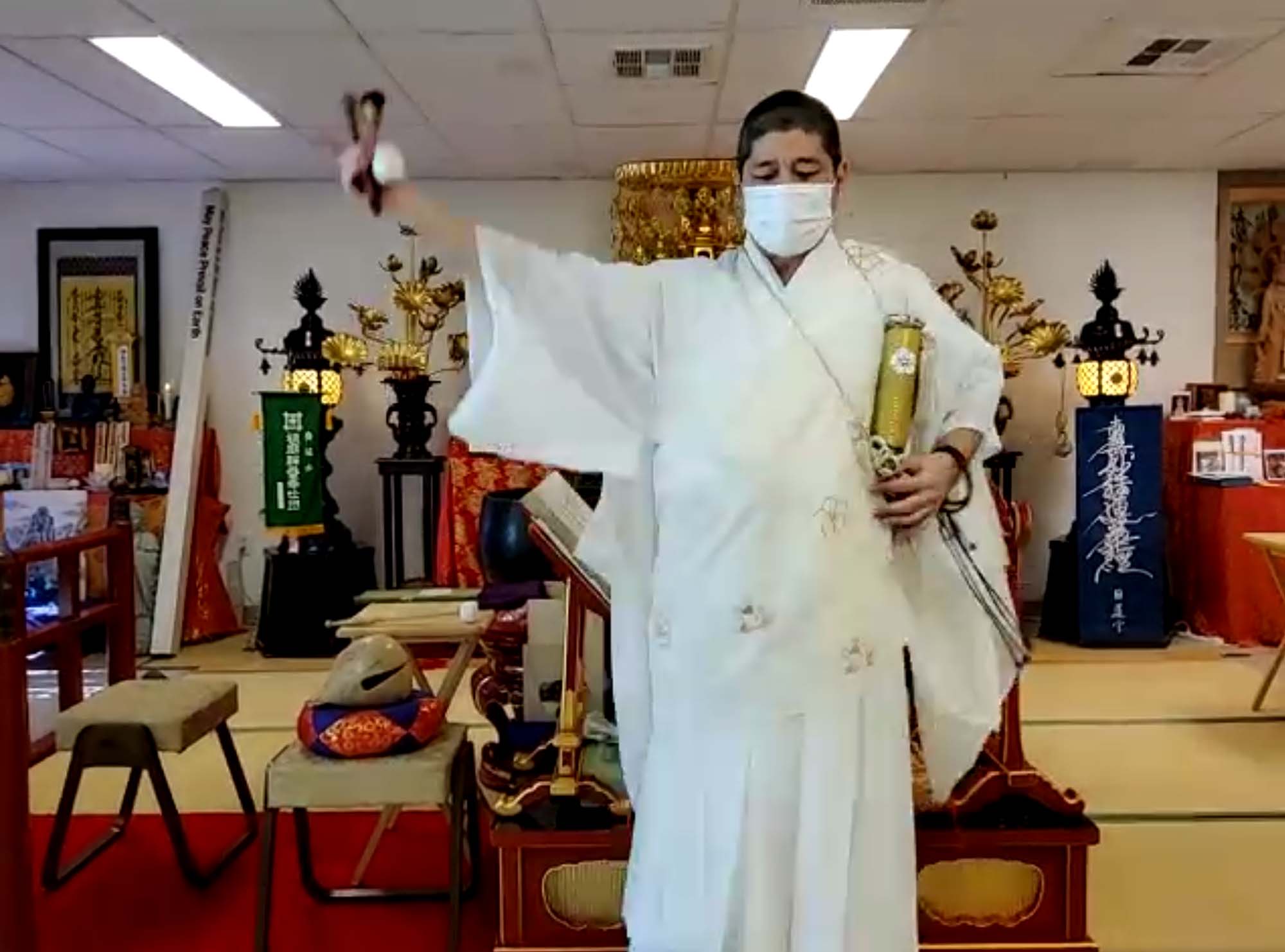
Sunday was something of an East meets West day of practice. I began the day with a 10:30am online kito blessing service from the Nichiren Buddhist Kannon Temple of Nevada, with Rev. Shoda Kanai demonstrating the mystical powers of a priest who has completed two 100-day Aragyo ascetic practice training. I followed that at 3pm with a two-hour lecture and Q&A session that sought to reach westerners whose scientific view of daily reality has stunted their ability to imagine something more.
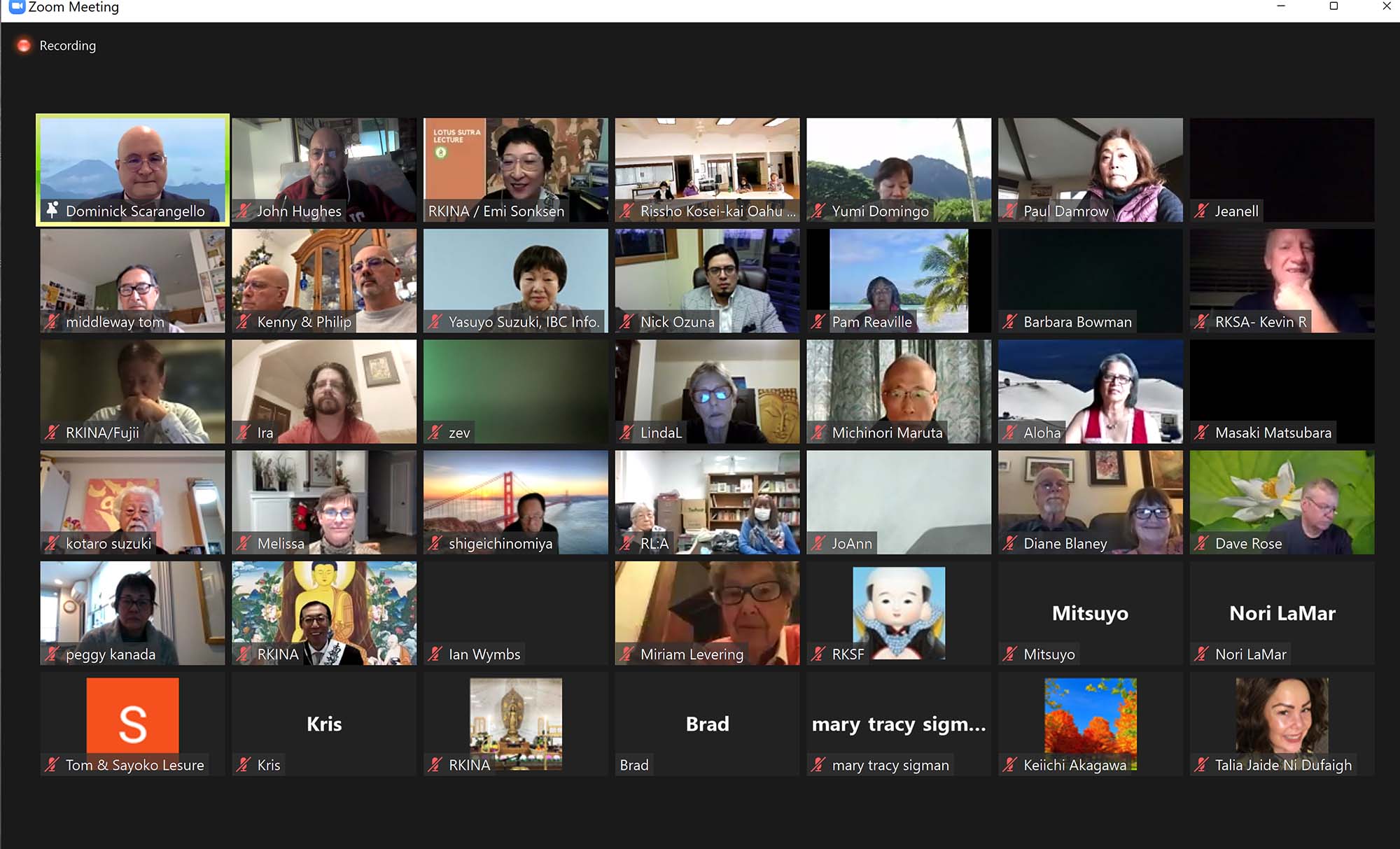
The lecture was sponsored by Rissho Kosei-kai International of North America and featured Dr. Dominick Scarangello. The title of the lecture was “Actualize Your Inner Potential By Modeling the Lotus Sutra’s Bodhisattvas,” but the main emphasis was to encourage westerners to use their imagination.
In the concluding slide of Dr. Scarangello’s presentation, he said:
What I’ve been trying to do so far is to draw upon modern scholars and philosophers to make the case for the value of interacting with the Lotus Sutra’s symbolic personifications of the teaching and engaging the sutra’s mythological stories in the sphere of the imaginal.
And I think if we can be open to this practice, more of the teachings of Founder Niwano and Rissho Kosei-kai will make sense to people in contemporary western cultures.
Founder Niwano was convinced that Buddhism is rational and compatible with modernity, but there is very much of the imaginal in his approach to practice, and I think it’s those aspects of his teachings and guidance the prove difficult for people in other cultures today.
The contrast between the Kaji Kito blessing and the academic discussion of contemporary western cultures couldn’t have been more stark. I found it fascinating.
Day 15
Day 15 concludes Chapter 10, The Teacher of the Dharma, and opens Chapter 11, Beholding the Stūpa of Treasures.

“Medicine-King! Suppose a man on a plateau felt thirsty and sought water. He dug a hole in order to get water. As long as he saw the dug-out lumps of earth were dry, he knew that water was still far off. He went on digging, and then found the dug-out lumps of earth wet. When he finally found mud, he was convinced that water was near. In the same manner, know this, the Bodhisattvas who have not yet heard, understood or practised this Sūtra of the Lotus Flower of the Wonderful Dharma, are still far from Anuttara-samyak-saṃbodhi. [The Bodhisattvas] who hear, understand, think over and practice this sūtra, will approach Anuttara-samyak-saṃbodhi. Why is that? It is because Anuttara-samyak-saṃbodhi which all the Bodhisattvas [should attain] is expounded only in this sūtra. This sūtra opens the gate of expedients and reveals the seal of the truth. The store of this Sūtra of the Lotus Flower of the Wonderful Dharma is sound and deep. No one can reach its core. Now I show it to the Bodhisattvas in order to teach them and cause them to attain [Anuttara-samyak-saṃbodhi].
The Daily Dharma from Sept. 27, 2021, offers this:
This sūtra opens the gate of expedients and reveals the seal of the truth. The store of this Sūtra of the Lotus Flower of the Wonderful Dharma is sound and deep. No one can reach its core. Now I show it to the Bodhisattvas in order to teach them and cause them to attain [Anuttara-samyak-saṃbodhi].
The Buddha declares these lines to Medicine-King Bodhisattva in Chapter Ten of the Lotus Sūtra. At the beginning of the sūtra, the Buddha declared that he was no longer preparing those who hear him to receive his highest wisdom. The purpose of his instruction was always to lead all beings to unsurpassed enlightenment, even though it seemed that he was ending their suffering. When later the Buddha revealed his true existence as constantly present in our world, he showed that this teaching is not just something he did 2500 years ago. He is teaching this Wonderful Dharma for the benefit of all beings right now, today.
The Daily Dharma is produced by the Lexington Nichiren Buddhist Community. To subscribe to the daily emails, visit zenzaizenzai.com
Tiāntái’s Five Periods
History and Teachings of Nichiren Buddhism, p 101-103
- 1. THE FIRST PERIOD: THE FLOWER GARLAND SUTRA
- This is the twenty-one day period following Śākyamuni’s enlightenment, during which he verified his awakening. Beneath the Bodhi Tree, the Buddha manifested as Vairocana and taught the Flower Garland Sūtra to the Bodhisattvas of the Dharma-body who had practiced sufficiently in their previous lives. Although Universal Worthy Bodhisattva and Mañjuśrī Bodhisattva understood his teaching, those with inferior capacities did not.
- 2. THE SECOND PERIOD: THE DEER PARK TEACHINGS
- After he became certain of his awakening, Śākyamuni left the Bodhi tree and went to Deer Park in modern day Benares. There he taught the Hinayāna teaching to five monks, or bhikṣu, including Ājñāta-Kauṇḍinya. Over the next twelve years, he taught the Agama sūtras to the people according to their capacities: the four noble truths to the śrāvakas, the twelve-fold chain of dependent origination to the pratyekabuddhas, and the six perfections to the bodhisattvas. Although he taught at locations other than Deer Park, this period is called the Deer Park period, as that is where he first began preaching the Agama sūtras.
- 3. THE THIRD PERIOD: THE EXPANDED TEACHINGS
- The Period of Expanded Teaching lasted eight years. In Sino-Japanese this period is called “Hōdō.” Hō, means wide, and in this period the teachings of both Mahāyāna and Hinayāna were taught, so the teachings were widened or expanded. Dō, or tō, means equal. The teachings of Hinayāna and Mahāyāna were taught to people equally, according to their capacities. Only the Mahāyāna teaching was taught during the first period and only the Hinayāna teaching during the second period, but this third period links Hinayāna and Mahāyāna, so this teaching is also called the “common” teaching. By comparing Hinayāna and Mahāyāna, people found the Mahāyāna teaching within the Hinayāna teaching, and people therefore learned Mahāyāna Buddhism. Sūtras expounded in this period included the Vimalakīrti Sūtra, Questions of Brahma Excellent Thought Sūtra, Entering Laṇkā Sūtra, Supreme Golden Light Sūtra, and the Lion’s Roar of Queen Śrimālā Sūtra.
- 4. THE FOURTH PERIOD: THE WISDOM TEACHINGS
- This period lasted twenty-two years. Here Śākyamuni expounded the Perfection of Wisdom and its doctrines. According to the Perfection of Wisdom teaching, there is no way to awakening other than Mahāyāna teaching, which is based on the concept of emptiness.
- 5. THE FIFTH PERIOD: THE LOTUS AND NIRVANA SUTRAS
- This period comprises the last eight years of Śākyamuni’s teaching. He taught the Lotus Sūtra for eight years, followed by the Nirvāṇa Sūtra. There are varying ideas of how long the Nirvāṇa Sūtra was preached. According to the Preaching Travels Sūtra and the Hinayāna Nirvāṇa Sūtra it was three months just before Śākyamuni’s passing. Based on the contents of the Mahāyāna Nirvāṇa Sūtra it was one day and one night.
Due to the Good Karma You Accumulated
It is easier to begin putting faith in the teaching of the Lotus Sūtra than to keep on believing in it to the very end. It is as though water flows in the direction of the wind and the color of flowers fade with dew.
You have steadfastly maintained your true faith in the Lotus Sūtra till today, which is very rare. How do you think you have had such a strong true faith in the Lotus Sutra? It was solely due to the good karma you accumulated during your lives in the past, in addition to the divine protection of the Buddha.
Matsuno-dono Nyōbō Go-henji, A Response to the Wife of Lord Matsuno, Nyonin Gosho, Letters Addressed to Female Followers, Page 244
Daily Dharma – Dec. 5, 2021
I knew that you were mean and timid. In order to give you a rest halfway, I expounded expediently to you the teaching of Nirvāṇa by the two vehicles. To those who attained the two [vehicles], I say, ‘You have not yet done all that you should do. You are near the wisdom of the Buddha. Think it over and consider it! The Nirvāṇa you attained is not true. I divided the One Vehicle of the Buddha into three only expediently.
The Buddha gives this explanation in Chapter Seven of the Lotus Sūtra after he tells the parable of the magic city. In that parable he compares himself, leading all beings to enlightenment, to a guide leading a group of travelers through a dangerous wilderness. The Buddha knows how frightening this world of conflict can be, so he uses teachings about ending suffering to keep us moving on the path. But then as the guide in the parable made the magic city disappear so that the travelers would continue to the real city, the Buddha tells us to abandon preoccupations with our own suffering so that we can enjoy his enlightenment.
The Daily Dharma is produced by the Lexington Nichiren Buddhist Community. To subscribe to the daily emails, visit zenzaizenzai.com
Day 14
Day 14 covers all of Chapter 9, The Assurance of Future Buddhahood of the Śrāvakas Who Have Something More to Learn and the Śrāvakas Who Have Nothing More to Learn, and opens Chapter 10, The Teacher of the Dharma.
Chapter 10: The Teacher of the Dharma
Thereupon the World-Honored One said to Medicine-King Bodhisattva in the presence of the eighty thousand great men:
“Medicine-King! Do you see the innumerable gods, dragonkings, yakṣas, gandharvas, asuras, garuḍas, kiṃnaras, mahoragas, men, and nonhuman beings, and [the four kinds of devotees:] bhikṣus, bhikṣunīs, upāsakās, and upāsikās, and those who are seeking Śrāvakahood or Pratyekabuddhahood or the enlightenment of the Buddha in this great multitude? If in my presence any of them rejoices, even on a moment’s thought, at hearing even a gāthā or a phrase of the Sūtra of the Lotus Flower of the Wonderful Dharma, I will assure him of his future Buddhahood, saying to him, ‘You will be able to attain Anuttara-samyak-saṃbodhi.’ ”
The Buddha said to Medicine-King:
“If after my extinction anyone rejoices, even on a moment’s thought, at hearing even a gāthā or a phrase of the Sūtra of the Lotus Flower of the Wonderful Dharma, I also will assure him of his future attainment of Anuttara-samyak-saṃbodhi. If anyone keeps, reads, recites, expounds and copies even a gāthā of the Sūtra of the Lotus Flower of the Wonderful Dharma, and respects a copy of this sūtra just as he respects me, and offers flowers, incense, necklaces, incense powder, incense applicable to the skin, incense to burn, canopies, banners, streamers, garments and music to it, or just joins his hands together respectfully towards it, Medicine-King, know this, he should be considered to have appeared in the world of men out of his compassion towards all living beings, although he already made offerings to ten billion Buddhas and fulfilled his great vow under those Buddhas in a previous existence.
The Daily Dharma from Nov. 13, 2021, offers this:
If after my extinction anyone rejoices, even on a moment’s thought, at hearing even a gāthā or a phrase of the Sūtra of the Lotus Flower of the Wonderful Dharma, I also will assure him of his future attainment of Anuttara-samyak-saṃbodhi.
The Buddha declares these lines to Medicine-King Bodhisattva at the beginning of Chapter Ten of the Lotus Sūtra. Other teachings had described beings becoming enlightened after making exorbitant offerings or strenuous practices over many lifetimes. In the teaching of the Wonderful Dharma, a single moment of joy at hearing the Dharma is enough to assure us that we will become enlightened.
The Daily Dharma is produced by the Lexington Nichiren Buddhist Community. To subscribe to the daily emails, visit zenzaizenzai.com
Grand Master Tiāntái’s life
History and Teachings of Nichiren Buddhism, p 99-100The following brief account of Grand Master Tiāntái’s life comes from Another Biography of the Great Master Zhizhe at Mount Tiāntái Guoqingsi. Great Master Tiāntái was given the posthumous name of Zhiyi. His parents named him Dean, with the family name of Chen. His father’s name was Chen Qizu, and his mother came from the Xu family. He lost his parents when he was seventeen years old, during the turbulent end of the Liang Dynasty. Soon after, he entered the Buddhist monastic life under Fazu at Guoyuansi temple and was awarded the complete monastic precepts from Precept Master Huikuang (543-613 CE). In 560 CE, Zhiyi visited Huisi (515-589 CE) on Mount Dasu, and under him studied the Lotus Sūtra. As a result of intense practice, he was said to have attained awakening through this phrase of the “Medicine King Chapter” of the Lotus Sūtra: “The Buddhas of those worlds praised him, saying simultaneously, ‘Excellent, excellent, good man! All you did was a true endeavor. You made an offering to us according to the true Dharma.’ ” Huisi certified his awakening.
With the recommendation of Huisi, Zhiyi left Mount Dasu, went to Jinling and stayed at Waguansi temple where he lectured to both clergy and laity over a period of eight years on the Title of the Lotus Sūtra, the Treatise on the Great Perfection of Wisdom, and the Source of the Meditation Gate. However, because of an anti-Buddhist movement by the Northern Zhou dynasty, Zhiyi retired to Mount Tiāntái in 575 CE at the age of 39. He undertook dhūta practice at the Flower Peak of the mountain, and lectured at Xiuchansi Temple. In 585 CE, at the age of 48, Zhiyi returned to Jinling, the capital of the Chen dynasty, at the request of the last emperor and governors of that dynasty.
In 587 CE, he gave lectures on the Lotus Sūtra, which were later compiled as The Words and Phrases of the Lotus Sūtra. To avoid the bloodshed caused by the conquest of the Chen dynasty by the Sui dynasty, Zhiyi stayed at Mount Lu and in the town of Changsha. In 591 CE, Prince Guang, later known as Yangdi, invited him to Yangzhou. He granted bodhisattva precepts to the prince, who gave him the honorific name Zhizhe.
Zhiyi established Yuquansi Temple in Jingzhou. He expounded The Profound Meaning of the Lotus Sūtra in 593 CE and The Great Calming and Contemplation in 594 CE. He returned to Mount Tiāntái in 595 CE. Two years later, in 597 CE, while he was on the way to see Prince Guang, he became sick and died at the age of 60.