
All posts by John Hughes

Establishing A Foundation for What It Means To Be A Nichiren Buddhist

Starting today and running through the end of 2021, I will be publishing excerpts from The History and Teachings of Nichiren Buddhism, From Śākyamuni Buddha Through Nichiren Shōnin to the Present. As always, these are things I want to remember and they don’t necessary represent the full breadth of the material covered. For example, I’ve saved nothing from the 31 pages devoted to the history of various Nichiren schools after Nichiren’s death. This is valuable information for the book’s original audience – Nichiren Shu priests in training – but holds little interest in my quest to establish the Lotus Sutra and Nichiren’s teachings as the guiding light of my daily life.

This material is translated from a collection of essays and as a result each essay author exerts an influence over the material. For example take this explanation of the trials Śākyamuni overcame as he sat under the bodhi tree:

Under the Bodhi tree, demons appeared who tried to interfere with his meditation with temptations. In the Sutta-nipāta, a collection of some of the oldest scriptures, Śākyamuni recalls the demon’s temptations as follows: “Sensual passions are your first army. Your second is called Discontent. Your third is Hunger and Thirst. Your fourth is called Craving. Fifth is Sloth and Drowsiness. Sixth is called Terror. Your seventh is Uncertainty, Hypocrisy and Stubbornness. Your eighth is Gains, Offerings, Fame and Status wrongly gained, and whoever would praise self and disparage others.”

Although Śākyamuni says that demons used ten weapons, it should be noted that the demons are certainly not portrayed as supernatural beings separate from reality. These demons are the embodiments of the essential desires or afflictions humans possess from birth.

This categorical rejection of a spiritual world is a little surprising. While I understand why a non-Buddhist might suggest that demons simply represent “embodiments of the essential desires or afflictions humans possess from birth,” such a statement strips from Buddhism its mystical heritage. It is that heritage that I believe the Aragyo training makes real. Ministers who accomplish the 100-day ascetic training emerge with a real sense of the spiritual realm. Since two of my favorite priests – Revs. Kenjo Igarashi and Shoda Kanai – have completed multiple Aragyo trainings, I am biased toward that view.

Although dry and academic, this book provides an excellent foundation for what it means to be a Nichiren Buddhist.
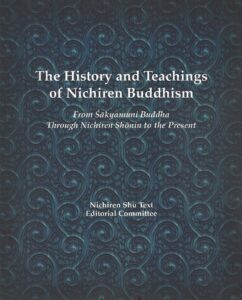
The History and Teachings of Nichiren Buddhism

From Śākyamuni Buddha Through Nichiren Shōnin to the Present

HisotryTeachingsNichirenBuddhism-bookcover
Available from Amazon
From Editor’s Introduction:

This collection of essays is the first English translation of Bukkyo No Oshie, Shakuson To Nichiren Shōnin. That book has been used mainly as the source material and study guide for an advanced examination taken by priests in the Nichiren Shū branch of Buddhism. Today, we have an increasing number of Nichiren Shū priests outside of Japan, many of whom do not speak Japanese fluently yet still want to participate in an English version of the exam.

The collection covers the life of Siddhārtha Gautama, also known as Śākyamuni Buddha; the teachings of the Buddha and their development over time; the Lotus Sūtra, the teaching of the Buddha which is the foundation of the practice of Nichiren Shū; the teachings of Tiāntái, a Chinese monk who lived in the 6th century CE and wrote extensively on the structure and ideas of the Lotus Sūtra; the life of Nichiren Shōnin who founded Nichiren Buddhism; the teachings of Nichiren Shōnin, based on the Lotus Sūtra and the teachings of the Buddha and Tiāntái; and finally a history of the various branches of Nichiren Buddhism following the death of Nichiren Shōnin in 1282 CE.

All those who worked on this first edition hope that it will find an audience beyond those ordained in Nichiren Shū, and provide a detailed background of Nichiren Buddhism, both for those who practice and for those with a more academic interest. …

With palms together,

Shinkyo Will Warner
Louisville, Kentucky, U.S.A.
April 2021


Book Quotes

 
Book List

Daily Dharma – Oct. 1, 2021

He was patient, gentle,
And friendly with others.
Even when many evils troubled him,
His mind was not moved.

The Buddha sings these verses in Chapter Seventeen of the Lotus Sūtra. This stanza is his description of the Bodhisattva perfection of patience. As with all the perfections, these are qualities we cultivate, rather than something to use to judge how close we or anybody else is to enlightenment. As we progress in these perfections, our view of the world is less obscured by our own mental formations. We begin to see the world for what it is, and each other for what we are.

The Daily Dharma is produced by the Lexington Nichiren Buddhist Community. To subscribe to the daily emails, visit zenzaizenzai.com

Day 17

Day 17 covers all of Chapter 12, Devadatta, and opens Chapter 13, Encouragement for Keeping this Sutra.

Having last month heard the tale of the time when the Buddha Bodhisattva in a previous existence and sought the Sūtra of the Lotus Flower of the Wonderful, we consider the tale in gāthās.

Thereupon the World-Honored One, wishing to repeat what he had said, sang in gāthās:

I remember that I became a king in a kalpa of the past.
Although I was a king,
I did not indulge in the pleasures of the five desires
Because I was seeking the Great Dharma.

I tolled a bell, and said loudly in all directions;
“Who knows the Great Dharma?
If anyone expounds the Dharma to me,
I will become his servant.”

There was a seer called Asita.
He came to [me, who was] the great king, and said:
“I know the Wonderful Dharma.
It is rare in the world.
If you serve me well,
I will expound the Dharma to you.”

Hearing this, I had great joy.
I became his servant at once.
I offered him
Anything he wanted.

I collected firewood and the fruits of trees and grasses,
And offered these things to him respectfully from time to time.
I never felt tired in body and mind
Because I was thinking of the Wonderful Dharma.

I sought the Great Dharma strenuously
Because I wished to save all living beings.
I did not wish to benefit myself
Or to have the pleasures of the five desires.

Although I was the king of a great country,
I sought the Dharma strenuously.
I finally obtained the Dharma and became a Buddha.
Therefore, I now expound it to you.

The Daily Dharma from March 20, 2021, offers this:

I collected firewood and the fruits of trees and grasses,
And offered these things to him respectfully from time to time.
I never felt tired in body and mind
Because I was thinking of the Wonderful Dharma.

The Buddha teaches these verses in Chapter Twelve of the Lotus Sūtra. They are part of a story of one of his previous lives. He was a king who gave up his throne to search for someone to teach him. When he found a seer who knew the Wonderful Dharma, he became the servant of the seer and served him with enthusiasm. These verses remind us of the enthusiasm that comes from hearing the Buddha’s teachings.

The Daily Dharma is produced by the Lexington Nichiren Buddhist Community. To subscribe to the daily emails, visit zenzaizenzai.com

Energy: Universal

Buddhists claim (1) that everything is change, and this flux is without beginning or end, (2) that all things arise and pass away dependent on the force of energy surging forth from other things, which themselves were similarly generated, ad infinitum, and (3) that therefore there is “no-self” or essential unchanging core to anything, since all things are temporary formations of energies that are simply passing through their current states.

No traditional metaphysical system, whether religious or philosophical, comes as close to prefiguring modern physics as the Buddhist one. Contemporary physics works out of an understanding of energy as the generator of all things. Energy is thought to take a broad range of forms – from nuclear energy, gravitational energy, electrical energy, heat energy, chemical energy, kinetic energy, elastic energy, radiant energy, to mass energy. We are told, by no less a source than Albert Einstein, that matter is energy – that the two are essentially interchangeable. The various theories of creation in contemporary physics all point to the energy required to give rise to the universe. The leading theory – the Big Bang – sees the cosmos resulting from a primordial explosion of energy that is still expanding into increasing complexity. Nevertheless, we are told, the amount of energy in the universe is constant. It never changes, even though the forms it takes are constantly changing. The energy of an exploding star is the same as that of a boulder tumbling down a mountain, which is the same as that stored in a carrot, released in the spin of Einstein’s mind or the play of a small child.

Six Perfections: Buddhism & the Cultivation of Character, p 171

Daily Dharma – Sept. 30, 2021

Suppose parents who had an aversion to alcohol had a son who loved to drink liquor. Because of their love for their son and also to cater to his whim, they made it a point to offer him alcohol, pretending that they were also drinkers of liquor. The hopeless son then assumed that his parents truly loved alcohol. Sutras preached according to others’ minds are the same.

Nichiren wrote this passage in his treatise, The Sutra Preached in Accordance to [the Buddha’s] Own Mind (Zui-jii Gosho). In the Lotus Sūtra, the Buddha sets aside his expedient teachings and leads us to his own way of thinking. He knew the difficulty of changing our habits and beliefs, so he started by catering to our selfish desires to be happy and end our own suffering. For us to realize our full potential for wisdom and compassion, we must stand up to our fears and nourish our true nature as Bodhisattvas: beings who exist to create benefits for the entire universe.

The Daily Dharma is produced by the Lexington Nichiren Buddhist Community. To subscribe to the daily emails, visit zenzaizenzai.com

Day 16

Day 16 concludes Chapter 11, Beholding the Stūpa of Treasures, and completes the Fourth Volume of the Sūtra of the Lotus Flower of the Wonderful Dharma.

Having last month concluded Chapter 11, Beholding the Stūpa of Treasures, we begin today’s portion again with Śākyamuni Buddha purifying lands to seat all of the his replicas.

Thereupon each of the Buddhas of the [worlds of the] ten quarters said to the Bodhisattvas under him, “Good men! Now I will go to Śākyamuni Buddha of the Sahā-World. I also will make offerings to the stūpa of treasures of Many-Treasures Tathāgata.”
At that instant the Sahā-World was purified. The ground of the world became lapis lazuli. The world was adorned with jeweled trees. The eight roads were marked off by ropes of gold. The towns, villages, cities, oceans, rivers, mountains, forests and thickets were eliminated. The incense of great treasures was burned; mandārava flowers, strewn over the ground; and jeweled nets and curtains with jeweled bells, hung over the world. The gods and men were removed to other worlds except those who were in the congregation.

See The Reason the Stupa Rises Out of the Earth

Opening the Gate

During the Month of September, as I did in March, I am publishing articles related to Higan, which occurs on the Spring and Fall Equinox and extends three days before and three days after to involve the six pāramitās.


The word myō means gusoku (to be equipped with perfect teaching); “six” means all kinds of practices collectively designated as six pāramitā or six kinds of practices required for the attainment of Buddhahood. Śāripūtra and others wished to know the way in which a bodhisattva could fulfill the six pāramitā in order to obtain Buddhahood. Gu in gusoku means “mutually-possessed characteristics of the Ten Realms, and soku means to be satisfactory, that is to say, it is satisfactory for each of the Ten Realms to contain in itself characteristics of the other Nine Realms. Altogether of the 69,384 characters of the Lotus Sūtra, in the twenty-eight chapters in eight fascicles, each contains the character myō; each of them represents the Buddha with thirty-two or eighty marks of physical excellence. As each of the Ten Realms contains in it characteristics of the realm of the Buddha, Grand Master Miao-lê states in his Annotations on the Great Concentration and Insight, “Each realm contains characteristics of the realm of the Buddha, not to speak of those of the other Nine Realms.”

In response to the request by Śāripūtra and others to know how to fulfill the six pāramitā, Śākyamuni Buddha declares in the second “Expedients” chapter of the Lotus Sūtra that all Buddhas hope to open the gate to the wisdom of the Buddha for the people. The people here refer to the men of the Two Vehicles such as Śāripūtra, who had been considered unable to obtain Buddhahood, men of icchantika lacking the Buddha-nature and all those in the Nine Realms (except the realm of the Buddha). Therefore, His vow to save all the numerous people was at last fulfilled in preaching the Lotus Sūtra. That is what He meant in declaring in the same second chapter of the Lotus Sūtra: “I had vowed to make everyone exactly like Myself. The original vow of Mine has already been fulfilled.”

Kaimoku-shō, Open Your Eyes to the Lotus Teaching, Writings of Nichiren Shōnin, Doctrine 2, Page 67-68

Daily Dharma – Sept. 29, 2021

He should not have fruitless disputes or quarrels about the teachings with others. He should have great compassion towards all living beings. He should look upon all the Tathāgatas as his loving fathers, and upon all the Bodhisattvas as his great teachers. He should bow to all the great Bodhisattvas of the worlds of the ten quarters respectfully and from the bottom of his heart. He should expound the Dharma to all living beings without partiality. He should be obedient to the Dharma. He should not add anything to the Dharma or take away anything from the Dharma.

The Buddha declares this passage in Chapter Fourteen of the Lotus Sūtra. In an earlier teaching, the Buddha proclaimed, “I do not quarrel with the world. The world quarrels with me.” The Buddha does not need to prove anything to anyone. He realized the truth and teaches it out of his compassion for all beings. He understood that when people reacted poorly to his teaching and began to argue with him or chastise him, it was due to the illusions they had not yet eliminated. This chapter of the sūtra instructs us to keep the same mind when we spread the Dharma. We teach from our compassion and respect.

The Daily Dharma is produced by the Lexington Nichiren Buddhist Community. To subscribe to the daily emails, visit zenzaizenzai.com

Day 15

Day 15 concludes Chapter 10, The Teacher of the Dharma, and opens Chapter 11, Beholding the Stūpa of Treasures.

Having last month concluded today’s portion of Chapter 11, Beholding the Stūpa of Treasures, we return to today’s portion of Chapter 10, The Teacher of the Dharma and consider the difficulty in understanding this sutra.

Thereupon the Buddha said again to Medicine-King Bodhisattva mahāsattvas:
“I have expounded many sūtras. I am now expounding this sūtra. I also will expound many sūtras in the future. The total number of the sūtras will amount to many thousands of billions. This Sūtra of the Lotus Flower of the Wonderful Dharma is the most difficult to believe and the most difficult to understand.

“Medicine-King! This sūtra is the store of the hidden core of all the Buddhas. Do not give it to others carelessly! It is protected by the Buddhas, by the World-Honored Ones. It has not been expounded explicitly. Many people hate it with jealousy even in my lifetime. Needless to say, more people will do so after my extinction.

“Medicine-King, know this! Anyone who copies, keeps, reads and recites this sūtra, makes offerings to it, and expounds it to others after my extinction, will be covered by my robe. He also will be protected by the present Buddhas of the other worlds. He will have the great power of truth, the power of vows, and the power of roots of good. Know this! He will live with me. I will pat him on the head.

See The Difficulty of the Lotus Sutra