The Hinayāna teaching and Mahāyāna teaching are not the same, but both were preached by the same Buddha. The Mahāyāna Buddhism that rejects Hinayāna Buddhism but tries to convert it to Mahāyāna Buddhism is the same as the Mahāyāna Buddhism that rejects provisional Mahāyāna Buddhism but attempts to lead it to the Lotus Sūtra. Although the objects of rejection, Hinayāna and provisional Mahāyāna, are not the same, in both cases the purpose is to lead them to the Lotus Sūtra. Therefore, the Sūtra of Infinite Meaning, the preface to the Lotus Sūtra, disregards all the sūtras preached before the Lotus Sūtra, declaring, “The true intention of the Buddha has not been revealed yet.”
It is also preached in the Lotus Sūtra, chapter 2 on the ” Expedients”: “If the Lotus Sūtra is not expounded after the preaching of other sūtras, the Buddha is accused of being stingy with the dharma. This is without doubt impermissible.” Namely, the Buddha said to Himself, “Born to this world, if I die after preaching sūtras such as the Flower Garland Sūtra and the Wisdom Sūtra without expounding the Lotus Sūtra, it would be as if I am stingy of turning over My property to My beloved children or leaving the sick to die without giving the best medicine to cure their illness.” The Buddha also predicts that He will fall into hell for the sin of not preaching the Lotus Sūtra. It is stated in the Lotus Sūtra, “This is impermissible.” “Impermissible” means going to hell. How much more so will it be for those who attach themselves to pre-Lotus sūtras and refuse to convert themselves to the Lotus Sūtra after hearing it preached. They are like subjects who refuse to follow the orders of the great king or children who are disobedient to parents.
Even if one does not slander the Lotus Sūtra, praising the pre-Lotus sūtras would be the equivalent to slandering the Lotus Sūtra. Grand Master Miao-lê, therefore, states in his Annotations on the Words and Phrases of the Lotus Sūtra, “If one praises the pre-Lotus sūtras, it means that one slanders the Lotus Sūtra (in fascicle 3);” and “Even if one has awaken aspiration for enlightenment, unless one knows the difference between the perfect and imperfect teachings and understands the basic purpose of the Buddha’s vow to save all living beings, one will not be able to escape the sin of slandering the True Dharma even if one hears and practices the dharma in the future (in fascicle 4).”
Kangyō Hachiman-shō, Remonstration with Bodhisattva Hachiman, Writings of Nichiren Shōnin, Doctrine 1, Page 274-275
I see that all living beings are burned by the fires of birth, old age, disease, death, grief, sorrow, suffering and lamentation. They undergo various sufferings because they have the five desires and the desire for gain…Notwithstanding all this, however, they are playing joyfully. They are not conscious of the sufferings. They are not frightened at the sufferings or afraid of them. They do not dislike them or try to get rid of them. They are running about this burning house of the triple world, and do not mind even when they undergo great sufferings.
The Buddha offers this explanation to his disciple Śāriputra in Chapter Three of the Lotus Sūtra. He compares his teaching of suffering and Nirvāṇa to a father luring his children from a dangerous house with a promise of better toys. The children were so preoccupied with their own entertainment that they could not hear their father’s warning. In this triple world of beautiful forms, fascinating ideas and consuming desires, it is easy to stay with our childish games and ignore the Buddha’s teaching. Our maturity as Bodhisattvas comes when we set these aside for the benefit of all beings.
The Daily Dharma is produced by the Lexington Nichiren Buddhist Community. To subscribe to the daily emails, visit zenzaizenzai.com
Having last month considered the difficulty in hearing the dharma, we conclude Chapter 2, Expedients and conclude the first volume of the Sūtra of the Lotus flower of the Wonderful Dharma.
Śāriputra, other Śrāvakas, and Bodhisattvas!
Know this!
This Wonderful Dharma is
The hidden core of the Buddhas.
The living beings
In the evil world of the five defilements
Are attached to many desires.
They do not seek the enlightenment of the Buddha.
Evil people in the future will doubt the One Vehicle
When they hear it from a Buddha.
They will not believe or receive it.
They will violate the Dharma, and fall into the evil regions.
Extol the teaching of the One Vehicle
In the presence of those who are modest,
Who are pure in heart,
And who are seeking enlightenment of the Buddha!
Śāriputra [and others], know this!
As a rule, the Buddhas expound the Dharma
With billions of expedients as stated above,
According to the capacities of all living beings.
Those who do not study the Dharma
Cannot understand it.
You have already realized
The fact that the Buddhas, the World-Teachers, employ expedients,
According to the capacities of all living beings.
Know that, when you remove your doubts,
And when you have great joy,
You will become Buddhas!
[Here ends] the First Volume of the Sūtra of the Lotus flower of the Wonderful Dharma.
This conception of the transfiguration of the world is very important for the understanding of Nichiren’s idea of the Catholic Buddhist Church, and to make it still clearer we may quote another passage from the dictated portions of his lectures on the Lotus [Ongi Kuden].
“It is said in the [Lotus Sutra]: ‘At that time I shall appear on Vulture Peak, together with my congregation.’ Here, ‘time’ means the age of the Latter Law, when the spiritual communion (between us and Buddha) shall be realized; ‘I’ means Śākyamuni; ‘with,’ the Bodhisattvas; ‘congregation,’ the community of Buddha’s disciples; ‘together’ implies the ten realms of existence; and ‘Vulture Peak’ is the Land of Serene Light. … ‘Appear’ means to make a manifestation at Vulture Peak, while ‘Vulture Peak’ means the manifestation of the Supreme Being, that is, the abode of Nichiren’s followers who utter the Adoration of the Lotus of Truth. …
“Any place where men practice the faith in the Sole Road [One Vehicle] of Adoration, the adoration of the Lotus of Truth, there is the castle of the eternal Serene Light, which is Vulture Peak. … Yet the primeval (entity) of Vulture Peak is nowhere else than in this very Sahā world, especially in Japan, the Land of Sunrise; the Sahā world furnished with the perfection of the primeval stage, where the Lotus of Truth is to be realized; the place where the unique Maṇḍala will be revealed and established – the Maṇḍala embodying the primeval import of what is taught in the chapter on the Life-duration, or the Eternal Life, of the Tathāgata.”
Where there lives a true Buddhist, there is manifest in his spirit and life, the Maṇḍala, the cycle embodying the cosmic truth. Where the Truth is manifest, there, is realized the eternal light of Buddhahood, and therefore the place is a paradise. A natural corollary to this idea is that the whole realm of existence ought to be the stage of this realization. But Japan, where the prophet of this gospel has appeared, should be the center of the Kingdom of Buddha. The man has appeared, and the stage is determined. A definite organization must now be provided for effecting the transformation according to the instructions given by the Prophet. This idea gradually crystallized in Nichiren’s mind into a definite plan for establishing the center of the universal church, the Holy See, the Kaidan. He had cherished this idea since his days in Sado, and expressed it, as we have seen, in the first writing after his retirement. More definite expression was given it in “The Perpetuation of the Three Great Mysteries,” which he wrote on the eighth of the fourth month, the day believed to be the birthday of Buddha, in 1281. It is also interesting to notice that this year was made memorable by the remarkable prediction Nichiren made to his followers concerning the threatening Mongol invasion. Of this prediction we shall speak later.
This virtue of Nichiren, I am sure, is known to all from the venerable Three Treasures above down to such heavenly beings as the King of the Brahma Heaven, Indra, and the sun and moon. The souls of my parents and Master Dōzen will be given plenty of help by this virtue of mine.
However, I have one doubt here. Venerable Maudgalyāyana tried to save his mother, Moggaliyā, who had fallen to the realm of hungry spirits, but in vain for she was kept suffering there. Sunakṣatra, a son of the Buddha Śākyamuni when He was a bodhisattva in His previous life, was influenced by evil friends and fell into the Hell of Incessant Suffering. The Buddha must have wished to save His son with His might, but He could not help him because that was caused by his own karma.
I do not think that the late Master Dōzen hated me, for I am one of his beloved disciples. However, he was cowardly. Moreover, he had a strong attachment to Mt. Kiyosumi. He was fearful of Steward Tōjō Kagenobu. Besides, Priests Enchi and Jitsujō, as evil as Devadatta and Kokālika, were always by his side, intimidating him. He was so frightened that he abandoned his disciples who followed him for many years, even though he loved them. Therefore, I am not sure about his next life. It was lucky for him that Kagenobu, Enchi, and Jitsujō died before him. They died because of the condemnation of the ten female rākṣasa demons, guardian deities of the Lotus Sūtra. If they had lived longer, Master Dōzen would not have had time even to have a little faith in the Lotus Sūtra. Their deaths enabled him to have a little faith in the Lotus Sūtra, but it was as useless as fighting sticks after quarrels are over or a lantern in the daytime. Besides, it is quite natural that one feels compassion for his children and disciples under any circumstances. Master Dōzen probably took pity on me exiled on the island of Sado, but he never asked about me, though it seemed possible for him to do so. I do not think, therefore, that he truly believed in the Lotus Sūtra.
Hōon-jō, Essay on Gratitude, Writings of Nichiren Shōnin, Doctrine 3, Pages 48-49.
The good men or women who expound even a phrase of the Sūtra of the Lotus Flower of the Wonderful Dharma even to one person even in secret after my extinction, know this, are my messengers. They are dispatched by me.
The Buddha declares these lines to Medicine-King Bodhisattva at the beginning of Chapter Ten of the Lotus Sūtra. When we are caught up in the suffering and unhappiness of this world of conflict, we can yearn for an escape from its troubles. We can believe that living in this world was not our choice, that we are here by chance or due to an obligation we no longer want to meet. When the Buddha reminds us that we are Bodhisattvas, beings whose existence is for the benefit of all beings, we realize that both the joys and the suffering we experience are for the benefit of others.
The Daily Dharma is produced by the Lexington Nichiren Buddhist Community. To subscribe to the daily emails, visit zenzaizenzai.com
Having last month considered what the Buddhas attained, we consider in gāthās why the profound and wonderful Dharma is difficult to see and difficult to understand.
Thereupon the World-Honored One, wishing to repeat what he had said, sang in gāthās:
The [ wisdom of the] World-Heroes is immeasurable.
None of the living beings in the world,
Including gods and men,
Knows the [ wisdom of the] Buddhas.
No one can measure the powers, fearlessness,
Emancipations, samādhis,
And other properties of the [present] Buddhas,
Because they, in their previous existence,
Followed innumerable Buddhas
And practiced the teachings of those Buddhas.
The profound and wonderful Dharma
Is difficult to see and difficult to understand.
I practiced the teachings of the [past] Buddhas
For many hundreds of millions of kalpas,
And became a Buddha at the place of enlightenment.
I have already attained the Dharma.
I know the various effects, rewards and retributions,
Natures and appearances of all things:
The Buddhas of the worlds of the ten quarters
Also know all this.
The Dharma cannot be shown.
It is inexplicable by words.
No one can understand it
Except the Buddhas
And the Bodhisattvas
Who are strong in the power of faith.
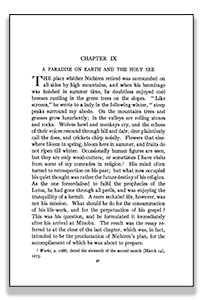
Everyone who realizes the truth of the fundamental unity is a Buddha, and everyone who lives in accordance with this enlightenment and works to propagate the Lotus of Truth is the messenger of the primeval Tathāgata. To such a man, all that surrounds him preaches the truth, and the place of his abode is a paradise. This idea of the connection between the actual life and the primeval enlightenment inspired Nichiren to such a degree that he always regarded his abode as a Buddha land. He voiced this feeling like a lyric poet, glorifying, thus, the hills and waters of Minobu. In a note (as in several others), he gives utterance to these thoughts:
“When the autumn evening draws on, lonesomely, the surroundings of the thatched hermitage are bedewed, and the spiders’ webs hanging from the eaves are transformed into garlands of jewels. Noiselessly, deeply tinged maple leaves come floating on the water that pours from the bamboo pipes, and the water, colored in pattern, seems to stream forth from the fountain of Tatsuta, where the Brocade-weaving Lady is said to abide. Behind the hermitage, the steep peaks rear their heads aloft, where on the slopes the trees bear the fruits of ‘the Unique Truth,’ and the singing crickets are heard among the branches. In front, flow clear rivulets, making music like drums and flutes, and the pools reflect the moonlight of ‘reality as it is.’ When the limitless sky of ‘entity’ is cloudless and the moon shines bright, it seems as if the ‘darkness of the shrouding delusion’ was gone forever.
‘In the hermitage thus situated, throughout the day we converse, and discuss the truths of the Unique Scripture, while in the evening and late into the night is heard the gentle murmur of the recitation of passages from the sacred text. Thus, we deem that to this place has been transferred Vulture Peak, where Lord Śākya lived.
“When fog veils the valley, and even when a gale is blowing, we go to gather wood in the forest, or through the bedewed bushes down to the dells to pick parsley leaves. … Reflecting on these conditions of my present life, I often think, so it must have been with Buddha, when he was in search of truth and disciplining himself in expiation and in mortification. …
Thus thinking, I sit on the mat of meditation, and in vision I see every truth present to the mind, so that even the call of a deer to its mate helps me to utter the innermost voice of my heart. Here I realize why, being shrouded by the heavy clouds of illusion, we transmigrate through the nine, while the pure bright moonlight shines within me, the illumination of the threefold aspects of reality fused into one, and the light of the threefold introspection of one and the same soul. Thus, I put my thoughts into verse:
Masses of clouds and thickening fog, Heaping upon me and shrouding the world – Let them be dispelled by a freshening breeze, The wind that perpetually blows from Vulture Peak, Whence streams forth the air of the eternal Truth.
In short, everything in Nichiren’s surroundings suggested to him something related to his ideal, and to his present life in service to the Truth. The poet, however, was never content merely to cherish these thoughts, but interpreted his environment by the [Lotus Sutra]. Thus he writes about his abode in the language of the [Lotus Sutra], and describes his life there, as if it were illuminated by the glories of paradise. Not only Minobu, but every place connected with the life of the prophet, of the one who is living the life of the Lotus of Truth, was glorified by him. In a letter written before he left Sado, he says: “I, Nichiren, am a native of Awa, a province of Japan where the Sun-goddess had her abode in the beginning and founded this nation. … She is indeed the loving mother of the people of this country. There must be some remote and mysterious connection with my life, that I, Nichiren, was born in that province.” In another letter, written after his retirement in Minobu, he repeats the same idea, and says: “Although Awa is a province far away from the center, it is somewhat like the center of Japan, because the Sun-goddess found there her first abode. … And I, Nichiren, began the propagation of the true religion by proclaiming it, for the first time, there in Awa.” Sometimes, he speaks more mystically about his spiritual presence everywhere. He wrote from Minobu to a nun in Sado who had served him during his days of exile there, saying in conclusion: “When you long to see Nichiren, look in reverence at the rising sun, or the moon rising in evening. My person is always reflected in the sun and moon. And moreover, hereafter I shall surely meet you in the Paradise of Vulture Peak.”
It is by mankind, in all kinds of existence, that the ideal perfection is to be achieved, and therefore the stage of its realization is this world, the abode of mankind. The Buddhist ideal of enlightenment is man’s awaking to the fundamental unity of his present existence with the primeval Buddhahood; while the key to make this world a hell or to transform it into a heaven is in our own hands. The use of the key consists in first calling forth the primeval Buddhahood in the innermost recess of our own soul, and in viewing this actual world as a heaven. This transfiguration means not merely imagining that earth is heaven, but living in conformity with the assumption, under the guidance of the enlightened mind. This ideal was realized by Buddha when he preached the Lotus of Truth on Vulture Peak, and the scene of the revelation was transfigured into a paradise. Nichiren had no doubt about the [Lotus Sutra] narrative, and now, in Minobu, he was himself experiencing such a transfiguration of his own abode. In expressing this conviction, he sometimes spoke, as we have seen, like a lyric poet; yet his poetry was never a mere play of fancy, but an earnest belief, founded on the authority of the [Lotus Sutra], as well as on his own experience. The union of poetic idealization and religious speculation can be clearly seen in the passages quoted above. Such was Nichiren’s thought about the paradise on earth, or rather on the proposition that this very world is paradise to those minds illumined by the truth of the primeval enlightenment.
According to your letter, epidemics have been widespread recently. They say that human beings have two kinds of sickness. First, our bodies get sick. Our bodies consist of the four elements: earth, water, fire and wind. As each of the four elements has 101 sicknesses, our bodies have a total of 404 sicknesses. These physical sicknesses do not necessarily depend on the Buddha to be cured. There is no physical sickness that cannot be cured by the medicine prepared by such famed physicians as Jisui, Rusui, Jivaka and P’ien-ch’üeh.
In the second place, our minds get sick in a vast number of ways. Beginning with the three poisons of greed, anger and stupidity, sickness in our minds totals as many as 84,000. Even the two heavenly beings and three hermits or the six non-Buddhist masters in India could not cure them, not to speak of the medicines administered by such sage rulers of ancient China as Shen-nung and the Yellow Emperor.
Toki Nyūdō-dono Go-henji: Chibyō-shō, A Response to Lay Priest Lord Toki: Treatise on Healing Sickness, Writings of Nichiren Shōnin, Doctrine 2, Page 252
He was strenuous and resolute in mind.
He concentrated his mind,
And refrained from indolence
For many hundreds of millions of kalpas.
The Buddha sings these verses to Maitreya Bodhisattva in Chapter Seventeen of the Lotus Sūtra. In this Chapter, the Buddha describes the benefits from practicing generosity, discipline, patience, perseverance, and in these verses, concentration. He then compares these benefits to those which come from understanding the ever-present nature of the Buddha, even for a time no longer than the time it takes to blink. The merits of the latter outshine the former as the sun in a clear sky outshines the stars. When we are assured of the Buddha’s constant presence, helping all of us to become enlightened, we find that we can accomplish far more than we thought possible.
The Daily Dharma is produced by the Lexington Nichiren Buddhist Community. To subscribe to the daily emails, visit zenzaizenzai.com