All posts by John Hughes

Mothers’ Day 2021

Mothers’ Day

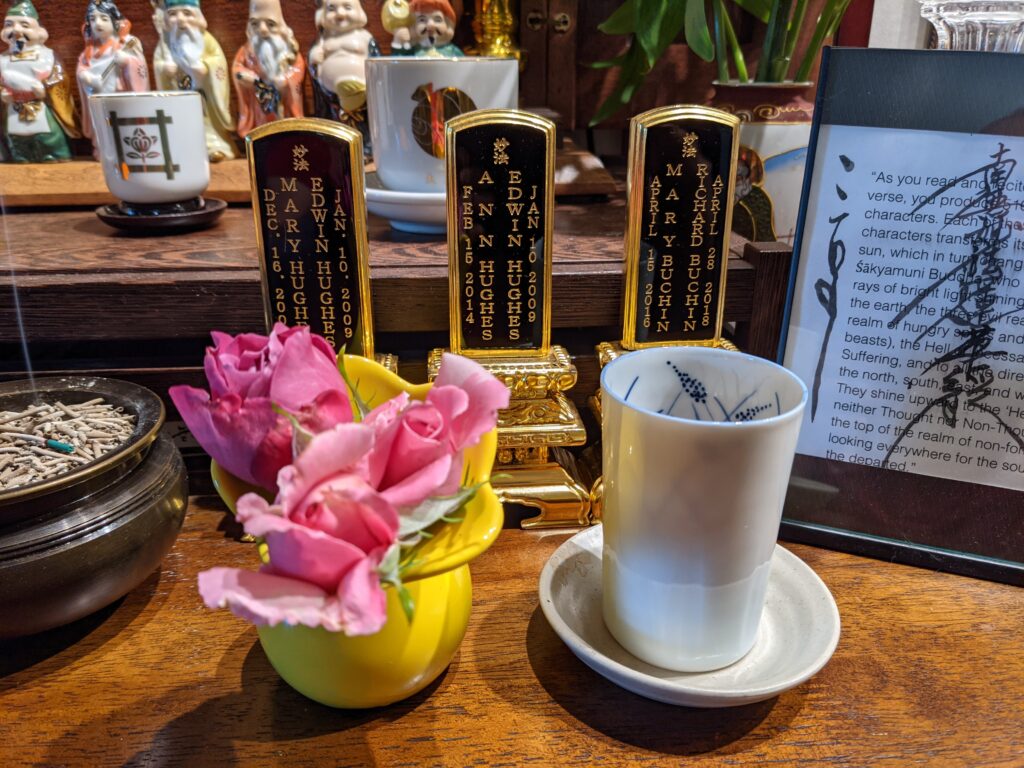
An offering of flowers

All Teachings Enter the Lotus Throne

All teachings, whether they contain three flavors or two flavors or one flavor or arouse all [flavors], resolve the crude and lead to the subtle; all enter the Lotus Throne. In the Tripiṭaka [Teaching] the result is preserved,591 that which is difficult to destroy is destroyed, that which is difficult to expose is exposed. How can it be said that it is easy to destroy and easy to expose? It is an entrance to the Lotus Throne which is completely in accordance with the feelings [of sentient beings], relies on the basis, and manifests the real [truth] of this doctrine.

The text [of the Lotus Sūtra] says, “The seven-jeweled great vehicles, whose number was immeasurable, was presented to each of all the sons.”592 This refers to exposing the conventional and manifesting the real. All of the crude [teachings] are [ultimately] subtle, the absolute subtlety.

If it is as I have explained above, the Lotus Sūtra embraces all the Sūtras, and phenomenal reality is ultimately explained here. This is the original intention of the Buddha in appearing in this world, the significance of all dharma-teachings.

Foundations of T'ien T'ai Philosophy, p 250
591
The Shakusen kōgi interprets this phrase as referring to the attachment to the fruit of arhatship and the resulting severance of the intent to attain Buddhahood. return
592
This quote is from the parable of the burning house. Hurvitz, Lotus Sūtra, 60, translates, “I have carriages such as these, made of the seven jewels, in incalculable numbers. I must give one to each of them with undiscriminating thought.” return

The Few With Sincere Faith

Look at the world around us. There are many who say they have deep faith, but there is not one person in 10,000,000 who is sincere. The Nirvana Sūtra says: “Those who do not have faith in the Buddha Dharma and fall into evil paths are as many as the dirt on the earth; those who have faith in the Buddha Dharma and become Buddhas are as few as the amount of dirt piled on a fingernail.”

Minobu-san Gosho, Mt. Minobu Letter, Writings of Nichiren Shōnin, Volume 5, Page 129

Daily Dharma – May 9, 2021

Anyone who expounds the Dharma, if he wishes,
Will be able to cause the living beings
Of the one thousand million Sumeru-worlds
To hear his wonderful voice.

The Buddha sings these verses to Constant-Endeavor Bodhisattva in Chapter Nineteen of the Lotus Sūtra, describing those who keep the Lotus Sūtra. When we learn to hear the voice of the Wonderful Dharma, we recognize it in everything that surrounds us. When we speak with the voice of the Wonderful Dharma, we are in accord with the reality of all things. There is no need to distinguish between our voice and the voice of the Ever-Present Buddha who is always thinking of how to lead all beings to enlightenment. The only thing that blocks this voice is the comfort of our own attachment and delusion.

The Daily Dharma is produced by the Lexington Nichiren Buddhist Community. To subscribe to the daily emails, visit zenzaizenzai.com

Day 8

Day 8 concludes Chapter 4, Understanding by Faith, and closes the second volume of the Sutra of the Lotus Flower of the Wonderful Dharma.

Having last month considered why the Śrāvakas did not care for the wisdom of the Buddha, we consider how the Śrāvakas are not what they were then.

Today we are not what we were then.
We have obtained
What we did not expect
To obtain
Just as the poor son obtained
The innumerable treasures.

World-Honored One!
We have attained enlightenment, perfect fruit.
We have secured pure eyes
With which we can see the Dharma-without-āsravas.

We observed the pure precepts of the Buddha
In the long night.
Today we have obtained the effects and rewards
[Of our observance of the precepts].
We performed the brahma practices for long
According to the teachings of the King of the Dharma.
Now we have obtained the great fruit
Of the unsurpassed Dharma-without-āsravas.

We are Śrāvakas in this sense of the word.
We will cause all living beings
To hear the voice telling
Of the enlightenment of the Buddha.

We are Arhats
In the true sense of the word.
All gods and men,
All Maras and Brahmans
In the worlds
Should make offerings to us.

You, the World-Honored One, are the great benefactor.
By doing this rare thing,
You taught and benefited us
Out of your compassion towards us.

No one will be able to repay your favors
Even if he tries to do so
For many hundreds of millions of kalpas.
No one will be able to repay your favors
Even if he bows to you respectfully,
And offers you his hands, feet or anything else.

No one will be able to repay your favors
Even if he carries you on his head or shoulders
And respects you from the bottom of his heart
For as many kalpas
As there are sands in the River Ganges,
Or even if he offers you
Delicious food, innumerable garments of treasures,
Many beddings, and various medicines,
Or even if he erects a stupa-mausoleum
Made of the cow-head candana,
And adorns it with treasures,
Or even if he covers the ground
With garments of treasures
And offers them to the Buddha
For as many kalpas
As there are sands in the River Ganges.

See Not Only the Śrāvaka But Also Śākyamuni Buddha Is Within Us

Gaining Entrance to the Lotus Throne

Those who are originally transformed and have entered the Lotus Throne are one extreme. Those who have not yet entered are, like the skillful means [to lead them to enter Buddhahood], without end. Those in the middle are also like this. Some [enter] by means of [the teachings of] the Avataṃsaka Sūtra, the Vaipulya, or the Prajn͂āpāramitā Sūtras; others enter the Lotus Throne by advancing from the Shared to the Distinct, from the shared to the Perfect, from the Distinct to the Perfect, and so forth. These are no different from the original entering [of the Lotus Throne by the Buddha]. These are the other extreme. Those who have not yet entered [the Lotus Throne] should “brew” the four flavors [from milk to butter] and then all will achieve [the ghee of] entrance to the Lotus Throne by means of this Lotus Sūtra.

Foundations of T'ien T'ai Philosophy, p 249

The Mt. Sumeru of All Sūtras

It is said in the Lotus Sūtra, fascicle 7 (chapter 23), “Mt. Sumeru is the greatest of mountains. Likewise, this Lotus Sūtra is supreme of all sūtras.” This means that the Lotus Sūtra transmitted to Japan is like Mt. Sumeru while all other sutras, that is 5,000 or 7,000 fascicles of pre-Lotus Sūtras such as the Flower Garland, Great Wisdom, and Great Sun Buddha Sūtras; the Sūtra of Infinite Meaning, which was preached at the same time as the Lotus Sūtra; and post-Lotus Sūtras such as the Nirvana Sūtra, as well as all the Buddhist sutras in India, the dragon’s palace, the heavens of the Four Heavenly Kings, Trāyastriṃsá Heaven, the sun and moon, and all the worlds in the universe are like earth mountains, black mountains, Small Surround ing Iron Mountains and Great Surrounding Iron Mountains, which encircle Mt. Sumeru.

Senji-shō, Selecting the Right time: A Tract by Nichiren, the Buddha’s Disciple, Writings of Nichiren Shōnin, Doctrine 1, Page 246-247

Daily Dharma – May 8, 2021

I am like the father. It is many hundreds of thousands of billions of nayutas of asaṃkhyas of kalpas since I became the Buddha. In order to save the [perverted] people, I say expediently, ‘I shall pass away.’ No one will accuse me of falsehood by the [common] law.

The Buddha gives this explanation in Chapter Sixteen of the Lotus Sūtra. In the story of the Physician and his children, the father leaves and sends word that he has died when his children refuse to take the antidote he has prepared for them. He gave his children no choice but to accept what they already had and make the effort to improve themselves and set aside their deluded minds. In the same way, when we take the Buddha for granted, and close our eyes to the Wonderful Dharma he has given us, he disappears. It is only when we open our eyes and see clearly this world and ourselves in it that we can recognize the Buddha and how he is always leading us.

The Daily Dharma is produced by the Lexington Nichiren Buddhist Community. To subscribe to the daily emails, visit zenzaizenzai.com

Day 7

Day 7 concludes Chapter 3, A Parable, and begins Chapter 4, Understanding by Faith.

Having last month considered the reaction of the men living the life of wisdom to the news that Śāriputra will become a Buddha, we consider the Parable of the Rich Man and His Poor Son.

“World-Honored One! Allow us to explain our understanding by telling a parable. Suppose there lived a man [in a certain country]. When he was a little boy, he ran away from his father. [The boy] lived in another country for a long time, say, for ten, twenty or fifty years. As time passed by, he became poorer. He wandered about all directions, seeking food and clothing.

“While wandering here and there, he happened to walk towards his home country. At that time his father stayed in a city [of that country]. He had been vainly looking for his son ever since. He was now very rich. He had innumerable treasures. His storehouses were filled with gold, silver, lapis lazuli, coral, amber and crystal. He had many servants, clerks, and secretaries. He also had countless elephants, horses, carts, cows, and sheep. He invested his money in all the other countries, and earned interest. He dealt with many merchants and customers.

“The poor son, having wandered from town to town, from country to country, from village to village, came to the city where his father was living. The father had been thinking of him for more than fifty years since he had lost him, but never told others [that he had a missing son]. He was alone, pining for his son. He thought, ‘I am old and decrepit. I have many treasures. My storehouses are filled with gold, silver, and other treasures. But I have no son [other than the missing one]. When I die, my treasures will be scattered and lost. I have no one to transfer my treasures to. Therefore, I am always yearning for my son.’ The father thought again, ‘If I can find my son and give him my treasures, I shall be happy and peaceful, and have nothing more to worry about.’

“World-Honored One! At that time the poor son, who had worked at various places as a day worker, happened to come to the house of his father. Standing by the gate of the house, he saw his father in the distance. His father was sitting on a lion-like seat, putting his feet on a jeweled footstool. Brāhmaṇas, kṣatriyas, and householders surrounded him respectfully. He was adorned with a necklace of pearls worth ten million. The secretaries and servants were standing on either side of him, holding insect-sweepers made of white hairs. Above him was a jeweled awning, from which streamers of flowers were hanging down. Perfume was sprayed and beautiful flowers were strewn on the ground. He was exhibiting treasures and engaging in trade. Adorned with these various things, he looked extraordinarily powerful and virtuous.

See A World Filled with Poor Sons

The Inducements to the Message of the Lotus Sūtra

Some person has said that from the very first [sermons in the] Deer Park, are all inducements to the [ultimate teaching of the] Lotus Sūtra. These words are not acceptable. There is a limited period587 of explanation because all [the sermons] since the sermon on the seat of enlightenment [the Avataṃsaka Sūtra] are inducements to [the message of] the Lotus Sūtra. Therefore as light illumines other lands, the Buddhas of the present all [preach] the sudden [teachings] and expose [its meaning] gradually.

Mañjuśrī follows previous Buddhas also by utilizing the sudden [Teaching] and exposing it gradually. Alas, this [forty-five year period of Śākyamuni’s life] is a very limited period of inducements [to the Lotus Sūtra].

[The Buddha] has performed the skillful means of the Lotus Sūtra for the sake of sentient beings since the time of Mahābhijfiājfiānābhibhu.588 It should be known that it [the inducements to the Lotus Sūtra] is not limited to [the Buddha’s] approaching and taking the seat of enlightenment [and preaching the Avataṃsaka Sūtra]. Even this is a limited period.

[The Buddha] has performed the skillful means of the Lotus Throne for the sake of sentient beings since the time of his original attainment of Buddhahood.589 Even this is a limited period. [The Buddha] has performed the skillful means of the Lotus Throne for the sake of sentient beings since the time of his original practices on the bodhisattva Path [even before attaining Buddhahood]. The text [of the Lotus Sūtra] says, “I originally made a vow that I would universally lead all sentient beings to attain this same path.”590 Thus should it be known. The inducements [to the message of the Lotus Sūtra] are certainly not limited to the present.

Foundations of T'ien T'ai Philosophy, p 248-249
587Lit. “close” or “near.” In this context it refers to the forty-five years of
the historical Buddha Śākyamuni’s life as a “limited” time compared to the immeasurable eons in which the Buddha has actually been preaching the Dharma. The Buddha has been preaching and performing “inducements” to the true message, finally and fully revealed only in the Lotus Sūtra, from the incalculable past and will continue into the far distant future. return

588
The Tathāgata Supreme in Great Penetrating Wisdom. The Lotus Sūtra speaks of this Buddha of the immeasurable past as an example of one who preached the Lotus Sūtra. See the first part of the chapter “On the Magical Castle.” Hurvitz, Lotus Sūtra, 145, translates this section as follows: “At that time, that Buddha, entertaining the śramaṇeras’ entreaty, when twenty thousand kalpas had passed, in the midst of the fourfold multitude finally preached this scripture of the Great Vehicle named the Lotus Blossom of the Fine Dharma, a Dharma taught to bodhisattvas, one which Buddhas keep in mind… . That Buddha preached this scripture for eight thousand kalpas, never resting or tiring. When he had finished preaching this scripture, straightaway he entered a quiet room, where he remained in dhyāna concentration for eighty-four thousand kalpas…” return
589
Explained in the Lotus Sūtra to have occurred immeasurable eons ago. For example, in the chapter “On the Life-span of the Tathāgata” the Buddha claims that “since in fact I achieved Buddhahood it has been incalculable, limitless hundreds of thousands of myriads of millions of nayutas of kalpas” (Hurvitz, Lotus Sūtra, 237). return
590
This is a paraphrase from verses in the second chapter “On Expedient Means.” Hurvitz, Lotus Sūtra, 35, translates this context as follows: “Śāriputra, be it known that formerly I a vow, wishing to cause all multitudes to be just like me, no different. In keeping with my former vow, all is now fulfilled, for I have converted all living beings, causing them to enter into the Buddha Path.” return