All posts by John Hughes

The Artist of the Mind

The Saddharma-smṛtyupasthāna Sūtra378 says that an artist paints all shapes by distributing the five colors. There are beautiful and ugly [images]. [The basis for these images] is discovered in the hand of the artist. The distinctions in the six destinies are not creations by Īśvara and so forth, but appear from a single thought of an ignorant mind.

When there is a combination of ignorance and the worst kind of evil activity,379 then the causes and conditions of hell arise, as an artist uses the color black. When there is a combination of ignorance and mediocre evil activity, then the causes and conditions of beasts arise, as an artist uses the color red. When there is a combination of ignorance and lesser evil activity, then the causes and conditions of preta arise, as an artist uses the color blue-green. When there is a combination of ignorance and lesser good activity, then the causes and conditions of asura arise, as an artist uses the color yellow. When there is a combination of ignorance and mediocre good activity, then the causes and conditions of human beings arise, as an artist uses the color white. When there is a combination of ignorance and the best good activity, then the causes and conditions of heavenly beings arise, as an artist uses the most superior white color.

One should know that it is through a combination of ignorance and every sort of [good and/or evil] activity that there arises name-and form, the six senses, experience, passion, attachment, existence, rebirth, decay, sickness, death, and so forth. [The results] are different according to the [past] level [of good and evil activity]. All the destinies such as that of human and divine beings include all [”10,000″] pleasures and sufferings which begin with rebirth and end in death, and after death they return to another rebirth. They roll through the past, present, and future like the wheels of a carriage on fire. Therefore a Sutra says, “Sentient beings are drowning in the whirlpool of the river of existence. Blinded by ignorance, they are not able to escape.”380

A Sutra also calls this a “twelve-linked chain” because we are all caught and tied up in it.381 It is also called the “twelve leveled castle,” and the “twelvefold garden of thorns.”382 This [interpretation of twelvefold dependent co-arising is [that phenomena are always] newly arising and perishing and do not remain [the same] from one thought to another thought. Therefore it is called [the understanding of] dependent co-arising as arising and perishing.

Part four of the [P’a sa] Ying lo ching383 says that ignorance is the condition for volitional activity, which gives birth to the twelvefold [chain of dependent co-arising]… up to birth being the condition for decay and death and gives birth to the twelvefold [chain of dependence].384 Thus there are one hundred and twenty links of conditioned co-arising.385 The first involves nescience so the rest up to decay and death also involve nescience. It involves nescience because it is [a state of] unenlightenment. The first [link of ignorance] is [a state of] unenlightenment, so the rest up to and including decay and death are [states of] unenlightenment. Birth is caused by nescience and death is caused by nescience.

If one is awakened concerning [the true nature of] conditioned co-arising, conditioned co-arising no longer occurs. If nescience does not occur, then future rebirth and death is exhausted. This is called being “enlightened.” To be enlightened means to follow the way [of the Buddha to enlightenment].

Foundations of T'ien T'ai Philosophy, p 213-214
378
This Sūtra is often quoted by Chih-i, who considered it a Mahāyāna text on meditation. According to the Bukkyō kaisetsu daijiten V, 329—330, its content is generally closer to Hinayāna teachings, but it contains Mahāyānistic elements, such as the analogy of the mind as a painter, which is very similar to that found in the Avataṃsaka Sūtra. The following comments by Chih-i are a summary of teachings found in this Sūtra. The Sutra says, “As a single artist produces many decorations, so a single mind produces various kinds of karma. Things are manifested in five colors; the perception of these arouses passions and pleasures. The [images] painted by the five sense organs are also like this. … Attractive and ugly forms are drawn … the activity of the mind is also like this. It is able to produce good and evil retribution.” return
379
In T’ien-t’ai doctrine, the first two links of twelvefold conditioned co-arising, that is, ignorance (avidyā) and volitional activity (saṃskāra), correspond to the Tripiṭaka Teaching, and therefore are discussed under the rubric of the interpretation of conditioned co-arising as conceptually understood and as arising and perishing. return
380
This phrase is from the Mahāparinirvāṇa Sūtra. return
381
This phrase is from the P’a-sa ying lo ching. This P’a-sa ying lo ching is not to be confused with the Ying lo ching which is an apocryphal Chinese Sūtra and one of Chih-i’s sources for the term “threefold truth.” In the Fa hua hsüan i, however, both of these texts are referred to merely as the Jên wang Ching. return
382
I was unable to locate the sources for these descriptions of twelvefold pratītyasamutpāda. The Shakusen kōgi identifies the phrase “twelve-leveled castle” as being from the Wu chü chang chü ching, but this text is not extant, as least as far as I was able to determine. return
383
The following is a summary of the Ying lo ching. The Ying lo ching says, “Ignorance is a condition for volitional activity, which also gives birth to the twelve [links]. Volitional activity is a condition for consciousness, which also gives birth to the twelve [links]. Consciousness is a condition for name and form, which also gives birth to the twelve [links] … and so forth. return
384
In other words, each of the twelve links includes the other eleven links. return
385
Twelve links times eleven should give the figure of one hundred and thirty-two. Chan-jan addresses this problem in the Fa hua hsüan i shih ch’ien [Annotations on “The Profound Meaning of the Lotus Sutra,”] and says that since birth and death are one category (saṃsāra), the figure of one hundred and twenty is reached by multi plying twelve by ten instead of eleven. return

Daily Dharma – April 14, 2021

Tomorrow, I, Nichiren, will be exiled to Sado Island. In this cold evening I am thinking of you in the cold dungeon. My thought is that you have read and practiced the Lotus Sutra with your thought and action, which would save your parents, brothers, sisters, relatives, ancestors and everyone around you. Other people read the sutra vocally without feeling it in their hearts. Even though they might read it with their heart, they do not experience it as the sutra teaches. Compared with them you are very precious since you are practicing the sutra with your actions, voice and spirit.

Nichiren wrote this passage in a Letter to his Disciple Nichiro (Tsuchi-ro Gosho). At this point in Nichiren’s life, he had been placed on the execution mat at Tatsunokuchi Beach, only to have the execution stopped at the last minute. Instead of deterring him from teaching the Wonderful Dharma, this experience cemented his resolve to continue admonishing all those who were harming the people of Japan. He taught that rewarding delusions and leading people away from the Buddha’s wisdom only causes misery. Nichiren recognized that his life was the experience of the Lotus Sūtra, and showed his appreciation to everyone who, as he put it, “reads it with their bodies.”

The Daily Dharma is produced by the Lexington Nichiren Buddhist Community. To subscribe to the daily emails, visit zenzaizenzai.com

Day 17

Day 17 covers all of Chapter 12, Devadatta, and opens Chapter 13, Encouragement for Keeping this Sutra.

Having last month concluded Chapter 12, Devadatta, we begin Chapter 13, Encouragement for Keeping this Sutra with the vow of Medicine-King Bodhisattva-mahāsattva and Great-Eloquence Bodhisattva-mahāsattva.

Thereupon Medicine-King Bodhisattva-mahāsattva and Great-Eloquence Bodhisattva-mahāsattva, together with their twenty-thousand attendants who were also Bodhisattvas, vowed to the Buddha:

“World-Honored One, do not worry! We will keep, read, recite and expound this sūtra after your extinction. The living beings in the evil world after [your extinction] will have less roots of good, more arrogance, more greed for offerings of worldly things, and more roots of evil. It will be difficult to teach them because they will go away from emancipation. But we will patiently read, recite, keep, expound and copy this sūtra, and make various offerings to it. We will not spare even our lives [in doing all this].”

See The Responsibility of Bodhisattvas

The Responsibility of Bodhisattvas

This teaching of universal salvation, of the potential in all living beings to become buddhas, is always also about us, the hearers and readers of the Dharma Flower Sutra. The focus of the chapter is the question of how the Dharma will survive in a hostile world without Shakyamuni Buddha to teach it. The answer is that it is a responsibility of bodhisattvas to teach and proclaim the Dharma everywhere. Among such bodhisattvas are women. This means that anyone can grow spiritually through encountering women and that one can meet the Buddha in a woman. This was very important in the development of Buddhism in China, and subsequently in the rest of East Asia, as it fostered the growth in devotion to Kwan-yin, in which the Buddha is encountered in female form.

The Stories of the Lotus Sutra, p172

Dōjōkan

Establishing the Place of Prayer

Namu-myōhō-renge-kyō

Here and now, we have just chanted Namu-myōhō-renge-kyō. At this moment, this place has become the place of prayer to Odaimoku, and the place of prayer for our heart during lifetime.

At this very place of prayer to Odaimoku, all Buddhas have attained enlightenment.

This is also the place where the Buddhas have expounded their teachings.

This world in which we live, believing in and chanting Odaimoku, is the place where the Buddhas live in peace.

Easy Readings of the Lotus Sutra

The Precious Doctrine Preached by Śākyamuni Buddha

The five characters of Myō, Hō, Ren, Ge, and Kyō are the precious doctrine preached by Śākyamuni Buddha when He entered the Stupa of Treasures sitting by the Buddha of Many Treasures. Buddhas in Manifestation gathered together from all over the universe. The Buddha then invoked bodhisattvas from underground, chose the essence of the Lotus Sūtra and expounded on it for us people in the Latter Age of Degeneration. There should be no doubt about its merit in this world.

Hokke Shuyō Shō, Treatise on the Essence of the Lotus Sūtra, Writings of Nichiren Shōnin, Doctrine 2, Page 215

Daily Dharma – April 13, 2021

She said, “Look at me with your supernatural powers! I will become a Buddha more quickly.”

These are the words of the young daughter of Dragon-King Sāgara in Chapter Twelve of the Lotus Sūtra. Mañjuśrī Bodhisattva knew that she was capable of becoming a Buddha, but none of the other Bodhisattvas or anyone else gathered to hear the Buddha teach believed that she could attain enlightenment. Before making this statement, she offered a priceless gem to the Buddha. In less time than it took for the Buddha to accept her offering, she herself became a Buddha before the eyes of all who doubted her. This story shows that all beings can become enlightened, male and female, young and old, human and non-human. When we lose our doubts about others’ enlightenment, we also lose our doubts about our own.

The Daily Dharma is produced by the Lexington Nichiren Buddhist Community. To subscribe to the daily emails, visit zenzaizenzai.com

Day 16

Day 16 concludes Chapter 11, Beholding the Stūpa of Treasures, and completes the Fourth Volume of the Sūtra of the Lotus Flower of the Wonderful Dharma.

Having last month witnessed the opening of the door to the Stupa of Treasures, we witness Many Treasures Buddha offer half of his see to Śākyamuni.

Thereupon Many-Treasures Buddha in the stūpa of treasures offered a half of his seat to Śākyamuni Buddha, saying, “Śākyamuni Buddha, sit here!”

Śākyamuni Buddha entered the stūpa and sat on the half-seat with his legs crossed. The great multitude, having seen the two Tathāgatas sitting cross-legged on the lion-like seat in the stūpa of the seven treasures, thought, “The seat of the Buddhas is too high. Tathāgata! Raise us up by your supernatural powers so that we may be able to be with you in the sky!”

Thereupon Śākyamuni Buddha raised them up to the sky by his supernatural powers, and said to the four kinds of devotees with in a loud voice:

“Who will expound the Sūtra of the Lotus Flower of the Wonderful Dharma in this Saha-World? Now is the time to do this. I shall enter into Nirvana before long. I wish to transmit this Sūtra of the Lotus Flower of the Wonderful Dharma to someone so that this sūtra may be preserved.”

See The Appearance of the Stupa of Treasures

Lessons and Learning

20210411_memorial-prayers
Ven. Kenjo Igarashi explains meaning of Memorial Prayers

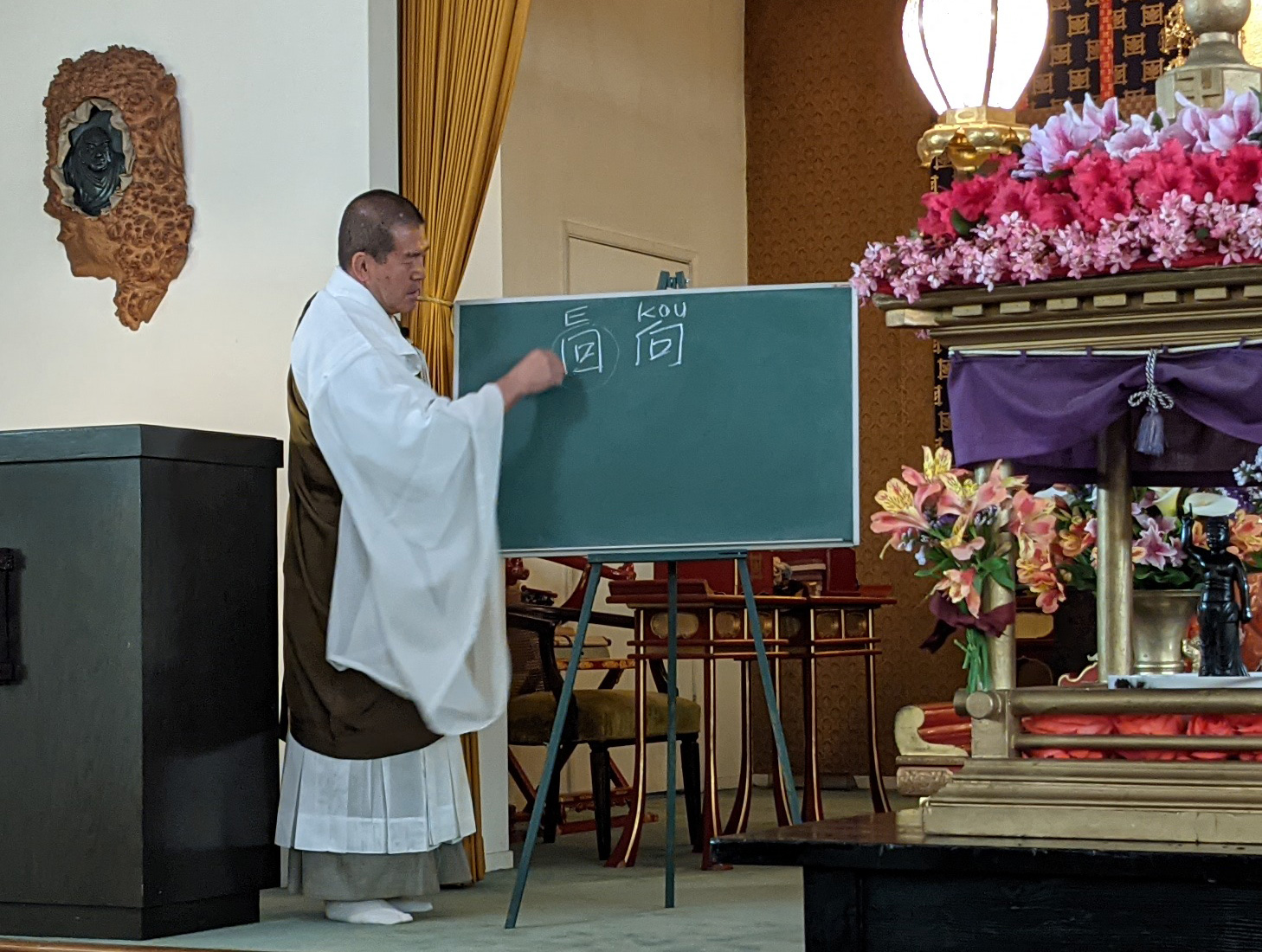
Following the Hanamatsuri service Sunday, Ven. Kenjo Igarashi brought out his portable chalkboard and set in on an easel next to his lectern. Already written in chalk were two Chinese characters. These were labeled E and Kou, which translate to Memorial Prayers.

For some reason I feel compelled to point out that the easel originally was part of a large floral display used at a funeral.  After the funeral, the display was moved to the parking lot and attendees were invited to scavenge individual flowers to take home. When all the flowers were gone, Rev. Igarashi kept the easel. The thin green legs of the easel and the green chalkboard look as if they were purchased together. The easel can be found on the altar dais behind a curtain next to his lectern.

And I think the juxtaposition of these two peripherally related tidbits inadvertently illustrates why I am unable to give a detailed recounting of  the sermon Rev. Igarashi gave on the topic of Memorial Prayers.

Last month, I recorded  Rev. Igarashi’s sermon after the Ohigan service, knowing in advance that I’d want a record of what he  said so I could add it to my Higan content. But instead of immediately posting the sermon after I transcribed the recording, I let it sit around for a week. Sunday I didn’t record the sermon and instead I am left to try to remember the lesson he gave.

Here is my dilemma: I want to explain the lesson I took from the sermon on E Kou without impugning Rev. Igarashi’s lesson. What I took in, what I recall, the lesson I received – it’s quite possible none of that was Rev. Igarashi’s intent.

This is what happens when “a bhikṣu, a bhikṣunī, an upāsakā, an upāsikā, or some other wise person, whether young or old, rejoices at hearing this sūtra in a congregation after my extinction. After leaving the congregation, he or she goes to some other place, for instance, to a monastery, a retired place, a city, a street, a town, or a village. There he or she expounds this sūtra, as he or she has heard it, to his or her father, mother, relative, friend or acquaintance as far as he or she can. Another person who has heard [this sūtra from him or her], rejoices, goes [to some other place] and expounds it to a third person. The third person also rejoices at hearing it and expounds it to a fourth person. In this way this sūtra is heard by a fiftieth person.” [Chapter 18, The Merits of a Person Who Rejoices at Hearing This Sutra]

What I can provide is my “fiftieth person” understanding. Please don’t blame Rev. Igarashi.

For Memorial Services, I’ve operated under a simple understanding: I accumulate merit with my practice and during the services I transfer that merit to my deceased ancestors. “Simple” is key here. Rev. Igarashi explained that the merit attained from our daily practice allows us to seek the intercession of Śākyamuni, Tahō Buddha, the great Bodhisattvas and all the protective deities. That’s where the power to help our deceased ancestors lies.

When I heard this I was reminded of a quote from Nichiren:

The Lotus Sūtra is called “Zui-jii,” namely it expounds the true mind of the Buddha. Since the Buddha’s mind is so great, even if one does not understand the profound meaning of the sūtra, one can gain innumerable merits by just reading it. Just as a mugwort among hemp plants grows straight and a snake in a tube straightens itself, if one becomes friendly with good people, one’s mind, behavior, and words become naturally gentle. Likewise, the Buddha thinks that those who believe in the Lotus Sūtra become naturally virtuous.

Zui-jii Gosho, The Sūtra Preached in Accordance to [the Buddha’s] Own Mind, Writings of Nichiren Shōnin, Faith and Practice, Volume 4, Page 155

It is this merit of Śākyamuni that we are able to transfer to our deceased ancestors. The more we practice Namu Myōhō Renge Kyō, our practice of the Lotus Sutra, the greater the merit. Rev. Igarashi explained that we need to devote our entire body to the effort. Not literally but figuratively like Gladly-Seen-By-All-Beings Bodhisattva, in the previous life of Bodhisattva Medicine King, who sacrificed his body as an offering to the Buddha.

Rev. Igarashi recalled his five times through the grueling Aragyo 100-day ascetic practice to illustrate how he gained his ability to offer purifying prayers for those who attend Kaji Kito services.

I will be 70 in December. Not a lot of physical body I can devote to my practice, but what there is goes to Namu Myōhō Renge Kyō.

20210412_new-juzu

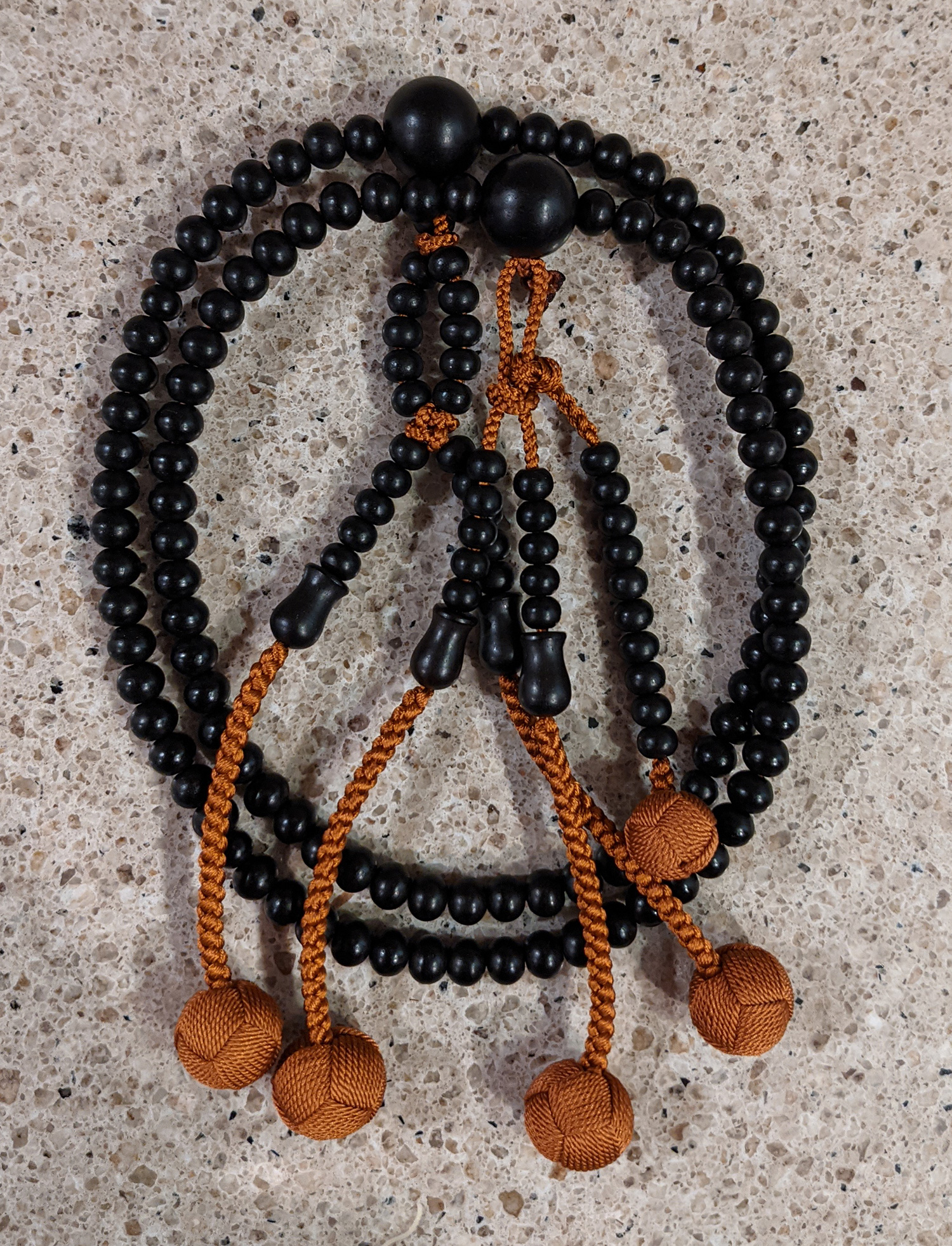
While I was at the church I asked Rev. Igarashi to bless a new set of Juzu I had purchased from the Nichiren Buddhist International Center. The beads came with a brochure, which offered this tidbit:

Prayer Beads are used by all Buddhists and by many other religions as well. These beads are called Juzu or Nenju in Japanese, Mala by the Tibetans and in Sanskrit they are called Japamala. When the Romans first saw prayer beads (Japamala) used by the Hindus, they mistakenly heard “jap” instead of “japa.” Jap in Sanskrit stands for rose. Translated into Latin Japmala comes out as “Rosarium” and in English as “Rosary.” The Juzu or Mala may have been the inspiration for the prayer beads used by some Christians and Muslims today.

San’mon

Adoration of Gohonzon

In the Maṇḍala Gohonzon, the object of our worship, is shown the origin of how the Mandala was written.

One day in the 12th month of 1274 (11th year of Bunnei), I (Nichiren) wrote the Gohonzon in the village of Hakii, Province of Kai (the present-day Minobusan, Yamanashi Prefecture).

Nichiren

It was the time when over 2220 Years had passed since Śākyamuni Buddha passed away. Nevertheless, in the three countries of India, China and Japan, namely in the world, there had never existed a Gohonzon like this. This is probably because none of our past masters attempted to spread the Gohonzon among the society even though they were aware of its existence. Or it may be that nobody knew about it.

Śākyamuni Buddha, after careful consideration, determined that He should conceal the Gohonzon until the arrival of an opportune moment to reveal it, leaving it to the people in the period of Mappō.

In fact, the Buddha preached in the Lotus Sutra that His messenger, Jōgyō Bosatsu, should spread the Buddha’s teachings in the first 500 years of Mappō. As predicted by the Buddha, Nichiren Daishōnin appeared in this world to reveal the Gohonzon, and expounded the teachings of the Odaimoku.

Signature given by Nichiren Shōnin himself.
Namu-myōhō-renge-kyō
Easy Readings of the Lotus Sutra