The Nirvāṇa we attained was
Only part of the immeasurable treasures of yours.
We were like a foolish man with no wisdom.
We satisfied ourselves with what little we had attained.
Five hundred of the Buddha’s monks give this explanation in Chapter Eight of the Lotus Sūtra. They had spent all of their time with the Buddha working to rid themselves of suffering. While this is a remarkable achievement, it does not compare to the true purpose of the Buddha’s teaching. When these monks heard the Buddha teach the Lotus Sutra, and understood that their true purpose was to benefit others, they realized that their earlier practice was preparation. By remaining preoccupied with suffering, they had lost sight of the treasure of enlightenment.
The Daily Dharma is produced by the Lexington Nichiren Buddhist Community. To subscribe to the daily emails, visit zenzaizenzai.com
Having last month considered the poisonings, killings and burnings that filled the house, we consider the expedient the rich man used to get his children to flee the burning house.
At that time the house-owner
Was standing outside the gate.
He heard a man say to him:
“Some time ago
Your children entered this house to play.
They are young and ignorant.
They are engrossed in playing.”
Hearing this,
The rich man was frightened.
He rushed into the burning house.
In order to save them
From burning to death,
He told them
Of the dangers of the house:
“There are demons and poisonous vermin here.
Flames have already spread all over.
Many sufferings are coming
One after another endlessly.
There are poisonous snakes,
Lizards, vipers,
Yakṣas, kumbhanda demons,
Small foxes, foxes, dogs,
Crested eagles, eagles,
Kites, owls and centipedes here.
They are unbearably hungry and thirsty.
They are dreadful.
These sufferings are difficult to avoid.
Worse still, there is a big fire.”
Though the children heard his warning,
They were still engrossed in playing.
They did not stop playing
Because they were ignorant.
The rich man
Thought:
“They are ignorant.
My anxiety deepens
There is nothing pleasant
In this house.
But they are engrossed
In playing.
They do not listen to me.
They will be burned to death.”
At the time
He thought of an expedient.
He said to them:
“I have many kinds of toys.
They are beautiful carts
Made of wonderful treasures.
They are sheep-carts, deer-carts,
And large bullock-carts.
They are outside the gate.
Come out!
I made those carts
For you.
Play with them
As you like!”
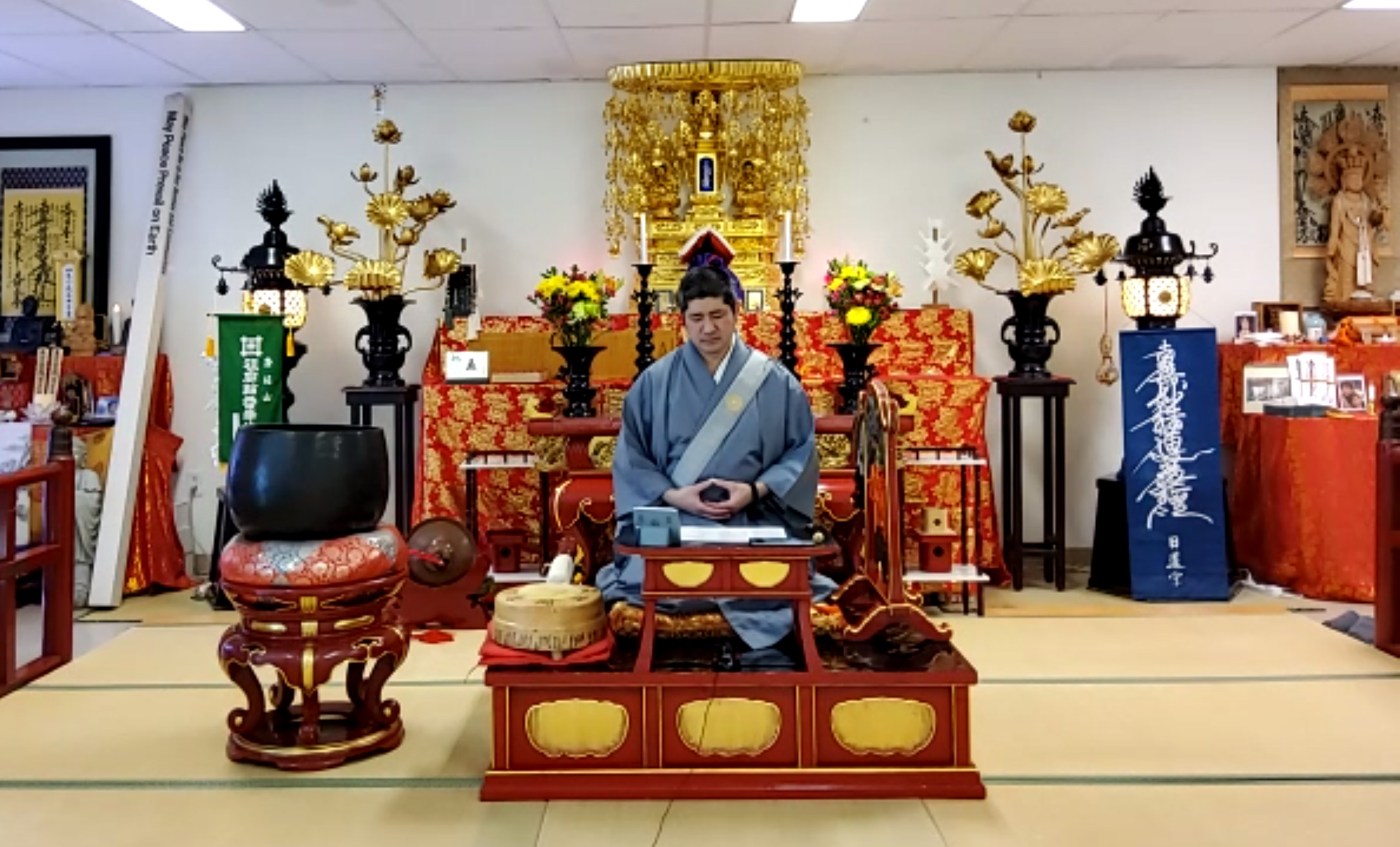
Rev. Shoda Kanai sits in silent meditation during the Shodaigyo service.
Had a full Sunday today. After my personal morning service, I attended the Nichiren Buddhist Kannon Temple of Nevada Shodaigyo service offered via Zoom by Rev. Shoda Kanai.
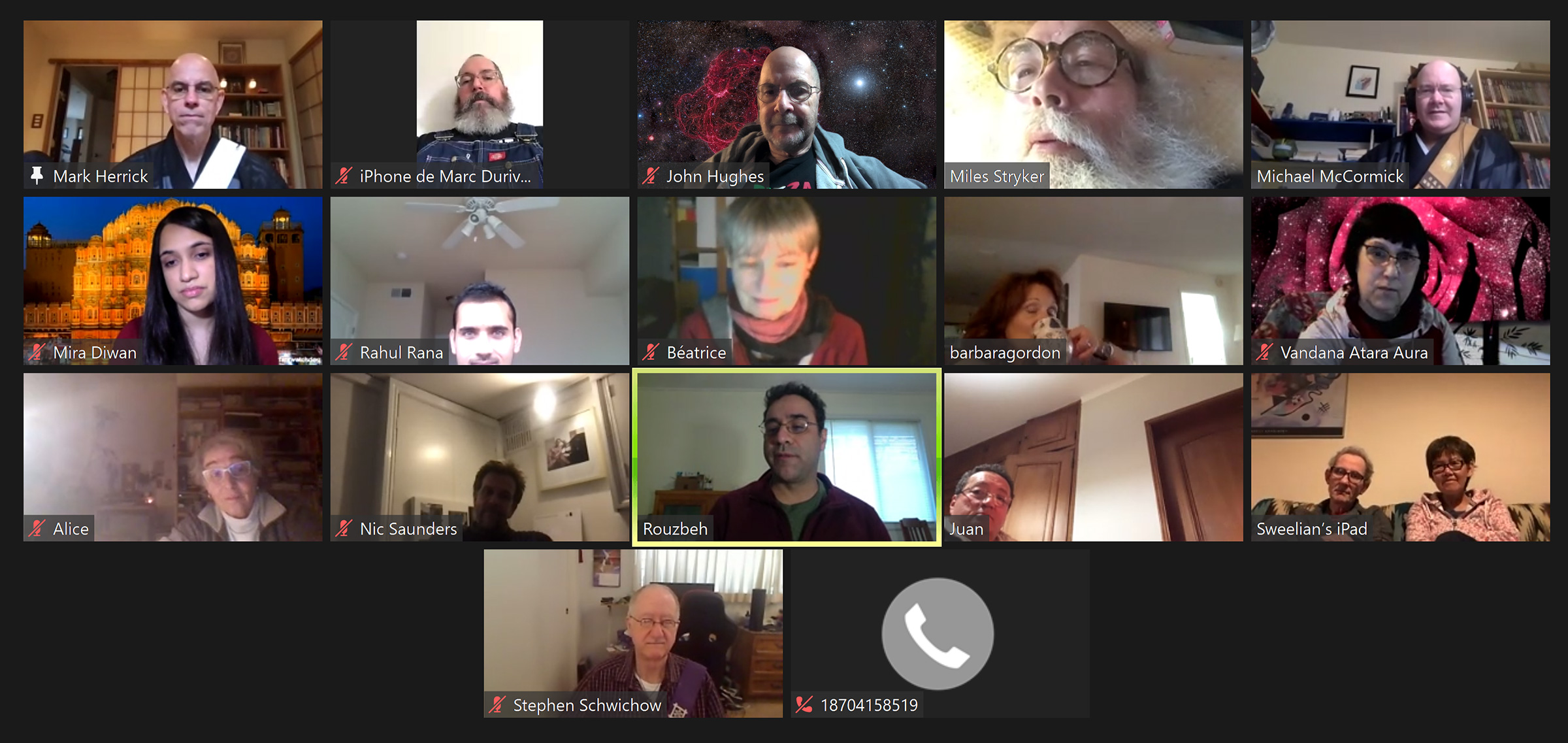
Attendees of Sunday’s Nichiren Buddhist Sangha of the San Francisco Bay Area included people from the Czech Republic, Portugal and England. When you add the people from across the United States the remaining folks from Northern California were a minority of the total.
Bay Area Nichiren Buddhist Sangha services currently feature discussion of the Lotus Sutra on the first and third Sundays and general discussions on the second, fourth and, when called for, the fifth Sundays.
Ryugan Mark Herrick, the shami who coordinates the services, and Rev. Ryuei Michael McCormick accepted my suggested topic for today’s discussion.
For the meeting I needed to set the stage for the question. Here’s how I did that:
Imagine you have received a phone call from a woman you know. She has been chanting Namu Myoho Renge Kyo for nearly 50 years. She is calling you because the man who guided her practice for most of those years died last year. She is feeling lost with his passing.
She is calling because her younger sister’s grandson, an 18-year-old straight-A high school senior, was shot and killed by gang-bangers who mistook him for someone else.
This woman is the matriarch of her large family. The day before she called she presided over a memorial vigil at the sight of the shooting. Now she was seeking spiritual help for herself.
My question for discussion today:
What can you say that will ease her distress and empower her to move forward?
This is not the sort of call I get regularly. I was unsure what I could say to help. In passing I mentioned to her that this was certainly a challenge to her faith and she accepted that as something she could focus on. But I didn’t want that to be the only thing she took from the call. I wanted something more positive and constructive.
The merit of chanting came to mind. Here was a woman with nearly a half-century of merit from which to draw.
In Chapter 21, the Supernatural Powers of the Tathāgatas, the Buddha says:
[A]ll the teachings of the Tathāgata, all the unhindered, supernatural powers of the Tathāgata, all the treasury of the hidden core of the Tathāgata, and all the profound achievements of the Tathāgata are revealed and expounded explicitly in this sūtra.
In Kanjin Honzon-shō, A Treatise Revealing the Spiritual Contemplation and the Most Venerable One (Writings of Nichiren Shōnin, Doctrine 2, Page 146), Nichiren writes:
Śākyamuni Buddha’s merit of practicing the bodhisattva way leading to Buddhahood, as well as that of preaching and saving all living beings since His attainment of Buddhahood are altogether contained in the five words of myō, hō, ren, ge, and kyō and that consequently, when we uphold the five words, the merits which He accumulated before and after His attainment of Buddhahood are naturally transferred to us.
I suggested to the woman that this vast pool of merit she had obtained from years of chanting Namu Myōhō Renge Kyō could be put to use to help her sister’s grandson in his journey after death.
Rev. Kenjo Igarashi of the Sacramento Nichiren Buddhist Church wrote an essay back in May 2016 on the 49-day journey after death in which we said:
While it may seem as if we take little part in the deceased individual’s 49-day journey, this is not the case. One way we can assist them, is by chanting ”Namu myo ho renge kyo,” which as you know, is the name of the Buddha nature that we all possess. We chant this odaimoku throughout the 49 days to call upon the deceased individual’s Buddha nature. If you recall, the Buddha nature can be imagined as the inside of a seed, while the outer shell represents bad karma resulting primarily from previous actions. Whenever we chant the odaimoku, the Buddha nature slowly grows. While this is a slow process, the more we chant, the more the Buddha nature shows, until it finally appears by sprouting through the outer shell.
I suggested that she hold a memorial service every seven days for seven weeks. The Memorial Prayer is available in the daily service book. This was something she could do, a concrete expression of her faith and her hope for her sister’s grandson.
I’m aware that some people fear that focusing on funerary services will somehow weaken Buddhism in America. And I will admit that those funerary services – Ohigan in the spring and fall, Obon in the summer, individual memorial services throughout the year – play a prominent role at the Sacramento Nichiren Buddhist Church, which was founded by five Japanese immigrant families in 1931. But funerary services do not require a diminishment of Buddhist studies or practice. We can have both, and I would argue that Buddhism is stronger for it.
The Prajn͂āpāramitā Sutra describes the perfection of wisdom, prajn͂ā paramita, as “the wings of a bird that can carry you very far.” It is the foundation and the key to the realization of all the paramitas. With this kind of understanding we can practice giving, mindfulness, inclusiveness, diligence, and meditation perfectly. Without prajn͂ā paramita the perfection of the other paramitas is impossible – without wings you cannot go far.
Rivers come together to form an ocean. Particles of dust accumulate to become Mt. Sumeru. When I, Nichiren, began having faith in the Lotus Sūtra, it was like a drop of water or a particle of dust in Japan. However, when the sūtra is chanted and transmitted to two, three, ten, a million, and a billion people, it will grow to be a Mt. Sumeru of perfect enlightenment or the great ocean of Nirvana. There is no way other than this to reach Buddhahood.
Senji-shō, Selecting the Right time: A Tract by Nichiren, the Buddha’s Disciple, Writings of Nichiren Shōnin, Doctrine 1, Page 243-244
“Good man! Go to Śākyamuni Buddha who is now living on Mt. Gṛdhrakūṭa! Ask him on my behalf, ‘Are you in good health? Are you peaceful? Are the Bodhisattvas and Śrāvakas peaceful or not?’ Strew these jeweled flowers to him, offer them to him, and say, ‘That Buddha sent me to tell you that he wishes to see the stūpa of treasures opened.’“
In Chapter Eleven of the Lotus Sūtra, Buddhas and their devotees from innumerable worlds come to our world of conflict and delusion to see Śākyamuni Buddha open the tower inhabited by Many-Treasures Buddha. As our capability for enlightenment wells up from within us, the tower of treasures sprang up from underground when the Buddha asked who would teach the Wonderful Dharma after the Buddha’s extinction. The treasures in the tower are nothing more than Many-Treasures Buddha declaring the Lotus Sūtra to be the Teaching of Equality, the Great Wisdom, the Dharma for Bodhisattvas and the Dharma upheld by the Buddhas.
Having last month repeated in gāthās Śāriputra’s understanding that the Buddha expounds the Dharma according to the capacities of all living beings, we consider Śāriputra’s fear that the Buddha was Mara in disguise.
In the midst of the great multitude,
You said to me, “You will become a Buddha.”
Hearing this truthful voice,
All my doubts are gone.
When I had heard this from you,
I was much frightened and perplexed; I thought:
“The Buddha troubles me.
Isn’t he Mara in the form of a Buddha?”
You skillfully expound the Dharma with various parables and similes,
And with various stories of previous lives.
Now my mind is as peaceful as the sea.
Hearing you, I have removed the mesh of doubts.
You said:
“The innumerable Buddhas in the past
Expounded the Dharma with expedients.
The numberless Buddhas at present
Also expound the Dharma
With expedients.
So will the countless Buddhas
In the future.”
You appeared in this world,
Left your home, attained enlightenment,
And now turn the wheel of the Dharma,
Also with expedients.
You expound the true teaching;
Papiyas does not.
Therefore, I know
That you are not a transformation of Mara.
I thought that the Dharma was expounded by Mara
Because I was in the mesh of doubts.
I hear your gentle voice.
Your voice is deep and wonderful.
You expound the Pure Dharma.
My heart is filled with great joy.
All my doubts are gone.
I have obtained true wisdom.
I shall become a Buddha without fail.
I shall be respected by gods and men.
I will turn the wheel of the unsurpassed Dharma,
And teach Bodhisattvas.
[Shariputra] is nourished from the Buddha’s mouth. Just as inheritance is not only biological, nourishment is not only physical, but mental and spiritual as well. Where should we look for mental and spiritual nourishment? We should not, I believe, think that because we are Buddhists or followers of the Dharma Flower Sutra our spiritual nourishment must always come from the Dharma Flower Sutra or from Buddhist sources alone. One of the wonderful things about the Lotus Sutra, as we will see when looking at the simile of the plants, is its recognition that the Buddha Dharma nourishes the whole world, not just Buddhists.
One way of understanding this, then, is to imagine that the Buddha can speak to us and nourish us in innumerable ways. In other words, anything at all, if we penetrate into it deeply enough, can be a revelation to us of Buddha Dharma. No matter how good or bad a person or situation or thing may be, it can be something from which we can learn; if we are open to it, we can find in it something of great value.
The subject of my debate was the status of the Buddha Sun and Moon Light before he became a Buddha in Chapter 1, Introduction. Reeves, in his book, The Stories of the Lotus Sutra said:
The fact that before becoming a fully awakened buddha Sun and Moon Light was a prince living in a palace with eight sons reveals a recurrent theme of the Sutra: the idea that what is happening now is both new and unprecedented, and has happened many times before.
Since Senchu Murano’s translation said the last Sun and Moon Light Buddha was a king, I jumped to the conclusion that Reeves was in error, only to discover that the other English-language translation don’t specify what his royal status was before becoming a Buddha, leaving the status undetermined.
Even Reeves’ translation of the Lotus Sutra doesn’t specify the status of the last Sun and Moon Light Buddha:
“Before the last of these buddhas had left his home, he had eight royal sons.
This royal status issue plays out again in Chapter 7, The Parable of a Magic City. Was Great-Universal-Wisdom-Excellence Buddha a prince or a king when he had 16 princes? This time Murano is silent on the issue:
Bhikṣus! At the end of the period of ten small kalpas, the Dharma of the Buddhas came into the mind of Great-Universal-Wisdom-Excellence Buddha. Now he attained Anuttara-samyak-saṃbodhi. Before he left home, he had sixteen sons.
Reeves translation:
Monks, only after ten small eons had gone by did the Dharma of the buddhas appear before Excellent in Great Penetrating Wisdom Buddha and he could attain supreme awakening. That Buddha, before he had left home, had sixteen sons, the first of whom was named Accumulated Wisdom.
The conclusion that this time the Buddha had been a prince is suggested by the next paragraph of Chapter 7, which specifies that the grandfather of the 16 princes – the father of the Buddha – was the wheel-turning-holy-king. (Of course this presupposes that the grandfather here is the paternal grandfather and not the father of the children’s mother, who is also mentioned in the same paragraph.)
This all comes up today after I published a portion of Ichidai Goji Keizu, Genealogical Chart of the Buddha’s Lifetime Teachings in Five Periods, Writings of Nichiren Shōnin, Doctrine 3, Page 248, in which Nichiren specifies that “The seventh chapter on ‘The Parable of a Magic City’ of the Lotus Sūtra states that the Great Universal Wisdom Buddha had been the king of a country with 16 princes before entering the priesthood.”
One thing I think everyone can agree on: This whole debate doesn’t really matter.
Dhyana, meditation, is the practice of calming, concentrating, and looking deeply. Meditation should be understood first of all as the cultivation of samadhi, meditative awareness. Then when we take teachings such as the Three Dharma Seals – impermanence, non-self, and nirvana – as the object of our concentration, they become real insights into our lived experience, not just ideas or concepts.
The core Buddhist teaching of impermanence tells us that all things arise and pass away according to their causes and conditions. Nothing lasts forever; nothing is a permanent, unchanging thing unto itself. Many practitioners think that they understand the teaching of impermanence perfectly, but they do not really believe in it. We have a strong tendency to believe that we will remain the same person forever and that our loved ones will also remain the same forever, but this is a kind of delusion that prevents us from living in a more mindful and compassionate way. If we believe that everyone and everything we love will always be there, we have little concern to take care of them, to treasure them deeply right here and now. When we lose something or someone we love, we suffer. Yet when that thing or person was still present in our lives we may not have treasured it, we didn’t fully appreciate him or her, because we lacked the insight of impermanence. It’s very important to make the insight of impermanence the object of our meditative awareness, because this insight is an essential element of love and compassion.