
The Stories of the Lotus Sutra, p190-191That the bodhisattvas are from the earth has traditionally been taken to be an affirmation of this world, usually called the “saha world” in the Sanskrit Saddharma-pundarika Sutra. That it is the saha world means that this world is the world in which suffering both must be and can be endured. There is a pattern in the Dharma Flower Sutra in which some great cosmic and supernatural event demonstrates or testifies to the cosmic importance of Shakyamuni Buddha, and, since Shakyamuni is uniquely associated with this world, its reality and importance is also affirmed in this way; and, since what Shakyamuni primarily gives to this world according to the Sutra is the Dharma Flower Sutra itself, it too is very special and important; and, since the Dharma Flower Sutra is not the Dharma Flower Sutra unless it is read and embraced by someone, the importance of the life of the hearer or reader of the Sutra is also affirmed; and, since the most appropriate way of life for a follower of the Dharma Flower Sutra is the bodhisattva way, it too is elevated and affirmed. These five – Shakyamuni Buddha, this world, the Dharma Flower Sutra, the hearer or reader of the Sutra, and the bodhisattva way – do not have to appear in this particular order. Any one of them leads to an affirmation of the others. But there is a pattern in the Dharma Flower Sutra, wherein there is a radical affirmation of this world, this world of suffering, but an affirmation that is necessarily linked to the importance of Shakyamuni Buddha and the Dharma Flower Sutra on the one hand and to the lives and bodhisattva practices of those who embrace the Sutra on the other.
Thus, we can say that to truly love and follow the Buddha is also to love and care for the world, which is also to love and care for other living beings. And the reverse is equally true: to really care for others is at the same time devotion to the Buddha. To be devoted to the Dharma Flower Sutra and to Shakyamuni Buddha is to be vitally concerned about the welfare of others, the common good, and therefore about the welfare of our home, the earth.
All posts by John Hughes
Why Is Slandering Lotus Sūtra So Important?
So the question is — what was really intended by these warnings not to engage in slander of the Lotus Sūtra?
As Nichiren has explained, the Lotus Sūtra’s two unique teachings concern the One Vehicle whereby even those who would seem to be excluded from attaining buddhahood are promised its attainment and the revelation that Śākyamuni Buddha had in fact been the Buddha since the remote past even before his awakening beneath the Bodhi Tree. Women, evildoers like Devadatta, and those disciples who were believed to have become arhats who would no longer return to the world after their passing, are all told that they will in fact return to the world and attain buddhahood. This was in seeming contradiction to the earlier teaching that only a very few could aspire to and attain buddhahood. The revelation of the attainment of buddhahood in the remote past means that even during the Buddha’s innumerable past lifetimes as an ordinary human being, or an animal, or some other form of sentient being striving to attain buddhahood the Buddha had been a buddha all along. And now even though the Buddha is going to appear to pass away for good, he asserts that he will still be present. In light of these two teachings, buddhahood should be understood as inclusive of all beings, all time, and all space. It is a constant and active presence even when it is not apparent or seems to be absent in the lives of those who strive for it. Throughout the Lotus Sūtra these ideas are put forward as the fullest expression of the Dharma and to embrace them with faith and joy is to embrace the Wonderful Dharma and to reject them is to reject the Wonderful Dharma. The Wonderful Dharma is held to be even more worthy of respect and offerings than the Buddha himself because it is through the Wonderful Dharma that one attains buddhahood. It is for this reason that rejection means a total alienation from what is truly of value in life, and therefore leads to rebirth in hell. It is for this reason that a single moment of faith and rejoicing in the Wonderful Dharma of the Lotus Sūtra is said to bring unequalled merit, rivaled only by the merit brought by the perfection of wisdom itself which is none other than buddhahood itself.
It would seem that the most important thing is to revere the Wonderful Dharma and to awaken to its full significance. This is why the Lotus Sūtra describes the vast demerit incurred or merit made by those who slander or praise it respectively. Whether the Buddha directly taught these sūtras or not, and whether or not there are literal rebirths in a Pure Land or an Avici Hell, the point seems to be that we create our own misery to the extent that we deny the Wonderful Dharma whereas we can attain awakening through upholding the Wonderful Dharma. And what is this Wonderful Dharma? It is not simply a formula, text, or even a creed that one must believe without evidence. It is none other than the true nature of all existence, the reality of all things. This is what all buddhas awaken to, praise, and point out to all sentient beings using many skillful methods so that they too may realize that they are buddhas as well.
The stated intent of the other sūtras and teachings upheld by the other schools of Buddhism is to provide people with a way to attain buddhahood or at least liberation from the cycle of birth and death. The Lotus Sūtra directly teaches that all beings can attain buddhahood and that buddhahood is beginningless and endless and therefore realizable here and now. The Lotus Sūtras teaching is that all beings are worthy of the most profound respect because all beings are destined for buddhahood and in fact the world of buddhahood already resides in the depths of their life, already embraces them. To denigrate this message is to denigrate the true value of life. The other sūtras and schools of Buddhism should not be trying to obscure or denigrate the message of the Lotus Sūtra but uphold it because the sūtra expresses the fulfillment of their own true intentions. Nichiren laments that this is not the case, and that on the contrary people find the lesser teachings to be easier to embrace and uphold.
Open Your Eyes, p312-313Each Character of Lotus Sūtra Is a Living Buddha
Each character of the Lotus Sūtra is a living Buddha but seen through the “naked eye” of a common person, it looks like nothing but a character. For instance, the Ganges River looks like fire to the hungry ghosts, water to human beings, and “nectar” to the heavenly beings. The same water appears to be different to those who live under different circumstances. These characters of the Lotus Sūtra cannot be seen at all by the blind, but they appear as black letters to the “naked-eye” of ordinary people, the sky to the “wisdom-eye” of the Two Vehicles, various doctrines to the “dharma-eye” of the bodhisattvas, and the Buddhas to the “Buddha-eye” of those in whom the seed of Buddha is ripe. Therefore, it is preached in the “Appearance of the Stupa of Treasures” chapter of the Lotus Sūtra, “He who upholds this sūtra sustains the Buddha,” and Grand Master T’ien-t’ai states in his “Ryaku Hokekyō,” “I believe in the Lotus Sūtra, consisting of eight fascicles, 28 chapters, namely 69,384 Chinese characters. Each of these characters is itself the true Buddha, who preaches the dharma for the benefit of people who listen.”
Hōren-shō, Letter to Hōren, Writings of Nichiren Shōnin, Volume 6, Followers I, Page 56-57
Daily Dharma – July 18, 2020
Flower-Virtue! Now you see Wonderful-Voice Bodhisattva here and nowhere else. But formerly he transformed himself into various living beings and expounded this sūtra to others in various places.
The Buddha makes this declaration to Flower-Virtue Bodhisattva in Chapter Twenty-Four of the Lotus Sūtra. In their efforts to benefit all beings, Bodhisattvas develop the capacity to adapt themselves to their circumstances. They know they cannot use the same methods to teach everyone. Instead of seeing the beings in our world of conflict as obstacles to getting what we want, we can learn to see them as great teachers who have transformed themselves into what we need to become enlightened. This can also help them to realize their nature as Bodhisattvas, rather than beings stuck in the world of conflict, absorbed in their own gratification.
The Daily Dharma is produced by the Lexington Nichiren Buddhist Community. To subscribe to the daily emails, visit zenzaizenzai.com
Day 19
Day 19 concludes Chapter 14, Peaceful Practices, and begins Chapter 15, The Appearance of Bodhisattvas from Underground.
Having last month considered the Parable of the Priceless Gem in the Top-Knot, we consider how this Sutra of the Lotus Flower of the Wonderful Dharma is the most excellent and profound.
“Mañjuśrī! This Sutra of the Lotus Flower of the Wonderful Dharma is the most excellent and profound teaching of all the Tathāgatas. Therefore, I expound it lastly just as the powerful king gave the brilliant gem lastly, the one which he had kept [in his topknot) for a long time.
“Mañjuśrī! This Sutra of the Lotus Flower of the Wonderful Dharma is the treasury of the hidden core of the Buddhas, of the Tathāgatas. It is superior to all the other sūtras. I kept it [in secret] and refrained from expounding it for the long night. Now I expound it to you today for the first time.”
Thereupon the World-Honored One, wishing to repeat what he had said, sang in gāthās:
Be patient, and compassionate
Towards all living beings,
And then expound this sūtra
Praised by the Buddhas!Anyone who keeps this sūtra
In the latter days after my extinction
Should have compassion towards laymen and monks
And towards those who are not Bodhisattvas.
He should think:
‘They do not hear this sūtra.
They do not believe it.
This is their great fault.
When I attain the enlightenment of the Buddha,
I will expound the Dharma to them
With expedients
And cause them to dwell in it.’
See The Real Superiority of this Sutra Lies in Its Comprehensiveness
The Real Superiority of this Sutra Lies in Its Comprehensiveness
The Stories of the Lotus Sutra, p181-182The final verse portion of the chapter says that the Buddha has taught many sutras as skillful means, and when he knows that people have gained sufficient strength from them, he at last and for their sake teaches the Dharma Flower Sutra. In other words, it is because other sutras have been taught and people have gained strength from them that the Buddha is at last able to teach the Dharma Flower Sutra. Other sutras and teachings prepare and open the way for the teachings of the Dharma Flower Sutra.
This means, of course, that while followers of the Dharma Flower Sutra may think it is the greatest of sutras, they should not disparage other sutras or other teachings, just as is taught in the four trouble-free practices in the early part of the chapter.
Yet in what way is the Lotus Sutra superior to or better than other sutras? In this story, this is not explicit, but if we look below the surface, we may find an answer to this question.
The jewel in the topknot is very valuable, but we are not told in what way it is more valuable than other valuable things. The text says that the Dharma Flower Sutra is “supreme,” the “greatest,” the “most profound,” the “highest.” But there are only a couple of hints or suggestions as to how it is supreme among sutras. One hint is that the Sutra, like the jewel in the topknot, is withheld to the last. But, surely, merely being last is not necessarily a great virtue and would not automatically make this Sutra any better than any other. The second thing we are told is that the Dharma Flower Sutra “can lead all the living to comprehensive wisdom.” Thus, we may think, the reason that being last is important in this case is because being last makes it possible for the Dharma Flower Sutra to take account of what has come before and be more inclusive than earlier sutras. While much use is made here of what are basically spatial metaphors, such as highest, or most profound, what is suggested here is that the real superiority of this Sutra lies in its comprehensiveness. And this is not so much a matter of repeating doctrine and ideas found in earlier sutras as it is a matter of having a positive regard both for the earlier sutras and for those who teach or follow them, and thus being more comprehensive.
This is why three of the four practices urged on bodhisattvas at the beginning of the chapter involve having a generous, respectful, positive, helpful attitude toward others. Rather than reject other teachings and sutras, the Dharma Flower Sutra teaches that all sutras should be regarded as potentially leading to the larger, more comprehensive, more inclusive wisdom of the Lotus Sutra itself.
The Lotus Sutra and Nichiren
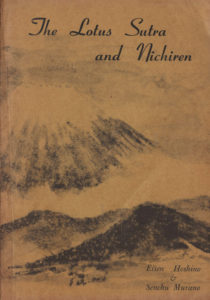 I have scanned and uploaded to the Sacramento Nichiren Buddhist Church’s Brochures page a copy of a small biography of Nichiren published in 1968. The Lotus Sutra and Nichiren was written by the Rev. Eisen Hosino, who at the time was Chief Priest of Jitsujoji Temple, Jomkuji, Achi-ken. The book was translated into English by Senchu Murano, then a Rissho University professor.
The book is factually thorough but not particularly inspiring. I much prefer Nichiren, the Buddhist Prophet, by Masaharu Anesaki or Nichiren, Leader of Buddhist Reformation in Japan by J.A. Christensen. I also highly recommend Rev. Ryuie McCormick’s Lotus in a Sea of Flames, a novelized account of Nichiren’s life steeped in Nichiren Shu doctrine.
Nichiren’s Four Admonitions
Nichiren is known primarily for his advocacy of the Lotus Sūtra as the Buddha’s highest teaching and for the practice of chanting its Odaimoku (lit. sacred title) in the form of Namu Myōhō Renge Kyō (lit. Devotion to the Sūtra of the Lotus Flower of the Wonderful Dharma). He is also known for his denunciation of other schools of Buddhism. This denunciation is often summarized in the form of the “four admonitions” (J. shika no kakugen):
Pure Land Buddhism is a way leading to the Hell of Incessant Suffering; Zen Buddhism is the act of heavenly devils, who hinder the Buddhist way; Mantra (Shingon) Buddhism is an evil teaching leading to the destruction of our nation; and Discipline (Ritsu) Buddhism is a false teaching by traitors. (Hori 1992, p. 178 adapted)
Open Your Eyes, p347‘I Pray So that I May Be Despised’
I pray so that I may be despised by the ruler of the country and sacrifice my life for the sake of the Lotus Sūtra in order for me to be free of the bonds of life and death. I wish also to see with my own eyes whether or not such virtuous deities as Goddess Amaterasu, Shōhachiman, the sun and moon, Indra, and the King of the Brahma Heaven, carry out the vow which they made in front of the Buddha.
Dannotsu Bō Gohenji, Response to a Follower, Writings of Nichiren Shōnin, Faith and Practice, Volume 4, Page 131
Daily Dharma – July 17, 2020
You, the World-Honored One, know
What all living beings have deep in their minds,
What teachings they are practicing,
And how much power of wisdom they have.
The children of Great-Universal-Wisdom-Excellence Buddha proclaim this to their father in a story told by Śākyamuni Buddha in Chapter Seven of the Lotus Sūtra. In our preoccupation with our pursuits in this world of conflict we are so focused on our schemes that we have forgotten the Buddha’s wisdom dormant in us all. With the Lotus Sūtra, the Buddha leads us to an unfamiliar and even uncomfortable way of seeing the world. But it is only when we leave the false safety of our delusions that we can truly benefit ourselves and others.
The Daily Dharma is produced by the Lexington Nichiren Buddhist Community. To subscribe to the daily emails, visit zenzaizenzai.com