All posts by John Hughes

Day 14

Day 14 covers all of Chapter 9, The Assurance of Future Buddhahood of the Śrāvakas Who Have Something More to Learn and the Śrāvakas Who Have Nothing More to Learn, and opens Chapter 10, The Teacher of the Dharma.

Having last month considered the benefit of praising the keeper of the sutra, we repeat in gāthās the benefits of keeping the Lotus Sūtra.

Thereupon the World-Honored One, wishing to repeat what he had said, sang in gāthās:

If you wish to dwell in the enlightenment of the Buddha,
And to obtain the self-originating wisdom,
Make offerings strenuously to the keeper
Of the Sūtra of the Lotus Flower of the Wonderful Dharma!

If you wish to obtain quickly the knowledge
Of the equality and differences of all things,
Keep this sūtra, and also make offerings
To the keeper of this sūtra!

Anyone who keeps
The sūtra of the Lotus Flower of the Wonderful Dharma,
Know this, has compassion towards all living beings
Because he is my messenger.
Anyone who keeps
The Sūtra of the Lotus Flower of the Wonderful Dharma
Should be considered to have given up his pure world and come here
Out of his compassion towards all living beings.

Know that he can appear wherever he wishes!
He should be considered
To have appeared in this evil world
In order to expound the unsurpassed Dharma.

Offer flowers and incense of heaven,
Jeweled garments of heaven,
And heaps of wonderful treasures of heaven
To the expounder of the Dharma!

Join your hands together and bow
To the person who keeps this sūtra
In the evil world after my extinction,
Just as you do to me!

Offer delicious food and drink,
And various garments to this son of mine,
And yearn to hear the Dharma [from him]
Even if for only a moment!

Anyone who keeps this sūtra in the future
Should be considered
To have been dispatched by me
To the world of men in order to do my work.

See The Work of Ordinary People

The Work of Ordinary People

The most important thing about [Chapter 10] is its emphasis on the Dharma teacher. Here we can see that the Sutra attempts to break through the limitations of the threefold shravaka-pratyekabuddha-bodhisattva distinction that had been prominent in earlier chapters of this Sutra and elsewhere in Mahayana Buddhism. According to Chapter 10, anyone – bodhisattva, pratyekabuddha, shravaka, or layperson, man or woman – can be a Dharma teacher.

This important point is certainly not unique to this chapter, but it is emphasized here in a special way: it is not only great bodhisattvas, great leaders, or great people who can teach the Dharma and do the Buddha’s work, but very ordinary people with even a limited understanding and even of limited faith can join in the Buddha’s work, if only by understanding and teaching a little. The point is, of course, that you and I can be Dharma teachers.

Thus the Buddha tells Medicine King Bodhisattva that if anyone wants to know what sort of living beings will become buddhas in the future, he should tell them that the very people before him, that is, all sorts of people, including very ordinary people, will become buddhas.

The Stories of the Lotus Sutra, p125-126

The Source of the Four Reliances

The source of the four reliances (or “four refuges”) is the Four Refuges Sūtra (S. Catuḥpratiśaraṇa Sūtra) according to Étienne Lamotte: “The Catuḥpratiśaraṇa Sūtra posits, under the name of refuges (pratisaraṇa), four rules of textual interpretation: (1) the dharma is the refuge and not the person; (2) the spirit is the refuge and not the letter; (3) the sūtra of precise meaning is the refuge and not the sūtra of provisional meaning; (4) (direct) knowledge is the refuge and not (discursive) consciousness. As will be seen, the aim of this sūtra is not to condemn in the name of sound assessment certain methods of interpretation of the texts, but merely to ensure subordination of human authority to the spirit of the dharma, the letter to the spirit, the sūtra of provisional meaning to the sūtra of precise meaning, and discursive consciousness to direct knowledge.” (Lamotte, p. 12)

Open Your Eyes, p491-492

Daily Dharma – June 8, 2020

May the merits we have accumulated by this offering
Be distributed among all living beings,
And may we and all other living beings
Attain the enlightenment of the Buddha!

These verses are from Chapter Seven of the Lotus Sutra, where the Brahma Kings from the ten quarters of the universe come to celebrate the enlightenment of Great-Universal-Wisdom-Excellence Buddha. We too can cultivate this wish that all the good results of our life’s work be for the benefit of all beings.

The Daily Dharma is produced by the Lexington Nichiren Buddhist Community. To subscribe to the daily emails, visit zenzaizenzai.com

Day 13

Day 13 covers all of Chapter 8, The Assurance of Future Buddhahood of the Five Hundred Disciples.

Having last month consider the Buddha’s prediction for the twelve hundred Arhats, we consider the response of the Arhats.

Thereupon the five hundred Arhats, having been assured by the Buddha of their future Buddhahood, felt like dancing with joy, stood up from their seats, came to the Buddha, worshipped him at his feet with their heads, and reproached themselves for their faults, saying:

“World-Honored One! We thought that we had already attained perfect extinction. Now we know that we were like men of no wisdom because we were satisfied with the wisdom of the Lesser Vehicle although we had already been qualified to obtain the wisdom of the Tathāgata.

“World-Honored One! Suppose a man visited his good friend. He was treated to drink, and fell asleep drunk. His friend had to go out on official business. He fastened a priceless gem inside the garment of the man as a gift to him, and went out. The drunken man did not notice what his friend had given him. After a while he got up, and went to another country. He had great difficulty in getting food and clothing. He satisfied himself with what little he had earned. Some time later the good friend happened to see him. He said, ‘Alas, man! Why have you had such difficulty in getting food and clothing? T fastened a priceless gem inside your garment on a certain day of a certain month of a certain year so that you might live peacefully and satisfy your five desires. The gem is still there, and you do not notice it. You are working hard, and worrying about your livelihood. What a fool you are! Trade that gem for what you want! You will not be short of anything you want.’

“You, the Buddha, are like his friend. We thought that we had attained extinction when we attained Arhatship because we forgot that we had been taught to aspire for the knowledge of all things by you when you were a Bodhisattva just as the man who had difficulty in earning his livelihood satisfied himself with what little he had earned. You, the World-Honored One, saw that the aspiration for the knowledge of all things was still latent in our minds; therefore, you awakened us, saying, ‘Bhikṣus! What you had attained was not perfect extinction. I caused you to plant the good root of Buddhahood a long time ago. [You have forgotten this; therefore,] I expounded the teaching of Nirvāṇa as an expedient. You thought that you had attained true extinction when you attained the Nirvāṇa [ which I taught you as an expedient].’

“World-Honored One! Now we see that we are Bodhisattvas in reality, and that we are assured of our future attainment of Anuttara-samyak-saṃbodhi. Therefore, we have the greatest joy that we have ever had.”

See The Treasure Close At Hand

The Treasure Close At Hand

The Buddha, we are told, is like that rich friend [who sews a priceless jewel in a poor man’s clothing]. He reminds us of good roots planted long ago. An arhat is like the poor man. Being satisfied with what little he has already attained, he does not realize that in reality he is a bodhisattva who will attain supreme awakening.

The central lesson of this parable is, of course, that the greatest treasure is never far off, but intimately close to each of us. Though we may not know it, we already have it. That is, each of us has within us abilities, skills, talents, strengths, potentialities, powers, and so forth with which to do the Buddha’s work, abilities that we do not yet know about and have not yet utilized.

The idea that the treasure we seek is very close may seem to conflict with the story of the fantastic castle-city discussed in the previous chapter. In that story, the goal is both very distant and very difficult to reach. But these two stories can be understood to be in harmony: the goal is very distant in one respect and very close in another.

The Stories of the Lotus Sutra, p103-104

Prayer of Repentance and Purification

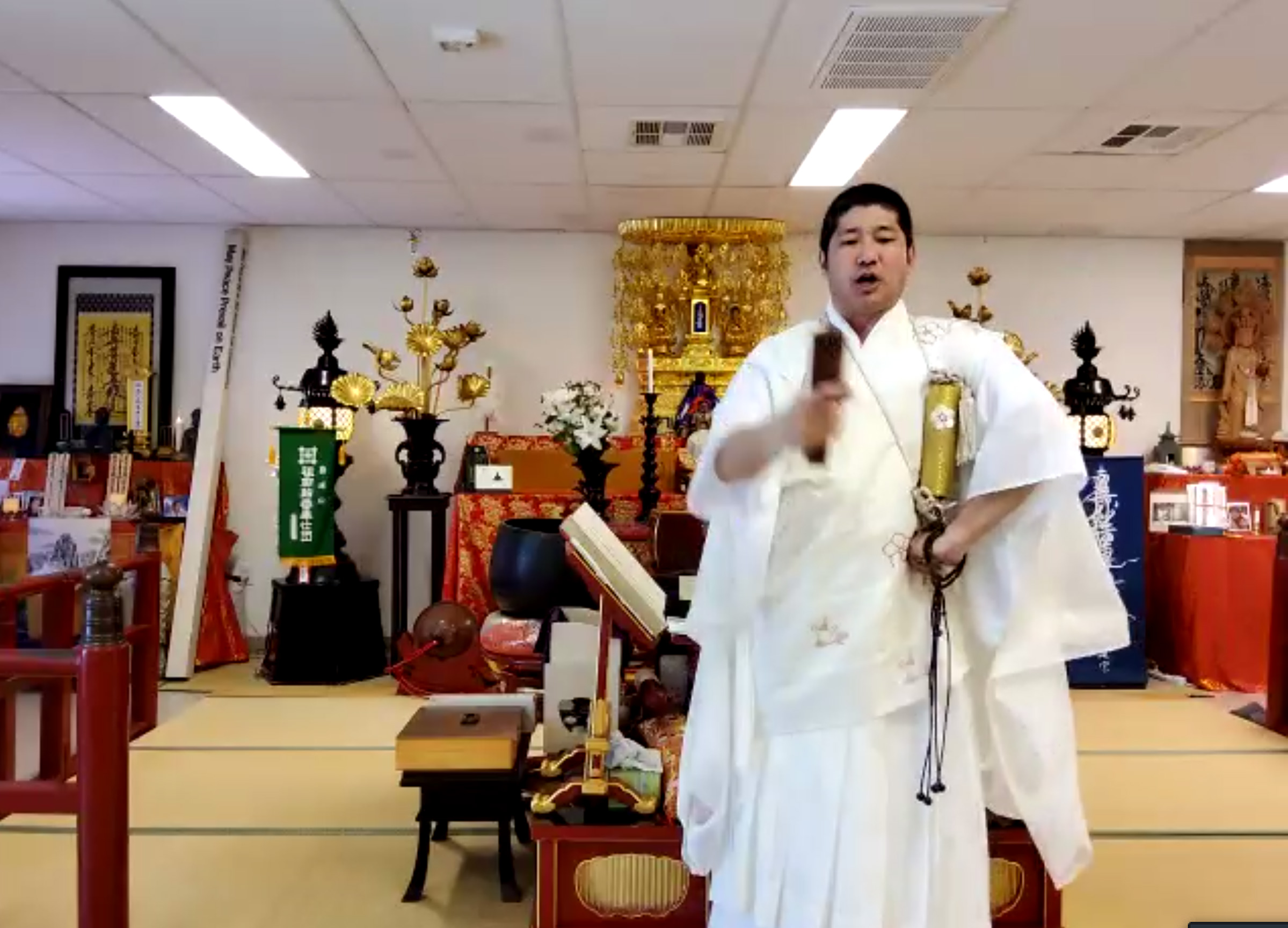
Shoda Kanai, Nichiren Buddhist Kannon Temple of Nevada, Las Vegas
Shoda Kanai performs Kaji Kito ceremony online from Nichiren Buddhist Kannon Temple of Nevada in Las Vegas

Very much enjoyed attending Rev. Shoda Kanai’s online Kaji Kito ceremony today. During this period of sheltering in place, I’ve enjoyed the opportunity to experience the Nichiren Buddhist Kannon Temple of Nevada in Las Vegas services.

Kaji Kito services are monthly events at the Sacramento Nichiren Buddhist Church and so I’m familiar with the ritual. Unlike Sacramento’s service, Rev. Shoda Kanai’s ceremony includes recitation by the congregation of a Prayer of Repentance. One of the values of such a prayer is its illustration of what is considered good and bad behavior. What should I be mindful of?

Prayer of Repentence

Repentance is the mysterious medicine which cures illness and the Secret Dharma to change one’s fate.

If we wish to cure terrible disease or transform evil karma, then we should repent our sins.

The law of cause and effect is strictly impartial and impossible to escape. Since even minute transgressions bring about dreadful effects, the great sins of being unfilial, unjust, unfair, unfaithful, unethical, turning one’s back on virtue and forgetting the debts of gratitude that we owe others who have shown us favor, will bring about even worse retribution. The accumulation of these sins becomes the cause for severe disease inviting misfortune and disaster.

Reflecting deeply upon this, I realize that I have perpetuated this behavior since the infinite past. I have become drunk with the wine of illusion which has consequently created unlimited and profoundly evil karma within my life.

For example:
I may have been a child who despised my parents,
A disciple who disgraced his master,
A subject who defied the sovereign,
A husband who oppressed his wife,
A wife who conquered her husband,
A mother-in-law who despised her daughter-in-law,
A daughter-in-law who opposed her mother-in-law,
Or a sibling who erected a wall of disharmony toward another.

I may have shown spite for those who treated me favorably, schemed to take advantage of another’s misfortune, broke a promise, spoke ill of others, lied, spoke recklessly or deceitfully,
Or acted immorally, behaved violently, killed, or stole.
Or my feelings were so strong that I refused to get along or compromise with others,
With feelings so cold that I could not love another,
Or so profoundly vindictive that I bore grudges against others.
Or I may have been unjust and caused others to suffer,
With desires so strong that I had uncontrollable attachment to things.

And I may have committed other various sins, offenses and transgressions which when accumulated, resulted in the manifestation of evil karma. This karma then became the very substance of my bones and flesh which beckoned miserable consequences. Not only did these evil actions give birth to terrible karma, but they set the stage for further commitment of other sins during this lifetime.

This phenomena is just like the person who wears black clothes and refuses to acknowledge the filthy grime around their own collar, or the person who wears white and is dreadfully terrified of even the slightest speck of dirt or impurity.

I must feel, however, profound joy for the one piece of great fortune that I possess. I have been able to encounter the Wonderful Dharma of Myoho-Renge-Kyo which is extremely difficult to encounter.

As I now kneel before the Eternal Buddha, sacred Lord of the Dharma Realm, I am grateful to have been endowed with the heart that is able to deeply repent in order to expiate my sins.

The Sutra states that the vast sea of evil karma is created from illusion to the truth. If I embrace the desire to repent my sins and sit erect in observance of the true aspects of life, I will see that the offenses of mankind are just as frost and dew which dissipate in the warm rays of the sun.

I sincerely repent my offenses, heartily praying that the ray of Namu-Myoho-Renge-Kyo that I chant and embrace, will shine its sacred light on the true aspects of my life.

I further pray that my evil karma which I myself have created since the infinite past be expiated, that I may quickly be saved from the suffering of illness, that my fixed evil karma be transformed and that I am granted the great benefit of peaceful existence throughout this lifetime.

This I sincerely pray, mindful of all that has been mentioned.

Now we agree to disagree on some of these. “A wife who conquered her husband?” If I raised this topic at home I’d get plenty of argument from my wife. And, of course, there are times, like the present, when it is every citizens’ duty to “defy the sovereign” and recognize institutionalized wrongs. Silence is complicity.

Keeping those anachronisms in mind, I’m going to include this prayer with my recitation of The Sutra of Contemplation of the Dharma Practice of Universal Sage Bodhisattva, which follows Day 32 in my 32 Days of the Lotus Sutra practice. Perhaps I’ll also include another Las Vegas innovation, the Reidan Daimoku Hand Gestures. I’m still unable to complete a full cycle without missteps.

Four Reliances

How can Nichiren insist that the Lotus Sūtra is the only sole sūtra that is difficult to receive and keep, read, recite, expound, and copy in the Latter Age after the Buddha’s passing?

In order to evaluate these claims, Nichiren refers to the first and last of the “four reliances” taught by the Buddha in the Mahāyāna Mahāparinirvāṇa Sūtra as a guide for discerning the meaning of Buddhist teachings. The four reliances are to: “Rely on the Dharma and not upon persons; rely on the meaning and not upon the words; rely on wisdom and not upon discriminative thinking; rely on sūtras that are final and definitive and not upon those which are not final and definitive.” (see Yamamoto, p. 153)

Nichiren takes the four reliances to mean that one should not trust the word of even great bodhisattvas like Samantabhadra or Mañjuśrī unless they are preaching with the sūtras in hand. Nichiren cites Nāgārjuna (late second to early third century), Zhiyi (538-597), Saichō (767-822; also known as Dengyō), and even Enchin (814-891; aka Chishō) who all state that one should only follow commentaries that accord with what is taught in the sūtras and furthermore that one should not believe in oral transmissions. All of these teachers are considered to be patriarchs of the Tiantai/Tendai school and therefore Nichiren is showing that the interpretations of the Tiantai school can be relied upon because they follow the principles of the four reliances. Nichiren’s contention is that the other schools of Buddhism were straying from these principles, because of sectarian pride in their own particular doctrines and methods. Though it might seem ironic to those who believe that Nichiren was himself a sectarian polemicist, he wrote, “Surely, those who aspire to enlightenment should not be biased, stay away from sectarian quarrels, and not despise other people.” (Hori 2002, p. 85) Nichiren did not see himself as trying to promote his own narrow view, or even the particular views of the Tiantai school. Rather, Nichiren was trying to find in the sūtras themselves the criteria for judging the relative merits of various Buddhist teachings. He believed that he had found such a criteria in the four reliances and in the statements of the Lotus Sūtra regarding its own supremacy. Nichiren’s conviction was that in China only the Tiantai school had upheld what the sūtras actually teach, and that in Japan, only Saichō and himself had properly passed on this teaching without distorting or compromising it.

Open Your Eyes, p490-491

Receiving Śākyamuni Buddha’s Merit of Practicing

I fear that I may debase these passages if I try to interpret them, but I dare do so in order to answer your question. The gist of these passages is that Śākyamuni Buddha’s merit of practicing the bodhisattva way leading to Buddhahood, as well as that of preaching and saving all living beings since His attainment of Buddhahood are altogether contained in the five words of myō, hō, ren, ge, and kyō and that consequently, when we uphold the five words, the merits which He accumulated before and after His attainment of Buddhahood are naturally transferred to us.

Kanjin Honzon-shō, A Treatise Revealing the Spiritual Contemplation and the Most Verable One, Writings of Nichiren Shōnin, Doctrine 2, Page 146

Daily Dharma – June 7, 2020

These men and women are great Bodhisattvas. They should be considered to have appeared in this world by their vow to expound the Sūtra of the Lotus Flower of the Wonderful Dharma out of their compassion towards all living beings, although they already attained Anuttara-samyak-saṃbodhi [in their previous existence].

The Buddha declares these lines to Medicine-King Bodhisattva at the beginning of Chapter Ten of the Lotus Sūtra. In the teachings of Nirvāṇa, the goal is to remove suffering so that we can be reborn in a peaceful realm. In this Sūtra, the Buddha reminds us that we who keep this Sūtra have given up the privilege of higher realms so that we can benefit beings where we find ourselves now. We do not fear rebirth in lower realms since our compassion takes us even there so we can benefit beings in those realms.

The Daily Dharma is produced by the Lexington Nichiren Buddhist Community. To subscribe to the daily emails, visit zenzaizenzai.com