
All posts by John Hughes

Day 6

Day 6 continues Chapter 3, A Parable

Having last month considered the expedient used to convince the children to escape the burning house, we consider the rich man’s decision to give large carts of treasures to his children.

Seeing them come out
Of the burning house
To the safe crossroad,
He sat on the lion-like seat,
And said to others with joy:
“I am happy.
These children are difficult to bring up.
They are young and ignorant.
They entered the dangerous house.
In that house were
Many poisonous vermin
And many dangerous mountain spirits.
Raging flames of big fires rose
From the four sides of the house
At the same time.
But my children were
Engrossed in playing.
Now I saved them
From the dangers.
Therefore, I am happy.”

The children saw their father
Sitting in peace.
They came to him,
And said:
“Give us
The three kinds of jeweled carts
That you promised us!
You said:
“Come out, and I will give you
The three kinds of carts as you like.”
Now is the time for that.
Give them to us now!”

He was a very rich man.
He had many storehouses.
He made many large carts
Adorned with treasures,
Such as gold, silver,
Lapis lazuli, shell and agate.

[The carts] were beautifully adorned.
Railings were put around them.
Bells were hanging on the four sides
With ropes of gold.

[The carts] were roofed
With nets of pearls.
Garlands of golden flowers
Were hanging on all sides.

Other ornaments of fabrics
Of divers colors
Encircled the bodies of the carts.
Bedding was made of soft cloth.
[The bedding] was covered
With the most wonderful woolen fabrics.
They were bright, white, pure and clean,
Worth hundreds of thousands of millions.

Large white bullocks,
Fat, stout, powerful,
And beautiful in their build,
Were yoked to the jeweled carts.
The carts were also guarded
By many attendants.

[The rich man] gave to each of his children
One of these wonderful carts.
The children
Danced with joy.

They drove these jeweled carts
In all directions.
They were happy and delighted.
Nothing could stop their joy.

The Unity of All Buddhism is one perspective on this:

Great Master Chih-i extolled the teaching of the One Vehicle as the unifying principle of Buddhism, presenting it as the doctrine which “opens the Three to reveal the One (Vehicle)” or “encompasses the three with the One.” Since the Three Vehicles symbolize all the sects of Buddhism united through this principle, the One Vehicle could also mean the unity of all the religions of the world, non-Buddhist as well as Buddhist.
Introduction to the Lotus Sutra
Five Periods of Buddha’s 50 Years of Teaching

The Tiantai school divided the Buddha’s fifty years of teaching into five periods of varying degrees of profundity. The first period occurred during the first few weeks that Śākyamuni Buddha sat beneath the Bodhi Tree. During that time, he taught the Flower Garland Sūtra, although Nichiren points out later in Kaimoku-shō that it would be more accurate to say that it was the bodhisattvas who were present that actually did the teaching. Starting with the discourse on the Four Noble Truths taught at the Deer Park to the five ascetics, Śākyamuni Buddha spent twelve years teaching the pre-Mahāyāna (aka Hinayāna) teachings found in the Āgama sūtras. After that he spent eight years teaching the preliminary Mahāyāna teachings of the Vaipulya or Expanded sūtras. He taught the Perfection of Wisdom sūtras during the twenty-two years that followed that. For the last eight years of his life, the Buddha taught the Lotus Sūtra. On the very last day and night of his life the Buddha taught the Mahāyāna Mahāparinirvāṇa Sūtra. It should be noted that even Nichiren points out in other writings that these time spans are uncertain. In any case, modern textual scholarship would dismiss all of this as arbitrary, especially since the Mahāyāna sūtras are now seen as compositions arising after the Buddha’s lifetime. Nevertheless, Mahāyāna Buddhism accepts these sūtras as embodying the word of the Buddha in the sense that they convey the full depths of the Buddha’s insight and compassion. The Tiantai system of classifying the sūtras into five periods of teaching can still be seen as a useful way of approaching the sūtras in terms of how they build upon one another and lead those who put them into practice into deeper and subtler insights.

Open Your Eyes, p138-139

Complete Agreement with the Lotus Sūtra

[I]n the Lotus Sūtra we find many things mysterious and difficult to believe. Yet when we think of doubting the Lotus Sūtra, the Buddha of Many Treasures testified it to be true, Lord Preacher Śākyamuni Buddha Himself declared it to be His direct and true words, and the Buddhas in manifestation throughout the universe extolled it by extending their wide and long tongues to the Brahma Heaven. This is like a father’s letter of conveyance attached by a mother’s signed deed and approved by a wise king. When they are in complete agreement, how can anyone doubt this?

Matsuno-dono Goshōsoku, Letter to Lord Matsuno, Writings of Nichiren Shōnin, Volume 7, Followers II, Page 66

Daily Dharma – April 27, 2020

Evil people in the future will doubt the One Vehicle
When they hear it from a Buddha.
They will not believe or receive it.
They will violate the Dharma, and fall into the evil regions.

The Buddha declares these verses in Chapter Two of the Lotus Sūtra. Nichiren wrote that while some people think hell is below the earth, it is really contained in our own bodies and minds. If we cannot believe or accept the Dharma the Buddha teaches us, then we are not seeing the world for what it is. We are creating worlds of our own separate from the Buddha’s world. We create worlds of greed, anger and ignorance, in which it is even more difficult to hear the Dharma. But even in these difficult worlds, the Buddha exists and works to benefit us. If we remember to look for him, he will show us the way out.

The Daily Dharma is produced by the Lexington Nichiren Buddhist Community. To subscribe to the daily emails, visit zenzaizenzai.com

Day 5

Day 5 begins Chapter 3, A Parable

Having last month considered the Buddha’s past efforts to lead Śāriputra to unsurpassed enlightenment, we hear the prediction for Śāriputra’s future buddhahood.

“Śāriputra! After a countless, inconceivable number of kalpas from now, you will be able to make offerings to many thousands of billions of Buddhas, to keep their right teachings, to practice the Way which Bodhisattvas should practice, and to become a Buddha called Flower-Light, the Tathāgata, the Deserver of Offerings, the Perfectly Enlightened One, the Man of Wisdom and Practice, the Well-Gone, the Knower of the World, the Unsurpassed Man, the Controller of Men, the Teacher of Gods and Men, the Buddha, the World-Honored One. The world of that Buddha will be called Free-From-Taint. That world will be even, pure, adorned, peaceful, and fertile, where gods and men will prosper. The ground of that world will be made of lapis lazuli; the roads will fan out from the center to the eight directions. Those roads will be marked off by ropes of gold, and the trees of the seven treasures on the roadsides will always bear flowers and fruit. Flower-Light Tathāgata will also lead the living beings [of his world] by the teaching of the Three Vehicles.

“Śāriputra! Although the world in which he appears will not be an evil one, that Buddha will expound the teaching of the Three Vehicles according to his original vow. The kalpa in which he appears will be called Great-Treasure-Adornment. Why will it be called Great-Treasure-Adornment? It is because in that world Bodhisattvas will be regarded as great treasures. The number of the Bodhisattvas [in that world] will be countless, inconceivable, beyond any mathematical calculation, beyond inference by any parable or simile. No one will know the number except the Buddha who has the power of wisdom. When those Bodhisattvas wish to go somewhere, jeweled flowers will receive their feet and carry them. Those Bodhisattvas will not have just begun to aspire for enlightenment. A long time before that they will have already planted the roots of virtue, performed the brahma practices under many hundreds of thousands of billions of Buddhas, received the praises of the Buddhas, studied the wisdom of the Buddhas, obtained great supernatural powers, and understood all the teachings of the Buddhas. They will be upright, honest, and resolute in mind. The world of that Buddha will be filled with such Bodhisattvas.

“Śāriputra! The duration of the life of Flower-Light Buddha will be twelve small kalpas excluding the period in which he was a prince and had not yet attained Buddhahood. The duration of the life of the people of his world will be eight small kalpas. At the end of his life of twelve small kalpas, Flower-Light Tathāgata will assure Resolution-Fulfillment Bodhisattva of his future attainment of Anuttara-samyak-saṃbodhi, saying to the bhikṣus, ‘This Resolution-Fulfillment Bodhisattva will become a Buddha immediately after me. He will be called Flower-Foot-Easy-Walking, the Tathāgata, the Arhat, the Samyak-sambuddha. His world will be like mine.’

“Śāriputra! After the extinction of Flower-Light Buddha, his right teachings will be preserved for thirty-two small kalpas. After that the counterfeit of his right teachings will be preserved also for thirty-two small kalpas.”

The significance of this prediction for Nichiren is outlined in Two Buddhas Seated Side by Side:

In the Lotus Sūtra’s narrative, Śāriputra is the first śrāvaka to receive the Buddha’s prediction of his future buddhahood. “When Śāriputra heard this,” Nichiren wrote, “he not only cut off the illusions arising from primal ignorance and reached the stage of the true cause [for liberation] but was acclaimed as the [future] tathāgata Padmaprabha [Lotus Light]. … This was the beginning of the attainment of buddhahood by all beings of the ten realms.”

For Nichiren, … the Lotus Sūtra’s message that persons of the two lesser vehicles could attain buddhahood was not about extending this possibility to a group of previously excluded individuals but, rather, established the mutual inclusion of the ten realms as the ground that, for the first time, opened buddhahood as a real possibility to anyone.

Two Buddhas, p82

Zoom Day

Don’t know exactly what prompted this extravagance but I decided to attend three Nichiren Shu services today.

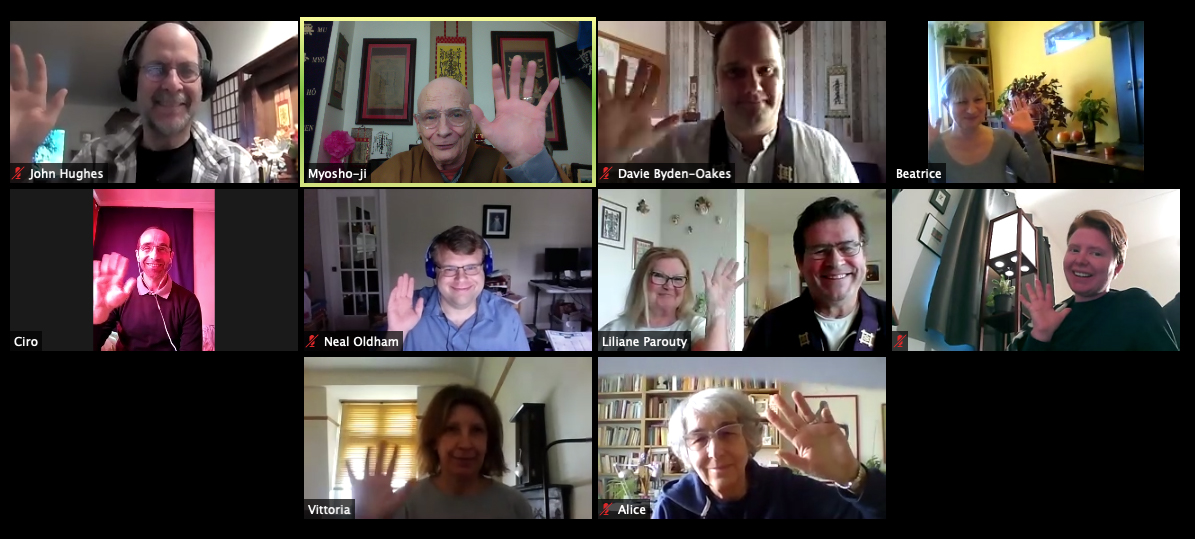
I got up at 6am to do my own personal service so that I would have time to join Rev. Ryusho Jeffus’ Myoshoji service at 7 am. And I was immediately happy I did so because today was the Jukai, Taking of Vows, for two long-time members of Ryusho’s virtual sangha, Davie Byden-Oaks, from London, and Neal Oldham, from North Carolina.


Joining Ryusho in Syracuse, NY, were Myoshoji regulars from Portugal, Czech Republic, France, England and the United States.

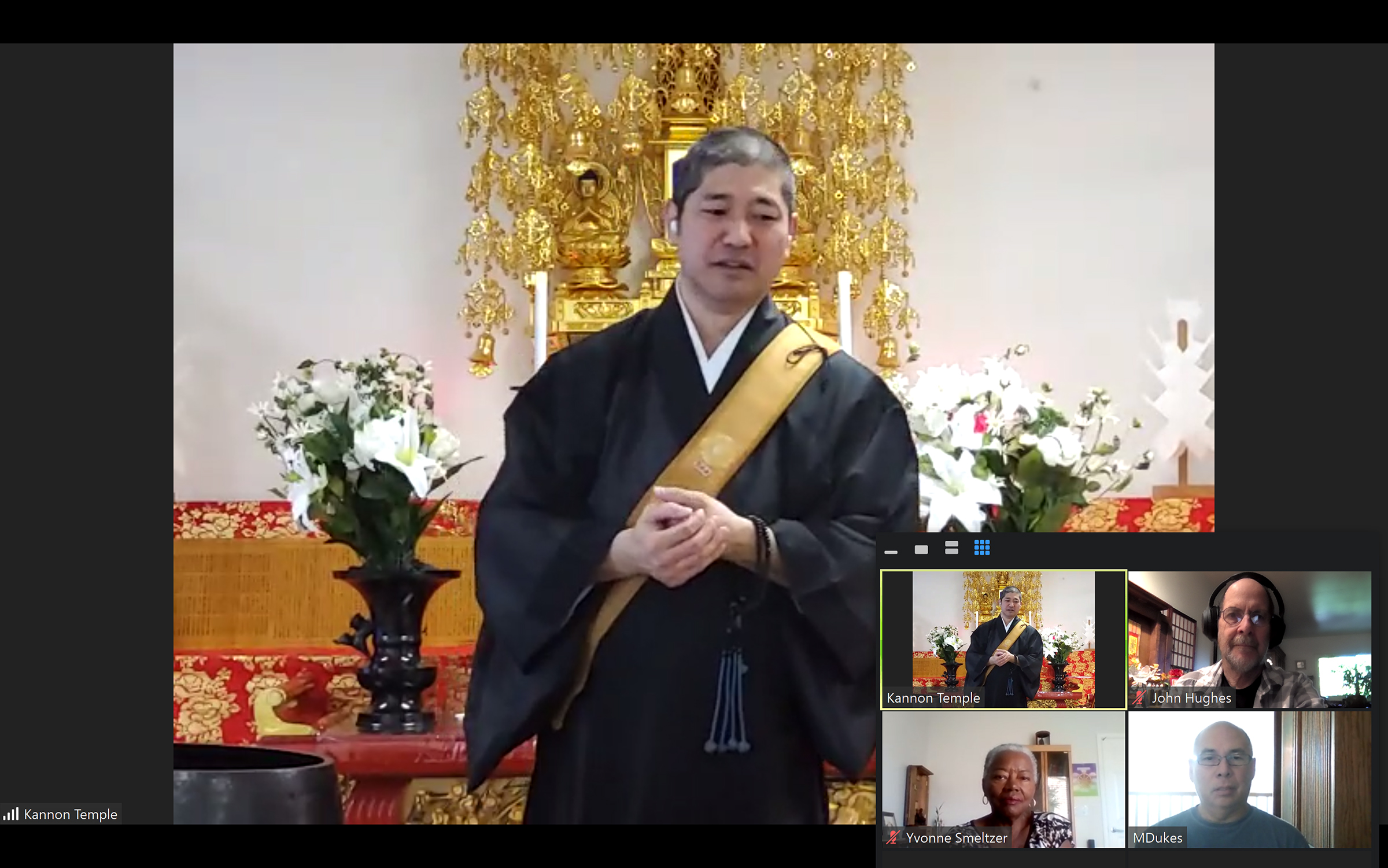
Following that I had time for a quick nap before joining Rev. Shoda Kanai of the Las Vegas Kannon Temple for a Shodaigyo service at 10:30am.
2020-04-26_LasVegas
This was my first time visiting Las Vegas. I tried to join last week, but I had difficulty getting the password for the Zoom session right. This time everything went as expected and I enjoyed the change of pace with the Shodaigyo service.

The day’s final service was at 12:30pm with the Nichiren Buddhist Sangha of the San Francisco Bay Area.
2020-04-26_bay-area
Rev. Ryuei McCormick and Shami Mark Herrick held the annual Nichiren Shu Founding Day Ceremony, marking the date on April 28, 1253, when Nichiren, from atop Mount Kiyosumi, greeted the rising sun with 10 Daimoku.

As with all services involving Ryuei, guests from as far away as Georgia and Oregon were treated to an excellent discussion of the Vimalakirti Sutra, a part of his ongoing Buddhist Study Program lectures.

The Buddha’s Greatest Desire

The Buddha calls upon us to not seek this enlightenment outside of our lives but to realize that we already are equal to the Buddha the difference being that the Buddha has awakened to this truth and we have not yet done so. The Buddha, in teaching the Lotus Sutra, seeks to remove the imaginary barrier that we think exists between our lives and Buddhahood. The Buddha is telling us that his greatest desire is that we manifest a life equal to that of all Buddhas.

Lecture on the Lotus Sutra

Eight Phases of Śākyamuni’s Life

Nichiren sometimes alludes to the eight phases of Śākyamuni Buddha’s life. This is a way of summing up the story of the Buddha in the following eight events:

  1. Descent from the Tushita Heaven — Before his last earthly rebirth, the future Buddha lived in the Heaven of Contentment (Skt. Tuṣita) awaiting the right time, place and family for his final rebirth.
  2. Entering Queen Māyā’s womb — When the right conditions arose Queen Māyā of Kapilavastu had a most singular dream. She dreamed that a six-tusked white elephant holding a white lotus flower in its trunk circled around her three times and then entered into her womb. At that moment Queen Māyā conceived the bodhisattva.
  3. Emerging from Queen Māyā’s womb—Queen Māyā gave birth to him painlessly while standing up and holding onto a sal tree branch while visiting the Lumbini Garden near Kapilavastu. The legend states that immediately upon entering the world, the young Prince Siddhārtha took seven steps and made the following statement: “I am born for awakening for the good of the world; this is my last birth in the world of phenomena.” (Asvaghosa’s Buddhacarita, part Il, p. 4)
  4. Leaving home— After witnessing an old man, a sick man, a funeral procession, and a religious mendicant, Prince Siddhārtha left his family (his father King Suddhodana, his wife Yaśodharā, and his son Rahula) and became an forest ascetic.
  5. Overcoming Māra — After turning away from asceticism, the bodhisattva sat beneath the Bodhi Tree at Bodhgaya and overcame temptations and distractions of the demon Māra.
  6. Attaining the Way—As the morning star (Venus?) rose in the morning sky, the bodhisattva attained buddhahood and henceforth became known as Śākyamuni Buddha.
  7. Turning the Wheel of the Dharma —Starting at the Deer Park near the city of Vārāṇasi, the Buddha began to teach the Dharma and continued to do so for fifty years.
  8. Entering final nirvāṇa —At the age of eighty, the Buddha passed away beneath the twin sal trees near the city of Kuśinagara.
Open Your Eyes, p137-138

The Difficulty of the Lotus Sūtra

In the “Life Span of the Buddha” chapter of the Lotus Sūtra the Buddha preaches about Himself, “I have been the Buddha since the eternal past, 500 (million) dust-particle kalpa (aeons).” We, ordinary beings, do not remember things in the past even things that occurred after our birth. How much more so can we remember things in the past life or two! How can we believe anything that took place as far away in the past as 500 million dust-particle kalpa ago?

The Buddha also spoke to His disciple Śāriputra predicting his future Buddhahood, “You will become a Buddha in the future after passing numerous and unimaginable number of kalpa (aeons). You will then be called the Flower Light Buddha.” Predicting the future of Mahā-Kāśyapa, the Buddha stated, “In a future life, you will become a Buddha named the Light Buddha during your last incarnation.”

These scriptural statements, however, are the predictions of the future, which does not seem possible for us ordinary people to put faith in. Therefore, this Lotus Sūtra is difficult for us, ordinary men and women, who have no knowledge of things in the past or in the future. Hence it does not make sense for us to practice the Lotus Sūtra. Yet it may be possible for some people to believe this Lotus Sūtra if there was someone at present who could present factual proofs to people in front of their very eyes.

Hōren-shō, Letter to Hōren, Writings of Nichiren Shōnin, Volume 6, Followers I, Page 50

Daily Dharma – April 26, 2020

If after my extinction anyone rejoices, even on a moment’s thought, at hearing even a gāthā or a phrase of the Sūtra of the Lotus Flower of the Wonderful Dharma, I also will assure him of his future attainment of Anuttara-samyak-saṃbodhi.

The Buddha declares these lines to Medicine-King Bodhisattva at the beginning of Chapter Ten of the Lotus Sūtra. Other teachings had described beings becoming enlightened after making exorbitant offerings or strenuous practices over many lifetimes. In the teaching of the Wonderful Dharma, a single moment of joy at hearing the Dharma is enough to assure us that we will become enlightened.

The Daily Dharma is produced by the Lexington Nichiren Buddhist Community. To subscribe to the daily emails, visit zenzaizenzai.com