 In my blog post on Nikkyō Niwano and the Lotus Sutra I made a passing reference to “what Risshō Kōsei-kai did to the Lotus Sutra when it re-edited its English translation of the Threefold Lotus Sutra.” Here’s what I was referencing.
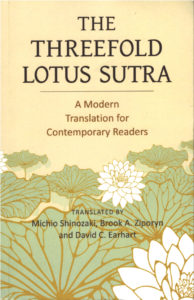
Kosei Publishing, the publishing arm of Risshō Kōsei, published in 2019 “The Threefold Lotus Sutra: A Modern Translation for Contemporary Readers.” The work is translated by Michio Shinozaki, Brook A. Ziporyn and David C. Earhart. The new edition replaced “The Threefold Lotus Sutra,” first published by Kosei Publishing in 1975.
Michio Shinozaki declares the goal of the new translation in the Preface to this edition:
[E]very classic has to be reborn according to the demands of time, and The Threefold Lotus Sutra is no exception. Owing to significant revision, this magnificent sutra is now reborn as a newly translated publication for people today. This translation responds to the needs of the twenty-first century, in which both the study and the practice of Buddhism have spread far beyond traditional Buddhist cultures, and people of all races, ethnicities, genders, and walks of life throughout the world are turning to Buddhism in ever greater numbers to find spiritual solace and bring meaning to their lives. In the context of a truly globalized Buddhism, two of the most important demands of our time are, first, an English translation suitable to the fundamental Buddhist practice of daily sutra recitation, and second, a translation that renders potentially discriminatory language and ideas, which often appear in ancient religious classics, in ways appropriate to the overall spirit of the text, the fundamental principles of Buddhism, and contemporary notions of equality and human dignity.
The Threefold Lotus Sutra (2019), pxiv
In the Introduction to the new edition, Brook A. Ziporyn expands on the reasoning behind the modernization.
The Lotus Sutra categorically affirms our unity with the Buddha: all of us, regardless of who we are or the circumstances of our birth in this world, will absolutely become buddhas. However, this positive message of universal liberation is, at times, undercut by language and expressions that may cause readers to doubt the Lotus Sutra’s dedication to the equality of all living beings as well as its respect for the dignity of life. I therefore would like to touch upon one of the most difficult and delicate issues to which this translation of the Threefold Lotus Sutra responds: potentially offensive or seemingly discriminatory words and phrases within the text itself. A correct understanding of these passages necessarily depends on the way we interpret and make sense of such expressions. As Dr. Earhart mentions in the textual notes on the translation (see below), we endeavored to create a well-balanced translation that takes into consideration both adherence to textual integrity and the spiritual requirements of readers today.
Let me point out a few examples. By using auxiliary verbs we mitigated some passages in chapter 3 that could be taken to imply that physical impairments are punishment for having slandered the sutra. One line of this section reads:
“Even if they [people who slander this sutra] can become human beings,
They may be unhearing, unseeing, and mute,
Or wrap themselves in
Poverty and decay.”
We are under no obligation to interpret such expressions literally, and as is often the case with sacred literature, reading these kinds of passages allegorically allows us to reconcile them with the overall spirit of the text and our commitment to human rights and the dignity of all life. Accordingly, we should understand this line of the sutra as a precaution against slandering the Dharma, which makes people deaf or blind in a spiritual sense and causes them to suffer the poverty of not knowing the Buddha’s teaching and being unable to attain happiness.
The Threefold Lotus Sutra (2019), pxx-xxi
I agree that the alternate meaning offered fits fully with the intent of the Lotus Sutra. However, such a translation ignores the most basic teaching of Buddhism, a teaching affirmed by the Lotus Sutra. Our provisional existence is the sum of our past causes and the conditions in which we exist. Our physical impairments must be included, otherwise we open the door to the chaos outside the law of cause and effect. Yes, it is more socially acceptable to say my Dyslexia is just a product of a random combination of genetic material when my father’s seed fertilized my mother’s egg. And yet, personally, I would rather accept that I don’t know what past causes I made, and instead focus on the assurance I am given in the Lotus Sutra that the causes that I make will affect my future — in this lifetime and the next.
In his Notes on the Translation, David C. Earhart explains:
Changes were made in this new translation based on the following four criteria.
One: Modernize the language to reflect current usage and common understanding. …
Two: Bring as much accuracy as possible to the translation by following the standard definitions of words and phrases, key terminology in particular. …
Three: Make the language more inclusive and avoid phrases that could be construed as prejudicial. To this end, gender-neutral language has been privileged throughout the text, which will be discussed below. Doctrinal terminology closely tied to other religious traditions has been avoided. For instance, “salvation” has been replaced with “liberation”; “repent” with “acknowledge and express remorse” and “repentance” with “acknowledgment and remorse”; and “creatures” with “living beings.”
We have tried to open a larger window for freer interpretation of some of the more controversial passages, taking inspiration from chapter 12, where the reader is first confronted with the notion (widely accepted in Asia at the time of the sutra’s exposition and compilation) that the female body is an unacceptable vehicle for Supreme Perfect Awakening but then encounters the remarkably protofeminist refutation of this patently bogus supposition. Indeed, the concept of skillful means (Chn., fang bian; Jpn., hoben), so carefully laid out in the first several chapters of the Sutra of the Lotus Flower of the Wondrous Dharma, supports these minor liberties within the text. Many of these changes toward a more gender-neutral translation, including comparisons to more traditional versions of the passages in question, are discussed in detail in the endnotes.
Four: Provide a translation that lends itself to being read aloud. …
The Threefold Lotus Sutra (2019), plvii
Some examples
In describing Pūrṇa’s future Buddha realm in Chapter 8, the Buddha says:
“There will be no evil ways and no womankind, [for] all living beings will be born transformed and have no carnal passion.
The Threefold Lotus Sutra (1975), p 172
and in gāthās:
“Joy in the Law and pleasure in meditation
Shall be their food, with no thought of other;
No womankind will be there,
Nor any evil ways.”
The Threefold Lotus Sutra (1975), p 175
In the new translation we get:
“In that land, there will be no gender distinction, for all living beings there will come into existence by transformation, free of carnal desire.”
The Threefold Lotus Sutra (2019), p191
and in the gāthās:
“Rejoicing in the Dharma and delighting in meditation
Will be their food, and they will think of no other.
There will be no carnal temptations in that place,
Nor any evil paths.”
The Threefold Lotus Sutra (2019), p194
In Chapter 23, the Former Deeds of the Bodhisattva Medicine-King:
“His domain had no women, no hells, no hungry ghosts, no animals, no asuras, no disasters…”
The Threefold Lotus Sutra (1975), p304
In the new translation we get:
“His domain was free of gender distinction. It had no hells, no hungry spirits, no beasts, no asuras and no perils.”
The Threefold Lotus Sutra (2019), p336
And later in Chapter 23:
“Star Constellation King Flower! If there be anyone who hears this chapter of the former deeds of the Medicine King Bodhisattva, he will also obtain infinite and boundless merits. If there be any woman who hears this chapter of the former deeds of the Medicine King Bodhisattva and is able to receive and keep it, she, after the end of her present woman’s body, will not again receive [one]. If, after the extinction of the Buddha, in the last five hundred years, there be any woman who hears this sutra and acts according to its teaching, at the close of this life she will go to the Happy World, where Amita Buddha dwells, encompassed by his host of great bodhisattvas, and will [there] be born in the middle of a lotus flower upon a jeweled throne. Never again will he be harassed by desire, nor be harassed by anger and foolishness, nor again be harassed by pride, envy, or uncleanliness, … “
The Threefold Lotus Sutra (1975), p309-310
In the new translation we get:
“Constellation King Flower, if a man hears this chapter of the Former Deeds of the Bodhisattva Medicine King, he will receive infinite and boundless merits. If a woman who hears this chapter of the Former Deeds of the Bodhisattva Medicine King is able to receive and embrace it, then after her present female body comes to its end, she will not receive another one in the next lifetime.
If, in the last five-hundred-year period following the Tathagata’s passing, a woman who hears this sutra practices it as taught, at the end of her lifetime she will go to the world of peace and ease where Amitabha Buddha resides surrounded by a multitude of great bodhisattvas. There she will be born upon a jeweled seat within a lotus flower, never again to be vexed by greed, anger, and ignorance, or be troubled by such defilements as arrogance and envy.
The Threefold Lotus Sutra (2019), p342-343
A footnote on this change says:
In an earlier passage in this chapter, the absence of female bodies in a buddha’s purified domain was understood to mean the absence, in that world, of gender distinctions and desires associated with them. In other words, freedom from gender is itself a form of purity. In this passage, however, gender plays a very different role. Here, the description of a woman who “is able to receive and embrace” the sutra and therefore be freed from further rebirth in a female body in subsequent lives is something of a refutation of prejudices against women in historical Indian society. The meaning of this passage can only be fully appreciated when understood in the context of this historical background: despite this traditional Indian view of women being inferior to men and therefore undergoing greater suffering, this passage affirms that women can, indeed, reach the same state of awakening as men, as the following sentence discusses the merit of women who practice the sutra as taught and therefore attain rebirth in Amitabha’s land of peace and bliss. One historical interpretation of these two sentences was to read them together, such that a woman’s not receiving a female body becomes a function of being reborn in the pure land of Amitabha, which at the time of the sutra’s compilation, was a message of equality put forth in a patriarchal society. Even this understanding presents difficulties for an entirely gender-neutral rendering, however, as the living beings in Amitabha’s pure land are described in other sutras and commentaries as possessing the thirty-two marks of a great person, which include biologically male features, suggesting that the reward for women practicing the teaching is to be reborn in a higher realm but in a male form. As a result of these constraints, the translators rendered this passage “after her present female body comes to its end, she will not receive another one in the next lifetime.” Nonetheless, readers should be aware that this passage, taken together with the story of the dragon king’s daughter attaining Perfect Awakening in chapter 12, has been seen as a positive affirmation that women will attain buddhahood, or rebirth in Amitabha’s pure land, a message of equality that has inspired significant devotion to the text.
The Threefold Lotus Sutra (2019), p425-426
Ignored in the footnote explanation is the decision to have the reward body of the woman reborn in Amitabha’s pure land to be female, thus ignoring the historical meaning of the thirty-two marks of a great person. Still, in this case I am less disturbed by that change. At least the translators didn’t feel compelled to change the transformation that the daughter of the dragon king went through on her way to quickly becoming a Buddha. They did, however, ignore her transformed gender once she began her Bodhisattva practices. Even the old version felt compelled to insert [she] where this now male Bodhisattva “sat on a precious lotus flower, attaining Perfect Enlightenment, with the thirty-two signs and the eighty kinds of excellence, and universally proclaiming the Wonderful Law to all living creatures in the universe.” The Murano translation does a much better job of handling this: “Thereupon the congregation saw that the daughter of the dragon-king changed into a man all of a sudden, performed the Bodhisattva practices, went to the Spotless World in the south, sat on a jeweled lotus-flower, attained perfect enlightenment, obtained the thirty-two major marks and the eighty minor marks [of the Buddha], and [began to] expound the Wonderful Dharma to the living beings of the worlds of the ten quarters.” Needlessly inserting she, as the new version repeatedly does, is not helpful.
The final chapter of the Lotus Sutra, gets several changes:
Moreover, I will give them dhārāṇis, and obtaining these dhārāṇis, no human or nonhuman being can Injure them, nor any woman beguile them.
The Threefold Lotus Sutra (1975), p341
Becomes:
Moreover, I will give them a dharani incantation. Because they will have received this dharani, nonhuman beings will be unable to do them harm or damage, and human beings will be unable to distract or seduce them.
The Threefold Lotus Sutra (2019), p377
A note attached to this sentence offers this defense:
We have rendered the Chinese word nuren, literally, “women,” as “human beings” in accord with our translation policy of gender neutrality, so that “bodhisattvas” in this passage becomes an inclusive term. A traditional reading might suggest that the bodhisattvas are all male and their seducers, female.
The Threefold Lotus Sutra (2019), p427
Elsewhere, the reward received by anyone who copies this sūtra is originally described as involving nymphs. [Murano specifies eighty-four thousand goddesses]
If they only copy it, these when their life is ended will be born in the Heaven Trāyastriṃsá, on which occasion eighty-four thousand nymphs, performing all kinds of music, will come to welcome them, and they, wearing seven-jeweled crowns, will joy and delight among those beautiful nymphs; how much more those who receive and keep, read and recite, rightly remember it, comprehend its meaning, and practice it as preached! If there be any who receive and keep, read and recite it, and comprehend its meaning, when their life is ended the hands of a thousand buddhas will be proffered, that they fear not, neither fall into any evil destiny, [but] go straight to Maitreya Bodhisattva in the Tushita heaven, [where] Maitreya Bodhisattva, possessed of the thirty-two signs, is surrounded by a host of great bodhisattvas and has hundreds of thousands of myriads of koṭis of nymph-followers, amongst whom they will be born. Such are their merits and benefits.
The Threefold Lotus Sutra (1975), p341-342
This reward is changed to become:
“Even if people only copy it, when their lifetimes come to an end, they will be born in Trayastrimsha Heaven, and on that occasion, eighty-four thousand heavenly beings, performing all kinds of music, will be there to welcome them. These people will put on crowns of the precious seven and pleasantly enjoy themselves in the company of refined attendants. How much greater, then, will be the merits and benefits of those who receive, embrace, read, and recite this sutra, rightly bear it in mind, comprehend its meaning, and practice it as taught.
“Those people who receive, embrace, read, and recite it and comprehend its meaning will, when their lifetimes are over, have the hands of a thousand buddhas extended to them. Therefore, they will have no fear and will not fall into an evil state of existence but will proceed directly to the place of Maitreya Bodhisattva in Tushita Heaven. There they will be born in the presence of Maitreya Bodhisattva, who possesses the thirty-two marks and is surrounded by a host of great bodhisattvas, and they will be accompanied by a retinue of hundreds of thousands of millions of heavenly beings. Such will be their merits and benefits.”
The Threefold Lotus Sutra (2019), p328
A note here underscores the deliberate nature of this change:
Taking into consideration gender neutrality—one of the guiding principles of this translation—we rendered three phrases in these two preceding paragraphs as follows: in the first paragraph, the original word tiannu, literally, “female heavenly beings,” was translated “heavenly beings,” and cainu, literally, “female attendants,” was translated “refined attendants”; and in the second paragraph, tiannu, was again translated as “heavenly beings.” Traditionally, the imagery of these two paragraphs would have male practitioners rewarded in a heavenly realm where they would be attended to by female beings, reflecting the patriarchal worldview of ancient Indian society.
The Threefold Lotus Sutra (2019), p427
Back in July 2016, I addressed this chapter’s patriarchal worldview and suggested it might be considered as simply a recruiting tool: “How could the youthful be awakened and their enthusiasm tapped? Perhaps ‘eighty-four thousand goddesses’ could convince some teenaged boys to give up their toys and leave the burning house.”
Something is lost when we take away the historical setting of the Buddha’s teaching. Will this new gender-neutral lesson better make the case for Buddhism today? I’m not convinced.