All posts by John Hughes

Day 28

Day 28 covers all of Chapter 24, Wonderful-Voice Bodhisattva, and concludes the Seventh Volume of the Sutra of the Lotus Flower of the Wonderful Dharma.

Having last month learned of Wonderful-Voice Bodhisattva’s transformations, we consider the great supernatural powers and the power of wisdom obtained by Wonderful-Voice Bodhisattva-mahāsattva.

“Flower-Virtue! This Wonderful-Voice Bodhisattva protects all living beings in this Sahā-World. He transforms himself into one or another of these various living beings in this Sahā World and expounds this sūtra to all living beings without reducing his supernatural powers, [his power of] transformation, and his wisdom. He illumines this Sahā World with the many [rays of light] of his wisdom, and causes all living beings to know what they should know. He also does the same in the innumerable worlds of the ten quarters, that is, in as many worlds as, there are sands in the River Ganges. He takes the shape of a Śrāvaka and expounds the Dharma to those who are to be saved by a Śrāvaka. He takes the shape of a Pratyekabuddha and expounds the Dharma to those who are to be saved by a Pratyekabuddha. He takes the shape of another Bodhisattva and expounds the Dharma to those who are to be saved by that Bodhisattva. He takes the shape of a Buddha and expounds the Dharma to those who are to be saved by a Buddha. He takes these various shapes according to the capacities of those who are to be saved. He shows his extinction to those who are to be saved by his extinction. Flower-Virtue! Such are the great supernatural powers and the power of wisdom obtained by Wonderful-Voice Bodhisattva-mahāsattva.”

See Bodhisattvas Who Meet the Needs of Sentient Beings

Bodhisattvas Who Meet the Needs of Sentient Beings

[Chapter 24] and the preceding, “Bhaiṣajyarāja” [The Previous Life of Medicine-King Bodhisattva] chapter feature bodhisattvas who manifest themselves in a variety of forms in order to meet the needs of sentient beings. Chapter 24 enumerates thirty-four appearances assumed by the bodhisattva Gadgadasvara [Wonderful-Voice Bodhisattva] through his mastery of the samādhi of manifesting all physical forms, the same samādhi attributed to the bodhisattva Sarvarūpasaṃdarśana [Gladly-Seen-By-All-Beings Bodhisattva] in Chapter 23. Chapter 25 similarly lists thirty-three forms assumed by the bodhisattva Avalokiteśvara [World-Voice-Perceiver Bodhisattva]. The phrase “gateway to everywhere” (J. fumon), sometimes translated as “universal gate,” in the title of Chapter 25 refers to precisely this activity by which buddhas and bodhisattvas assume various forms to aid suffering beings. An eleventh-century poem based on this chapter celebrates the universal compassion of Avalokiteśvara:

the world is saved
because no one can shut
the gate to everywhere:
O who will not enter?

Two Buddhas, p239

The Ten Worlds: Heavenly Beings

The world of the heavenly beings is where the gods make their abode. Unlike the Western concept of heaven, however, Buddhist heavens do not refer to a realm of eternal salvation. Rather, they are temporary realms of bliss where all of one’s desires are satisfied. The heavens are also realms of increasing subtlety and refinement, transcending our worldly concepts of time, space, and matter. The heavens are attained as a reward for good deeds, as well as through the cultivation of meditation of other spiritual disciplines. Eventually, however, those in the heavens will have to leave and “come back down to earth.”

Lotus Seeds

Chih-i’s Concept of Perfect Precepts

Chih-i’s concept of a bodhisattva who performed Sudden practices presaged Saichō’s claim that the Perfect precepts were suitable for the bodhisattva who could take a direct path (jikidō) to enlightenment. However, a crucial difference remained between the views of Chih-i and Saichō. Chih-i never attempted to reject the Hinayāna precepts, nor did he argue that ordinations with bodhisattva precepts should precede full Hinayāna ordinations. In the Fa hua hsüan i, he stated that the Hinayāna precepts should be explained in a way which revealed their Mahāyāna contents. According to Chih-i, the bodhisattva who followed Sudden practices perfected and encompassed both the Hinayāna and Mahāyāna precepts. Consequently, the concept of sudden practices did not imply that the Hinayāna precepts were to be rejected.

Besides the concept of a bodhisattva who performed Sudden practices, Chih-i also introduced another concept utilized by Saichō, the Perfect precepts (enkai). The term ‘Perfect precepts’ referred to Chih-i’s classification of Buddhist doctrine into four categories and designated the precepts appropriate for followers of the Perfect teaching. Chih-i equated the Perfect precepts with the precepts of the Buddha. They were realized through meditation, practice, and the development of a mind which was free from passions and thus able to perceive things as they really are (jissōshin). The Perfect precepts were usually not identified in Chih-i’s writings with any particular set of rules such as the precepts of the Fan wang ching (Sūtra of Brahma’s Net), Hinayāna sets or even with the anrakugyō (Serene and Pleasant Activities) of the Lotus Sūtra. Elsewhere, however, Chih-i stated that adherence to the Lotus Sūtra (jikyō) was equivalent to holding the most profound precepts. Such precepts were called absolute (rikai) and were free of specific content. They were realized in two ways. A monk or nun might gradually practice precepts of increasing subtlety until the Perfect precepts were attained, or he or she might attain them in an instant through Sudden practices.

Saichō: The Establishment of the Japanese Tendai School, p224-225

A Variable Transmission for the One Vehicle

Chapter 13, Encouragement for Keeping This Sūtra, opens with Medicine-King Bodhisattva-mahāsattva and Great-Eloquence Bodhisattva-mahāsattva, together with their twenty-thousand attendants who were also Bodhisattvas, vowing to the Buddha that they will keep, read, recite and expound this sūtra in the difficult Sahā world after the Buddha’s extinction.

The Buddha does not reply.

Then after the arhats and śrāvakas and the Buddha’s step-mother and former wife all offer to teach the dharma in other lands outside the Sahā world, the Buddha silently looks “at the eighty billion nayuta Bodhisattva-mahāsattvas. These Bodhisattvas had already reached the stage of avaivartika, turned the irrevocable wheel of the Dharma, and obtained dhārāṇis.” These Bodhisattvas are waiting for the Buddha to command them to keep and expound the Lotus Sūtra.

The Buddha remains silent.

This has always puzzled me. These Bodhisattvas, unlike those in Chapter 15, are not identified as having come from other worlds. Are the “eighty billion nayuta Bodhisattva-mahāsattvas” of Chapter 13 a subset of the “Bodhisattva-mahāsattvas, more than eight times the number of the sands of the River Ganges, who had come from the other worlds” in Chapter 15?

I’ve found an answer to my puzzlement in Two Buddhas Seated Side by Side, although it is hidden behind misleading shorthand in the book.

In the post Bodhisattvas from Other Worlds, I discuss the book’s suggestion that all of the Bodhisattvas who volunteer at the start of Chapter 13 “have arrived from other worlds.”

I posted on the Nichiren Shu group on Facebook the question, “With the exception of Maitreya, are all of the great bodhisattvas listed in Chapter 1, Introductory, from other worlds?”

In response, Michael McCormick said: “As far as I can tell, yes, the bodhisattva’s whose names I am familiar with in that opening passage are bodhisattvas who are of a more cosmic nature and two of them, Avalokitesvara and Mahasthamaprapta are particularly associated as attendants of Amitabha Buddha. I think the idea is that the only bodhisattva officially associated with this particular world is Maitreya Bodhisattva. The Lotus Sutra, being a relatively early Mahayana sutra, is taking the assumed cosmology and personnel of the teachings found in the Agamas and Pali canon and spinning it.”

But I believe the answer is more nuanced, and that nuance is provided by Jacqueline Stone’s explanation of how Nichiren saw the transmission of the Lotus Sūtra.

Chapters Twenty-Three, Twenty-Four, and Twenty-Five describe how specific bodhisattvas display their powers in the world to benefit sentient beings. … From Nichiren’s standpoint, the bodhisattvas appearing in these chapters had received only the general transmission described in the “Entrustment” chapter. Either they had come from other worlds, or they were followers of Śākyamuni in his provisional guise as the Buddha of the trace teaching or shakumon portion of the sūtra. Thus, their work was chiefly confined to the True and Semblance Dharma ages.

Two Buddhas, p236

It is Nichiren’s explanation that “[the Bodhisattvas] had come from other worlds, or they were followers of Śākyamuni in his provisional guise as the Buddha of the trace teaching” that explains why the Buddha does not answer the Bodhisattvas who volunteer to spread the Lotus Sūtra in Chapter 13.

Stone quotes Nichiren’s letter “Kashaku hōbō metsuazai shō” to explain:

As for the five characters Myōhō-renge-kyō: Śākyamuni Buddha not only kept them secret during his first forty-some years of teaching, but also refrained from speaking of them even in the trace teaching, the first fourteen chapters of the Lotus Sūtra. Not until the “Lifespan” chapter did he reveal the two characters renge, which [represent the five characters and] indicate the original effect and original cause [of the Buddha’s enlightenment]. The Buddha did not entrust these five characters to Mañjuśrī, Samantabhadra, Maitreya, Bhaiṣajyarāja, or any other such bodhisattvas. Instead he summoned forth from the great earth of Tranquil Light the bodhisattvas Viśiṣṭacāritra, Anantacāritra, Vlśuddhacāritra, and Supratiṣṭhitacāritra along with their followers and transmitted the five characters to them.

Two Buddhas, p219-220

To shorthand this by saying — as the book does repeatedly — these Bodhisattvas are all from other worlds, distracts the reader from the distinction between the trace teaching and the origin teaching and the significance of the transmission of Namu Myōhō-renge-kyō to the Bodhisattvas who have been the Buddha’s students since the beginningless past.

Paying What I Owe My Country

Encountering this terrible state of the nation, I, Nichiren, studied all the scriptures of Buddhism, in which I found scriptural proofs answering why various prayer services are of no avail, only intensifying disasters. Finally, I could not refrain from composing a written opinion, entitling it the “Risshō ankoku-ron (Treatise on Spreading Peace Throughout the Nation by Establishing the True Dharma).” I submitted this to the late Lay Priest Lord Saimyō-ji (Hōjō Tokiyori ) at eight o’ clock in the morning on the sixteenth day of the seventh month in the first year of the Bunnō Era (1260) through his chamberlain, Lay Priest Yadoya. It was nothing but a way for me to pay for what I owe my country.

Ankoku-ron Gokanyurai, The Reason for Submitting the “Risshō Ankoku-ron,” Writings of Nichiren Shōnin, Doctrine 1, Pages 147

Daily Dharma – Oct. 28, 2019

Only perverted people say:
“All things exist,” or “Nothing exists,”
Or “All things are real,” or “Nothing is real,”
Or “All things are born,” or “Nothing is born.”

The Buddha declares these verses in Chapter Fourteen of the Lotus Sūtra in which he describes the peaceful practices of a Bodhisattva. Hearing these descriptions can be confusing. We think that we have to choose from among these views, and that these are the only views possible. The Buddha shows us another way. When we think of things as either unchanging or nonexistent, we live in a world of either judgement or despair. The Buddha shows us how to value what exists as it is changing and not attach ourselves to our expectations of stability. It is only because we are changing, and the world is changing around us, that we have the potential to become enlightened.

The Daily Dharma is produced by the Lexington Nichiren Buddhist Community. To subscribe to the daily emails, visit zenzaizenzai.com

Day 27

Day 27 concludes Chapter 23, The Previous Life of Medicine-King Bodhisattva.

Having last month learned that this sūtra is a good medicine for the diseases of the people, we conclude today’s portion of Chapter 23, The Previous Life of Medicine-King Bodhisattva.

“Star-King-Flower! Strew blue lotus flower and a bowlful of powdered incense to the person who keep this sūtra when you see him! After strewing these things [to him], you should think, ‘Before long he will collect grass [for his seat], sit at the place of enlightenment, and defeat the army of Mara. He will blow the conch-shell horn of the Dharma, beat the drum of the great Dharma, and save all living beings from the ocean of old age, disease and death.’

“In this way, those who seek the enlightenment of the Buddha should respect the keeper of this sūtra whenever they see him.”

When the Buddha expounded this chapter of the Previous Life of Medicine-King Bodhisattva, eighty-four thousand Bodhisattvas obtained the dharanis by which they could understand the words of all living beings. Many-Treasures Tathāgata in the stupa of treasures praised Star-King-Flower Bodhisattva, saying:

“Excellent, excellent, Star-King-Flower! You obtained inconceivable merits. You asked this question to Śākyamuni Buddha, and benefited innumerable living beings.”

See The Last Five Hundred Years

The Last Five Hundred Years

After the ten analogies and ten similes, the Lotus goes on to extol the merits of embracing the “Bhaiṣajyarāja” chapter [The Previous Life of Medicine-King Bodhisattva] specifically, suggesting that it may have been composed by a group of Lotus practitioners particularly devoted to this bodhisattva. Nichiren, however, read the passage as applying to his own time and to the Lotus as a whole. For example, a statement near the end of this chapter reads, “During the period of five hundred years after my parinirvāṇa, you must spread it far and wide in Jambudvipa [i.e., this world] and not allow it to be destroyed.” The “five hundred years after my parinirvāṇa” here probably indicates the time in which the Lotus Sūtra’s compilers understood themselves to be living, that is, within five centuries of the historical Buddha’s death. But in Kumārajīva’s Chinese translation, “the period of five hundred years after” can also be read as “the last five hundred years.” Nichiren, like other later East Asian interpreters, took this phrase to mean the last of five consecutive five-hundred-year periods following the parinirvāṇa as described in the Great Collection Sūtra (Skt. Mahāsamnipāta Sūtra; Ch. Daji jing, T 397); the “last five hundred years” is predicted to be a time of dissension among the Buddha’s followers, corresponding to the beginning of the mappō era, when the true dharma will be obscured. In other words, Nichiren took this passage as referring to his own, present time. Repudiating the idea that mappō is necessarily an age of Buddhism’s decline, he drew on the third analogy of the “Bhaiṣajyarāja” chapter, which compares the Lotus Sūtra to the moon that outshines all stars. “The blessings of the Lotus Sūtra surpass those of other sūtras even during the two thousand years of the True and Semblance Dharma ages,” he wrote. “But when the spring and summer of the two thousand years of the True Dharma and Semblance Dharma ages are over and the autumn and winter of the Final Dharma age have arrived, then the light of this moon [i.e., the Lotus] will shine even more brightly.” In the sūtra text, the “it” which is to be “spread far and wide” (J. kōsen-rufu) refers specifically to the “Bhaiṣajyarāja” chapter. Nichiren, however, took it as referring to the sūtra itself, and more specifically, to its title or daimoku, Namu Myōhō-renge-kyō.

Two Buddhas, p230-231

2019 Oeshiki Service

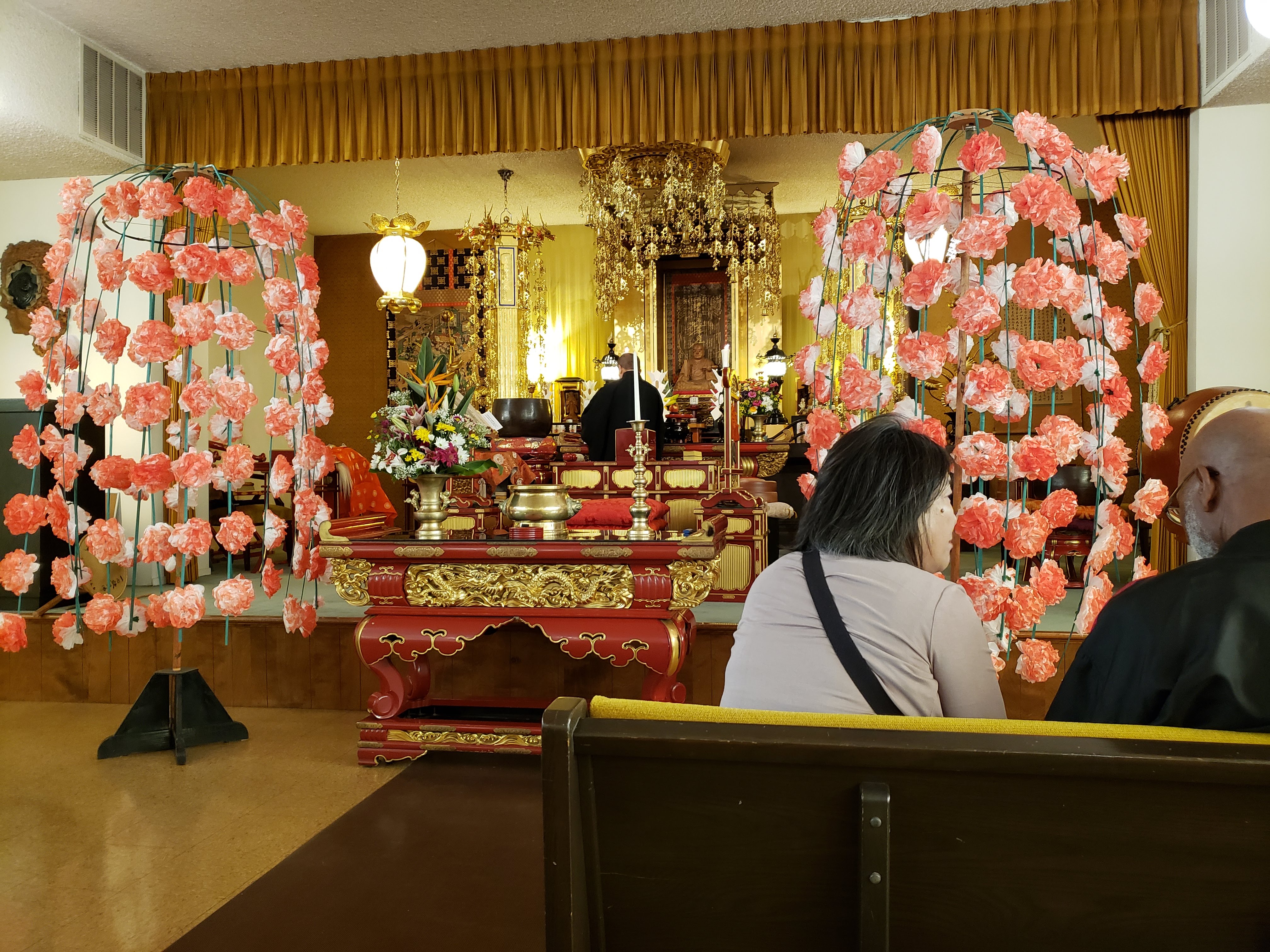
Oeshiki Service decorations

Attended traditional Oeshiki Service today at the Sacramento Nichiren Buddhist Church. The service, which is normally held closer to Oct. 13, Nichiren’s death, was delayed because the Fall Food Bazaar and Rummage Sale was held on Oct. 12.

Following the service everyone adjourned to the social hall for a meal prepared by the fujinkai.