Mind is called the spiritual aspect while voice is the physical aspect. Therefore the spiritual aspect reveals the physical aspect. But it is also possible to perceive the mind by listening to the voice. In this case, the physical aspect (voice) reveals the spiritual aspect (mind)
Nichiren wrote this passage in his Treatise on Opening the Eyes of Buddhist Images, Wooden Statues or Portraits (Mokue Nizō Kaigen no Koto). This is one of the many instructions Nichiren gives us for how to read the Lotus Sūtra and find the wisdom of the Buddha within it. It is easy to understand how the intentions we have in our minds guide our words and actions. By cultivating the intention to benefit all beings, rather than just focusing on making ourselves happy, we mold our speech and actions to accord with that intention. Finding the mind behind the voice is more difficult. When we look for the Buddha speaking to us in all situations, especially those which are demanding, we bring ourselves closer to the Buddha’s own mind. We bring our speech and actions into harmony with the world as it is.
The Daily Dharma is produced by the Lexington Nichiren Buddhist Community. To subscribe to the daily emails, visit zenzaizenzai.com
First, I’m constantly reminded that this is not a Buddhist text but instead an academic text about Buddhism. Grin and bear such slights as:
As we shall see, the Lotus Sūtra is obsessed, perhaps above all, with its own legitimation, with an almost palpable anxiety to prove that it was spoken by the Buddha. That obsession is evident from the first three words of the Sanskrit text: evam mayā ‘rutam, ” thus have I heard.”
Roughly a thousand years after the Lotus Sūtra’s compilation, in an entirely different cultural sphere, the Buddhist teacher Nichiren maintained that now in the time of mappō, the entire sūtra was encompassed in its daimoku or title, and that chanting the title was the chief practice of the Lotus Sūtra for the present era. “Whatever sūtra he expounded,” Nichiren wrote, “the Buddha assigned it a title expressing its ultimate principle.” Today we know that the historical Buddha did not preach, let alone name, the Lotus Sūtra, but the idea that a sūtra’s title embodies its essence was well established in Nichiren’s time.
And I’m just going to ignore the declaration that the “early Buddhist tradition” will be called “mainstream Buddhism,” the choice of modern scholars, we’re told on Page 37. Mahāyāna is not mainstream? Seriously?
But that is not to say I haven’t found nuggets worth picking up and putting in my pocket.
Take for example the discussion of what “mainstream” Buddhists would be shocked by in the first chapter, Introduction.
There is much to ponder here [in Mañjuśrī’s recollection of time long in the past], as the Lotus Sūtra makes a powerful claim for its own authority. The sūtra, which no one has ever heard before, is not new. In fact, it is very old, so old that it has been all but forgotten. It was taught many eons ago, by a buddha so ancient that his name does not appear in the standard list of the previous buddhas. The only familiar name in the story is Dipamkara (16), the first buddha in the list of twenty-five buddhas of the past, according to the Pali tradition.
In that tradition, it was at the feet of Dipamkara that Sumedha, the yogin who would one day become Śākyamuni Buddha, vowed to follow the long bodhisattva path to buddhahood. It was Dipamkara who prophesied that Sumedha would become a buddha named Gautama. Hence, the first buddha known to the collective memory of the tradition was the last son of the last buddha Candrasūryapradipa [the Buddha Sun-Moon-Light in Muran’s translation] to become enlightened. This means that the story told by Mañjuśrī is about events in a past so distant that no record of them exists. In other words, prior even to the time of the buddha Dipamkara, under whom the buddha of our world, Gautama or Śākyamuni, first took his bodhisattva vows, another buddha, Candrasūryapradipa, taught the Lotus Sūtra. Furthermore, Candrasūryapradipa was Dipamkara’s father, placing him in a position of authority, both in age and in lineage, to the first buddha named by the tradition. The Lotus Sūtra is therefore older than any teaching previously known.
And this description of how the shaking of the worlds in Chapter 1 is linked by Nichiren to the devastating quakes of his time:
Nichiren was initially moved to remonstrate with government authorities by the suffering he had witnessed following a devastating earthquake in 1257. It was then that he composed and submitted his treatise Risshō ankoku ron, his first admonishment to persons in power. Initially he saw that earthquake as collective karmic retribution for the error of neglecting the Lotus Sūtra. But over time it came to evoke for him the shaking of “the whole buddha world” (5) in the “Introduction” chapter presaging Śākyamuni’s preaching of the Lotus. Thus the 1257 quake assumed for him a second meaning as a harbinger of the spread of the daimoku of the Lotus Sūtra, the teaching for the Final Dharma age. “From the Shōka era (1257-1259) up until the present year (1273) there have been massive earthquakes and extraordinary celestial portents,” he wrote. “… You should know that these are no ordinary auspicious or inauspicious omens concerning worldly affairs. They herald nothing less than the rise or decline of this great dharma.” Just as the quaking of the earth had presaged the Buddha’s preaching of the Lotus Sūtra, a violent earthquake had preceded his own dissemination of the sūtra and the practice of chanting its daimoku. This is but one example of how Nichiren read the events of his own life and times as mirrored in the Lotus Sūtra.
Chih-i had advanced the correct interpretation of the Lotus Sūtra’s One-vehicle teaching, but the T’ien-t’ai School had been eclipsed by the popularity of the Fa-hsiang School and its Three-vehicle teachings. However, even at the height of the Fa-hsiang School’s popularity and influence, Chinese monks who were versed in Yogācāra doctrine, such as Fa-pao and Lingjun, had argued for a One-vehicle interpretation of Buddhism. Eventually, the One-vehicle teachings of Fa-tsang’s Hua-yen School and the One-vehicle Esoteric teachings of Subhakarasirpha and Vajrabodhi received the support of the state, and the Three-vehicle teachings were vanquished. As Saichō declared in the Shugo kokkaishō: “The years during which the expedient (Three-vehicle teachings flourished) have already set with the western sun. The sun of the ultimate (teaching of the One-vehicle) will rise in the east (Japan).’
Saichō dated the rise of the One-vehicle teaching in Japan with the allocation of yearly ordinands to the Tendai School in 806. The date suggests that Saichō believed that he was the messenger who had brought the new teaching to Japan and that he was responsible for defending it.
When they come to him
With good intent
In order to hear
About the enlightenment of the Buddha,
He should expound the Dharma to them
Without fear,
But should not wish to receive
Anything from them.
The Buddha makes this explanation to Mañjuśrī Bodhisattva in Chapter Fourteen of the Lotus Sūtra in which he describes the peaceful practices of a Bodhisattva. In our zeal to practice this Wonderful Dharma we may come to expect that because this is such a wonderful teaching, we deserve to be rewarded for providing it to others. With this expectation, we then lose our focus on using the Dharma to benefit others and instead use it to benefit ourselves. When we show how to give freely, without expectations, we embody generosity, the same generosity the Buddha himself demonstrated when he provided the teaching to us.
The Daily Dharma is produced by the Lexington Nichiren Buddhist Community. To subscribe to the daily emails, visit zenzaizenzai.com
Having begun last month with the explanation of the practice of the great Bodhisattvas, I want to conclude the great-being bodhisattvas wondrous power to do beneficial works.
These are the true companions of good influence for all living beings. These are bountiful spheres of kindness for all living beings. These are the spontaneous teachers of all living beings. These are centers of joyful tranquility, places of deliverance, shelters for protection, and great havens of reliability for all living beings. As such, they serve everywhere as extraordinary guides who are of benefit to all—capable of acting as eyes for those who do not see, as ears for those who do not hear, as a nose for those with no sense of smell, as a tongue for those who do not speak. They are able to make deficient faculties become whole, and to turn contrariness, unbalance, frenzy, and confusion into complete right mindfulness. They are the shipmasters and great captains that ferry living beings across the river of birth and death, landing them on nirvana ‘s shore. They are the greatest physicians and master doctors who distinguish the aspects of illnesses, know well the properties of medicines, offer remedies appropriate to an affliction, and have beings trustingly take them. They are directors and master directors who never lose control—like tamers of elephants or horses who are capable of training without fail. They are like valiant lions whose unconquerable majesty invites respect from all other beasts. Comfortably progressing in all bodhisattva practices of perfection, steadfast and immovable in the Tathāgata realm, serenely abiding in the strength of their resolve, and refining buddha lands far and wide, they will realize and achieve the full dynamic of ultimate enlightenment before long. All such great-being bodhisattvas possess this kind of wondrous power to do beneficial works.
For me, Buddhism is bodhisattva practice. As the translators note in their introduction:
While the Lotus Sutra is never mentioned by name in this text, the Infinite Meanings Sutra, like the Lotus, is a strong proponent of the concept of bodhisattva practice. In his discourse in the sutra, the Buddha emphasizes that leading others to the Way is a prime factor in attaining ultimate enlightenment, and that the teaching of the sutra itself is infinite in its meanings because it relates to the unlimited desires of living beings.
I have not read past the Author’s Introduction for Two Buddhas Seated Side by Side. I’m looking forward to reading this chapter-by-chapter introduction to the Lotus Sutra and Nichiren’s interpretation as part of my 32 Days of the Lotus Sutra.
Two Buddhas is written by Jacqueline I. Stone, Emeriti Faculty in the Department of Religion at Princeton University, and Donald S. Lopez Jr., the Arthur E. Link Distinguished University Professor of Buddhist and Tibetan Studies in the University of Michigan’s Department of Asian Languages and Cultures.
Lopez, however, is more of a mystery to me. His academic focus is Tibetan Buddhism, and his University of Michigan biography does not mention the Lotus Sutra. Lopez’s lack of specialization in the Lotus Sutra is underscored by his book The Lotus Sutra A Biography, which I read back in February.
Maybe when I finish Two Buddhas I will better appreciate why Lopez gets top billing here. For now, I want to revisit his Biography of the Lotus Sutra and address two points that cause me to be wary of his influence in Two Buddhas.
First, his opening introduction to Biography:
It must have been the spring of 1972. I was in my sophomore year at the University of Virginia. A friend told me that his roommate had invited a Buddhist teacher to come over from Richmond to give a talk at their apartment in town. I decided to go along. I knew nothing about Buddhism. I was taking a course on Hinduism at the time and understood that Buddhism was somehow like Hinduism. In those days, people still used phrases such as “Oriental philosophy” and “Eastern mysticism” to subsume the various religious traditions of Asia in a single category. When I arrived at my friend’s apartment that night, I was surprised to find that the Buddhist teacher was a white guy, a distinctively unhip white guy. He looked like Matt Foley, the motivational speaker played by Chris Farley on Saturday Night Live. He was dressed in a plaid sport coat, with a white shirt and narrow tie. He wore glasses, and he had short, thinning hair, greased back. He was relatively tall, heavyset, probably in his early fifties. A short Japanese woman was with him, apparently his wife. He gave a brief talk, which I cannot remember. I noticed that in the corner of the room, there was a wooden cabinet sitting on a coffee table. It was about two feet tall. He opened two little doors, and there was a small statue of the Buddha inside. To my amazement, the man got down on his knees, joined his palms together, and started chanting something. We were all supposed to chant along with him. I did not know what it meant or even what language it was.
Later, tea and cookies were served. A guy walked up to me; he was probably in his mid-twenties, someone who had come over from Richmond. He was dressed in the standard uniform of the day, a blue work shirt and bell-bottom jeans. He started telling me about the wonders of chanting. He said, “I was walking down the street the other day, chanting to myself. I happened to look down at the sidewalk, and—I don’t know whether you’re into this, man—I found an ounce of hash.” (Only years later did I learn that Chapter Five of the Lotus Sūtra is called “Medicinal Herbs.”)
The white guy in the sport coat was the first Buddhist I ever met. I guess I was expecting something more exotic, perhaps a shaved head and long robes. I didn’t know that a Buddhist could look like Willy Loman, carrying in his cases a cabinet with a Buddha inside. I now know that the incomprehensible words that he was chanting were Namu Myōhō Renge Kyō, Japanese for “Homage to the Lotus Sūtra.” Millions of Americans would hear Tina Turner chant the phrase on Larry King Live on February 21, 1997.
Lopez is about six months younger than me, according to his university biography. In the Spring of 1972, I was floating in the Gulf of Tonkin aboard the USS Midway, working 7 at night to 7 in the morning in maintenance administration for an F-4 fighter squadron. We both had to decide what to do about the Vietnam War draft. I admit that’s more a curiosity and not germane, but for me it’s a filter that colors my view of what he says.
Anyway, Lopez makes clear he believes he was at a meeting of Nichiren followers, most likely an early Nichiren Shoshu of America propagation effort long before the days of an independent Soka Gakkai International. I make this assumption because, as far as I know, no one else was propagating the teachings of Nichiren in such a way at that time in America.
But if this was a Nichiren Shoshu – or any other Nichiren sect – meeting, that wooden cabinet on a coffee table would not have contained a “small statue of the Buddha inside.” Nichiren Shoshu does not allow any statues, even ones of Nichiren, on altars and certainly not in home shrines. For Nichiren Shu, a solitary Buddha is not an object of worship because it is important to ensure that people understand that this treasure is the eternal Śākyamuni as revealed in the 16th Chapter of the Lotus Sutra. Two Buddhas seated side by side with the Daimoku between is one example of how Śākyamuni can be represented in temples and home shrines. Is this “small Buddha” a case of Lopez’s Tibetan studies bleeding into the dim recollection of a meeting during his sophomore year at the University of Virginia?
Beyond that, Lopez’s use of the tale of the guy who found some hash on the sidewalk and took it as a reward for his practice of chanting Namu Myōhō Renge Kyō underscores everything wrong with the Nichiren Shoshu/Soka Gakkai focus on using the Daimoku as a wish-granting gem. Lopez’s reference to Chapter 5 of the Lotus Sutra, “Medicinal Herbs,” in this context is an unwanted effort at humor.
My other complaint with Lopez’s Biography of the Lotus Sutra was his use of a tale he said came from the Dainihonkoku hokekyōkenki. He retells this story:
In one story, a monk memorizes the first twenty-five chapters of the Lotus but, despite repeated efforts, is unable to memorize the final three. He eventually learns in a dream that in a previous life he had been a grasshopper who perched in a temple room where a monk was reciting the sūtra. After reciting the first seven scrolls of the sūtra (which contain the first twenty-five chapters), the monk rested before beginning the final roll. He leaned against the wall and inadvertently killed the grasshopper. The grasshopper was reborn as a human as a result of the merit he received from hearing the first twenty-five chapters of the Lotus. When he became a monk, however, he was unable to memorize the final three chapters because he, as the grasshopper, had died before he heard them. (Page 79-80)
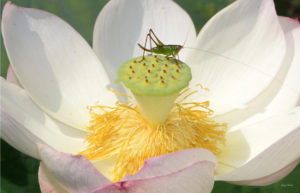
I want to thank Lopez for mentioning this book. I purchased the English translation of the Miraculous Tales of the Lotus Sutra from Ancient Japan and used its tales of the Lotus Sutra in my 32 Days of the Lotus Sutra practice. I was so impressed with the tale of the monk who in a past life was a grasshopper that I purchased a framed photo of a grasshopper on a lotus flower.
But there is no story of a monk who was a grasshopper in a past life anywhere in the Dainihonkoku hokekyōkenki translation. I purchased Nihon ryōiki, which contains a collection of stories gathered by a monk named Kyōkai, thinking perhaps the earlier stories included the grasshopper monk. Still no story.
In the end, I’m wary of Lopez’s influence on Two Buddhas Seated Side by Side, but I’m excited about the opportunity to use this book in my daily practice.
For someone who only reads English, the value of this opportunity to read, recite and study the Lotus Sutra cannot be explained by any calculation, parable or simile.
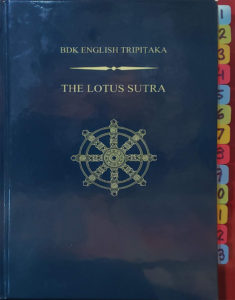
In my 46th and 47th cycles through the Lotus Sutra, I’m setting aside Gene Reeves translation, and picking up the BDK English Tripitaka translation of The Infinite Meanings Sutra, the Lotus Sutra and The Sutra Expounded by the Buddha on Practice of the Way through Contemplation of the Bodhisattva All-embracing Goodness.
I’m using this translation of these sutras because that’s the translation favored in Two Buddhas Seated Side by Side by Donald S. Lopez Jr. and Jacqueline I. Stone.
The Authors’ Introduction, explains the choice of texts:
All quotations from the Lotus Sūtra are taken from the translation done by Tsugunari Kubo and Akira Yuyama. See The Lotus Sūtra, rev. 2nd ed., trans. by Tsugunari Kubo and Akira Yuyama, BDK English Tripitaka Series (Berkeley: Numata Center for Buddhist Translation and Research, 2007). For the reader’s convenience, we have provided in-text page references to this translation after each quotation. Please note that the pagination of the printed version of the text (used here) differs from the pagination of the version presently available online.
Kubo and Yuyama based their translation on the celebrated Chinese version of the sūtra produced by the Central Asian scholar-monk Kumārajīva in 406. In several places, however, they chose not to follow traditional Sino-Japanese interpretation but have instead consulted the Sanskrit and, in a few instances, the Tibetan versions of the Lotus (see their “Translators’ Introduction,” xiv). One way in which their English version departs from Kumārajīva’s Chinese lies in the handling of proper names. Where Kumārajīva translated many names of figures appearing in the Lotus Sūtra, Kubo and Yuyama give them in the original Sanskrit. We have followed suit, not to give primacy to the Sanskrit text, but for consistency with the Kubo-Yuyama translation. However, some of the longer Sanskrit names can prove daunting to readers unfamiliar with that language. We have accordingly provided in parentheses with the first occurrence of such names the English rendering given by Leon Hurvitz in his translation of the Lotus Sūtra: Scripture of the Lotus Blossom of the Fine Dharma (the Lotus Sūtra), published by Columbia University Press (1976; rev. 2009), or a translation of our own.
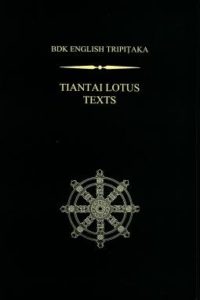
The opening and closing sutras are included in the BDK English Tripitaka Tiantai Lotus Texts, which also includes The Commentary on the Lotus Sutra by Vasubandhu and A Guide to the Tiantai Fourfold Teachings by the Buddhist Monk Ghegwan. A PDF copy of the book is available here.
An essential companion to a timeless spiritual classic
The Lotus Sūtra is among the most venerated scriptures of Buddhism. Composed in India some two millennia ago, it affirms the potential for all beings to attain supreme enlightenment. Donald Lopez and Jacqueline Stone provide an essential reading companion to this inspiring yet enigmatic masterpiece, explaining how it was understood by its compilers in India and, centuries later in medieval Japan, by one of its most influential proponents.
In this illuminating chapter-by-chapter guide, Lopez and Stone show how the sūtra’s anonymous authors skillfully reframed the mainstream Buddhist tradition in light of a new vision of the path and the person of the Buddha himself, and examine how the sūtra’s metaphors, parables, and other literary devices worked to legitimate that vision. They go on to explore how the Lotus was interpreted by the Japanese Buddhist master Nichiren (1222–1282), whose inspired reading of the book helped to redefine modern Buddhism. In doing so, Lopez and Stone demonstrate how readers of sacred works continually reinterpret them in light of their own unique circumstances.
An invaluable guide to an incomparable spiritual classic, this book unlocks the teachings of the Lotus for modern readers while providing insights into the central importance of commentary as the vehicle by which ancient writings are given contemporary meaning.
Saichō believed that Japanese Buddhism was at a crucial point in its history. The Buddha’s ultimate teaching, the One-vehicle doctrine of the Lotus Sūtra had just been recognized by the Japanese court with the allocation of Tendai yearly ordinands by Emperor Kanmu. If this teaching was to flourish it had to be further encouraged. The Fan wang precepts played a key part in Saichō’s defense of the Tendai School. Second, Japanese Buddhism had traditionally been patronized by the court, and in turn, had performed ceremonies to protect the nation and court. Saichō redefined Nara state Buddhism by establishing the autonomy of the Tendai School and increasing the number of people to whom Buddhism appealed. The Fan wang precepts played a significant role in Saichō’s efforts to reform church-state relations.