Having last month considered the second peaceful practices the Bodhisattva should do before he expounds the Sūtra of the Lotus Flower of the Wonderful Dharma, we repeat in gāthās.
Thereupon the World-Honored One, wishing to repeat what he had said, sang in gāthās:
The Bodhisattva should wish
To make all living beings peaceful,
And then expound the Dharma to them.
He should make a seat in a pure place,
Apply ointment to his skin,
Wash dirt and dust off himself,
Wear a new and undefiled robe,
Clean himself within and without,
Sit on the seat of the Dharma peacefully,
And then expound the Dharma in answer to questions.
He should expound with a smile
The wonderful meaning of the Dharma
To bhikṣus and bhikṣunīs,
To upāsakās and upāsikās,
To kings and princes,
To government officials,
And to common people.
When he is asked questions,
He should answer
According to the meaning of the Dharma.
He should expound the Dharma to them
With stories of previous lives, parables and similes.
With these expedients he should cause them
To aspire for enlightenment,
To promote their understanding step by step,
And finally to enter into the Way to Buddhahood.
He should give up indolence,
Negligence, grief and sorrow.
He should expound the Dharma to them
Out of his compassion towards them.
He should expound to them
The teaching of unsurpassed enlightenment
With stories of previous lives
And with innumerable parables and similes
Day and night,
And cause them to rejoice.
He should not wish to receive
Garments or bedding,
Food and drink, or medicine
From them.
He should expound the Dharma to them,
Wishing only two things:
To attain the enlightenment of the Buddha
And also to cause them to do the same.
This is a peaceful offering to them.
This offering will bring them a great benefit.
A Bhikṣu who expounds this Sūtra
Of the Lotus Flower of the Wonderful Dharma
With patience
After my extinction,
Will be emancipated
From jealousy, anger, and other illusions,
That is to say, from all obstacles.
He will have no sorrow.
He will not be spoken ill of.
He will not be in fear.
He will not be threatened with swords or sticks,
Or driven out [of his monastery].
A man of wisdom
Who controls his mind
As previously stated
Will be peaceful.
His merits will be innumerable.
You would not be able to tell the number of them
By any parable or simile even if you tried to do so
For thousands of billions of kalpas.
On my 21-day retreat encouraged by Universal-Sage Bodhisattva, we consider Day 8 of 21.
Programming note: Having completed a week of daily recitation of the Sutra of Innumerable Meanings and the Sutra of Contemplation of the Dharma Practice of Universal Sage Bodhisattva, it’s time to start offering quotes each day from the portions of these sutras that stand out to me.
And back to our program….
The opening of the Sutra of Innumerable Meanings begins with a long list of Bodhisattvas present at Rajagriha on Holy Eagle Peak (remember, this occurs just before the start of the Lotus Sutra) and then proceeds to explain just how great these guys are. To quote the Reeves translation:
Moreover, knowing well the abilities, natures, and desires of all, with incantations and unobstructed eloquence, [these Bodhisattvas] obediently and skillfully turn the Dharma wheel of the buddhas.
First, they have small drops of moisture fall to dampen the dust of desire, and by opening the gateway of nirvana, fanning the wind of liberation, and ridding themselves of the heat of worldly passions, they bring about the cooling quality of the Dharma.
Next, raining down the profound teaching of the twelve causes and conditions, pouring it on the ferocious, intense rays of suffering – ignorance, old age, illness, death, and so on – they pour out the unexcelled Great Vehicle, soak the good roots of all the living with it, scatter seeds of goodness over the field of blessings, and everywhere bring forth sprouts of awakening.
With wisdom as bright as the sun and the moon, and timely use of skillful means, they make the enterprise of the Great Vehicle prosper and grow, and lead many to attain supreme awakening quickly. Always living in the blessedness of a reality that is fine and wonderful, with immeasurable great compassion, they save the living from suffering.
They are truly good friends of living beings, an excellent field of blessings for the living. Without having to be asked, they teach living beings. They are a place of tranquil happiness for living beings, a place of salvation, a place of protection, and a place of great reliance.
I find this incredibly encouraging, thinking of these “good friends.”
It is worth noting that the only mention of the arhats in the audience is this list:
Those monks included Great Wisdom Shariputra, Divine Power Maudgalyayana, Wisdom Life Subhuti, Maha-Katyayana, Maitrayani’s son Purna, Ajnata-Kaundinya, Divine Eye Aniruddha, Precept-Keeping Upali, Attendant Ananda, Buddha’s son Rahula, Upananda, Revata, Kapphina, Vakkula, Acyuta, Svagata, Dhuta Maha-Kashyapa, UruvilvaKashyapa, Gaya-Kashyapa, and Nadi-Kashyapa. There were twelve thousand monks such as these. All were arhats, unconstrained by bondage or faults, free from attachments and truly liberated.
Unlike in the Lotus Sutra, these monks play no role in this teaching. This is, as the Lotus Sutra says, “the Dharma for Bodhisattvas, the Dharma Upheld by the Buddhas.”
The six internal sense fields refer to the five physical senses of sight, hearing, taste, smell, and touch plus mind (the mind is always included with the five senses in Buddhist thought, for a total of six, not the usual Western five). These internal sense fields are the base of all perception, physical or mental. The six external sense fields are the objects perceived by the six internal sense fields. The six consciousnesses are the awarenesses that arise as a consequence of perception at the juncture of internal and external sense fields. The six contacts are the result of the combination of internal sense fields, external sense fields, and consciousness. The six feelings refer to the arising of pain or pleasure with regard to the object perceived immediately after the emergence of consciousness. The six cravings are the reactions of like or dislike born of the feeling of pain or pleasure. Basic Buddhist Concepts
Therefore, the man of wisdom
Who hears the benefits of these merits
And who keeps this sūtra after my extinction,
Will be able to attain
The enlightenment of the Buddha
Definitely and doubtlessly.
The Buddha sings these verses to Superior-Practice Bodhisattva (Jōgyo, Viśiṣṭacārītra) in Chapter Twenty-One of the Lotus Sūtra. Superior-Practice is the embodiment of the fourth vow of a Bodhisattva: The Buddha’s teachings are immeasurable; I vow to attain supreme enlightenment. It is through our determination to benefit all beings, and our confidence in the Wonderful Dharma of the Lotus Sūtra, that we maintain our lives in this world of conflict.
The Daily Dharma is produced by the Lexington Nichiren Buddhist Community. To subscribe to the daily emails, visit zenzaizenzai.com
Having last month concluded today’s portion of Chapter 13, Encouragement for Keeping this Sutra, we return to Chapter 12, Devadatta, and the Buddha’s previous life as a king seeking the Dharma.
Thereupon the Buddha said to the Bodhisattvas, gods, men and the four kinds of devotees:
“When I was a Bodhisattva] in my previous existence, I sought the Sūtra of the Lotus Flower of the Wonderful Dharma for innumerable kalpas without indolence. I became a king [and continued to be so] for many kalpas. [Although I was a king,] r made a vow to attain unsurpassed Bodhi. I never faltered in seeking it. I practiced alms-giving in order to complete the six pāramitās. I never grudged elephants, horses, the seven treasures, countries, cities, wives, children, menservants, maidservants or attendants. I did not spare my head, eyes, marrow, brain, flesh, hands or feet. I did not spare even my life.
“In those days the lives of the people of the world were immeasurably long. [One day] I abdicated from the throne in order to seek the Dharma[, but retained the title of king]. I entrusted the crown prince with the administration of my country. l beat a drum and sought the Dharma in all directions, saying with a loud voice, ‘Who will expound the Great Vehicle to me? If there is anyone, I will make offerings to him, and run errands for him for the rest of my life.’
On my 21-day retreat encouraged by Universal-Sage Bodhisattva, we consider Day 7 of 21.
In Kangyō Hachiman-shō, Remonstration with Bodhisattva Hachiman (Writings of Nichiren Shōnin, Doctrine 1, Page 257-258), Nichiren writes in part:
At the beginning of the Kalpa of Construction, when the world is being created, gods were born with excellent rewards of virtuous acts in previous lives, and men were not evil. Therefore, heavenly beings were shiny in body, pure in spirit, as bright as the sun and moon, and as brave as the lion and elephant. When the Kalpa of Construction was over and the world entered the Kalpa of Continuance, heavenly beings from the previous period grew old and declined like the waning moon, newly born gods were mostly equipped with inferior rewards of actions in their previous lives. As a result, the three calamities and seven disasters occurred all over the world and people everywhere began experiencing sufferings and joys.
Then the Buddha appeared in this world and prepared the panacea of life, that is Buddhism, for the gods and people. Like oil added to a lamp or a cane supporting an elderly person, heavenly beings regained the authority and power they possessed in the Kalpa of Construction.
I bring this up to illustrate my attitude toward and interaction with divine beings and protective deities. As I see it, the more I practice, the more I recite sutras, the more daimoku I chant, the more I feed these gods and protective deities and the more their influence grows. Fat and happy gods!
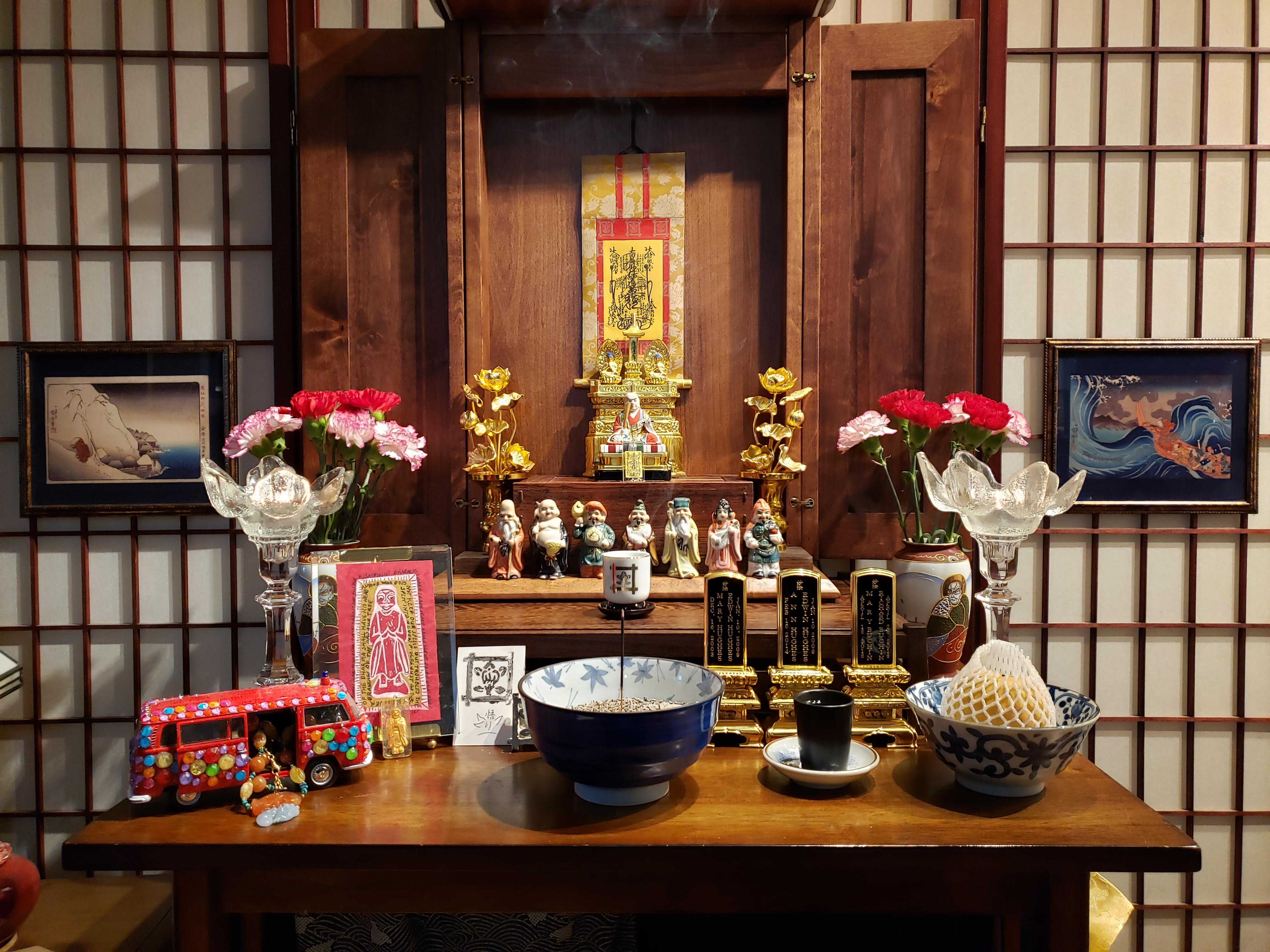
This is especially true with a recent addition to my altar: Shichi Fukujin, the Seven Happy Gods.
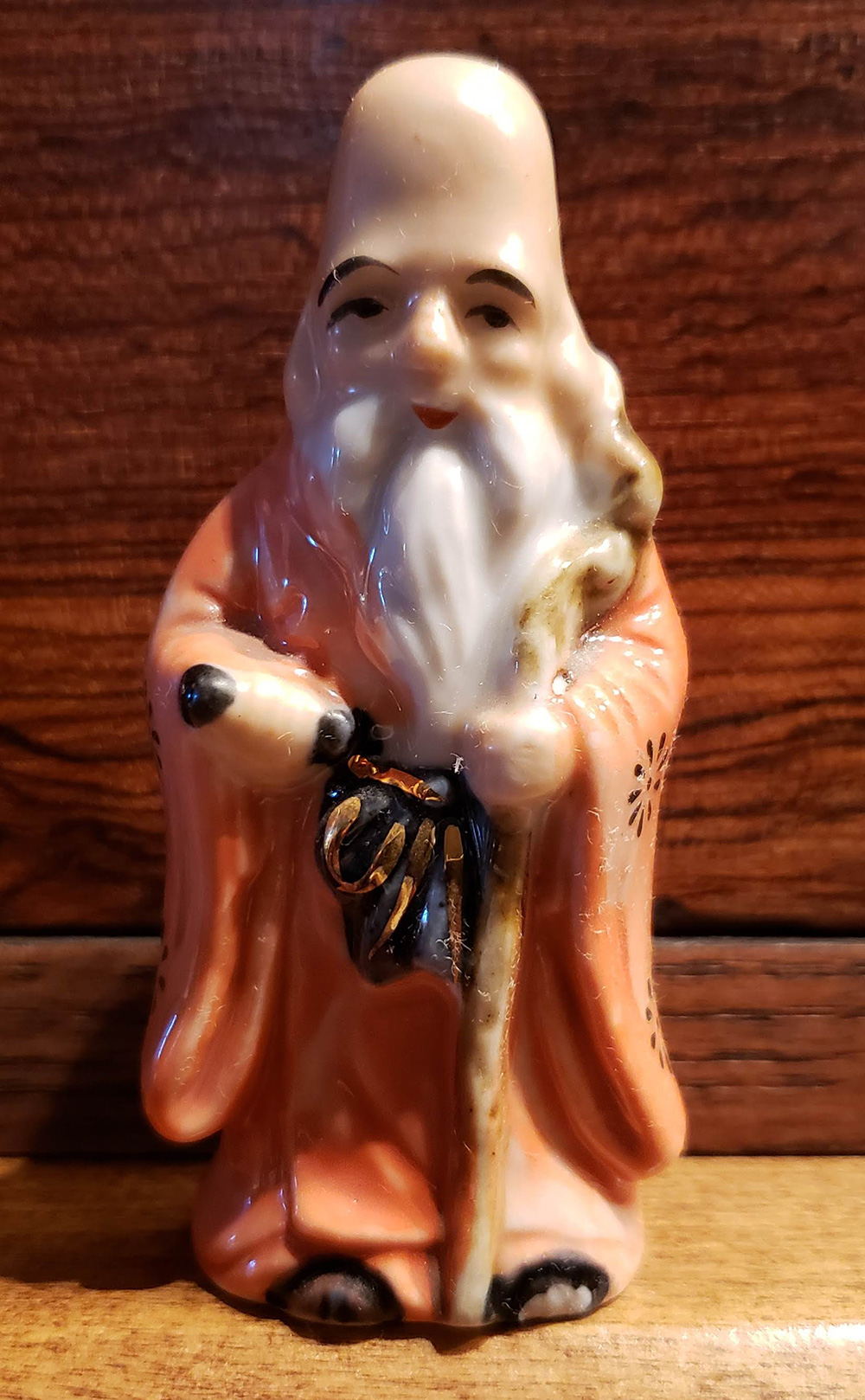
FukurokujuFukurokuju 福禄寿 Represents Longevity
From Japanese fuku, “happiness”; roku, “wealth”; and ju, “longevity.” Brought from China’s Taoist-Buddhist traditions, Fukurokuju is the God of Wealth, Happiness, and Longevity. He is usually represented with customary clothes of a Chinese scholar, holding a walking stick with a scroll tied to it. He is the only one from the seven who has the ability to revive the dead.
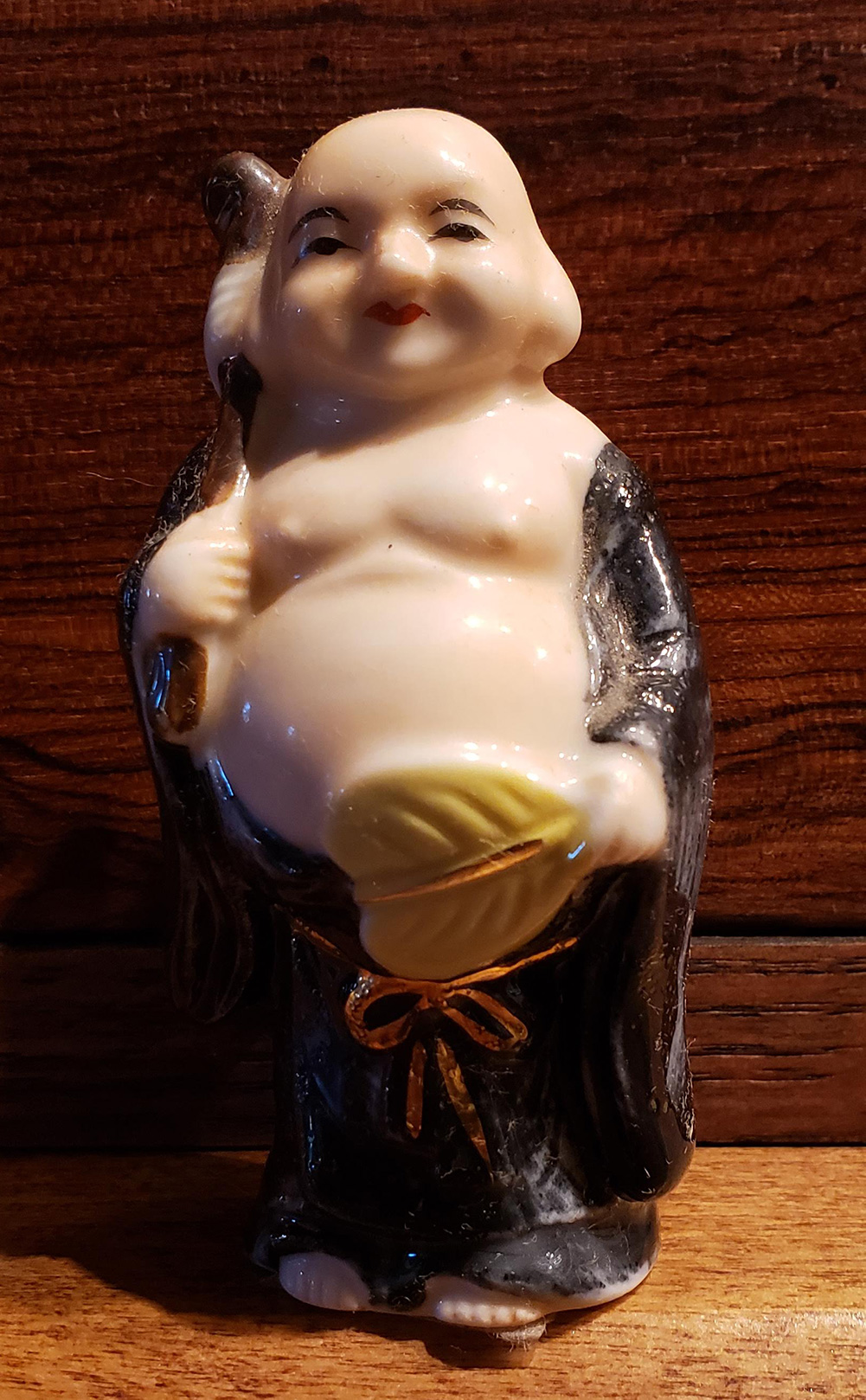
HoteiHotei 布袋 Represents Happiness
Said to be an incarnation of Miroku (Maitreya) Bodhisattva, Hotei (a.k.a Budai) is the God of Happiness and Abundance. He is supposedly based on an actual person, a Chinese hermit Budaishi (d. 917). He is represented as a Buddhist monk with a smiling face and a prominent belly, holding a sack and a wooden staff, usually seated or sleeping in his bag. Outside Japan, he is known as “Laughing Buddha.”
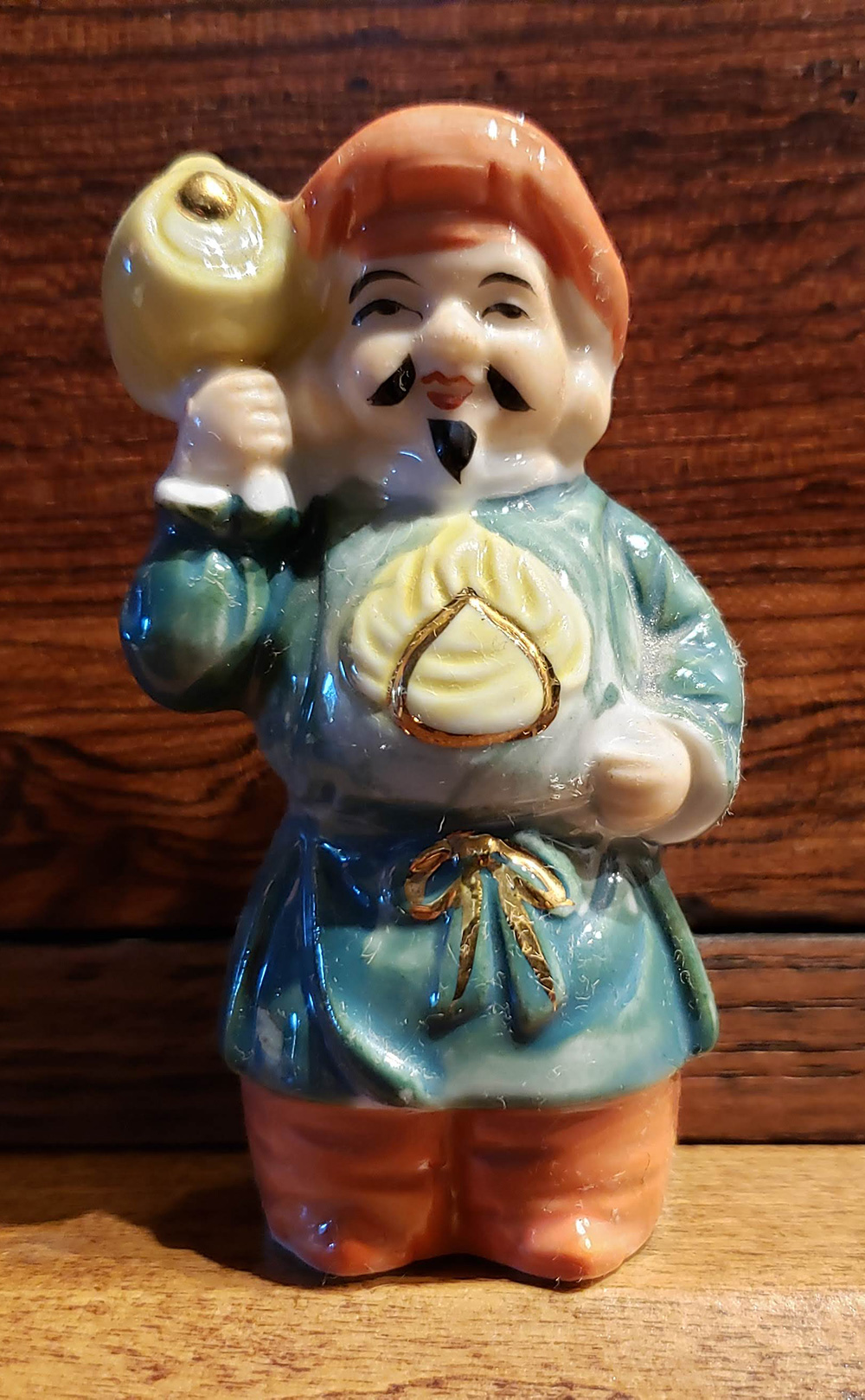
DaikokuDaikoku 大黒天 Represents Fortune
Originally a Hindu warrior deity named Mahākāla, once introduced in Japan he became the God of Wealth and Prosperity. Daikoku evolved from the Buddhist form of the Indian deity Shiva intertwined with the Shinto god Ōkuninushi. He is well known for his happy-looking smile and is often presented with a bag on this shoulder filled with money and a magic mallet standing on two bales of rice.
EbisuEbisu 恵比須 Represents Honesty
Also known as Yebisu or Kotoshiro-nushi-no-kami. The God of Fishing, Shipping and Commerce, he is the only one to have his origins in Japan. Ebisu is very popular among farmers and sailors. He is commonly presented wearing formal court clothes or hunting robes. He is often presented with a fishing rod in his right hand and a large red sea bream under his left arm.
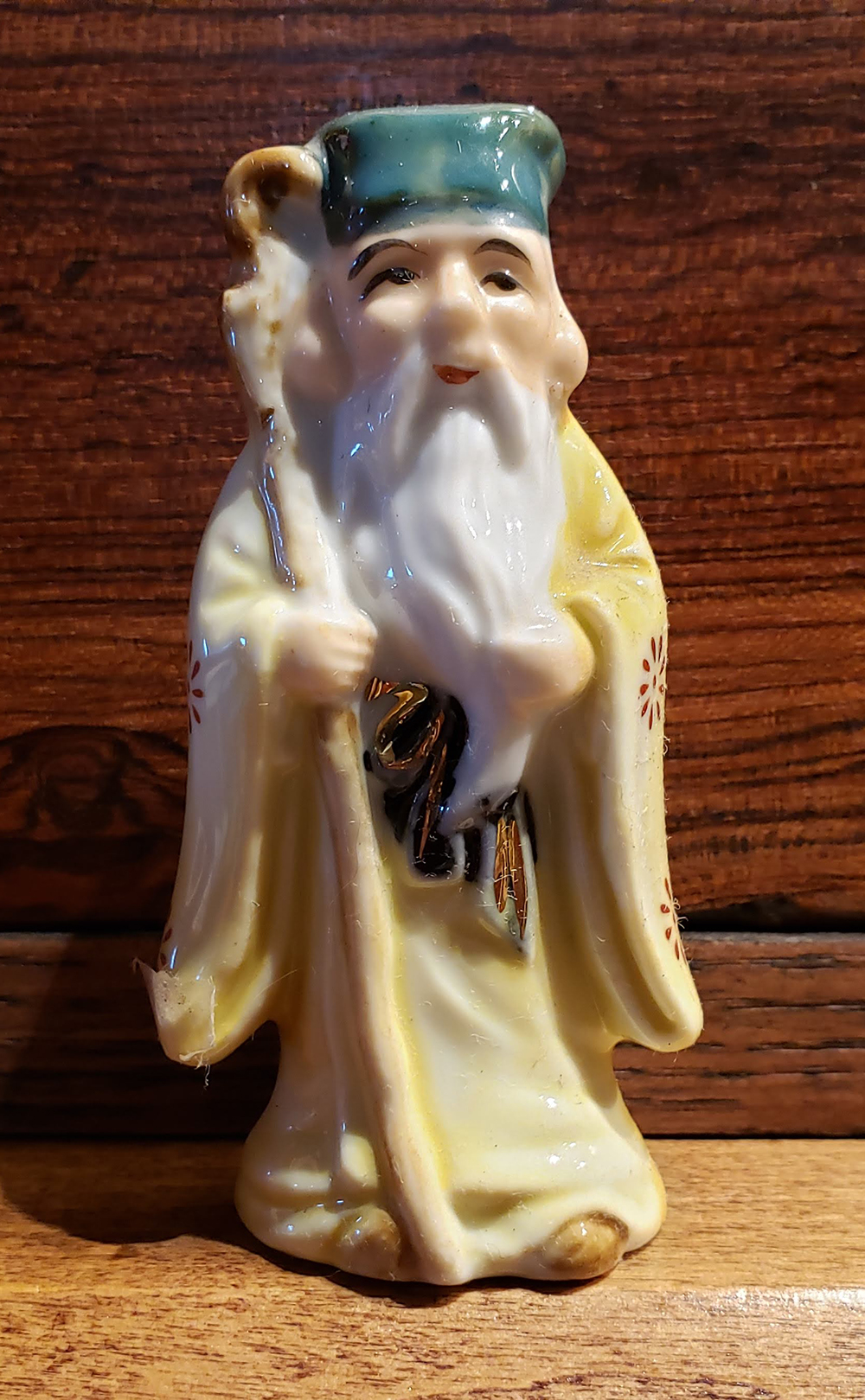
JurojinJurōjin 寿老人 Represents Wisdom
The God of Wisdom, he originated from the Chinese Taoist god, the Old Man of the South Pole. He is commonly presented as an old man wearing a hat with a long white beard holding a knobbed walking staff with a scroll tied to it. He is often confused with Fukurokuju. A black deer always accompanies Jurōjin as a messenger and as symbol of longevity.
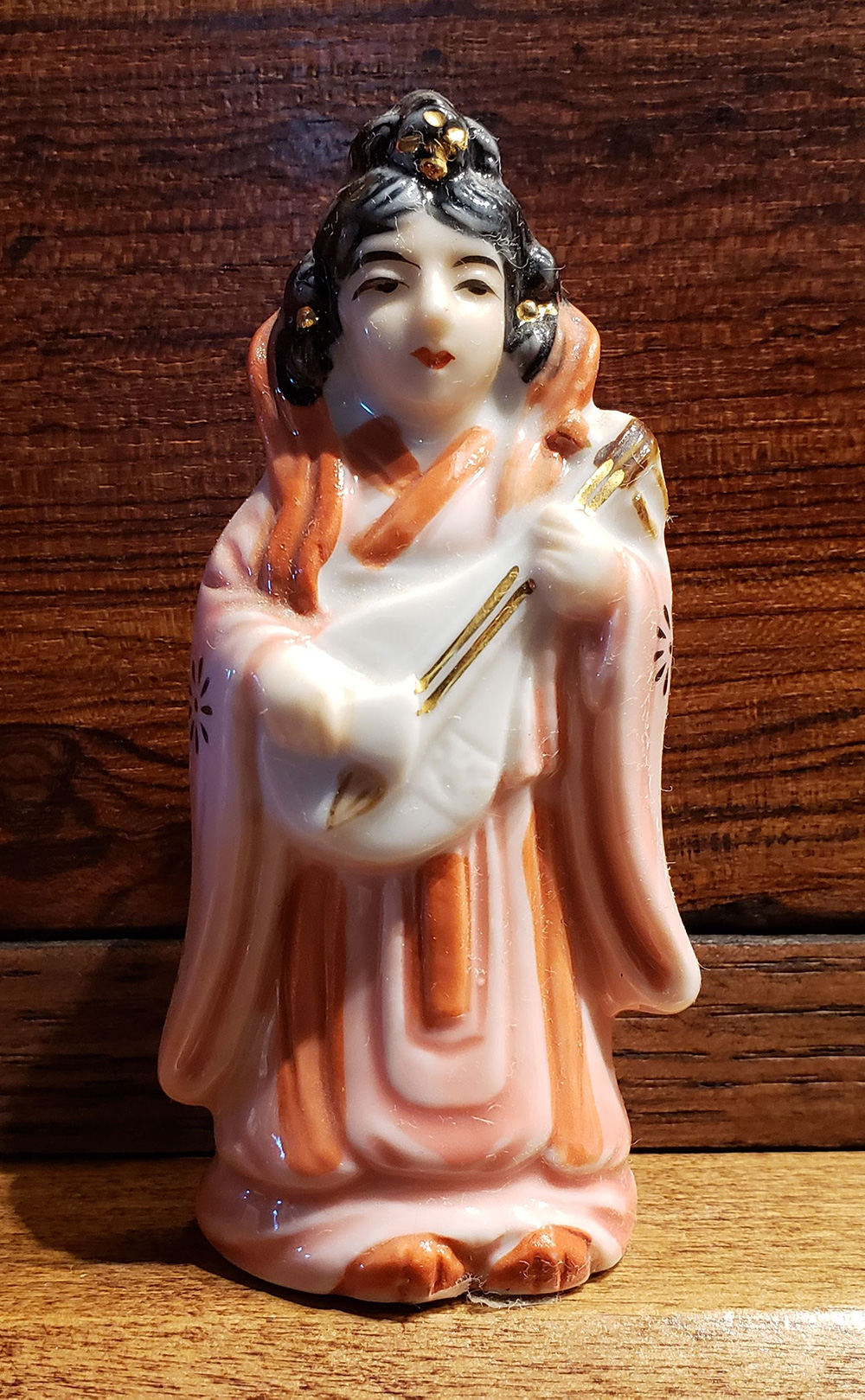
BenzaitenBenzaiten 弁財天 Represents Joy
Benzaiten (Benten) was originally the Hindu goddess of water Sarasvati. In her Japanese representation, she is the Goddess of Arts and Knowledge. Her common form is a beautiful woman dressed in a flowing Chinese-style dress and playing the biwa. She is frequently depicted riding on, or accompanied by, a sea dragon.
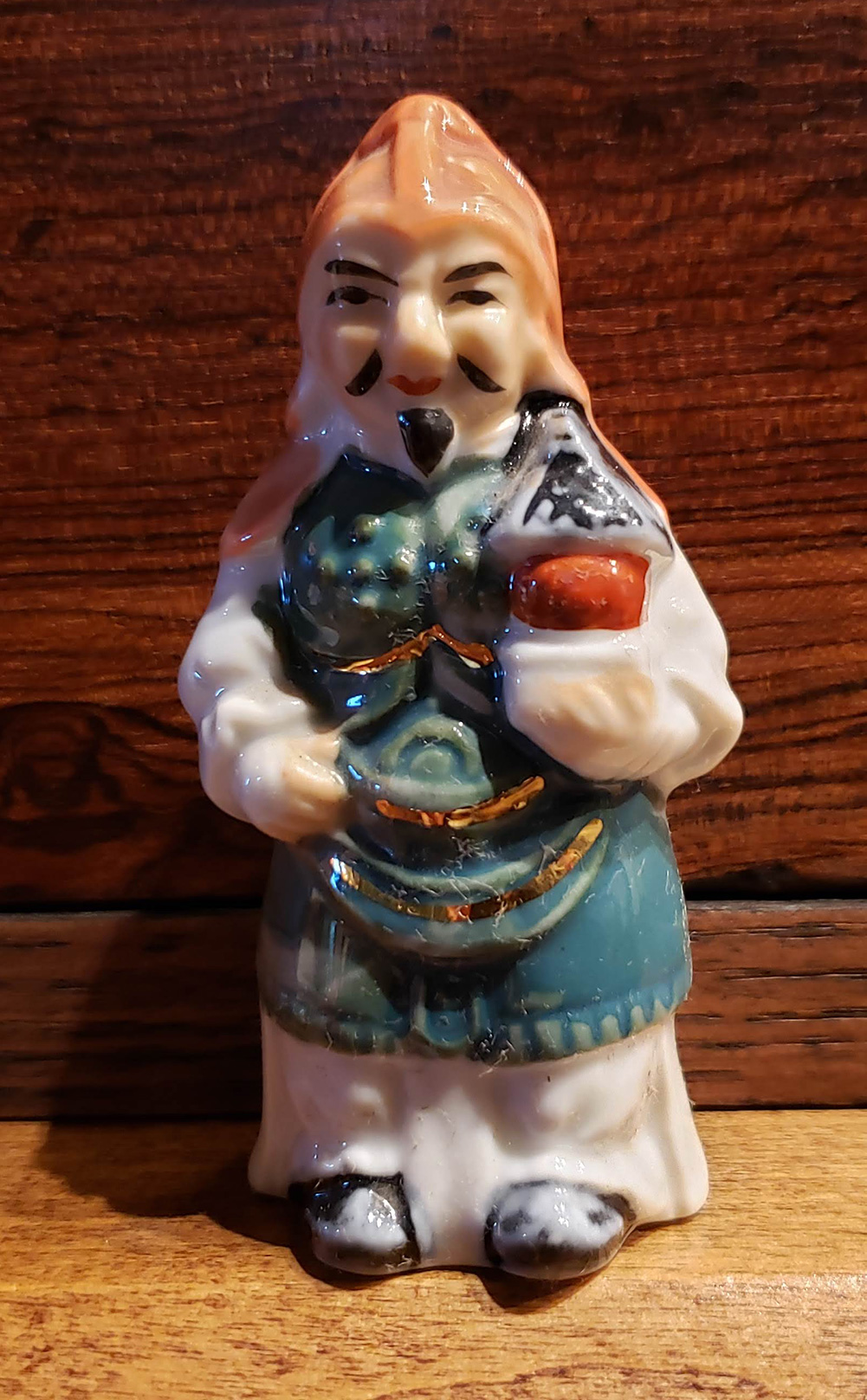
BishamonBishamon 毘沙門天 Represents Dignity
The Buddhist guardian of the north (Vaiśravaṇa), Bishamon is the God of Warriors (not war). He is also a God of Defense Against Evil. Almost always dressed in armor with a fierce look and standing over one or two demons symbolizing the defeat of evil. In one hand he has a weapon to fight against evil influences and suppress the enemies. On the other hand he holds a treasure pagoda or stupa, which is his main identifying attribute.
At this point I should digress and explain the difference between statues and what I have been told are “just decoration.”
He smiled and said, “No. This is just decoration.”
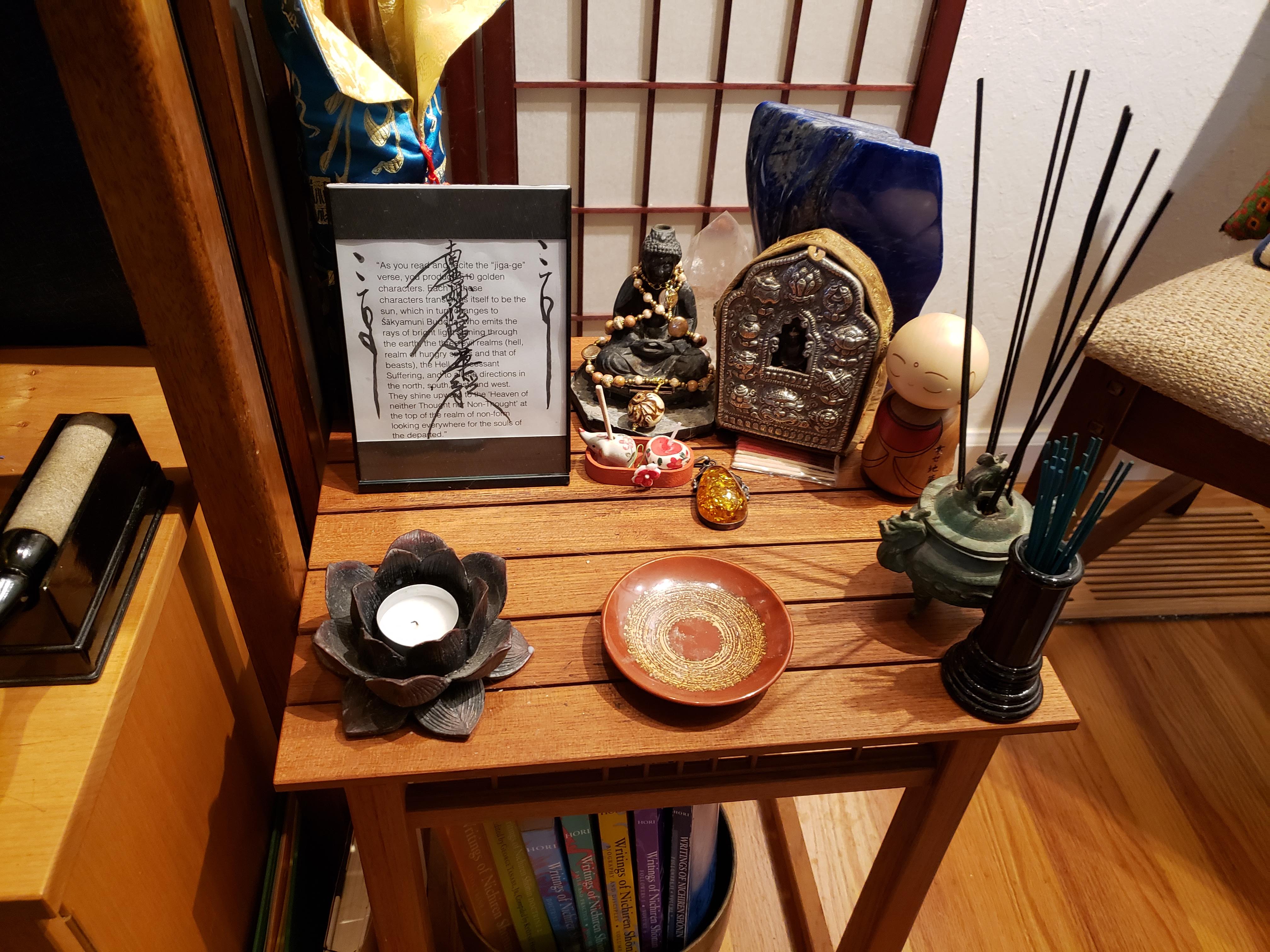
No problem. I have a side altar where I keep my “decorations,” which today in addition to Jizo Bodhisattva includes a traveling Tibetan prayer box stuffed with flags and a Buddha incense burner draped in a necklace. (These are all donations from my wife.)
Then last month, I noticed a box containing the Seven Happy Gods had been donated to the church rummage sale. The porcelain figurines were made in Japan and purchased in the 1987. Someone had labeled each of them (mislabeling Fukurokuju as Jurojin) and crafted a display stand.
The Seven Happy Gods sparked my interest because my step-mother, who lived in Japan during the Korean War (her father was an Army general), had a wooden set of these in her home in Florida. Her’s were certainly just decorations.
Could these statues be eye-opened and added to my altar? I went to Rev. Igarashi expecting to have to re-arrange my decorations. Instead I was surprised to find him receptive to the idea. He took the box and said he’d get back to me.
A day or so later he said that, Yes, he could eye-open the Seven Happy Gods. But, he cautioned, I would need to make them part of my practice. He said the figurines had been eye-opened before but the effect had withered. Basically they had starved to death.
After the next Sunday service I picked up the eye-opened Seven Happy Gods and took them home. I’ve learned their names and each day I devote a portion of my daimoku to each. I’m not expecting any “benefit” from having these gods on my altar. Instead, I’m enjoying the idea of nourishing divine spirits, helping them regain the authority and power they possessed.
KishimojinIn addition to the newly arrived Happy Gods, I also have Kishimojin 鬼子母神: Mother of Demon Children. In the “Dhāranī” (twenty-sixth) chapter of the Lotus Sutra, Kishimojin and 10 rākṣasas daughters pledge before Shakyamuni Buddha to safeguard the votaries of the sutra. Kishimojin is revered as a god of procreation and easy delivery.
The print and the amulet were purchased from Rev. Ryusho Jeffus several years ago. (The Kishimojin amulet and a amulet Gohonzon I purchased compose my traveling altar.)
To accept the theory that the realm of Buddha exists and that Śākyamuni Buddha exists in oneself are quite different in meaning. Here the world of “Ri” changes to the world of “Ji” and the theoretical and philosophical doctrine becomes the warm hearted religious doctrine. Nichiren Shōnin said,
“Śākyamuni Buddha within our minds,” (Kanjin Honan Shō, WNS2, page 146)
and,
“the World Honored One is in my (Nichiren’s) head” (Oto Gozen Goshōsoku).
Ichinen Sanzen of Ji and the Essential Section are based on these words.
When they expound the scriptures of non-Buddhist schools, or give advice to the government, or teach the way to earn a livelihood, they will be able to be in accord with the right teachings of the Buddha.
The Buddha gives this explanation to Constant-Endeavor Bodhisattva in Chapter Nineteen of the Lotus Sūtra, describing those who keep the Lotus Sūtra. In this chapter, the Buddha shows that our practice of this Wonderful Dharma is not separate from our existence in this world. The purpose of the Buddha’s wisdom is not to escape to a better life, but to see our lives for what they are, and to use that clarity for the benefit of all beings.
The Daily Dharma is produced by the Lexington Nichiren Buddhist Community. To subscribe to the daily emails, visit zenzaizenzai.com
Day 16 concludes Chapter 11, Beholding the Stūpa of Treasures, and completes the Fourth Volume of the Sūtra of the Lotus Flower of the Wonderful Dharma.
Having last month concluded Chapter 11, Beholding the Stūpa of Treasures, we return to the top and Śākyamuni’s effort to purify the Sahā-World in order to accommodate all of his emanations from the worlds of the ten quarters.
Thereupon each of the Buddhas of the [worlds of the] ten quarters said to the Bodhisattvas under him, “Good men! Now I will go to Śākyamuni Buddha of the Sahā-World. I also will make offerings to the stūpa of treasures of Many-Treasures Tathāgata.”
At that instant the Sahā-World was purified. The ground of the world became lapis lazuli. The world was adorned with jeweled trees. The eight roads were marked off by ropes of gold. The towns, villages, cities, oceans, rivers, mountains, forests and thickets were eliminated. The incense of great treasures was burned; mandārava flowers, strewn over the ground; and jeweled nets and curtains with jeweled bells, hung over the world. The gods and men were removed to other worlds except those who were in the congregation.
At that time each of the Buddhas was accompanied by an attendant who was a great Bodhisattva. Some of the Buddhas came under the jeweled trees in the Sahā-World. The jeweled trees were five hundred yojanas tall, and adorned with branches, leaves, flowers and fruits. Under the jeweled trees were lion-like seats five yojanas tall, adorned with great treasures. The Buddhas sat cross-legged on the seats [under the jeweled trees]. The seats [under the jeweled trees] in the [Sahā-World composed of] one thousand million Sumeru-worlds were, however, too few to receive all the Buddhas of Śākyamuni Buddha’s replicas who were to come from the worlds even of one of the ten quarters. [Seeing this,] Śākyamuni Buddha purified two hundred billion nayuta worlds of each of the eight quarters [neighboring the Sahā-World] to receive all the Buddhas of his replicas. The hells, the regions of hungry spirit , the regions of animals, and the regions of asuras [of those worlds] were eliminated; and the gods and men [of those worlds] were removed to other worlds. The ground of those purified world became lapis lazuli. The worlds were adorned with jeweled trees five hundred yojanas tall. The trees were adorned with branches, leaves, flowers and fruits. Under the trees were lion-like seats of treasures five yojanas tall, adorned with various treasures. The great oceans, rivers, the Mucilinda Mountains, the Maha-Mucilinda Mountains, the Surrounding Iron Mountains, the Great Surrounding Iron Mountains, the Sumeru Mountains, and all the other great mountains [of those worlds] were eliminated, and all those worlds were amalgamated into one Buddha-world [that is, into the world of Śākyamuni Buddha). The jeweled ground of this [expanded] world was even. Jeweled curtains and canopies adorned with streamers were hung over this [expanded] world; the incense of great treasures, burned; and jeweled flowers of heaven, strewn over the ground.
Śākyamuni Buddha again purified two hundred billion nayuta more worlds of each of the eight quarters [neighboring the expanded world] to seat all the Buddhas of his replicas. The hells, the regions of hungry spirits, the regions of animals, and the regions of asuras [of those worlds] were eliminated; and the gods and men [of those worlds] were removed to other worlds. The ground of those purified worlds became lapis lazuli. The worlds were adorned with jeweled trees five hundred yojanas tall. The trees were adorned with branches, leaves, flowers and fruits. Under the trees were lion-like seats of treasures five yojanas tall, adorned with great treasures. The great oceans, rivers, the Mucilinda Mountains, the Maha-Mucilinda Mountains, the Surrounding Iron Mountains, the Great Surrounding Iron Mountains, the Sumeru Mountains, and all the other great mountains [of those worlds] were eliminated, and all those worlds were amalgamated into one Buddha-world [that is, into the world of Śākyamuni Buddha]. The jeweled ground of this [expanded] world was even. Jeweled curtains and canopies adorned with streamers were hung over this [expanded] world; the incense of great treasures, burned; and jeweled flowers of heaven, strewn over the ground.
Thereupon the Buddhas of the replicas of Śākyamuni Buddha in the worlds of the east, who were expounding the Dharma in those worlds numbering hundreds of thousands of billions of nayutas, that is, as many as there are sands in the River Ganges, came [to this expanded world]. So did the Buddhas of the worlds of the nine other quarters. They sat on the seats [under the jeweled trees]. [The Sahā-World and] the four hundred billion nayuta worlds of each of the eight quarters[, which were amalgamated into one Buddha world,] were filled with those Buddhas, with those Tathāgatas.
On my 21-day retreat encouraged by Universal-Sage Bodhisattva, we consider Day 6 of 21.
The encouragement of Universal-Sage Bodhisattva, for which this stay-cation retreat is named, is opening for me some ideas on how to expand my own practice.
Today, I recited the BDK English Tripitaka version of The Sutra Expounded by The Buddha On Practice of The Way Through Contemplation of The Bodhisattva All-Embracing Goodness as translated from the Chinese of Dharmamitra.
I am really tempted to turn this portion of the sutra into a personal practice that would go like this.
Repeat three times:
The buddhas, the World-honored Ones, are always present in this world. Yet even though I believe in the comprehensive sutras, I am unable to clearly discern the buddhas because of my karmic encumbrances. I now take refuge in the Buddha! May you, Śākyamuni, Fully Enlightened World-honored One, please become my mentor! O Mañjuśrī, possessor of great wisdom, with your wisdom and understanding, please initiate me in the pure bodhisattva ways! Thereby, out of compassion for me, Maitreya Bodhisattva, the sun of surpassing mercy, will permit me to take up the bodhisattva ways; the buddhas of the ten directions will appear to bear witness for me; and the eminent bodhisattvas—those supreme great leaders who safeguard living beings, who inspire and watch over those like me—will each make themselves known by name.
On this day I accept and embrace the comprehensive sutras! Even if I should fall into hells and suffer innumerable hardships upon reaching the end of this life, through it all I will never renounce the correct Dharma of the buddhas! By means and reason of these causes and the power of their beneficial effects, Śākyamuni Buddha now becomes my mentor and Mañjuśrī becomes my steward! O Maitreya who is to come—please impart the teachings to me! O buddhas of the ten directions—please bear witness for my assurance! O great virtuous bodhisattvas—please be my companions!
Trusting now in the wonderful and most profound principle of the Great Vehicle sutras, I take refuge in Buddha, I take refuge in Dharma, and I take refuge in Sangha!
Conclude by saying:
Here, this day, I have awakened the aspiration for enlightenment! Through the beneficial effects of this, may I universally ferry all living beings!
Of special note is the conclusion’s focus on saving all living beings. This is not a solitary practice, even when on a solitary stay-cation retreat.