Having last month heard Mañjuśrī repeat what he had said in gāthās, we consider the ray of light that illumined eighteen thousand Buddha-worlds in the east.
The worlds of the Buddhas quaked much.
The Buddha emitted a ray of light
From between his eyebrows,
And showed things rarely to be seen.
This ray of light illumined
Eighteen thousand Buddha-worlds in the east.
It showed the region
To which each living being was to go by his karmas.
The worlds of the Buddha were
Adorned with many treasures,
And given the colors of lapis lazuli and crystal.
I saw all this by the light of the Buddha.
Kōkū, a priest of Konshōji Temple, was from Ōmi Province. During many years of ascetic practices, he recited the Hokekyō in a pure and beautiful voice with ringing bell-like tones.
Heikō of Hyōbu, a close relative of Masakado of Taira, was a wild warrior who had committed evil deeds. Hyōbu became acquainted with Priest Kōkū, trusted him, and had him stay in his house for several years. His retainers started a rumor that his wife had a relationship with Kōkū. Hearing the rumor, Hyōbu developed a resentment against Kōkū, took him into a deep mountain, bound him to a large tree, and had his retainer release an arrow at him. But the arrow broke before reaching Kōkū’s abdomen.
Kōkū saw that his suffering was due to karmic causes. Even though innocent, he only concentrated on the recitation of the Hokekyō in his high and noble voice.
Several arrows were vainly released, since all broke before striking Kōkū. Now Hyōbu himself tried to shoot, but his arrows became broken just like the others. Thirty-nine arrows were released futilely. In the end, the greatly impressed Hyōbu released Kōkū, begged his pardon, and said, “I have made a great mistake by trying to harm the holy man. Hereafter, I will never harm him.” Hyōbu tearfully repented for his sins and took Kōkū home.
Hyōbu dreamed at night of a golden-hued Bodhisattva Fugen mounted on a white elephant. The shafts of many arrows projected from the middle of Fugen’s body. In his dream, Hyōbu questioned Fugen about the arrows. Fugen replied, “On the previous day, you tried to kill the Hokekyō reciter, Kōkū, in spite of his innocence. I have received all the arrows in his place!”
The awakened Hyōbu was appalled, tearfully repented of his sin in front of Kōkū, retired to his room, and told everything to his retainers.
Three days later, being deeply disappointed by secular life, Kōkū took his Buddhist images and left Hyōbu’s house about midnight.
Hyōbu dreamed again of Fugen who said, “You have venerated me during past years. Due to your merits, you will be delivered in due course. Yet, you once wanted to harm me, in spite of my innocence. You should quickly refrain from evil deeds and progress to goodness. This is what the Buddhas have been preaching and this is why I have left your place forever and am moving to a different location.”
After awakening, the surprised Hyōbu hurried to Kōkū’s room, only to find that Kōkū had already gone. Hyōbu greatly lamented and grieved. (Page 93-94)
In Nichiren Buddhism, non-duality is the real aspect of all things. The real aspect of all things transcends birth and death, subject and object, and all other dualities. This real aspect is the Buddha-nature and the Middle Way of which all things are just partial manifestations. It is identified with Namu Myoho Renge Kyo because we are able to realize this truth through devotion to the Lotus Sutra.
You, the World-Honored One, are exceptional.
You reminded me of the teachings
Of innumerable Buddhas in the past
As if I had heard them today.
Ānanda, the Buddha’s cousin and one of his leading disciples, sings these verses in Chapter Nine of the Lotus Sūtra. In the Story, Ānanda had just been personally assured by the Buddha that he would become a Buddha himself in a future life. All the teachings of the Buddha across all time are always available to us. What prevents us from hearing them and putting them into practice is nothing more than our own attachment to our suffering and our doubts about our capacity for wisdom and compassion. When we take to heart the assurance that we and all beings can become enlightened, it clears away our delusion and allows to see the Buddha teaching us in all aspects of our lives.
The Daily Dharma is produced by the Lexington Nichiren Buddhist Community. To subscribe to the daily emails, visit zenzaizenzai.com
Having last month introduced the Bodhisattvas and other followers gathered on Mt. Gṛdhrakūṭa in the City of King-House, we meet the gods and others in the gathering.
Sakra-Devanam-Indra was also present. Twenty thousand gods were attending on him. There were also Beautiful-Moon God, Universal-Fragrance God, Treasure-Light God, and the four great heavenly-kings. Ten thousand gods were attending on them. Freedom God and Great-Freedom God were also present. Thirty thousand gods were attending on them. Brahman Heavenly-King who was the lord of the Saha-World, Great Brahman Sikhin, and Great Brahman Light were also present. Twelve thousand gods were attending on them.
There were also the eight dragon-kings: Nanda Dragon-King, Upananda Dragon-King, Sagara Dragon-King, Vasuki DragonKing, Taksaka Dragon-King, Anavatapta Dragon-King, Manasvin Dragon-King, and Utpalaka Dragon-King, each accompanied by hundreds of thousands of attendants. There were also the four kiṃnara-kings: Dharma Kiṃnara-King, Wonderful-Dharma Kiṃnara-King, Great-Dharma Kiṃnara-King, and DharmaKeeping Kiṃnara-King, each accompanied by hundreds of thousands of attendants.
There were also the four gandharva-kings: Musical GandharvaKing, Musical-Voice Gandharva-King, Beautiful Gandharva-King, and Beautiful-Voice Gandharva-King, each accompanied by hundreds of thousands of attendants.
There were also the four asura-kings: Balin Asura-King, Kharaskandha Asura-King, Vemacitrin Asura-King, and Rahu Asura-King, each accompanied by hundreds of thousands of attendants.
There were also the four garuda-kings: Great-Power-Virtue Garuda-King, Great-Body Garuda-King, Great-Fulfillment GarudaKing, and Free-At-Will Garuda-King, each accompanied by hundreds of thousands of attendants.
Priest Tenjō of Yamato Province was living on Mount Mitake. He had a strong character and lost his temper quickly. He relied on the Law, was devoted to the Hokekyō, and had memorized six rolls of the sūtra. However, he was unable to learn the seventh and the eighth rolls even though he spent days and nights in the attempt.
Months and years passed. Now Tenjō was middle-aged. Once again he decided to learn all the chapters of the sūtra and carefully recited so as to learn them by heart. He spent several months but was unable to learn even a few pages of these chapters. How could he learn an entire chapter in this way? With firmer determination, Tenjō repeated a single phrase thirty thousand times, spending days and nights. Yet he could not learn it.
Finally, Tenjō visited the Great Bodhisattva Zaō, remaining for ninety days during his summer retreat. He offered purified water, incense, and tapers six times a day, and prayed nightly three thousand times to Zaō. Towards the end of his retreat, Tenjō dreamed of the Yaksa arrayed in dragon headgear. He was dressed in a heavenly person’s garments with various ornaments, and stepped on lotus flowers, holding an iron rod in his hand. He was surrounded by his relatives. The Yaksa said to Tenjō, “Due to the karmic relationship, you are unable to learn these two chapters. In your former existence, you were a large poisonous snake living in a mountain stable of the Akaho District of Harima Province. One day, a holy man took shelter in the stable. You, the snake on the eaves, were hungry since you had been without food for a long time, and you thought of devouring the holy man.
Unaware of the snake, the holy man washed his hands and mouth, and began to recite the Hokekyō. His voice was clear and resonant as if to expiate the listeners’ sins. As the snake heard the reciting voice, he closed his eyes, suppressed his desires, left his evil thoughts, and fervently listened to the recitation.
When the holy man finished the sixth chapter, day dawned, and he left the stable without reciting the seventh and the eighth chapters. Thanks to having suppressed your evil desires and thoughts, and to having earnestly listened to the recitation, you could alter your suffering state as a snake in numerous cycles of birth and death and were reborn as a human Hokekyō devotee. Since you had not heard the last two chapters in your previous life, you are still unable to learn them in this life. Your characteristics are those of the snake. However, if you practice diligently and recite the sūtra devotedly, you will attain enlightenment in your present life and will leave the cycle of birth and death in the future.”
Tenjō woke up and appreciated his dream. His deep faith was affirmed, and he continued to recite the sūtra more fervently. Finally, a Deva King, Vaiśravaṇa, helped Tenjō to attain the Buddhahood he had desired. Tenjō passed away during the second year of Kashō. (Page 115-116)
The Buddha will remove
Any doubt of those who seek
The teaching of the Three Vehicles.
No question will be left unresolved.
Mañjuśrī declares these verses at the end of Chapter One of the Lotus Sūtra. They remind us how important questions are to what the Buddha teaches. Questions come up throughout the book, and they lead to many important aspects of this Wonderful Dharma. It is important for us to ask questions respectfully whenever we hear a teaching, knowing that we will find an answer.
The Daily Dharma is produced by the Lexington Nichiren Buddhist Community. To subscribe to the daily emails, visit zenzaizenzai.com
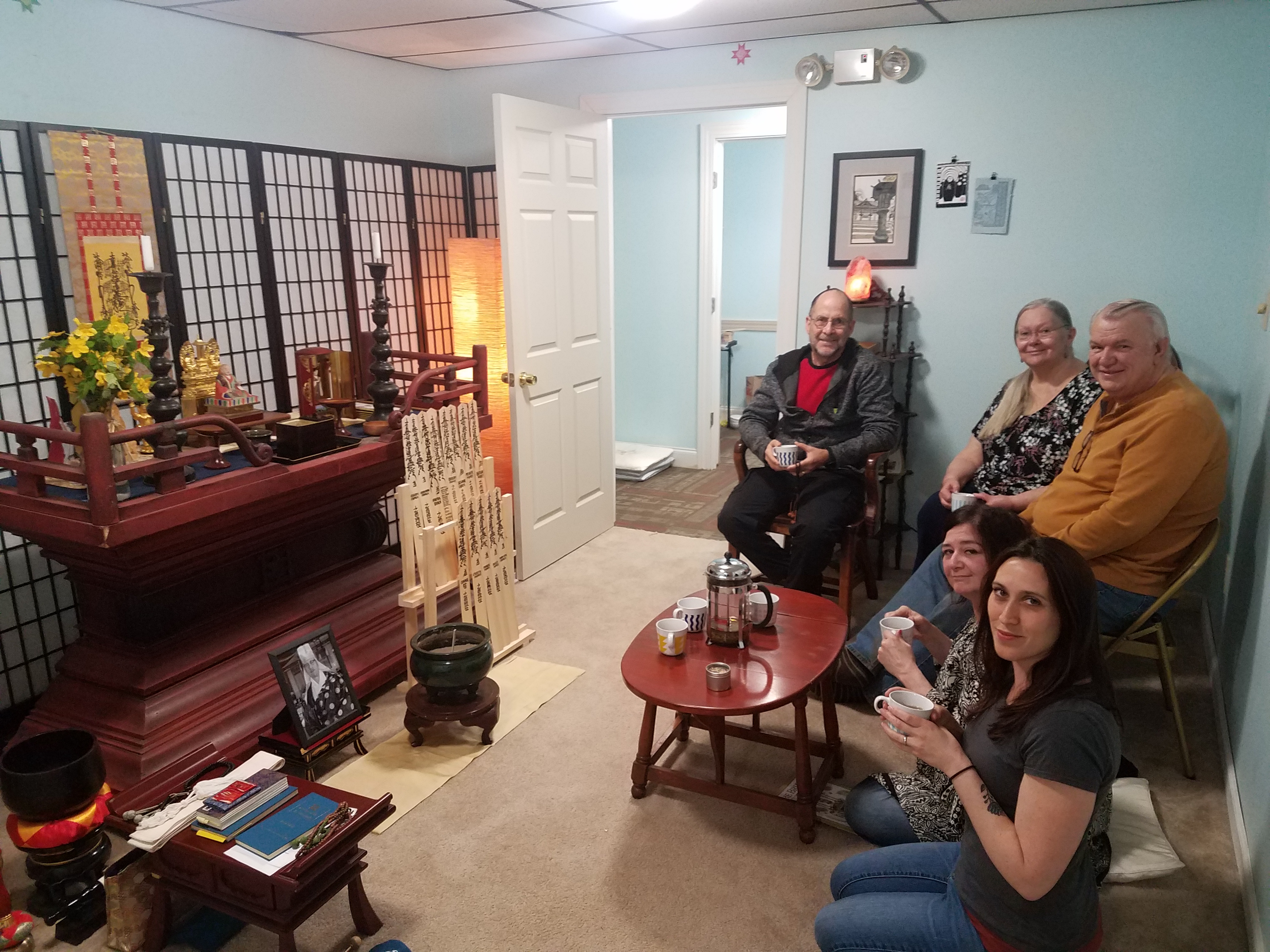
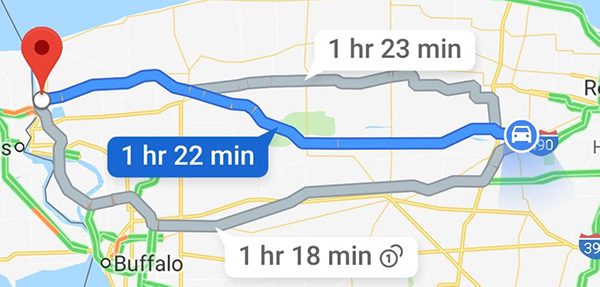
Tea following the Sunday service at Ro-Ō Zan Enkyoji Nichiren Buddhist TempleLike a good Mahayana Buddhist, I took the Middle Path to Lewiston.
I’ve been in Churchville, NY, for a week helping to prepare my wife’s parents’ house to be sold. Today, I took the opportunity to visit Kanjo Grohman’s Ro-Ō Zan Enkyoji Nichiren Buddhist Temple and attend the 9am service.
After the service we were discussing tea and the dharma and it occurred to be that understanding the properties of tea – this one will calm, this will energize, this will help digestion – is much like studying the dharma.
As Nichiren Buddhists we know that chanting Namu Myōhō Renge Kyō is the essential practice. Nothing else is required. As I like to envision it, the daimoku is a magnifying glass that focuses the sunlight of the Buddha’s teaching into a single spot so hot that it can burn away our delusions.
But as our practice’s focus shifts from inward to outward, from easing our own troubles to saving all sentient beings, we benefit from studying. The example that came up in the meeting was the use of chamomile tea. Weakly brewed chamomile is soothing and helps relax and promote sleep. Strongly brewed chamomile is bitter and perfect for digestive distress.
In Ichidai Shōgyō Tai-i, Outline of All the Holy Teachings of the Buddha, Writings of Nichiren Shōnin, Doctrine 3, Pages 81, Nichiren underscores the importance of study. He writes:
For one cannot correctly understand the teaching of the Lotus Sūtra without learning the pre-Lotus Sūtras, although one may study the pre-Lotus Sūtras without learning about other Sūtras.
In support of this, Grand Master T’ien-t’ai stated in his Profound Meaning of the Lotus Sūtra, “When attempting to spread various sūtras other than the Lotus Sūtra, the essential part of the teaching will not be lost even if a doctrinal analysis of all the teachings of the Buddha is not rendered. When attempting to spread the Lotus Sūtra, however, the essence of the teaching may be lost if a doctrinal analysis is not made.” It is preached in the Lotus Sūtra (chapter 2, “Expedients”), “Although the Buddhas expound various teachings, it is for the purpose of leading the people into the world of the One Buddha Vehicle.” “Various teachings” here refer to all the pre-Lotus Sūtras. “For the purpose of leading the people into the world of the One Buddha Vehicle” means to expound all the scriptures of Buddhism to reveal the Lotus Sūtra.
Personally, I hold to the theory that, especially in a country like America where Buddhism is relatively unknown, it helps to know the expedient teachings that paved the way for the Lotus Sūtra.
However, even with such study, we need to keep our primary focus on the daimoku.
In Ueno-dono Gohenji, A Reply to Lord Ueno, Writings of Nichiren Shōnin, Faith and Practice, Volume 4, Page 119, Nichiren writes:
Some of my disciples pretend to know the details of doctrines. They are mistaken. The odaimoku, Namu Myōhō Renge Kyō, is the essence of the Lotus Sūtra. It is like a human being’s spirit. If any other teachings were to be added to the odaimoku, it would be the cause of great trouble. It would be like the Empress marrying two Emperors, or committing adultery. The teachings of the Lotus Sūtra did not spread far enough during the Ages of the True Dharma and the Semblance Dharma. This was because these periods were intended for other sūtras.
We are presently living in the Latter Age of Degeneration. The Lotus Sūtra and other sūtras are no longer efficacious in bringing about enlightenment. Only the odaimoku can accomplish this. This is not my arbitrary opinion. It was so-arranged by the Buddha, the Buddha of Many Treasures, various Buddhas from all over the universe, and numerous great bodhisattvas from beneath the earth such as Superior Practice Bodhisattva.
It is a serious mistake to mix other teachings with the odaimoku. For example, when the sun rises, we no longer need to use lamps. When it rains, the dew is of no use. A baby does not need any nourishment except for milk. We do not need to add supplements to effective medicine.
While many of Kyōkai’s stories didn’t meet my requirements for inclusion in my 32 Days of the Lotus Sūtra practice, I wanted to set aside some of the “morals” that Kyōkai added to his tales.
Swift is the penalty for evil deeds. How can we not believe in the law of karmic causality? Beasts in the present life might have been our parents in a past life. We pass through the six modes of existence and four manners of birth. Reflection shows us that we cannot be without mercy. (Page 133)
* * *
Truly we learn that retribution is close at hand in the present life. Why do we not behave ourselves prudently? The Nehan-gyō [Nirvāṇa Sūtra] is referring to this when it says: “All evil deeds originate in wicked minds.” The Daijōbu-ron says: “If you offer alms with compassion, the merit will be as great as earth; if you do so to all for your own sake, the reward will be as tiny as a mustard seed. It is better to save a person in danger than to make all kinds of offerings. (Page 143)
* * *
How miraculous! Just as the Nehan-gyō [Nirvāṇa Sūtra] says: “If a man does good deeds, his name will be noticed among heavenly beings; if he does evil deeds, his name will be recorded in hell.” (Page 187)
* * *
Indeed, we learn that an evil mind is a sharp sword which kills the bearer; an angry mind is an evil fiend which incurs calamities; greediness causes the suffering of a hungry fiend; avarice is an impenetrable bush to block the offering of compassion. When you see a mendicant, you should be merciful and happy and make spiritual and material offerings. Therefore, the Jōbu-ron gives this passage: “Those who are greedy value even mud more than gold and jewels, while those who are merciful offer gold and jade, caring less for them than grass and trees. At the sight of a mendicant they cannot bear to say they have no alms and wail in sorrow…” (Page 242)
* * *
Speaking of wealth, it is shared by five parties: first, government officials who might come and ask for it unreasonably; second, robbers who might come to steal it; third, water which might wash it away; fourth, fire which might destroy it suddenly; fifth, wicked children who might waste it unreasonably. Therefore, a bodhisattva is very happy to make offerings. (Page 269)
Day 32 covers Chapter 28, The Encouragement of Universal-Sage Bodhisattva, closing the Eighth Volume of the Sutra of the Lotus Flower of the Wonderful Dharma.
Having last month heard what one needs to do to hear the Lotus Sūtra in the Latter Day, we hear Universal-Sage Bodhisattva’s vow to protect anyone who practices the Sūtra of the Lotus Flower of the Wonderful Dharma.
Thereupon Universal-Sage Bodhisattva said to the Buddha:
“World-Honored One! If anyone keeps this sūtra in the defiled world in the later five hundred years after [your extinction], I will protect him so that he may be free from any trouble, that he may be peaceful, and that no one may take advantage [of his weak points]. Mara, his sons, his daughters, his subjects, his attendants, yakṣas, rākṣasas, kumbhāṇḍas, piśācakas, kṛtyas, pūtanas, vetādas or other living beings who trouble men shall not take advantage [of his weak points]. If anyone keeps, reads and recites this sūtra while he walks or stands, I will mount a kingly white elephant with six tusks, go to him together with great Bodhisattvas, show myself to rum, make offerings to him, protect him, and comfort him, because I wish to make offerings to the Sūtra of the Lotus Flower of the Wonderful Dharma. If he sits and thinks over this sūtra, I also will mount a kingly white elephant and appear before him. If he forgets a phrase or a gāthā of the Sūtra of the Lotus Flower of the Wonderful Dharma, I will remind him of it, and read and recite it with him so that he may be able to understand it. Anyone who keeps, reads and recites the Sūtra of the Lotus Flower of the Wonderful Dharma [after your extinction], will be able to see me with such joy that he will make more efforts. Because he sees me, he will be able to obtain samadhis and a set of dhārāṇis. The set of dhārāṇis will be the dhārāṇis by which he can memorize repetitions of teachings, the dhārāṇis by which he can memorize hundreds of thousands of billions of repetitions of teachings, and the dhārāṇis by which he can understand the expediency of the voice of the Dharma.