
Following the traditional T’ien-t’ai classificatory schema of the five periods and eight teachings (goji hakkyō), Nichiren assigned the Lotus Sūtra to the last period of the Buddha’s preaching life and asserted that all other, earlier sūtras are provisional (gon) while the Lotus alone is true (jitsu). For textual support, he often cited the passage from the Wu-liang-i Ching (Sūtra of Immeasurable Meanings), the introductory scripture to the Lotus, which states: “In these forty years and more, I [Śākyamuni] have not yet revealed the truth,” and another from the Lotus itself: “Among all those [sūtras] I [Śākyamuni] have preached, now preach, or will preach, this Lotus Sūtra is the hardest to believe, the hardest to understand.” Nichiren, like other T’ien-t’ai/Tendai scholars before him, saw the superiority of the Lotus Sūtra as lying in two teachings unique to this scripture and identified respectively with the trace and origin teachings—specifically, with the second chapter (“Skillful Means”) and the sixteenth (“Fathoming the Lifespan of the Tathāgata”). The first is that persons of the two vehicles can attain Buddhahood (nijō sabutsu). Since those practicing the two vehicles of the Śrāvaka and the Pratyekabuddha are followers of the Hinayāna path, a number of Mahāyāna sūtras deny their capacity for the Buddhahood. The Lotus Sūtra’s pronouncement that they can become Buddhas was taken as representing the potential for the Buddhahood of all beings. Second is the revelation of the Buddha’s enlightenment in the remote past (kuonjitsujō). According to the sūtra, all other Buddhas are merely emanations or manifestations of Śākyamuni. Moreover, Śākyamuni is said to have dis played himself as entering final nirvāṇa as a “skillful means” to arouse people’s longing for his teaching, but in reality, he is “always here in this Sahā world.” As noted before, the Buddha’s enlightenment in the far distant past was also widely understood in Nichiren’s time to mean that the Buddha is eternal and constantly abides in this world. Like other Tendai thinkers of his day, Nichiren also associated these two teachings respectively with “principle” (ri) and “actuality” (ji). (Page 253-253)
Original Enlightenment and the Transformation of Medieval Japanese BuddhismAll posts by John Hughes
Chih-i’s Ten Subtleties
From Chih-i’s scheme of the Ten Subtleties, we can clearly see that these Ten Subtleties are elaborated in an interrelated system. With this system, Chih-i offers us an extremely comprehensive scheme of Buddhism as a whole, with the ultimate goal of attaining Buddhahood. None of these categories of Subtlety can be looked at in isolation to others. Chih-i’s comprehensive system provides reconciliation to the two different tendencies in the South and in the North engaged in doctrinal discourse and practical approach respectively. With Chih-i’s system, the exclusive view of either emphasizing the doctrinal or the practical aspect of Buddhism is inadequate and irrelevant, because neither of these two aspects can exist without another; or rather, each aspect is elaborated in relation to the other. (Vol. 2, Page 317)
The Profound Meaning of the Lotus Sutra: Tien-tai Philosophy of BuddhismDay 19
Day 19 concludes Chapter 14, Peaceful Practices, and begins Chapter 15, The Appearance of Bodhisattvas from Underground.

Having last month considered the consider the dream of a Bodhisattva, we conclude Chapter 14, Peaceful Practices.
He also will dream:
‘I am now in the forest of a mountain.
[ studied and practiced good teachings.
[ attained the truth of the reality of all things.
I am now in deep dhyāna-concentration.
I see the Buddhas of the worlds of the ten quarters.’He also will have a good dream:
‘The bodies of the Buddhas are golden-colored.
They are adorned with a hundred marks of merits.
Having heard the Dharma from them,
I am now expounding it to others.’He also will dream:
‘Although I was a king,
I gave up the five desires
And the most wonderful pleasures.
I left my palace and attendants,
And reached the place of enlightenment.
I sat on the lion-like seat under the Bodhi-tree,
And sought enlightenment.
After seven days, I obtained the wisdom of the Buddhas
And attained unsurpassed enlightenment.
I emerged [from dhyāna] and turned the wheel of the Dharma.
I expounded the Dharma to the four kinds of devotees
For a thousand billion kalpas.
I expounded the Wonderful Dharma-without-āsravas
And saved innumerable living beings.
Then I entered into Nirvana
Just as a flame dies when smoke is gone.’Anyone who expounds
This supreme teaching
In the evil world after [my extinction]
Will obtain great benefits as previously stated.
The Introduction to the Lotus Sūtra offers this explanation of Peaceful Practices of Resolution:
This is to resolve solemnly to make every effort to realize and spread the Lotus Sutra in the Age of Degeneration, or the evil world of the future. There are three points.
- The Bodhisattva should have great loving-kindness toward both clergy and laity, and great compassion toward those who are not Bodhisattvas. (This is called the subject of resolution.)
- The reason is that people do not understand that the Buddha expounded expedient teachings according to the capacities of living beings, and they neither believe it nor understand it. (This is the reason for resolution.)
- Therefore, when a Bodhisattva attains supreme-perfect-enlightenment, he or she will resolve to lead all people to the Lotus Sutra, and by means of his acquired supernatural powers and wisdom, cause them to understand the law (p. 220).
Daily Dharma – Jan. 30, 2019
The Buddhas expound the teaching of the Three Vehicles
Only as an expedient.
There is only the One Buddha-Vehicle.
The two [vehicles] were taught only as resting places.
The Buddha declares these verses in Chapter Seven of the Lotus Sūtra after telling the parable of the Magic City. The parable is his explanation of why expedient teachings are necessary, and why we must eventually set them aside to attain the enlightenment that is our true nature.
The Daily Dharma is produced by the Lexington Nichiren Buddhist Community. To subscribe to the daily emails, visit zenzaizenzai.com
Gyōja and Jikyōsha
In his Izu writings, Nichiren began to refer to himself as the gyōja— practitioner or votary—of the Lotus Sūtra. In contrast to the more conventional term jikyōsha, one who “holds” the sūtra and recites it as his or her personal practice, gyōja for Nichiren meant one who lived the sūtra through one’s actions, experiencing in one’s own person the great trials that it predicts. His later writings would call this “reading with the body” (shikidoku). Having been exiled, as he saw it, for the sūtra’s sake, Nichiren rejoiced that even when not specifically reciting it, he was in effect now practicing the sūtra continuously, walking, standing, sitting, and lying down, throughout all the hours of the day and night. (Page 252)
Original Enlightenment and the Transformation of Medieval Japanese BuddhismUniversal Salvation
Chih-i’s category, Subtlety of Retinues, is meant to reveal the result of the teaching of the Buddha. Only if living beings are retinues of the Buddha, can they receive benefits as the result of the Buddha’s teaching. Chih-i’s enumeration of various types of retinues intends to confirm that all beings are destined to attain Buddhahood, since universal salvation is the ultimate goal of the Buddha’s teaching. What should be pointed out is, in Chih-i ‘s enumeration of retinues that are related to mind contemplation, two types of retinues that are formed by the mind that contains defilement of wrong attitudes and defilement of false views indicate devious and heretical paths practitioners may encounter. By stating these two types of retinues, Chih-i not only warns us of errors that may occur in terms of contemplating mind due to one’s own false views and wrong attitudes, but also confirms that even these two types of retinues are included as retinues of the Buddha, since the ultimate goal of the Buddha’s teaching is universal salvation. (Vol. 2, Page 300)
The Profound Meaning of the Lotus Sutra: Tien-tai Philosophy of BuddhismDay 18
Day 18 concludes Chapter 13, Encouragement for Keeping this Sutra, and begins Chapter 14, Peaceful Practices.
Having last month heard Mañjuśrī’s question on how an ordinary Bodhisattva-mahāsattvas should expound this sūtra in the evil world after the Buddha’s extinction, we consider the first set of peaceful practices.
“First, he should perform proper practices, approach proper things, and then e pound this sūtra to all living beings.
“Mañjuśrī! What are the proper practices the Bodhisattva-mahāsattvas should perform? He should be patient, mild and meek. He should not be rash, timorous, or attached t anything. He should see things as they are. He should not be attached to his nonattachment to anything. Nor should he be attached to his seeing thing as they are. These are the proper practices the Bodhisattva-mahāsattvas should perform.
“What are the proper things the Bodhisattva-mahāsattvas should approach? He should not approach kings, princes, ministers or other government directors. He should not approach heretics, aspirants for the teaching of Brahman, Nirgraṇṭhas, writer of worldly literature, writers of non-Buddhist songs of praise, Lokāyatas or Anti-Lokāyatas. He should not approach players of dangerous sports such as boxers or wrestlers. He should not approach naṭas or other various amusement-makers. He should not approach caṇḍālas, boar-keepers, shepherds, poulterers, dog-keepers, hunters, fishermen, or other people who do evils for their livelihood. When they come to him, he should expound the Dharma to them, but should not wish [to receive anything from them]. He should not approach those who seek Śrāvakahood, be they bhikṣus, bhikṣunīs, upāsakās or upāsikās. He should not exchange greeting with them. He should not stay with them in the same monastery, promenade or lecture-hall. When they come to him, he should expound the Dharma to them according to their capacities, but should not wish [to receive anything from them]. Mañjuśrī! The Bodhisattva-mahāsattvas should not expound the Dharma to a woman with a desire for her. He should not wish to look at her. When he enters the house of others, he should not talk with a little girl, an unmarried woman or a widow. He should not approach or make friend with anyone of the five kinds of eunuchs. He should not enter the house of others alone. lf he must enter it alone for some rea on, he should think of the Buddha with all his heart. When he expounds the Dharma to a woman, he should not laugh with his teeth visible to her. He should not expose his breast to her. He should not be friendly with her even for the purpose of expounding the Dharma to her. Needless to say, he should not be so for other purposes. He should not wish to keep young disciples, śramaṇeras or children. He should not wish to have the same teacher with them.
“He should always make it a pleasure to sit in dhyāna. He should live in a retired place and concentrate his mind. Mañjuśrī! [A retired place] is the first thing he should approach.
The Daily Dharma from June 20, 2018, offers this:
Mañjuśrī! What are the proper practices the Bodhisattva-mahāsattva should perform? He should be patient, mild and meek. He should not be rash, timorous, or attached to anything. He should see things as they are. He should not be attached to his non-attachment to anything. Nor should he be attached to his seeing things as they are. These are the proper practices the Bodhisattva-mahāsattva should perform.
The Buddha makes this explanation to Mañjuśrī in Chapter Fourteen of the Lotus Sūtra in which he describes the peaceful practices of a Bodhisattva. When we learn to see things differently, we act differently. Conversely, when we act in ways that are not beneficial, either to ourselves or to others, it is an indication that we are not seeing things as they are. At the same time, not being attached to non-attachment helps us realize that becoming enlightened is a process, and that becoming proud of our achievements is another indication of being stuck and not seeing things as they are.
The Daily Dharma is produced by the Lexington Nichiren Buddhist Community. To subscribe to the daily emails, visit zenzaizenzai.com
Tsuito-e and New Year Party

Turned this year’s Sacramento Nichiren Buddhist Church’s Tsuito-e service and New Year Party into a family affair. The Tsuito-e service is a memorial service for deceased members marking an everlasting membership in a community of believers. This is followed with the New Year Party put on by the Fujinkai (women’s group). The luncheon acts as a Fujinkai fund-raiser and as an opportunity to thank those who helped out in the various church activities during the previous year.
This was apparently the first time my wife attended the luncheon and certainly the first time my son and his girlfriend attended. Perhaps we can make this into a family tradition.
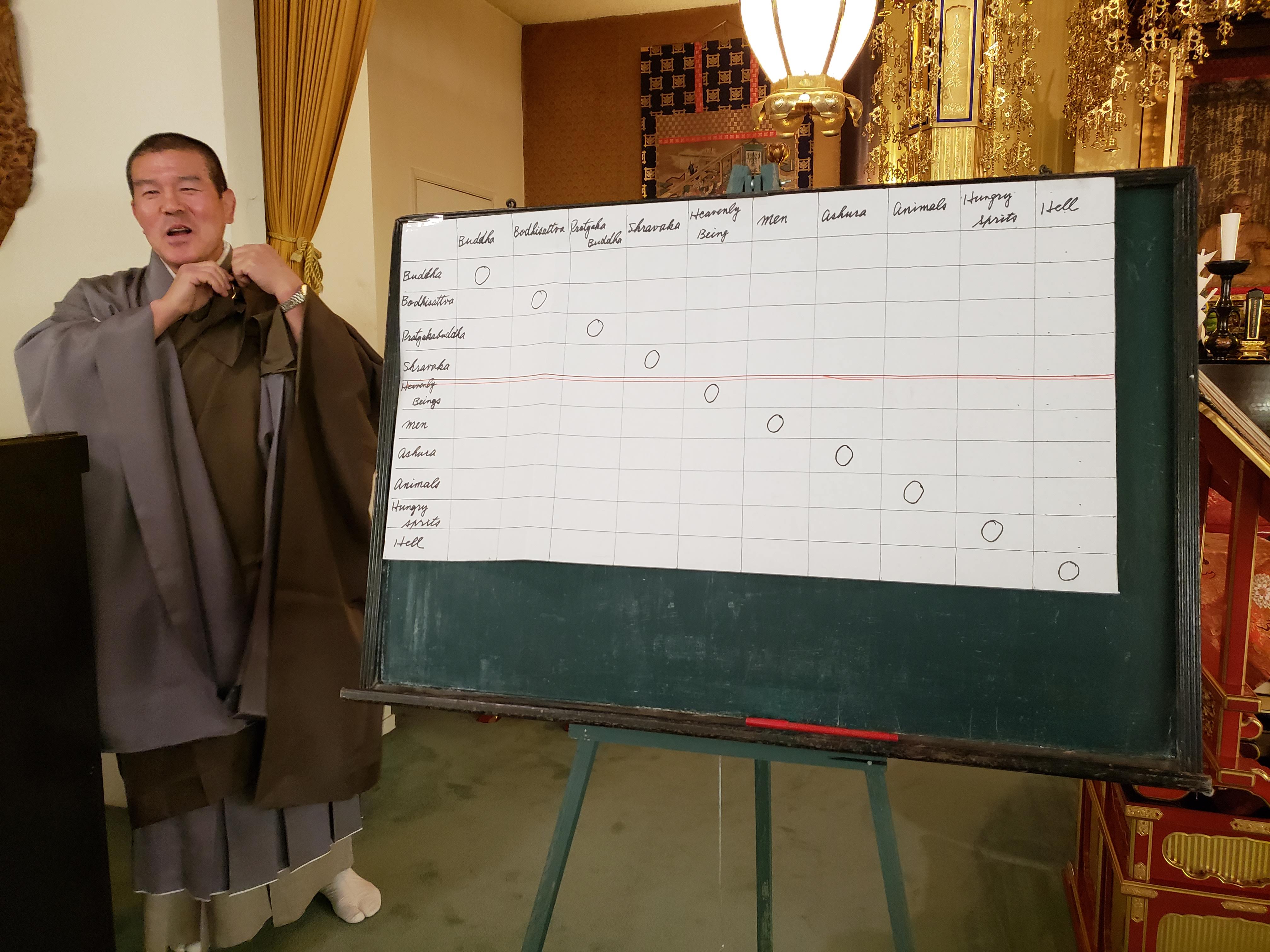
Ven. Kenjo Igarashi used the opportunity of the large crowd at the service to offer a quick overview of Ichinen Sanzen, a shorter version of the lecture he gave last year on The Logic of 3000 Realms.
Lay Buddhist Precepts
The … 5 precepts for lay Buddhists: not to take life, not to steal, not to indulge in improper sexual activity, not to lie, and not to drink intoxicants. Stated positively, these precepts exhort us to love and protect living creatures (including both human and nonhuman beings), to be generous and munificent, to lead lives of sexual morality, to tell the truth always, and to lead sober lives free of dissipation.
Basic Buddhist Concepts
Daily Dharma – Jan. 29, 2019
The good men or women who keep, read, recite, expound or copy this Sūtra of the Lotus Flower of the Wonderful Dharma, will be able to obtain eight hundred merits of the eye, twelve hundred merits of the ear, eight hundred merits of the nose, twelve hundred merits of the tongue, eight hundred merits of the body, and twelve hundred merits of the mind.
The Buddha gives this teaching in Chapter Nineteen of the Lotus Sūtra. This is another reminder that the practice of the Wonderful Dharma does not take us out of the world of conflict we live in. Instead, it helps us to use the senses we have, in ways we did not think were possible, to see the world for what it is. Merits in this sense are not status symbols. They are an indication of clarity, of our faculties not being impeded by anything that blocks their capacity.
The Daily Dharma is produced by the Lexington Nichiren Buddhist Community. To subscribe to the daily emails, visit zenzaizenzai.com