
All posts by John Hughes

Day 3

Day 3 covers the first half of Chapter 2, Expedients.

Having last month heard Śākyamuni explain that the Buddhas teach only Bodhisattvas because they wish to show the insight of the Buddha to all living beings, we conclude today’s portion of Chapter 2, Expedients.

“Śāriputra! The Buddhas appear in the evil worlds in which there are the five defilements. The worlds are defiled by the decay of the kalpa, by illusions, by the deterioration of the living beings, by wrong views, and by the shortening of lives. Śāriputra! When a kalpa is in decay, the living beings [in that kalpa] are so full of illusions, so greedy, and so jealous that they plant many roots of evil. Therefore, the Buddhas divide the One Buddha-Vehicle into three as an expedient.

“Śāriputra! Some disciples of mine, who think that they are Arhats or Pratyekabuddhas, will not be my disciples or Arhats or Pratyekabuddhas if they do not hear or know that the Buddhas, the Tathāgatas, teach only Bodhisattvas.

“Śāriputra! Some bhikṣus and bhikṣunīs do not seek Anuttara-samyak-saṃbodhi because they think that they have already attained Arhatship, that they have already reached the final stage of their physical existence, and that the Nirvāṇa attained by them is the final one. Know this! They are arrogant because it cannot be that the bhikṣus who attained Arhatship do not believe the Dharma. Some bhikṣus who live in a period in which no Buddha lives after my extinction may not believe the Dharma after they attain Arhatship because in that period it will be difficult to meet a person who keeps, reads, and recites this sūtra, and understands the meanings of it. They will be able to understand the Dharma when they meet another Buddha.

“Śāriputra and all of you present here! Understand the Dharma by faith with all your hearts! There is no vehicle other than the One Buddha-Vehicle.”

The Daily Dharma from Dec. 31, 2018, offers this:

Śāriputra! Some disciples of mine, who think that they are Arhats or Pratyekabuddhas, will not be my disciples or Arhats or Pratyekabuddhas if they do not hear or know that the Buddhas, the Tathāgatas, teach only Bodhisattvas.

The Buddha makes this declaration to his disciple Śāriputra in Chapter Two of the Lotus Sutra. When the Buddha says he only teaches Bodhisattvas, he does not mean that he excludes anyone from his teaching. It is only when we realize and develop our capacities as Bodhisattvas, beings who exist to benefit all beings, rather than being preoccupied with our own suffering, can we hear, practice and appreciate the Buddha Dharma.

The Daily Dharma is produced by the Lexington Nichiren Buddhist Community. To subscribe to the daily emails, visit zenzaizenzai.com

The Lineage Chart of the Authentic Teaching of the Lotus Sutra

The list of names that appears at the bottom of the Great Mandala provides a kind of lineage chart of the authentic teaching of the Lotus Sutra according to Nichiren. This lineage comprises the historical transmission of the Lotus Sutra that began with the historical Shakyamuni Buddha. Nichiren refers to this in the Spiritual Contemplation of the Focus of Devotion:

“… I should say that during the period spanning the time the Buddha was still alive and some 1,800 years after His death, there appeared only three throughout the three lands of India, China, and Japan who perceived the ultimate truth, that is, the Lotus Sutra. They are Shakyamuni Buddha of India, Grand Master T’ien-t’ai of China, and Grand Master Dengyo of Japan, who are the three sages of Buddhism.”

If Nichiren Shonin is included in this number, these teachers are known collectively as the “four masters in three lands,” who comprise the outer or historical transmission. This is distinguished from the inner or spiritual transmission from the Eternal Shakyamuni Buddha to Superior Practice Bodhisattva who appeared in the Latter Age of the Dharma as Nichiren Shonin.

Lotus World: An Illustrated Guide to the Gohonzon

Daily Dharma – Jan. 14, 2019

If you wish to dwell in the enlightenment of the Buddha,
And to obtain the self-originating wisdom,
Make offerings strenuously to the keeper
Of the Sūtra of the Lotus Flower of the Wonderful Dharma!

The Buddha sings these verses to Medicine-King Bodhisattva at the beginning of Chapter Ten of the Lotus Sūtra. This teaching does not mean that we who practice the Buddha Dharma should expect offerings because of our practice. Rather, it encourages us to appreciate all those who are seeking enlightenment, whether or not they are aware of their true nature as Bodhisattvas. It also means that innumerable beings are helping us reach enlightenment. We are never alone in this practice.

The Daily Dharma is produced by the Lexington Nichiren Buddhist Community. To subscribe to the daily emails, visit zenzaizenzai.com

Contemplating the Realm of the Inconceivable

The first and most fundamental, “contemplating the realm of the inconceivable” (kuan pu-k’o-ssu-i Ching, kanfukashigi kyō), is to discern that the present object of contemplation is identical with the true aspect of reality, that is, the threefold truth. This is the portion of the text that sets forth the “single thought-moment comprising three thousand realms.” Since explanations of this concept in English sources are few, and since it is important not only in the medieval Tendai context but to the discussion in chapter 6 of Nichiren’s thought, it is worth presenting here in some detail.

The “single thought-moment” indicates the briefest possible instant in the thoughts of ordinary worldings that arise from one moment to the next, while the “three thousand realms” indicates the whole of phenomenal reality. In explaining the structure of “one mind” being “three thousand realms,” Chih-i says:

“Now one mind comprises ten dharma realms, but each dharma realm also comprises ten dharma realms, giving a hundred dharma realms. One realm comprises thirty kinds of realms, hence a hundred dharma realms comprise three thousand kinds of realms. These three thousand are contained in a fleeting moment of thought. Where there is no mind, that is the end of the matter; but if mind comes into being to the slightest degree whatsoever, it immediately contains the three thousand.”

Although each “thought-moment” is here said to “contain” the three thousand realms, Chih-i is careful to make clear that, in his system, the mind is not prior to dharmas:

“One may say neither that the one mind is prior and all dharmas posterior nor that all dharmas are prior and the one mind posterior. … If one derives all dharmas from the one mind, this is a vertical relationship. If the mind all at once contains all dharmas, this is a horizontal relationship. Neither vertical nor horizontal will do. All one can say is that the mind is all dharmas, and all dharmas are the mind. Therefore, the relationship is neither vertical nor horizontal, neither the same nor different. It is obscure, subtle and profound in the extreme. Knowledge cannot know it, nor can words speak it. Herein lies the reason for its being called ‘the realm of the inconceivable.’ ace;” (Page 178-179)

Original Enlightenment and the Transformation of Medieval Japanese Buddhism


Subtlety

[T]here is no distinction between coarseness and subtlety in the Lotus Sūtra, since all living beings are subtle in terms of their inherent Buddha-nature, and all responses of the Buddha are subtle as well, since these responses are for the purpose of leading beings to attain Buddhahood. (Vol. 2, Page 267)

The Profound Meaning of the Lotus Sutra: Tien-tai Philosophy of Buddhism


Day 2

Chapter 1, Introductory (Conclusion).

Having last month considered what Mañjuśrī saw innumerable, inconceivable, asamkya kalpas ago, we consider the teaching of the last Sun-Moon-Light Buddha.

“Maitreya, know this! All those Buddhas were called Sun-Moon-­light with the ten epithets. Their expounding of the Dharma was good at the beginning, good in the middle, and good at the end. The last Sun-Moon-Light Buddha was once a king. He had eight sons born to him before he renounced the world. The first son was called Having-Intention; the second, Good-Intention; the third, Infinite-­Intention; the fourth, Treasure-Intention; the fifth, Increasing­-Intention; the sixth, Doubts-Removing-Intention; the seventh, Resounding-Intention; and the eighth, Dharma-Intention. These eight princes had unhindered powers and virtues. Each of them was the ruler of the four continents [of a Sumeru-world]. Having heard that their father had renounced the world and attained Anuttara-samyak-saṃbodhi, they abdicated from their thrones, and followed their father. They renounced the world, aspired for the Great Vehicle, performed brahma practices, and became teachers of the Dharma. They had already planted the roots of good under ten million Buddhas in their previous existence.

“Thereupon the last Sun-Moon-Light Buddha expounded a Sūtra of the Great Vehicle called the ‘Innumerable Teachings, the Dharma for Bodhisattvas, the Dharma Upheld by the Buddhas.’ Having expounded this sūtra, he sat cross-legged [facing the east] in the midst of the great multitude, and entered into the samādhi for the purport of the innumerable teachings. His body and mind became motionless.

“Thereupon the gods rained mandarava-flowers, maha­-mandarava-flowers, manjusaka-flowers, and maha-manjusaka­flowers upon the Buddha and the great multitude. The world of the Buddha quaked in the six ways. The great multitude of the congregation, which included bhikṣus, bhikṣunīs, upāsakās, upāsikās, gods, dragons, yak􀁳as, gandharvas, asuras, garuḍas, kiṃnaras, mahoragas, men, nonhuman beings, the kings of small countries, and the wheel turning-holy kings, were astonished. They rejoiced, joined their hands together [towards the Buddha], and looked up at him with one mind.

‘Thereupon the Tathagata emitted a ray of light from the white curls between his eyebrows, and illumined all the corners of eighteen thousand Buddha-worlds in the east just as this Buddha is illumining the Buddha-worlds as we see now.

Nichiren wrote in Zuisō Gosho, Writing on Omens concerning the great omens of the Lotus Sūtra:

Grand Master T’ien-t’ai states in his Profound Meaning of the Lotus Sūtra fascicle 6, “It is said in a secular society that a cobweb is an advance notice of a happy event and chirps of a magpie foretell the arrival of a traveler. Even such trifle matters in the secular world are foreshadowed by an omen, how much more so the advent of the Buddhist Dharma. Based on worldly matters, we can conjecture the profound truth of Buddhism.” Thus the Buddha showcased the greatest omens that had never been seen during the more than 40 years in His lifetime when He expounded the theoretical section of the Lotus Sūtra.

Zuisō Gosho, Writing on Omens, Writings of Nichiren Shōnin, Volume 6, Followers I, Page 122

Nichiren Buddhist Sangha in Oakland practice/discussion Sunday 13th

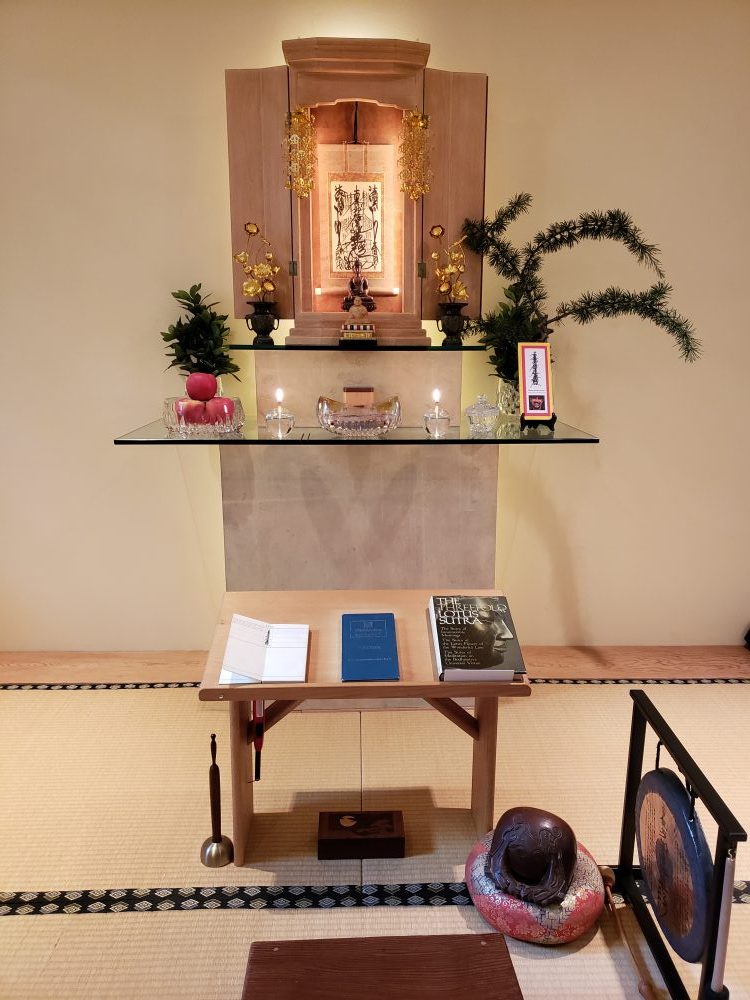
Altar in Mark Herrick’s Piedmont home where the Oakland Sangha meets
Heading back to Sacramento, having taken Amtrak to Oakland to attend the “Nichiren Buddhist Sangha in Oakland practice/discussion Sunday 13th.” The traditional Nichiren Shu service and discussion meeting was held in the Piedmont home of Mark Herrick. While not as convenient as last November’s service at the Bay Area Thelemic Temple across from the Lake Merritt BART station, it was no trouble getting a Lyft ride to and from the Oakland Jack London Amtrak station.

I would like to find a way to fit regular trips into my practice since I really appreciate the opportunity to take part in Ryuei McCormick’s discussions on Buddhism.

Amtrak waiting to return to Sacramento

Jogo-Noten

There is an important concept relating to karma which is called “Jogo-Noten” It means that even though we have some karmic destiny in our lives and live under the influence of karma, we can change our bad karma with good karma. Usually, we human beings think and make decisions by relying on information acquired with our five senses, such as hearing, seeing and feeling things. However, it seems that the direction of our lives is controlled by imperceptible spiritual forces, rather than perceptible physical forces. Karma is a representative of imperceptible spiritual forces. Perceptible physical forces are just the effects of the spiritual world, thus we cannot notice when we are making bad karma. When the harvest comes, we react, “Why do I have to experience such terrible things? I am quite innocent!” No one thinks they are guilty, and we always try to put the blame on others. If we take this way, our bad karma will never improve.

Summer Writings

Daily Dharma – Jan. 13, 2019

Anyone who keeps this sūtra
Will be able to expound
The meanings of the teachings,
And the names and words [of this sūtra].
Their eloquence will be as boundless
And as unhindered as the wind in the sky.

The Buddha sings these verses to Superior-Practice Bodhisattva (Jōgyo, Viśiṣṭacārītra) in Chapter Twenty-One of the Lotus Sūtra. This teaching transforms us from beings who exist for our own comfort and awakens our true nature as Bodhisattvas: beings who exist for the benefit of all beings. This transition requires that we engage with these other beings and break out of the isolation of our own attachments. The first step is simply to listen, to be present and accept whatever the world has to offer. But at some point we need to speak. It can be difficult to know what to say. But with this Wonderful Dharma of the Lotus Sūtra, we find that because it embodies the Buddha’s highest wisdom, so long as we transmit what it has taught us, we will always have ways to use it to benefit other beings and bring this teaching to life in our world.

The Daily Dharma is produced by the Lexington Nichiren Buddhist Community. To subscribe to the daily emails, visit zenzaizenzai.com

The Sequential Threefold Contemplation

The Mo-ho chih-kuan [Great Calming and Contemplation] explains the “threefold” aspect of this contemplation as follows. First is “entering [the insight of] emptiness from the [viewpoint of] the conventional”; that is, one contemplates the conditioned, dependent nature of all phenomena, which are without permanence or self-essence. From the perspective of this insight, all categories, hierarchies, and boundaries are collapsed; it is a discernment of ultimate equality. The discernment of all phenomena as empty frees one from attachment to desires and intellectual constructs and is said to correspond to the insight of arhats and bodhisattvas of the Tripiṭaka and shared teachings. Next is “entering [insight into] the conventional from [the discernment of] emptiness.” Having discerned the nonsubstantial, contingent nature of things, one cognizes their provisional existence as phenomena arising through dependent origination and is thus able to act in the world in a soteriologically effective way. This discernment reestablishes categories and distinctions, but without biased attachment or false essentializing; it is said to correspond to the wisdom of bodhisattvas of the separate teaching. Last is the “contemplation of the Middle Way that is the supreme meaning.” Here one contemplates phenomena as both empty and provisionally existing, discerning both aspects simultaneously. This is said to correspond to the wisdom of the Buddha and of the perfect teaching. This progression through the three contemplations of emptiness, conventional existence, and the middle described here is called the “sequential threefold contemplation” (tz’u-ti san-kuan, shidai sangan). However, Chih-i defines as superior the contemplation in which all three truths are discerned simultaneously; this is the “perfect and immediate calming and contemplation” (yüan-tun chih-kuan, endon shikan). (Page 177-178)

Original Enlightenment and the Transformation of Medieval Japanese Buddhism