Category Archives: Blog

The Fragrant Dharma

This follows yesterday’s post, The Bodhisattva’s Illness.

The Vimalakirti Sutra contains a fascinating description of a world in which everything is composed of fragrances (Page 112-115).

At that time Shariputra thought to himself, “It is almost noon. What are all these bodhisattvas going to eat?”

Then Vimalakirti, knowing what was in his mind, said, “The Buddha preached the eight emancipations. You, sir, should undertake to practice them. Why be distracted by thoughts of eating when you are listening to the Law? If you want something to eat, wait a moment. I will see that you get the sort of food you have never had before! ”

Vimalakirti then entered samadhi and, employing his transcendental powers, showed the great assembly a country called Many Fragrances, situated in a region high above, beyond Buddha lands as numerous as the sands of forty-two Ganges. The Buddha named Fragrance Accumulated was at that time present there. The fragrance of his country was finer than the fragrance of all the human and heavenly realms of the Buddha lands of the ten directions. In this land there was not even the term voice-hearer or pratyekabuddha, but only great bodhisattvas, pure and clean, for whom the Buddha preached the Law. All the inhabitants of his world built their halls and towers out of fragrances, strolled the fragrant ground, and had gardens all made of fragrances. The fragrant aroma of their food wafted to immeasurable worlds in the ten directions. At this time the Buddha and the various bodhisattvas were just sitting down together to eat. Heavenly offspring, all named Fragrant Garland, all with their minds set on attaining anuttara-samyak-sambodhi, were serving the meal to the Buddha an the bodhisattvas.

Among the great assembly [gathered at Vimalakirti’s house,] there were none who could not see these things with their own eyes.

Then Vimalakirti addressed the bodhisattvas, saying, “Sirs, who among you can bring us some of that Buddha’s food ?”

Out of deference to Manjushri’s authority and supernatural powers, however, all of them remained silent.

[Addressing Manjushri,] Vimalakirti said, “Sir, a great assembly such as this – this is shameful, is it not?”

Manjushri replied, “As the Buddha has told us, never despise those who have yet to learn.”

Thereupon Vimalakirti, without rising from his seat but in the presence of the whole gathering, conjured up a phantom bodhisattva whose auspicious features, shining brightness, authority and virtue were so superior that they outshone the entire group. Then he announced to this bodhisattva, “You must go to the region high above, beyond Buddha lands numerous as the sands of forty-two Ganges, where there is a country called Many Fragrances. The Buddha, named Fragrance Accumulated, is just now sitting down with his bodhisattvas to a meal. When you arrive in his presence, speak as I instruct you, saying, ‘Vimalakirti bows his head before the feet of the World-Honored One with immeasurable reverence and begs to inquire if in your daily activities your illnesses are few, your worries are few. Does your strength suffice you? He desires to obtain the leftovers from this meal of the World-Honored One so he may carry out the Buddha’s work by dispensing them in the saha world, enabling those who delight in a lesser doctrine to be broadened by the great way, and also to cause the Thus Come One’s fame to be heard on all sides.’ ”

At that time this conjured bodhisattva in the presence of the gathering ascended to the region high above. Everyone in the entire assembly could see him as he departed, and as he arrived in the world called Many Fragrances and made his obeisance at the feet of the Buddha there. And they could hear him say, ‘Vimalakirti bows his head before the feet of the WorldHonored One with immeasurable reverence and begs to inquire if in your daily activities your illnesses are few, your worries are few. Does your strength suffice you? He desires to obtain the leftovers from this meal of the World-Honored One so he may carry out the Buddha’s work by dispensing them in the saha world, ensuring that those who delight in a lesser doctrine will be broadened by the great way, and also that the Thus Come One’s fame may be heard on all sides.”

When the great men [of the country Many Fragrances] saw this conjured bodhisattva, they sighed at seeing what they had never seen before, and said, “Where has this superior being come from? The saha world – where is that? What is this thing he calls a ‘lesser doctrine?’ ”

When they had put these questions to their Buddha, the
Buddha announced to them, “In the lower region, beyond Buddha lands as numerous as the sands of forty-two Ganges, there is a world called saha. The Buddha named Shakyamuni is at present manifesting himself in that evil world of the five impurities in order to expound the teachings of the Way to living beings who delight in a lesser doctrine. He has a bodhisattva named Vimalakirti who dwells in the emancipation Beyond Comprehension and preaches the Law for the other bodhisattvas. He has purposely dispatched this phantom being to come and extol my name and praise this land, so that thereby he may bring increased benefits to those bodhisattvas.”

The bodhisattvas said, “How can this man conjure up a phantom such as this? Does he possess such strength of virtue, such fearlessness, such transcendental powers?”

The Buddha replied, “His powers are great indeed! He dispatches phantoms in all the ten directions to carry out the Buddha’s work and bring enrichment to living beings.”

Then the Thus Come One Fragrance Accumulated took a bowl of many fragrances, filled it with fragrant rice, and gave it to the phantom bodhisattva.

The provisional nature of The Vimalakirti Sutra is underscored by this denigration of voice-hearers or pratyekabuddhas. As is explained in the Profound Meaning of the Lotus Sutra:

For Chih-i, the … differentiation of the coarse and the subtle is for the purpose of reaching non-distinction, since the intention of the Buddha is for universal salvation. Ultimately speaking, the coarseness and the subtlety are all merged in the Lotus Sūtra, for the Buddha made decisive and clear that all of them are dissolved in the subtlety (Chüeh-liao Jumiao). Regardless of whether they are viewed as coarse or subtle, and or neither coarse nor subtle, they all contain the ultimate intention of the Buddha in leading beings to attain Buddhahood. (Vol. 2, Page 105)
The Profound Meaning of the Lotus Sutra: Tien-tai Philosophy of Buddhism


Or as Nichiren writes:

As all Mahāyāna sūtras except one do not preach on the basis of the “revealing the truth and merging all the provisional” doctrine, neither the doctrine of obtaining Buddhahood for the Two Vehicles nor that of attainment of Buddhahood by Śākyamuni Buddha in the eternal past is preached in them. The Lotus Sūtra on the other hand, is expounded on the basis of the “revealing the truth and merging all the provisional” doctrine, thus both doctrines of attaining Buddhahood by the Two Vehicles and the attainment of Buddhahood by Śākyamuni Buddha in the eternal past are revealed in it.

Ken Hōbō-shō, A Clarificaton of Slandering the True Dharma, Writings of Nichiren Shōnin, Doctrine 3, Pages 133.

One other link between the Vimalakirti and Lotus sutras is this warning given following the above discussion of the saha world:

At that time the nine million bodhisattvas all spoke out in unison, saying, “We wish to visit that saha world and offer alms to Shakyamuni Buddha. And we also wish to see Vimalakirti and the many other bodhisattvas.”

“You may go,” said the Buddha. “But draw in your bodily fragrances so that you will not cause living beings to be deluded or beguiled by them. And you should put aside your real form so that the persons in that country who are striving to become bodhisattvas will not feel intimidated or ashamed. And you must not look on that land with disdain or contempt or rouse thoughts that obstruct progress. Why? Because all the lands in the ten directions are as empty as the sky. It is just that, since the Buddhas wish to convert those who delight in a lesser doctrine, they do not reveal the full purity of the land.”

Compare that with Pure-Flower-Star-King-Wisdom Buddha’s admonition to Wonderful-Voice Bodhisattva in Chapter 24:

“Do not despise that world! Do not consider it to be inferior [to our world]! Good Man! The Sahā-World is not even. It is full of mud, stones, mountains’ and impurities. The Buddha [of that world] is short in stature! So are the Bodhisattvas [of that world]. You are forty-two thousand yojanas tall. I am six million an eight hundred thousand yojanas tall. You are the most handsome. You have thousands of millions of marks of merits, and your light is wonderful. Do not despise that world when you go there! Do not consider that the Buddha and Bodhisattvas of that world are inferior [to us]! Do not consider that that world is inferior [to ours]!”
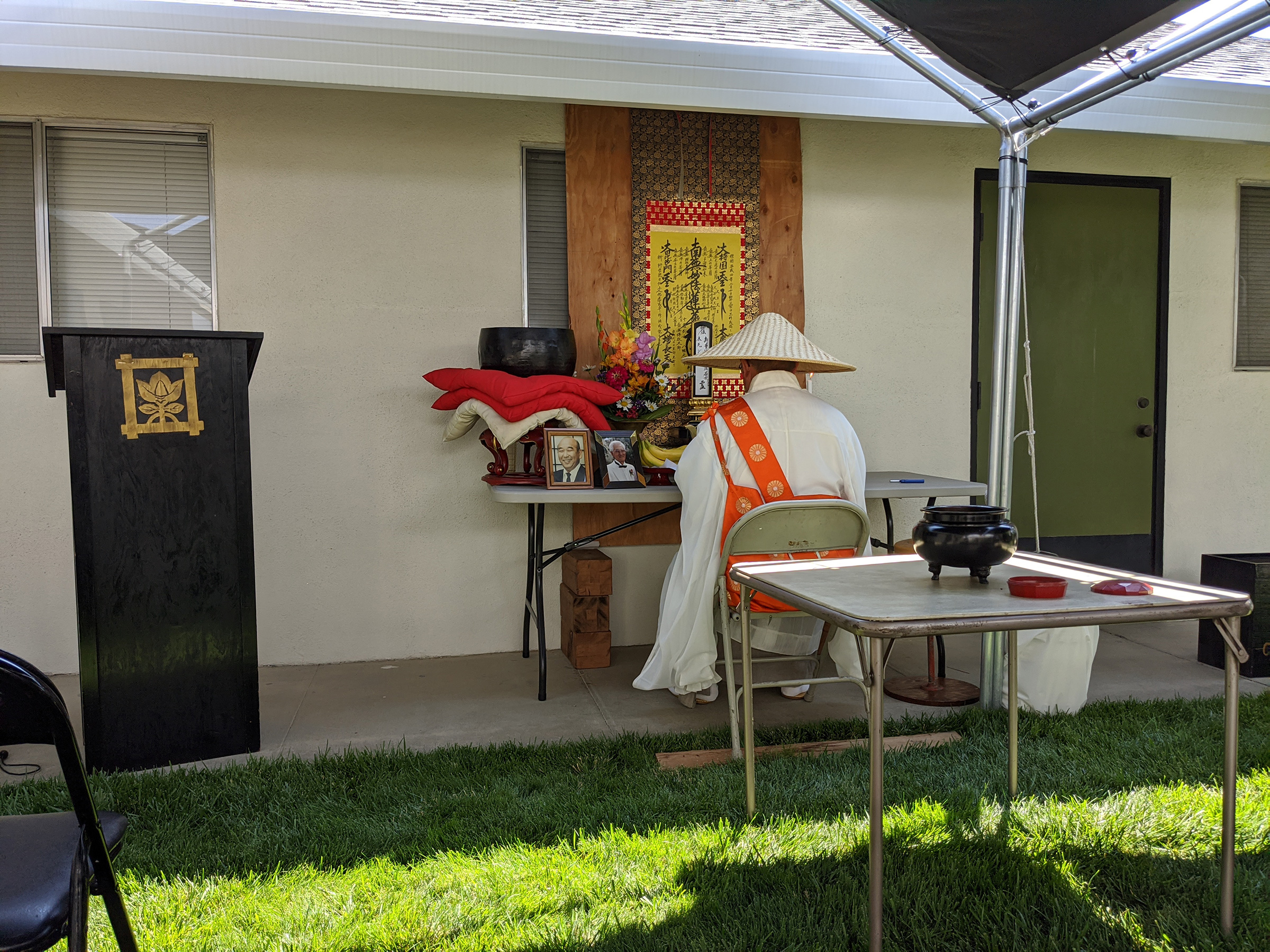
Outdoor Service

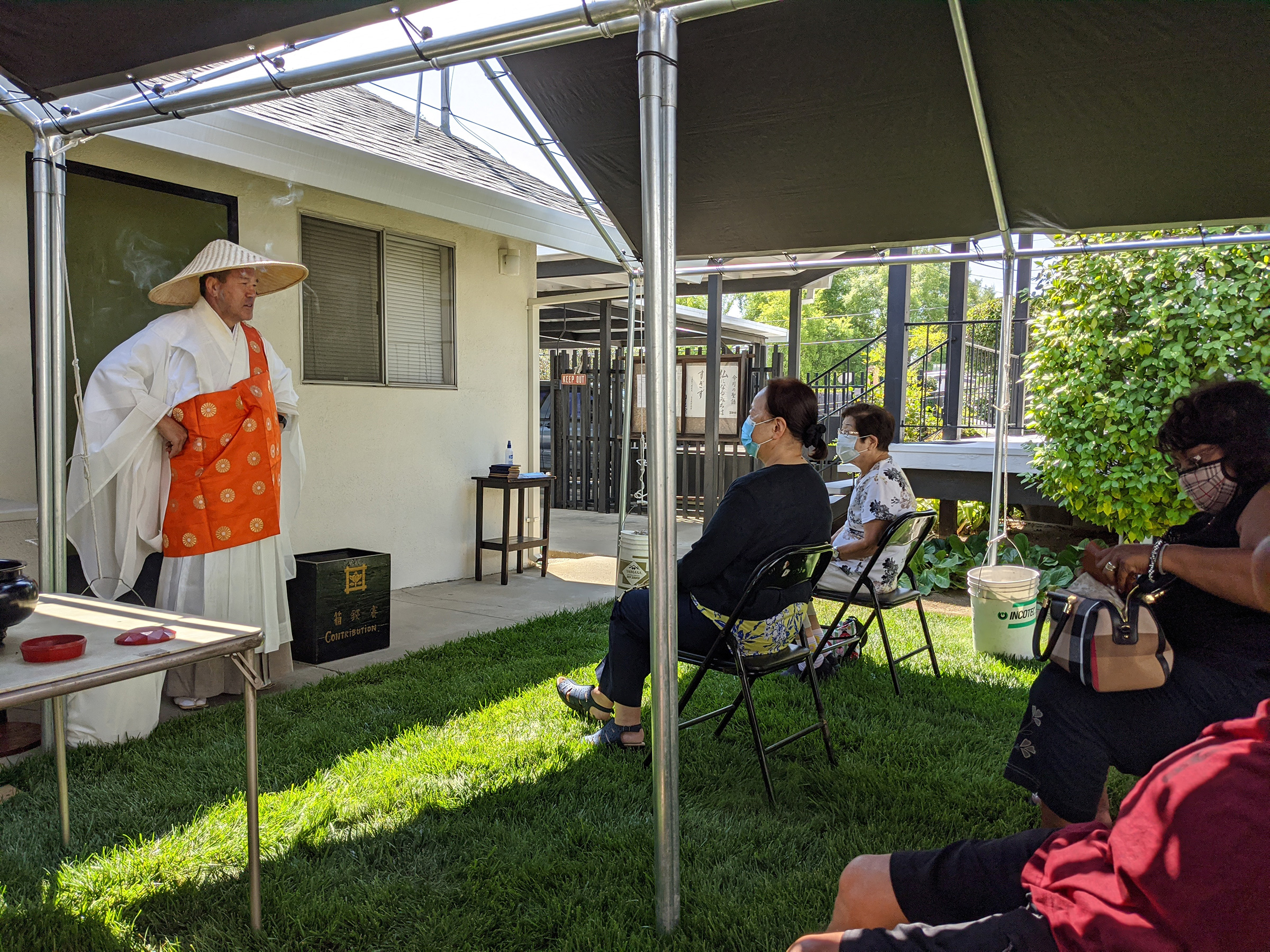
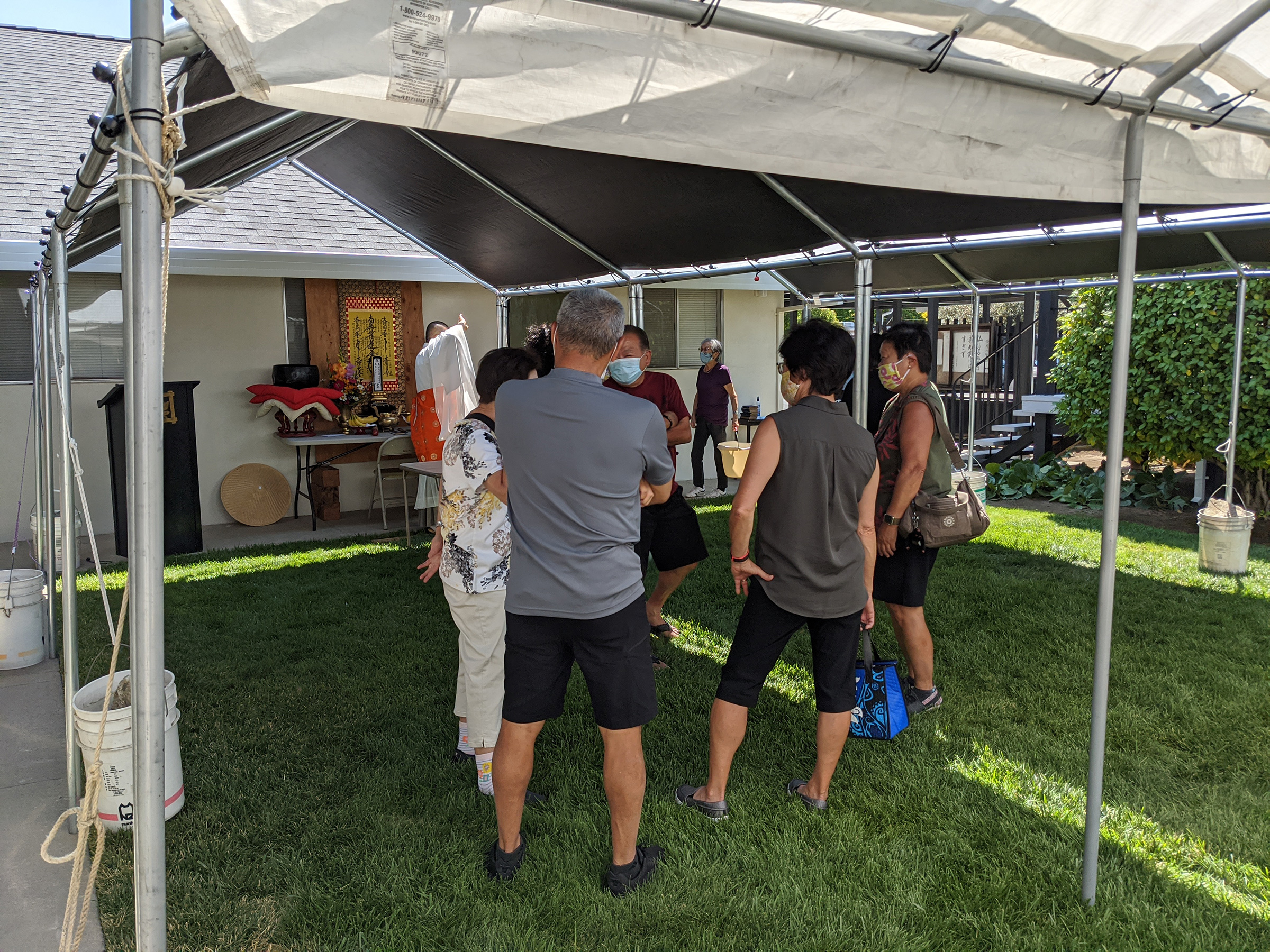
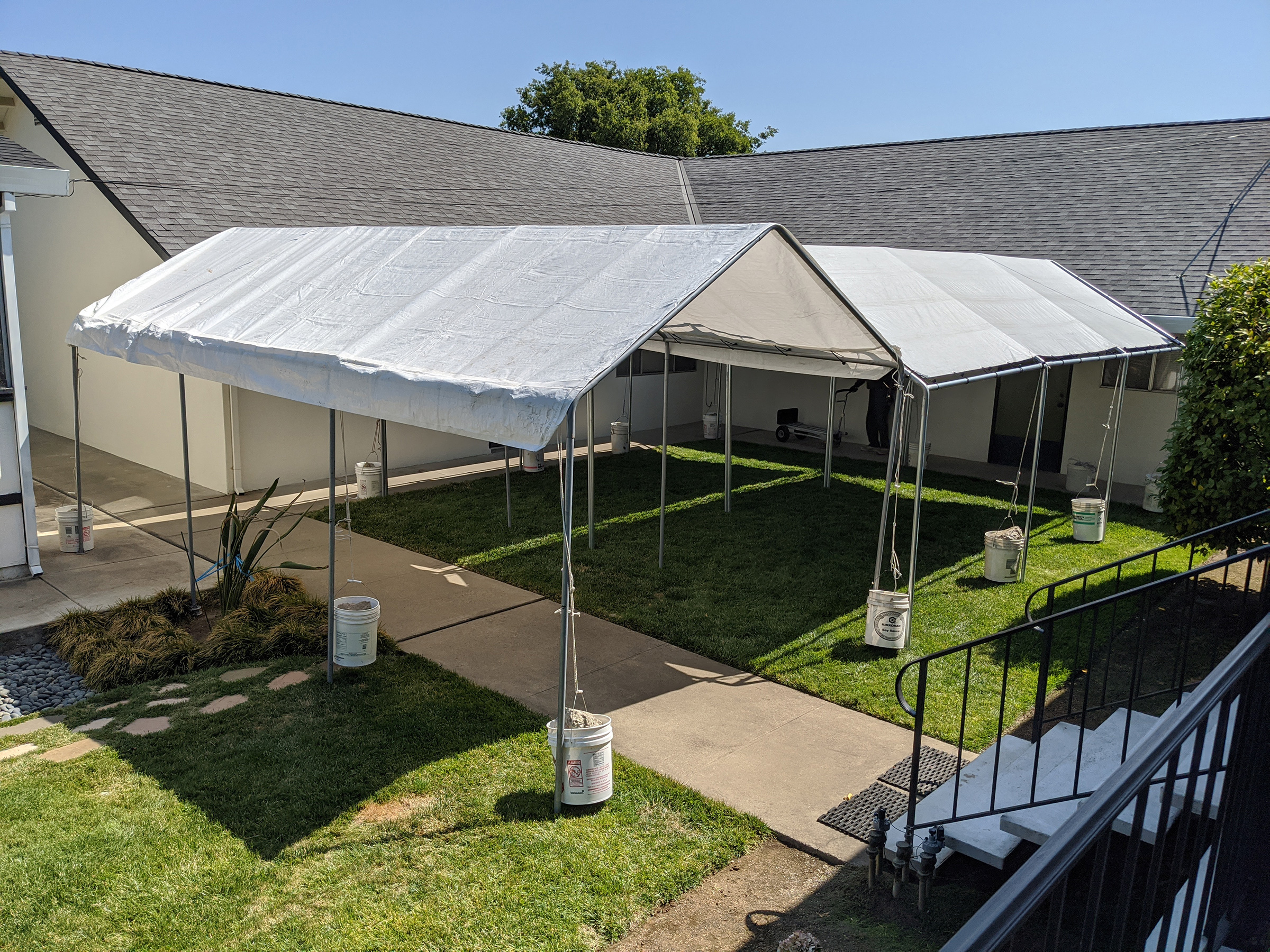
California recently prohibited all indoor religious services and so the Sacramento Nichiren Buddhist Church set up outside in a grassy area between the Social Hall and the Temple.

Three 20 by 10 feet canopies were erected on Saturday. These canopies are normally used during the Summer Food Festival.


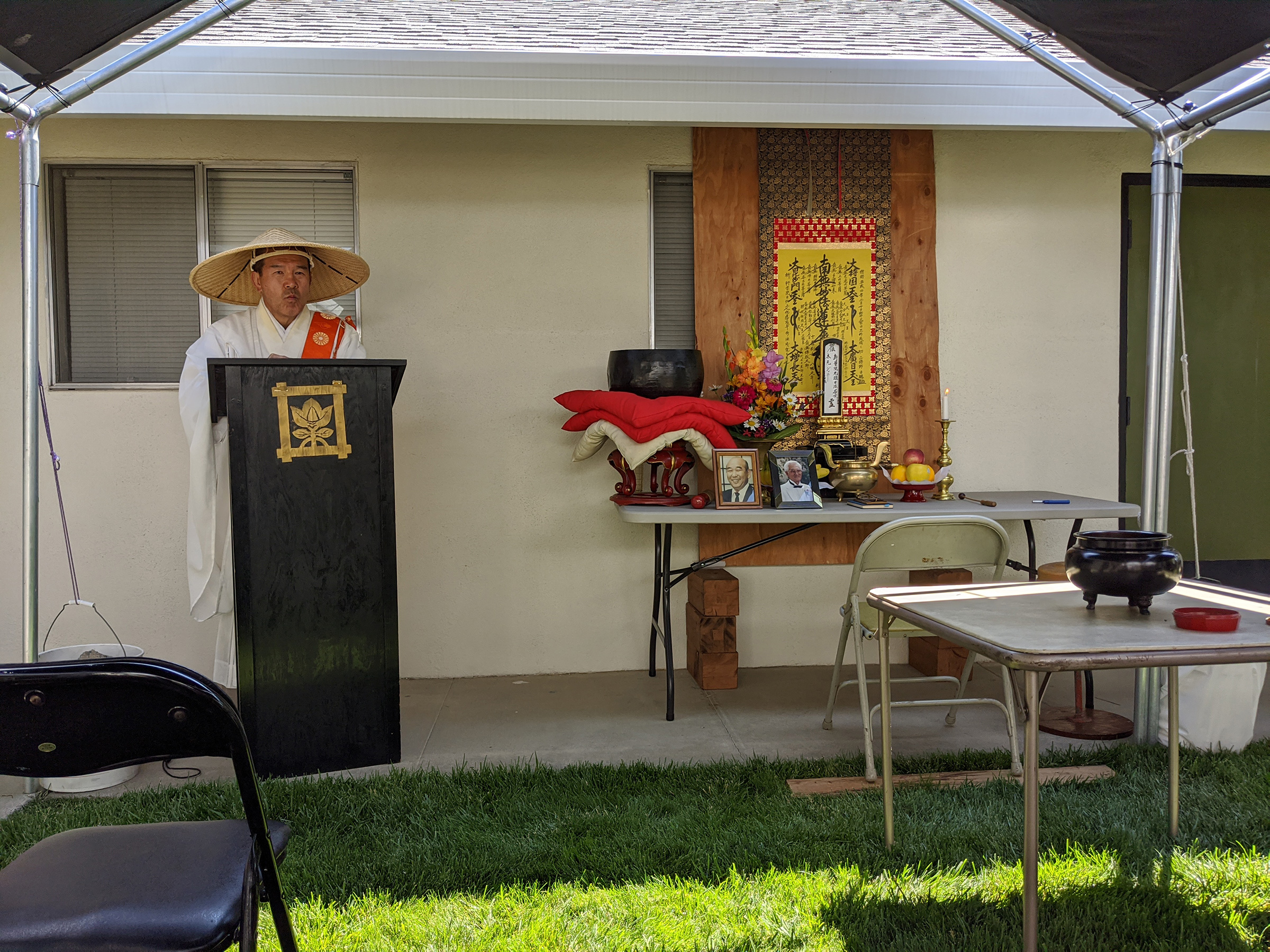
Rev. Igarashi stands at podium next to makeshift altar. The podium originally belonged to the San Francisco Nichiren Buddhist Church, where Rev. Igarashi worked before moving to Sacramento in 1989. The Mandala Gohonzon was presented to Rev. Igarashi after the completion of his third Aragyo session, the 100-day ascetic practice. Rev. Igarashi has completed five of the Aragyo sessions.


Rev. Igarashi at the altar.


Rev. Igarashi chats with masked, socially-distant parishioners under the canopies.

A group of masked-parishioners chat after the service.

Having the service outside was workable, but it was quite warm at times – could have used a litttle more breeze – and the traffic on the nearby street made Rev. Igarashi’s Dharma talk difficult to hear at times.

The Bodhisattva’s Illness

Recently I completed reading The Vimalakirti Sutra as translated by Burton Watson. I was reading this as part of Rev. Ryuei McCormick’s Buddhist Study Program. This also plays into reading I’ve been doing on T’ien-t’ai’s teaching and, in particular, how it constrasts with the Madhyamika.

As with all of my quotes here, the purpose is to file these away for future reference. I’ve never been famous for my retention of what I read, and at 68 years of age I’m not getting any better.

Today’s quote is about illness, from pages 64-66.

INQUIRING ABOUT THE ILLNESS

At that time the Buddha said to Manjushri, “You must go visit Vimalakirti and inquire about his illness.”

Manjushri replied to the Buddha, “World-Honored One, that eminent man is very difficult to confront. He is profoundly enlightened in the true nature of reality and skilled at preaching the essentials of the Law. His eloquence never falters, his wisdom is free of impediments. He understands all the rules of bodhisattva conduct, and nothing in the secret storehouse of the Buddhas is beyond his grasp. He has overcome the host of devils and disports himself with transcendental powers. In wisdom and expedient means he has mastered all there is to know. Nevertheless, in obedience to the Buddha’s august command, I will go visit him and inquire about his illness.” …

“Layman, this illness of yours – can you endure it? Is the treatment perhaps not making it worse rather than better? The World-Honored One countless times has made solicitous inquiries concerning you. Layman, what is the cause of this illness? Has it been with you long? And how can it be cured?”

Vimalakirti replied, “This illness of mine is born of ignorance and feelings of attachment. Because all living beings are sick, therefore I am sick. If all living beings are relieved of sickness, then my sickness will be mended. Why? Because the bodhisattva for the sake of living beings enters the realm of birth and death, and because he is in the realm of birth and death he suffers illness. If living beings can gain release from illness, then the bodhisattva will no longer be ill.

“It is like the case of a rich man who has only one child. If the child falls ill, then the father and mother too will be ill, but if the child’s illness is cured, the father and mother too will be cured. The bodhisattva is like this, for he loves living beings as though they were his children. If living beings are sick, the bodhisattva will be sick, but if living beings are cured, the bodhisattva too will be cured. You ask what cause this illness arises from – the illness of the bodhisattva arises from his great compassion.”

This certainly resonates with this day of COVID-19.

Prayers for Rev. Ryusho Jeffus

20200726_myoshoji_service
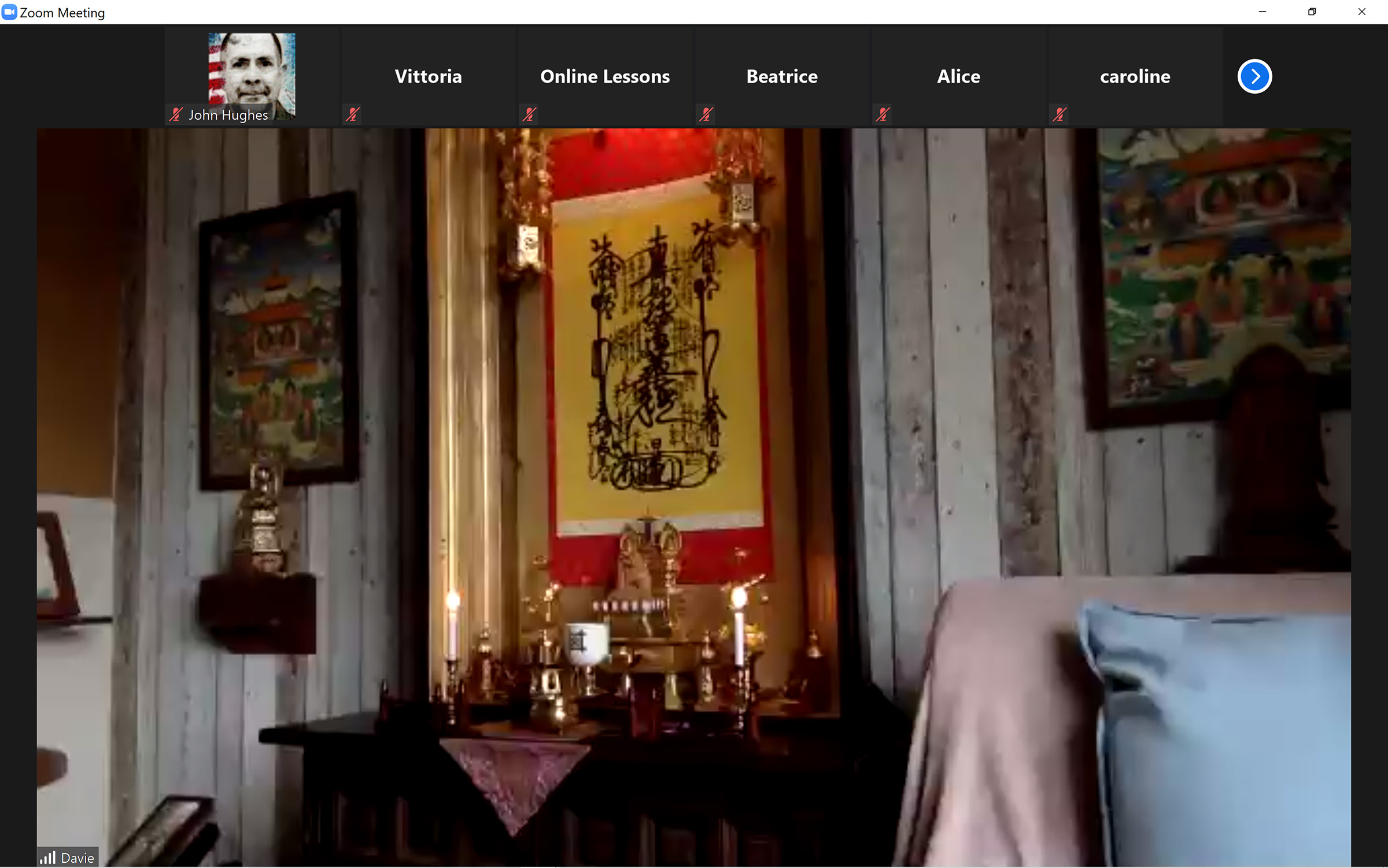
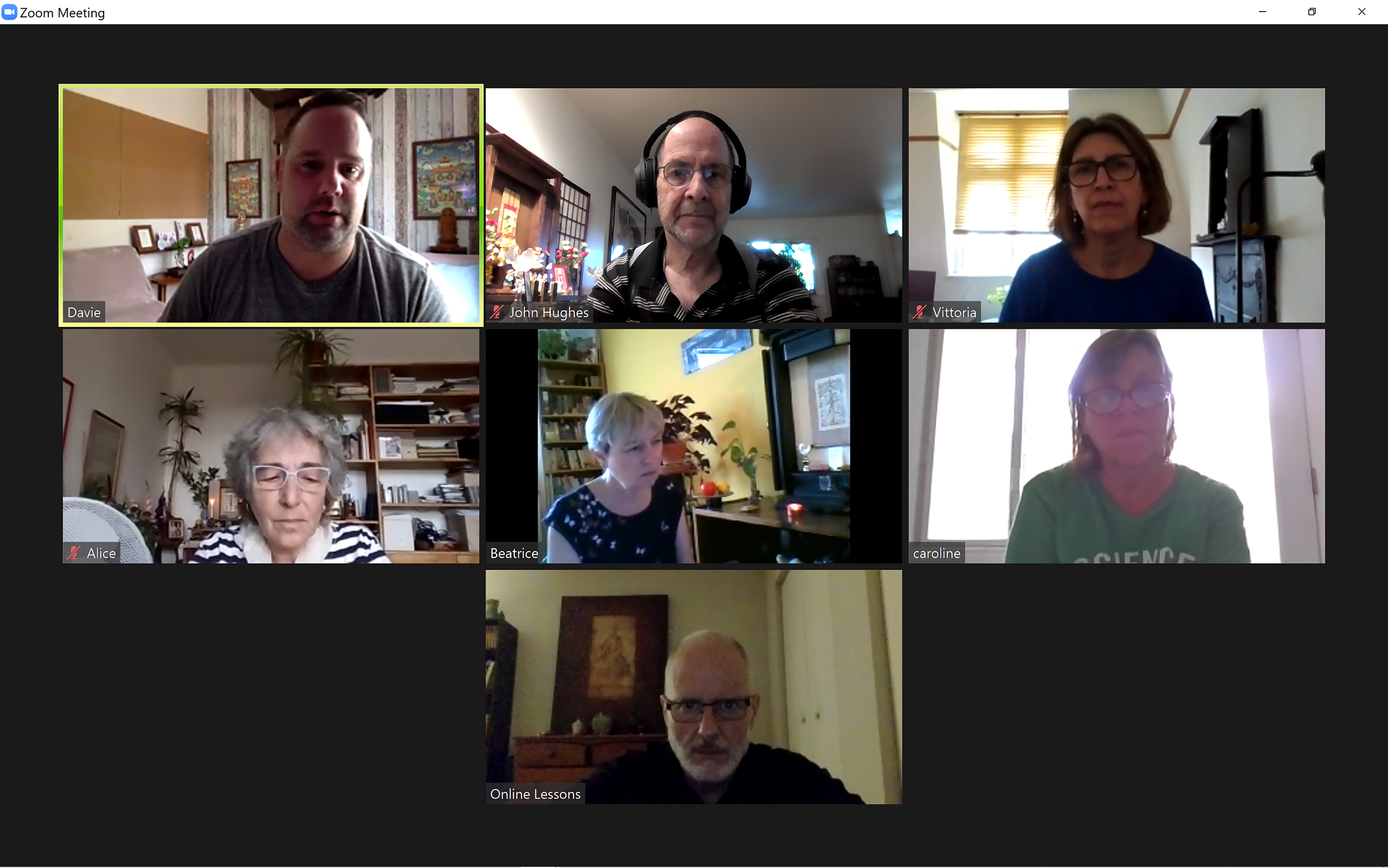
With Rev. Ryusho Jeffus in hospital, Davie Byden-Oakes took over from England to offer a Sunday service.

Members of Rev. Ryusho Jeffus’ online Sangha gathered today to hold a service and offer prayers for Ryusho, who has been in hospital since Friday. Ryusho communicated with my wife to say his news from the doctors “was not good” and that he was receiving palliative care at the Syracuse VA Medical Center for extreme pain and difficulty breathing. Nothing has been heard since. Davie Byden-Oakes, who led Sunday’s service from England, said he had received a brief note from Ryusho saying he was in hospital and receiving palliative care.

20200726_Myoshoji_Service_Attendees
Attendees of Myoshoji online service led by Davie Byden-Oakes in England

The Awakening of Faith in the Mahāyāna

The secret to my constant flow of quotes from books I read is an app on my phone called Office Lens. This is a Microsoft product that integrates with One Drive. Using Office Lens I can take a picture of a block of text and have the app save an editable version of the text in a Word file. Best of all, the image is included so that occasional OCR failures can be fixed.

Not every book I read merits extensive quotes. My Office Lens folder is cluttered with quotes I’ve set aside but never uploaded here. Since they don’t do me any good there, I’m working my way through the odds and ends.

Today’s example is The Awakening of Faith, which is attributed to Aśvaghoṣa. The Awakening of Faith is described as a “comprehensive summary of the essentials of Mahāyāna Buddhism.” While there is a great deal of substance here, I only set aside two things I felt merited saving for use later.

First is the full title of the work, The Awakening of Faith in the Mahāyāna.

It should be noted that the term “Mahāyāna” here is not used in the usual sense of the word, that is, Mahāyāna versus Hinayāna. According to the definition given in the discussion immediately following, Mahāyāna designates Suchness or the Absolute. The title of the text, the Awakening of Faith in the Mahāyāna, should therefore be understood as the “Awakening of Faith in the Absolute,” not in Mahāyāna Buddhism as distinguished from Hinayāna Buddhism.

I wonder whether this applies in more instances where the Great Vehicle is discussed.

The second concerns how one is to look at the Reality of Dependent Origination.

“Because these two aspects are mutually inclusive”: Reality is conceived as the intersection of the Absolute order and the phenomenal order; therefore, it contains in itself both the Absolute and the phenomenal order at once. The Absolute order is thought to be transcendental and yet is conceived as not being outside of the phenomenal order. Again the phenomenal order is thought to be temporal and yet is conceived as not being outside of the Absolute order. In other words, they are ontologically identical; they are two aspects of one and the same Reality. Perhaps the most famous and simplest statement of the relationship between the Absolute and the phenomenal order can be found in the sayings of Nāgārjuna (second century A.D.), e.g., “There is no difference whatsoever between nirvāṇa (Absolute) and saṃsāra (phenomena); there is no difference whatsoever between saṃsāra and nirvāṇa.”

This is a recurring discussion. I recently finished T’ien-t’ai Buddhism and Early Mādhyamika, which is almost entirely devoted where Nāgārjuna and T’ien-t’ai intersect and diverge. I’ve lots of quotes that I’ll need to eventually add here.

Finally, I have this excellent summary of what it means to be a Buddhist.

On Mount Chunwang in Henan province there was a monk [Chan Master Daolin] who practiced meditation sitting in a tall pine tree day after day. His practice was so effortless and spontaneous that birds formed their nests next to his meditation Site. People gave him the nickname “Bird Nest Master” and frequented his treehouse to seek his guidance. …

One day the great Tang poet Bo Juyi (772-846), who was then a regional magistrate, visited Daolin at his treehouse. Bo Juyi asked Daolin, “Master, your residence looks so high on the tree. Isn’t it dangerous?”

The master said, “Magistrate, yours is far more dangerous than mine.”

Bo continued, “But, Master, I, your humble disciple, rule over all the rivers, mountains, and lands in this region. Why am I in a danger?

“Fire and firewood destroying each other,” replied the Master, “that’s how your mind ‘s thoughts operate, and you cannot quiet them. Is that not truly dangerous?”

Bo paused and then asked again, “Master, please instruct me in the cardinal teaching of Buddhism.”

Daolin said, “Abstain from all bad deeds, and practice all good deeds.”

“Even a three-year-old child knows that,” said Bo with dissatisfaction.

Daolin told Bo, “A three-year-old child may know it, but even an eighty-year-old man cannot put it into practice.”

Bo Juyi bowed low at the master’s feet.

The Lotus Sutra and Nichiren

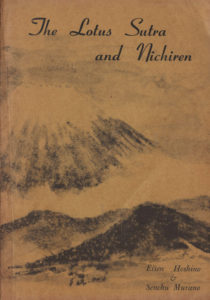
1968_TheLotusSutra_and_Nichiren_Hoshino_Murano-coverI have scanned and uploaded to the Sacramento Nichiren Buddhist Church’s Brochures page a copy of a small biography of Nichiren published in 1968. The Lotus Sutra and Nichiren was written by the Rev. Eisen Hosino, who at the time was Chief Priest of Jitsujoji Temple, Jomkuji, Achi-ken. The book was translated into English by Senchu Murano, then a Rissho University professor.

The book is factually thorough but not particularly inspiring. I much prefer Nichiren, the Buddhist Prophet, by Masaharu Anesaki or Nichiren, Leader of Buddhist Reformation in Japan by J.A. Christensen.  I also highly recommend Rev. Ryuie McCormick’s Lotus in a Sea of Flames, a novelized account of Nichiren’s life steeped in Nichiren Shu doctrine.

Nichiji Shonin and the Relics of Senka

NichijiStatueEishoji
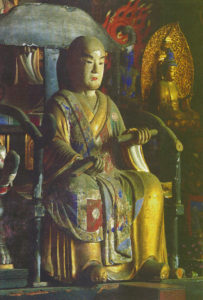
This photo is of Nichiji Shonin’s statue enshrined at Eishoji Temple
Recently I came across a Nichiren Shu brochure published in 1994 to mark the 700th memorial year of Nichiji Shonin. The brochure includes photos of objects found at Rikkaji Temple in Senka, China.

    1. A scroll of Mandala written by Nichiren Shonin
    2. An image of Nichiren Shonin
    3. Odaimoku written by Nichiji Shonin
    4. A cup made of silver
    5. Kegon Sutra
    6. A container of Incense
    7. A pill case
    8. An incense case
    9. A crape wrapper

Included with these objects was a poem:

Seven years of travel seems
but one night’s dream,
Endless missionary journeys
East and West and East
Against the Moon, a bird – please!
fly one thousand leagues,
Speak my heart to my master
loving to his grave.

I’ve posted the text and images from the brochure on the Sacramento Nichiren Buddhist Church website.

Daily Practice Evolution

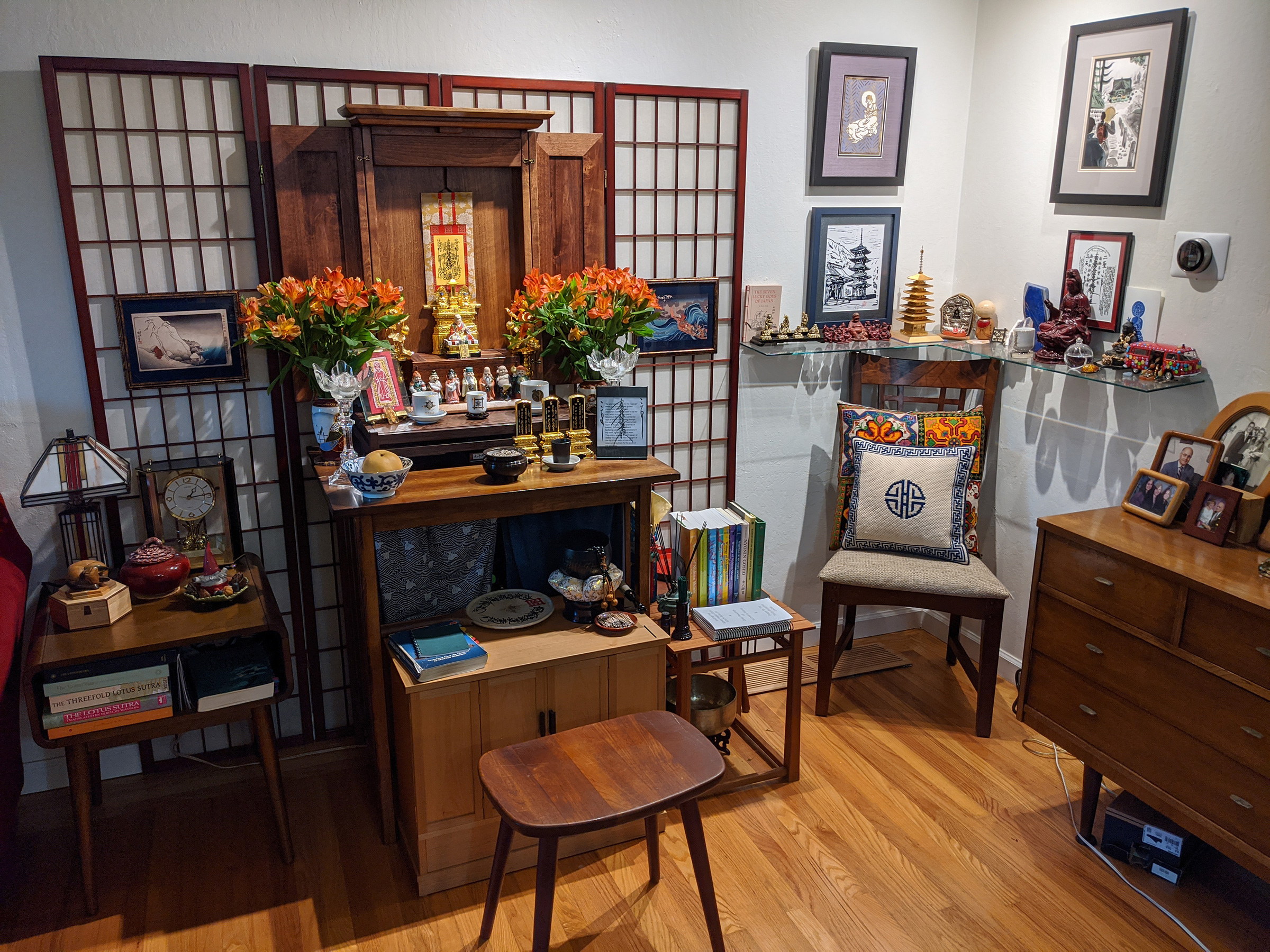
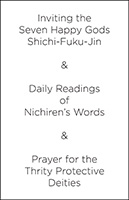
20200704_DailyDeitiesGoshoFor several days I’ve wanted to write about my new supplemental service booklet I created but I keep getting distracted. Sanshō-shima.
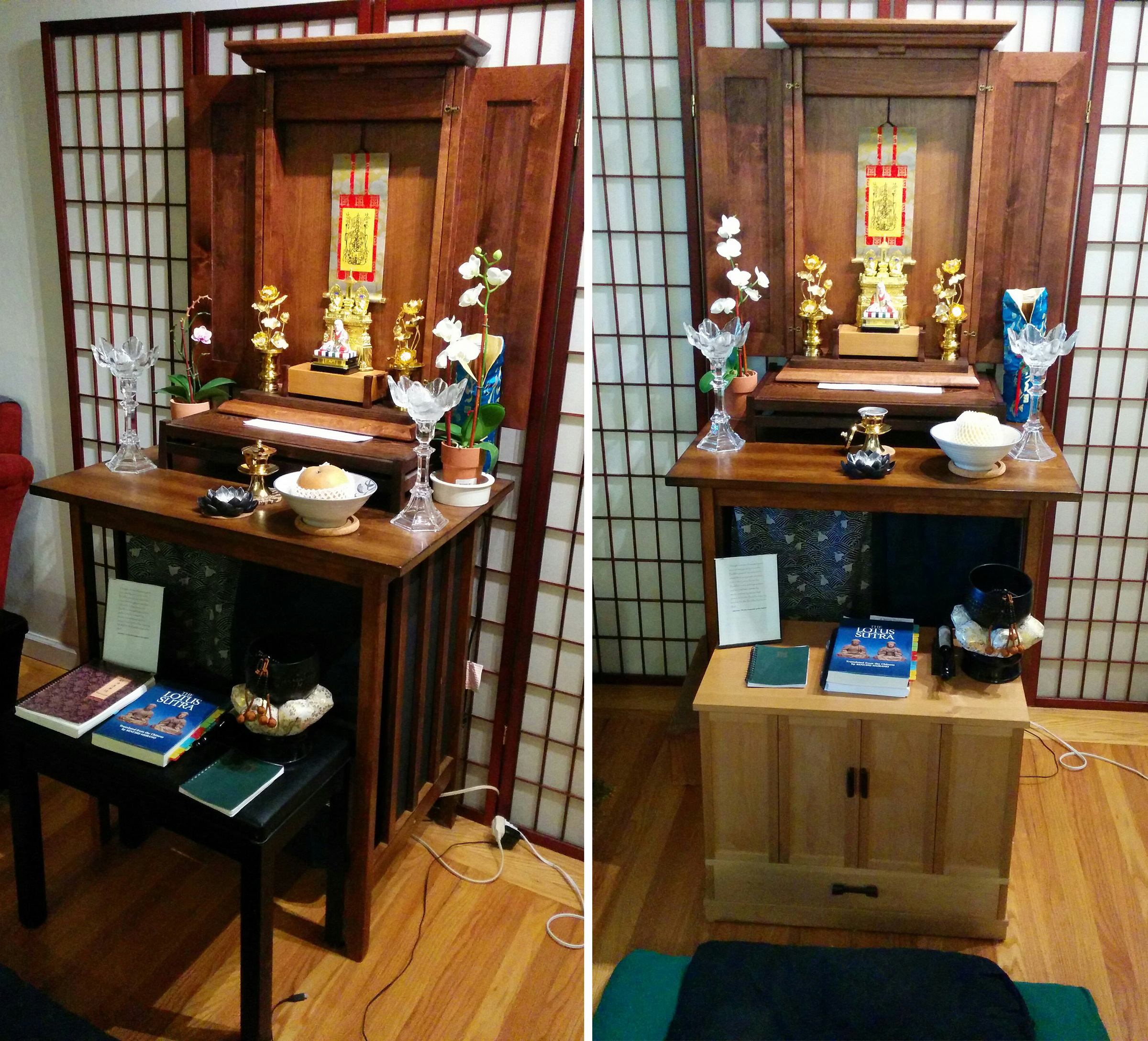
My first attempt was sidetracked into an illustrated tour of my altar’s evolution.

When I started today I got distracted updating the booklet text to include macrons that had been dropped from several words.

So here I am again.

In the past 2000 days, my daily service has not evolved as much as my altar, but it has changed. For example, back in September 2015, I was chanting Daimoku an average 10 minutes each service. Today, it’s more like 20 minutes. Then I used a timer; now I have a ritual that includes counting 40 to 50 Daimoku while focusing on the Mandala Gohonzon, then 40 to 50 Daimoku on Śākyamuni, and then 40 to 50 Daimoku on Many Treasures and then 40 to 50 Daimoku on the Buddhas in Manifestation Throughout the Universe. Then I focus 40 to 50 Daimoku on Nichiren and then move on to my traveling altar, first the mandala amulet and then the Kishimojin amulet. (I count using my fingers, with four or five Daimoku for each finger depending on how many I can chant with one breath.) Then I greet each of the Seven Happy Gods, identifying each of them – e.g. Bishamon, Vaiśravaṇa, Heavenly King of the North, who represents Dignity – followed by three Daimoku. After I’ve identified all seven I repeat their features – Dignity, Honesty, Joy, Wisdom, Longevity, Happiness and Fortune – and three more Daimoku. I then focus three Dailmoku each on my deceased parents and stepmother and my wife’s parents. I finished by chanting while reading silently a portion of the Letter to Hōren, Writings of Nichiren Shōnin, Volume 6, Followers I, Pages 56-57.

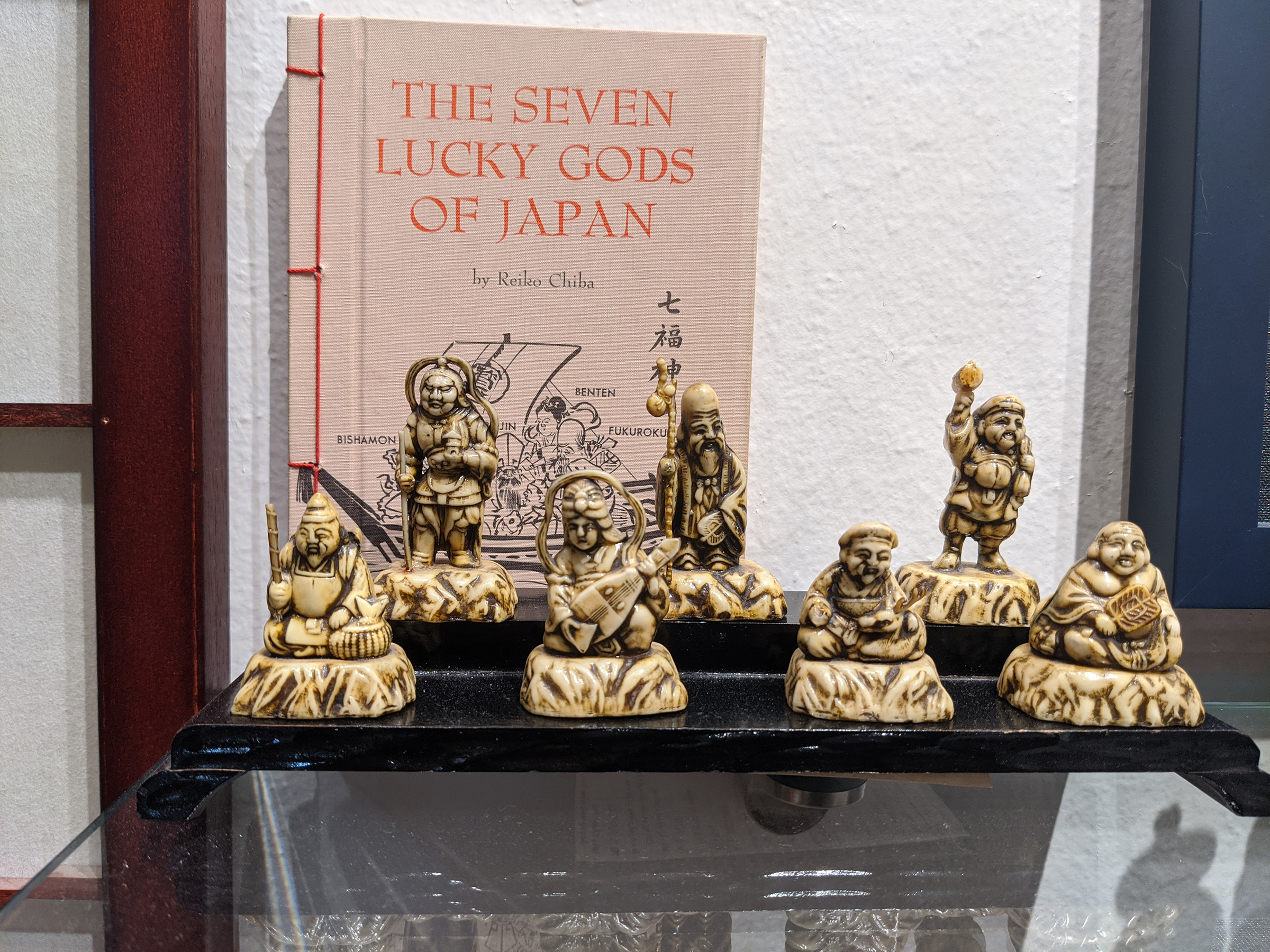
Since last summer, when I added the Seven Happy Gods to my altar, I have given each god it’s own day. In November last year, I settled on my present order – Monday, Bishamon; Tuesday, Ebisu; Wednesday, Benten; Thursday, Jurojin; Friday, Fukurokuju; Saturday, Hotei; and Sunday, Daikoku – and in March, I assigned each a character from Na Mu Myo Ho Ren Ge Kyo.

These are not the only gods I’m including in my daily service. In January of last year I began offering a daily prayer for the 30 Guardian of he Lotus Sutra, Sanjubanshin. At the time there was a booklet you could buy with a page for each of the 30 deities, but that is no longer available.

Prayers for the daily Happy God and the daily guardian deity are said before my morning service.

What prompted the creation of my new supplemental service booklet was the desire to add a daily quote from Nichiren’s writing. I found the quotes in Raihai Seiten, a Nichiren Shu Service Book Companion compiled by the Los Angeles Nichiren Buddhist Temple’s Nichiren Shu Beikoku Sangha Association. This was compiled in 2001-2002 when Rev. Shokai Kanai was the head priest. I was able to purchase a copy of the booklet from Rev. Shokai Kanai’s son, Rev. Shoda Kanai, who is the head priest at the Nichiren Buddhist Kannon Temple of Nevada. The quotes are not the same as the A Phrase A Day booklet created in 1986.

I’ve created two PDF versions of the booklet. One is suitable for reading and the other is formatted to be printed on both sides of 8.5×11 paper.

PDF files updated April 2, 2021

20200704_DailyDeitiesGosho-small-reading
Download Readable PDF

20200704_DailyDeitiesGosho_Booklet-sm-printable
Download Printable Booklet

For anyone who donates $20 or more to the Sacramento Nichiren Buddhist Church, I will print out the booklet on my laser printer, fold and staple the pages, and mail the booklet to you. Forward a copy of your donation receipt to me at [email protected] along with your mailing address.

2000 Days Later

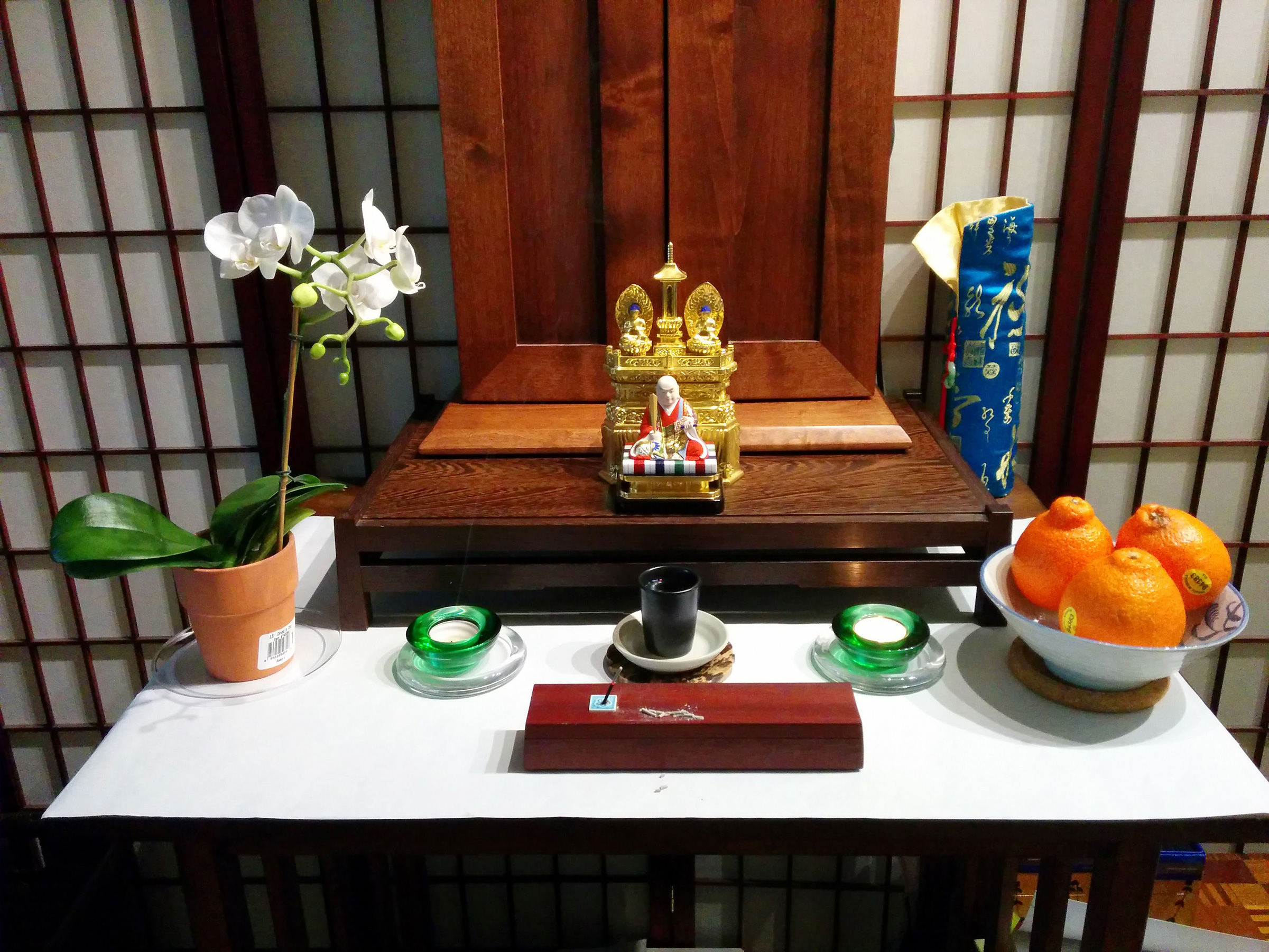
20150125_altar
My altar on January, 25, 2015. I kept my old SGI Mandala Gohonzon closed inside the Butsudan and instead purchased a pair of statues to become my Gohonzon.
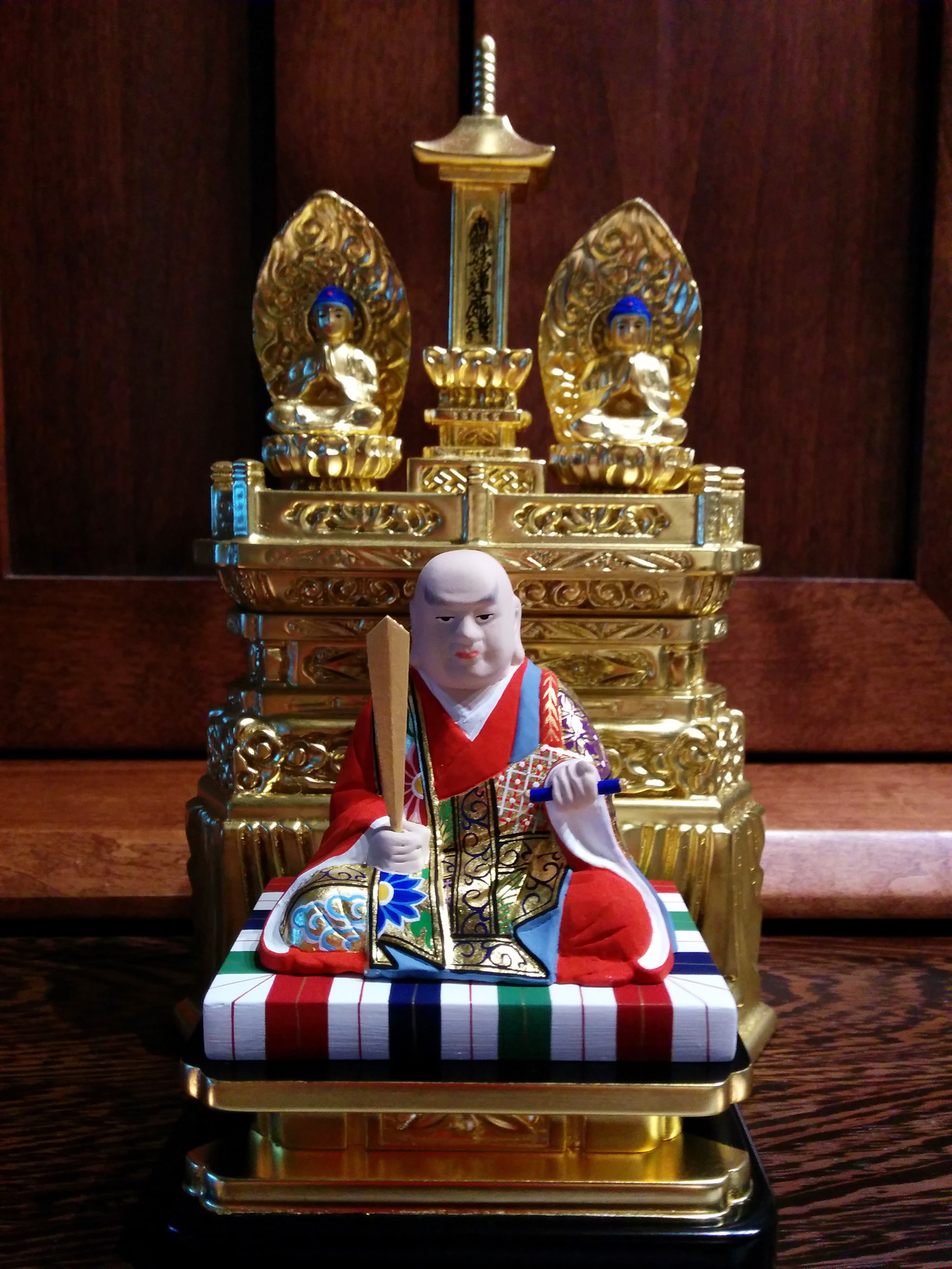
20150122_gohonzon
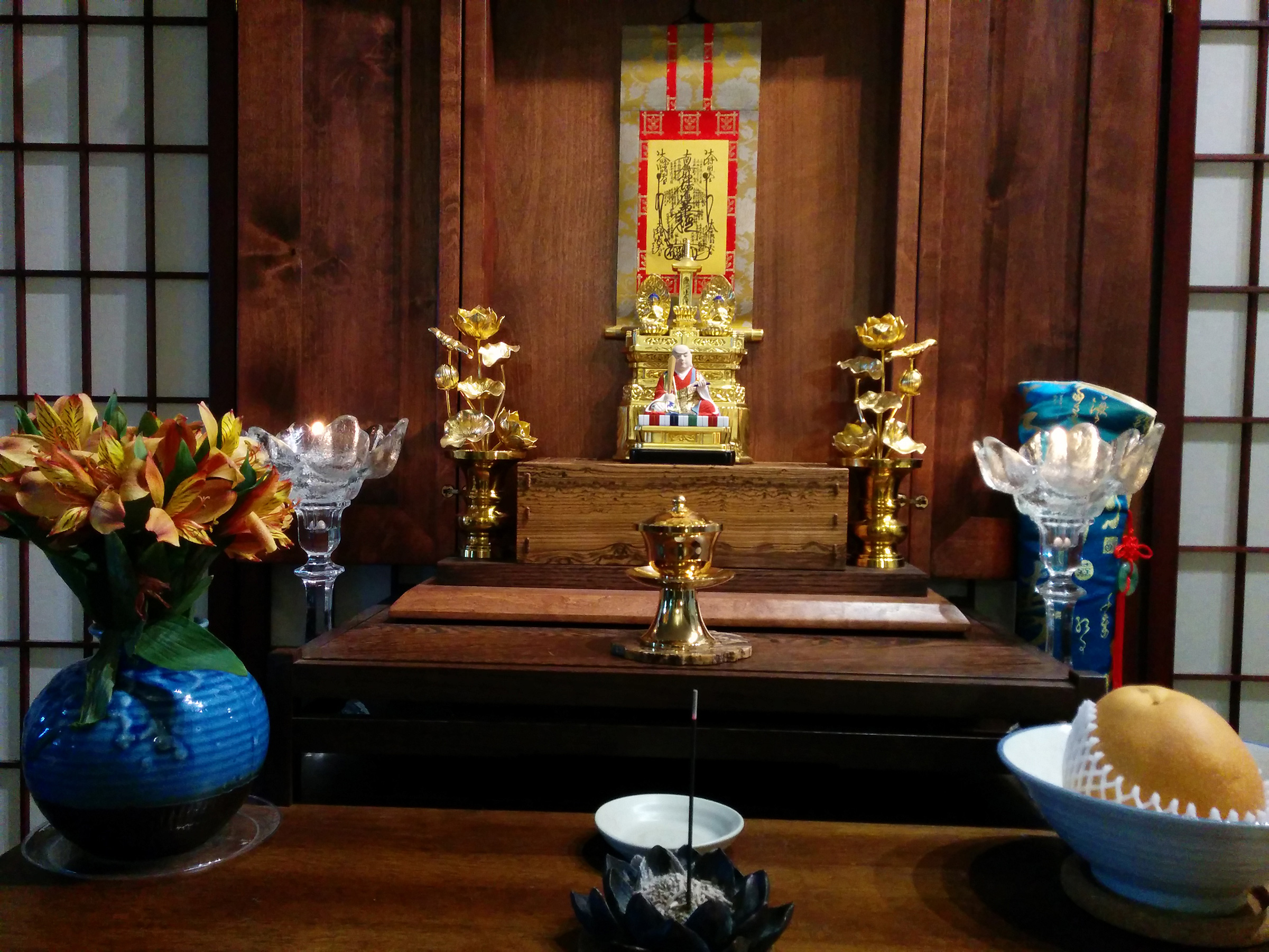
The stupa with Sakyamuni and Many Treasures buddhas on either side of the Odaimoku and the statue of Nichiren were purchased on Ebay from Japan.

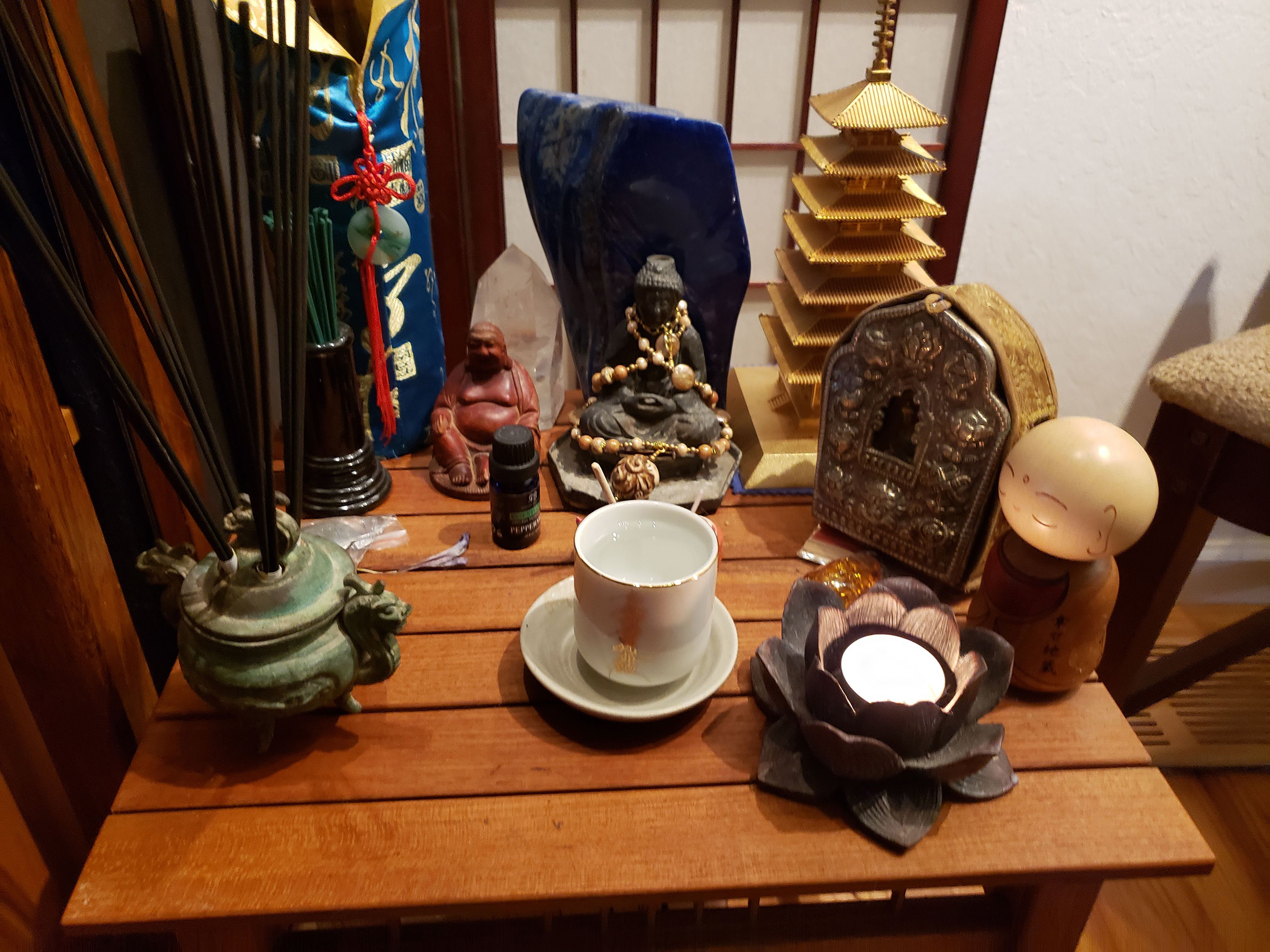
On June 23, I passed the 2,000 day marker on this 500 Yojanas Journey to the Place of Treasures. It occurred to me while chanting this morning that a pictorial view of the evolution of my altar would be a nice way to mark the occasion.

My blog post from the conclusion of the first 500 days offers a nice retrospective on how this journey began. But sitting in front of my altar today I am in awe of how my life has changed in such a short 2000 days. I’m not suggesting the elaborate changes to my altar space are particularly beneficial. I often think a simple altar with just a Lotus Sutra, a candle, flowers, incense and water would be a perfect tribute to the One Vehicle. Still, the evolution of my altar reflects my growing faith.

So, here’s a retrospective:

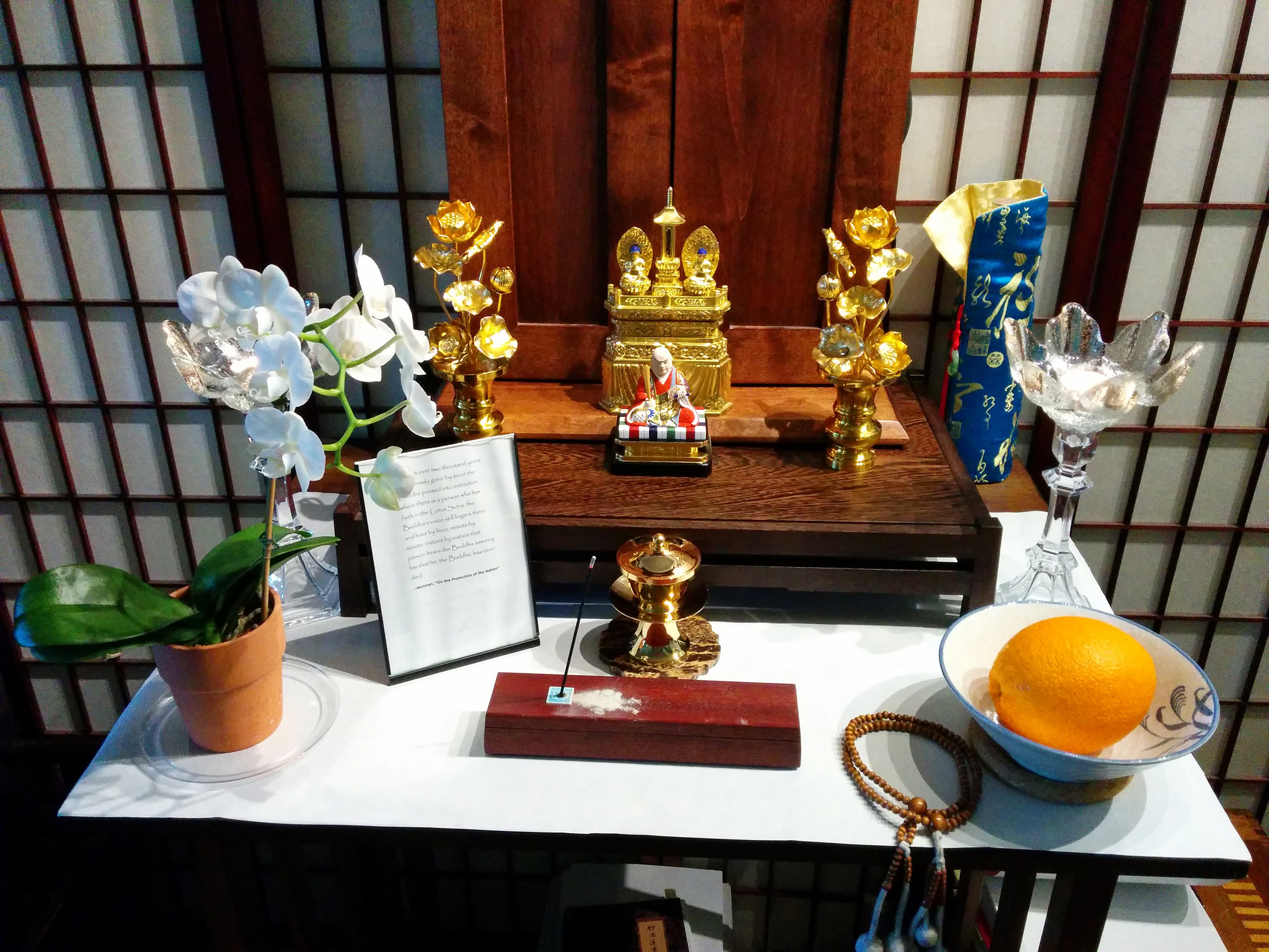
20150223_altar
By the end of February 2015, I had added metal Lotus flowers to either side of the statues and a water offering bowl. In addition I had found tea-light candle holders in the shape of glass Lotus flowers. The blue cloth-wrapped bottle is Saki that was given to my wife and I on our wedding in 1990. It’s been an offering ever since.

20150705_altar
In July 2015, I asked Ven. Kenjo Igarashi to perform an eye-opening ceremony for my statues. He chose that opportunity to give me a Nichiren Shu Mandala Gohonzon to add to my altar. I gave my SGI Mandala to Rev. Igarashi to eye-close and dispose of.

20150802_altar_chest
For some time I had been using a piano bench (left) as a table when knelling on the floor. In August 2015, I hired a Japanese craftsman in Sacramento to custom build a chest that could provide a table top and storage for the altar.

20160206_altar_box_final
In September 2015, I modified the Butsudan to elevate the statues. The box is one of my wife’s collection made by the same Japanese craftsman and sold by Sakura Gifts From Japan in Midtown Sacramento.

20160529_altar_memorial
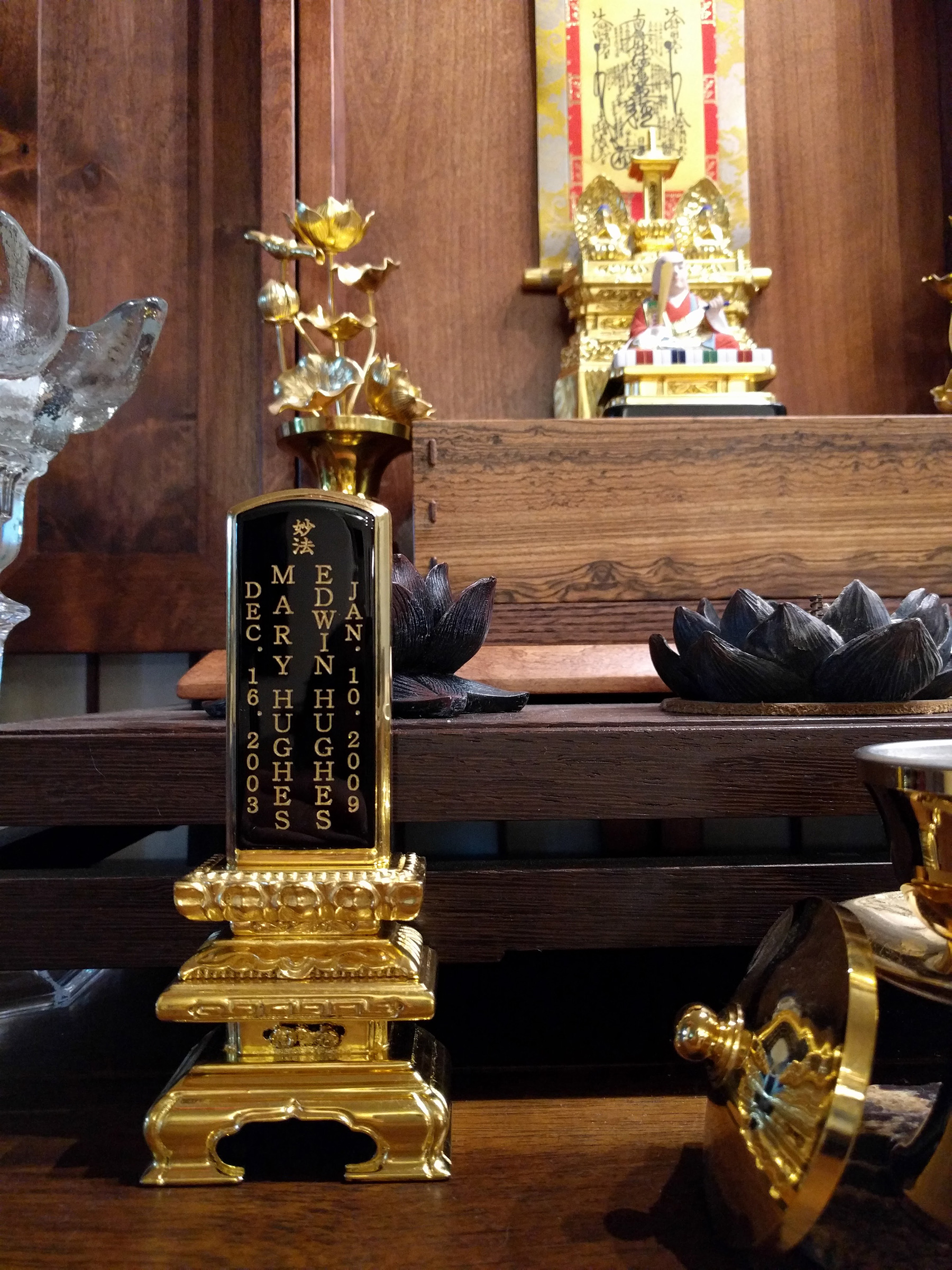
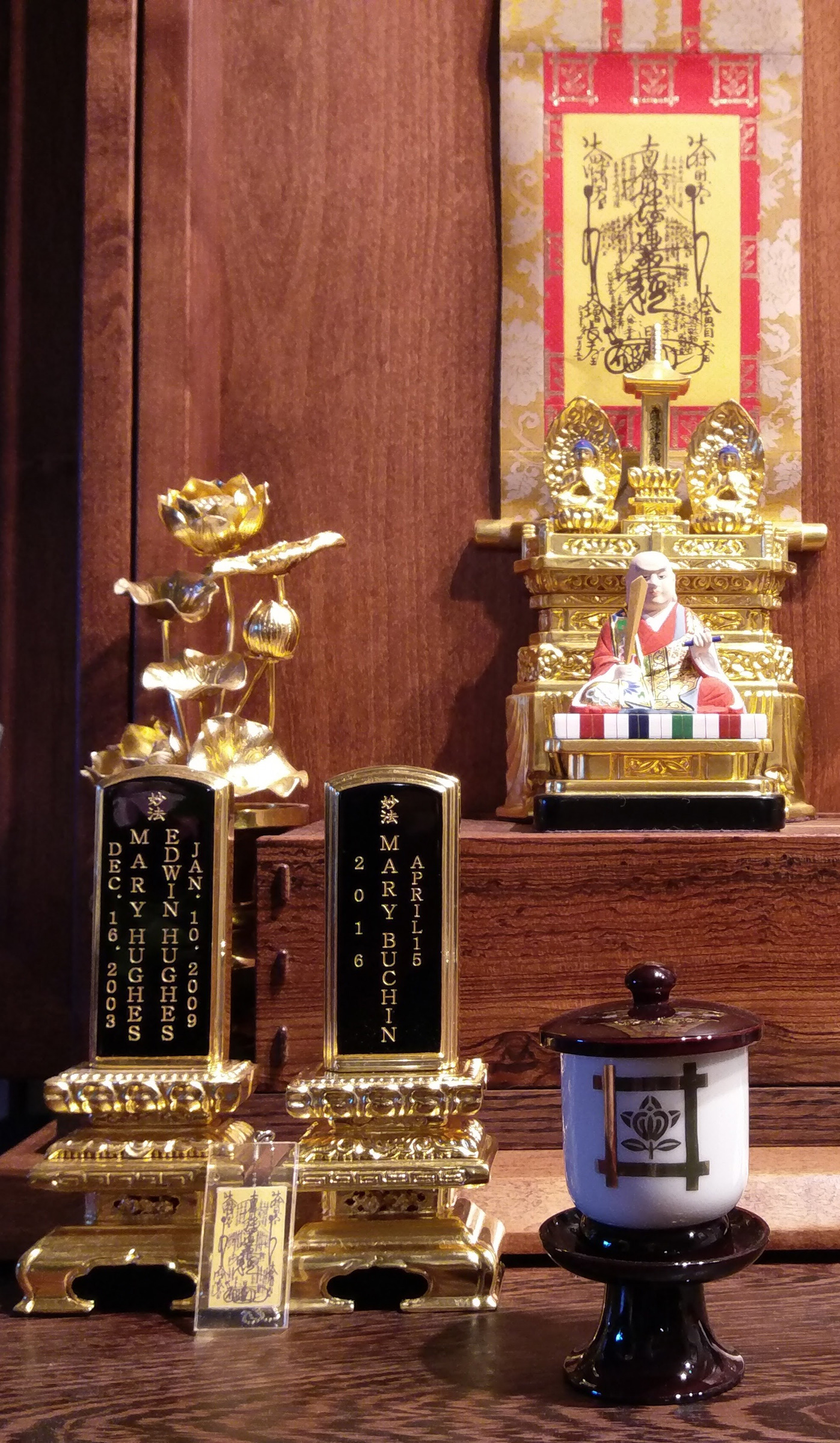
In May 2016, I asked Rev. Igarashi to have a memorial tablet made for my parents. He ordered it for me from a shop in Japan and picked it up during his annual trip to Nichiren Shu headquarters.

20160725_altar_uchiwa_daiko
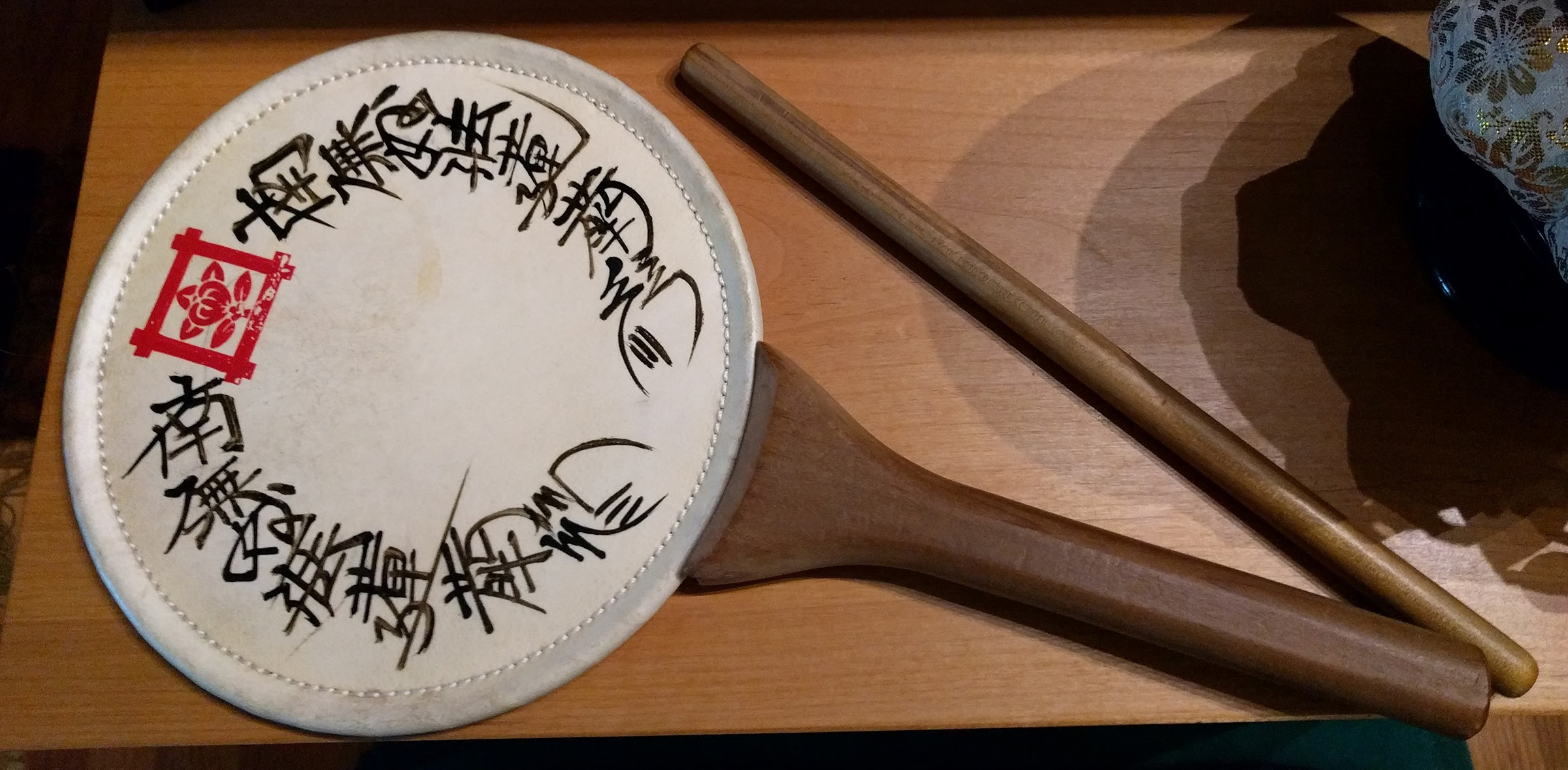
In July 2016, I purchased an uchiwa daiko, a traditional fan drum.

20160817_altar_vases
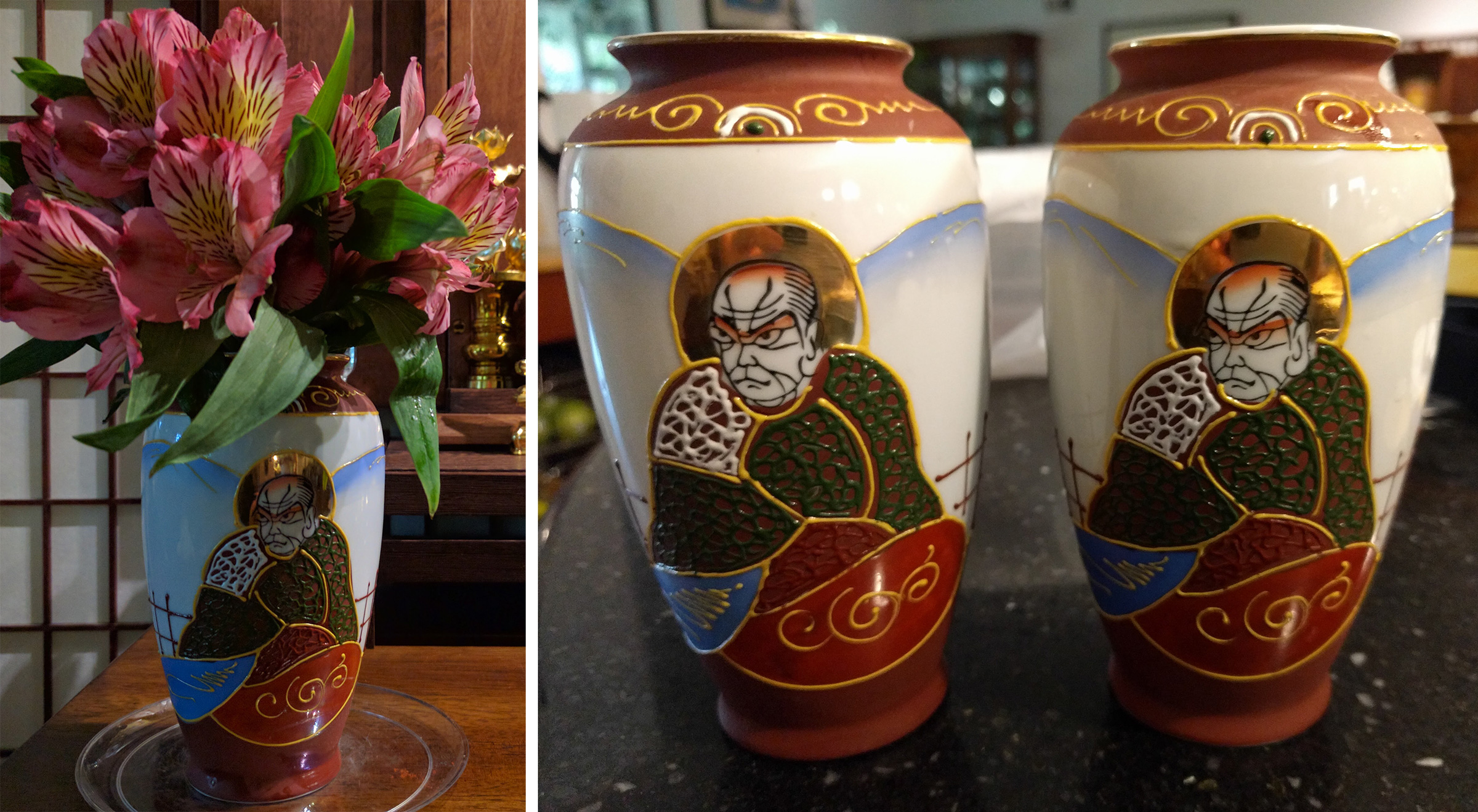
In August 2016, my wife found these vases picturing Nichiren at Sakura Gifts from Japan.

20170402_altar_knickknacks
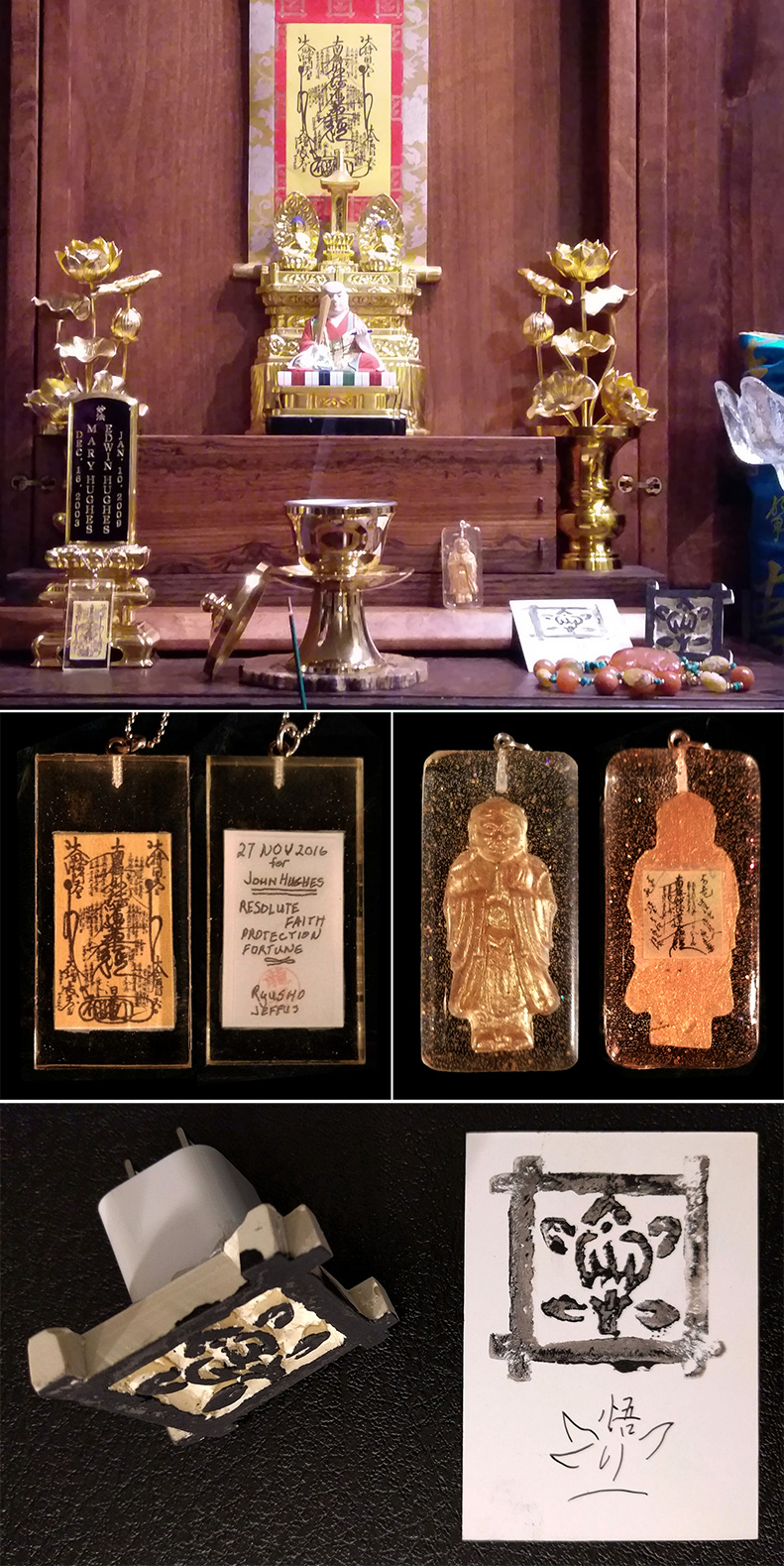
Several knickknacks were added to the altar in 2016. The miniature Mandala Gohonzan and the Kishimojin amulet were purchased from Rev. Ryusho Jeffus and became my traveling altar. A 2016 Father’s Day gift from my son became a treasured altar knickknack.

20170723_altar_marybuchin_memorial
In July 2017 I added a memorial tablet for my wife’s mother, who had died the year before.

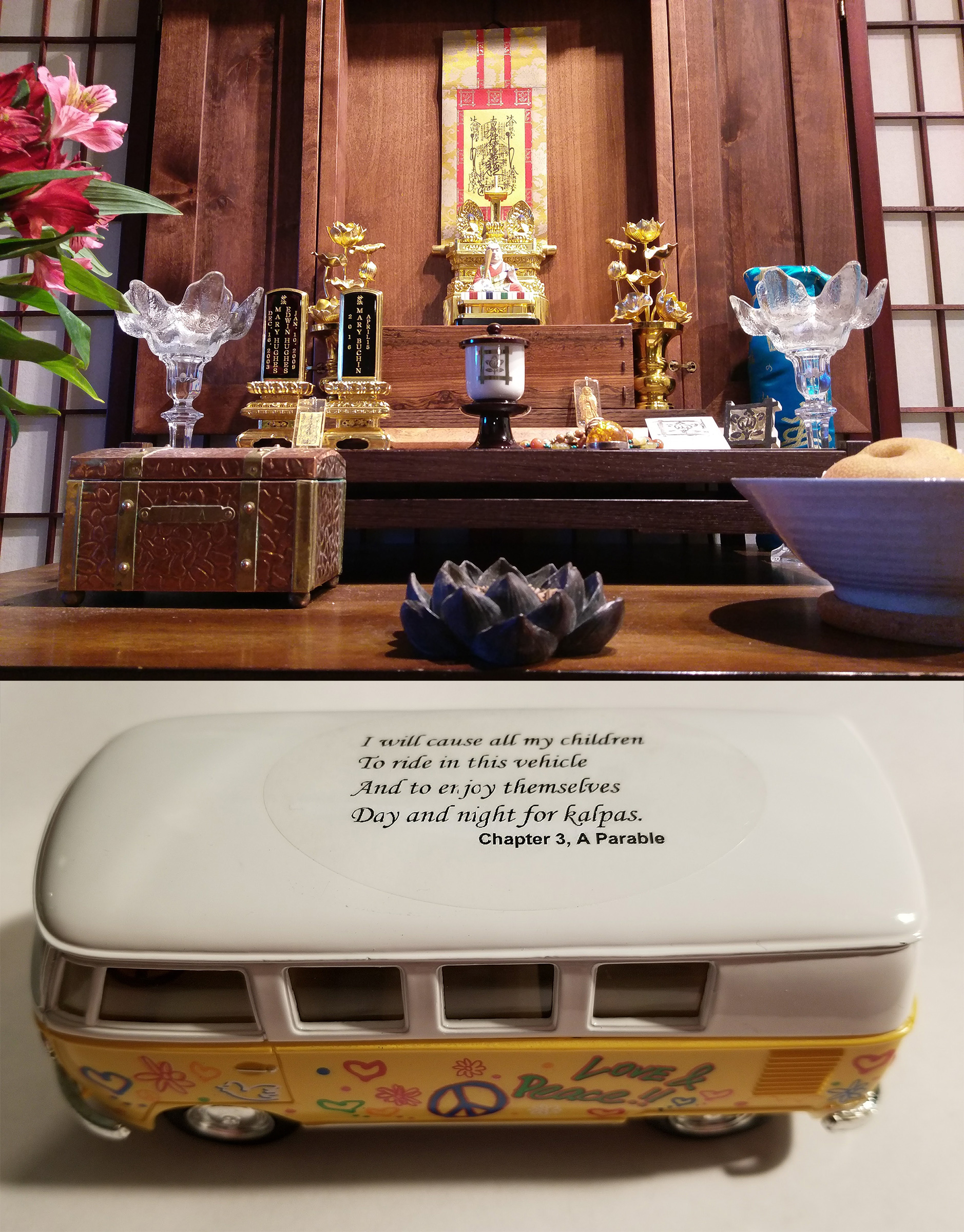
20170926_altar_copperbox

20171230_altar_jeweled_vehicle_making
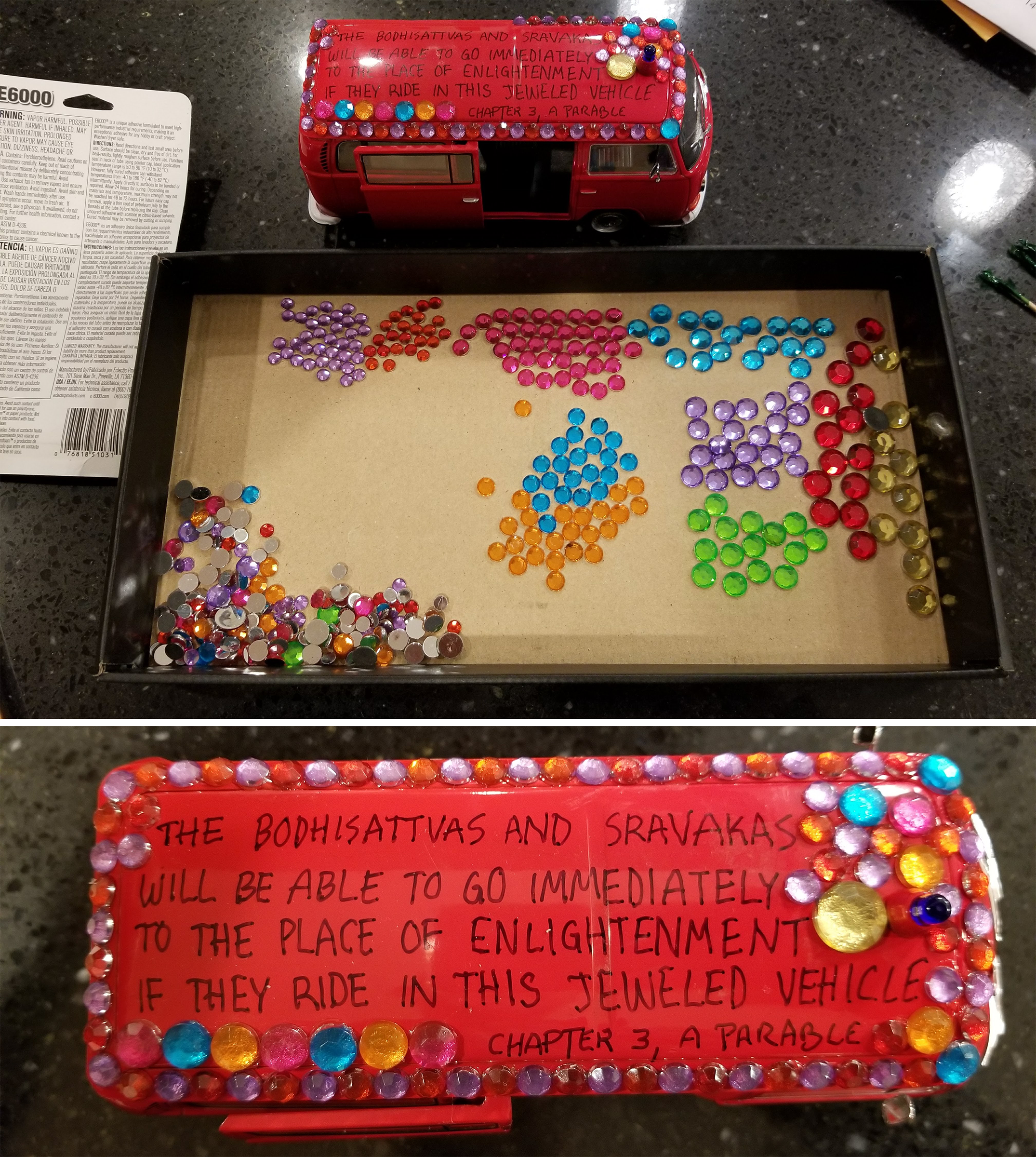
In 2017 I went through a craftsy phase. I found a copper box to illustrate Chapter 19, The Merits of the Teacher of the Dharma quote: “He will be able to recognize by smell the gold, silver and other treasures deposited underground, and the things enclosed in a copper box.” I decorated toy vehicles to illustrate Chapter 3, A Parable. The box and Love Van have been retired but the Jeweled Vehicle holds a prominent spot on my side altar.


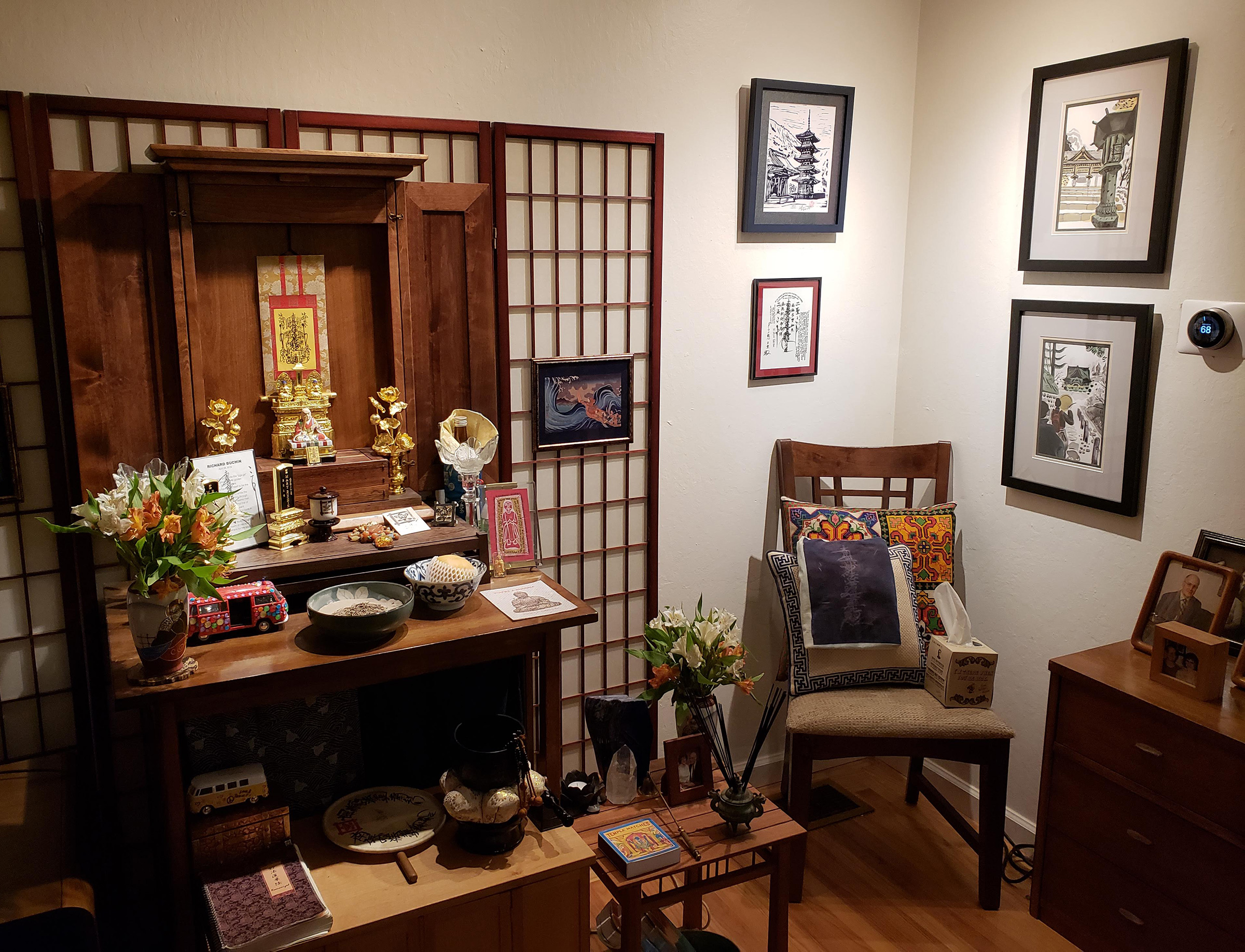
20180131_altar_corner
By 2018 the decorations associated with my altar have begun to take over the corner next to the altar. The pictures on the left side of the corner are by Ryusho Jeffus and the paintings on the right by Kanjo Grohman. Ryusho’s Kishimojin painting has been added to the altar and paired with his amulet.

20181217_altar_memorials
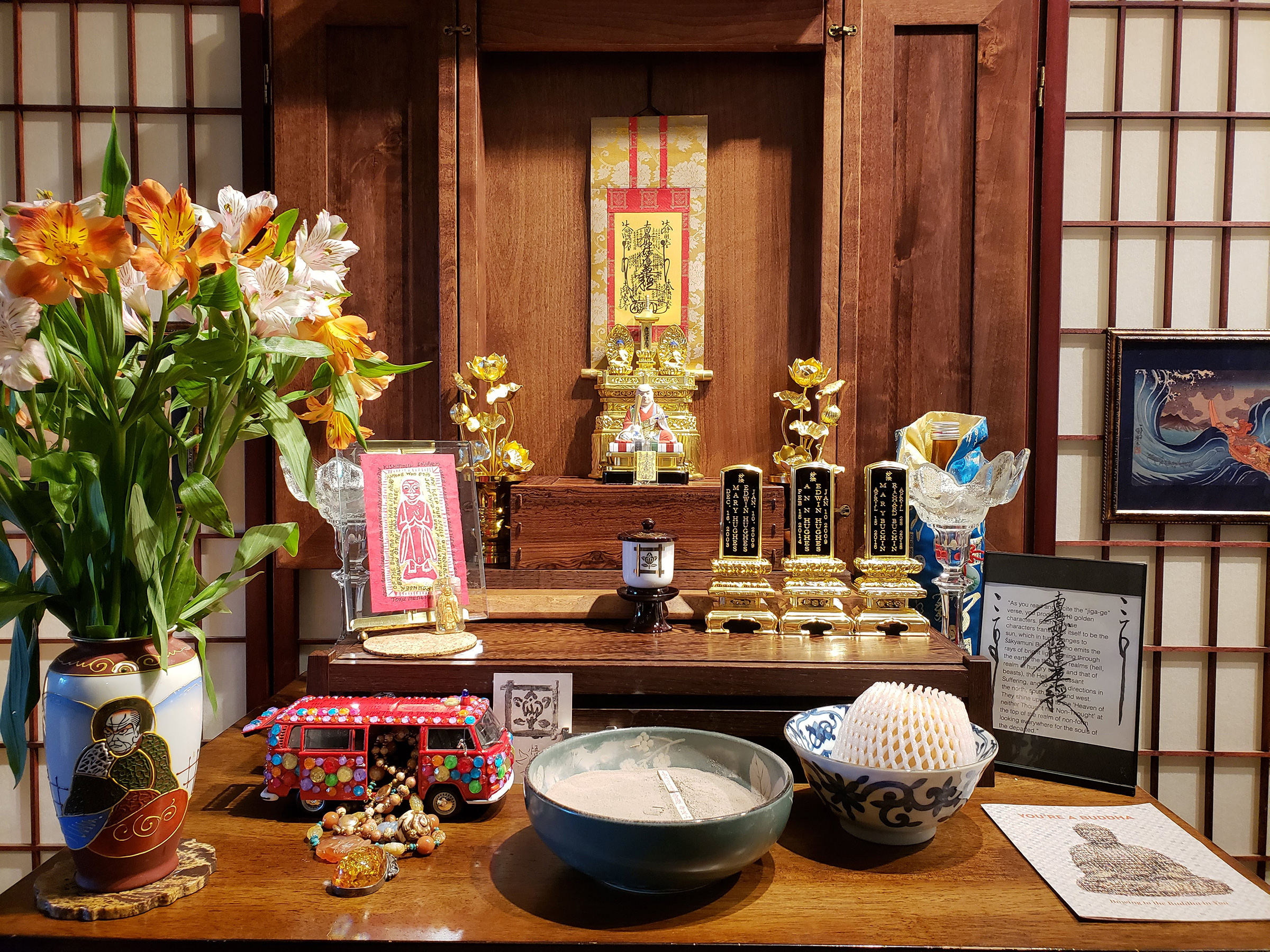
By the end of 2018 I had replaced my mother-in-law’s memorial tablet with one that included my wife’s father, who died earlier in the year. I also added a memorial tablet with my stepmother and my father. The jewels spewing from the jeweled vehicle are donations from my wife and symbolize the many necklaces given to the Buddha in the Lotus Sutra.

20190702_altar_main
In 2019 I found a set of Seven Happy Gods statues among donations to the Sacramento Nichiren Buddhist Church rummage sale and added these to my altar after Rev. Igarashi eye-opened them for me. See this story and this story.

20190702_altar_side
The addition of the Seven Happy Gods prompted a rearrangement that spilled a bunch of decorations onto a side table.

20200101_altar_corner
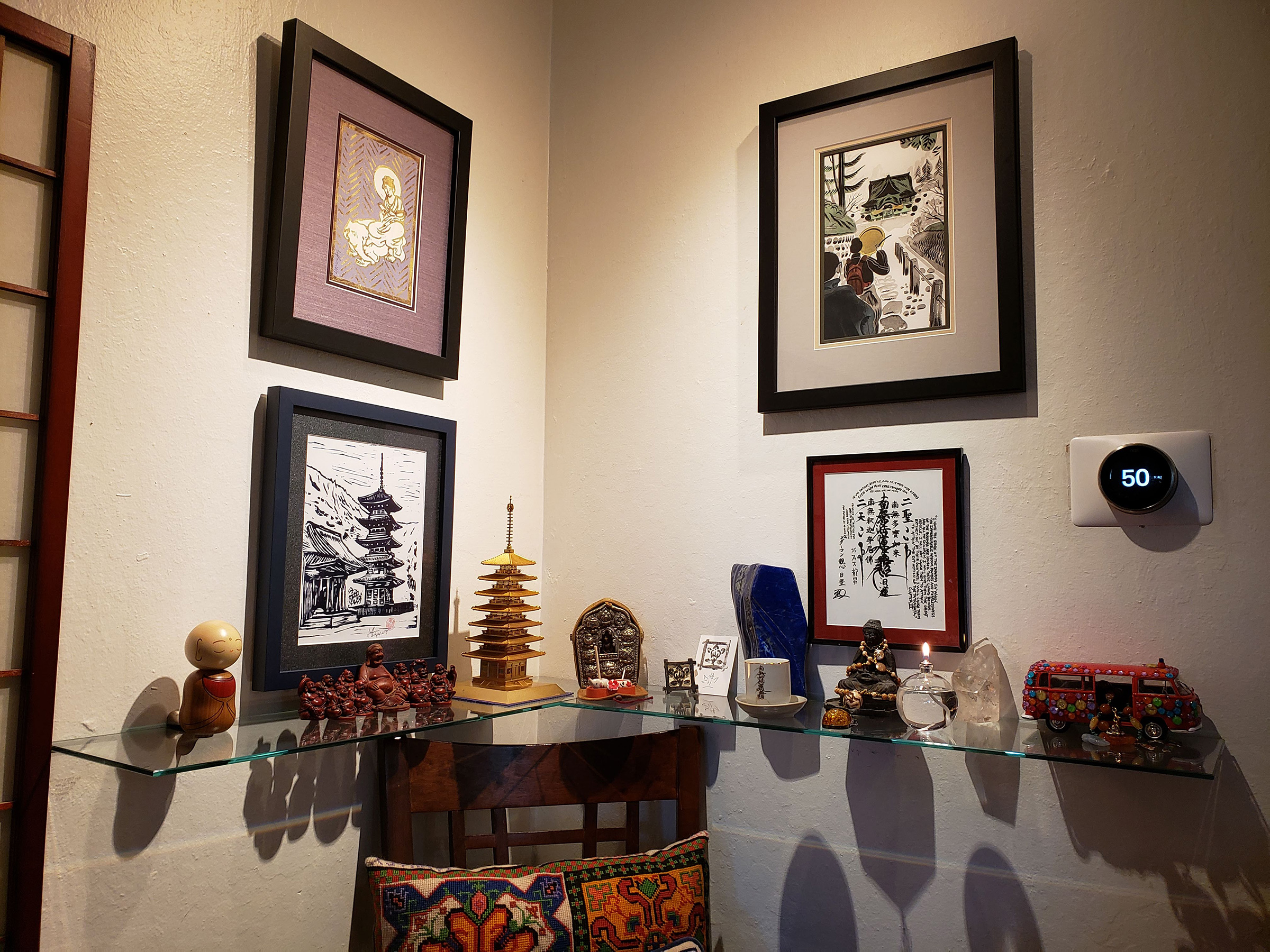
In January of this year, I installed glass shelves in the corner next to the altar to display the decorations that had been crowding the side table.

20200313_altar_corner_7gods
The Seven Happy Gods belonging to my stepmother were moved to my new display area along with a book on the gods I purchased.

20200629_altar_corner_Kwan-yin
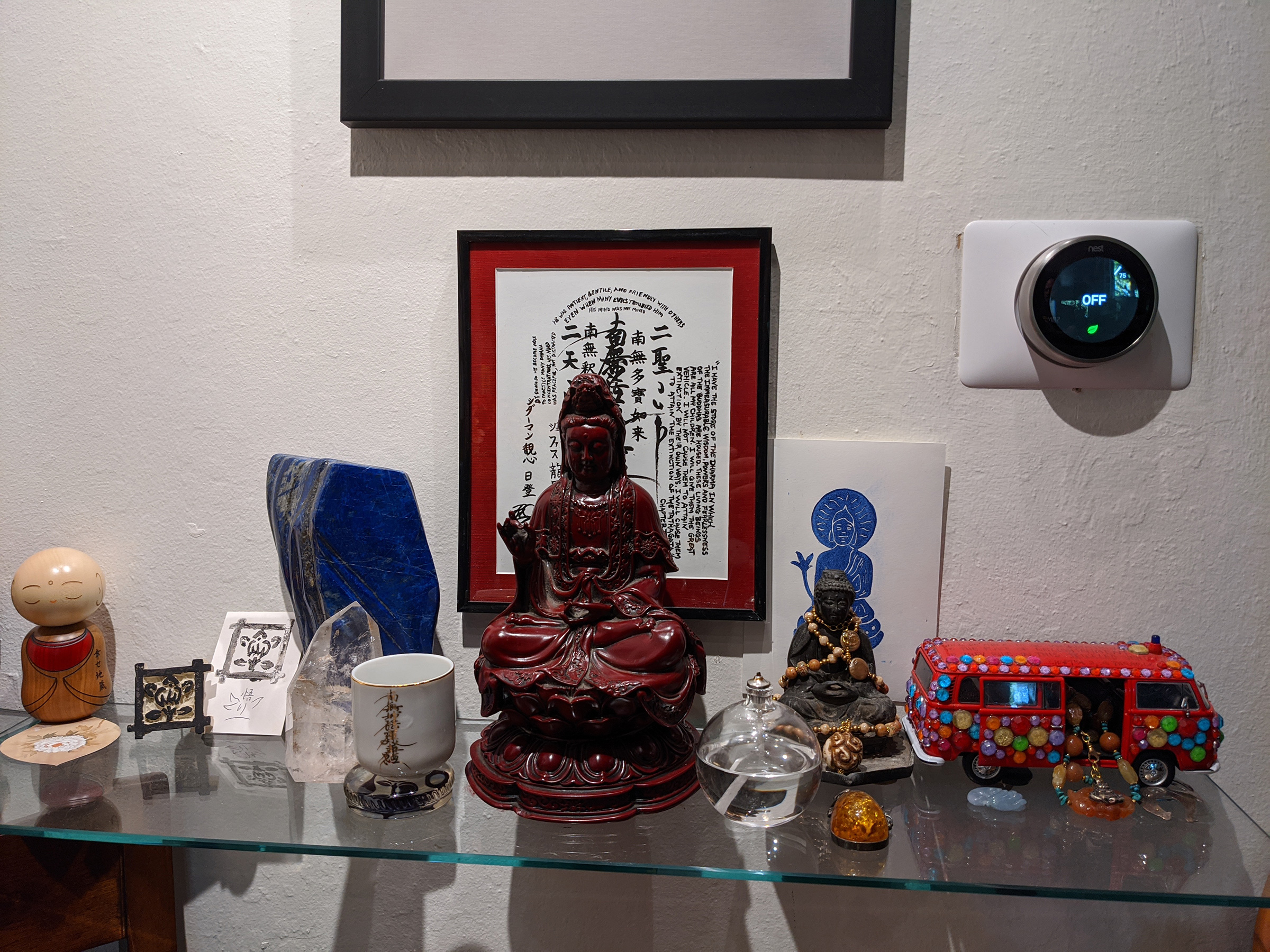
During the COVID-19 pandemic I’ve been attending online services from the Nichiren Buddhist Kannon Temple of Nevada. I have enjoyed Rev. Shoda Kanai’s services and plan to attend whenever I don’t have a local Sacramento Nichiren Buddhist Church service. It occurred to me recently that my son had left a statue of Kannon, World Voice Perceiver Bodhisattva, when he moved out. I rearranged the side corner to place the Chinese Kwan-yin statue in front of the Mandala Gohonzon from Rev. Ryusho Jeffus’s Incarcerated Lotus book. The blue Buddha drawn by Ryusho represents Medicine Buddha.

20200629_altar_corner
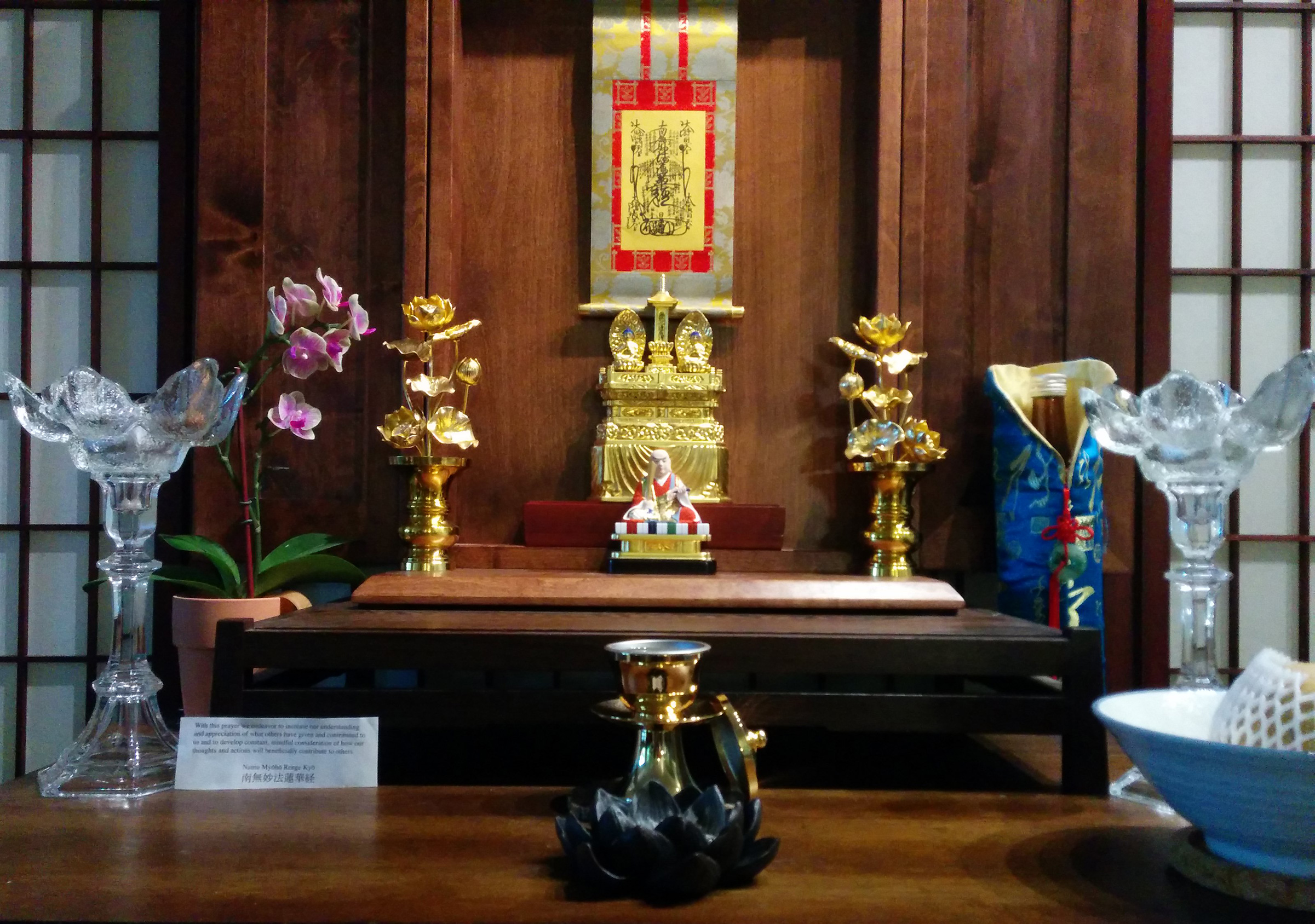
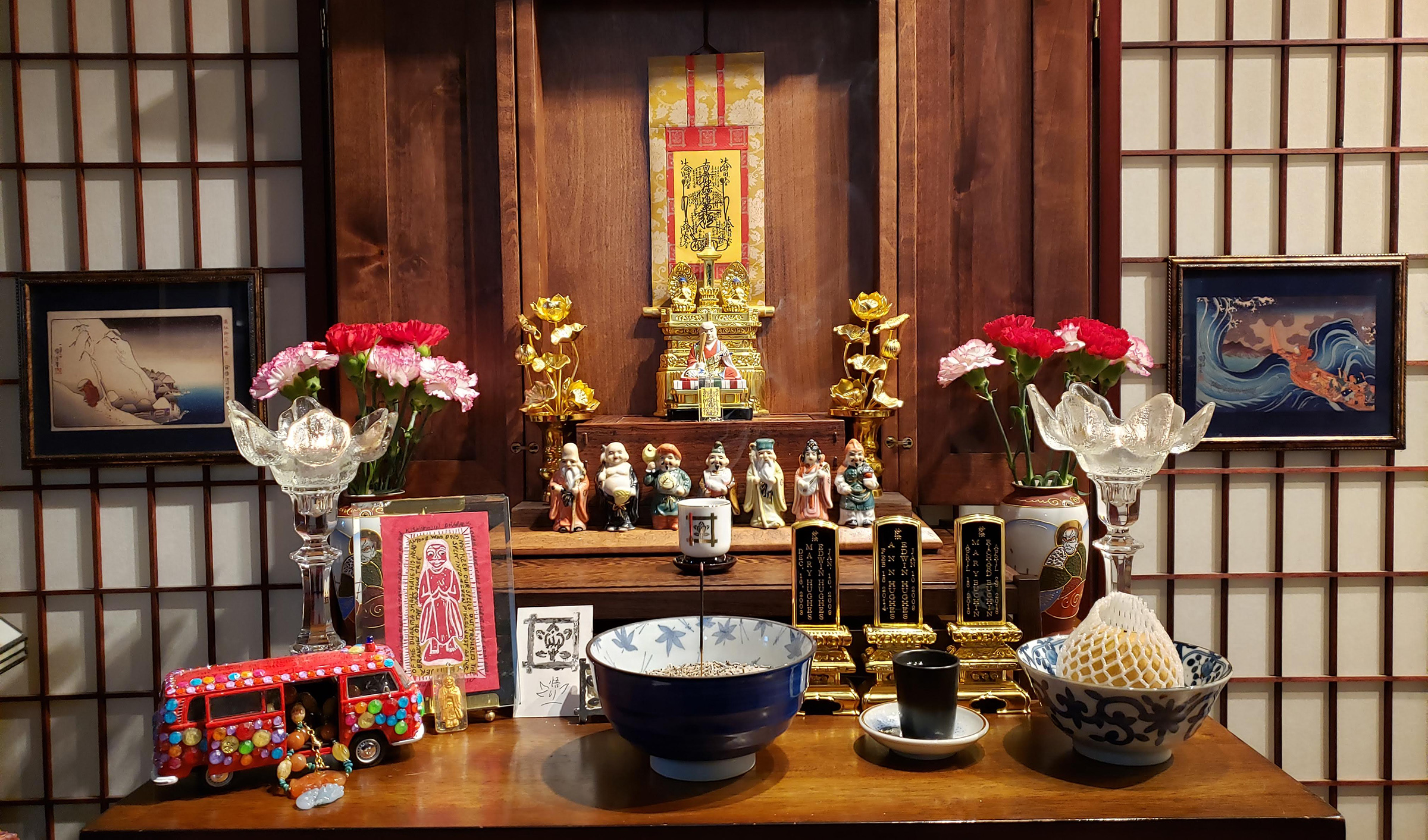
Which brings us to the altar today, 2000 days into my Journey to the Place of Treasures

The Other Side of This Life

My mother died in 2003 and my father in 2009. At that time I was practicing with Soka Gakkai, which had no teaching regarding the spiritual world, the other side of this world through which we pass after death. As an SGI follower I offered generic prayers for the deceased but nothing more. My wife’s parents died in 2016 and 2018, and by then I was practicing with Nichiren Shu and the Sacramento Nichiren Budddhist Church. The experience as a Nichiren Shu follower was helpful, both for my wife and her loss and for my relationship with my deceased parents.

This topic comes up because a man I know is suffering through the pending death of his mother. He sees his practice for world peace as of little merit in this situation. But his daily practice and his prayers can be very beneficial.

In Hōren-shō, Letter to Hōren, Writings of Nichiren Shōnin, Volume 6, Followers I, Pages 56-57, Nichiren explains:

“As you read and recite the ‘jiga-ge’ verse, you produce 510 golden characters. Each of these characters transforms itself to be the sun, which in turn changes to Śākyamuni Buddha, who emits the rays of bright light shining through the earth, the three evil realms (hell, realm of hungry spirits and that of beasts), the Hell of Incessant Suffering, and to all the directions in the north, south, east, and west. They shine upward to the ‘Heaven of neither Thought nor Non-Thought’ at the top of the realm of non-form looking everywhere for the souls of the departed.”

I have found the Japanese idea of what happens after death comforting. The soul of the person (we are NOT going to discuss the fact that Ryuei McCormick would tell us we DON’T have souls) travels on a 49 day journey during which seven trials are held before magistrates.

At the start, the deceased must climb a mountain. The height of the mountain is determined by the deceased’s bad karma. This takes seven days. At the end of seven days the deceased must cross the Sanzu River, the river of three crossings. Those with sufficient good karma can cross the river on a bridge. Those with less good karma can cross on a shallow ford. Those with overwhelmingly bad karma must bob across, sinking to the bottom and then rising to the surface, repeating the process. The journey across the Sanzu River takes seven days.

At 14 days, the deceased stands before a magistrate to be judged on how much the person stole during his life. Egregious thieves are sent straight to hell while the others are allowed to pass onto the next trial.

At 21 days, the deceased are judged on their sins of lust, using a cat and a snake. As explained in Meido: The Japanese Underworld, “The cat is used to judge the souls of men; it bites at their penises, and the degree of the injury – from a slight scratch to completely severed – is used as a measure of one’s sexual sin. The snake is used to judge the souls of women; it is inserted into the woman, and the depth to which it can enter is used to determine the depth of her sin.” Again, the egregiously sinful are cast into hell and the remainder are allowed to pass onto the next test.

At 28 days, the deceased are judged on the number of lies they told. The lies are piled on a scale and the number of heavy stones it takes to balance the scale determines the weight of the deceased’s sins.The really heavy sinners are sent directly to hell, and the rest allowed to proceed to the next trial.

The trial on the 35th day is the last one in which memorial prayers can impact the outcome. During this trial, the deceased is shown a mirror on which the individual’s former life is reflected, with all of their sins and transgressions clearly laid out. A recommendation is made at this point on which of the six realms – hell, hungry spirits, animals, asuras, human or heaven – the deceased merits being reborn in.

On the 42nd day, a magistrate takes the weight of the deceased’s sins and the life reflected in the mirror to determine the location for the deceased rebirth.

It is on the 49th day that the fate of the deceased is sealed. The deceased enters a room with six gates. There are no markings on the gates or any indication where they lead.

As told by Ven. Kenjo Igarashi, “This judge in front of the six gates, will not guide this individual to the proper gate, but only instruct them to choose one. The individual will choose the gate based on what they may think is only instinct, yet this decision will also be guided by the actions that the individual took during their time on this earth.

“While it may seem as if we take little part in the deceased individual’s 49-day journey, this is not the case. One way we can assist them, is by chanting ‘Namu myo ho renge kyo,’ which as you know, is the name of the Buddha nature that we all possess. We chant this odaimoku throughout the 49 days to call upon the deceased individual’s Buddha nature. If you recall, the Buddha nature can be imagined as the inside of a seed, while the outer shell represents bad karma resulting primarily from previous actions. Whenever we chant the odaimoku, the Buddha nature slowly grows. While this is a slow process, the more we chant, the more the Buddha nature shows, until it finally appears by sprouting through the outer shell. If the Buddha nature does not appear at the end of the 49 days, the individual will not be able to reach Enlightenment.

“While death signifies the end of an individual’s time in this world, it does not mark the ultimate endpoint of their spirit. Please remember that your Buddhist practice can serve an important purpose in providing happiness for not only yourself, but also others, including the deceased.”