Category Archives: Blog

The Trouble with Interfaith Truth

Interfaith logoGene Reeves’ The Stories of the Lotus Sutra was published by Risshō Kōsei Kai in 2010 as a companion to Reeves’ updated translation of the threefold Lotus Sutra. This is the second Kōsei kai book I’ve read that brings up the concept that all religions share a common, inter-faith truth. As Reeves puts it:

[W]ithout the nourishment of the Dharma [as revealed in the Simile of the Herbs] we would dry up and die. But this Dharma that nourishes all is not something to be found only in the Buddhist religion. It is universal. It is everywhere. The Dharma can be found even in the ordinary food that we eat and the water we drink, making it possible for us to live.

The Stories of the Lotus Sutra, p81

Or this conflating of Jesus and Krishna with the Eternal Buddha:

[E]ven when we think we cannot see him, the Buddha can be found right next to us. The Buddha may not even go by the name of a buddha. Sometimes perhaps he goes by the name of Christ, or Krishna, or even Jane. Belonging to a Buddhist temple or organization is not, in itself, the Buddha Way, nor is it the only way to enter or follow the Buddha Way. The “universal gate” is many gates, many more than you or I could possibly know in a lifetime.

The Stories of the Lotus Sutra, p71

Reeves comes at this whole issue of inter-faith Dharma from a number of directions.

One of the important insights to be gained from the teaching of skillful means is that many things that are not the whole truth are nevertheless important truths. Just as we should seek the potential to be a buddha in ourselves even though we are far from perfect, we should seek the truth, even the hidden truths, in what others say, in their words and in their stories.

“Others” includes of course other religions and their followers. Followers of the Dharma Flower Sutra can be glad when they encounter people of other faiths who have found carriages appropriate for themselves. The Sutra teaches that there are many successful ways, some, no doubt, beyond our imagination.

The Stories of the Lotus Sutra, p51

Or this:

Apart from the Buddha and blind to the Buddha Dharma, we are like someone wandering around, destitute, impoverished, without purpose, miserable. In a sense, this is the destiny of those who do not, in some way, follow the Buddha Way. This does not mean, however, that one has to be a Buddhist in the ordinary sense. To follow the Buddha is to put one’s trust in and devote oneself to the happiness of others and the life of the whole. It is to share in a kind of common human faith that life is meaningful, a faith that finds expression in a variety of religious and other forms.

The Stories of the Lotus Sutra, p70

I struggle with this concept that the One Buddha Vehicle includes Christian chariots along with the Śrāvakayāna sheep cart and Pratyekabuddha deer cart and Bodhisattva bullock cart.

Stretching the One Buddha Vehicle to cover all of the Buddha’s teachings is, for me, the essence of the Lotus Sutra. I view the Lotus Sutra as the blueprint that allows the practicer to gather from all of the building materials (other sutras) what is needed to create a hall within which one can practice the Buddha way. The Lotus Sutra is the ocean into which all streams have flowed. But I’m unable – or perhaps just unwilling – to stretch it further to include all religions.

These ideas troubled me and it occurred to be that someone who had a statue of a Roman Catholic saint eye-opened for his Buddhist altar might be able to share some insight. I sent this as an email to Ryuei McCormick.
Ryuei McCormick’s response

Zoom Day

Don’t know exactly what prompted this extravagance but I decided to attend three Nichiren Shu services today.

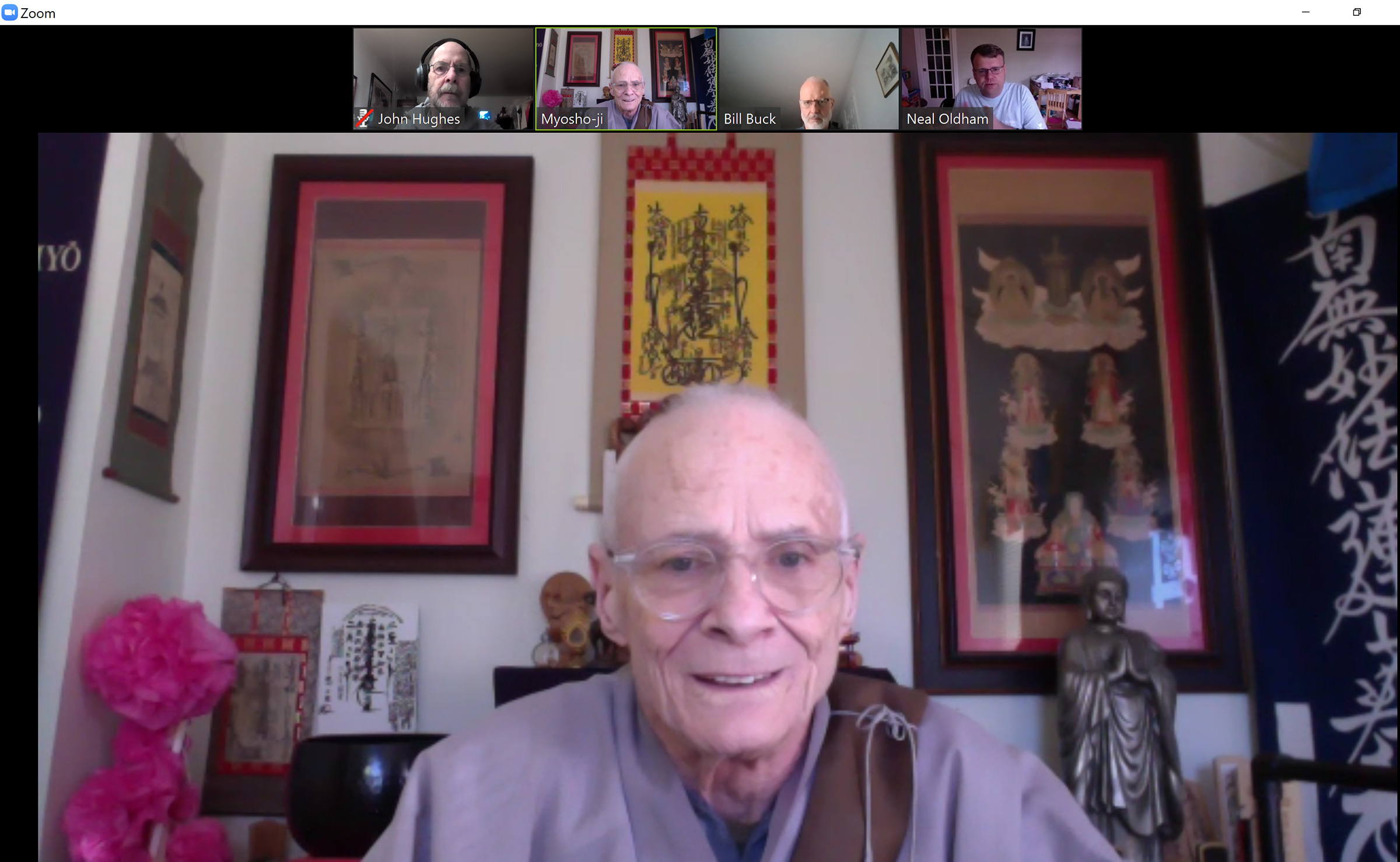
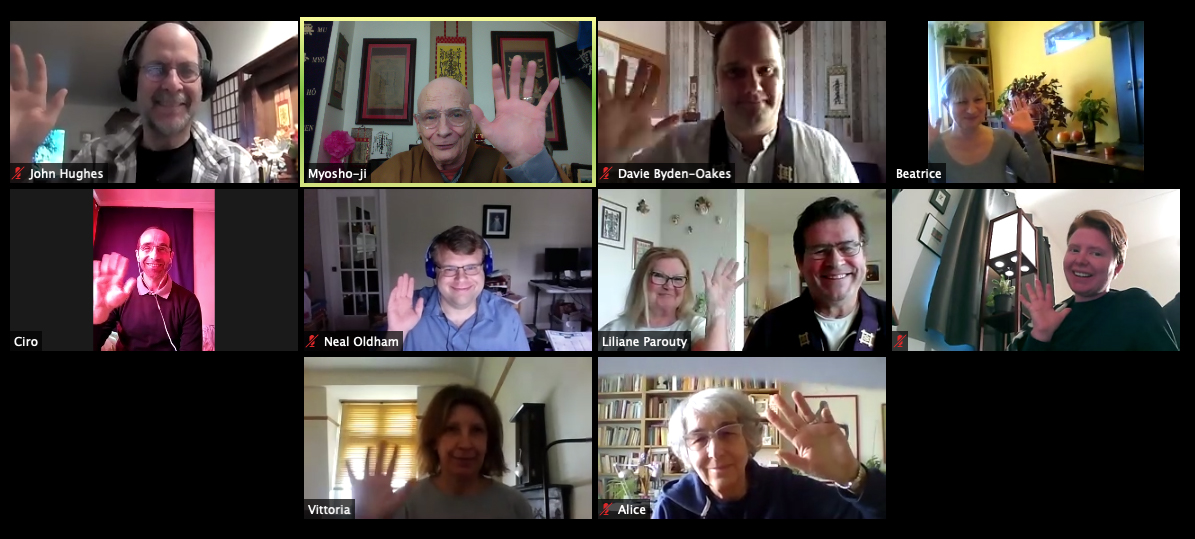
I got up at 6am to do my own personal service so that I would have time to join Rev. Ryusho Jeffus’ Myoshoji service at 7 am. And I was immediately happy I did so because today was the Jukai, Taking of Vows, for two long-time members of Ryusho’s virtual sangha, Davie Byden-Oaks, from London, and Neal Oldham, from North Carolina.


Joining Ryusho in Syracuse, NY, were Myoshoji regulars from Portugal, Czech Republic, France, England and the United States.

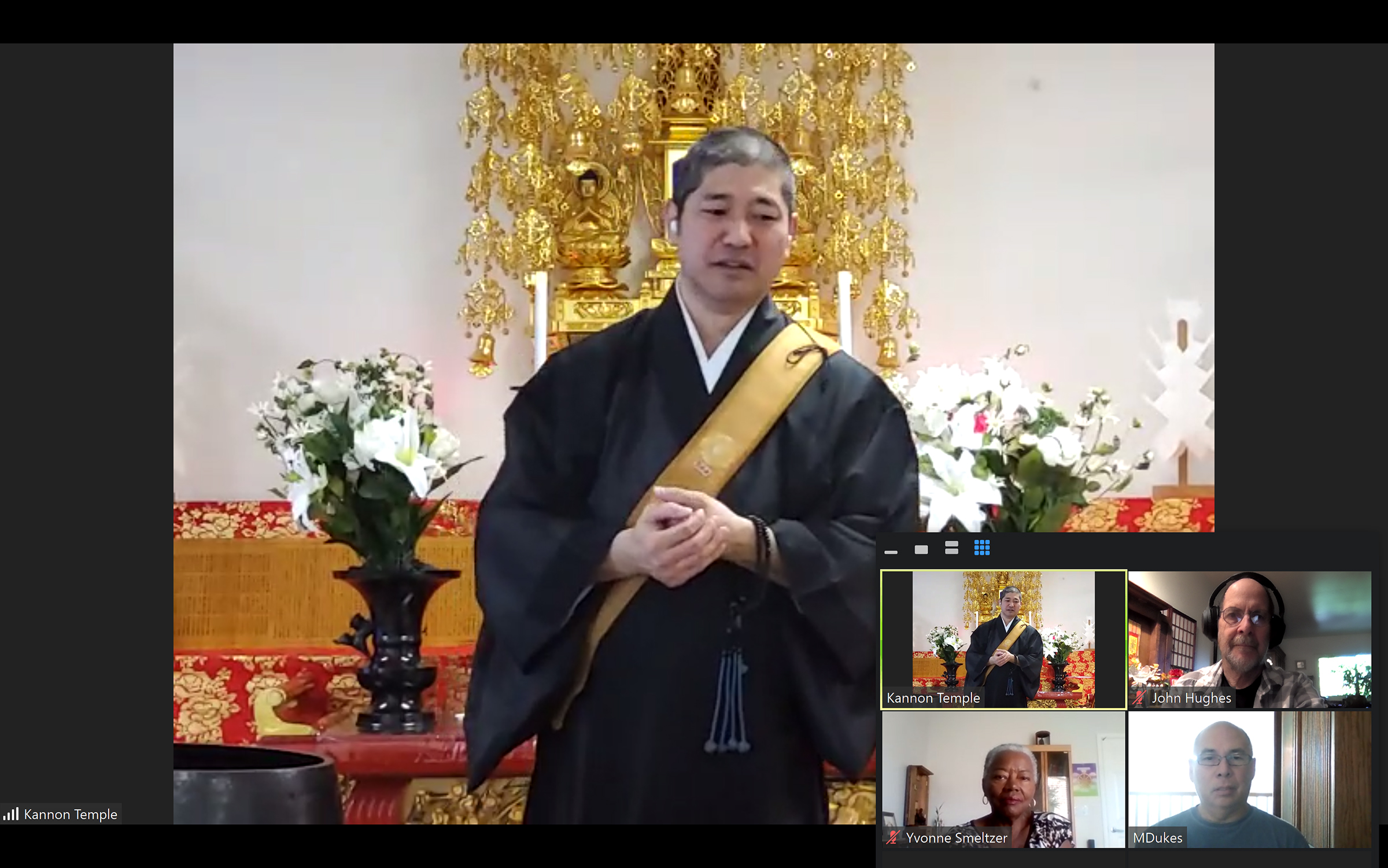
Following that I had time for a quick nap before joining Rev. Shoda Kanai of the Las Vegas Kannon Temple for a Shodaigyo service at 10:30am.
2020-04-26_LasVegas
This was my first time visiting Las Vegas. I tried to join last week, but I had difficulty getting the password for the Zoom session right. This time everything went as expected and I enjoyed the change of pace with the Shodaigyo service.

The day’s final service was at 12:30pm with the Nichiren Buddhist Sangha of the San Francisco Bay Area.
2020-04-26_bay-area
Rev. Ryuei McCormick and Shami Mark Herrick held the annual Nichiren Shu Founding Day Ceremony, marking the date on April 28, 1253, when Nichiren, from atop Mount Kiyosumi, greeted the rising sun with 10 Daimoku.

As with all services involving Ryuei, guests from as far away as Georgia and Oregon were treated to an excellent discussion of the Vimalakirti Sutra, a part of his ongoing Buddhist Study Program lectures.

Auto Insurance Renewal

This slideshow requires JavaScript.

Back in 2017 I leased a Chevy Volt, a plug-in electric hybrid sedan, and took it to Rev. Kenjo Igarashi at the Sacramento Nichiren Buddhist Church and had him purify and protect the car. Now three years later I’ve traded in the Volt for an all-electric Bolt and returned to get my auto insurance renewed.

The ritual involves prayers and purification and a boundary spell made with rice, salt, water and saki. An omamori amulet hangs from the steering wheel.

Practicing the Lotus Sutra

In considering how to practice the Lotus Sutra, I find it helpful to think of all the Buddha’s teachings as specific pieces of lumber crafted for specific purposes, ridge poles, beams, doors, windows, flooring and roof tiles. It is with the use of the Lotus Sutra that we are able to take those expedient teachings and build our wonderful practice hall, to see the One Buddha Vehicle encompasses and doesn’t replace these teachings, to realize the Eternal Sakyamuni Buddha is ever present and ever active performing Bodhisattva practices. Academics who study just the words and miss the meaning of the sutra, complain that there is no actual teaching there. It is just a preface to a sutra that is never delivered. What these academics miss is that the every emptiness of the Lotus Sutra provides the space within the structure of the expedient teachings within which we can pursue the Buddha Way, both for ourselves and all other beings.

I posted the above statement in the Nichiren Shu Facebook group in response to this question:

“Can someone chant Odaimoku with adoration for the Lotus Sutra (especially with it’s focus on Ekayana (one vehicle) and Upaya (skillfully means)), while also practicing zazen or vipassana, or should one give up all other practices and practice the mantra alone?”

I’ve raised this concept of the Lotus Sutra practice space before and eventually I hope to expand this into a more detailed thesis incorporating Chih-i’s teaching. I’m posting this here so that I can come back to this at that time.

See also this post: Between Day 32 and Day 1: Practicing the Great Vehicle

The Nature of Buddhist Philosophy

Rejecting idle speculation, Shakyamuni was concerned – as all Buddhists must be – with the present life, its joys, sorrows, loves, hates, and infinite choices. In other words, instead of being concerned with existence as an abstract study, Buddhist philosophy deals with the nature of the human condition in this life and the manner in which human beings respond to it.
Basic Buddhist Concepts

An Apology

Last August, at the suggestion of a good friend, I created a page here where people new to Nichiren Shu could receive some direction. Where to Begin.

I was particularly happy to be able to provide the basic Nichiren Shu service so that those new to the practice could follow along with recordings of the various parts of the service and practice their pronunciation. The Basic Nichiren Shu Service

Today – more than seven months later – I am deeply embarrassed to have discovered that the shindoku text I provided for Hoben Pon was missing words and entire lines. Had I done a simple test of following along with the recording while reading the shindoku, I would have caught this back in August.

These errors in the Hoben Pon shindoku have been corrected along with some additional typos in other areas where words ran together.

I apologize for having failed to adequately check my work.

The Dharma Sound

Today I was scanning my news feed and ran across an article at Buddhistdoor entitled, Frequencies, the Brain, and Wisdom Traditions, which explores the effects of sound frequencies and music on mental states. The take-away point for me was this:

The use of sound has been historically central also in the Buddhadharma. In the Mahayana traditions (which includes Vajrayana), every practice is transmitted first and foremost through sound, irrespective of whether or not the recipient understand the meaning of the words being transmitted. It is said that only hearing the sound of a particular Buddhist teaching initializes the mindset necessary to benefit from Dharma practices.

This is exactly why Nichiren Buddhists chant the Lotus Sūtra in Shindoku. As Ryuoh Michael Faulconer explains in the introduction to Myoho Renge Kyo Romanized:

Around the world, the Lotus Sūtra is traditionally read in shindoku, a reading of the Chinese translation of the Sūtra with a Japanese pronunciation. It is a form of faith reading done as a practice which our inner Buddha nature understands.

And, of course, this is also the foundation of why we chant Namu Myōhō Renge Kyō:

QUESTION: If someone chanted Namu Myōhō Renge Kyō without understanding its meaning will the benefit of understanding still be received?

ANSWER: When a baby nurses, it does not comprehend the taste; nevertheless, it receives the benefits of the milk naturally. Did anyone know the ingredients or formula for Jīvaka’s wondrous medicines? Water is without intent but it can extinguish fire; and even though fire consumes many things, can we say it does this deliberately? This is Nāgārjuna and T’ien-t’ai’s idea! I am merely repeating it.

Shishin Gohon-shō, The Four Depths of Faith and Five Stages of Practice, Writings of Nichiren Shōnin, Faith and Practice,
Volume 4, Page 106-107

Virtual Saṃghas

ryusho shonin

Got up this Sunday morning at 6am to do my regular morning service and followed that at 7am with Ryusho Shonin‘s broadcast from Syracuse. Just me and a man from North Carolina today.

Ryuei ShoninMark Ryugan Herrick

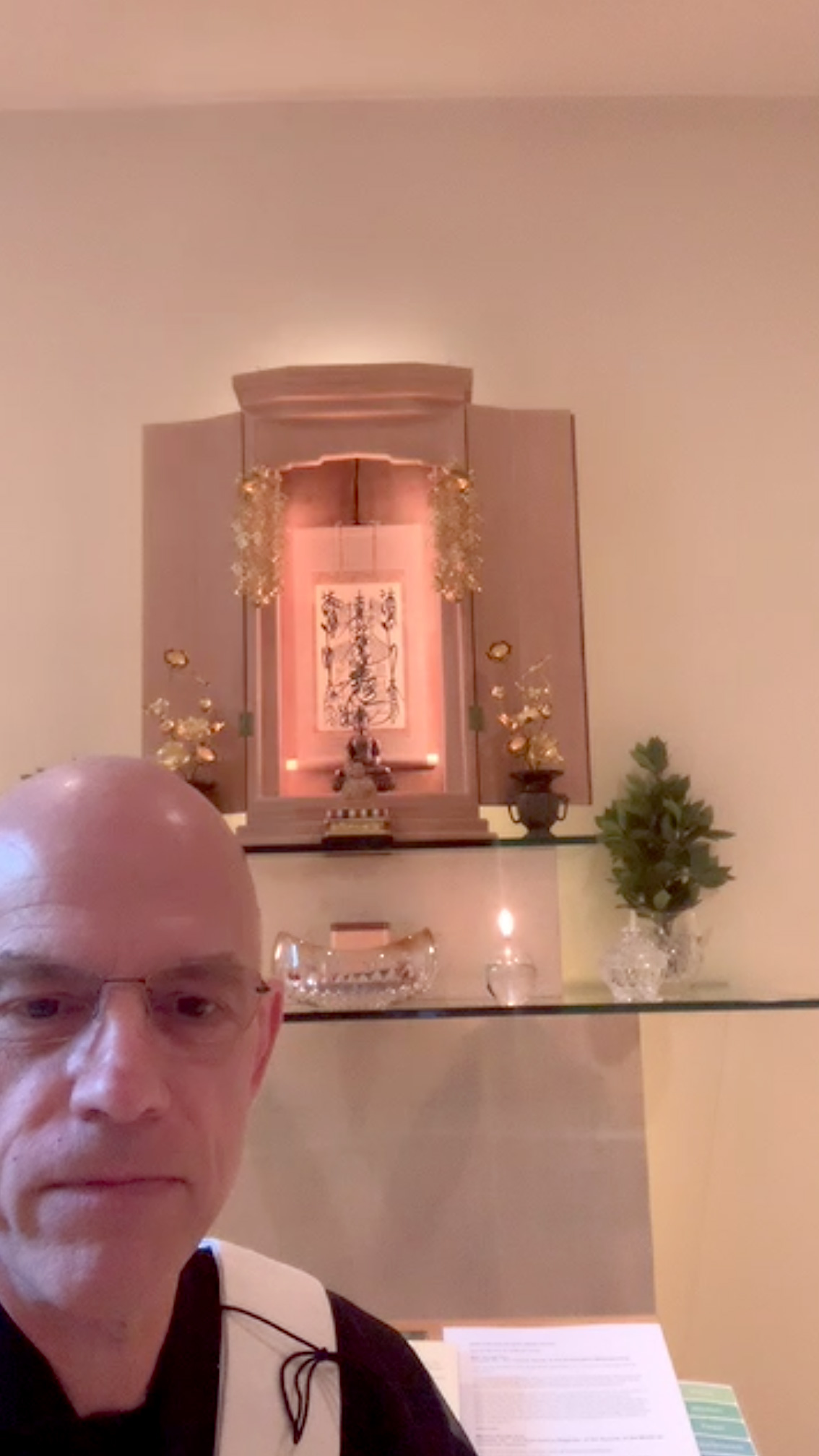
Then at 12:30pm I joined the first-ever broadcast service by the Nichiren Buddhist Sangha of the San Francisco Bay Area. The service was led by Mark Ryugan Herrick from his house (right) and followed by a lecture on the Vimalakirti Sutra by Michael Ryuei McCormick. While I enjoy taking Amtrak from Sacramento to Oakland to attend the Bay Area services, it was a treat to do this from home.

Unfortunately, the Sacramento Nichiren Buddhist Church doesn’t have the capacity to broadcast services. Perhaps I can do something about that.

Returning to a Good Friend

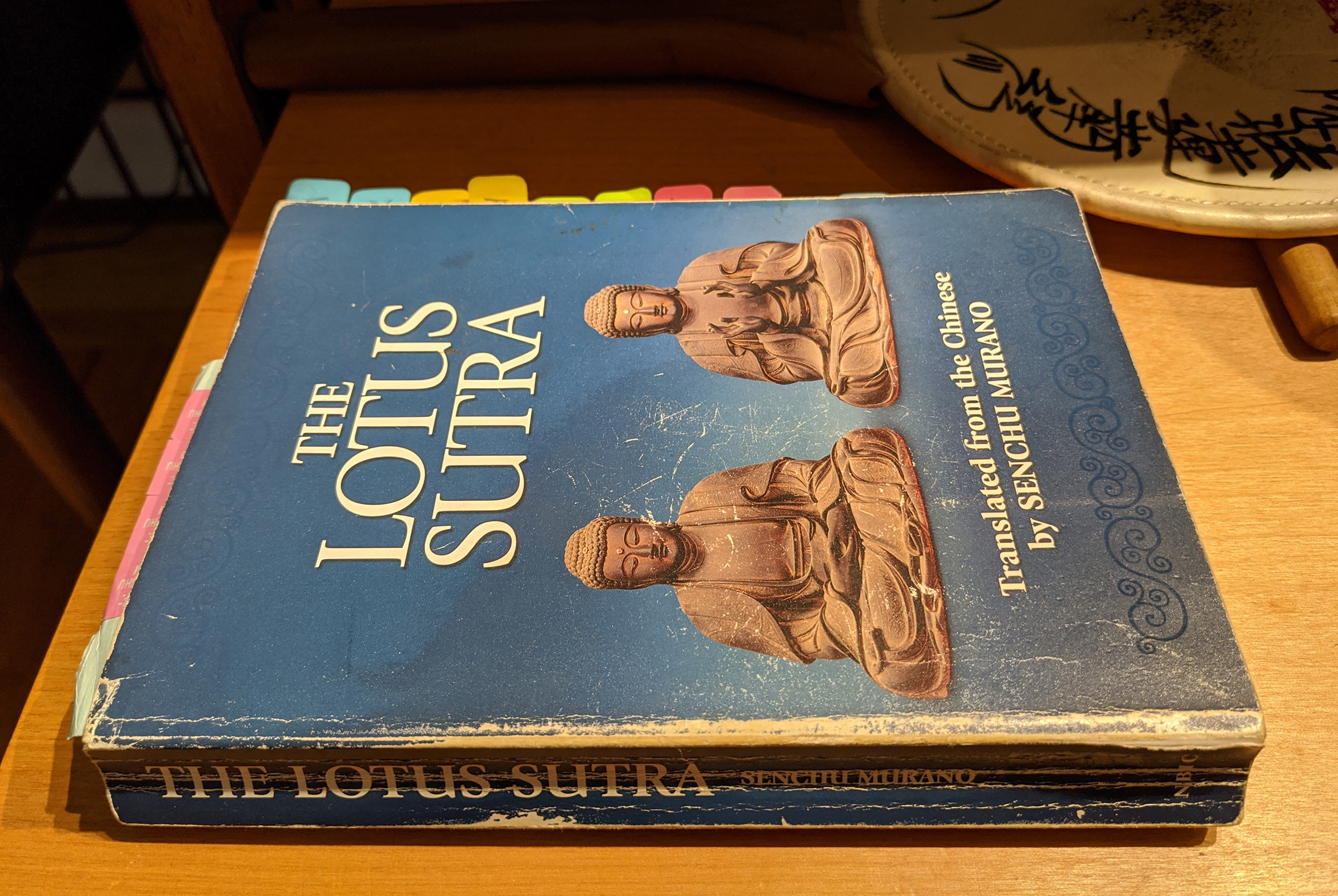
Lotus Sutra by Senchu Murano

For this evening’s service I welcomed an old friend, my Senchu Murano translation of the Lotus Sutra. For the past 10 cycles through my 32 Days of the Lotus Sutra practice I have been working my way through all of the English translations of Kumarajiva’s Chinese translation of the Lotus Sutra, beginning with “The Scripture of the Lotus Blossom of the Fine Dharma,” the translation of the Lotus Sutra made by Leon Hurvitz, and concluding with Burton Watson’s translation for Soka Gakkai. I suspect that Rissho Kosei-kai’s translation, “The Threefold Lotus Sutra: A Modern Translation for Contemporary Readers,” which was published in 2019, will become the modern standard. The Nichiren Shu Buddhist Sangha of the San Francisco Bay Area intends to use this translation rather than Murano’s for its service booklet. Personally, I’m not convinced that the translators’ aggressive effort to remove gender bias is beneficial. I wrote about this in a January blog post.

In any event, on this 51st cycle through the Lotus Sutra, I’m very happy to return to Murano’s translation.

Social Distancing

Zoom capture of service

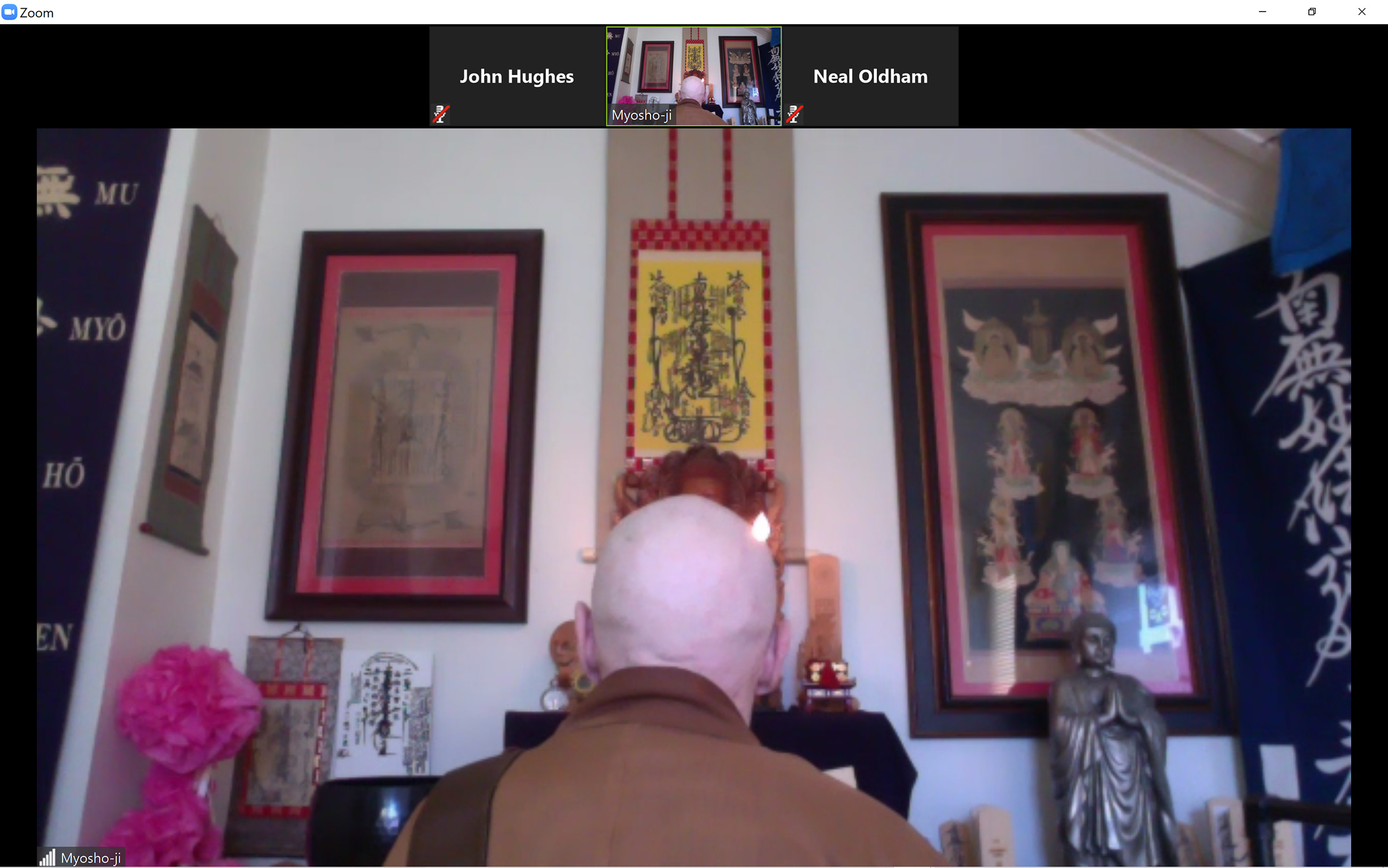
The COVID-19 precautions are keeping me home and canceling the Sacramento Nichiren Buddhist Church services but that doesn’t impede my virtual sangha. Today I joined Rev. Ryusho Jeffus’ Myoshoji service. Ryusho Shonin is in Syracuse, New York, and the other two attendees joined from different parts of North Carolina, where Ryusho once had a physical temple. The Myoshoji services often include Nichiren Shu practitioners from several European countries.