Category Archives: Blog

Two Authors Seated Side by Side

Jacqueline-Stone-150-150
Jacqueline I. Stone
donald_s_lopez_jr_150x150
Donald S. Lopez Jr.

I have not read past the Author’s Introduction for Two Buddhas Seated Side by Side. I’m looking forward to reading this chapter-by-chapter introduction to the Lotus Sutra and Nichiren’s interpretation as part of my 32 Days of the Lotus Sutra.

Two Buddhas is written by Jacqueline I. Stone, Emeriti Faculty in the Department of Religion at Princeton University, and Donald S. Lopez Jr., the Arthur E. Link Distinguished University Professor of Buddhist and Tibetan Studies in the University of Michigan’s Department of Asian Languages and Cultures.

I have long admired Stone, whose Original Enlightenment and the Transformation of Medieval Japanese Buddhism, is a marvelous introduction to Nichiren Buddhism. She has edited or contributed to several anthologies of papers discussing the Lotus Sutra. Her fame was such that when the 100th Anniversary Celebration of the Nichiren Order in North America (NONA) was held in Los Angeles in June 2014, Stone was invited to lecture.

Lopez, however, is more of a mystery to me. His academic focus is Tibetan Buddhism, and his University of Michigan biography does not mention the Lotus Sutra. Lopez’s lack of specialization in the Lotus Sutra is underscored by his book The Lotus Sutra A Biography, which I read back in February.

Maybe when I finish Two Buddhas I will better appreciate why Lopez gets top billing here. For now, I want to revisit his Biography of the Lotus Sutra and address two points that cause me to be wary of his influence in Two Buddhas.

First, his opening introduction to Biography:

It must have been the spring of 1972. I was in my sophomore year at the University of Virginia. A friend told me that his roommate had invited a Buddhist teacher to come over from Richmond to give a talk at their apartment in town. I decided to go along. I knew nothing about Buddhism. I was taking a course on Hinduism at the time and understood that Buddhism was somehow like Hinduism. In those days, people still used phrases such as “Oriental philosophy” and “Eastern mysticism” to subsume the various religious traditions of Asia in a single category. When I arrived at my friend’s apartment that night, I was surprised to find that the Buddhist teacher was a white guy, a distinctively unhip white guy. He looked like Matt Foley, the motivational speaker played by Chris Farley on Saturday Night Live. He was dressed in a plaid sport coat, with a white shirt and narrow tie. He wore glasses, and he had short, thinning hair, greased back. He was relatively tall, heavyset, probably in his early fifties. A short Japanese woman was with him, apparently his wife. He gave a brief talk, which I cannot remember. I noticed that in the corner of the room, there was a wooden cabinet sitting on a coffee table. It was about two feet tall. He opened two little doors, and there was a small statue of the Buddha inside. To my amazement, the man got down on his knees, joined his palms together, and started chanting something. We were all supposed to chant along with him. I did not know what it meant or even what language it was.

Later, tea and cookies were served. A guy walked up to me; he was probably in his mid-twenties, someone who had come over from Richmond. He was dressed in the standard uniform of the day, a blue work shirt and bell-bottom jeans. He started telling me about the wonders of chanting. He said, “I was walking down the street the other day, chanting to myself. I happened to look down at the sidewalk, and—I don’t know whether you’re into this, man—I found an ounce of hash.” (Only years later did I learn that Chapter Five of the Lotus Sūtra is called “Medicinal Herbs.”)

The white guy in the sport coat was the first Buddhist I ever met. I guess I was expecting something more exotic, perhaps a shaved head and long robes. I didn’t know that a Buddhist could look like Willy Loman, carrying in his cases a cabinet with a Buddha inside. I now know that the incomprehensible words that he was chanting were Namu Myōhō Renge Kyō, Japanese for “Homage to the Lotus Sūtra.” Millions of Americans would hear Tina Turner chant the phrase on Larry King Live on February 21, 1997.

Lopez is about six months younger than me, according to his university biography. In the Spring of 1972, I was floating in the Gulf of Tonkin aboard the USS Midway, working 7 at night to 7 in the morning in maintenance administration for an F-4 fighter squadron.  We both had to decide what to do about the Vietnam War draft. I admit that’s more a curiosity and not germane, but for me it’s a filter that colors my view of what he says.

Anyway, Lopez makes clear he believes he was at a meeting of Nichiren followers, most likely an early Nichiren Shoshu of America propagation effort long before the days of an independent Soka Gakkai International. I make this assumption because, as far as I know, no one else was propagating the teachings of Nichiren in such a way at that time in America.

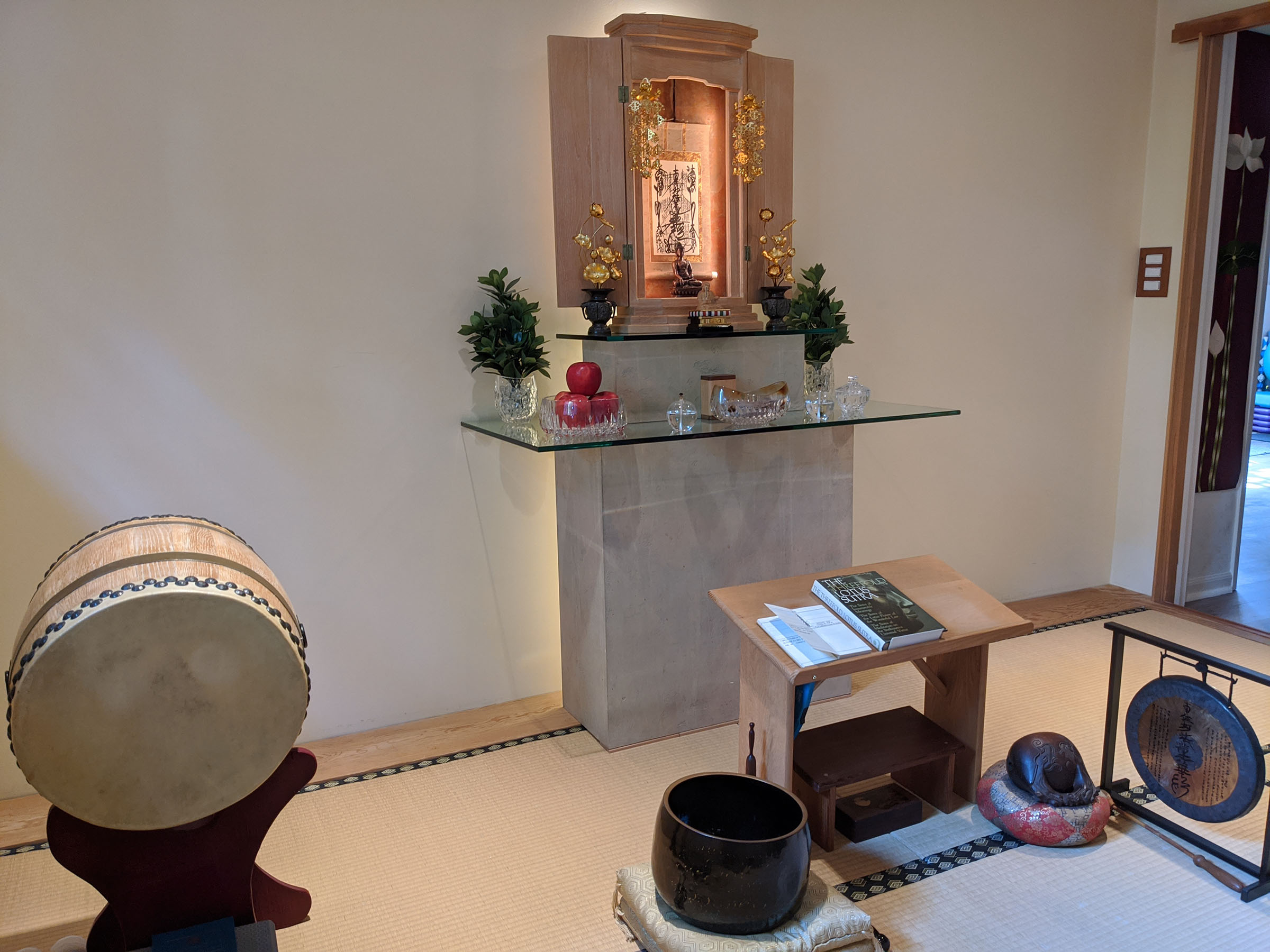
But if this was a Nichiren Shoshu – or any other Nichiren sect – meeting, that wooden cabinet on a coffee table would not have contained a “small statue of the Buddha inside.” Nichiren Shoshu does not allow any statues, even ones of Nichiren, on altars and certainly not in home shrines. For Nichiren Shu, a solitary Buddha is not an object of worship because it is important to ensure that people understand that this treasure is the eternal Śākyamuni as revealed in the 16th Chapter of the Lotus Sutra. Two Buddhas seated side by side with the Daimoku between is one example of how Śākyamuni can be represented in temples and home shrines. Is this “small Buddha” a case of Lopez’s Tibetan studies bleeding into the dim recollection of a meeting during his sophomore year at the University of Virginia?

Beyond that, Lopez’s use of the tale of the guy who found some hash on the sidewalk and took it as a reward for his practice of chanting Namu Myōhō Renge Kyō underscores everything wrong with the Nichiren Shoshu/Soka Gakkai focus on using the Daimoku as a wish-granting gem. Lopez’s reference to Chapter 5 of the Lotus Sutra, “Medicinal Herbs,” in this context is an unwanted effort at humor.

My other complaint with Lopez’s Biography of the Lotus Sutra was his use of a tale he said came from the Dainihonkoku hokekyōkenki. He retells this story:

Grasshopper on a lotus In one story, a monk memorizes the first twenty-five chapters of the Lotus but, despite repeated efforts, is unable to memorize the final three. He eventually learns in a dream that in a previous life he had been a grasshopper who perched in a temple room where a monk was reciting the sūtra. After reciting the first seven scrolls of the sūtra (which contain the first twenty-five chapters), the monk rested before beginning the final roll. He leaned against the wall and inadvertently killed the grasshopper. The grasshopper was reborn as a human as a result of the merit he received from hearing the first twenty-five chapters of the Lotus. When he became a monk, however, he was unable to memorize the final three chapters because he, as the grasshopper, had died before he heard them. (Page 79-80)

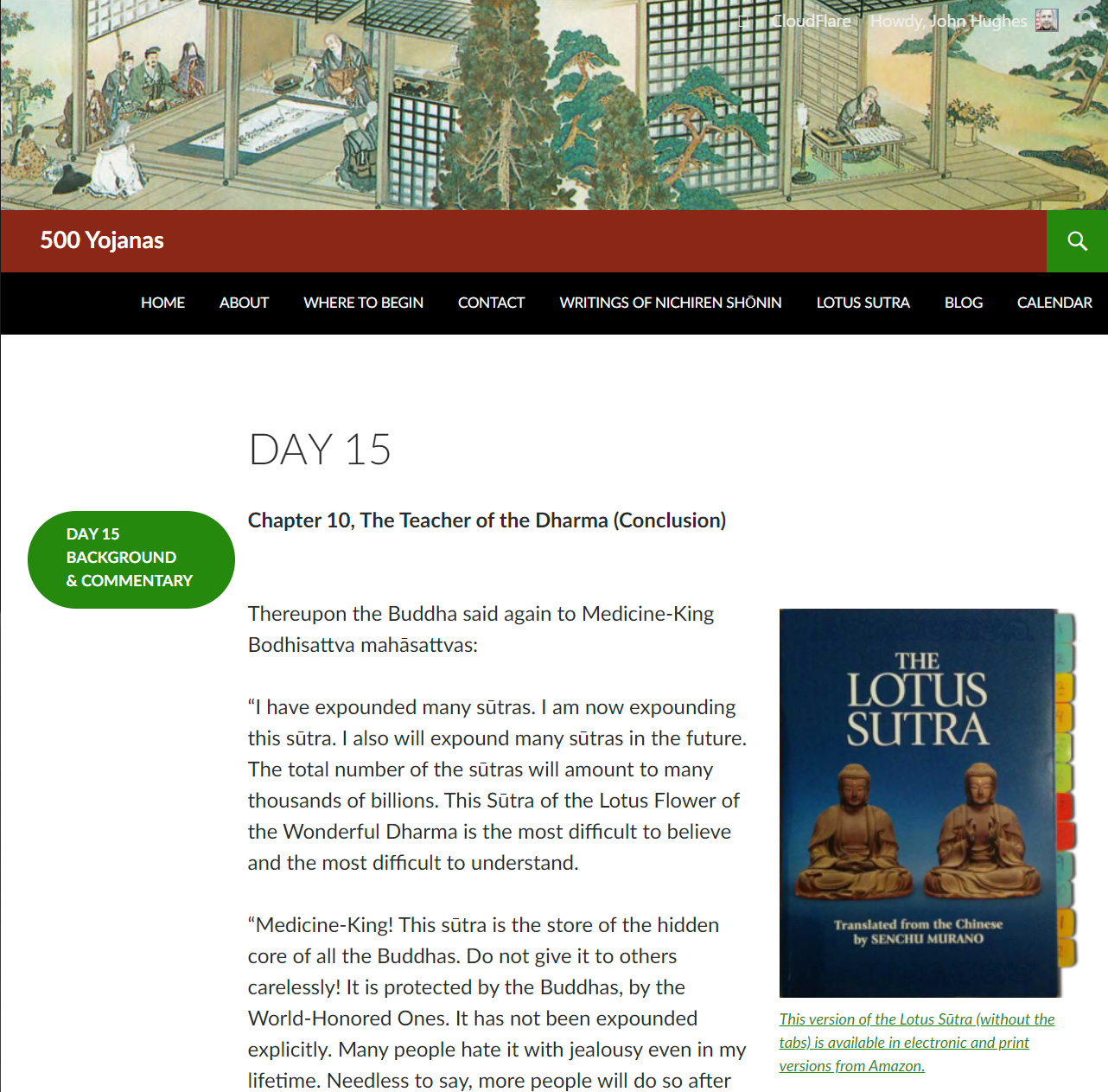
I want to thank Lopez for mentioning this book. I purchased the English translation of the Miraculous Tales of the Lotus Sutra from Ancient Japan and used its tales of the Lotus Sutra in my 32 Days of the Lotus Sutra practice. I was so impressed with the tale of the monk who in a past life was a grasshopper that I purchased a framed photo of a grasshopper on a lotus flower.

But there is no story of a monk who was a grasshopper in a past life anywhere in the Dainihonkoku hokekyōkenki translation. I purchased Nihon ryōiki, which contains a collection of stories gathered by a monk named Kyōkai, thinking perhaps the earlier stories included the grasshopper monk. Still no story.

So where did this tale come from? There are plenty of stories about monks who in past lives were animals. See Priest Renson A Hokekyo Reciter of Twenty-Seven Chapters. Was this another attempt at humor?

In the end, I’m wary of Lopez’s influence on Two Buddhas Seated Side by Side, but I’m excited about the opportunity to use this book in my daily practice.


See the conclusion of Apocryphal Text.

Rissho Peace Movement

SaveTheEarth-cover
Children’s anti-war brochure published by Nichiren Shu headquarters

Today I completed my recent project of adding old brochures found in the Sacramento Nichiren Buddhist Church classroom to the church website’s collection of brochures. This final brochure is entitled Save the Earth. The roughly 4-inch by 6-inch pamphlet unfolds into a seven panel brochure with comic-book-like illustrations on one side and a text-only article on the other.

Japanese postwar pacifism is one of the things I find very foreign, especially as it relates to Nichiren Buddhism. After all, my father fought in Europe in World War II, earning a bronze star for valor for holding his position during the Battle of the Bulge. My wife’s father served in counterintelligence in Tokyo during Gen. McCathur’s post-war occupation of Japan. That’s where he met my wife’s mother, a translator who had been a teenager in Tokyo during the war. I served in the US Navy in the Vietnam War, although that was mostly because I was going to be drafted into the Army. Being a self-proclaimed anti-war Christian at the time, I toyed with flight to Canada or principled jail time, but ended up joining the Navy. While I thought that would keep me out of the war, I ended up spending 11 months in and out of the Gulf of Tonkin on the aircraft carrier USS Midway. I worked in squadron maintenance administration, shuffling papers related to the maintenance of F4 Phantom jets.

Anyway, the thought of teaching children that war is bad, especially in our current age of endless war in Afghanistan, seems both inspiring and naive.

The Save the Earth brochure concludes:

To realize peace we must abandon greed and make the “principle of thankfulness” the basis of civilization. Buddhism teaches that “all phenomena are produced by causation.” This means that nothing—be it living or non-living things, natural or artificial phenomena—can exist by itself. The existence of anything is dependent on the existence of others. When we become thankful for others, we learn to be contented. Here arises dialogue, mutual understanding, the spirit of tolerance and friendship.

In his writings Nichiren repeatedly stresses the importance of peace. He says,

“You must be awakened promptly to the true teaching of Buddha Sakyamuni. Then the world will become the land of the Buddha. How can the Land of Buddha decline or be destroyed? If the nation does not decline and the land is not destroyed, we can be safe and calm:”
Uphold Righteousness and Bring Peace to the Country

We are promoting the “Rissho Peace Movement” in accordance with Nichiren’s teachings. Peace will never be realized while we are standing idly by. Let’s join hands and speak out worldwide for the realization of peace.

My Google search for background on “Rissho Peace Movement” failed to turn up any references to Nichiren Shu activities. However, it did point me to Millennialism, Persecution, and Violence: Historial Cases, a collection of essays published by Syracuse University Press in January 2000. In this book, Jacqueline Stone writes in an article entitled Japanese Lotus Millennialism: From Militant Nationalism to Contemporary Peace Movements:

During Japan’s modern imperial period, intense nationalism, militarism, and war were assimilated to new millennial visions of a world harmoniously united under Japanese rule. Certain elements in the teachings of the medieval Buddhist teacher Nichiren were appropriated to these visions. His discourse about Japan as the place where a new Dharma would arise to illuminate the world was given an imperialist reading; his advocacy of assertive proselytizing or shakubuku—which for Nichiren had meant preaching and debate—was adopted as a metaphor for armed force; and his emphasis on giving one’s life for the Lotus became a celebration of violent death in the imperial cause. Such millennialist appropriations inspired not only extremists committed to political assassination or coups but also broadly legitimated the violence that pitted Japan as a whole against other Asian countries and the West.

A World Without War

It is little exaggeration to say that ultranationalistic Lotus millennialism died in August 1945 in the flames of Hiroshima and Nagasaki. But even before these ruined cities had been rebuilt, a new Lotus millennialism had risen to take its place. Postwar Lotus millennialism envisions a time when, by awakening to the universal Buddha nature, people everywhere will live in harmony and with mutual respect. Different Nichiren-and Lotus-related religious groups offer variations on this basic theme, but on one point they all agree: in that future time, there will be no war. Nuclear weapons, in particular, will be abolished.

Download full article

I suppose the use of Nichiren’s writings to take both sides of the question of war shows the universality of his message. Or, perhaps more to the point, it shows how the one True Dharma is subverted by innumerable meanings.

Retirement News from Myoshoji

2019-09-15_ryusho_retiring

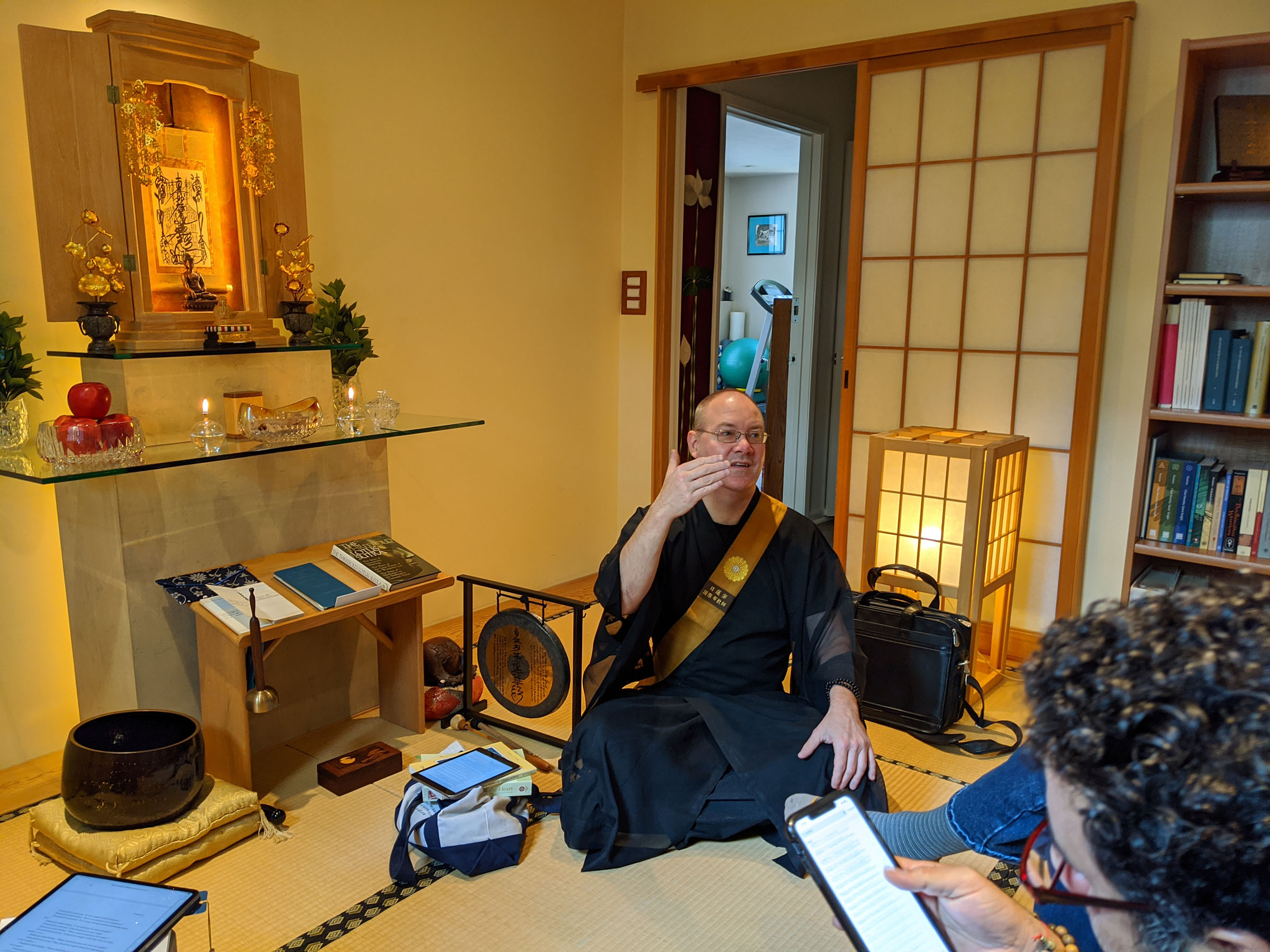
Attended the online service with Rev. Ryusho Jeffus and three other members of the Myoshoji sangha today. I haven’t been attending as often as I once did. And now, apparently, I will soon have even fewer chances to attend.

Today, Rev. Ryusho Jeffus announced that he will be retiring on Oct. 13, 2019. He plans a formal announcement later, so I’ll leave the details of his plans for that time.

I became a Nichiren Shu follower at the start of 2015 and, as you can tell from the story about why I started this blog – see the About page – Ryusho has been an important influence.

Ryusho plans to continue services after his retirement but other activities he plans to pursue will make those services less frequent. That will be a real loss.

Sept. 6, 2015, Service at Myoshoji with Ryusho Jeffus Shonin
This is the first photo I posted of an online service – Sept. 6, 2015. At the time, Myoshoji was in Charlotte, North Carolina.

The Buddha’s Pure and Immaculate Voice

Yesterday I wrote about Senchu Murano’s penchant for inserting his twist on tales from the Lotus Sutra (“Questions and Fantasy Answers“). I also posted that article on the Nichiren Shu Group on Facebook and asked if anyone could offer a defense for the use of “fantasy” stories in place of actual Lotus Sutra verses in teaching Nichiren Buddhism.

Judging from the comments I received, my original post failed to make clear my point. Let me try again.

In Nichiren’s Treatise on Opening the Eyes of Buddhist Images, Wooden Statues or Portraits (Writings of Nichiren Shōnin, Faith and Practice, Volume 4, Page 91), he writes:

The written words of the Lotus Sutra express in a visible and tangible form the Brahma’s voice of the Buddha, which is invisible and intangible, so that we can see and read them with our eyes. The Buddha’s pure and immaculate voice, which had disappeared, is resuscitated in the form of written characters for the benefit of humankind.

Shinkyo Warner, in his Daily Dharma post on this quote, says:

Living in this world, 2500 years after the Buddha Śākyamuni walked the Earth, it is difficult to hear his voice leading us to enlightenment and encouraging us to let go of our attachments. In the Lotus S̄ūtra we have an instrument for creating the Buddha’s voice in our own time. This is his highest teaching. It brings all beings to liberation, whether they are clever or dull, stupid or wise, focused or distracted. It reminds us of our true nature as Bodhisattvas who chose this life out of our determination to benefit all beings. It shows us how to transform the poison of suffering into the medicine of compassion, and the poison of ignorance into the medicine of wisdom.

When Senchu Murano inserts his words and ideas into his “fantasy” about the Lotus Sutra, what do we hear?

In Murano’s 1997 booklet, The Gohonzon, he tells this tale about the Buddha Many Treasures (Prabhutaratna, Taho):

The fantastic narration of the Lotus Sutra begins with the story of Prabhutaratna (Many-Treasures, Taho) Buddha, as follows:

There lived a Buddha called Taho many kalpas ago in a world called Treasure-Pure, which was located far to the east of the Saha World. Taho Buddha knew the Wonderful Dharma, but did not expound it by himself because he thought that the Wonderful Dharma should be expounded by a Buddha who would emanate from himself as many Replica-Buddhas as there are worlds in the universe, dispatch them to those worlds, and then expound the Wonderful Dharma in a sutra called the Lotus Sutra. Taho Buddha decided to wait for the advent of such a Buddha, and to approve the truthfulness of the Lotus Sutra expounded by that Buddha.

In Murano’s 1998 booklet, Questions and Answers on Nichiren Buddhism, he suggests this is how Chapter 11 starts:

Sakyamuni Buddha did what he had never done before at the beginning of Chapter XI of the Lotus Sutra. He produced innumerable Replica Buddhas of his own from himself, told them to expound what he was going to expound from that moment, and dispatched them to the worlds of the ten quarters: the four quarters, the four intermediate quarters, zenith, and nadir. After he saw them having reached their assigned worlds, Sakyamuni Buddha expounded the teaching of the One Vehicle, that is the Lotus Flower of the Wonderful Dharma. Obedient to their Original Buddha, his Replica-Buddhas expounded the same teaching throughout the universe and as a result the universal validity of the Wonderful Dharma was revealed.

The stupa of the seven treasures sprang up from underground and hung in the sky before the Buddha at the opening of Chapter 11. There is no discussion of emanations of Śākyamuni until the congregation asks Śākyamuni to open the stupa. As for whether other Buddhas can create emanations, that is clearly the case in The Sutra of Contemplation of the Dharma Practice of Universal Sage Bodhisattva, which is the concluding portion of the Threefold Lotus Sutra. (See this post.)

If the tale of the Stupa of Treasures, as Murano says, is where “the fantastic narration of the Lotus Sutra begins,” then what of the earlier 10 chapters?

In Chapter 11, Śākyamuni explains to the congregation what has happened:

“The perfect body of a Tathāgata is in this stūpa of treasures. A long time ago there was a world called Treasure-Purity at the distance of many thousands of billions of asaṃkhyas of worlds to the east [of this world]. In that world lived a Buddha called Many-Treasures. When he was yet practicing the Way of Bodhisattvas, he made a great vow: ‘If anyone expounds a sūtra called the Lotus Flower of the Wonderful Dharma in any of the worlds of the ten quarters after I become a Buddha and pass away, I will cause my stūpa-mausoleum to spring up before him so that I may be able to prove the truthfulness of the sūtra and say ‘excellent’ in praise of him because I wish to hear that sūtra [directly from him].”

“He attained enlightenment[, and became a Buddha]. When he was about to pass away, he said to the bhikṣus in the presence of the great multitude of gods and men, ‘If you wish to make offerings to my perfect body after my extinction, erect a great stūpa!’

“If anyone expounds the Sūtra of the Lotus Flower of the Wonderful Dharma in any of the worlds of the ten quarters, that Buddha, by his supernatural powers and by the power of his vow, will cause the stūpa of treasures enshrining his perfect body to spring up before the expounder of the sūtra. Then he will praise [the expounder of the sūtra], saying, ‘Excellent, excellent!’

“Great-Eloquence! Now Many-Treasures Tathāgata caused his stūpa to spring up from underground in order to hear the Sūtra of the Lotus Flower of the Wonderful Dharma [directly from me]. Now he praised me, saying, ‘Excellent, excellent!’ ”

Senchu Murano’s words are pure fabrication, a whole cloth that muffles the Buddha’s pure and immaculate voice.

How does one defend such an act, especially when the book was written in English for an audience that knew little if any of the teachings of the Lotus Sutra?

Previous: Questions and Fantasy Answers

Questions and Fantasy Answers

Questions and Answers book cover
Read contents of this book
I’ve uploaded the content from Senchu Murano’s Questions and Answers on Nichiren Buddhism to the Sacramento Nichiren Buddhist Church’s brochures page. I’ve formatted the text into accordions so that it is easy to peruse the content and then read the full text. I originally published a selection of the content here back in 2017.

This is the second booklet by Senchu Murano from the late 1990s that I’ve uploaded to the church website. It was curious to see that both include “fantasy” text inserted by Murano into discussion of the Lotus Sutra. I commented earlier about his Gohonzon booklet in which he has an entire section entitled The Fantasy of the Lotus Sutra.

In this booklet, Murano goes to great lengths to expand the story of the Buddha Many Treasures (Prabhutaratna, Taho) in a discussion prompted by a request to “Please explain the Dai Mandala Gohonzon.”

Murano replies:

Sakyamuni Buddha did what he had never done before at the beginning of Chapter XI of the Lotus Sutra. He produced innumerable Replica Buddhas of his own from himself, told them to expound what he was going to expound from that moment, and dispatched them to the worlds of the ten quarters: the four quarters, the four intermediate quarters, zenith, and nadir. After he saw them having reached their assigned worlds, Sakyamuni Buddha expounded the teaching of the One Vehicle, that is the Lotus Flower of the Wonderful Dharma. Obedient to their Original Buddha, his Replica-Buddhas expounded the same teaching throughout the universe and as a result the universal validity of the Wonderful Dharma was revealed.

Prabhutaratna (Taho), a past Buddha of a world located far to the east, rejoiced at seeing all this. You should bear in mind that a past Buddha, who had already entered Parinirvana, can see, hear, speak, and let his Stupa move at his will. When Prabhutaratna entered Parinirvana, his disciples enshrined him in his stupa, and shut the door of the stupa. Since then Prabhutaratna had been sitting in meditation in his Stupa with no disciple attendants. He had wished to expound the Wonderful Dharma by himself during his lifetime, but refrained from it because he thought that the Wonderful Dharma should be expounded by a Buddha whose emanations be the Buddhas of the worlds of the ten quarters to show the universal validity of the Dharma. Prabhutaratna himself had not such Replica Buddhas, so he had waited for the advent of such a Buddha for so long a time.

Overjoyed with Sakyamuni’s expounding the Wonderful Dharma, Prabhutaratna caused his Stupa to travel westwards through the skies of innumerable worlds. The Stupa reached the sky below the Saha-world, passed the world from underneath, and stayed in the sky just above Mt. Sacred Eagle, where Sakyamuni Buddha was expounding the Wonderful Dharma.

He continues with the Buddha emitting a light and calling home all of his emanations and opening the stupa and taking a seat offered by Many Treasures Buddha. Murano adds that Many Treasures Buddha gave Sakyamuni the lesser seat, believing that he was older than Sakyamuni.

Murano continues his version of events after the congregation is raised level with the two Buddhas in the stupa:

Thereupon Sakyamuni addressed the congregation that his Parinirvana day was drawing near, and that he was going to transmit the Wonderful Dharma to someone. Hearing this, many Bodhisattvas appealed to him for the transmission. Sakyamuni refused their appeal, however, saying that there were proper persons for that. And he issued rays of light from himself as a sign of call-up.

All of a sudden the earth quaked and cracked, and innumerable Bodhisattvas came from underground. To the astonishment of the congregation, those Bodhisattvas exchanged greetings with Sakyamuni Buddha. How strange! The congregation had never heard of them.

Sakyamuni addressed the congregation, “I am older than any other Buddhas. All the Buddhas of the past, present and future are my emanations. Those Bodhisattvas who have arrived from underground are my disciples.” Here it is revealed that the One Vehicle, that is the Wonderful Dharma, is universally valid not only spatially but also temporally.

Seeing all this, Prabhutaratna was shocked. He felt ashamed of his ignorance of the fact that the Buddha sitting next to him was his Original Buddha. He tried to change the seats, but Sakyamuni checked him, saying, “You are now the State Guest of the World-State of the Eternal Sakyamuni. You are now representing all the Buddhas of the past, present and future.” Prabhutaratna understood Sakyamuni, and remained at his seat, motionless.

I am sincerely puzzled as to why Murano insists on inserting his “fantasy” into these booklets. How does this advance understanding of the Lotus Sutra, especially in countries outside Japan with very limited contact with the Lotus Sutra?

NEXT: The Buddha’s Pure and Immaculate Voice

The View of Nichiren Shū in 1985

1985_Nichiren_Shu-cover
View this brochure online

I’ve added another brochure to the Sacramento Nichiren Buddhist Church website. This one was published by the Asia Buddhist Friendship Association Nichiren Shū in 1985. The booklet is bilingual, with English on the lefthand pages and Japanese on the right.

This brochure declares that Nichiren was Bodhisattva Viśiṣṭacaritra – Jōgyō in Japanese and Superior Practice in English.

saint-nichirenViśiṣṭacaritra is a Bodhisattva who is predicted to appear in this impure world in what was termed lawlessness (Mappō in Japanese) two thousand years following Buddha’s passing. Here, in compliance with the spirit of the sage, Śākyamuni, this Bodhisattva is to undertake Buddhist austerities armed with the Lotus Sutra. However, in this sutra it also explains that without fail persecution will be encountered while propagating and teaching the Lotus Sutra in this age of degeneration. It is in the face of this oppression that resolution must not waver, even to the extent of martyrdom, so that teaching of the Lotus Sutra can be carried out. In compliance with this prediction of the Lotus Sutra, Saint Nichiren was born at the beginning of the age of lawlessness (Mappō) during the Kamakura-Era (1185-1333). In preaching this text he suffered repented persecution and at one stage almost became a martyr in its cause. Finally, it was in his pursuit of the course expounded in the Lotus Sutra that Saint Nichiren attained the realization that he was in fact Viśiṣṭacaritra Bodhisattva.

Pictorial History of Practicing in Oakland

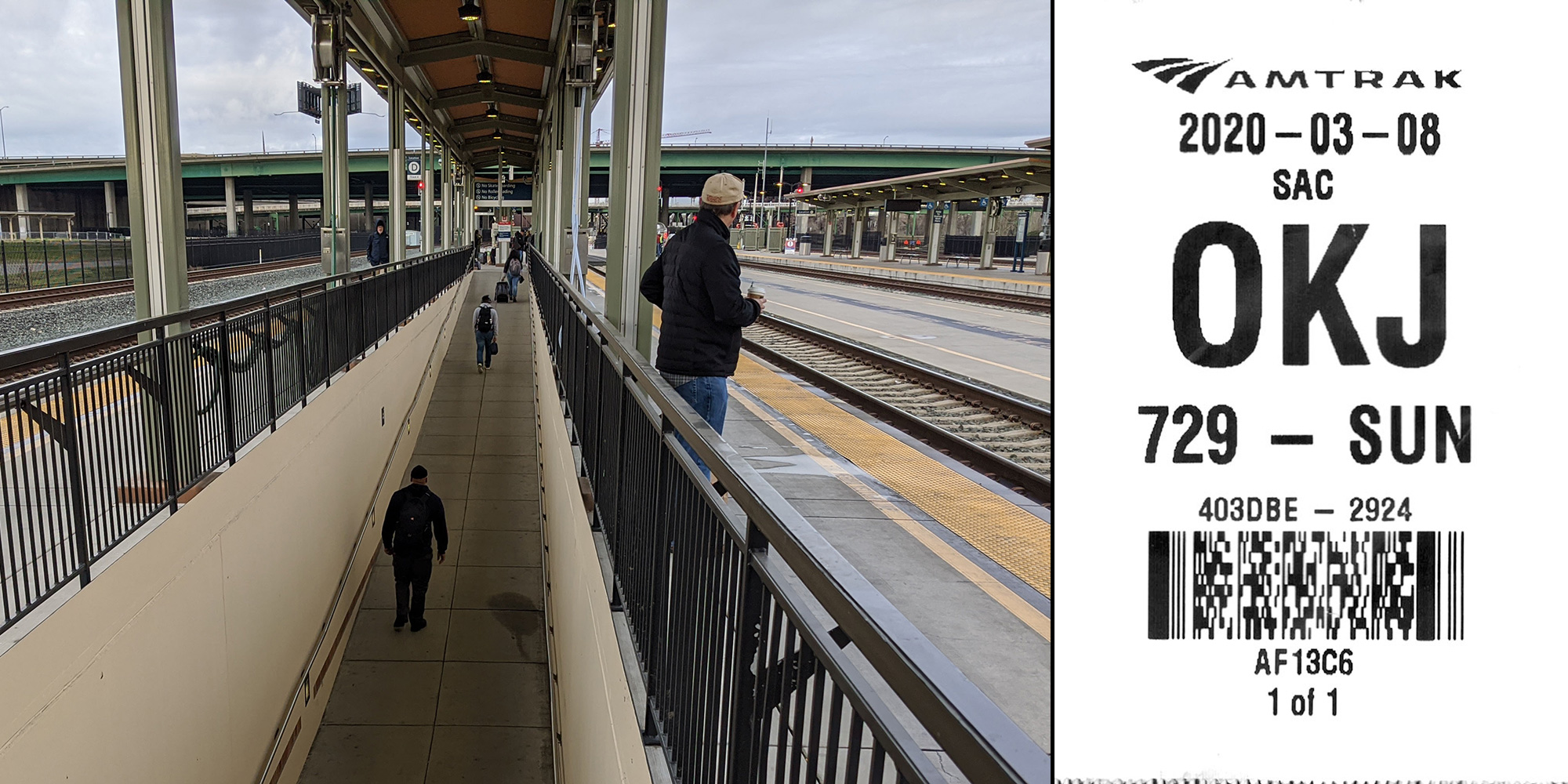
Sacramento Station
Waiting in Sacramento for the 8:59am train headed to San Jose

Oakland A's fans
Most of the people waiting for the train were headed to the Oakland A’s vs. Detroit Tigers game.

20190908-walk-map
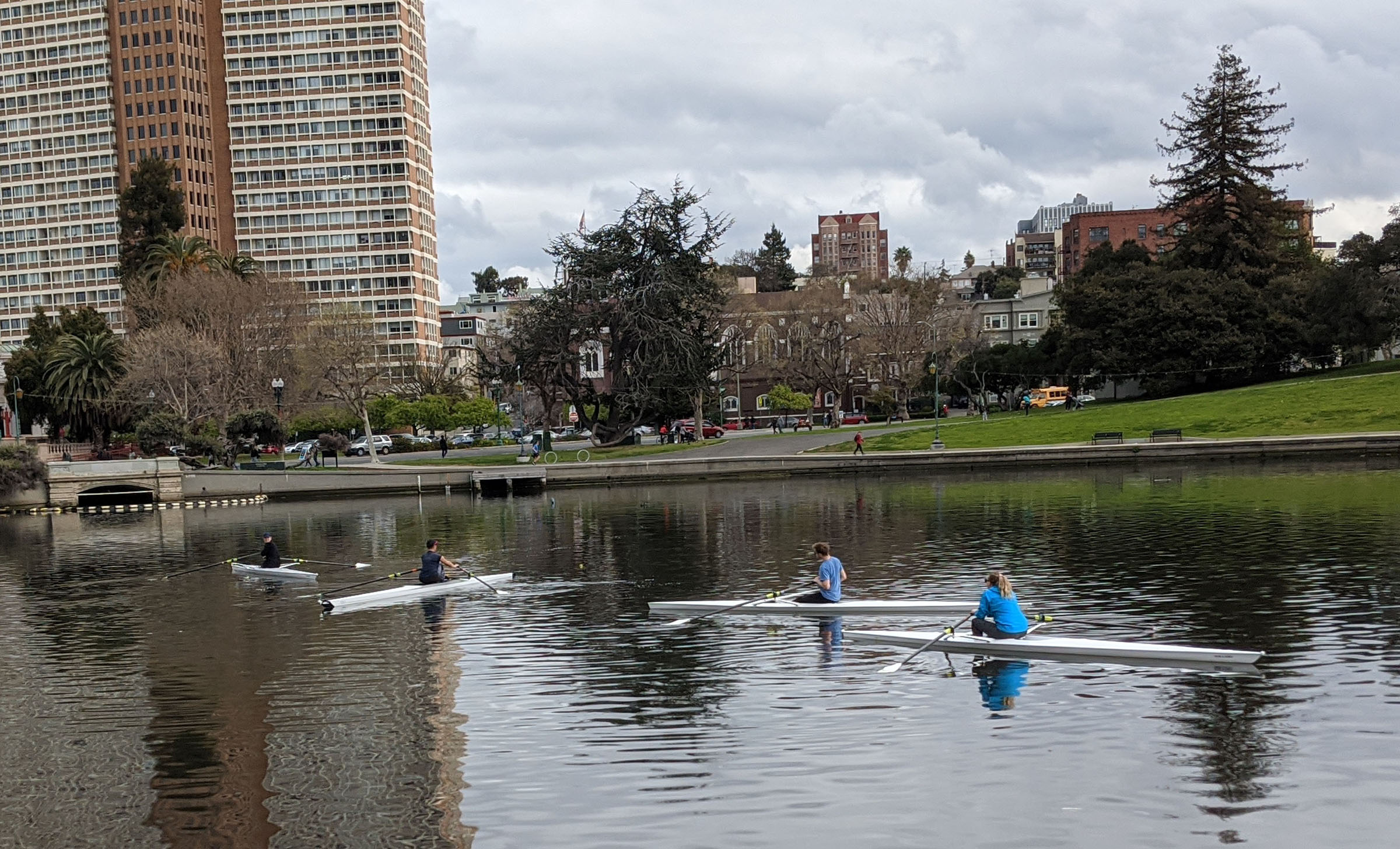
Arriving at Oakland Jack London station with an hour and a half before the service I decided to walk to Mark Herrick’s house in Piedmont. The distance is just a 10th of a mile longer than I normally walk each day.

Lake Merritt
The walk was pleasant, although it did get warm by the time I arrived.

20190908_mccormick-Herrick
Michael McCormick and Mark Herrick discuss a book before the service.

20190908_152446
And finally the ride home. Plenty of room to stretch out.

The Pictorial Life of Saint Nichiren

1986_The_Pictorial_Life_Of_Saint_Nichiren-cover
1986 publication of the Nichiren-shū Sia Buddhist Friendship Association

I’ve uploaded to the Sacramento Nichiren Buddhist Church website another of those treasures I discovered when I was cleaning out the Sunday school classroom. This one is a 5×7 booklet that tells the story of Nichiren’s life with paintings by Chokusai Uenaka.

From the Preface:
NichirenSince ancient times a genre of art called emakimono, in which biographies of individuals and narrative tales were presented in picture and written form, has existed in Japan. This book, following the traditional Japanese method, illustrates the biography of St. Nichiren, founder of the Nichiren-shu (sect) of Buddhism. An explanation of the scenes is also included.

The paintings of St. Nichiren’s life were executed by Chokusai Uenaka. Including a descriptive text which I composed, a Japanese edition of this book was published under the title of Nichiren Shonin eden (A Pictorial Biography of St. Nichiren) by the Kuonji Temple of Mt. Minobu. This English edition contains a selection of sixteen paintings from the original with a re-edited digest of the original text.

In order that people all over the world learn about St. Nichiren and his faith, publishing projects have been a business concern of the Nichiren-shu Asian Buddhist Friendship Association.

Uenaka Chokusai, the artist who created the scenes for this publication, is ranked as a great master of the traditional Tosa-e painting school. In completing this pictorial biography of St. Nichiren, he gave great attention to detail. After carefully researching the period, he took care to make sure that the elements of St. Nichiren’s era-Kamakura period (1192-1333) customs, mannerisms, clothing and architecture-were illustrated accurately.

In the original Japanese edition, the explanatory text was summarized and edited into an English digest by Junpei Kawasaki. However, in order to make the text more understandable it has been given a standardized style, certain areas have been altered or retranslated, and the whole text has been rechecked for accuracy and readability. This has been accomplished through the cooperation of David A. Hall, a Ph.D. candidate in Buddhist Studies from the University of California, Berkeley. The Publishing of this English edition is being made possible through the assistance of Nichiren-shu.

Kyoyu Fujii, Editor
President, Nichiren-shu Asian Buddhist Friendship Association Tokyo, July 1986

The text and images are displayed on the Sacramento Nichiren Buddhist Church website. A PDF copy of the booklet is also available for download.

I’m using cropped versions of some of these images in the header of my website.

Hagiography and History

By definition, a hagiography is an idealizing or idolizing biography. It’s not history. Threads of truth and threads of imagination are woven into a tapestry and pinned to the wall to encourage the faithful. But if the faithful recognize the hagiography for what it is, how are we to react?

Nichiren Shōnin offers a history Saichō, the Grand Master Dengyō, in his Ankoku-ron Gokanyurai, The Reason for Submitting the “Risshō Ankoku-ron” (Writings of Nichiren Shōnin, Doctrine 1, Pages 147-148):

The line of Japanese sovereigns, beginning with the seven generations of heavenly deities and five generations of terrestrial deities, is supposed to be followed by one hundred generations of human emperors (hyakuō). During the reign of the thirtieth human emperor, Emperor Kimmei, Buddhism was introduced for the first time from the country of Paekche on the Korean Peninsula to Japan. It has been over 260 years since then to the reign of Emperor Kammu, a reign of more than fifty sovereigns. During this period all the scriptures of Buddhism, as well as the six schools of Buddhism in Nara (Kusha, Jōjitsu, Ritsu, Sanron, Hossō and Kegon Schools) were introduced to Japan. Tendai and Shingon schools, however, were not.

“During the reign of Emperor Kammu, a poor monk, Saichō, a disciple of Venerable Gyōhyō of the Yamashinadera (Kōfukuji) Temple in Nara, lived. He was later called Grand Master Dengyō. Saichō studied thoroughly the doctrines of the six schools of Nara, which had been transmitted to Japan earlier, and Zen Buddhism without finding them satisfactory. Later he read the T’ien-t’ai school’s writings transmitted to Japan by Venerable Chien-chên (Ganjin) of T’ang China forty years or so earlier during the reign of Emperor Shōmu, and was awakened to the profound meaning of Buddhism.

Thereupon Saichō founded the Enryakuji Temple on Mt. Hiei in the fourth year of the Enryaku Period (785) in order to pray for peace and tranquility of the country. Taking refuge in the temple, Emperor Kammu named it the “Temple of the Imperial Guardian Star.” He gave up faith in the six schools of Nara, putting sole faith in the “perfect” Tendai School.

In the thirteenth year of the same Enryaku Period (794), the imperial capital was moved from Nagaoka to the newly founded city of Heian (Kyoto). On the nineteenth of the first month in the twenty-first year of the same period (802), the Emperor ordered fourteen scholars of the six schools of Nara, such as Gonsō and Chōyō, from seven great temples in the southern capital (Nara), to meet with Saichō in the Takao-dera Temple for debate. The brilliant scholars of the six schools could not answer even one question, keeping their mouths shut tightly.

The doctrine of five teachings of the Flower Garland (Kegon) Sect, the three-period teaching of the Dharma Characteristics (Hossō) Sect and the doctrines of two storehouses and three periods of the Three Discourses (Sanron) Sect were all refuted by Saichō. Not only were their doctrines destroyed but it also became clear that they were all slanderers of the True Dharma. Ten days later, on the twenty-ninth of the same month, an imperial edict was issued censuring the fourteen scholars of the six schools of Nara, who respectfully submitted a letter of apology to the emperor.

Again in Senji-shō, Selecting the Right time: A Tract by Nichiren, the Buddha’s Disciple (Writings of Nichiren Shōnin, Doctrine 1, Page 202-203), Nichiren Shōnin writes:

[D]uring the reign of Emperor Kammu, the fiftieth emperor, 800 years after the beginning of the Age of the Semblance Dharma, a monk called Saichō appeared, who was later known as Grand Master Dengyo. At first, he studied the six schools of Buddhism (Sanron, Hossō, Kegon, Kusha, Jōjitsu, and Ritsu) as well as Zen Buddhism from such masters as Bishop Gyōhyō. Meanwhile, he himself established the Kokushōji Temple (later renamed the Enryakuji Temple) on Mt. Hiei, where he checked basic sūtras and commentaries of the six schools against the interpretations by scholars of those schools. He found many discrepancies between interpretations of scholars and their basic sūtras and commentaries. Moreover, they produced so many false opinions that he felt that all those who believed in them would fall into the three evil realms (hell, realm of hungry souls, and that of beasts).

Besides, Saichō found that those scholars of the six schools each boastfully claimed mastery of the true teaching of the Lotus Sūtra without actually mastering it. He tormented himself thinking: “If I point this out, there will be disputes; if I keep silent, I will be going against the Buddha’s warning.” Fearful of the Buddha’s warning, he finally appealed to Emperor Kammu, who was astonished and ordered the scholars of the six schools to meet Saichō in debate. At the beginning their banner of self-pride waved as high as a mountain and their evil thoughts were more vicious than poisonous snakes. However, they finally had to surrender to Saichō in front of the Emperor, and the six schools and seven temples all became his disciples.

“A Buddhist Kaleidoscope: Essays on the Lotus Sutra,” published in 2002, includes an article by Nikkyō Niwano (1906-1999), the founder of Risshō Kōsei-kai. Niwano’s essay, “The Threefold Lotus Sutra: An Introduction,” was originally published in Japanese as part of Shinshaku Hokke Sambu-kyō (New Commentary on the Threefold Lotus Sutra) and translated into English for this book.

In discussing the history of Buddhism in Japan in his essay, Niwano writes:

Saichō established a temple called Ichijōshikan-in (later known as Komponchū-dō, the center of the Enryaku-ji temple complex) on Mount Hiei and made it his center for spreading the True Dharma, that is, the Lotus Sutra. His impressive learning and virtue earned him the trust of Emperor Kammu (781-806), who had moved the capital from Nara to Kyoto (then known as Heian-kyō) in 794, thus ushering in the long Heian period (794-1185). The emperor’s favor led to a dramatic increase in Saichō’s following, and the new Tendai sect flourished.

But the eminent priests of the Nara schools of Buddhism did not look kindly on Saichō’s popularity. How uncomfortable it must have made them to see this young man of only thirty or so gaining strength and support—and that in a new place rather than the traditional center of Japanese Buddhism, the old capital of Nara. Their opposition gradually became more overt, finally taking the form of political action. People who felt that this antagonism should not be allowed to fester any longer obtained the court’s permission for a debate between Saichō and representatives of the Nara schools on their positions and beliefs.

The debate was held at the temple Takaosan-ji (present-day Jingo-ji), in Kyoto, with Saichō facing more than ten leading Buddhist scholars of Nara. The entire party of Nara priests was won over by Saichō’s exposition of the wonderful teachings of the Lotus Sutra and conceded defeat. The excellent character of the Nara priests is evinced by the fact that after returning to the old capital they had representatives of the seven Nara schools send a letter to the emperor declaring that they had been made to realize the great worth of the Lotus Sutra. Their respect for the truth and their ability to humble themselves and acknowledge their error are admirable indeed.

With all of that history in mind, I was more than surprised to find nothing about a debate with the leaders of the Nara temples, let alone their defeat and surrender to Saichō’s Tendai school, in Paul Groner’s Saichō: The Establishment of the Japanese Tendai School.

Groner’s book, originally published in 1984 and reissued in 2000 with a new preface, is a footnote-filled scholarly look at Saichō’s effort to carve out a home for his new school in the state machinery that governed Buddhism in that period.

While there is no dramatic showdown at Takaosan-ji where the Nara establishment is soundly defeated, Groner details Saichō’s efforts to gain recognition for his school.

After Saichō submitted his works [to the emperor], the accuracy of his quotations from other texts was verified by the assistant director of the Bureau of Books and Drawings, Tamazukuri. Finding them correct, he forwarded them to the Sōgō (Offce of Monastic Affairs). The Eizan Daishiden reports that the Sōgō was completely overwhelmed by Saichō’s arguments and unable to reply. In fact, Gomyō had already decided to fight Saichō’s proposals through the normal channels, challenging them in the Sōgō and Genbaryō, rather than engaging in a public debate.

Saichō: The Establishment of the Japanese Tendai School, p156-157


While Saichō’s arguments can be said to have won this “debate,” it wasn’t until after his death that the fruits of that victory could be harvested.

On the fourth day of the sixth month of 822, Saichō died. His most influential lay patrons, Minister of the Right (udaijin) Fujiwara no Fuyutsugu, Vice Councilor (chūnagon) Yoshimine no Yasuyo, Provisional Vice Councilor (gonchūnagon) Fujiwara no Mimori, and Vice Controller of the Left (sachūben) Ōtomo no Kunimichi, submitted a petition to the Emperor requesting approval of the Shijōshiki (Regulations in Four Articles). Seven days after he died, Saichō’s request was granted. …

Saichō’s death had presented Fuyutsugu and Saichō’s other supporters with a chance to press for approval of the Shijōshiki. In addition, it had presented the court with an opportunity to grant Saichō’s request as a token of its grief at his passing. Thus the court was able to honor Saichō without allowing the Tendai School an undue advantage over the Nara schools. Approval of Saichō’s requests during his lifetime would have been the equivalent of court recognition of Tendai superiority.

Saichō: The Establishment of the Japanese Tendai School, p162-163


Just to check the history, I purchased a copy of John Stevens’ The Marathon Monks of Mount Hiei, which includes a lengthy history of Saichō’s efforts to establish the Tendai school in Japan. His version matched Groner’s. Success in creating a new school, but no debate, no public defeat on the Nara schools.

Personally I find the history of Saichō’s bureaucratic battle very inspiring. The victory may not have been as clean as the hagiography, but it can still encourage the faithful.

The Life of Buddha

Example card with Thai painting and information on reverse

In 1957 the United States Information Service published a book entitled “The Life of Buddha” that used Thai Temple paintings to tell the story. Some time later, the Asia Buddhist Friendship Association, a Nichiren Shu organization, published sets of 5×7 cards with the paintings on one side and information on the back. I found an envelope of cards 8-1 to 8-8 at the Sacramento Nichiren Buddhist Church Sunday school classroom.

Each card contains a Thai Temple painting. On the back of the card is a list of Famous Buddhist Sites. (Same sites on all cards). Each card has a different ‘Buddha’s saying’ quote and information about that card’s Thai painting. The inside cover of the envelope contains a short biography of the Buddha.

I have re-created the package on the Sacramento Nichiren Buddhist Church’s page of Nichiren Shu brochures. A PDF copy of the package is also available.

View re-created package of 5×7 cards