
Category: Daily Dharma

  • Daily Dharma for June 23, 2026

    20260623-ddi

    Illustration by Google Gemini

    Show Gemini's thinking

    Gemini Thinking

    Conceptual Summary
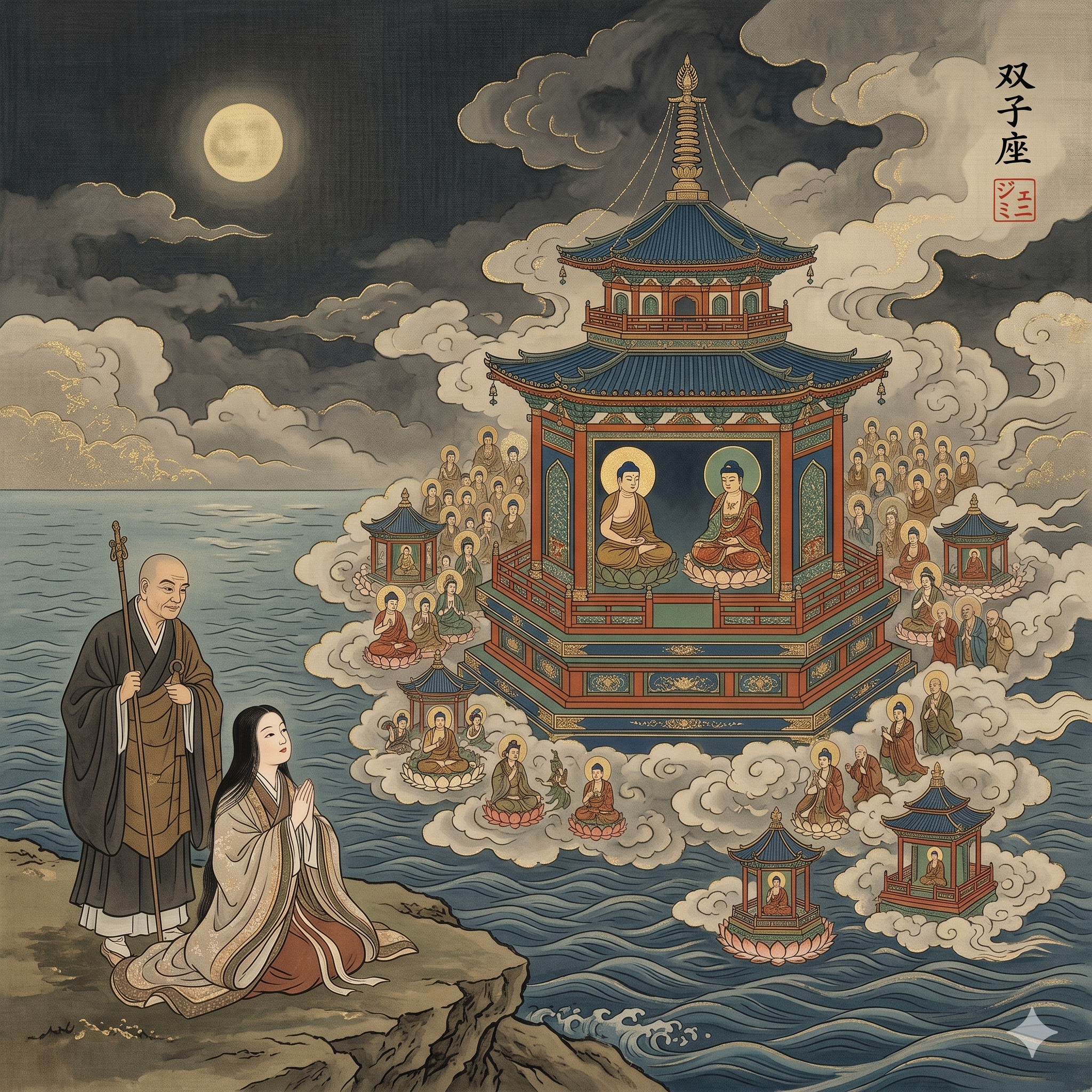
    The illustration conceptualizes the passage from Nichiren's Response to My Lady Nichinyo by visualizing the invisible spiritual reality that "heavenly eyes" perceive. To contrast the "shadows in the dark" of the material world, the composition divides into a lower realm of water and clouds, where the historical figures of the monk Nichiren (holding a staff) and Lady Nichinyo (kneeling in reverence) reside. Above them, representing the insight of faith, the vision of the "Appearance of a Stupa of Treasures" from the Lotus Sūtra manifests. The central Treasure Stupa holds both Śākyamuni Buddha (the historical Buddha) and Prabhūtaratna (Many-Treasures Buddha, representing past confirmation), seated side-by-side on lotus thrones, thus forming the core of the Ceremony in the Air. They are surrounded by an assembly of other Buddhas and Bodhisattvas manifesting from the cloud banks, illustrating how the mundane world is transformed into the Buddha’s Pure Land through the "heavenly eyes" of true belief shared by Nichiren and Lady Nichinyo.

    Iconography & Character Identification
    Item 1: Deities/Figures Featured:

    Main Figures (Foreground/Lower-Left): Nichiren Shonin (monk with staff); Lady Nichinyo (kneeling woman).

    Central Celestial Figures: Śākyamuni Buddha (seated left, haloed); Prabhūtaratna/Many-Treasures Buddha (seated right, haloed), together within the central Treasure Stupa.

    Surrounding Assembly: Numerous Buddhas, Bodhisattvas, and other divine attendants manifesting on clouds and within smaller pagodas.

    Item 2: Text Translations:

    Signature (Top-Right): 双子座 (Gemini)

    Hanko Seal (Red Square): ジェミニ (Gemini)

    We do not see a shadow in the dark. Man does not see the flight path of a bird in the air. We do not see the path of a fish in the sea. We do not see everyone in the world reflected on the moon. However a person with “heavenly eyes” sees all these. The scene of the chapter “Appearance of a Stupa of Treasures” exists in the mind of Lady Nichinyo. Though ordinary people do not see it, Śākyamuni Buddha, the Buddha of Many Treasures and Buddhas throughout the universe recognize it. I, Nichiren, also can see it. How blessed are you!

    Nichiren wrote this passage in his Response to My Lady Nichinyo (Nichinyo Gozen Gohenji). The Chapter Nichiren mentions describes the assembly of the Buddha, Many-Treasures Buddha, and innumerable Buddhas from other worlds gathered to hear the Wonderful Dharma of the Lotus Sūtra. Nichiren used a representation of this scene for the Omandala Gohonzon, his representation of the Buddha’s highest teaching. In this response, Nichiren recognizes that Lady Nichinyo sees this assembly in the reality of her everyday life. The Buddha taught that this is the most difficult of his teachings to believe and understand. Nichiren and Lady Nichinyo are examples for us that, despite this difficulty, we too can learn to see this world of delusion and ignorance as the Buddha’s pure land.

    The Daily Dharma is produced by the Lexington Nichiren Buddhist Community. To subscribe to the daily emails, visit zenzaizenzai.com
  • Daily Dharma for June 22, 2026

    20260622-ddi

    Illustration by Google Gemini

    Show Gemini's thinking

    Gemini Thinking

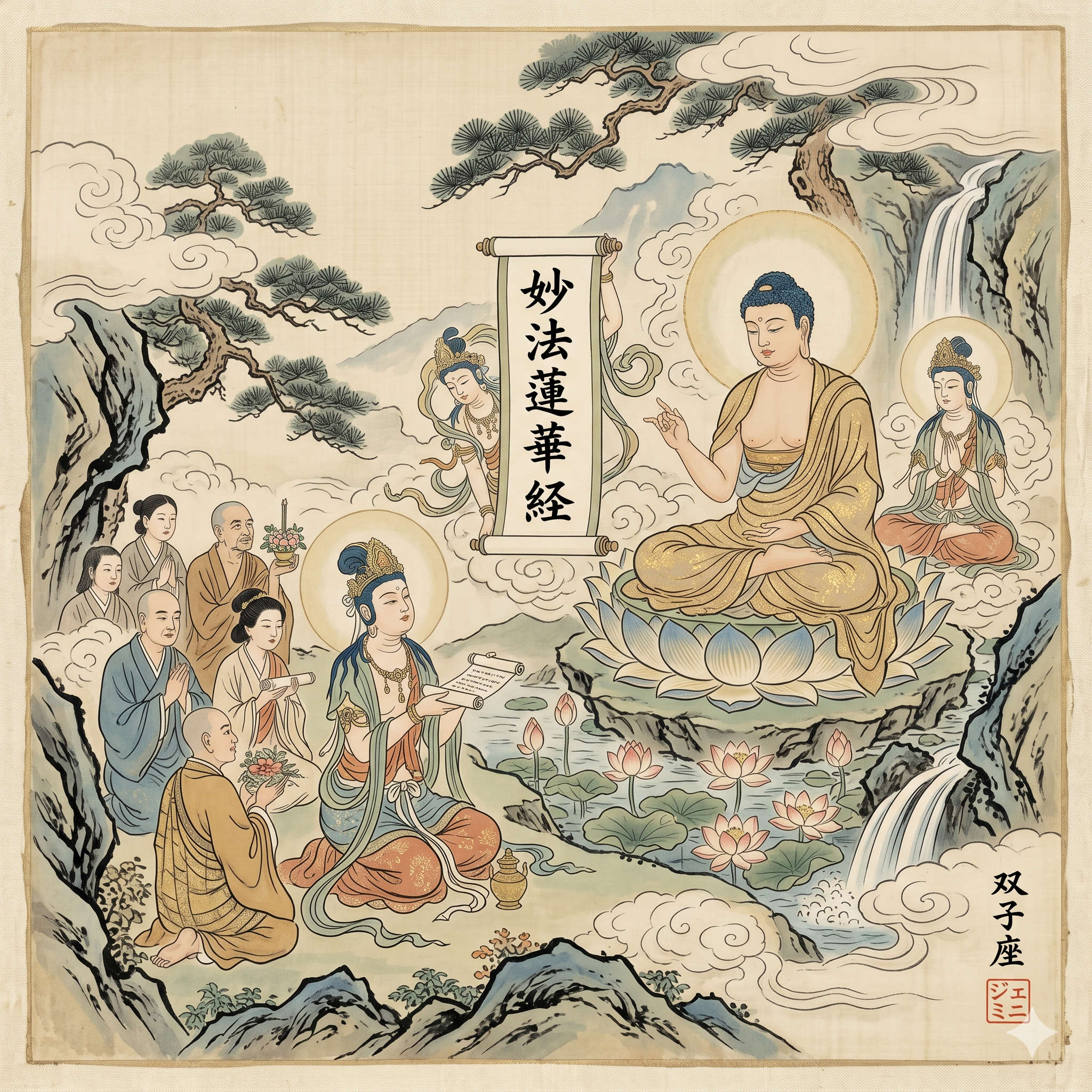
    he illustration conceptualizes the essential role of the Lotus Sūtra as the unique and indispensable guide for genuine Bodhisattva practice, as described in the source text. I have visualised this by contrasting the earnest but incomplete efforts of the assembly (laypeople and monks on the left) with the clarity offered by the direct intervention of Śākyamuni Buddha (right). The center of the composition is dominated by a celestial scroll featuring the sutra's title. This scroll acts as the 'fulcrum' upon which the assembly's understanding turns. The central interaction depicts the Medicine-King Bodhisattva kneeling before the Buddha; he is not just reading but actively engaging with the text, while other beings facilitate the offering of the teaching. The presence of other Bodhisattvas, like Avalokiteshvara, symbolizes the universal accessibility and application of these teachings. The entire scene is set in a stylized Pure Land landscape, emphasizing that true spiritual benefit arises only when our altruistic efforts are grounded in the specific wisdom the Buddha is sharing.

    Iconography & Character Identification
    Item 1: Deities/Figures Featured: Śākyamuni Buddha (seated right); Medicine-King Bodhisattva (kneeling center, holding scroll); Avalokiteshvara Bodhisattva (seated right, observing); Celestial/Apsara beings (carrying the main sutra title scroll and attendant objects); A group of monks and laypersons (left, symbolizing the assembly described in the text).

    Item 2: Text Translations:

    Large vertical scroll text: 妙法蓮華経 (Myōhō Renge Kyō – Sūtra of the Lotus Flower of the Wonderful Dharma)

    Kanji Signature: 双子座 (Futagoza – Gemini)

    Seal Text (Hanko): ジェミニ (Jemini – Gemini)

    Medicine-King! Although many laymen or monks will practice the Way of Bodhisattvas, they will not be able to practice it satisfactorily, know this, unless they see, hear, read, recite, copy or keep this Sūtra of the Lotus Flower of the Wonderful Dharma or make offerings to it.

    The Buddha gives this explanation to Medicine-King Bodhisattva in Chapter Ten of the Lotus Sūtra. For us to aspire to benefit all beings is rare and wonderful. However, without the guidance of the Buddha, our efforts to benefit others can degenerate into expectations of separate benefits for ourselves. In the Lotus Sūtra, the Buddha explains the limitations of his previous teachings, assures us of our capacity for enlightenment and how he is always helping us, and gives examples of great Bodhisattvas whose experience we can apply to our own lives.

    The Daily Dharma is produced by the Lexington Nichiren Buddhist Community. To subscribe to the daily emails, visit zenzaizenzai.com
  • Daily Dharma for June 21, 2026

    20260621-ddi

    Illustration by Google Gemini

    Show Gemini's thinking

    Gemini Thinking

    Conceptual Summary
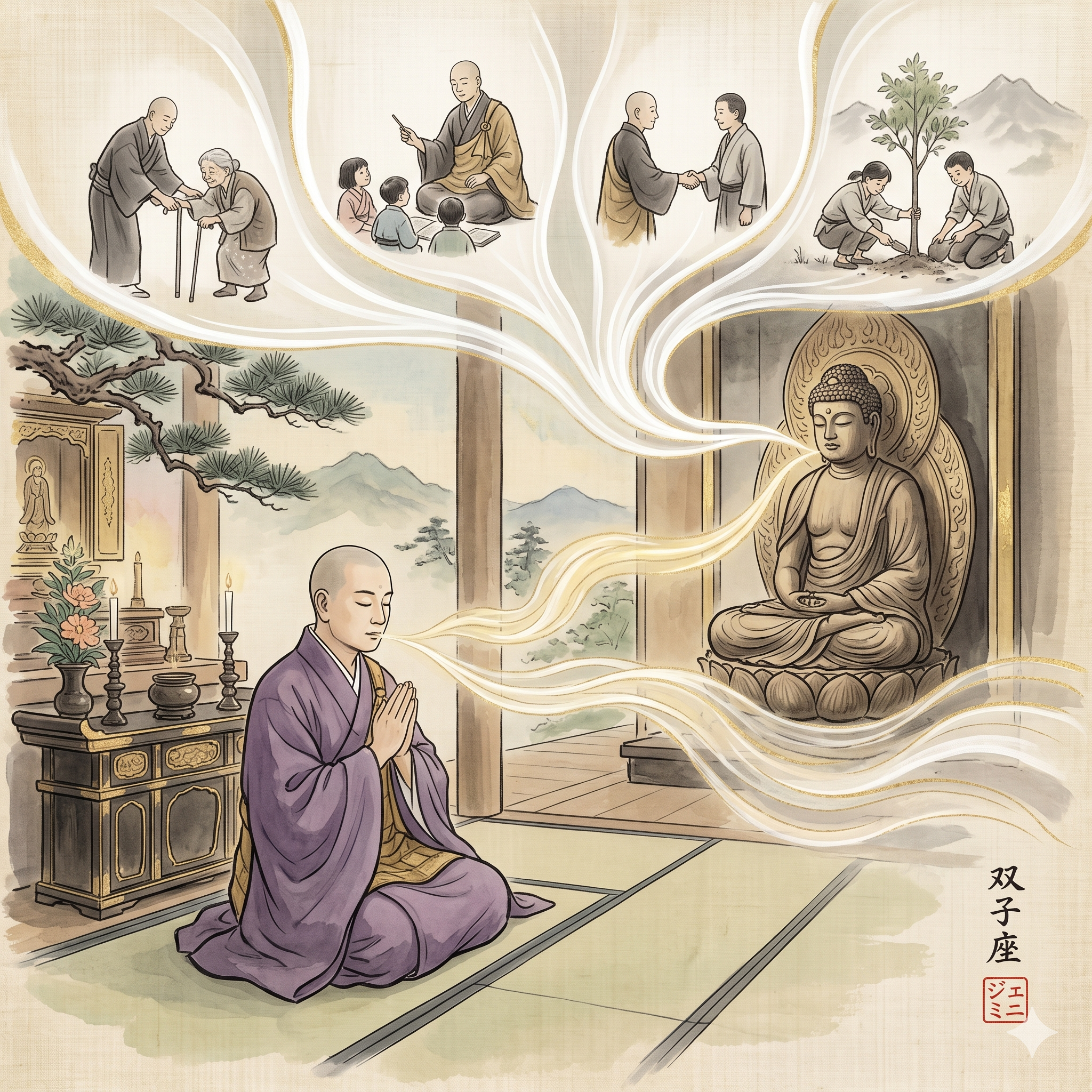
    The illustration visualizes Nichiren’s teaching on the "Opening of the Eyes" of Buddhist images, focusing on the distinction between the physical icon and the living truth it represents. The composition, on a silk-textured background, adheres to a traditional Japanese Buddhist aesthetic, using mineral pigments and soft colors. It places a practitioner in purple robes chanting before a central wooden statue within an altar, rather than the abstract Omandala. The core concept of the Buddha's "invisible voice" is represented through golden light rays and abstract wave-like energy. These emanations flow from the image to the practitioner, symbolizing the reception of the pure, immutable Brahma’s voice, which cannot be painted or carved. This internal enlightenment is shown transforming into external action; subtle streams extend from the main scene to four distinct vignettes. These smaller, almost sketch-like scenarios illustrate acts of mercy, benevolent care, community unity, and respect for nature, showing how hearing the Dharma directly improves the world for all beings.

    Iconography & Character Identification
    Item 1: Deities/Figures Featured: A central monk practitioner in traditional purple robes, a wooden statue of a Buddha (identifiable by the 32 marks and mudra as Shakyamuni Buddha), various smaller figures in the four vignettes showing acts of community service, care, and tree planting.

    Item 2: Text Translations: [双子座: Gemini]; [ジェミニ: Gemini (katakana)]

    The Buddha possesses 32 marks of physical excellence, all of which belong to the category of matter. The Brahma’s voice, pure and immaculate voice of the Buddha, however is invisible. Therefore it is impossible for us to depict it in pictures or statues.

    Nichiren wrote this passage in his Treatise on Opening the Eyes of Buddhist Images, Wooden Statues or Portraits (Mokue Nizō Kaigen no Koto). The statues, portraits and other images of the Buddha and other protective deities which we use in our practice are not meant to be idols. They are living examples of the perfections to which we aspire and from which we draw strength. The ceremony in which we “Open the Eyes” of an Omandala or anything else we use in our practice reminds us that everything around us has life. When we hear the Buddha’s voice from them, leading us to enlightenment, then we learn how to improve the world for ourselves and all beings.

    The Daily Dharma is produced by the Lexington Nichiren Buddhist Community. To subscribe to the daily emails, visit zenzaizenzai.com
  • Daily Dharma for June 20, 2026

    20260620-ddi

    Illustration by Google Gemini

    Show Gemini's thinking

    Gemini Thinking

    Conceptual Summary
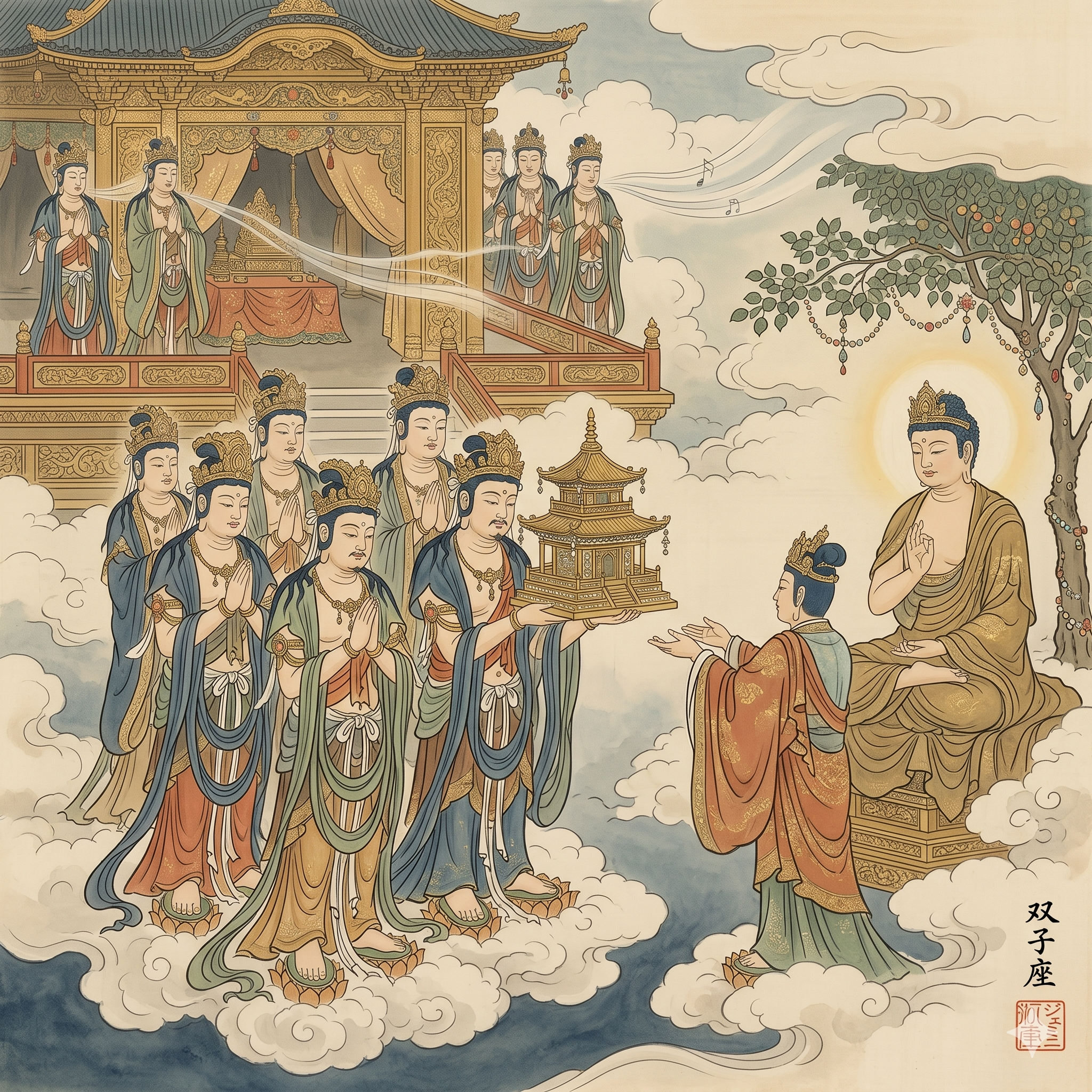
    My conceptual thinking for this illustration focused on visualizing the literal scene described in the Lotus Sutra source text—the Brahma-Heavenly-Kings making their offering. I visualized the "adorned palaces" as tangible miniature models being presented, moving the concept from an offering of possessions to a metaphorical offering of the kings' accumulated merit. I depicted the Brahma Kings as a celestial procession within a pure land setting to emphasize their high status and the result of their "previous existence" merits. The specific inclusion of wind instruments and singing figures on the balcony illustrates the literal "sing these verses" line from the text. Great-Universal-Wisdom-Excellence-Buddha is seated receiving the gift, surrounded by a compassionate light that represents the requested "compassion" from the kings and the sharing of wisdom mentioned in the interpretation. The overall composition is designed to reflect the transition from individual gain to communal benefit.

    Iconography & Character Identification
    Deities/Figures Featured: The illustration features a group of five Brahma-Heavenly-Kings in the foreground, adorned with intricate crowns and jewelry, presenting a miniature pagoda-palace as their offering. To the far right, seated under a stylized bodhi tree, is Great-Universal-Wisdom-Excellence-Buddha (recognizable as a historical Buddha figure in this context, rather than the forbidden transcendental Buddhas). On the palace balcony, other celestial attendants are visible, including figures playing a wind instrument (shō) and singing figures (implied by the sound waves emanating from them), representing the verses mentioned.

    Text Translations: The Kanji text visible in the bottom right corner is '双子座', which translates to 'Gemini'. The red seal below contains the Katakana 'ジェミニ', which is also the phonetic spelling of 'Gemini'.

    Our palaces are beautifully adorned
    Because we accumulated merits in our previous existence.
    We offer [these palaces] to you.
    Receive them out of your compassion towards us!

    The Brahma-Heavenly-Kings of the East sing these verses in Chapter Seven of the Lotus Sutra. In the story, they came to the world of Great-Universal-Wisdom-Excellence-Buddha from their worlds of beauty and pleasure when that Buddha became enlightened. Their offering shows their understanding that while they can enjoy the results of the merits they have created, these results are meant to be shared with all beings. No matter how much or how little we have, being grateful for what we have, rather than being resentful for what we lack, is an expression of the Buddha’s wisdom.

    The Daily Dharma is produced by the Lexington Nichiren Buddhist Community. To subscribe to the daily emails, visit zenzaizenzai.com
  • Daily Dharma for June 19, 2026

    20260619-ddi

    Illustration by Google Gemini

    Show Gemini's thinking

    Gemini Thinking

    Conceptual Summary
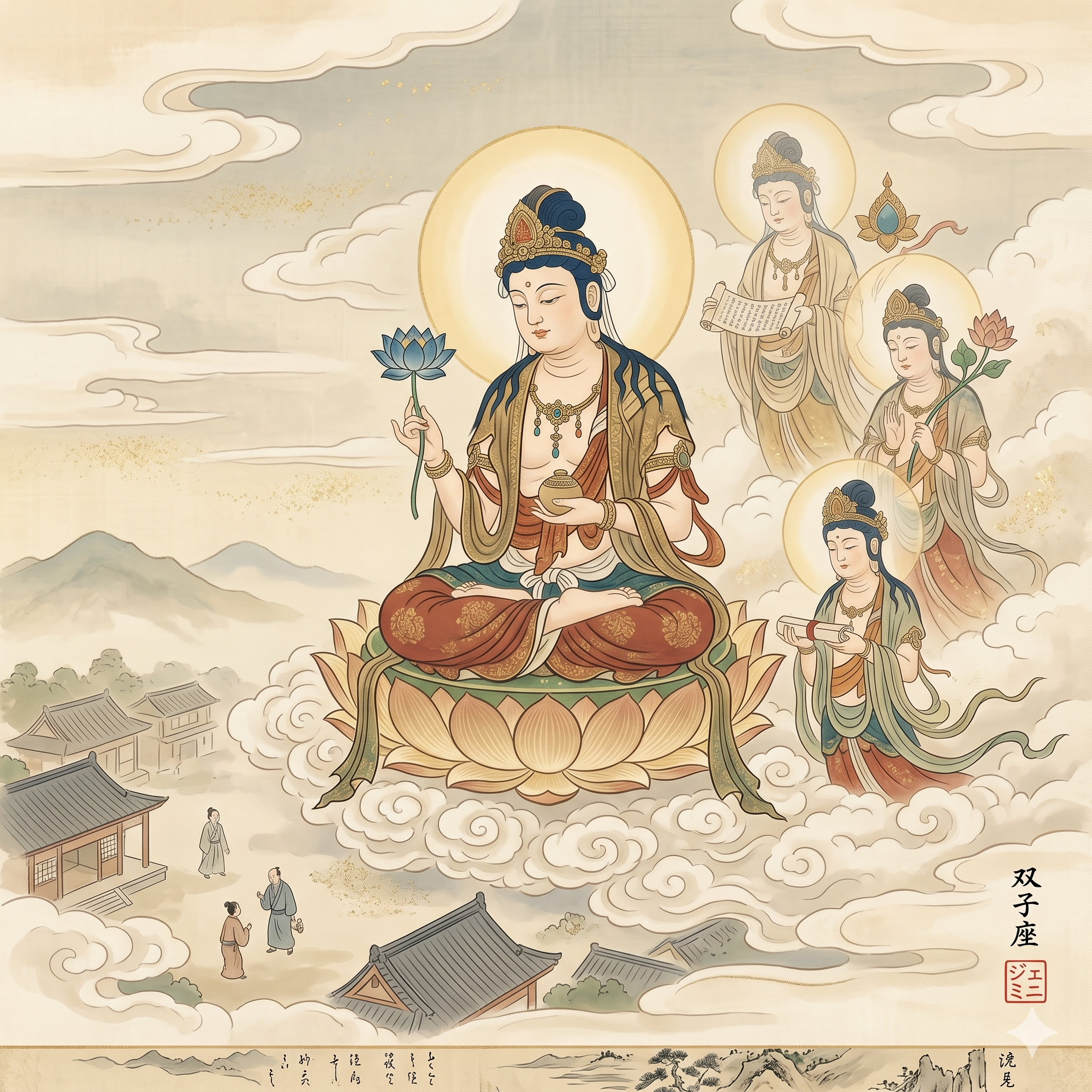
    This illustration visualizes the core concept from Chapter Ten of the Lotus Sūtra, focusing on the vow of Great Bodhisattvas who, having already attained enlightenment (Anuttara-samyak-saṃbodhi), choose rebirth within the suffering realm of the world (Saha) out of compassion (Karunā). The central figure is Yao-wang Pusa (Medicine-King Bodhisattva), representing the primary listener of this teaching. Medicine-King is portrayed as a serene Bodhisattva holding a stylized lotus and radiating calming light, embodying the 'Wonderful Dharma.' He floats above a stylized depiction of the human realm, which is illustrated using standard classical motifs: simple, tiled-roof structures, small figures of common people performing simple tasks, and swirling clouds. This contrast emphasizes the choice of the enlightened beings to enter the 'lower realm' for the benefit of others, rather than remaining in a serene, isolated Nirvana. The composition deliberately centers on Medicine-King and the human realm, adhering strictly to the exclusions list by avoiding any representation of Śākyamuni Buddha, Amida, or Dainichi, focusing instead on the action of the vow through the iconography of Medicine-King.

    Iconography & Character Identification
    Deities/Figures Featured: The central figure depicted is Yao-wang Pusa (Medicine-King Bodhisattva), identifiable by his calm demeanor, lotus attribute, and the theme of the source text.

    Text Translations: The Kanji signature visible in the bottom corner is 双子座, which translates to 'Gemini.' The text within the red seal is the katakana ジェミニ, also reading 'Gemini.'

    These men and women are great Bodhisattvas. They should be considered to have appeared in this world by their vow to expound the Sūtra of the Lotus Flower of the Wonderful Dharma out of their compassion towards all living beings, although they already attained Anuttara-samyak-saṃbodhi [in their previous existence].

    The Buddha declares these lines to Medicine-King Bodhisattva at the beginning of Chapter Ten of the Lotus Sūtra. In the teachings of Nirvāṇa, the goal is to remove suffering so that we can be reborn in a peaceful realm. In this Sūtra, the Buddha reminds us that we who keep this Sūtra have given up the privilege of higher realms so that we can benefit beings where we find ourselves now. We do not fear rebirth in lower realms since our compassion takes us even there so we can benefit beings in those realms.

    The Daily Dharma is produced by the Lexington Nichiren Buddhist Community. To subscribe to the daily emails, visit zenzaizenzai.com
  • Daily Dharma for June 18, 2026

    20260618-ddi

    Illustration by Google Gemini

    Show Gemini's thinking

    Gemini Thinking

    Conceptual Summary
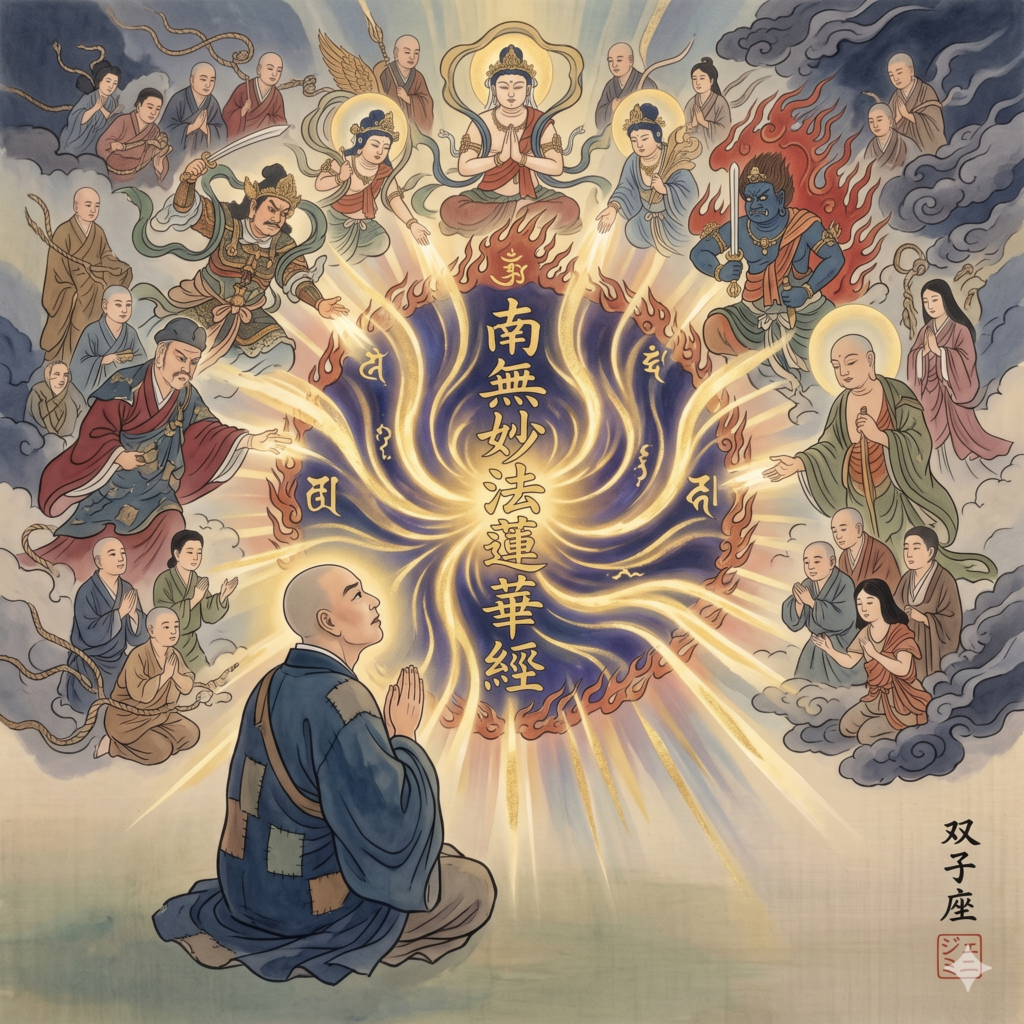
    This illustration visualizes the practical results of faith in the Gohonzon, as described by Nichiren Daishonin. It captures the dynamic interaction between the practitioner and the protective forces of the universe. The central focus is a radiating mandala symbolizing the Gohonzon, from which a vibrant 'great light' of protective power flows out to all beings. The composition visualizes both aspects of the passage: Sairen-bō's personal faith draws down the blessing of the assembly of Buddhas, visible as heavenly light, while he simultaneously radiates this light outward to protect the laypeople suffering at the base. This duality illustrates how sincere endeavors in faith (the central practitioner) awaken the innate Buddha nature, transforming the individual into a protector for others. The style is that of a classical Japanese Buddhist silk painting, utilizing mineral pigments, gold leaf, and soft colors to evoke a sense of spiritual luminescence.

    Iconography & Character Identification
    Figures Featured: The illustration depicts Sairen-bō (the central kneeling monk) in a state of reverence (gassho). The assembly above includes various traditional figures like Fudō Myōō (the wisdom king with sword and flames), several other monks and laypersons, and the serene female celestial deity Benzaiten. This representation emphasizes the inclusive protection of all Buddhas and deities. At the bottom, suffering laypeople of both genders are shown receiving light from Sairen-bō, visualizing the act of freeing others from suffering.

    Text Translations: The Kanji signature is 双子座 (Futagoza), which translates to 'Gemini'.

    Have faith in the great Mandala Gohonzon, the most superlative in the world. Endeavor! Endeavor to strengthen your faith, so that you may be blessed with the protective powers of all Buddhas.

    Nichiren wrote this as part of his letter to monk Sairen-bō in his Treatise on All Phenomena as Ultimate Reality (Shohō-Jissō Shō). One way of reading this passage is that as we develop our faith in the Omandala Gohonzon, the Buddhas will provide more protection for us. Another way to read it is that as our faith develops, so does the power we have to protect others, free them from suffering and help them to awaken their Buddha nature. Either way, Nichiren shows us the practical results of our faith.

    The Daily Dharma is produced by the Lexington Nichiren Buddhist Community. To subscribe to the daily emails, visit zenzaizenzai.com
  • Daily Dharma for June 17, 2026

    20260617-ddi

    Illustration by Google Gemini

    Show Gemini's thinking

    Gemini Thinking

    Conceptual Summary
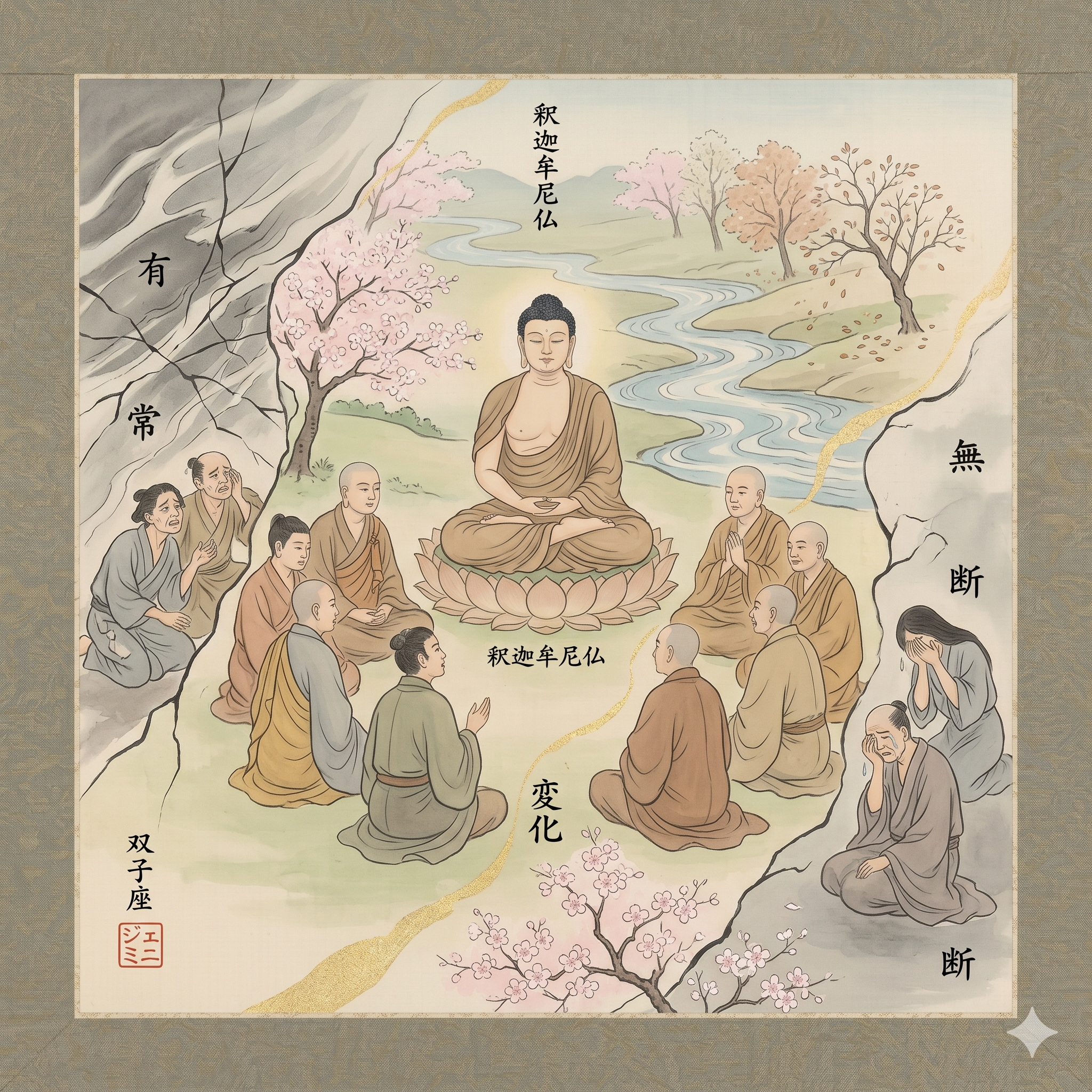
    The illustration interprets Chapter 14 of the Lotus Sūtra by contrasting extreme philosophical views with the peaceful path of change and enlightenment. Śākyamuni Buddha is positioned centrally in a harmonious garden, demonstrating the "middle way" through his balanced presence and natural surroundings. On the left and right sides of the composition, specific groups of people represent those who hold "perverted" or extreme views (such as eternalism and nihilism). These individuals appear distressed or confused by their attachment to unchanging concepts (stability vs. despair). The river and flora flowing through the garden symbolize constant transformation (変化), showing that recognizing and valuing impermanence is the very basis for spiritual growth, leading to potential enlightenment as depicted near the serene monks.

    Iconography & Character Identification
    Deities/Figures Featured:

    Śākyamuni Buddha (釈迦牟尼仏 - Shakyamuni Butsu): The central figure on the lotus throne, surrounded by listeners.

    Confused figures representing attachment to views.

    Bodhisattvas/Monks: Attentive listeners.

    Text Translations:

    釈迦牟尼仏: Shakyamuni Buddha

    有: Existence (Being)

    無: Non-existence (Void)

    常: Permanence (Eternalism)

    断: Annihilation (Nihilism)

    変化: Transformation (Change)

    双子座: Gemini (Kanji Signature)

    Only perverted people say:
    “All things exist,” or “Nothing exists,”
    Or “All things are real,” or “Nothing is real,”
    Or “All things are born,” or “Nothing is born.”

    The Buddha declares these verses in Chapter Fourteen of the Lotus Sūtra in which he describes the peaceful practices of a Bodhisattva. Hearing these descriptions can be confusing. We think that we have to choose from among these views, and that these are the only views possible. The Buddha shows us another way. When we think of things as either unchanging or nonexistent, we live in a world of either judgement or despair. The Buddha shows us how to value what exists as it is changing and not attach ourselves to our expectations of stability. It is only because we are changing, and the world is changing around us, that we have the potential to become enlightened.

    The Daily Dharma is produced by the Lexington Nichiren Buddhist Community. To subscribe to the daily emails, visit zenzaizenzai.com
  • Daily Dharma for June 16, 2026

    20260616-ddi

    Illustration by Google Gemini

    Show Gemini's thinking

    Gemini Thinking

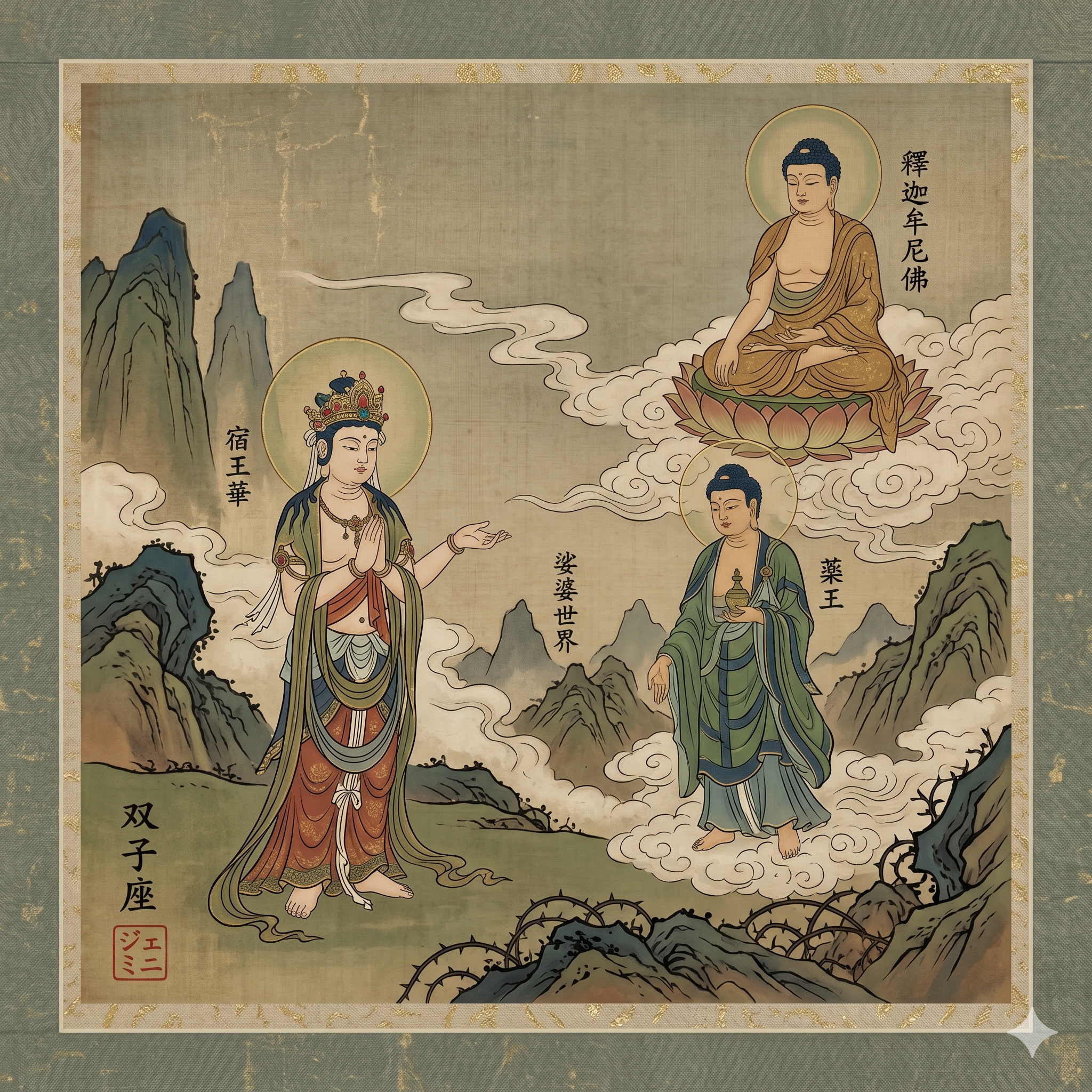
    This 1:1 composition visualizes the narrative tension in Chapter Twenty-Three of the Lotus Sutra. We conceptualized Star-King-Flower Bodhisattva (identified on the left) addressing the Buddha (top right), inquiring about the arduous path of Medicine-King Bodhisattva. The thorny, rough foreground of the Sahā-World directly interprets the 'hundreds of thousands of billions of nayutas of austerities' mentioned in the text. We placed Medicine-King Bodhisattva (identified on the lower right) on a separate cloud path, visually separate from the Buddha’s serene dwelling, illustrating his descent from the higher realms. The overall traditional style and composition reinforce the visual translation of this sacred dialogue.

    Iconography & Character Identification
    Deities/Figures Featured:

    宿王華 (Star-King-Flower): The Bodhisattva addressing the Buddha, distinguished by his elaborate crown and red dhoti.

    釋迦牟尼佛 (Shakyamuni Buddha): The 'World-Honored One' in the posture of meditation (Dhyana Mudra) on a lotus throne. He is depicted in traditional form.

    薬王 (Medicine-King): The Bodhisattva of focus, depicted in blue-green robes, descending toward the Sahā-World and holding a small medicine jar or sutra casket.

    娑婆世界 (Sahā-World): This refers to the rocky, thorny landscape in the lower section, visualizing the world of conflict and endurance.

    Text Translations:

    双子座 (Signature): 'Gemini' (lit. 'Twin Stars Constellation').

    Seal Katakana (Hanko): 'ジェミニ' ('Gemini').

    Thereupon Star-King-Flower Bodhisattva said to the Buddha: “World-Honored One! Why does Medicine-King Bodhisattva walk about this Sahā-World? World-Honored One! This Medicine-King Bodhisattva will have to practice hundreds of thousands of billions of nayutas of austerities in this world.

    This excerpt is from Chapter Twenty-Three of the Lotus Sutra. Star-King-Flower Bodhisattva is aware of the difficulties that Medicine-King or any other Bodhisattva will encounter while living in this world of conflict (Sahā) and asks the Buddha why this Bodhisattva would give up the pleasures of the higher realms to which he is entitled. The Buddha then tells the story of Medicine-King’s previous life, in which he gave up many attachments, including the attachment to his own body. These stories of Bodhisattvas are reminders of our own capacities, and that no matter what difficulties we face in our lives, our determination to benefit all beings, our certainty of enlightenment, and the help we receive from other beings will lead us to overcome any problems.

    The Daily Dharma is produced by the Lexington Nichiren Buddhist Community. To subscribe to the daily emails, visit zenzaizenzai.com
  • Daily Dharma for June 15, 2026

    20260615-ddi

    Illustration by Google Gemini

    Show Gemini's thinking

    Gemini Thinking

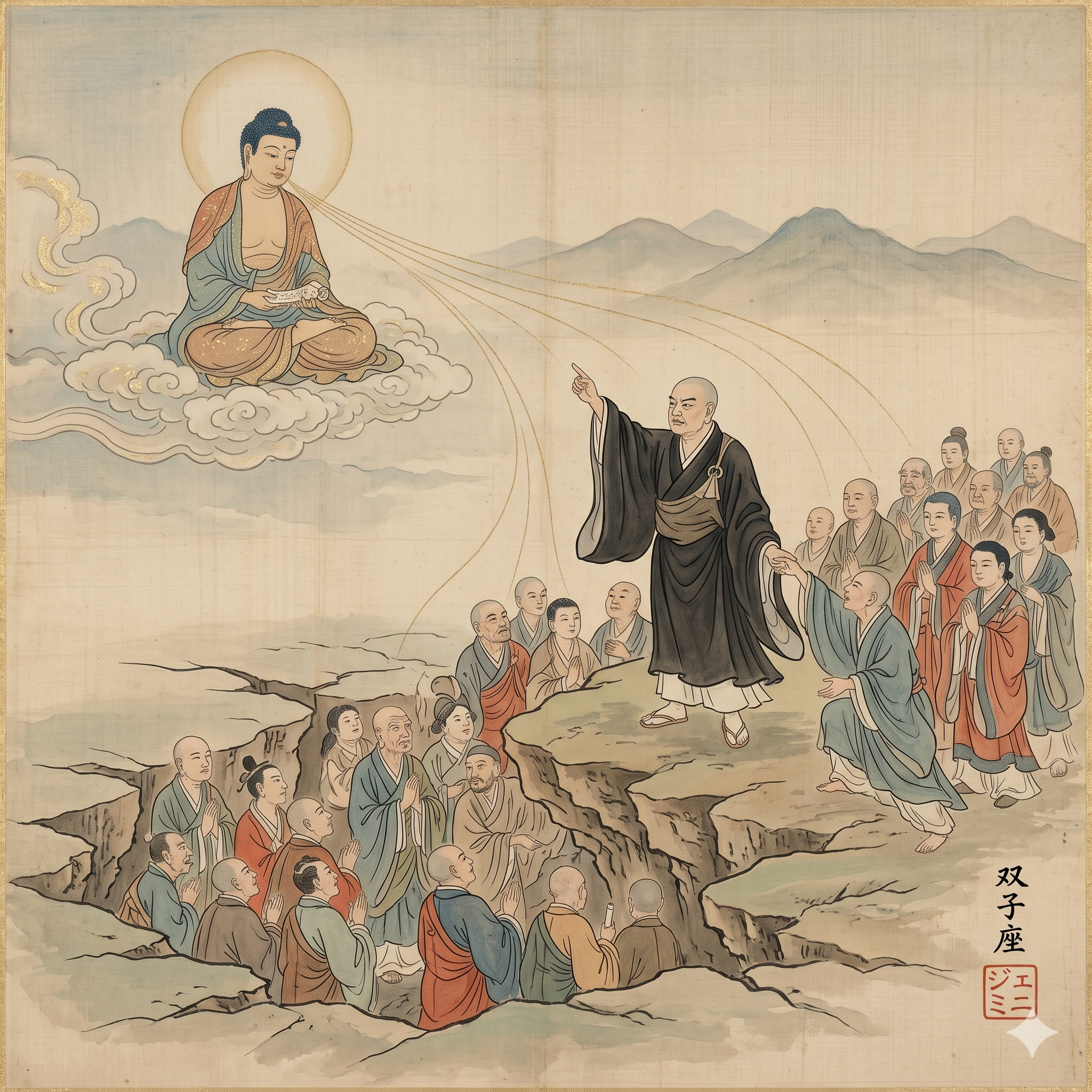
    his illustration visualizes Nichiren’s self-identification as the forerunner of the 'Bodhisattvas of the Earth' and his assertion that his disciples are fellow messengers of the Buddha. In the composition, I have depicted Nichiren Daishōnin rising from the fissured ground—symbolizing the 'emerging from the earth' from Chapter Fifteen of the Lotus Sūtra—and extending a hand backward. This gesture signifies him as a 'forerunner' leading a multitude of diverse followers who are also emerging from the same cracked earth, visually validating his argument that his disciples share this profound identity. In the upper register, Śākyamuni Buddha is seated upon a cloud and is actively expounding a secret phrase of the Lotus Sūtra, directly linking the scene to the 'Teacher of the Dharma' chapter quoted in the text: "If someone expounds even a phrase of the Lotus Sūtra even to one person in secret... such a person is my messenger." The surrounding gold leaf and mineral blue pigment mountains emphasize the ultimate reality referenced in the treatise and the sacred nature of this moment.

    Iconography & Character Identification
    Deities/Figures Featured: Śākyamuni Buddha (atop the clouds), Nichiren Daishōnin (the monastic figure in the foreground leading the ascent), and a multitude of diverse figures representing the Bodhisattvas of the Earth.

    Text Translations:

    双子座: Gemini (Found as the artist's signature).

    I, Nichiren, am the lone forerunner of the bodhisattvas who emerged from the earth. I may even be one of them. If I am counted as one of the bodhisattvas who emerged from the earth, my disciples and followers too are among the ranks of those bodhisattvas from the earth, are they not? The “Teacher of the Dharma” chapter states, “If someone expounds even a phrase of the Lotus Sūtra even to one person in secret, then you should know that such a person is my messenger, dispatched by Me and carries out My work.” This refers to none other than us.

    Nichiren wrote this passage as part of his Treatise on All Phenomena as Ultimate Reality (Shohō Jissō-Shō), sent to the monk Sairen-Bō. He refers to Chapters Ten and Fifteen of the Lotus Sūtra. This passage reminds us of our position as followers of Nichiren, and fellow messengers of Śākyamuni Buddha.

    The Daily Dharma is produced by the Lexington Nichiren Buddhist Community. To subscribe to the daily emails, visit zenzaizenzai.com

  • Daily Dharma for June 14, 2026

    20260614-ddi

    Illustration by Google Gemini

    Show Gemini's thinking

    Gemini Thinking

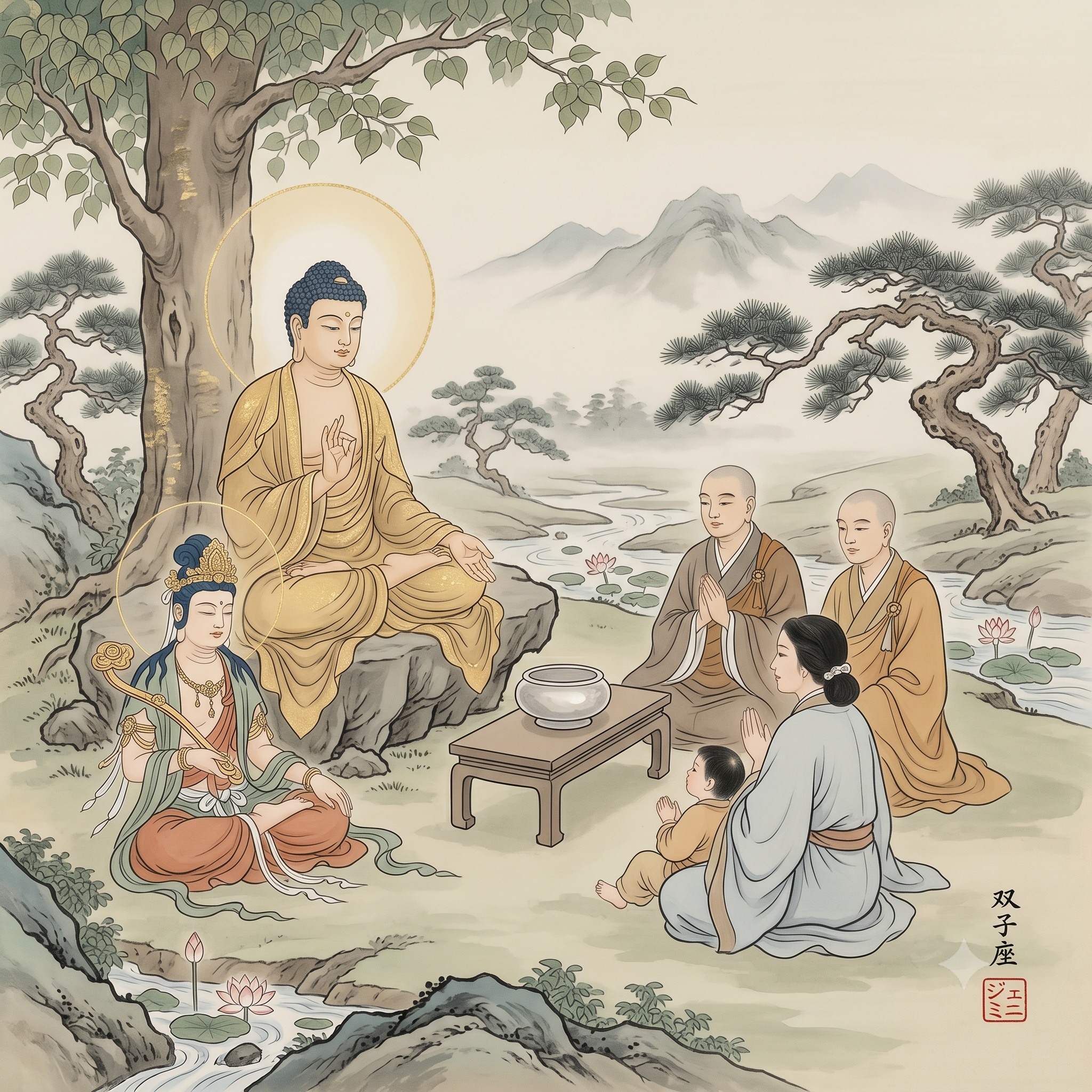
    This illustration conceptualizes the monumental proclamation from Chapter Sixteen of the Lotus Sutra, where Śākyamuni Buddha reveals his eternal, ever-present cosmic nature. The composition utilizes a 1:1 square format to contrast the vastness of the cosmos with an intimate, devout earthly assembly. Set against a serene landscape of rolling hills, ancient pines, and a winding stream, Śākyamuni Buddha (Shaka Nyorai) sits majestically on an elevated rock throne beneath a stylized Bodhi tree, his timeless presence emphasized by a soft, radiant circular gold halo. Gathered reverently before him on the ground is a diverse group of seekers representing "gods, men, and asuras": two bald Buddhist Monks in simple robes, a devout laywoman with her hair neatly pinned, a young child, and a richly adorned celestial Bodhisattva holding a golden scepter. Emerging gently from the upper right and cascading across the deep-space sky are countless glowing, smaller Emanation Buddhas (分身仏, Funshinbutsu), visualizing the innumerable eons and endless forms through which he has guided sentient beings toward enlightenment.

    Kanji Translations
    双子座 (Futago-za): "Gemini" (The artist's brush signature)
    ジェミニ (Jemini): "Gemini" (The katakana text carved within the red square hanko seal)

    When they come to him
    With good intent
    In order to hear
    About the enlightenment of the Buddha,
    He should expound the Dharma to them
    Without fear,
    But should not wish to receive
    Anything from them.

    The Buddha makes this explanation to Mañjuśrī Bodhisattva in Chapter Fourteen of the Lotus Sūtra in which he describes the peaceful practices of a Bodhisattva. In our zeal to practice this Wonderful Dharma we may come to expect that because this is such a wonderful teaching, we deserve to be rewarded for providing it to others. With this expectation, we then lose our focus on using the Dharma to benefit others and instead use it to benefit ourselves. When we show how to give freely, without expectations, we embody generosity, the same generosity the Buddha himself demonstrated when he provided the teaching to us.

    The Daily Dharma is produced by the Lexington Nichiren Buddhist Community. To subscribe to the daily emails, visit zenzaizenzai.com