
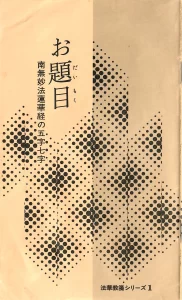
This is Gemini’s translation of a 1985 pamphlet entitled, O-Daimoku: The Five and Seven Characters of Namu Myoho Renge Kyo. I found this pamphlet in a storage room at the Sacramento Nichiren Buddhist Church. The fact that a brochure seeking to teach the proper way to chant is written totally in Japanese, says a great deal about the focus of propagation efforts in the mid-1980s. This was not intended for non-Japanese, which is unfortunate.
Lotus Sutra Booklet Series 1
1. How Should One Recite the Daimoku?
Gassho and Bowing (Gassho-Raihai)
At a temple, sit upright with a straight back in front of the Three Treasures (the Buddha, the Dharma, and the Sangha); at home, do so before the Buddhist altar (Butsudan), and join both hands together in reverence (Gassho). Next, lean your body forward, rest both elbows on the floor, raise both palms up to the level of your ears, and respectfully lower your head as if receiving the Buddha’s feet with your hands. After completing the bow, return to the upright sitting position, join your hands again in Gassho, and quietly calm your mind.
Chanting the Daimoku (Ro-ro Shodai)
Chant the Daimoku with deep sincerity, at a slow pace, and in a clear, resonant voice. Repeat the phrase: Namu—Myo—Ho—Ren—Ge—Kyo. Please chant for at least ten minutes.
Proper Mindset and Demeanor During Chanting
Chanting rapidly, shouting, looking around, or swaying your body are not correct ways to chant. It is essential to hold both hands firmly together, drape the prayer beads (Juzu) over your left hand, bring them near your chest in Gassho, and—while fixing your eyes upon the Sacred Object of Worship (Gohonzon) and the Three Treasures—chant slowly with single-minded devotion and a sincere heart.
By doing so, your mind will naturally settle, feel refreshed, and find peace. Chant with your voice, chant with your body, pray for healing from illness and for healthy, bright daily living, wish for everyone to live happily, and pledge in your heart to live according to the Buddha’s teachings while chanting the Daimoku.
When finishing the chanting session, recite the final three Daimoku even more slowly. After completing the chanting, perform Gassho and bow once more in the same manner as described above.
2. What Is the O-Daimoku?
The O-Daimoku refers to the title of the Lotus Sutra (Myoho Renge Kyo). Namu Myoho Renge Kyo is the O-Daimoku.
The Daimoku is not merely the name of a scripture. It is the core essence of all the sutras taught by Shakyamuni Buddha. It is the supreme, highest teaching that expresses the true heart and soul of the Lotus Sutra, which reveals true salvation.
Imbued within the Daimoku are the boundless wisdom and compassionate heart of Shakyamuni Buddha, who saves and guides all living beings. Shakyamuni Buddha and all other Buddhas attained Buddhahood precisely by chanting this Daimoku.
Therefore, Shakyamuni Buddha gathered all the virtues accumulated through long periods of ascetic practice, as well as his ultimate vow to save and guide all beings as a Buddha, into a supreme medicine—the Daimoku. He entrusted this medicine to Bodhisattva Superior Practices (Jogyo Bosatsu) and other emissaries, to bestow it upon us who suffer from illnesses of body and mind, thereby eliminating our suffering and endowing us with a Buddha’s heart of compassion. The Daimoku is the precious jewel of the heart, crystallizing the Buddha’s merit and soul of salvation.
3. Why Do We Chant the Daimoku?
By chanting the Daimoku without sparing our voices, believing in the teachings of the Lotus Sutra, engraving them upon our hearts, and embodying them in our daily lives, we can attain equality with the Buddha in our present physical forms. This is because chanting purifies us from all defilements of earthly desires (Kleshas) and enables us to possess the same wisdom and compassionate heart as the Buddha.
We recite Namu Myoho Renge Kyo with a pledge and a prayer to sincerely believe in the Lotus Sutra—the true teaching spoken by Shakyamuni Buddha—and to live with the Lotus Sutra as our spiritual foundation. This practice is called Shodai (chanting the Daimoku).
When we chant the Daimoku, all the merits and enlightened wisdom accumulated by Shakyamuni Buddha inherent in the Daimoku are directly conferred upon us. Through chanting, the Buddha-nature within our own hearts is awakened; we become one with the mind of the Buddha and can live peacefully, sustained by the Buddha’s life force.
Furthermore, those who chant the Daimoku are constantly protected by all Buddhas.
4. How Does the Daimoku Differ from the Buddha?
The Daimoku is the parent who gave birth to the Buddha; the Buddha is the child born from the Daimoku.
Generally, since Shakyamuni Buddha taught the Lotus Sutra, people assume that the Daimoku was created and presented by the Buddha. In one sense, that is correct. However, it is through the revelation of the Lotus Sutra that the true teaching of the Buddha becomes known. Moreover, Shakyamuni Buddha and all other Buddhas attained Buddhahood precisely by believing in the Lotus Sutra. The Lotus Sutra is the parent of Shakyamuni Buddha and the progenitor of all Buddhas. All Buddhas were born with the Lotus Sutra as their seed, practiced diligently, and attained Buddhahood.
Therefore, Shakyamuni Buddha urges us: “Believe in the Lotus Sutra as I have, chant the Daimoku with your whole life, and attain Buddhahood.”
5. How Does Namu Myoho Renge Kyo Differ from Namu Amida Butsu?
The Daimoku is the seed for attaining Buddhahood conferred by our spiritual parent, Shakyamuni Buddha. Praying to Amida Buddha, who has no karmic connection to this world, will not bring salvation.
In this world where we live, Shakyamuni Buddha is the sole teacher who was born as a human being, realized the enlightenment of the Lotus Sutra to become a Buddha, and became our benefactor, teacher, and parent. He alone guides us to chant the Daimoku and become Buddhas.
The Daimoku, which Shakyamuni Buddha believed in and realized, is the most supreme soul of salvation and the ultimate seed of Buddhahood. In contrast, Amida Buddha has no karmic connection with us in this earthly realm. For us, as children of Shakyamuni Buddha, to fail to revere our parent and fail to chant the Daimoku through which our parent became a Buddha would be an unfilial act that forgets the parent’s benevolence.
6. Why Must It Be the Daimoku of Nichiren Shu?
Only Nichiren Shu adopts the heart of Shakyamuni Buddha and the Lotus Sutra as its own, chanting the Daimoku strictly in accordance with the teachings of Nichiren Shonin. Let us chant the Daimoku of Nichiren Shu to purify our hearts and build a life filled with happiness and peace.
The Daimoku itself possesses the same merit regardless of who chants it. Just as looking at a dried plum makes one’s mouth water, or a baby drinks milk without knowing its chemical composition, it is vital to receive the heart of the Daimoku with single-minded simplicity.
However, this does not mean one may chant the Daimoku self-indulgently, nor does it mean one may disregard Shakyamuni Buddha who bestowed the Daimoku, the salvation of the Lotus Sutra, or Nichiren Shonin who transmitted the Daimoku.
Because the Daimoku reveals the heart of Shakyamuni Buddha and embodies his saving grace, chanting it apart from Shakyamuni’s vow of salvation or in opposition to the Lotus Sutra will yield no merit; rather, it leads to the sufferings of hell. Furthermore, the Daimoku was transmitted by Bodhisattva Superior Practices (Jogyo Bosatsu), the Buddha’s emissary, to save people living in the present age. True chanting means following Nichiren Shonin—who stood in the awareness of Bodhisattva Superior Practices, urged people to chant, and strived to save society and humanity—to plant the seed of Buddhahood in our hearts.
Chanting merely to satisfy selfish desires or following the words of a specific group’s founder is not the correct way to chant:
- Soka Gakkai: The Daimoku chanted by Soka Gakkai misguides reverence toward Nichiren Shonin while defaming Shakyamuni Buddha as an empty husk. It is chanted not to plant the seed of Buddhahood, but to satisfy personal desire. This discards and abandons the spirit of Shakyamuni Buddha inherent in the Daimoku, making it an erroneous way of chanting.
- Other New Religious Movements: Some new religious groups chanting the Daimoku may nominally respect Shakyamuni Buddha, but by setting up their own founders as the Great Leader, they close off the path of following Nichiren Shonin—the true Great Leader. They chant while ignoring Nichiren Shonin’s way of life, which aimed to spread the Lotus Sutra, save all beings, and establish peace and happiness. This, too, is an incorrect way of chanting.
Such practices are like abandoning a monkey to search for its liver, or mistaking the reflection of the moon in a pond for the real moon. Even if one chants with their mouth, the merit of the Daimoku will not be engraved upon their body and mind, causing them to lose the vow and purpose of reviving Buddha-nature and attaining Buddhahood.
The Daimoku of Nichiren Shu is the correct Daimoku chanted with single-minded faith in the Lotus Sutra, which reveals Shakyamuni Buddha’s compassionate heart and true salvation. Let us follow the life of Nichiren Shonin—who urged us to chant with voice, mind, and body so that all may enter the Buddha Way toward true happiness and peace—and chant the Daimoku with an open and sincere heart.
7. What Are the Meanings and Merits of the Characters of Namu Myoho Renge Kyo?
Character Literal Meaning Spiritual Significance & Merit 南無 (Namu) Venerate / Devote life (Kimyo) Expressed whenever paying respect to the Buddha. It signifies devoting one’s life to the Buddha (Kimyo), expressing a vow and prayer to believe in and practice the Buddha’s teachings with one’s whole life. It represents a heart of reverence and joyful compliance. 妙 (Myo) Mystic / Wonderful / Reviving Contains all the merits accumulated by the Buddha. Refers to profound truth beyond words. It unlocks the inherent Buddha-nature within our hearts. It possesses the power of Sosei (revival/resurrection)—awakening those who lost their purpose to live rightly. It turns the poison of afflictions into the medicine of enlightenment (changing poison into medicine). 法 (Ho) Law / True Teaching Refers to the true, correct teaching of Shakyamuni Buddha, the savior of this world. Only the Lotus Sutra reveals eternal life with boundless wisdom and compassion to guide all beings to the Buddha world. It is called the “Eye of All Buddhas,” “True Words of the Buddha,” and “Classic of Filial Piety of Buddhism.” 蓮華 (Renge) Lotus Flower Metaphor for the Mystic Law with three meanings:
- Simultaneity of Cause and Effect: Flower and fruit appear together; believing instantly leads to attaining Buddhahood.
- Longevity / Eternal Life: Lotus seeds endure for centuries; symbolizes Shakyamuni’s eternal life and opening the flower of Buddha-nature in all beings.
- Purity in the Mud: Blooms pure flowers from muddy water; symbolizes living pure, noble lives amidst the defiled Latter Day of the Law (Mappo) without fleeing worldly suffering.
経 (Kyo) Sutra / King of Teachings Signifies the supreme king of all sutras. All other sutra teachings flow into the Lotus Sutra like rivers into the ocean. Just as the sun is supreme among stars, this sutra illuminates the dark world and human hearts. Chanting it brings unfathomable merit. The Daimoku—Namu Myoho Renge Kyo—is the essence of the entire Lotus Sutra and stands at the summit of all Buddhist scriptures. It is both the essential core of the Dharma and the glowing jewel of compassion within the Lotus Sutra. Chanting it plants the seed of Buddhahood in human hearts that have strayed into delusion, polishing the mind to shine brilliantly like a precious jewel.
Even if one’s practice is shallow or one cannot comprehend complex scriptural meanings, the merit of the Daimoku is deep. Chanting single-mindedly with a pure heart is the foundation of faith. This practice is known as Shodai Shugyo (the practice of chanting the Daimoku).
Author: Kyojo Ishikawa
Edited & Published by: Nichiren Shu Shimbunsha
3-16-9 Ikegami, Ota-ku, Tokyo 146 (Nichiren Shu Administrative Headquarters Second Building)
Publication Date: Revised Edition, 3rd Printing — March 21, 1985 (Showa 60)
Printer: Kyodo Printing Co., Ltd.
© Nichiren Shu Shimbunsha
Tomorrow: Considering Why Must It Be the Daimoku of Nichiren Shu?