
Buddhism is a philosophical religion, and its core is the concept of the Buddha. Profound studies and observations of the Buddha have been conducted from many different perspectives. For instance, the teaching of Mahayana (the Great Vehicle) unfolds its dominant idea that the Buddha is the eternal, infinite truth itself, because he attained that truth, participates in it, and totally identifies himself with it. The Buddha, when regarded this way, is called the Dharma-body, Law-body, or Truth-body. Although the Buddha as Truth gives us some idea of the profundity of his existence (all existence, for that matter), this particular concept of the Buddha may seem somewhat distant from the world of our experience. Such a truth can be understood (as Chapter Two states) only by another Buddha. It is not easy for us ordinary people to awaken to transcendent reality. The Buddha as Truth is too abstract for ordinary people to grasp. We need a more concrete identity of the Buddha in order to feel his existence.
Introduction to the Lotus SutraAuthor: John Hughes
-
‘A Wonderful Dispensation of Nature’
“Ho” generally means a “rule” or “precept” today. Originally, “Ho” came from the Sanskrit word “Dharma,” which means “holding” and “law”, but when used in a Buddhist context it has a unique meaning. It means “a wonderful dispensation of nature” and “permanent truths” or “Universal Law,” and also means the Buddha’s teaching. This is because of the Buddha’s enlightenment 2,500 years ago. His achievement was to fully understand the “Universal Law.” So, “Ho” or “Dharma” means both “Universal Law” and the Buddha’s teachings. The essence of the “Universal Law” is expounded by the Buddha in the Lotus Sutra.
Spring Writings
-
Daily Dharma – Feb. 27, 2018
I attained perfect enlightenment and now save all living beings because Devadatta was my teacher.
The Buddha makes this declaration in Chapter Twelve of the Lotus Sūtra. Devadatta was a cousin of the Buddha who became jealous of the Buddha’s enlightenment. Several times he tried to kill the Buddha. He also caused a split in the Buddha’s Sangha, and convinced a young prince to kill his father and usurp the throne. Devadatta was so evil that he fell into Hell alive. Despite all this, the Buddha credits Devadatta with helping him become enlightened, and assures Devadatta personally that he will become enlightened. This shows us that even those beings who create great harm have Buddha nature. They may not deserve our admiration, but they at least deserve our respect.
The Daily Dharma is produced by the Lexington Nichiren Buddhist Community. To subscribe to the daily emails, visit zenzaizenzai.com
-
Day 1
Day 1 covers the first half of Chapter 1, Introductory
Having last month completed the introduction of the crowd, the World-Honored One expounds a sūtra of the Great Vehicle called the “innumerable Teachings, the Dharma for Bodhisattvas, the Dharma Upheld by the Buddhas.”
Thereupon the four kinds of devotees, who were surrounding the World-Honored One, made offerings to him, respected him, honored him, and praised him. The World-Honored One expounded a sūtra of the Great Vehicle called the “innumerable Teachings, the Dharma for Bodhisattvas, the Dharma Upheld by the Buddhas.” Having expounded this sūtra, the Buddha sat cross-legged [facing the east], and entered into the samadhi for the purport of the innumerable teachings. His body and mind became motionless.
Thereupon the gods rained mandārava-flowers, mahā-mandārava-flowers, mañjūṣaka-flowers, and mahā-mañjūṣaka-flowers upon the Buddha and the great multitude. The world of the Buddha quaked in the six ways. The great multitude of the congregation, which included bhikṣus, bhikṣunīs, upāsakās, upāsikās, gods, dragons, yakṣas, gandharvas, asuras, garuḍas, kiṃnaras, mahoragas, men, nonhuman beings, the kings of small countries, and the wheel-turning-holy-kings, were astonished. They rejoiced, joined their hands together [towards the Buddha], and looked up at him with one mind.
-
Three Locations of the Teaching
The Lotus Sutra consists of twenty-eight chapters. At the beginning, the Buddha taught from Mount Sacred Eagle (Grdhrakuta, “Vulture Peak,” in Sanskrit) near the city of Rajagriha, India, which today is called Rajgir. In Chapter Eleven, “Beholding the Stupa of Treasures,” he ascended to the sky and remained there until returning to Mt. Sacred Eagle in Chapter Twenty-three, “The Previous Life of Medicine-King Bodhisattva.” Thus he held three assemblies, which are called the First Assembly on Mt. Sacred Eagle; the Assembly in the Sky; and the Second Assembly on Mt. Sacred Eagle. We can divide the chapters of the sutra into three parts according to these three locations.
Introduction to the Lotus Sutra
-
The Teachings of Nirvana
In the Parable of the Magic City, the Buddha continues with his message explaining that all he had taught before the Lotus Sutra was only designed to get folks to the place where they would be able to understand and follow the Lotus Sutra. Because the Lotus Sutra is being taught the other teachings are not invaluable, nor are they to be discarded.
The teachings of Nirvana are not the final objective of Buddhist practice; it can be compared to the magic city the guide conjured in the Parable of the Magic City. If the Buddha had not taught Nirvana and instead opened his teaching career with the Lotus Sutra then people would have thought it was impossible and not have made the effort. The Buddha knew the road to the enlightenment equal to all Buddhas is a long and difficult path and he knew that the people of his time, his disciples, would not be able to complete the journey if he had started with that as the objective. As it is, even in their own lifetime his disciples could not attain enlightenment, they are only able to attain this after several lifetimes and only in places other than this Saha World.
Lecture on the Lotus Sutra
-
Daily Dharma – Feb. 26, 2018
Suppose you are sentenced to death,
And the sword is drawn to behead you.
If you think of the power of World-Voice-Perceiver,
The sword will suddenly break asunder.The Buddha gives this description of World-Voice-Perceiver Bodhisattva (Kannon, Kanzeon, Kuan Yin, Avalokitesvara) to Endless-Intent Bodhisattva in Chapter Twenty-Five of the Lotus Sūtra. World-Voice-Perceiver is the embodiment of compassion. When we think of this Bodhisattva, and the power that she holds in this world, we realize what we can accomplish through compassion. When we can be present for the suffering that exists in other beings, and see them without judgement for the flawed creatures that they are, then we allow them to make that same connection with us. The power of compassion is that it inspires others to face what lies at the core of their being: the wish that all beings be peaceful and free from suffering. To break the sword of violence in this world, we must first break it within ourselves.
The Daily Dharma is produced by the Lexington Nichiren Buddhist Community. To subscribe to the daily emails, visit zenzaizenzai.com
-
Is this recording? Check Check Test
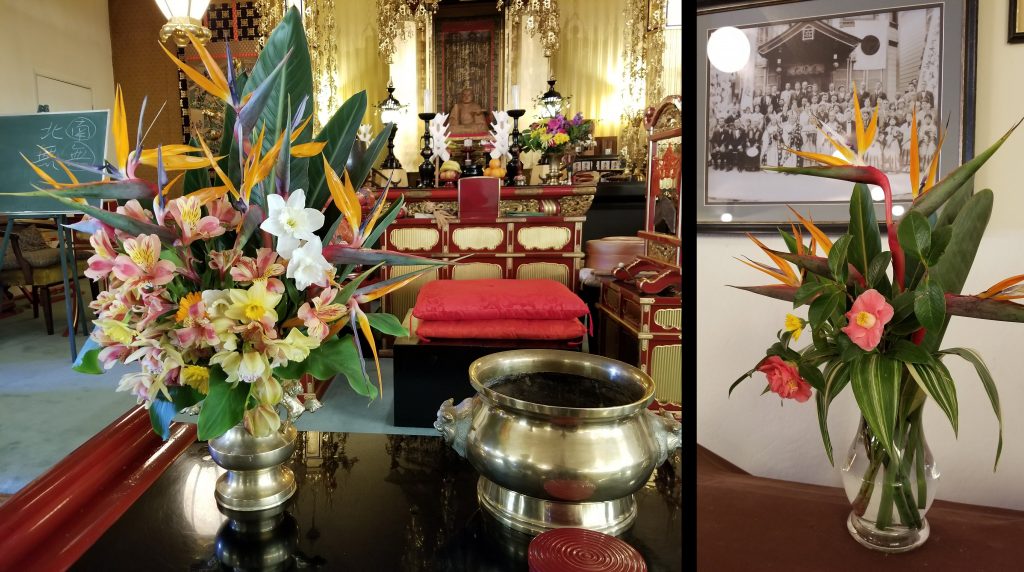
Ven. Kenjo Igarashi’s wife, Mihoko, is a master of Japanese flower arranging. I asked Rev. Igarashi if his wife offered Ikebana classes and he laughed. No such luck.
I have permission from Ven. Kenjo Igarashi to record services as long as I don’t publish the actual recording. I use the recordings to capture Rev. Igarashi’s gosho lectures and then summarize them here.Before today’s service commemorating Nichiren’s birthday, which was followed by a Kaji Kito purification ceremony, I placed my voice recorder on the lectern. I returned to my seat, got distracted while greeting my friends, enjoyed Rev. Igarashi’s talk and, after chatting with friends after the service, got in my car to leave.
As I started the car Rev. Igarashi walked up and handed me the voice recorder. “This wasn’t on,” he said as he gave me the recorder.
Oh, well. Rev. Igarashi promises a gosho on Namu Myoho Renge Kyo next time. Here’s hoping I have better luck.
On the topic of Odaimoku, I’ve added brochure from The Nichiren Buddhist International Center to the Sacramento Nichiren Buddhist Church’s website. I now have 10 brochures available there.
-
Day 32
Day 32 covers Chapter 28, The Encouragement of Universal-Sage Bodhisattva, closing the Eighth Volume of the Sutra of the Lotus Flower of the Wonderful Dharma.
Having last month learned how the good men or women who live after Śākyamuni’s extinction will be able to obtain this Sūtra of the Lotus Flower of the Wonderful Dharma, we hear Universal-Sage’s vow to protect anyone keeps this sūtra.
Thereupon Universal-Sage Bodhisattva said to the Buddha:
“World-Honored One! If anyone keeps this sūtra in the defiled world in the later five hundred years after [your extinction], I will protect him so that he may be free from any trouble, that he may be peaceful, and that no one may take advantage [of his weak points]. Mara, his sons, his daughters, his subjects, his attendants, yakṣas, rākṣasas, kumbhāṇḍas, piśācakas, kṛtyas, pūtanas, vetādas or other living beings who trouble men shall not take advantage [of his weak points]. If anyone keeps, reads and recites this sūtra while he walks or stands, I will mount a kingly white elephant with six tusks, go to him together with great Bodhisattvas, show myself to rum, make offerings to him, protect him, and comfort him, because I wish to make offerings to the Sūtra of the Lotus Flower of the Wonderful Dharma. If he sits and thinks over this sūtra, I also -will mount a kingly white elephant and appear before him. If he forgets a phrase or a gāthā of the Sūtra of the Lotus Flower of the Wonderful Dharma, I will remind him of it, and read and recite it with him so that he may be able to understand it. Anyone who keeps, reads and recites the Sūtra of the Lotus Flower of the Wonderful Dharma [after your extinction], will be able to see me with such joy that he will make more efforts. Because he sees me, he will be able to obtain samadhis and a set of dhārāṇis. The set of dhārāṇis will be the dhārāṇis by which he can memorize repetitions of teachings, the dhārāṇis by which he can memorize hundreds of thousands of billions of repetitions of teachings, and the dhārāṇis by which he can understand the expediency of the voice of the Dharma.
-
Striving to Live a Better Life
We have desires as long as we live. Even if we satisfy one desire, another immediately arises to succeed it. As a result, we are always unsatisfied and even frustrated. Besides, to satisfy any desire we must make an effort; we cannot get anything by remaining idle. Thus, whether we act or just sit and dream, we are always unsatisfied. Although there are physical sufferings, such as illness or poverty, suffering in essence may be psychological. (What matters is not the problems of life but how we react to them.) We suffer dissatisfaction as long as we are seeking fulfillment in life. Even striving in the pursuit of happiness means we have not yet achieved the happiness we desire. For this reason, “All existence is suffering” is not a pessimistic view of life. Rather, it can be the reverse image of a positive view—striving to live a better life.
Introduction to the Lotus Sutra
