To Nichiren Shonin, the essence of the Buddha’s true will was distilled in a scripture called the Lotus Sutra, which recorded his most important teaching. More specifically, Nichiren Shonin believed the essence of this was expressed in the Odaimoku. Odaimoku is the Japanese word for “Sacred Title.” This refers to the expression of faith in the ultimate truth that is embodied in the full title of the Lotus Sutra, prouounced “Namu Myoho Renge Kyo” in Sino-Japanese. Namu Myoho Renge Kyo means “I devote myself to the Sutra of the Lotus Flower or the Wonderful Dharma.” Nichiren Shonin saw himself as the Buddha’s messenger, and taught with the conviction that the Buddha had entrusted him with a teaching and practice that would enable all people to attain awakening.
Universal-Sage! If you see anyone who keeps, reads and recites the Sūtra of the Lotus Flower of the Wonderful Dharma in the later five hundred years after my extinction, you should think, ‘Before long he will go to the place of enlightenment, defeat Māra and his followers, attain Anuttara-samyak-saṃbodhi, turn the wheel of the Dharma, beat the drum of the Dharma, blow the conch-shell horn of the Dharma, send the rain of the Dharma, and sit on the lion-like seat of the Dharma in the midst of the great multitude of gods and men.’
The Buddha gives this instruction to Universal-Sage Bodhisattva (Fugen, Samantabhadra) in Chapter Twenty-Eight of the Lotus Sūtra. Nichiren explained that the later five hundred years mentioned in this passage is the time in which we are living today. The Buddha is therefore talking about all of us who practice the Wonderful Dharma. When we can grow our capacity to respect each other as we respect the Buddha, it inspires the respect at the core of all beings, and transforms this world.
The Daily Dharma is produced by the Lexington Nichiren Buddhist Community. To subscribe to the daily emails, visit zenzaizenzai.com
Day 1 covers the first half of Chapter 1, Introductory
And so it starts again. Moving, as I do, one point at a time, I’m back at the beginning to underscore the importance of those present.
Thus have I heard. The Buddha once lived on Mt. Grdhrakuta in the City of King-House. He was accompanied by twelve thousand great bhiksus. They were Arhats. They had already eliminated asravas, and had no illusions. They had already benefited themselves, broken off the bonds of existence [in the world of birth and death], and obtained liberty in their minds. They included Ajnata-Kaundinya, Maha-Kasyapa, Uruvilva-Kasyapa, Gaya-Kasyapa, Nadi-Kasyapa, Sariputra, Great Maudgalyayana, Maha-Katyayana, Aniruddha, Kapphina, Gavarppati, Revata, Pilindavatsa, Bakkula, Maha-Kausthila, Nanda, Sundarananda, Purna, who was the son of Maitrayani, Subhuti, Ananda, and Rahula. They were great Arhats well known to the multitude.
There were also two thousand [Sravakas], some of whom had something more to learn while others had nothing more to learn. Maha-Prajapatri Bhiksuni was present with her six thousand attendants. Yasodhara Bhiksuni, the mother of Rahula, was also present with her attendants.
There were also eighty thousand Bodhisattva-mahasattvas. They never faltered in [seeking] Anuttara-samyak-sambodhi. They had already obtained dharanis, turned the irrevocable wheel of the Dharma with eloquence according to the wishes [of all living beings], made offerings to many hundreds of thousands of Buddhas, and planted the roots of virtue under those Buddhas, by whom they had always been praised. They had already trained themselves out of their compassion towards others, entered the Way to the wisdom of the Buddha, obtained great wisdom, and reached the Other Shore so that their fame had already extended over innumerable worlds. They had already saved many hundreds of thousands of living beings. They included Manjusri Bodhisattva, World-Voice-Perceiver Bodhisattva, Great-Power-Obtainer Bodhisattva, ConstantEndeavor Bodhisattva, Never-Resting Bodhisattva, TreasurePalm Bodhisattva, Medicine-King Bodhisattva, Brave-In-Giving Bodhisattva, Treasure-Moon Bodhisattva, Moon-Light Bodhisattva, Full-Moon Bodfosattva, Great-Power Bodhisattva, ImmeasurablePower Bodhisattva, Transcending-Triple-World Bodhisattva, Bhadrapala Bodhisattva, Maitreya Bodhisattva, AccumulatedTreasure Bodhisattva, and Leading-Teacher Bodhisattva. Eighty thousand Bodhisattva-mahasattvas such as these were present.
Having passed this point more than 13 times before, I appreciate the importance of these people. These Arhats and Sravakas will hear promises denied to them in other sutras. And equally important (from this modern observer’s perspective) the inclusion of women of prominence, who will also hear a new truth denied them in other sutras.
Suppose parents who had an aversion to alcohol had a son who loved to drink liquor. Because of their love for their son and also to cater to his whim, they made it a point to offer him alcohol, pretending that they were also drinkers of liquor. The hopeless son then assumed that his parents truly loved alcohol. Sutras preached according to others’ minds are the same.
Nichiren wrote this passage in his treatise, The Sutra Preached in Accordance to [the Buddha’s] Own Mind (Zui-jii Gosho). In the Lotus Sūtra, the Buddha sets aside his expedient teachings and leads us to his own way of thinking. He knew the difficulty of changing our habits and beliefs, so he started by catering to our selfish desires to be happy and end our own suffering. For us to realize our full potential for wisdom and compassion, we must stand up to our fears and nourish our true nature as Bodhisattvas: beings who exist to create benefits for the entire universe.
The Daily Dharma is produced by the Lexington Nichiren Buddhist Community. To subscribe to the daily emails, visit zenzaizenzai.com
Day 32 covers Chapter 28, The Encouragement of Universal-Sage Bodhisattva, closing the Eighth Volume of the Sutra of the Lotus Flower of the Wonderful Dharma.
Having last month reviewed “how the good men or women who live after your extinction will be able to obtain this Sutra of the Lotus Flower of the Wonderful Dharma,” I’ll continue with Universal-Sage Bodhisattva’s vow:
Thereupon Universal-Sage Bodhisattva said to the Buddha:
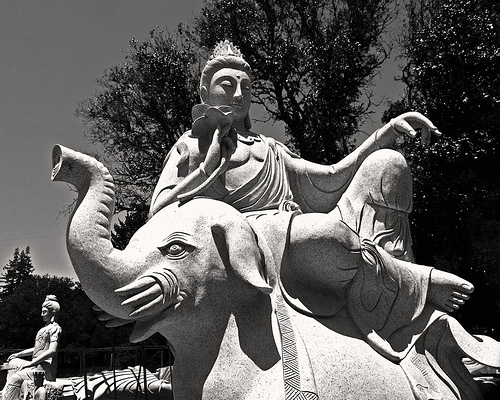
World-Honored One! If anyone keeps this sutra in the defiled world in the later five hundred years after [your extinction], I will protect him so that he may be free from any trouble, that he may be peaceful, and that no one may take advantage [of his weak points]. Mara, his sons, his daughters, his subjects, his attendant , yaksas, raksasas, kumbhandas, pisacakas, krtyas, putanas, vetadas or other living beings who trouble men shall not take advantage [of his weak points].Universal-Sage atop a kingly white elephant with six tusks. If anyone keeps, reads and recites this sutra while he walks or stands, I will mount a kingly white elephant with six tusks, go to him together with great Bodhisattvas, show myself to him, make offerings to him, protect him, and comfort him, because I wish to make offerings to the Sutra of the Lotus Flower of the Wonderful Dharma. If he sits and thinks over this sutra, I also will mount a kingly white elephant and appear before him. If he forgets a phrase or a gatha of the Sutra of the Lotus Flower of the Wonderful Dharma, I will remind him of it, and read and recite it with him so that he may be able to understand it. Anyone who keeps, reads and recites the Sutra of the Lotus Flower of the Wonderful Dharma [after your extinction], will be able to see me with such joy that he will make more efforts. Because he sees me, he will he able to obtain samadhis and a set of dharanis. The set of dharanis will be the dharanis by which he can memorize repetitions of teachings, the dharanis by which he can memorize hundreds of thousands of billions of repetitions of teachings, and the dharanis by which he can understand the expediency of the voice of the Dharma.
If anyone keeps, reads and recites this sūtra while he walks or stands, I will mount a kingly white elephant with six tusks, go to him together with great Bodhisattvas, show myself to him, make offerings to him, protect him, and comfort him, because I wish to make offerings to the Sūtra of the Lotus Flower of the Wonderful Dharma.
Universal-Sage Bodhisattva (Fugen, Samantabhadra) makes this vow to the Buddha in Chapter Twenty-Eight of the Lotus Sutra. Out of his gratitude for the teaching of the Wonderful Dharma, Universal Sage promises to encourage anyone who may be struggling in their practice of the Buddha Dharma. This is a reminder of how no matter what obstacles or difficulties we may encounter, great beings are helping us and we are in harmony with things as they truly are.
The Daily Dharma is produced by the Lexington Nichiren Buddhist Community. To subscribe to the daily emails, visit zenzaizenzai.com
One must … be aware that by chanting Namu Myoho Renge Kyo, one chants not only the of heart of the Lotus Sutra and the essence of all the Buddha’s teachings, but the very nature of his enlightenment itself.
Now you have awakened us, saying:
“What you attained was not true extinction.
When you have the unsurpassed wisdom of the Buddha,
You will attain true extinction.”
Five hundred of the Buddha’s monks give this explanation in Chapter Eight of the Lotus Sūtra. These monks believed that by extinguishing their desires and ending their suffering, they would reach the wisdom of the Buddha. They had not yet heard the teaching of the Lotus Sūtra in which the Buddha reveals his wisdom and the path to attain it. This is the path of the Bodhisattva: beings who resolve to work for the enlightenment of all beings and not just end their own suffering. We may start on the path towards enlightenment by wanting to be happy. Then as we progress, we find our happiness entwined with that of all beings.
The Daily Dharma is produced by the Lexington Nichiren Buddhist Community. To subscribe to the daily emails, visit zenzaizenzai.com
Day 31 covers Chapter 27, King Wonderful-Adornment as the Previous Life of a Bodhisattva.
It’s time to start over on this story of two children whose efforts purify their father so that he can understand the Dharma by faith. These kids, Pure-Store and Pure-Eyes by name, had many merits before any of this started.
The two sons had great supernatural powers, merit , virtues and wisdom. A long time ago, they had already practiced the Way which Bodhisattva should practice. They had already practiced the dana-paramita, the sila-paramita, the ksanti-pararnita, the virya-paramita, the dhyana-paramita, the prajna-paramita, and the paramita of expediency. They also had already obtained [the four states of mind towards all living beings:] compassion, loving-kindness, joy and impartiality. They also had already practiced the thirty-seven ways to enlightenment. They had done all this perfectly and clearly. They also had already obtained the samadhis of Bodhisattvas: that is, the samadhi for purity, the samadhi for the sun and the stars, the samadhi for pure light, the samadhi for pure form, the samadhi for pure brightness, the samadhi for permanent adornment, and the samadhi for the great treasury of powers and virtues. They had already practiced all these samadhis.
On the topic of the four states of mind, the Daily Dharma from July 26, 2015, offers this:
They also had already obtained [the four states of mind towards all living beings:] compassion, loving-kindness, joy and impartiality.
The Buddha gives this description in Chapter Twenty-Seven of the Lotus Sutra of two boys who had been the previous lives of Medicine-King and Medicine-Superior Bodhisattvas. These four states of mind are those which allow to see the world for what it is and bring true benefit for all beings. Any living being is capable of them. Their opposites: cruelty, indifference, misery and prejudice, are never what we aspire to, even though we find ourselves in them far too often. But even these states can be used as an indication that we are not seeing things for what they are, and lead us back to a true curiosity and appreciation for what we have.
The Daily Dharma is produced by the Lexington Nichiren Buddhist Community. To subscribe to the daily emails, visit zenzaizenzai.com
Those who, without concentrating their minds,
Offered nothing but a flower to the picture of the Buddha,
Became able to see
Innumerable Buddhas one after another.
We can read these words of the Buddha from Chapter Two of the Lotus Sūtra as if we had to wait until another life to see Buddhas. But by making offerings to an image of the Buddha, by practicing respect towards a representation of the Buddha, we start to look for and recognize the Buddha in ourselves and in all of the beings who share the world with us. When we see this world of conflict and suffering as the Buddha’s Pure Land, then we see all beings as our enlightened teachers. We see innumerable Buddhas.
The Daily Dharma is produced by the Lexington Nichiren Buddhist Community. To subscribe to the daily emails, visit zenzaizenzai.com
In my attempt to limit myself to a single topic on each day I have to resist the temptation to talk only about my favorite topic each time. In Chapter 26, Dharanis, what I always want to discuss are the ten rakshasis and their mother, Hariti.
After offering their dharanis, they explain:
Anyone who does not keep our spells
But troubles the expounder of the Dharma
Shall have his head split into seven pieces
Just as the branches of the arjaka-tree [are split].
Anyone who attacks this teacher of the Dharma
Will receive the same retribution
As to be received by the person who kills his parents,
Or who makes [sesame] oil without taking out worms [from the sesame],
Or who deceives others by using wrong measures and scales,
Or by Devadatta who split the Samgha.
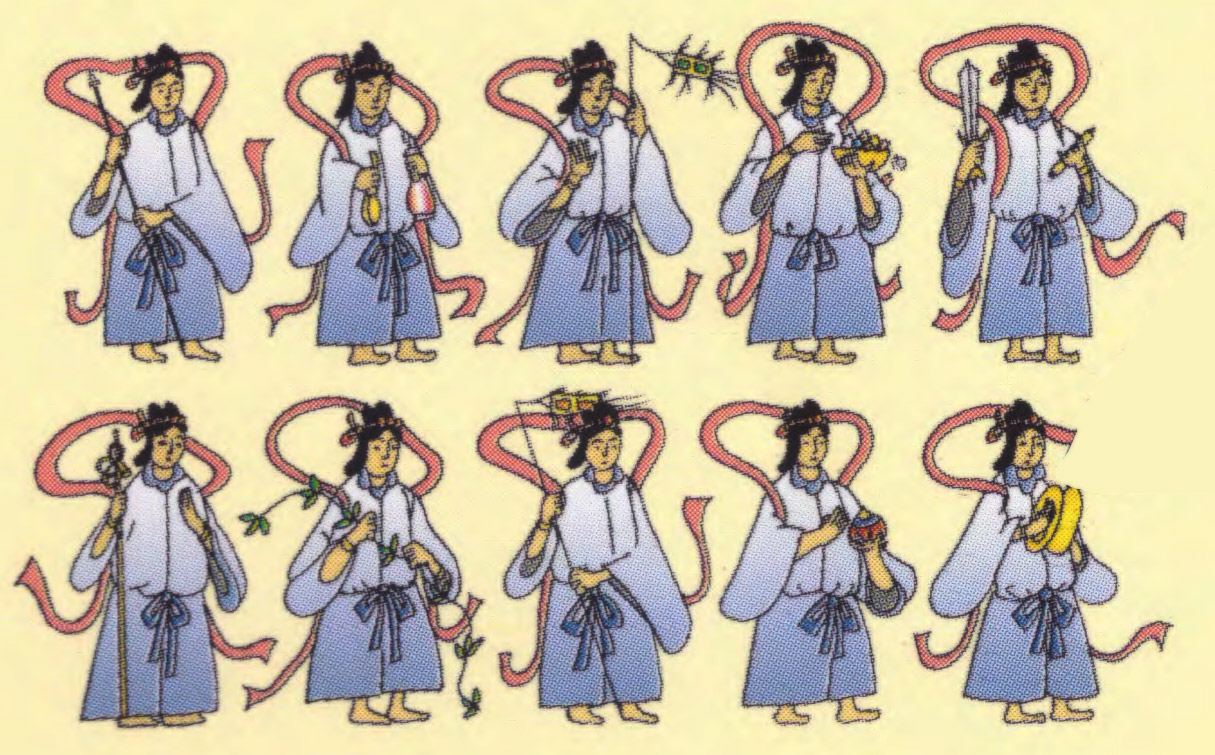
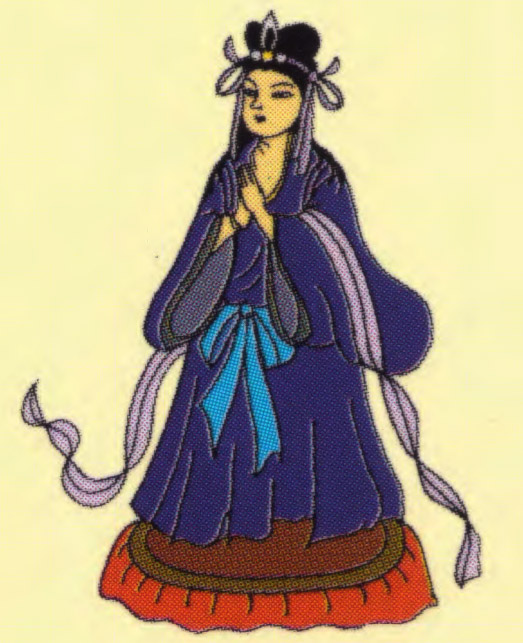
Rakshasas are a kind of flesh eating, blood drinking, or spirit draining demon or spirit. The tamer ones are known as yakshas and are the spirits of the trees, forests, and villages. They are considered a powerful type of hungry ghost. They appear as beautiful women (though they are sometimes shown with fangs) in courtly attire bearing various weapons or other symbolic objects. 10 Rakshasas Daughters from book Lotus WorldHariti, also known as Kishimojin
Kunti carries a spear.
Insatiable carries a curved scepter in her right hand, while her left hand holds a flower vase.
Black Teeth carries a banner in her left hand.
Crooked Teeth carries a tray of flowers.
Lamba holds a sword in her right hand and a sutra in her left.
Plunderer of Energy of All Beings holds a staff with rings.
Necklace Holding holds a garland in both hands.
Many Hairs carries a banner in both hands.
Flower Teeth carries the cintamani, or “wish-fulfilling gem.”
Vilamba carries cymbals.
The ten rakshasis and their mother, Hariti, appear in Chapter 26 of the Lotus Sutra and together offer dharanis for the protection of the teacher of the Lotus Sutra.