
All posts by John Hughes

Day 26

Day 26 concludes Chapter 21, The Supernatural Powers of the Tathāgatas, includes Chapter 22, Transmission, and introduces Chapter 23, The Previous Life of Medicine-King Bodhisattva.

Having last month considered that “all the profound achievements of the Tathagata are revealed and expounded explicitly in this sutra,” this month I’ll use the gathas to review the Supernatural Powers of the Tathāgatas.

The Buddhas, the World-Saviors, have
Great supernatural powers.
They display their immeasurable, supernatural powers
In order to cause all living beings to rejoice.

The tips of their tongues reach the Heaven of Brahman.
Innumerable rays of light are emitted from their bodies.
For those who are seeking the enlightenment of the Buddha
The Buddhas do these things rarely to be seen.

The sound of coughing of the Buddhas
And the sound of their finger-snapping
Reverberate over the worlds of the ten quarters,
And the ground [of those worlds] quakes in the six ways.

The Buddhas joyfully display
Their immeasurable, supernatural powers
Because [the Bodhisattvas from underground]
[Vow to] keep this sutra after my extinction.

Even if I praise for innumerable kalpas
The keeper of this sutra,
To whom it is to be transmitted,
I cannot praise him highly enough.

His merits are as limitless,
As infinite, as boundless
As the skies of the worlds
Of the ten quarters.

Anyone who keeps this sutra
Will be able to see me. He also will be able to see Many-Treasures Buddha,
[The Buddhas of] my replicas,
And the Bodhisattvas whom I have taught today.

Anyone who keeps this sutra will be able to cause me to rejoice.
He also will be able to bring joy
To [the Buddhas of] my replicas
And also to Many-Treasures Buddha who once passed away.

He also will be able to see
The present, past and future Buddhas
Of the worlds of the ten quarters,
Make offerings to them, and cause them to rejoice.

I smile in reading this. The “Buddhas joyfully display” their powers in response to the Bodhisattvas’ vow. And I am “able to bring joy/To [the Buddhas of] my replicas/And also to Many-Treasures Buddha” and “cause [present, past and future Buddhas] to rejoice” by keeping the Sutra of the Lotus Flower of the Wonderful Dharma.
Consciousness-Only

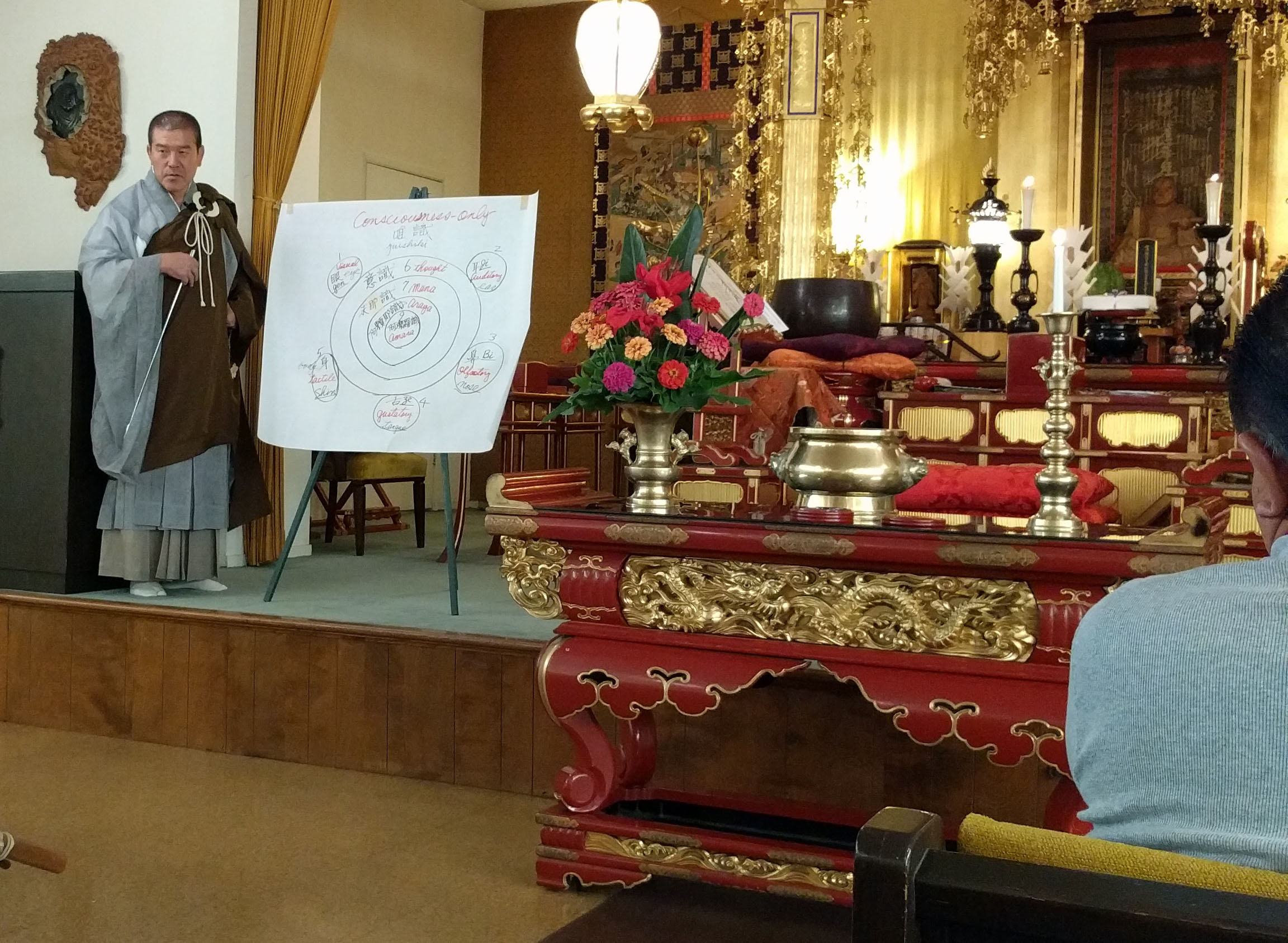
Ven. Kenjo Igarashi offering a lesson in Conciousness-Only
Sunday lesson
Sunday lesson

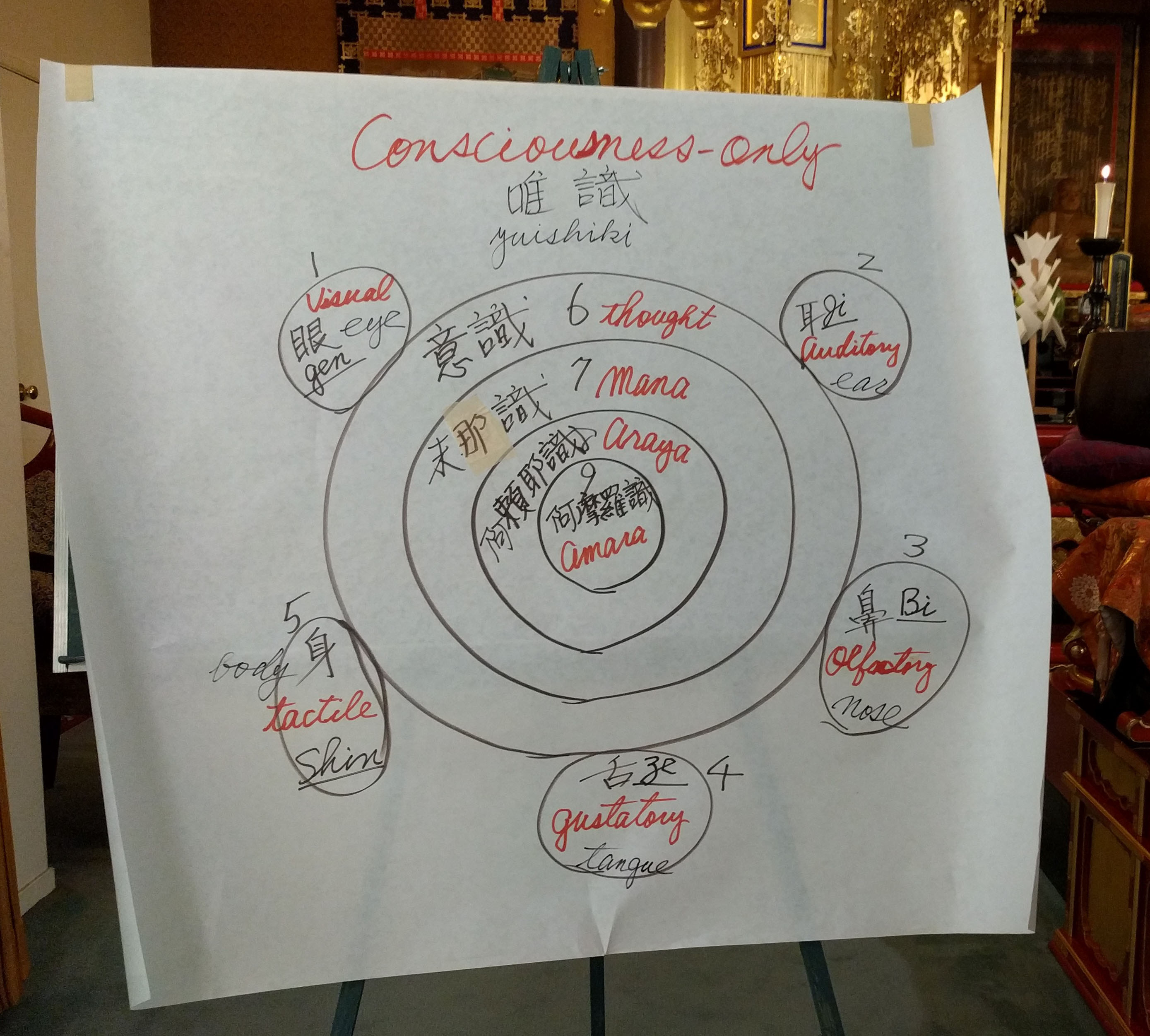
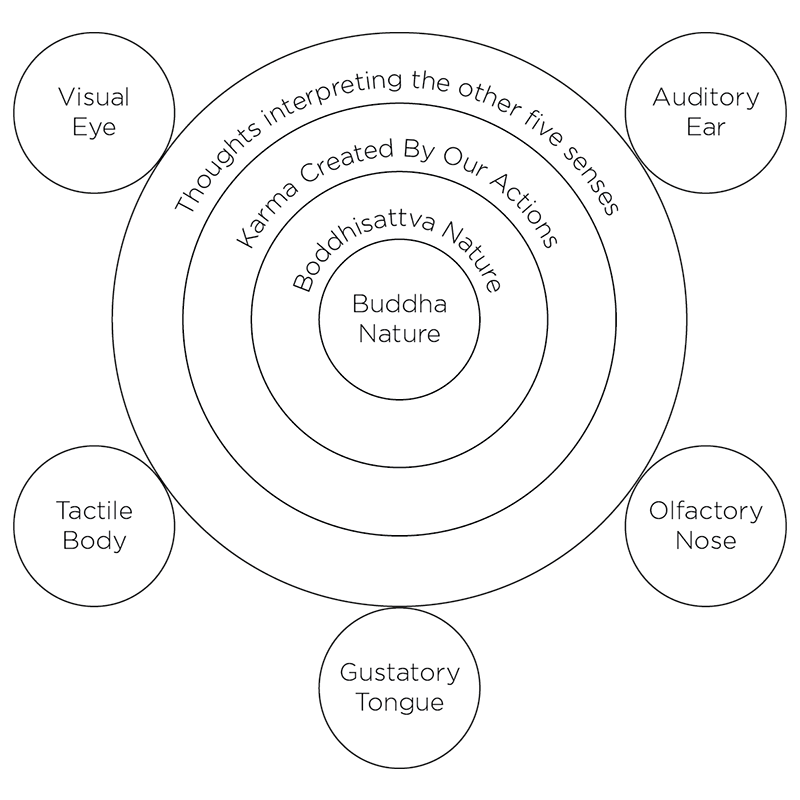
Viewed from the inside out, our inherent Buddha nature is surrounded by a Boddhisattva Nature of pure compassion. This basic goodness is hidden from us by our karma created by our actions. Viewed from the outside in, the visual, tactile, gustatory, olfactory and auditory inputs are interpreted by our thoughts and prompt our actions. These actions harden the shell around our basic goodness.

Ven. Kenjo Igarashi offered a lesson in Consciousness-Only as seen from the Nichiren perspective following the Sunday Ohigan ceremony in which he offered prayers for the ancestors of church members.

And before I begin I must underline that this is my understanding of what he said and is only as accurate as I can make it. Any errors are mine alone.

On one level, the chart he displayed offered an explanation of what exists when we are alive and what remains in the “special realm” after we die.

The eye, ear, nose, tongue and body sense organs do not “know” anything. The sixth level, thought, interprets the five sense organs. What we do with this information – our good and bad actions – are stored in the seventh level.

The eye, ear, nose, tongue, body and mind are the transitory part subject to birth and death that create the illusion that we conceive of as our world.

Our good and bad actions create a shell of intentions that shape our future. This shell encloses our pure Bodhisattva compassion. And that Bodhisattva compassion itself encloses our innate Buddha nature.

Prayers for our ancestors in which we transfer our merit received from chanting Namu Myoho Renge Kyo and studying the Sutra of the Lotus Flower of the Wonderful Dharma seek to mitigate that shell of intentions that will control our ancestors’ future lives.

For myself, I saw this chart and was reminded of Chapter 19, The Merits of the Teacher of the Dharma, and promised effect “the good men or women who keep, read, recite expound or copy this sutra after my extinction, will be able to obtain.”

And considering this from the inside out, I appreciated this picture of universal Buddha nature, this seed, that exists wrapped in compassion. The goal of chanting Namu Myoho Renge Kyo is to realize this equality and difference.

Daily Dharma – Sept. 25, 2016

Those who have much lust will be saved from lust if they constantly think of World-Voice-Perceiver Bodhisattva and respect him. Those who have much anger will be saved from anger if they constantly think of World-Voice-Perceiver Bodhisattva and respect him. Those who have much stupidity will be saved from stupidity if they constantly think of World-Voice-Perceiver Bodhisattva and respect him.

The Buddha gives this description of World-Voice-Perceiver Bodhisattva (Kannon, Kanzeon, Avalokitesvara) to Endless-Intent Bodhisattva in Chapter Twenty-Five of the Lotus Sūtra. World-Voice-Perceiver is the embodiment of compassion for all beings, the wish that all beings be freed from suffering and realize the enlightenment of the Buddha. This compassion is the antidote to the three poisons of lust, anger and stupidity. By aspiring to the example of World-Voice-Perceiver and awakening our own compassion, we can overcome these poisons and bring benefits to all beings.

The Daily Dharma is produced by the Lexington Nichiren Buddhist Community. To subscribe to the daily emails, visit zenzaizenzai.com

Day 25

Day 25 covers all of Chapter 20, Never-Despising Bodhisattva, and opens Chapter 21, The Supernatural Powers of the Tathāgatas.

It’s time to leave Never-Despising Bodhisattva and examine the Supernatural Powers of the Tathāgatas. And to start we need the context of why the Buddha and his replicas put on this display of their powers.

The powers we’re going to see are prompted by the vow made by the Bodhisattvas who had sprung up from underground:

Thereupon the Bodhisattva-mahasattvas as many as the particles of dust of one thousand worlds, who had sprung up from underground, joined their hands together towards the Buddha with all their hearts, looked up at his honorable face, and said to him:

World-Honored One! After your extinction, we will expound this sutra in the worlds of the Buddhas of your replica and also in the place from which you will pass away. Why is that? It is because we also wish to obtain this true, pure and great Dharma, to keep, read, recite, expound and copy [this sutra], and to make offerings to it.

It’s worth noting that in the 12 months that I’ve been parsing the Lotus Sutra, I’ve apparently never offered these verses to explain exactly why the Buddha and his replicas go on to perform their supernatural powers.

So that’s that. Next month a cough and a finger snap.

Daily Dharma – Sept. 24, 2016

World-Honored One! It is difficult for anyone in the world to believe this. It is as difficult as to believe a handsome, black-haired man twenty-five years old who points to men a hundred years old and says, ‘They are my sons,’ or as to believe men a hundred years old who point to a young man and say, ‘This is our father. He brought us up.’

Maitreya Bodhisattva explains his perplexity to the Buddha in Chapter Fifteen of the Lotus Sūtra. The Buddha has just revealed that all of the Bodhisattvas who have appeared from underground to continue teaching the Wonderful Dharma after the extinction of the Buddha have been taught by the Buddha in the time since he became enlightened. Maitreya realizes that his doubts are no different from the doubts of those gathered to hear the Buddha teach and asks the Buddha to explain. The Buddha says later that he sees the world differently than other living beings. But this does not mean that when our experience does not match what the Buddha teaches, we must keep silence and just accept what he tells us. It is only through sincere questioning that we find the Buddha’s mind and make it our own.

The Daily Dharma is produced by the Lexington Nichiren Buddhist Community. To subscribe to the daily emails, visit zenzaizenzai.com

Day 24

Day 24 concludes Chapter 19, The Merits of the Teacher of the Dharma and closes the Sixth Volume of the Sutra of the Lotus Flower of the Wonderful Dharma.
Having covered the merits of the nose, the merits of the tongue, and the merits of the body, it’s time to finish up this with the merits of the mind.

The good men or women who keep, read, recite expound or copy this sutra after my extinction, will be able to obtain twelve hundred merits of the mind. When they hear even a gatha or a phrase [of this sutra] with their pure minds, they will be able to understand the innumerable meanings [of this sutra]. When they understand the meanings [of this sutra] and expound even a phrase or a gatha [of thi sutra] for a month, four months, or a year, their teachings will be consistent with the meanings [of this sutra], and not against the reality of all things. When they expound the scriptures of non-Buddhist schools, or give advice to the government, or teach the way to earn a livelihood, they will be able to be in accord with the right teachings of the Buddha. They will be able to know all the thoughts, deeds, and words, however meaningless, of the living beings of the one thousand million Sumeru-worlds each of which is composed of the six regions.

And in gathas…

Their minds will become pure, clear, keen and undefiled.
They will be able to recognize with their wonderful minds
The superior, mean and inferior teachings.
When they hear even a gatha [of this sutra],
They will be able to understand
The innumerable meanings of [this sutra].

When they expound [this sutra]
In good order according to the Dharma
For a month, four month or a year,
They will be able to understand at once
The thought of gods, dragons, men, yaksas, demigods,
And of all the other living beings
Inside and outside this world
Composed of the six region
Because they keep
The Sutra of the Lotus Flower of the Wonderful Dharma.

They also will be able to hear and keep
The Dharma expounded to all living beings
By the innumerabl Buddhas of the worlds of the ten quarters Who are adorned with the marks of one hundred merits.

When they think over the innumerable meaning [of this sutra],
And endlessly repeat the expounding of those meanings,
They will not forget or mistake the beginnings and ends [of quotations]
Because they keep the Sutra of the Lotus Flower of the Wonderful Dharma.

They will see the reality of all things.
Knowing the position [of this sutra in the series of sutras], And the names and words [of this sutra], according to the meanings of it.
They will expound [this sutra] as they understand it.

They will expound the Dharma
Already taught by the past Buddhas.
Therefore, they will be fearless
Before the multitude.

The Daily Dharma from Nov. 10, 2015, offers this:

When they expound the scriptures of non-Buddhist schools, or give advice to the government, or teach the way to earn a livelihood, they will be able to be in accord with the right teachings of the Buddha.

The Buddha gives this explanation to Constant-Endeavor Bodhisattva in Chapter Nineteen of the Lotus Sūtra, describing those who keep the Lotus Sūtra. In this chapter, the Buddha shows that our practice of this Wonderful Dharma is not separate from our existence in this world. The purpose of the Buddha’s wisdom is not to escape to a better life, but to see our lives for what they are, and to use that clarity for the benefit of all beings.

The Daily Dharma is produced by the Lexington Nichiren Buddhist Community. To subscribe to the daily emails, visit zenzaizenzai.com


Our Buddha Nature

Buddhism does not focus on worshiping or appeasing some superhuman being whose powers and understanding are forever beyond our reach. Neither is Buddhism idolatry: Buddhists do not worship arcane symbols, statues, or a group of deities. It is true that Buddhists believe in an ultimate reality, sometimes called the Buddha-nature, that enables us to attain awakening, but this should not be confused with the historical person called the Buddha. The historical Buddha is revered as the one who taught the Way, but he does not transcend our ability to emulate him. Likewise, the Buddha-nature is not a person to worship, but is the fertile ground from which we can bring out our own Buddha-like qualities by practicing the Buddha’s teachings.

Lotus Seeds

Daily Dharma – Sept. 23, 2016

Evil people in the future will doubt the One Vehicle
When they hear it from a Buddha.
They will not believe or receive it.
They will violate the Dharma, and fall into the evil regions.

The Buddha declares these verses in Chapter Two of the Lotus Sūtra. Nichiren wrote that while some people think hell is below the earth, it is really contained in our own bodies and minds. If we cannot believe or accept the Dharma the Buddha teaches us, then we are not seeing the world for what it is. We are creating worlds of our own separate from the Buddha’s world. We create worlds of greed, anger and ignorance, in which it is even more difficult to hear the Dharma. But even in these difficult worlds, the Buddha exists and works to benefit us. If we remember to look for him, he will show us the way out.

The Daily Dharma is produced by the Lexington Nichiren Buddhist Community. To subscribe to the daily emails, visit zenzaizenzai.com

Day 23

Day 23 covers all of Chapter 18, The Merits of a Person Who Rejoices at Hearing This Sutra, and opens Chapter 19, The Merits of the Teacher of the Dharma.

Having dealt with the example of the propagation of the Lotus Sutra contained in the story of the 50th “good man or woman who rejoices at hearing this sutra” here and here, it’s time to move to the Merits of the Teacher of the Dharma.

Thereupon the Buddha said to Constant-Endeavor Bodhisattva­-Mahasattva:

The good men or women who keep, read, recite, expound or copy this Sutra of the Lotus Flower of the Wonderful Dharma, will be able to obtain eight hundred merits of the eye, twelve hundred merits of the ear, eight hundred merits of the nose, twelve hundred merits of the tongue, eight hundred merit of the body, and twelve hundred merits of the mind.

The Daily Dharma of June 4, 2016, offers this:

The Buddha gives this teaching in Chapter Nineteen of the Lotus Sūtra. This is another reminder that the practice of the Wonderful Dharma does not take us out of the world of conflict we live in. Instead, it helps us to use the senses we have, in ways we did not think were possible, to see the world for what it is. Merits in this sense are not status symbols. They are an indication of clarity, of our faculties not being impeded by anything that blocks their capacity.

The Daily Dharma is produced by the Lexington Nichiren Buddhist Community. To subscribe to the daily emails, visit zenzaizenzai.com

Daily Dharma – Sept. 22, 2016

Offer him heaps of the treasures of heaven! Why is that? It is because, while he is expounding the Dharma with joy, if you hear it even for a moment, you will immediately be able to attain Anuttara-samyak-saṃbodhi.

The Buddha gives this instruction to Medicine-King Bodhisattva at the beginning of Chapter Ten of the Lotus Sūtra. In Chapter Twenty-Three, the Buddha tells of all the hardships Medicine-King endured to practice the Wonderful Dharma. This Bodhisattva knows all the difficulties we face because he has experienced them himself. When anyone sees us practicing, living and sharing the Dharma with others, they will see the joy we have and want to experience it for themselves. The treasures of heaven we receive from Medicine-King are not like the pleasures and comforts we find in the world. They are the assurance we have of our enlightenment and that of all beings.

The Daily Dharma is produced by the Lexington Nichiren Buddhist Community. To subscribe to the daily emails, visit zenzaizenzai.com