The Indian lizard kṛkalāsa eats in the wind; it won’t grow if there is no wind. A fish lives in the water, and a bird makes a nest in the tree. Likewise, Buddhas live in the Lotus Sutra. As the moon’s reflection resides in the water, Buddhas reside in the Lotus Sutra. Therefore, you must remember that where there is no Lotus Sutra, there are no Buddhas.
Nichiren wrote this passage in his Response to My Lady the Nun, Mother of Lord Ueno (Ueno-dono Haha-ama Gozen Gohenji). We may take for granted our opportunity to find and practice the Lotus Sūtra in this lifetime. In Nichiren’s writings, and in the Lotus Sūtra itself, we are reminded of the great benefit we have created and the great hardships we have already endured to allow us to find this Wonderful Dharma and have the opportunity to practice it. When we try to rely on the transitory aspects of our lives, we are surely disappointed. It is only when we keep and practice this Sūtra that we find the Buddha leading us to our true birthright, the enlightenment he knows we and all beings can reach.
The Daily Dharma is produced by the Lexington Nichiren Buddhist Community. To subscribe to the daily emails, visit zenzaizenzai.com
Day 18 concludes Chapter 13, Encouragement for Keeping this Sutra, and begins Chapter 14, Peaceful Practices.
Having finished going through the Peaceful Practices last month, it’s time to return to the Encouragement for Keeping this Sutra.
Before continuing I want to confess to having skipped the first part of this chapter yesterday. Literally. I was so focused on the Devadatta chapter that I didn’t notice that the day’s reading continued with Encouragement for Keeping this Sutra. And I did it twice! In the morning shindoku reading and the evening English translation. In the more than a year that I’ve made this regimen my practice that’s the first time I’ve done that.
So I caught up today, reading all of Encouragement for Keeping this Sutra and the opening of Peaceful Practices. I’ll get to the opening of Encouragement for Keeping this Sutra on Day 17 next month, for today I start with the “eighty billion nayuta Bodhisattvas” who have been hearing about the promise of future Buddhahood for the Arhats, Sravakas and Bhiksunis.
These Bodhisattvas had already reached the stage of avaivartika, turned the irrevocable wheel of the Dharma, and obtained dharanis. They rose from their seats, came to the Buddha, joined their hands together [towards him] with all their hearts, and thought, “If the World-Honored One commands us to keep and expound this sutra, we will expound the Dharma just as the Buddha teaches.”
They also thought, “The Buddha keeps silence.’ He does not command us. What shall we do?”
There are two ways to view this question. Most obvious: These Bodhisattvas have yet to hear about the Bodhisattvas from underground and don’t know that those Bodhisattvas will be tasked with propagating the Sutra of the Lotus Flower of the Wonderful Dharma after the Buddha’s extinction. The other view is from their eyes: What to do when all you hear is silence?
In order to follow the wish of the Buddha respectfully, and also to fulfill their original vow, they vowed to the Buddha with a loud voice like the roar of a lion:
World-Honored One! After your extinction, we will go to any place [not only of this Saha-World but also] of the worlds of the ten quarters, as often as required, and cause all Jiving beings to copy, keep, read and recite this sotra, to expound the meanings of it, to act according to the Dharma, and to memorize this sOtra correctly. We shall be able to do all this only by your powers. World-Honored One! Protect us from afar even when you are in another world!
Today I found that determination to push on when unsure very inspiring.
Mind is called the spiritual aspect while voice is the physical aspect. Therefore the spiritual aspect reveals the physical aspect. But it is also possible to perceive the mind by listening to the voice. In this case, the physical aspect (voice) reveals the spiritual aspect (mind)
Nichiren wrote this passage in his Treatise on Opening the Eyes of Buddhist Images, Wooden Statues or Portraits (Mokue Nizō Kaigen no Koto). This is one of the many instructions Nichiren gives us for how to read the Lotus Sūtra and find the wisdom of the Buddha within it. It is easy to understand how the intentions we have in our minds guide our words and actions. By cultivating the intention to benefit all beings, rather than just focusing on making ourselves happy, we mold our speech and actions to accord with that intention. Finding the mind behind the voice is more difficult. When we look for the Buddha speaking to us in all situations, especially those which are demanding, we bring ourselves closer to the Buddha’s own mind. We bring our speech and actions into harmony with the world as it is.
The Daily Dharma is produced by the Lexington Nichiren Buddhist Community. To subscribe to the daily emails, visit zenzaizenzai.com
Day 17 covers all of Chapter 12, Devadatta, and opens Chapter 13, Encouragement for Keeping this Sutra.
There’s much to enjoy in this chapter – Devadatta as the person responsible for Sakyamuni’s enlightenment and the example of the 8-year-old Dragon girl – and yet what I enjoy more is Sakyamuni’s explanation of why he sought enlightenment at the time when Devadatta was his teacher:
I sought the Great Dharma strenuously
Because I wished to save all living beings.
I did not wish to benefit myself
Or to have the pleasures of the five desires.
Although I was the king of a great country,
I sought the Dharma strenuously.
I finally obtained the Dharma and became a Buddha.
Therefore, I now expound it to you.
I look forward to the fulfillment of this promise:
Good men or women in the future who hear this chapter of Devadatta of the Sutra of the Lotus Flower of the Wonderful Dharma with faithful respect caused by their pure minds, and have no doubts [about this chapter], will not fall into hell or the region of hungry spirits or the region of animals. They will be reborn before the Buddhas of the worlds of the ten quarters. They will always hear this sutra at the places of their rebirth. Even when they are reborn among men or gods, they will be given wonderful pleasures. When they are reborn before the Buddhas, they will appear in lotus-flowers.
The Trinity of Buddha’s person, however, is not limited to him alone, but in each of us is inherent the corresponding Trinity, or, as we may conveniently express it, the unity of the universal foundation and the particular manifestation. A concrete human being is a reality, but his full meaning is based on humanity in general. There is a man, and he is the man who would embody in his person the essential nature of humanity, not in the abstract, but concretely. The universal “humanity” is the “Truth-body” of every human being, and his life under particular conditions is his “Condescension-body,” while his own self-consciousness, and the influence that he means to exert upon his fellow-beings constitute his “Bliss-body.” In short, the unity of the universal man and the particular man is the reality of man.
Those Buddhas came under the jeweled trees.
The trees are adorned with those Buddhas
Just as a pond of pure water is adorned
With lotus flowers.
In these verses from Chapter Eleven of the Lotus Sūtra, the Buddha describes the scene after he calls the Buddhas of his replicas from innumerable worlds to join him and open the treasure tower of Many-Treasures Buddha. By comparing how a pond is made beautiful by flowers growing in it to how the world is made beautiful with Buddhas in it, the Buddha shows us that wherever we see beauty, we see the Buddha.
The Daily Dharma is produced by the Lexington Nichiren Buddhist Community. To subscribe to the daily emails, visit zenzaizenzai.com
Day 16 concludes Chapter 11, Beholding the Stupa of Treasures, and completes the Fourth Volume of the Sutra of the Lotus Flower of the Wonderful Dharma.
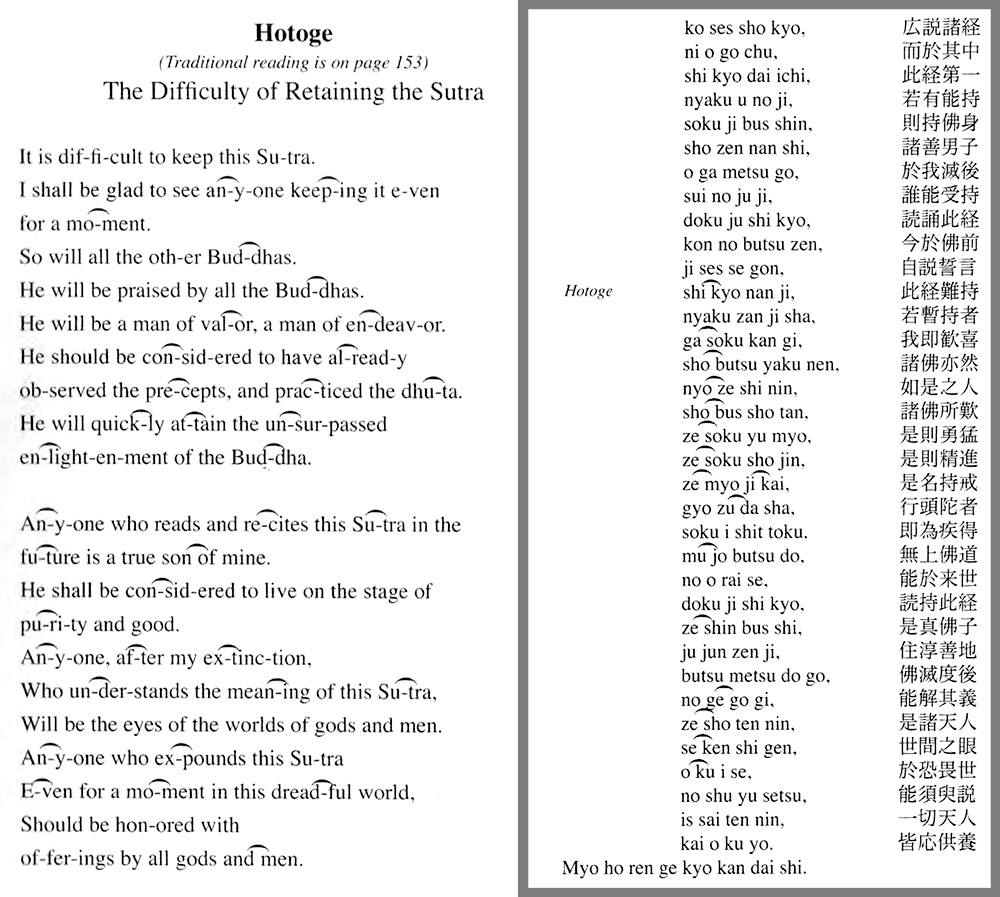
Having last month taken on the hard and easy things, it is time to review the The Difficulty of Retaining the Sutra, the Hotoge section read twice each day following the chanting of Daimoku as part of the Nichiren Shu practice.
It is difficult to keep this sutra.
I shall be glad to see
Anyone keeping it even for a moment.
So will all the other Buddhas.
He will be praised by all the Buddhas.
He will be a man of valor,
A man of endeavor.
He should be considered
To have already observed the precepts,
And practiced the dhuta.
He will quickly attain
The unsurpassed enlightenment of the Buddha.
Anyone who reads and recites this sutra in the future
Is a true son of mine.
He shall be considered to live
On the stage of purity and good.
Anyone, after my extinction,
Who understands the meaning of this sutra,
Will be the eye of the worlds
Of gods and men.
Anyone who expounds this sutra
Even for a moment in this dreadful world,
Should be honored with offerings
By all gods and men.
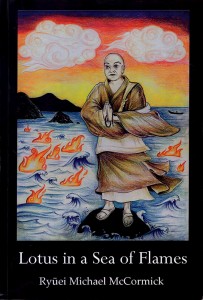
Lotus in a Sea of Flames can be purchased from the Nichiren Buddhist International Center or by by sending a check for $31 (this includes shipping and handling) made out to the San Jose Nichiren Buddhist Temple and mailed to San Jose Nichiren Buddhist Temple, 3570 Mona Way, San Jose, CA 95130.And this also allows me to reintroduce Rev. Ryuei Michael McCormick’s Lotus in the Sea of Flames. Recently I’ve begun republishing by quote collection, but I don’t have quotes from this novelization of Nichiren’s life. I do, however, have the book’s explanation for the rhythmic reading that is performed when reciting this section.
At this point in the book, Nichiren is being taken away to Izu on his first exile.
“I am no magistrate,” said the official. “I am not interested in your arguments. I am only interested in getting you onto that ship, out of Kamakura, and on to Izu. Now keep quiet!”
Nichiren put his palms together and bowed. His disciples cried out to him, some in tears. The guards kept back all but one. Nichiro, now a strong young man of 16, would not be cowed. He slipped past the guards and ran down to the boat just as it was being pushed off into the surf.
“Get back!” screamed the official.
But Nichiro would not get back. Crying for his master as he reached out to him, he waded out into the bay after the boat. Nichiren exhorted him to be calm, but his disciple was too overwrought and would not listen. “Take me with you!” He shouted again and again. Exasperated, the official took an oar and struck the young monk with bone shattering force. Clutching at his broken right arm, Nichiro finally backed away, his face white with pain.
Tears fell from Nichiren’s eyes as he saw his faithful disciple so brutalized. “Nichiro! Calm yourself. Is this how a disciple of the Buddha should act? From now on, when you see the sun setting in the west behind Izu, think of me. When I see the sun rising from the sea, I shall think of you.”
Nichiro nodded. “Forgive me, master.” Becoming faint, he went down on his knees in the water, sweat and tears coursing down his face. One of the guards finally reached him and escorted him back to where Nissho and the other monks were gathered.
As the boat moved away Nichiren began to chant the final verses from the eleventh chapter of the Lotus Sutra, “It is difficult to keep this sutra. I shall be glad to see anyone keeping it even for a moment.” The rocking of the waves caused his voice to fade in and out, giving the recitation an odd rhythm. The passage ended with, “Anyone who expounds this sutra even for a moment in this dreadful world should be honored with offerings by all gods and men.” From that point on Nichlren knew that he and his disciples had truly become practitioners of the Lotus Sutra as its predictions of hardships that would be faced by the teachers of the True Dharma began to be fulfilled in their own lives.
Even if one should read 80,000 holy scriptures, set up stupas as numerous as the number of dust-particles of the great earth, observe the Mahayana and Hinayana precepts, and love all the people in all the worlds throughout the universe just as one’s sole child, one cannot dissipate the sin of slandering the Lotus Sutra. It is solely due to the sin of slandering the Lotus Sutra that we are unable to attain Buddhahood throughout the past, present and future lives and continue to suffer in the lower six realms.
Nichiren wrote this passage in his Treatise on Śubhākarasiṃha (Zemmui-shō). It is difficult to understand what Nichiren means by “slandering the Lotus Sutra.” Many wise people have debated this term over many years. We know that it prevents us from seeing things as they are and becoming enlightened, but it is as hard to tell whether we are slandering the Sutra as it is to see our own delusions. When we deny the possibility of enlightenment, either for ourselves or others, when we ignore the teaching provided by the Lotus Sutra and rely on our power over others, or when we remain preoccupied with our own suffering, these are surely ways that we slander the Sutra and stray from the path to Enlightenment.
The Daily Dharma is produced by the Lexington Nichiren Buddhist Community. To subscribe to the daily emails, visit zenzaizenzai.com
Day 15 concludes Chapter 10, The Teacher of the Dharma, and opens Chapter 11, Beholding the Stūpa of Treasures.
Last month covered the concept that a stupa housing the Lotus Sutra contains the Buddha’s perfect body. And this month, I dig for the water of Anuttara-samyak-sambodhi.
Medicine-King! Although many laymen or monks will practice the Way of Bodhisattvas, they will not be able to practice it satisfactorily, know this, unless they see, hear, read, recite, copy or keep this Sutra of the Lotus Flower of the Wonderful Dharma or make offerings to it. If they hear this sutra, they will. Anyone who, while seeking the enlightenment of the Buddha, sees or hears this Sutra of the Lotus Flower of the Wonderful Dharma, and after hearing it, understands it by faith and keeps it, know this, will approach Anuttara-samyak-sambodhi.
Medicine-King! Suppose a man on a plateau felt thirsty and sought water. He dug a hole in order to get water. As long as he saw the dug-out lumps of earth were dry, he knew that water was still far off. He went on digging, and then found the dug-out lumps of earth wet. When he finally found mud, he was convinced that water was near. In the same manner, know this, the Bodisattvas who have not yet heard, understood or practised this Sutra of the Lotus Flower of the Wonderful Dharma, are still far from Anuttara-samyak-sambodhi. [The Bodhisattvas] who hear, understand, think over and practice this sutra, will approach Anuttara-samyak-sambodhi. Why is that? It is because Anuttara-samyak-sambodhi which all the Bodhisattvas [should attain] is expounded only in this sutra. This sutra opens the gate of expedients and reveals the seal of the truth. The store of this Sutra of the Lotus Flower of the Wonderful Dharma is sound and deep. No one can reach its core. Now I show it to the Bodhisattvas in order to teach them and cause them to attain [Anuttara-samyak-sambodhi].
Medicine-King! The Bodhisattvas who, having been surprised at hearing this Sutra of the Lotus Flower of the Wonderful Dharma, doubt and fear it, know this, are beginners in Bodhisattvahood. The Sravakas who, having been surprised at hearing this sutra, doubt and fear it, know this, are men of arrogance.
Medicine-King! Although many laymen or monks will practice the Way of Bodhisattvas, they will not be able to practice it satisfactorily, know this, unless they see, hear, read, recite, copy or keep this Sūtra of the Lotus Flower of the Wonderful Dharma or make offerings to it.
The Buddha gives this explanation to Medicine-King Bodhisattva in Chapter Ten of the Lotus Sūtra. For us to aspire to benefit all beings is rare and wonderful. However, without the guidance of the Buddha, our efforts to benefit others can degenerate into expectations of separate benefits for ourselves. In the Lotus Sūtra, the Buddha explains the limitations of his previous teachings, assures us of our capacity for enlightenment and how he is always helping us, and gives examples of great Bodhisattvas whose experience we can apply to our own lives.
The Daily Dharma is produced by the Lexington Nichiren Buddhist Community. To subscribe to the daily emails, visit zenzaizenzai.com
I shall become a Buddha without fail.
I shall be respected by gods and men.
I will turn the wheel of the unsurpassed Dharma,
And teach Bodhisattvas.
These verses are spoken by Śāriputra, regarded as the wisest of the Buddha’s disciples, at the beginning of Chapter Three of the Lotus Sūtra. His words come not from conceit, but from joy. How does our view of the problems in the world change when we have the assurance that we will become Buddhas? How does our view of others change when we know that they too will become Buddhas? For one thing, we might spend less effort demanding respect and more giving respect.
The Daily Dharma is produced by the Lexington Nichiren Buddhist Community. To subscribe to the daily emails, visit zenzaizenzai.com