Author: John Hughes

  • Day 32

    Day 32 covers Chapter 28, The Encouragement of Universal-Sage Bodhisattva, closing the Eighth Volume of the Sutra of the Lotus Flower of the Wonderful Dharma.

    Universal-Sage Bodhisattva asks the Buddha how “the good men or women who live after your extinction will be able to obtain this Sutra of the Lotus Flower of the Wonderful Dharrna!” To which the Buddha responds:

    “The good men or women will be able to obtain this Sutra of the Lotus Flower of the Wonderful Dharma after my extinction if they do the following four things: 1. secure the protection of the Buddhas, 2. plant the roots of virtue, 3. reach the stage of steadiness [in proceeding to enlightenment], and 4. resolve to save all living beings. The good men or women will be able to obtain this sutra after my extinction if they do these four things.”

    Universal-Sage Bodhisattva pledges:

    If anyone keeps, reads and recites this sutra while he walks or stands, I will mount a kingly white elephant with six tusks, go to him together with great Bodhisattvas, show myself to him, make offerings to him, protect him, and comfort him, because I wish to make offerings to the Sutra of the Lotus Flower of the Wonderful Dharma. If he sits and thinks over this sutra, I also will mount a kingly white elephant and appear before him. If he forgets a phrase or a gatha of the Sutra of the Lotus Flower of the Wonderful Dharma, I will remind him of it, and read and recite it with him so that he may be able to understand it. Anyone who keeps, reads and recites the Sutra of the Lotus Flower of the Wonderful Dharma [after your extinction], will be able to see me with such joy that he will make more efforts.

    This chapter always presents an odd contrast to me. At one point, it speaks of spells that prevent one from being “captivated by women,” and then promises:

    Anyone who copies this sutra will be reborn in the Heaven of the Trayastrimsa Gods immediately after his present life. On that occasion, eighty-four thousand goddesses will come and receive him, making many kinds of music. A crown of the seven treasures will be put on his head, and he will enjoy himself among the ladies in waiting.

    But getting back the real message, the Buddha promises:

    Anyone who keeps, reads and recites this Sutra of the Lotus Flower of the Wonderful Dharma, memorizes it correctly, studies it, practices it, and copies it, should be considered to see me, and hear this sutra from my mouth. He should be considered to be making offerings to me. He should be considered to be praised by me with the word ‘Excellent!’ He should be considered to be caressed by me on the head. He should be considered to be covered with my robe.

  • Daily Dharma – Jan. 19, 2016

    I know the Way. I have opened the Way. I will expound the Way. Gods, men and asuras! Come and hear the Dharma!

    The Buddha makes this declaration at the beginning of Chapter Five of the Lotus Sūtra. If anyone besides the Buddha had said this, we would accuse them of arrogance: pretending to know what they do not. The Buddha does not separate himself from us. Because he knows we can become as enlightened as he is, he does not place himself as superior. He also knows that unless we hear him, he cannot help us to become enlightened. To accept this help means taking responsibility for our progress on the path. We cannot continue alone but we must make our own effort.

    The Daily Dharma is produced by the Lexington Nichiren Buddhist Community. To subscribe to the daily emails, visit zenzaizenzai.com

  • Day 31

    Day 31 covers Chapter 27, King Wonderful-Adornment as the Previous Life of a Bodhisattva.

    This is one of my favorite chapters because of the lessons about teachers and doing the work of the Buddha as Bodhisattvas.

    The two sons of King Wonderful-Adornment – Pure-Store and Pure-Eyes – were not your ordinary children:

    The two sons had great supernatural powers, merit, virtues and wisdom. A Jong time ago, they had already practiced the Way which Bodhisattva should practice. … They also had already obtained the four states of mind towards all living beings:] compassion, loving kindness, joy and impartiality.

    At the time, a Buddha called Cloud-Thunderpeal-Star-King-Flower-Wisdom expounded the Sutra of the Lotus Flower of the Wonderful Dharma, wishing to lead King Wonderful-Adornment. The sons, for their part, had asked their mother for permission to join the Buddha. She convinced the sons to convince their father to give up his heretical views.

    The mother said to them, ‘Show some wonders to your father out of your compassion towards him! If he sees [the wonders], he will have his mind purified and allow us to go to that Buddha.’

    And the display by the sons had the desired effect:

    By displaying these various wonders, they purified the mind of their father, that is, of the king, and caused him to understand the Dharma by faith.

    Note that the King’s conversion was the result of his own roots of good:

    These two sons of mine did the work of the Buddha. They converted me from wrong views by displaying wonders. They caused me to dwell peacefully in your teachings. They caused me to see you. These two sons of mine are my teachers. They appeared in my family in order to benefit me. They inspired the roots of good which I had planted in my previous existence.

    The Buddha’s words on teachers is compelling:

    So it is, so it is. It is just as you say. The good men or women who plant the roots of good will obtain teachers in their successive lives. The teachers will do the work of the Buddha, show the Way [to them], teach them, benefit them, cause them to rejoice, and cause them to enter into the Way to Anuttara-samyak-sambodhi. Great King, know this! A teacher is a great cause [of your enlightenment] because he leads you, and cause you to see a Buddha and aspire for Anuttara-samyak-sambodhi.

  • Daily Dharma – Jan. 18, 2016

    Ajita! Anyone who hears that my life is so long, and understands it by faith even at a moment’s thought, will be able to obtain innumerable merits.

    The Buddha makes this declaration to his disciple Maitreya, also known as Invincible (Ajita) in Chapter Seventeen of the Lotus Sutra. In the previous chapter, the Buddha revealed for the first time that his impending death was merely an expedient, intended to reach those who would take him for granted if they thought they could see him at any time. The Buddha explained that this is the teaching that is most difficult to believe and difficult to understand. Namely that he is always present, leading us and all beings to enlightenment.

    The Daily Dharma is produced by the Lexington Nichiren Buddhist Community. To subscribe to the daily emails, visit zenzaizenzai.com

  • Day 30

    Day 30 covers all of Chapter 26, Dhāraṇīs.

    The chapter opens with Medicine-King Bodhisattva asking the Buddha, “How many merits will be given to the good men or women who keep, read, recite, understand or copy the Sutra of the Lotus Flower of the Wonderful Dharma?”

    The Buddha said to him:

    “Suppose some good men or women make offerings to eight hundred billion nayuta Buddhas, that is, as many Buddhas as there are sands in the River Ganges. What do you think of this? Are the merits given to them many or not?”

    “Very many, World-Honored One!” The Buddha said: “More merits will be given to the good men or women who keep, read or recite even a single gatha of four lines of this sutra, understand the meanings of it or act according to it.”

    Following this Medicine-King Bodhisattva, Brave-In-Giving Bodhisattva, Vaisravana Heavenly-King, and World-Holding Heavenly-King each offer dharanis spells for the protection of teacher of the Dharma.

    Then we are introduced to the 10 raksasas daughters:

    1. Lamba
    2. Vilamba
    3. Crooked-Teeth
    4. Flower-Teeth
    5. Black-Teeth
    6. Many-Hairs
    7. Insatiable
    8. Necklace-Holding
    9. Kunti
    10. Plunderer-Of-Energy-Of-All-Beings

    And their mother.  Together they vow:

    “World-Honored One! We also will protect the person who reads, recites and keeps the Sutra of the Lotus Flower of the Wonderful Dharma so that he may have no trouble. No one shall take advantage of the weak points of this teacher of the Dharma.”

    Their vow of protection warns:

    Anyone who attacks this teacher of the Dharma
    Will receive the same retribution
    As to be received by the person who kills his parents,
    Or who makes [sesame] oil without taking out worms [from the sesame],
    Or who deceives others by using wrong measures and scales,
    Or by Devadatta, who split the Sarngha.

    In response, the Buddha promises the demon daughters and their mother:

    “Excellent, excellent! Your merits will be immeasurable even when you protect the person who keeps only the name of the Sutra of the Lotus Flower of the Wonderful Dharma. Needless to say, so will be your merits when you protect the person who keeps the sutra itself, and makes to a copy of this sutra hundreds of thousands of offerings such as flowers, incense, necklaces, powdered incense, incense applicable to the skin, incense to burn, streamers, canopies, music, and various lamps like lamps of butter oil, oil lamps, lamps of perfumed oil, lamps of sumanas-flower oil, lamps of campaka flower oil, lamps of varsika-flower oil, and lamps of utpala-flower oil. Kunti! You [raksasis] and your attendants should protect this teacher of the Dharma.”

  • Technical Difficulties

    Technical difficulties waiting for Windows
    Waiting for Windows to open. A metaphor for life?

    I missed the opening of the Myoshoji service this morning waiting for my computer to restart after it refused to open the GoToMeeting software needed to participate in the service. Learning patience while chanting Odaimoku for 10 minutes.

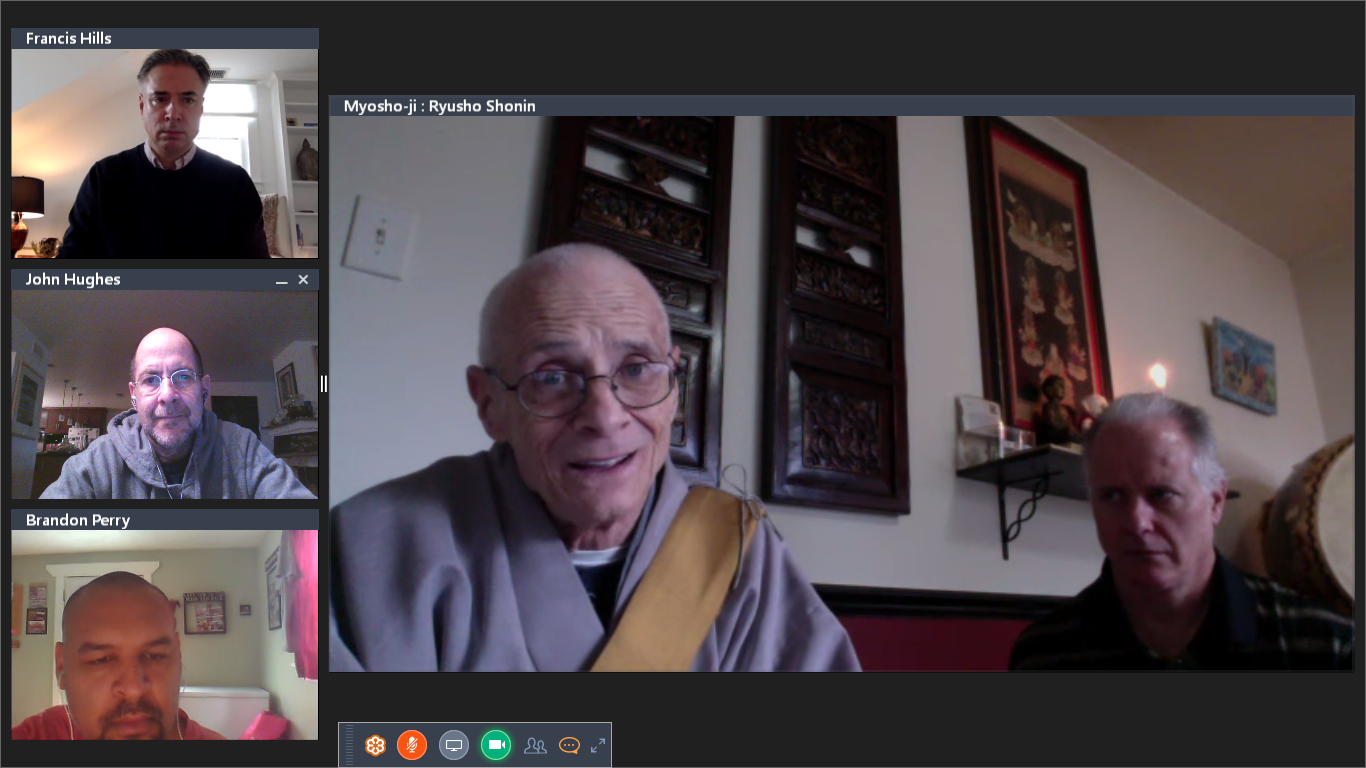
    Online discussion following the Myoshoji service

    Following the service, Rev. Ryusho Jeffus discussed how each of us can show the Lotus Sutra in our lives, challenging us to write our story in the context of the Lotus Sutra.

    When Ryusho Shonin invited questions I offered up a question from Chapter 25, The Universal Gate of World Voice Perceiver Bodhisattva. Why, I asked, does World Voice Perceiver refuse to accept an offering made to him. Here’s the section in question from the chapter:

    The Endless-Intent Bodhisattva said to the Buddha, “WorldHonored One! Now I will make an offering to World-VoicePerceiver Bodhisattva.” From around his neck, he took a necklace of many gems worth hundreds of thousands of ryo of gold, and offered it [to the Bodhisattva], saying, “Man of Virtue! Receive this necklace of wonderful treasures! I offer this to you according to the Dharma!”

    World-Voice-Perceiver Bodhisattva did not consent to receive it. Endless-Intent said to World-Voice-Perceiver Bodhisattva again, “Man of Virtue! Receive this necklace out of your compassion towards us!”

    Thereupon the Buddha said to World-Voice-Perceiver Bodhisattva:

    “Receive it out of your compassion towards this Endless-Intent Bodhisattva, towards the four kinds of devotees, and towards the other living beings including gods, dragons, yaksas, gandharvas, asuras, garudas, kimnaras, mahoragas, men and nonhuman beings!”

    Thereupon World-Voice-Perceiver Bodhisattva received the necklace out of his compassion towards the four kinds of devotees, and towards the other living beings including gods, dragons, men and nonhuman beings. He divided [the necklace] into two parts, and offered one part of it to Sakyamuni Buddha and the other to the stupa of Many-Treasures Buddha.

    Ryusho considered this and decided something more than an off-the-cuff response was needed. I look forward to when he gets back to me.

    I mentioned the question to my wife, who works for the State of California, and she suggested it’s just like working in public service. “I recently had to return a gift card a customer sent to me,” she explained. “We’re not allowed to accept gifts.”

    Why? It is even more puzzling when you consider that in the story of the Dragon Girl, she gives a priceless gem to the Buddha and he accepts quickly. The quickness of his acceptance is used as a measure of how fast she will become a Buddha.

    Something to ponder.

  • Daily Dharma – Jan. 17, 2016

    When he expounds or reads this sūtra, he should not point out the faults of other persons or sūtras. He should not despise other teachers of the Dharma. He should not speak of the good points or bad points or the merits or demerits of others. He should not mention Śrāvakas by name when he blames them. Nor should he do so when he praises them. He should not have hostile feelings against them or dislike them. He should have this peace of mind so that he may not act against the wishes of the hearers. When he is asked questions, he should not answer by the teachings of the Lesser Vehicle, but expound the Dharma only by the teachings of the Great Vehicle so that the questioners may be able to obtain the knowledge of the equality and differences of all things.

    The Buddha gives this explanation to Mañjuśrī Bodhisattva in Chapter Fourteen of the Lotus Sūtra in which he describes the peaceful practices of a Bodhisattva. For us who aspire to be Bodhisattvas in this world of conflict, this passage reminds us not to create more conflict in our efforts to benefit others. Rather we should work to remind them of their good qualities and demonstrate the respect we want to receive.

    The Daily Dharma is produced by the Lexington Nichiren Buddhist Community. To subscribe to the daily emails, visit zenzaizenzai.com

  • Day 29

    Day 29 covers all of Chapter 25, The Universal Gate of World-Voice-Perceiver Bodhisattva.

    I’ll reframe from repeating what I started with last month when I used Ryūei Michael McCormick’s Lotus in a Sea of Flames to illustrate the power of World-Voice-Perceiver Bodhisattva. Still, Sakyamuni’s emancipation proclamation bears repeating:

    Good man! If many hundreds of thousands of billions of living beings hear [the name of] World-Voice-Perceiver Bodhisattva and call his name with all their hearts when they are under various sufferings, World-Voice-Perceiver Bodhisattva will immediately perceive their voices, and cause them to emancipate themselves [from the sufferings].

    Something that did seem new to me this time around was the repetition of the idea that “if one of the crew…” or “one of the members of a party…” calls on World-Voice-Perceiver Bodhisattva, everyone benefits in one case and everyone is inspired to follow the lead of the first person. Individual effort; group benefit.

    In any event, thinking of World-Voice-Perceiver pays dividends:

    Those who have much lust will be saved from lust if they constantly think of World-Voice-Perceiver Bodhisattva and respect him. Those who have much anger will be saved from anger if they constantly think of World-Voice-Perceiver Bodhisattva and respect him. Those who have much stupidity will be saved from stupidity if they constantly think of World-Voice-Perceiver Bodhisattva and respect him. Endless-Intent! World-Voice-Perceiver Bodhisattva has these great supernatural powers. He gives many benefits to all living beings. Therefore, they should constantly think of him.

    And a comparison of benefits:

    “Endless-Intent! Suppose a good man or woman keeps the names of six thousand and two hundred million Bodhisattvas, that is, of as many Bodhisattvas as there are sands in the River Ganges, and offers drink, food, clothing, bedding and medicine to them throughout his or her life. What do you think of this? Are his or her merits many or not?”

    Endless-Intent said, “Very many. World-Honored One!”

    The Buddha said:

    “Anyone who keeps the name of World-Voice-Perceiver Bodhisattva and bows and makes offerings to him even for a moment, will be given as many merits as to be given to the good man or woman as previously stated. The merits will not be exhausted even after hundreds of thousands of billions of kalpas. Endless-Intent! Anyone who keeps the name of World-Voice-Perceiver Bodhisattva will be given these benefits of innumerable merits and virtues.”

    In the same manner as Wonderful-Voice Bodhisattva, when World-Voice-Perceiver Bodhisattva is not emancipating people he goes about this Saha-World expounding the Dharma to the living beings:

    Good man! In a certain world, World-Voice-Perceiver Bodhisattva takes the shape of a Buddha and expounds the Dharma to those who are to be saved by a Buddha. He takes the shape of a Pratyekabuddha and expounds the Dharma to those who are to be saved by a Pratyekabuddha. He takes the shape of a Sravaka and expounds the Dharma to those who are to be saved by a Sravaka. He takes the shape of King Brahman and expounds the Dharma to those who are to be saved by King Brahman. He takes the shape of King Sakra and expounds the Dharma to those who are to be saved by King Sakra. He takes the shape of Freedom God and expounds the Dharma to those who are to be saved by Freedom God. He takes the shape of Great-Freedom God and expounds the Dharma to those who are to be saved by Great-Freedom God. He takes the shape of a great general in heaven and expounds the Dharma to those who are to be saved by a great general in heaven. He takes the shape of Vaisravania and expounds the Dharma to those who are to be saved by Vaisravania. He takes the shape of the king of a small country and expounds the Dharma to those who are to be saved by the king of a small country. He takes the shape of a rich man and expounds the Dharma to those who are to be saved by a rich man. He takes the shape of a householder and expounds the Dharma to those who are to be saved by a householder. He takes the shape of a prime minister and expounds the Dharma to those who are to be saved by a prime minister. He takes the shape of a brahmana and expounds the Dharma to those who are to be saved by a brahmana. He takes the shape of a bhiksu, a bhiksuni, an upasaka or an upasika and expounds the Dharma to those who are to be saved by a bhiksu, a bhiksuni, an upasaka or an upasika. He takes the shape of a wife and expounds the Dharma to those who are to be saved by the wife of a rich man, of a householder, of a prime minister, or of a brahmana. He takes the shape of a boy or a girl and expounds the Dharma to those who are to be saved by a boy or a girl. He takes the shape of a god, a dragon, a yaksa, a gandharva, an asura, a garuda, a kimnara, a mahoraga, a human being or a nonhuman being and expounds the Dharma to those who are to be saved by one or another of these living beings. He takes the shape of Vajra-Holding God and expounds the Dharma to those who are to be saved by Vajra-Holding God.

    He could literally be anyone you hear expounding this sutra.

    And in gathas:

    World-Voice-Perceiver will save
    All living beings from misfortunes
    And from innumerable sufferings of the world
    By the wonderful power of his wisdom.

    And:

    He sees the truth of all things and their purity.
    He sees all things with his great wisdom.
    He sees all things with loving-kindness and compassion.
    Think of him constantly! Look up at him constantly!

    All darkness is dispelled by the light of his wisdom
    As spotless and as pure as the light of the sun.
    The light destroys the dangers of wind and fire,
    And illumines the whole world brightly.

    His precepts out of his loving-kindness brace us up as thunderbolts.
    His wishes out of his compassion are as wonderful as large clouds.
    He pours the rain of the Dharma as sweet as nectar,
    And extinguishes the fire of illusions.

  • Daily Dharma – Jan. 16, 2016

    The rich man thought:
    “He is ignorant, narrow-minded, and mean.
    If I tell him that I am his father,
    He will not believe me.”

    These verses are part of the story of the Wayward Son told by Subhūti, Mahā-Kātyāyana, Mahā-Kāśyapa, and Mahā-Maudgalyāyana in Chapter Four of the Lotus Sūtra. The son in the story has forgotten who his father is. The father cannot just bring him into his inheritance while the son is still attached to his lowly life. The story explains the disciples’ understanding of why the Buddha cannot give his highest teaching without expedients.

    The Daily Dharma is produced by the Lexington Nichiren Buddhist Community. To subscribe to the daily emails, visit zenzaizenzai.com

  • Day 28

    Day 28 covers all of Chapter 24, Wonderful-Voice Bodhisattva, and concludes the Seventh Volume of the Sutra of the Lotus Flower of the Wonderful Dharma.

    As Chapter 24 opens, Sakyamuni Buddha faces the east and emits rays of light that illuminate “one hundred and eight billion nayuta Buddha-worlds.” In a world “beyond those worlds” – a world named All-Pure-Light-Adornment – a Buddha named Pure-Flower-Star-King-Wisdom was teaching the Dharma to bodhisattvas. One of those bodhisattvas was Wonderful-Voice. When the light emitted by Sakyamuni Buddha illumined him, Wonderful-Voice said to Pure-Flower-Star-King-Wisdom Buddha:

    World-Honored One! I wish to visit the Saha-World, bow to Sakyamuni Buddha, attend on him, and make offerings to him. I also wish to see Mafijusri Bodhisattva, who is the Son of the King of the Dharma. [I also wish to see] Medicine-King Bodhisattva, Brave-In-Giving Bodhisattva, Star-King-Flower Bodhisattva, Superior-Practice-Intent Bodhisattva, Adornment-King Bodhisattva, and Medicine-Superior Bodhisattva.

    The Buddha offered advice for all travellers:

    Do not despise that world! Do not consider it to be inferior [to our world]! Good Man! The Saha-World is not even. It is full of mud, stones, mountains’ and impurities. The Buddha [of that world] is short in stature! So are the Bodhisattvas [of that world]. You are forty-two thousand yojanas tall. I am six million and eight hundred thousand yojanas tall. You are the most handsome. You have thousands of millions of marks of merits, and your light is wonderful. Do not despise that world when you go there! Do not consider that the Buddha and Bodhisattvas of that world are inferior [to us]! Do not consider that that world is inferior [to ours]!

    The arrival of Wonderful-Voice in the Saha-World prompted questions and Sakyamuni Buddha explained to Flower-Virtue Bodhisattva:

    Flower-Virtue! Now you see Wonderful-Voice Bodhisattva here and nowhere else. But formerly he transformed himself into various living beings and expounded this sutra to others in various places. He became King Brahman, King Sakra, Freedom God, Great-Freedom God, a great general in heaven, Vaisravana Heavenly-King, a wheel-turning-holy-king, the king of a small country, a rich man, a householder, a prime minister, a brahmana, a bhiksu, a bhiksuni, an upasaka, an upasika, the wife of a rich man, that of a householder, that of a prime minister, that of a brahmana, a boy, a girl, a god, a dragon, a yaksa, a gandharva, an asura, a garuda, a kimnara, a mahoraga, a human being or a nonhuman being. [After he transformed himself into one or another of these living beings,] he expounded this sutra, and saved the hellish denizens, hungry spirits, animals, and all the other living beings in the places of difficulties. When he entered an imperial harem, he became a woman and expounded this sutra.

    “Flower-Virtue! This Wonderful-Voice Bodhisattva protects all living beings in this Saha-World. He transforms himself into one or another of these various living beings in this Saha-World and expounds this sutra to all living beings without reducing his supernatural powers, [his power of] transformation, and his wisdom. He illumines this Saha-World with the many [rays of light] of his wisdom, and causes all living beings to know what they should know. He also does the same in the innumerable worlds of the ten quarters, that is, in as many worlds as, there are sands in the River Ganges.

    Watching for the transformations of Wonderful-Voice Bodhisattva in the Saha-World.