Author: John Hughes

  • Daily Dharma – Jan. 15, 2016

    Ajita! They need not build a stūpa or a monastery in my honor, or make the four kinds of offerings to the Saṃgha because those who keep, read and recite this sūtra should be considered to have already built a stūpa or a monastery or made offerings to the Saṃgha.

    The Buddha sings these verses to Maitreya Bodhisattva, whom he calls Ajita – Invincible, in Chapter Seventeen of the Lotus Sūtra. In our zeal to emulate the great deeds of the Buddha, or even of our founder Nichiren, we might believe that only by extraordinary accomplishments can we show our gratitude for this teaching. The Buddha reminds us in this chapter that because we are practicing his Dharma in this world of conflict, we have already made these extraordinary accomplishments. He also reminds us that others who practice with us should be treated with the same admiration we have for anyone who has done valuable work.

    The Daily Dharma is produced by the Lexington Nichiren Buddhist Community. To subscribe to the daily emails, visit zenzaizenzai.com

  • Day 27

    Day 27 concludes Chapter 23, The Previous Life of Medicine-King Bodhisattva.

    Let’s skip Gladly-Seen-By-All-Beings Bodhisattva’s arm-burning demonstration and the suggestion that “Anyone who aspires for, and wishes to attain Anuttara-samyak-sambodhi, should offer a light to the stupa of the Buddha by burning a finger or a toe” and get down to the business of scorch-free merit in following the Lotus Sutra:

    [T]he merits to be given to the person who fills the one thousand million Sumeru-worlds with the seven treasures and offers that amount of the seven treasures to the Buddhas, to the Great Bodhisattvas, to the Pratyekabuddhas, and to the Arhats, are less than the merits to be given to the person who keeps even a single gatha of four lines of this Sutra of the Lotus Flower of the Wonderful Dharma.

    Following a lengthy list of examples illustrating how the Lotus Sutra is greater than all other sutras, we get to the bottom line:

    Star-King-Flower! This sutra saves all living beings. This sutra saves them from all sufferings, and gives them great benefits. All living beings will be able to fulfill their wishes by this sutra just as a man who reaches a pond of fresh water when he is thirsty, just as a man who gets fire when he suffers from cold, just as a man who is given a garment when he is naked, just as a party of merchants who find a leader, just as a child who meets its mother, just as a man who gets a ship when he wants to cross [a river], just as a patient who finds a physician, just as a man who is given a light in the darkness, just as a poor man who gets a treasure, just as the people of a nation who see a new king enthroned, just as a trader who reaches the seacoast. Just as a torch dispels darkness, this Sotra of the Lotus Flower of the Wonderful Dharma saves all living beings from all sufferings, from all diseases, and from all the bonds of birth and death. The merits to be given to the person who, after hearing this Sutra of the Lotus Flower of the Wonderful Dharma, copies it, or causes others to copy it, cannot be measured even by the wisdom of the Buddha. Neither can the merits to be given to the person who copies this sutra and offers flowers, incense, necklaces, incense to burn, powdered incense, incense applicable to the skin, streamers, canopies, garments, and various kinds of lamps such as Lamps of butter oil, oil lamps, lamps of perfumed oil, lamps of campaka oil, lamps of sumanas oil, lamps of patala oil, lamps of varsika oil, and lamps of navamalika oil [to the copy of this sotra].

    Special benefits are promised to women in particular for keeping this chapter of the Previous Life of Medicine-King Bodhisattva, but everyone benefits.

    Star-King-Flower! Protect this sutra by your supernatural powers! Why is that? It is because this sutra is a good medicine for the diseases of the people of the Jambudvipa. The patient who hears this sutra will be cured of his disease at once. He will not grow old or die.

  • Daily Dharma – Jan. 14, 2016

    I shall become a Buddha without fail.
    I shall be respected by gods and men.
    I will turn the wheel of the unsurpassed Dharma,
    And teach Bodhisattvas.

    These verses are spoken by Śāriputra, regarded as the wisest of the Buddha’s disciples, at the beginning of Chapter Three of the Lotus Sūtra. His words come not from conceit, but from joy. How does our view of the problems in the world change when we have the assurance that we will become Buddhas? How does our view of others change when we know that they too will become Buddhas? For one thing, we might spend less effort demanding respect and more giving respect.

    The Daily Dharma is produced by the Lexington Nichiren Buddhist Community. To subscribe to the daily emails, visit zenzaizenzai.com

  • Day 26

    Day 26 concludes Chapter 21, The Supernatural Powers of the Tathāgatas, includes Chapter 22, Transmission, and introduces Chapter 23, The Previous Life of Medicine-King Bodhisattva.

    Why is the Lotus Sutra great?

    To sum up, all the teachings of the Tathagata, all the unhindered, supernatural powers of the Tathagata, all the treasury of the hidden core of the Tathagata, and all the profound achievements of the Tathagata are revealed and expounded explicitly in this sutra. Therefore, keep, read, recite, expound and copy this sutra, and act according to the teachings of it with all your hearts after my extinction!

    Wherever a copy of this sutra is found is a place of enlightenment:

    Here the Buddhas attained Anuttara-samyak-sambodhi. Here the Buddhas turned the wheel of the Dharma. Here the Buddhas entered into Parinirvana.

    Repeating what we had learned yesterday in gathas:

    The Buddhas, the World-Saviors, have
    Great supernatural powers.
    They display their immeasurable, supernatural powers
    In order to cause all living beings to rejoice.

    The tips of their tongues reach the Heaven of Brahman.
    Innumerable rays of light are emitted from their bodies.
    For those who are seeking the enlightenment of the Buddha
    The Buddhas do these things rarely to be seen.

    The sound of coughing of the Buddhas
    And the sound of their finger-snapping
    Reverberate over the worlds of the ten quarters,
    And the ground [of those worlds] quakes in the six ways.

    The Buddhas joyfully display
    Their immeasurable, supernatural powers
    Because [the Bodhisattvas from underground]
    [Vow to] keep this sutra after my extinction.

    Underline and highlight this passage wherever found:

    Anyone who keeps this sutra
    Will be able to see me. He also will be able to see
    Many-Treasures Buddha,
    [The Buddhas of] my replicas,
    And the Bodhisattvas whom I have taught today.

    Anyone who keeps this sutra will be able
    to cause me to rejoice.
    He also will be able to bring joy
    To [the Buddhas of] my replicas
    And also to Many-Treasures Buddha
    who once passed away.

    Just like the Sun and the Lotus:

    Anyone who understands why the Buddhas
    expound [many] sutras,
    Who knows the position [of this sutra
    in the series of sutras],
    And who expounds it after my extinction
    According to its true meaning,
    Will be able to eliminate the darkness.
    Of the living beings of the world where he walks about,
    Just as the light of the sun and the moon
    Eliminates all darkness.
    He will be able to cause innumerable Bodhisattvas
    To dwell finally in the One Vehicle.

    Compassion and equality:

    Keep, read, recite and expound [this sutra in which the Dharma is given], and cause all living beings to hear it and know it! Why is that? It is because I have great compassion. I do not begrudge anything. I am fearless. I wish to give the wisdom of the Buddha, the wisdom of the Tathagata, the wisdom of the Self-Existing One, to all living beings. I am the great almsgiver to all living beings. Follow me, and study my teachings without begrudging efforts!

    Repaying the favor:

    When you see anyone who does not receive [this sutra] by faith, you should show him some other profound teachings of mine, teach him, benefit him, and cause him to rejoice. When you do all this, you will be able to repay the favors given to you by the Buddhas.

    Chapter 23, The Previous Life of Medicine-King Bodhisattva, always presents a challenge for my literal mind. But the symbolism of the acts of Gladly-Seen-By-All-Beings Bodhisattva are compelling:

    Having made these offerings [to the Buddha], he emerged from the samadhi, and thought, ‘I have now made offerings to the Buddha by my supernatural powers. But these offerings are less valuable than the offering of my own body.’

    And the example of this Bodhisattva’s offering of his body in flames is reflected in the selflessness witnessed in Nichiren’s life:

    The light of the flame illumined the worlds numbering eight thousands of millions of times the number of the sands of the River Ganges.

    The Buddhas of those worlds praised him, saying simultaneously ‘Excellent, excellent, good man! All you did was a true endeavor. You made an offering to us according to the true Dharma. This offering excels the offerings of flowers, incense, necklaces, incense to burn, powdered incense, incense applicable to the skin, streamers and canopies of heavenly cloth, and the incense of the candana grown on this shore of the sea. It also excels the offerings of countries, cities, wives and children. Good man! This is the most excellent and honorable offering because you made it to us according to the Dharma.’

  • Daily Dharma – Jan. 13, 2016

    When they come to him
    With good intent
    In order to hear
    About the enlightenment of the Buddha,
    He should expound the Dharma to them
    Without fear,
    But should not wish to receive
    Anything from them.

    The Buddha makes this explanation to Mañjuśrī Bodhisattva in Chapter Fourteen of the Lotus Sūtra in which he describes the peaceful practices of a Bodhisattva. In our zeal to practice this Wonderful Dharma we may come to expect that because this is such a wonderful teaching, we deserve to be rewarded for providing it to others. With this expectation, we then lose our focus on using the Dharma to benefit others and instead use it to benefit ourselves. When we show how to give freely, without expectations, we embody generosity, the same generosity the Buddha himself demonstrated when he provided the teaching to us.

    The Daily Dharma is produced by the Lexington Nichiren Buddhist Community. To subscribe to the daily emails, visit zenzaizenzai.com

  • Day 25

    Day 25 covers all of Chapter 20, Never-Despising Bodhisattva, and opens Chapter 21, The Supernatural Powers of the Tathāgatas.

    The teachings of Powerful-Voice-King Buddha “innumerable, limitless, inconceivable, asamkhya kalpas ago”:

    Powerful-Voice-King Buddha expounded the Dharma to the gods, men and asuras of his world. To those who were seeking Sravakahood, he expounded the teaching suitable for them, that is, the teaching of the four truths, saved them from birth, old age, disease and death, and caused them to attain Nirvana. To those who were seeking Pratyekabuddhahood, he expounded the teaching suitable for them, that is, the teaching of the twelve causes. To the Bodhisattvas who were seeking Anuttara-samyak-sambodhi, he expounded the teaching suitable for them, that is, the teaching of the six paramitas, and caused them to obtain the wisdom of the Buddha.

    In the age of the counterfeit of the right teachings of the first Powerful-Voice-King Tathagata there lived a Bodhisattva called Never Despising who took the form of a bhiksu.

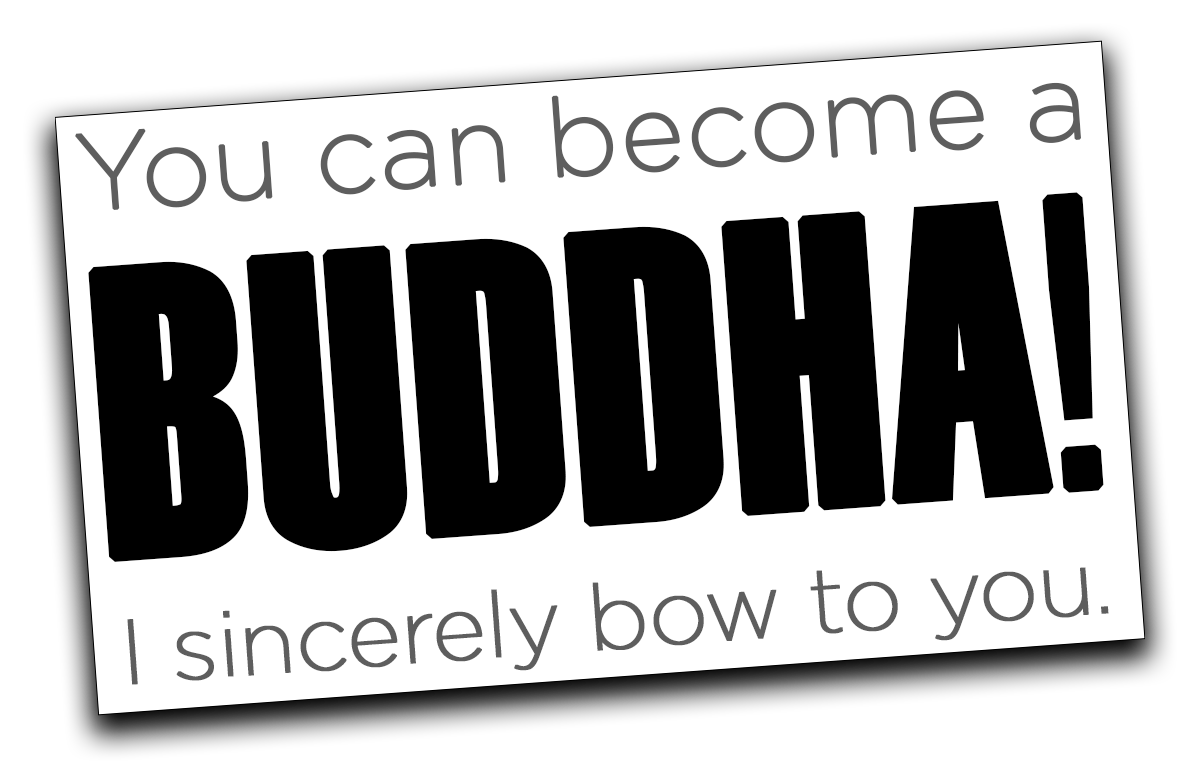
    He did not read or recite sutras. He only bowed to the four kinds of devotees. When he saw them in the distance, he went to them on purpose, bowed to them, and praised them, saying, ‘I do not despise you because you can become Buddhas.’

    I want to print up business cards to hand out. Perhaps something like this:
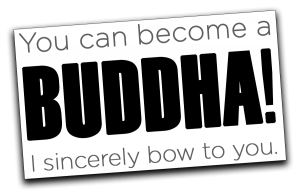
    Never Despising business card

    When he was about to pass away, he heard [from a voice] in the sky the twenty thousand billion gathas of the Sutra of the Lotus Flower of the Wonderful Dharma, which had been expounded by the Powerful-Voice-King Buddha. Having kept all these gathas, he was able to have his eyes, ears, nose, tongue, body and mind purified as previously stated. Having his six sense-organs purified, he was able to prolong his life for two hundred billion nayuta more years.

    Putting those years to good use:

    This Never-Despising Bodhisattva-mahasattva made offerings to those Buddhas, respected them, honored them, praised them, and planted the roots of good. After that, he was able to meet thousands of billions of Buddhas. He also expounded this sutra under those Buddhas. By the merits he had accumulated in this way, he was able to become a Buddha.

    Great-Power-Obtainer! What do you think of this? The Never-Despising Bodhisattva at that time was no one but myself. If I had not kept, read or recited this sutra or expounded it to others in my previous existence, I should not have been able to attain Anuttara-samyak-sambodhi so quickly. Because I kept, read and recited this sutra, and expounded it to others under those past Buddhas, I attained Anuttara-samyak-sambodhi quickly.

    And in gathas:

    Never-Despising [Bodhisattva] at that time
    Was myself.
    The four kinds of devotees,
    Who were attached to views at that time,
    Were able to meet innumerable Buddhas
    After they heard
    The words of Never-Despising [Bodhisattva]:
    “You will become Buddhas.”
    They are now present here
    In this congregation.

    This is a one-time opportunity:

    This Sutra of the Lotus Flower of the Wonderful Dharma
    Can be heard only once
    In hundreds of millions of billions of kalpas,
    That is, in an inconceivable number of kalpas.

    The Buddhas, the World-Honored Ones,
    Expound this sutra only once
    In hundreds of millions of billions of kalpas,
    That is, in an inconceivable number of kalpas.

    Therefore, anyone who hears this sutra
    And practices the Way
    After my extinction,
    Should have no doubts about [this sutra].

    He should expound this sutra with all his heart;
    Then he will be able to meet Buddhas
    Throughout all his existences,
    And quickly attain the enlightemnent of the Buddha.

    In the following chapter, the Bodhisattvas who sprung up from underground vow to expound the Lotus Sutra after the Buddha’s extinction, which prompts the Buddha and all of his replicas to put on a display of supernatural powers involving tongues and lights for 100,000 years.

    Then they pulled back their tongues, coughed at the same time, and snapped their fingers. These two sounds [of coughing and snapping] reverberated over the Buddha-worlds of the ten quarters, and the ground of those worlds quaked in the six ways. By the supernatural powers of the Buddhas, the living beings of those worlds, including gods, dragons, yaksas, gandharvas, asuras, garudas, kimnaras, and mahoragas, men and nonhuman beings, saw the many hundreds of thousands of billions of Buddhas sitting on the lion-like seats under the jeweled trees in this Saha-World. They also saw Sakyamuni Buddha sitting by the side of Many-Treasures Tathagata on the lion-like seat in the stupa of treasures. They also saw that the many hundred of thousands of billions of Bodhisattva-mahasattvas and the four kinds of devotees were surrounding Sakyamuni Buddha respectfully. Having seen all this, they had the greatest joy that they had ever had.

  • Lotus in a Sea of Flames

    Lotus in a Sea of Flames bookcover
    Lotus in a Sea of Flames can be purchased from the Nichiren Buddhist International Center or by by sending a check for $31 (this includes shipping and handling) made out to the San Jose Nichiren Buddhist Temple and mailed to San Jose Nichiren Buddhist Temple, 3570 Mona Way, San Jose, CA 95130.

    From the author Rev. Ryuei Michael McCormick’s Preface to the book:

    At the age of 18 I was introduced to Nichiren Buddhism. Since that time I have voraciously read everything I could find in English translation connected to Buddhism, Mahayana Buddhism, the Lotus Sutra, the teachings of Tiantai, and the life and writings of Nichiren Shonin, the founder of the school of Buddhism that I am ordained in as a minister. So this book is the product of my 30 years of research, some might say obsession. However, it would not have begun at all had not my sensei, the Ven. Ryusho Matsuda, asked me to write a book about Nichiren Shonin’s life using as my primary source the seven volumes of the Writings of Nichiren Shonin put out by the Nichiren Shu Overseas Propagation and Promotion Association. To get me started, I was handed two very thick sheaves of notes. One was a collection of passages from the aforementioned seven volumes pertaining to events in Nichiren’s life, and the second consisted of my sensei’s outline of Nichiren’s life based on those passages and other sources. He also provided me with his own translation of the booklet that accompanies a documentary DVD on the life of Nichiren Shonin by Dr. Takashi Nakao. Provided with these materials, I began to marshal my own resources and set to work. The end result is the present book. This book is my attempt, given my own limitations, to present a historical novelization of the life of Nichiren Shonin in order to understand him in the context of his own time and place. I hope that I have at least partially succeeded in conveying some of his spirit so that others will come to appreciate his life, teachings, and sacrifices as I have.

    On Jan. 11, 2016, Rev. Ryusho Jeffus of Myosho-ji Temple in Charlotte, NC, hosted an online discussion with Ryuei Shonin.


    With other books on this website, I’ve selected quotes that help me remember favorite passages. I’m not doing that with this book.

    As with Ryuei’s other books written on behalf of the San Jose Nichiren Temple – Lotus World and Lotus Seeds  – Lotus in a Sea of Flames takes the reader from the basics of Buddhism, and in this book Japanese culture, to a thorough appreciation of the nuances of the topic. People with little knowledge of Nichiren or even Buddhism in general will find this book very informative and even entertaining.

    The scholarly aspect of this historical novel benefits from fact-checking assistance provided by Dr. Jacqueline I. Stone, Professor of Japanese Religions in the Religion Department of Princeton University.

    Ryuei has used Nichiren’s deathbed reminiscences as a vehicle to tell Nichiren’s life story. The first and last chapters are particularly well written. The scenes – nearly all based on the writings of Nichiren Shonin – are often very compelling. One of my favorites comes as Nichiren is being taken away to Izu on his first exile.

    “I am no magistrate,” said the official. “I am not interested in your arguments. I am only interested in getting you onto that ship, out of Kamakura, and on to Izu. Now keep quiet!”

    Nichiren put his palms together and bowed. His disciples cried out to him, some in tears. The guards kept back all but one. Nichiro, now a strong young man of 16, would not be cowed. He slipped past the guards and ran down to the boat just as it was being pushed off into the surf.

    “Get back!” screamed the official.

    But Nichiro would not get back. Crying for his master as he reached out to him, he waded out into the bay after the boat. Nichiren exhorted him to be calm, but his disciple was too overwrought and would not listen. “Take me with you!” He shouted again and again. Exasperated, the official took an oar and struck the young monk with bone shattering force. Clutching at his broken right arm, Nichiro finally backed away, his face white with pain.

    Tears fell from Nichiren’s eyes as he saw his faithful disciple so brutalized. “Nichiro! Calm yourself. Is this how a disciple of the Buddha should act? From now on, when you see the sun setting in the west behind Izu, think of me. When I see the sun rising from the sea, I shall think of you.”

    Nichiro nodded. “Forgive me, master.” Becoming faint, he went down on his knees in the water, sweat and tears coursing down his face. One of the guards finally reached him and escorted him back to where Nissho and the other monks were gathered.

    As the boat moved away Nichiren began to chant the final verses from the eleventh chapter of the Lotus Sutra, “It is difficult to keep this sutra. I shall be glad to see anyone keeping it even for a moment.” The rocking of the waves caused his voice to fade in and out, giving the recitation an odd rhythm. The passage ended with, “Anyone who expounds this sutra even for a moment in this dreadful world should be honored with offerings by all gods and men.” From that point on Nichiren knew that he and his disciples had truly become practitioners of the Lotus Sutra as its predictions of hardships that would be faced by the teachers of the True Dharma began to be fulfilled in their own lives.

    Each day I recite the Hotoge, those verses from Chapter 11, and I wonder what was the source of the odd rhythm.

    Hotoge with rhythm markings

  • Daily Dharma – Jan. 12, 2016

    They also will be able to see the living beings of those worlds, to know the karmas which those living beings are now doing and the region to which each of those living beings is destined to go by his karmas.

    The Buddha gives this explanation to Constant-Endeavor Bodhisattva in Chapter Nineteen of the Lotus Sūtra, describing those who keep the Lotus Sūtra. In our world of conflict and ignorance, we sometimes envy people who use force to get what they want. In this deluded state of mind, we believe that cruelty, violence and greed can make us happy. When we use the Buddha’s wisdom to see things for what we are, we realize the power that comes from patience, generosity, compassion and selflessness. We avoid the misery of self-importance, and find the peace that comes from being tied into this world rather than setting ourselves apart from it.

    The Daily Dharma is produced by the Lexington Nichiren Buddhist Community. To subscribe to the daily emails, visit zenzaizenzai.com

  • Day 24

    Day 24 concludes Chapter 19, The Merits of the Teacher of the Dharma and closes the Sixth Volume of the Sutra of the Lotus Flower of the Wonderful Dharma.

    This portion of the merits of the teacher of the Dharma covers the 800 merits of the nose, 1,200 merits of the tongue, 800 merits of the body and 1,200 merits of the mind. And I’m again unable not to be intrigued by the sense of smell to be enjoyed by the good men or women who keep, read, recite, expound or copy this sutra.

    He will be able to know by smell
    Whether an unborn child is a boy or a girl,
    Or a child of ambiguous sex,
    Or the embryo of a nonhuman being.

    He will be able to know by smell
    Whether a woman is an expectant mother,
    Or whether she will give an easy birth
    To a happy child or not.

    He will be able to know by smell
    What a man or a woman is thinking of,
    Or whether he or she is greedy, ignorant or angry,
    Or whether he or she is doing good.

    He will be able to recognize by smell
    The gold, silver, and other treasures
    Deposited underground,
    And the things enclosed in a copper box.

    He will be able to know by smell
    The values of various necklaces,
    And the deposits of their materials,
    And also to locate the necklaces [when they are lost].

    And with all this:

    Even when they recognize all this by smell, their organ of smell will not be destroyed or put out of order. If they wish, they will be able to tell others of the differences [of those scents] because they remember them without fallacy.

    The merits of the tongue extend beyond mere taste to cover their “deep and wonderful voices” that can “reach the hearts of the great multitude so that the great multitude may be joyful and cheerful.”

    The Buddhas and their disciples who hear
    The voice of the expounder of the Dharma,
    Will think of him, protect him,
    And sometimes appear before him.

    As a result of the merits of the body, “all things in the world will be reflected on the pure body of this person” who keeps, reads, recites, expounds or copies this sutra. “No one but he will be able to see all things clearly.”

    Although he has not yet obtained the wonderful body
    [Of th Bodhisattva who know ] the nature of the Dharma-without-asravas,
    He will be able to have all these things
    Reflected on his pure and natural body.

    As for the merits of the mind:

    When they hear even a gatha or a phrase [of this sutra] with their pure minds, they will be able to understand the innumerable meanings [of this sutra]. When they understand the meanings [of this sutra] and expound even a phrase or a gatha [of this sutra] for a month, four months, or a year, their teachings will be consistent with the meanings [of this sutra], and not against the reality of all things.

  • Daily Dharma – Jan. 11, 2016

    Great-Eloquence! Now I will collect the Buddhas of my replicas who are now expounding the Dharma in the worlds of the ten quarters.

    The Buddha makes this declaration to Great-Eloquence Bodhisattva in Chapter Eleven of the Lotus Sūtra. In the story, a large tower has sprung up from underground. From inside, the voice of Many-Treasures Buddha proclaims the truth of the Lotus Sutra that Śākyamuni Buddha is teaching. Before the Buddha can open the door to this tower and allow the congregation to see this Buddha, Śākyamuni must summon all the other Buddhas in the other worlds throughout the universe. We often say of others, “They live in their own world.” We are surrounded by as many worlds as there are people in our lives. When we summon their Buddha-Nature using our Buddha-Nature, we open doors to treasures we can barely imagine.

    The Daily Dharma is produced by the Lexington Nichiren Buddhist Community. To subscribe to the daily emails, visit zenzaizenzai.com