All posts by John Hughes

Daily Dharma – Feb. 4, 2023

Anyone who respects the stūpa-mausoleum,
Who is modest before bhikṣus,
Who gives up self-conceit,
Who always thinks of wisdom,
Who does not get angry when asked questions,
And who expounds the Dharma
According to the capacities of the questioners,
Will be able to obtain innumerable merits.

The Buddha sings these verses to Maitreya Bodhisattva in Chapter Seventeen of the Lotus Sūtra. The merits of which he speaks are not an indication that we are better than other beings, that we deserve more respect than others, or that we are closer to enlightenment. Merits are a measure of clarity. When we lose attachment and delusion, we gain merit. When we see things for what they are, we gain the wisdom to truly benefit others.

The Daily Dharma is produced by the Lexington Nichiren Buddhist Community. To subscribe to the daily emails, visit zenzaizenzai.com

Day 32

Day 32 covers Chapter 28, The Encouragement of Universal-Sage Bodhisattva, closing the Eighth Volume of the Sutra of the Lotus Flower of the Wonderful Dharma.


Having last month considered Universal-Sage Bodhisattva’s vow protect those who keep the Lotus Sutra, we consider Universal-Sage Bodhisattva’s vow given to those who study and practice the Lotus Sutra for three weeks.

“World-Honored One! The bhikṣus, bhikṣunīs, upāsakās or upāsikās who seek, keep, read, recite and copy this Sūtra of the Lotus Flower of the Wonderful Dharma in the defiled world in the later five hundred years after [your extinction], if they wish to study and practice this sūtra, should concentrate their minds [on study and practice] strenuously for three weeks. When they complete [the study and practice of] three weeks, I will mount a white elephant with six tusks, and appear before them with my body which all living beings wish to see, together with innumerable Bodhisattvas surrounding me. I will expound the Dharma to them, show them the Way, teach them, benefit them, and cause them to rejoice. I also will give them dhārāṇi spells. If they obtain these dhārāṇis, they will not be killed by nonhuman beings or captivated by women. Also I myself will always protect them. World-Honored One! Allow me to utter these dhārāṇis spells!”

Thereupon he uttered spells before the Buddha:

“Atandai (1), tandahatai (2), tandahatei (3), tandakusharei (4), tandashudarei (5), shudarei (6), shudarahachi (7), botsudahasennei (8), sarubadarani-abatani (9), sarubabasha-abataru (10), hu­abatani (11), sōgyahabishani (12), sōgyaneku-kyadani (13), asogi (14), sōgyahagyadai. (15), teirei-ada-sōgyatorya-aratei-haratei (16), sarubasogya-sammaji-kyarandai (17), sarubadaruma­shuharisettei (18), saru-basatta-rodakyōsharya-atogyadai (19), shin-abikiridaitei (20).”

[He said to the Buddha:]

“World-Honored One! It is by my supernatural powers, know this, that a Bodhisattva can hear these dhārāṇis.

The Daily Dharma from Nov. 11, 2022, offers this:

World-Honored One! The bhikṣus, bhikṣunīs, upāsakās or upāsikās who seek, keep, read, recite and copy this Sūtra of the Lotus Flower of the Wonderful Dharma in the defiled world in the later five hundred years after [your extinction], if they wish to study and practice this sūtra, should concentrate their minds [on study and practice] strenuously for three weeks. When they complete [the study and practice of] three weeks, I will mount a white elephant with six tusks, and appear before them with my body which all living beings wish to see, together with innumerable Bodhisattvas surrounding me.

Universal-Sage Bodhisattva (Fugen, Samantabhadra) makes this declaration to the Buddha in Chapter Twenty-Eight of the Lotus Sūtra. Nichiren interprets “the later five hundred years” as the time in which we live today. Universal sage describes the ways in which we can practice this Sūtra. To seek it is to find it in all aspects of our lives. To keep it is to rely on its teachings and have confidence in its ability to lead us to the Buddha’s wisdom. To read and recite it is to continue to remind ourselves and others of the details of the teachings. To copy it is to make it available to others. The merits we gain through these practices allow us to see the world for what it is and be part of making it better for everyone.

The Daily Dharma is produced by the Lexington Nichiren Buddhist Community. To subscribe to the daily emails, visit zenzaizenzai.com

Lifetime Beginner

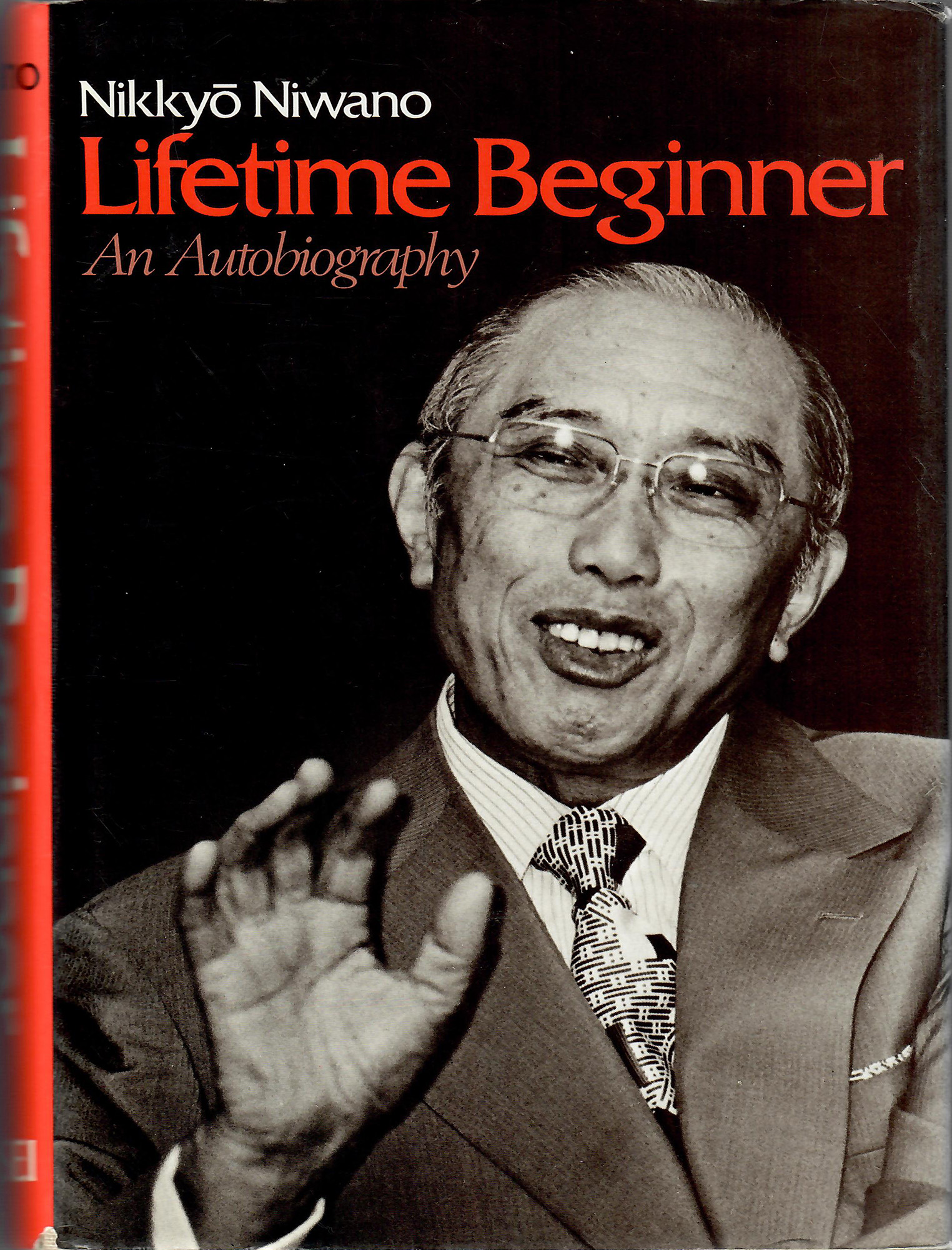
Lifetime Beginner bookcoverI recently finished reading Nikkyō Niwano’s autobiography Lifetime Beginner and, frankly, I’m glad that I read Buddhism for Today before reading this. The book was originally published in Japan in 1975 and the first English translation published in 1978. As explained by Rissho Kosei-kai:

This is a refreshingly candid account of the author’s life, from his childhood on a small farm in northern Japan, through his years of religious search, and finally to the founding and growth of Rissho Kosei-kai, a lay Buddhist organization with well over six million members throughout the world.

As with all things Rissho Kosei-kai, I’m ambivalent, but rather than dwell on the troublesome aspects I want to underscore the important teaching I found.

Two Halves of the Lotus Sutra

The Lotus Sutra is divided into two sections. In the first half, defined as the “Law of Appearance,” the World-honored One, the historical Buddha, Shakyamuni, discusses the organization of the universe, human life, and human relationships on the basis of his experience and enlightenment. This section of the sutra teaches human beings how they ought to live. In the second half, the “Law of Origin,” Shakyamuni Buddha expands his teachings. For the first time, he says that the true Buddha exists without beginning and without end and that he himself has consistently preached the Law and taught people throughout the universe since the infinite past.

The Buddha of the Law of Origin—the Eternal Original Buddha— is the basic life-force of the universe; he is the truth, life, and law of the entire cosmos. The teachings of the Law of Origin inform us that by tuning the wavelength of our own lives to that of the universe we can achieve the spiritual state we should attain and become truly happy. The Law of Appearance contains what is often called the expedient teachings; the Law of Origin contains the true teachings. The former is essential for a transition into the latter, but neither teaching is superior to the other: they are the complementary halves of a single Truth. (p160)

The Essential Unity

The completely egalitarian Lotus Sutra teaches that not only human beings but all beings in the universe share the potential to attain buddhahood through full manifestation and complete development of their essences, each according to their true natures. When all things, including humanity, have attained this state, we shall achieve perfect peace in the Land of Eternally Tranquil Light, which ought to be the ultimate goal of all mankind.

This is the ideal concept of the teachings of the Lotus Sutra, but it is not sufficient to save man, who is weak and requires spiritual support to be able to live in peace. All things in the world of phenomena are transient, and nothing is permanent enough to serve as a spiritual support except the Eternal Original Buddha, the great force of life that is the origin of the universe. Human beings and all other beings are but visible manifestations of this great invisible universal life-force.

Since the life-force is eternal and indestructible, in essence human life too is eternal, though the manifested physical body dies. A person enlightened to this truth in the deepest part of his understanding experiences everlasting tranquility. This very tranquility itself is at the same time the joy of life that throbs in man’s physical and spiritual being.

Profound enlightenment to this truth leads to an awareness of the essential unity binding all things into one great family of life. This awareness in turn inspires a deep sense of equality and love for all beings, a greater love that is called compassion. A person who is compassionate in this sense is truly valuable, and a society of such people is a paradise. This is fundamental in the teachings of the Lotus Sutra. Living daily in correct spiritual and physical attunement with these teachings inspires the joy of living with the Eternal Original Buddha, generates love and compassion, and eliminates the need for the kind of spiritual support provided by revelations from protective deities.
(p161-162)

Bruce Springsteen told the concert crowd at Amalie Arena in Tampa, Fla., on Wednesday, Feb. 1, 2023, “At 15, it’s all tomorrows. And at 73, it’s a whole lot of yesterdays.” That’s certainly how I feel today at 71 years of age. I wish I had heard at age 15 the advice Nikkyō Niwano gave to Rissho Kosei-kai youth in January 1958:

“You young people are filled with energy and with the power to absorb things. This is why I want all of you to read at least part of the Threefold Lotus Sutra daily. Even a few lines are enough if you are very busy. But try to read the entire sutra once a month. If you do this, in three or four years you will make new spiritual discoveries within yourself. These discoveries will be an inspiration to you and will bring great light and good tidings into your life. Remember that we make our own happiness. And with this in mind, go forward with determination.” (p170-171)

In March 2015, I began my 32 Days of the Lotus Sutra Practice. Next month will mark the completion of the eighth year of my monthly reading of the Lotus Sutra. In that time I’ve made “new spiritual discoveries” and these discoveries have brought “great light and good tidings” into my life.

The Work of the Buddha Is Never Fully Done

There is no division between us and them or self and other. Namu Myoho Renge Kyo manifests what’s in our mind and everything beyond our minds from the perspective of the Original Buddha. The trick is for us to operate from that perspective of the Original Buddha within us. That’s incredibly difficult to maintain in every moment of one’s life. It’s not impossible; just hard. There is no easy path to enlightenment, as you can see. The work of the Buddha, our work, is never fully done.

Important Matters, p 56

The ‘Actual’ Three Great Secret Dharmas

These three great secret dharmas are certainly what I, Nichiren, at the head of the group of bodhisattvas emerged from underground received from Lord Śākyamuni Buddha orally more than 2,000 years ago. Therefore, what I practice today are the “actual” three great secret dharmas revealed in “The Life Span of the Buddha” chapter, which are exactly the same as what was transmitted on Mt. Sacred Eagle without a shred of difference.

Sandai Hiho Honjo-ji, The Transmission of the Three Great Secret Dharmas, Writings of Nichiren Shōnin, Doctrine 2, Page 290-291

Daily Dharma – Feb. 3, 2023

The father thought, ‘These sons are pitiful. They are so poisoned that they are perverted. Although they rejoice at seeing me and ask me to cure them, they do not consent to take this good medicine. Now I will have them take it with an expedient.’

The Buddha gives this description as part of the Parable of the Wise Physician in Chapter Sixteen of the Lotus Sūtra. In the story, the physician’s children have mistakenly taken poison, yet refuse the remedy their father provides for them. The children are just like us as we cling to our attachments and delusions and refuse the good medicine of the Buddha Dharma. This refusal can be for many reasons. The children may think the remedy is worse than the poison. They may be holding out for another remedy that may be even more pleasant. They may enjoy being poisoned. They may not trust that their father can cure them. As the father in the story faked his death to bring the children to their right minds, the Buddha seems to disappear from our lives so that we may learn to accept the teaching he provides for us. And as the father reappeared to the children once they took the remedy, the Buddha reappears to us when we practice his teaching.

The Daily Dharma is produced by the Lexington Nichiren Buddhist Community. To subscribe to the daily emails, visit zenzaizenzai.com

Day 31

Day 31 covers Chapter 27, King Wonderful-Adornment as the Previous Life of a Bodhisattva.


Having last month considered how the king’s two sons were his teacher, we conclude Chapter 27, King Wonderful-Adornment as the Previous Life of a Bodhisattva.

“King Wonderful-Adornment came down from the sky and said to that Buddha [staying in the sky], ‘World-Honored One! You are exceedingly exceptional. You have merits and wisdom. Therefore, the fleshy tuft on your head shines bright. Your eyes are long, wide, and deep blue in color. The curls between your eyebrows are as white as a bright moon. Your teeth are white, regular and bright. Your lips are as red and as beautiful as the fruits of a bimba-tree.’

“Thereupon King Wonderful-Adornment, having praised the Buddha for his many hundreds of thousands of billions of merits including those previously stated, joined his hands together towards the Tathāgata, and with all his heart, said to that Buddha again, ‘World-Honored One! I have never seen anyone like you before. Your teachings have these inconceivable, wonderful merits. The practices performed according to your teachings and precepts are peaceful and pleasant. From today on, I will not act according to my own mind. I will not have wrong views, arrogance, anger or any other evil thought.’ Having said this, he bowed to that Buddha and retired.”

The Buddha said to the great multitude:

“What do you think of this? King Wonderful-Adornment was no one but Flower-Virtue Bodhisattva of today. Queen Pure-Virtue was no one but the Light-Adornment-Appearance Bodhisattva who is now before me. She appeared in that world out of her compassion towards King Wonderful-Adornment and his attendants. The two sons were Medicine-King Bodhisattva and Medicine-Superior Bodhisattva of today. Medicine-King Bodhisattva and Medicine-Superior Bodhisattva have already obtained those great merits. Because they planted the roots of virtue under many hundreds of thousands of billions of Buddhas [in their previous existence], they obtained those inconceivable merits. All gods and men in the world should bow to those who know the names of these two Bodhisattvas.”

When the Buddha expounded this chapter of King Wonderful-Adornment as the Previous Life of a Bodhisattva, eighty-four thousand people released themselves from the dust and dirt of illusions, and had their eyes purified enough to see all teachings.

The Daily Dharma from Sept. 27, 2022, offers this:

World-Honored One! I have never seen anyone like you before. Your teachings have these inconceivable, wonderful merits. The practices performed according to your teachings and precepts are peaceful and pleasant. From today on, I will not act according to my own mind. I will not have wrong views, arrogance, anger or any other evil thought.

King Wonderful-Adornment makes this declaration to Cloud-Thunderpeal-Star-King-Flower-Wisdom Buddha in Chapter Twenty-Seven of the Lotus Sūtra. The king had been led to this Buddha by his sons, who showed him the wonders they learned from their practice of the Buddha Dharma. With his mind purified by hearing the Buddha’s teachings, he makes this aspiration to behave differently. Whether or not he can keep this aspiration, he shows his realization that hearing the teachings is not enough. Practicing them means changing our minds and how we live.

The Daily Dharma is produced by the Lexington Nichiren Buddhist Community. To subscribe to the daily emails, visit zenzaizenzai.com

The Importance of Faith and Practice

Whether the focal point of your gazing or veneration is a mandala Gohonzon or a statue arrangement Gohonzon, there is no doctrinal distinction. They are all equal. In Nichiren Shu, there are five versions of the object of worship that are recognized: a full statue arrangement, a full calligraphic scroll, the single phrase Namu Myoho Renge Kyo, a statue of the Buddha, a statue of the Buddha and Namu Myoho Renge Kyo. Each is equal to the others. Never fear that because you don’t have all the statues you are somehow missing out. Regardless of which one you have or if you have none, it is your faith and practice that is most important.

Important Matters, p 55-56

The Mirror of the Lotus Sūtra

How does the mirror of the Lotus Sūtra reflect on those who put faith in the Lotus Sūtra during the Latter Age of Degeneration as stated in the sūtra? Śākyamuni Buddha unmistakably declares that they are the ones who made offering to ten trillion Buddhas in the past (in the “Teacher of the Dharma” chapter).

Concerned that ordinary people in the Latter Age of Degeneration might not believe in the words uttered by just one Buddha, the Buddha of Many Treasures in the Treasure Purity World to the east far away beyond many countries took the trouble of making a trip to this world in order to see Śākyamuni Buddha and testify that the Lotus Sūtra contains nothing but the truth.

Could there be any doubt unresolved after this? Nevertheless, perhaps because ordinary people in the Latter Age of Degeneration may not be wholly convinced, numerous Buddhas were summoned throughout the universe to stretch their long and wide tongues, which told nothing but the truth from incalculable kalpa (aeons) ago till today, upward high in the sky like Mt. Sumeru. This was indeed an event of great significance.

Therefore, if an ordinary person in the Latter Age of Degeneration believes in even one or two words of the Lotus Sūtra, it is equivalent to embracing the truth set forth by the tongues (dharmas) of Buddhas throughout the universe.

Hokke Shōmyō-shō, Treatise on the Testimony of the Lotus Sūtra, Writings of Nichiren Shōnin, Faith and Practice, Volume 4, Page 184-185

Daily Dharma – Feb. 2, 2023

The merits of the [fiftieth] person
[Who hears this sūtra] are immeasurable.
Needless to say, so are the merits of the first person
Who rejoices at hearing it in the congregation.

The Buddha sings these verses to Maitreya Bodhisattva in Chapter Eighteen of the Lotus Sutra. This chapter includes a story of a person who hears the Wonderful Dharma, then explains it to the best of their ability to someone else. In this way there is a chain of fifty people who hear versions of this teaching modified by the capacities of those transmitting it. The effectiveness of this teaching does not depend on who delivers it. No matter what our capacity, any of us can teach the Lotus Sutra and practice it in our lives.

The Daily Dharma is produced by the Lexington Nichiren Buddhist Community. To subscribe to the daily emails, visit zenzaizenzai.com