All posts by John Hughes

Daily Dharma – Feb. 6, 2023

He will be able to know by smell
What a man or a woman is thinking of,
Or whether he or she is greedy, ignorant or angry,
Or whether he or she is doing good.

The Buddha gives this explanation to Constant-Endeavor Bodhisattva in Chapter Nineteen of the Lotus Sūtra, describing those who keep the Lotus Sūtra. As Bodhisattvas we chose to come into this world, as frightening and dangerous as it is, to make things better for all beings. We do not lose any of the six senses we have, but learn to use them in ways that may seem impossible to others. Any of our senses can be deluded. When we remove our attachments and delusions, we see with the Buddha’s eye the world as it is.

The Daily Dharma is produced by the Lexington Nichiren Buddhist Community. To subscribe to the daily emails, visit zenzaizenzai.com

Another Innumerable Day Before Day 1

Having last month considered the teachings that followed the Buddha arising from beneath the bodhi tree, we consider that the buddhas have but one message.

“O you of good intent! I expounded the Four Noble Truths for the benefit of those seeking to become śrāvakas during the initial period; yet, eight hundred million heavenly beings came down to hear teaching and awakened the aspiration for enlightenment. I spoke about the sublimely profound twelve-linked chain of dependent origination at various locations during the middle period for the benefit of people seeking to become pratyekabuddhas; nevertheless, innumerable living beings awakened the aspiration for enlightenment or remained as śrāvakas. I next described kalpas-long bodhisattva practice by expounding twelve types of comprehensive sutras, the Great Perfection of Wisdom Sutra (Mahāprajñāpāramitā-sūtra), and the similes of clouds and oceans in the Flower Garland Sutra (Avataṃsaka-sūtra); even so, a hundred thousand monks, hundreds of millions of myriads of human and heavenly beings, and innumerable living beings15 attained the fruit of entering the stream, attained the fruit of one remaining return, attained the fruit of non-returning, attained the fruit of arhatship, or stayed within their understanding of the principle of dependent origination as pratyekabuddhas. O you of good intent! Accordingly, it should be known that even though the discourse is the same, its meaning will vary. Because the meaning varies, living beings have various understandings. Because their understanding varies, so also does their grasp of the Dharma, their attainment of its fruits, and their realization of the Way.

“And so, you of good intent, starting from when I established the Way and first began to expound the Dharma, until this moment in which I am discoursing on the all-ferrying Infinite Meanings Sutra, there has never been a time when I have not expounded suffering, emptiness, ever changingness, nonexistence of self, non-reality, non-unreality, non- greatness, non-smallness, intrinsic non-origination,16 continuing non-cessation, the formlessness of all things, that aspects and natures of phenomena neither come nor go, and that the four modes are the dynamic of living beings.

“O you of good intent! What all this means is that the buddhas have but one message: they are able to conform universally to all voices by means of a single sound. From a single body they are able to manifest embodiments as countless and immeasurable as millions upon millions of myriads of Ganges Rivers’ sands; then, in each embodiment, manifest various shapes as countless as millions upon millions of myriads of Ganges Rivers’ sands; then, in each shape, display appearances as countless as some millions upon millions of myriads of Ganges Rivers’ sands. O you of good intent! This, in fact, is the profound and unimaginable realm of all of the buddhas! It is neither knowable by those of the two vehicles nor reachable by bodhisattvas in the tenth development stage! Only a buddha together with a buddha can fathom it completely! O you of good intent! Thus do I expound the transcendent, profound, incomparable, all-ferrying Infinite Meanings Sutra! Its content and principles are true and correct, and its value is supreme and unsurpassed. It is embraced by the buddhas of the past, present, and future together. It is impervious to the influence of disruptive forces and the influence of differing views, and is neither corrupted nor destroyed by any deluded perception or the cycle of births and deaths. If great-being bodhisattvas wish to achieve ultimate enlightenment quickly, they should achieve mastery in the practice of this deeply profound, unsurpassed, all-ferrying Infinite Meanings Sutra.”

See Immeasurable Meanings From One Dharma

A Tiny Blessing

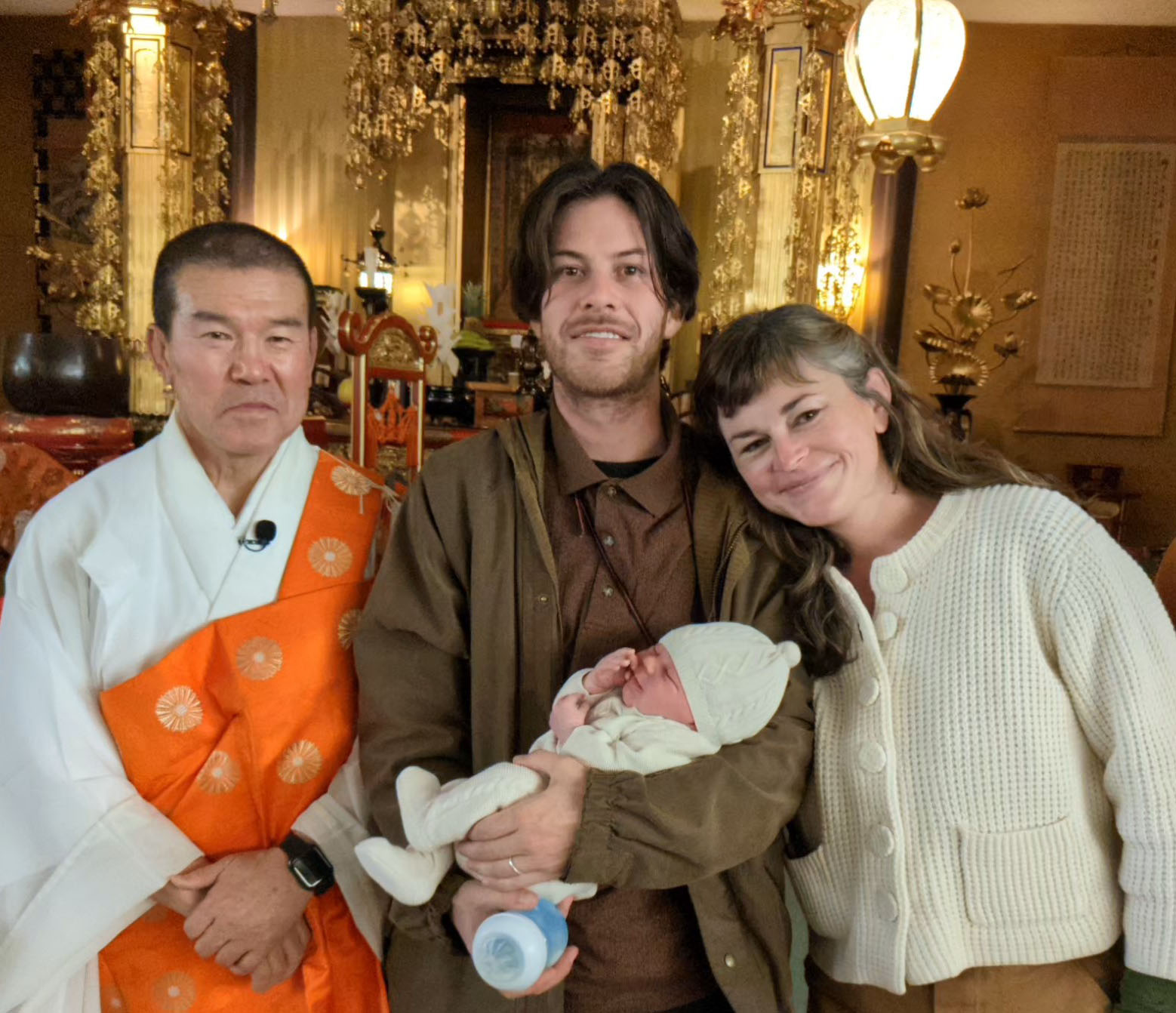
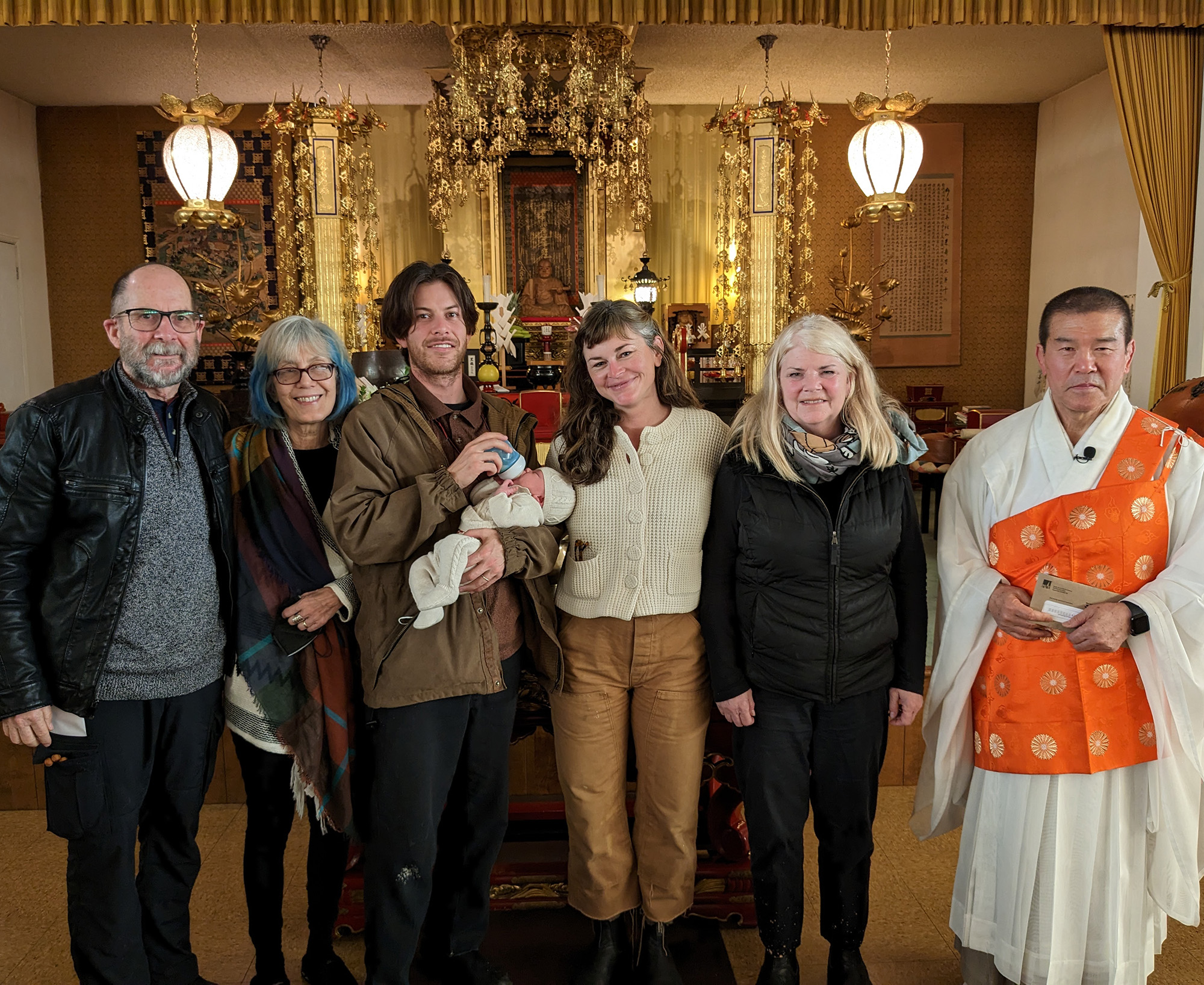
Rev. Igarashi blesses Edwin Lou Woodford Hughes during Setsubun service

Today was the Setsubun service at the Sacramento Nichiren Buddhist Church.

Setsubun literally means ‘season-division,’ dividing Winter from Spring. Prayers are said for our good health and protection against calamity or misfortunes. Traditionally, toshi-otoko (a man of the year) and yoshi-onna (a woman of the year), who were born in the year with the same animal name as the current year, throw soy beans to chase out evil spirits from each house and throw hard candy to welcome good luck throughout the year. At the Sacramento Nichiren Buddhist Church we toss the candy into the audience and afterward hand out envelopes of roasted soy beans. This year was my turn – Year of the Rabbit – to toss the candy.

This was a special Setsubun because it was the first time my grandson, Edwin Lou Woodford Hughes, attended services. He was born just two weeks ago on Jan. 21, 2023. Rev. Igarashi gave his standard Setsubun purification to all in the congregation and then invited my son, Richard, to bring up Edwin to receive a special blessing. Amazingly, Edwin slept through it all.

Rev. Igarashi, Richard and Edwin and Alexis

Grandparents to the left; grandmother to the right and the Venerable Rev. Igarashi

The Ocean of the Odaimoku

Think about the Odaimoku manifesting in our minds and hold the image of that Odaimoku as a great ocean. There are numerous waves, and they are formed due to a variety of causes. Some waves are the result of the gravitational pull of the moon. Various winds also cause waves. Further causes for waves are the geographic formations beneath the surface of the ocean.

Consider your mind and what sorts of waves are being created by your thoughts. In my case, my thoughts sometimes create those huge tropical storm waves and storm surge. You may, however, never make such waves. Your waves may be the gentle ones formed by gentle thoughts. Sometimes my ocean is calm and at other times it can be extremely stormy and hazardous to any ships or surfers. Other times I might get lucky and create the perfect surfing wave, and I’m imagining

Important Matters, p 57-58

Knowing Nichiren

Professor Jacqueline Stone
Tricycle Magazine

The Spring 2023 issue of Tricycle Magzazine has an excellent interview with Princeton Emerita Professor Jacqueline Stone discussing the history of Nichiren Buddhism. I highly recommend Knowing Nichiren.

The Words of Lotus Sūtra Are the Mind of the Buddha

Those who read the Lotus Sūtra, therefore, should not regard it as consisting of merely written words. The words are the mind of the Buddha. Grand Master T’ien-t’ai states:

“When the Buddha was requested to expound the Lotus Sūtra, He preached the meaning of the teachings, not merely the words of the sūtra. The meaning of the teaching is the mind of the Buddha, which is the insight of the Buddha. The insight of the Buddha is so profound that the Buddha declined three times to preach it. He agreed to expound it only upon the fourth request. Why was it necessary to make such a difficult arrangement? It is because the Lotus Sūtra expounds the insight of the Buddha. Other sūtras were preached simply without such an arrangement.”

The “mind of the Buddha” in this commentary arises from the interpretation that the Lotus Sūtra, which is itself of the physical aspect, is of the spiritual aspect. When we define the Lotus Sūtra as the spiritual aspect and enshrine it alongside a wooden or painted image of the Buddha with 31 marks of physical excellence, the image itself becomes the living Buddha. This is what is called the attainment of Buddhahood by trees and plants.

Mokue Nizō Kaigen no Koto, Opening the Eyes of Buddhist Images, Wooden Statues or Portraits, Writings of Nichiren Shōnin, Faith and Practice, Volume 4, Page 91-92

Daily Dharma – Feb. 5, 2023

Although I shall never enter into Nirvāṇa, I say to men of little virtue, ‘I shall pass away.’ I teach them with this expedient. Why is that? It is because, if they see me for a long time, they will not plant the roots of good, but become poor and base, and cling to the five desires so much that they will be caught in the nets of wrong views.

The Buddha gives this explanation in Chapter Sixteen of the Lotus Sutra. This Chapter is the first time he reveals himself as the Ever-Present Buddha who became enlightened in the far distant past and will continue to lead all beings to enlightenment into the far distant future. The Buddha uses the death of his physical body as an expedient so that those who take him for granted will make efforts to practice his teachings. When we practice the Wonderful Dharma of the Lotus Sūtra, then we learn to see the Buddha in ourselves and all beings.

The Daily Dharma is produced by the Lexington Nichiren Buddhist Community. To subscribe to the daily emails, visit zenzaizenzai.com

Between Day 32 and Day 1: The Function of Your Sense Faculty of Sight

Having last month considered the instructions for the purification of the six sense faculties, we consider the sense faculty of sight.

Throughout innumerable existences, the function of your sense faculty of sight has caused you to yearn for and become attached to various kinds of forms. Because of your attachments to various forms, you are passionate about the smallest of matters. Because of your passions for the smallest of matters, your body is derived from a woman.22 Wherever you take birth, in life after life, you are attracted and attached to all kinds of forms. Forms spoil your eyes, and you become a slave to emotion and passion: forms thus make you23 wander throughout the three realms. Such impairment renders you blind, so that you can perceive nothing.

Now, take the comprehensive Great Vehicle sutras to heart! In these sutras it is taught that forms and embodiments of the buddhas of the ten directions never cease to exist: you must now be able to recognize whether or not this is true! The dysfunction of your sense faculty of sight does you great harm! Heed what we are saying: Take refuge in the buddhas and in Śākyamuni Buddha! Regarding the impurities and faults in your sense faculty of sight, say this:

“May I be cleansed and be made to become pure by means of the Dharma water of the profound insight24 of buddhas and bodhisattvas!”

After saying these words, the practitioner must pay homage to the buddhas of the ten directions and, directing his or her heart and mind toward Śākyamuni Buddha and the Great Vehicle sutras, speak again, saying:

“I now recognize that heavy impurities obstruct, cloak, defile, and cloud my sense faculty of sight: I am blinded and can perceive nothing! May the Buddha, with great mercy and compassion, protect me! O Bodhisattva Universal Sage – aboard the great ship of Dharma in company with countless bodhisattvas of the ten directions, universally ferrying all living beings: Out of compassion and sympathy for me, please accept my way of amending myself of the unwholesome and harmful encumbrances of my sense faculty of sight!”

The practitioner must say this three times, prostrate him- or herself on the ground, and maintain right mindfulness of the Great Vehicle, neither forgetting nor forsaking it. This is called the method of self-amendment regarding impurities of the sense faculty of sight.

One who calls upon the buddhas by name, burns incense, scatters flowers, generates a Great Vehicle consciousness, hangs banners, flags, and canopies, speaks to the faults and afflictions of the eye, and undertakes self-amendment for his or her impurities will behold Śākyamuni Buddha in this present world and innumerable buddhas emanated from him as well. He or she will not fall into bitter conditions for countless kalpas of time. Through the affirmation and the power of the Great Vehicle, such a person will constantly be among and accompany all of the bodhisattvas that possess Dharma-grasping empowerments. Producing such a focus of mind is the effecting of right mindfulness; focusing on other things is described as aberrant thought. This is said to be the condition of the first stage with regard to the sense faculty of sight.

See The Eye of Buddhas

Inside the Odaimoku

The Odaimoku in the center of the Mandala Gohonzon is manifesting the entity of the Original Buddha in our mind. As such, it contains all the Buddhas of the ten directions — the four cardinal points, the intersections between each, and the zenith and nadir. It also contains all the sentient beings of all the Dharma realms, the lands of those realms and, in fact, everything in them. In other words, everything is contained in and embraced by Namu Myoho Renge Kyo.

Important Matters, p 56

Guiding People with the Lotus Sūtra from the Beginning

QUESTION: If the Buddha preached the Lotus Sūtra not at the beginning but after four decades of preaching lest the people might slander the sūtra, why do you suddenly expound the Lotus Sūtra without preaching the provisional sūtras first, causing the people to slander the True Dharma and fall into the evil realms?

ANSWER: While in this world the Buddha sat under the bodhi tree contemplating the capacity of the people. He foresaw that preaching the Lotus Sūtra then would cause the people to slander it and fall into the evil realms, but preaching it 40 years or so later would not cause them to slander it; instead, it would cause them to enter the way of bodhisattvas attaining the rank of shojü (state of non-regression) or even the highest rank of myōkaku (wonderful enlightenment).

In the Latter Age of Degeneration, however, it seems that there is no person equipped with the capacity to be saved by the Buddha’s dharma, not even one out of 10,000, who would be able to enter the rank of shojū. Also Buddhist masters who guide the people are no longer Buddhas, who can make judgment about the capability of the people to understand and accept the Buddha’s teaching. Therefore, the Buddha has permitted us to guide the people, both believers (who will attain Buddhahood by following the Buddha’s teaching) and non-believers (who will eventually attain Buddhahood through the merit of reverse relationship), with the Lotus Sūtra from the beginning. Even after the death of the Buddha, however, the provisional sūtras may be preached first for those whose capacity is not for the Lotus Sūtra. Also, those who place emphasis on giving joy to the people should preach provisional sūtras first just as Śākyamuni Buddha did, while those who emphasize relieving the people of their sufferings first should preach the true Lotus Sūtra just as Never-Despising Bodhisattva did.

Ken Hōbō-shō, A Clarificaton of Slandering the True Dharma, Writings of Nichiren Shōnin, Doctrine 3, Pages 119-120.