
All posts by John Hughes

Day 23

Day 23 covers all of Chapter 18, The Merits of a Person Who Rejoices at Hearing This Sutra, and opens Chapter 19, The Merits of the Teacher of the Dharma.

Having last month considered merits to be received by encouraging others to hear this sutra, we consider in gāthās the merits of the 50th person who rejoices at hearing this sutra.

Thereupon the World-Honored One, wishing to repeat what he had said, sang in gāthās:

Suppose a man rejoices at hearing this sūtra
Or at hearing even a gāthā of it
In a congregation,
And expounds it to a second person.

The second person expounds it to a third person.
In this way it is heard by a fiftieth person.
Now I will tell you of the merits
Of the fiftieth person.

Suppose there was a great almsgiver.
He continued giving alms
To innumerable living beings
For eighty years according to their wishes.

Those living beings became old and decrepit.
Their hair became grey; their faces, wrinkled;
And their teeth, fewer and deformed.
Seeing this, he thought:
“I will teach them because they will die before long.
I will cause them to obtain the fruit of enlightenment.”

Then he expounded the truth of Nirvana to them
As an expedient, saying:
“This world is as unstable
As a spray of water,
Or as a foam, or as a filament of air.
Hate it, and leave it quickly!”

Hearing this teaching, they attained Arhatship,
And obtained the six supernatural powers,
Including the three major supernatural powers,
And the eight emancipations.

The superiority of the merits of the fiftieth person
Who rejoices at hearing even a gāthā [of this sūtra]
To the merits of this [great almsgiver]
Cannot be explained by any parable or simile.

The merits of the [fiftieth] person
[Who hears this sūtra] are immeasurable.
Needless to say, so are the merits of the first person
Who rejoices at hearing it in the congregation.
See Merits of an Ignorant Person Who Rejoices

Deluded Views and Wrong Attitudes

The truth of the cause of suffering concerns the accumulation of ignorance and attachment that produces suffering. It is the same as obsession with false views and wrong attitudes. The cause of suffering is the result of false views and confused thinking as well as emotional afflictions or defilements. Deluded views are classified into 88 defilements and wrong attitudes into 81 degrees.
The 88 defilements of deluded views can be divided into ten major categories:

  1. Mistaken view of an independent, unchanging self
  2. Extreme views of either nihilism or eternalism
  3. Attachment to false views
  4. Attachment to non-Buddhist precepts
  5. Wrong views denying causality
  6. Greed
  7. Hatred
  8. Ignorance
  9. Arrogance
  10. Debilitating doubt

When included under each of the four noble truths of the triple world, these ten defilements differ in quantity but total eighty-eight.

History and Teachings of Nichiren Buddhism, p 111

Candle Power

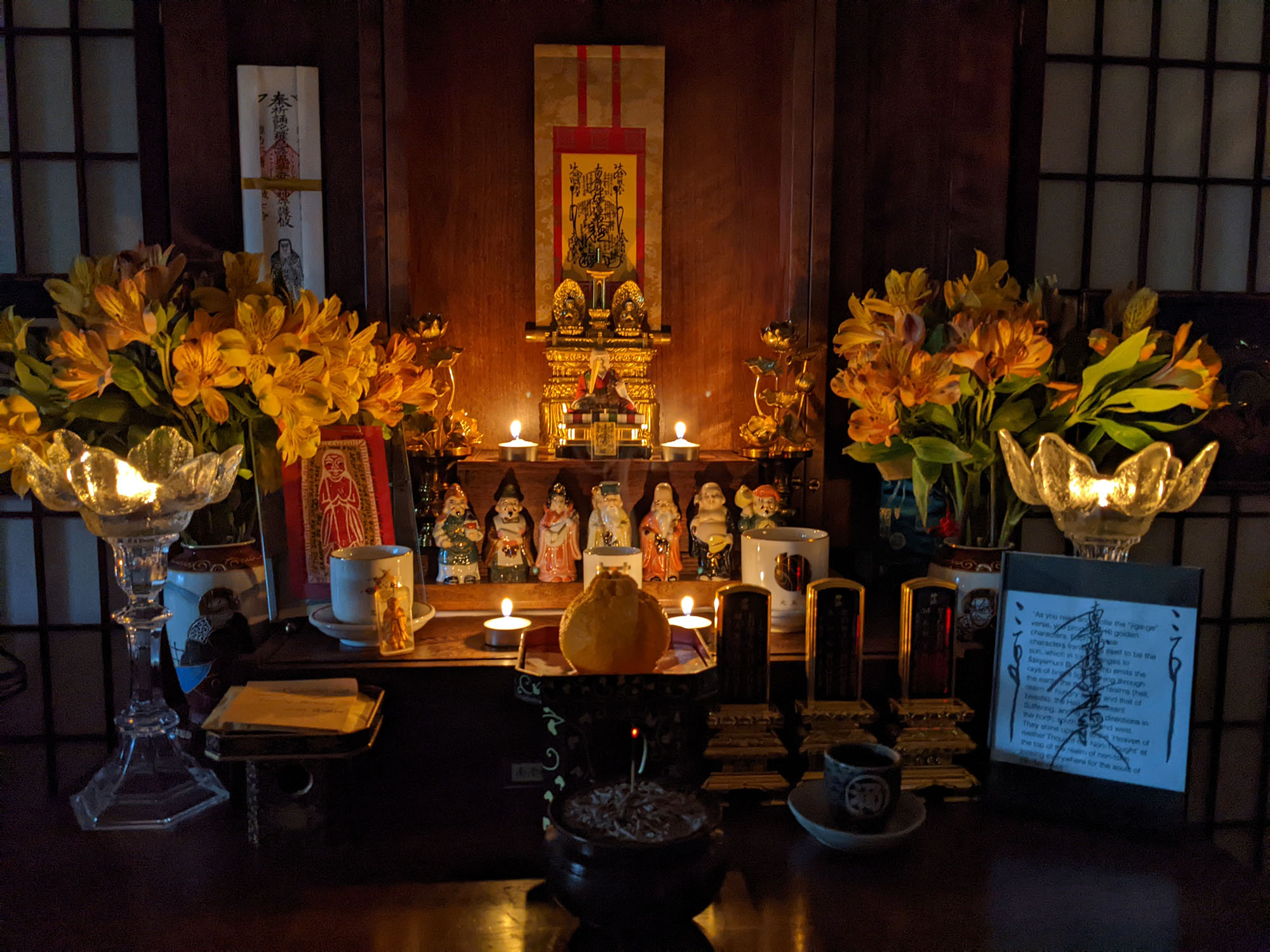
This morning just as I was going to start chanting Daimoku the power went out. I added a few candles to illuminate the altar and resumed chanting Daimoku. A half-hour later, just as I was concluding my morning service with a final Namu Myoho Renge Kyo, the power returned and the lights snapped on. We need the rain here in California but I’m not sure we need this much wind.

Daily Dharma – Dec. 13, 2021

Anyone who rejoices at hearing this sūtra,
And who receives it respectfully,
Know this, has already reached
The stage of not-returning.

The Buddha sings these verses in Chapter Three of the Lotus Sūtra. The state of non-returning means having the certainty of reaching enlightenment. As Bodhisattvas, when we go into any realm, whether higher or lower, it is to benefit the beings there. It is easy to become discouraged by the difficulties we face in this world of conflict, and to forget that we are not alone in our efforts to help others. When we return to the joy of the Lotus Sūtra, the Buddha reminds us of who we are, what we are doing, and where we are going, no matter what obstacles we may find.

The Daily Dharma is produced by the Lexington Nichiren Buddhist Community. To subscribe to the daily emails, visit zenzaizenzai.com

Day 22

Day 22 covers all of Chapter 17, The Variety of Merits.

Having last month concluded Chapter 17, The Variety of Merits, we return to the top and consider the merits earned at hearing the duration of the Buddha’s life was so many kalpas.

Thereupon the innumerable, asaṃkhya living beings in the great congregation, who had heard from the Buddha that the duration of his life was so many kalpas as previously stated, obtained great benefits.
At that time the World-Honored One said to Maitreya Bodhisattva-mahāsattva:

“Ajita! When I said that the duration of my life was so long, six hundred and eighty billion nayuta living beings, that is, the living beings as many as there are sands in the River Ganges, obtained the truth of birthlessness. Bodhisattva-mahāsattvas numbering one thousand times the number of these living beings obtained the dharanis by which they could memorize all that they had heard. Bodhisattva-mahāsattvas as many as the particles of earth of a Sumeru-world obtained eloquence without hindrance. Another group of Bodhisattva-mahāsattvas as many as the particles of earth of a Sumeru world obtained the dharanis by which they could memorize many hundreds of thousands of billions of repetitions of teachings. Bodhisattva-mahāsattvas as many as the particles of earth of one thousand million Sumeru-worlds obtained the faculty of turning the irrevocable wheel of the Dharma. Bodhisattva-mahāsattvas as many as the particles of earth of one million Sumeru-worlds obtained the faculty of turning the wheel of the pure Dharma. Bodhisattva-mahāsattvas as many as the particles of earth of one thousand Sumeru-worlds obtained the faculty of attaining Anuttara-samyak-saṃbodhi after eight rebirths. Bodhisattva-mahāsattvas four times the number of the particles of earth of the four continents obtained the faculty of attaining Anuttara-samyak-saṃbodhi after four rebirths. Bodhisattva-mahāsattvas three times the number of the particles of earth of the four continents obtained the faculty of attaining Anuttara-samyak-saṃbodhi after three rebirths. Bodhisattva-mahāsattvas twice the number of the particles of earth of the four continents obtained the faculty of attaining Anuttara-samyak-saṃbodhi after two rebirths. Bodhisattva-mahāsattvas as many as the particles of earth of the four continents obtained the faculty of attaining Anuttara-samyak-saṃbodhi immediately after this life. Living beings as many as the particles of earth of eight Sumeru-worlds aspired for Anuttara-samyak-saṃbodhi.”

When the Buddha said that these Bodhisattva-mahāsattva had obtained the great benefits of the Dharma, [the gods) in heaven rained mandārava-flowers and mahā-mandārava-flowers on the many hundreds of thousands of billions of Buddhas sitting on the lion-like seats under the jeweled trees. They also rained those flowers on [the two Buddhas:] Many-Treasures Tathāgata, who had passed away a long time ago, and Śākyamuni Buddha, both of whom were sitting on the lion-like seat in the stupa of the seven treasures. They also rained those flowers on the great Bodhisattvas’ and the four kinds of devotees. They also rained the fine powder of the incense of candana and aloes [on them). Heavenly drums automatically sounded wonderful and deep in the sky. [The gods] also rained thousands of heavenly garments and hung many necklaces made of pearls, mani gems or free-at-will gems over the nine quarters. They also burned priceless incense which was put in incense-burners of many treasures. The incense-burners automatically went around the great congregation, and the odor of the incense was offered to all the members of the congregation. Above each of the Buddhas [sitting under the trees), Bodhisattvas lined up vertically one upon another to the Heaven of Brahman, holding canopies and streamers. They praised the Buddhas, singing innumerable verses with their wonderful voices.

See Four Stages of Faith, Five Stages of Practice

Morality by the numbers

The five grave offenses are: killing one’s father; killing one’s mother; killing an arhat; injuring a buddha; and causing a schism in the saṃgha.

The ten evil acts are: the physical evils of killing, stealing, and sexual misconduct; the verbal evils of lying, harsh speech, malicious speech, and idle chatter or gossip; and the mental evils of giving in to covetousness, ill-will, and wrong views or foolishness.

The five virtues are: benevolence, righteousness, propriety, wisdom, and faithfulness.

The ten good acts consist of refraining from committing the ten evil acts.

The five precepts are not to kill, not to steal, not to engage in sexual misconduct’ not to lie, and not to consume intoxicants.

p110

Consequences

The Lotus Sūtra, fascicle 7 (the “Never-Despising Bodhisattva” chapter) preaches: “Among the four kinds of devotees, there were some who had impurity in mind and gave way to anger. They spoke ill of the bodhisattva, called him an ignorant priest, … struck him with a stick or a piece of wood or a piece of tile or a stone. … Upon death, they underwent great torment in the Avīci Hell for 1,000 kalpa.” This scriptural statement means that those who abused the practicer of the Lotus Sūtra or struck him with a stick, unable to atone for their sins, had to suffer in the Avīci Hell for as long as 1,000 kalpa.

Ken Hōbō-shō, A Clarificaton of Slandering the True Dharma, Writings of Nichiren Shōnin, Doctrine 3, Pages 114.

Daily Dharma – Dec. 12, 2021

Because they did sinful karmas,
They lose pleasures and the memory of pleasures.
They are attached to wrong views.
They do not know how to do good.
They are not taught by a Buddha;
Therefore, they fall into the evil regions.

The Heavenly-King Brahmas from the zenith sing these verses to Great-Universal-Wisdom-Excellence Buddha in Chapter Seven of the Lotus Sūtra. They describe how beings live in a world in which they can find no Buddha, their joy that Great-Universal-Wisdom-Excellence Buddha has appeared, and their hope that this Buddha will lead all beings from the regions of difficulties. When these Brahmas speak of pleasure, it is not what comes from getting what we want. It is the pleasure of the Dharma, the pleasure enjoyed by all Buddhas when they become enlightened, and the pleasure available to us when we resolve to benefit all beings and practice the Buddha Dharma as Bodhisattvas.

The Daily Dharma is produced by the Lexington Nichiren Buddhist Community. To subscribe to the daily emails, visit zenzaizenzai.com

Day 21

Day 21 covers all of Chapter 16, The Duration of the Life of the Tathāgata.

Having last month considered the implications of the Parable of the Skillful Physician and His Sick Children, we repeat in gāthās how the Tathāgata has been expounding the the Dharma for countless kalpas.

Thereupon the World-Honored One, wishing to repeat what he had said, sang in gāthās:

It is many hundreds of thousands
Of billions of trillions
Of asaṃkhyas of kalpas
Since I became the Buddha.

For the past innumerable kalpas
I have always been expounding the Dharma
To many hundreds of millions of living beings
In order to lead them into the Way to Buddhahood.

In order to save the [perverted] people,
I expediently show my Nirvāṇa to them.
In reality I shall never pass away.
I always live here and expound the Dharma.

Although I always live here
With the perverted people
I disappear from their eyes
By my supernatural powers.

When they see me seemingly pass away,
And make offerings to my śarīras,
And adore me, admire me,
And become devout, upright and gentle,
And wish to see me
With all their hearts
At the cost of their lives,
I reappear on Mt. Sacred Eagle
With my Saṃgha,
And say to them:
“I always live here.
I shall never be extinct.
I show my extinction to you expediently
Although I never pass away.
I also expound the unsurpassed Dharma
To the living beings of the other worlds
If they respect me, believe me,
And wish to see me.
You have never heard this
Therefore, you thought that I pass away.”

I see the [perverted] people sinking
In an ocean of suffering.
Therefore, I disappear from their eyes
And cause them to admire me.
When they adore me,
I appear and expound the Dharma to them.

I can do all this by my supernatural powers.
I live on Mt. Sacred Eagle
And also in the other abodes
For asaṃkhya kalpas.

The Daily Dharma from Aug. 5, 2021, offers this:

I see the [perverted] people sinking
In an ocean of suffering.
Therefore, I disappear from their eyes
And cause them to admire me.

The Buddha sings these verses in Chapter Sixteen of the Lotus Sūtra. With the story of the wise physician in this chapter, the Buddha explains how he disappears from our view even though he is always present to us. The children in the story would not accept the remedy their father prepared for them to counteract the poison they had taken. Some of them hoped for another remedy, some believed the remedy would be worse than the poison. It was not until the father left and told them he would not return that the children realized the value of what they already had. When we take the Buddha for granted, as the children in the story took their father for granted, and ignore the path he has laid out for us, we lose sight of the Buddha. It is only when we realize we are lost that we look for a guide. When we bring the Buddha’s teachings to life, we find him everywhere.

The Daily Dharma is produced by the Lexington Nichiren Buddhist Community. To subscribe to the daily emails, visit zenzaizenzai.com

The Truth of Suffering

The truth of suffering states that all existence — the twenty-five states of existence, six paths, and the triple world — is bound by the suffering of repeated rebirth. Consequently, suffering is the objective circumstance of all existence.

The twenty-five states of existence classify the world into twenty-five parts, outlined as follows:

The Four Evil Destinies

1. Hell-dwellers
2. Hungry ghosts
3. Animals
4. Fighting demons

The Four Continents

5. Pūravavideha in the east
6. Jambudvīpa in the south
7. Aparagodānīya in the west
8. Uttarakuru in the north

The Six Heavens of the Desire Realm

9. Heaven of the Four Heavenly Kings
10. Heaven of the Thirty-three Gods
11. Heaven of Time
12. Heaven of Contentment
13. Heaven of Delight in Creation
14. Heaven of Controlling the Creations of Others

The Seven Heavens of the Form Realm, including the Four Heavens of Meditative Absorption

15. Heavens of Great Brahma
16. First Heaven of Meditative Absorption
17. Second Heaven of Meditative Absorption
18. Third Heaven of Meditative Absorption
19. Fourth Heaven of Meditative Absorption
20. Heaven of the Non-Percipient
21. Heavens of the Pure Abodes

The Four Formless Heavens

22. Heaven of Space
23. Heaven of Consciousness
24. Heaven of Nothingness
25. Heaven of Neither Perception Nor Non-Perception

All twenty-five of these realms exist within the triple world and the six paths. All beings will have different karma so each will have different joys and sorrows and therefore different experiences.

History and Teachings of Nichiren Buddhism, p 108-109