[This] pure world of mine is indestructible.
But the [perverted] people think:
“It is full of sorrow, fear, and other sufferings.
It will soon burn away.”
The Buddha sings these verses in Chapter Sixteen of the Lotus Sūtra. When we are not aware of our own potential for enlightenment, and of the Ever-Present Buddha Śākyamuni who is helping us and all beings to reach this potential, we can easily sink into despair. So long as we are preoccupied with suffering, when we live as if our purpose were to feel good as much as possible and feel bad as little as possible, we long for escape from this world of conflict. As we continue to grow the Buddha’s own mind within us, we see how this world is being transformed. When we know where we are going, all obstacles become stepping stones.
The Daily Dharma is produced by the Lexington Nichiren Buddhist Community. To subscribe to the daily emails, visit zenzaizenzai.com
Having last month considered the Brahman-heavenly-kings of the five hundred billion worlds in the zenith pleading with the Buddha to turn the wheel of the Dharma, we consider the 16 śramaṇeras.
“The sixteen princes were young boys at that time. They renounced the world and became śramaṇeras. Their sense organs were keen; and their wisdom, bright. They had already made offerings to hundreds of thousands of billions of Buddhas, performed brahma practices, and sought Anuttara-samyak-saṃbodhi in their previous existence. They said to the Buddha simultaneously, ‘World-Honored One! All these Śrāvakas of great virtue, many thousands of billions in number, have already done [what they should do]. World-Honored One! Expound to us the teaching of Anuttara-samyak-saṃbodhi! If we hear that teaching, we will study and practice it. World-Honored One! We wish to have the insight of the Tathāgata. You know what we have deep in our minds.’
“Seeing the sixteen princes having renounced the world, eight billion followers of the wheel-turning-holy-king begged the king to allow them to do the same. He conceded to them immediately.
“The Buddha assented to the appeal of the śramaṇeras, but it was twenty thousand kalpas afterwards that he expounded to the four kinds of devotees the sūtra of the Great Vehicle called the ‘Lotus Flower of the Wonderful Dharma, the Dharma for Bodhisattvas, the Dharma Upheld by the Buddhas.’
“When the Buddha completed the expounding of this sūtra, the sixteen śramaṇeras kept, recited and understood this sūtra in order to attain Anuttara-samyak-saṃbodhi. The sixteen śramaṇeras, [ who were] Bodhisattvas, received this sūtra by faith. Some Śrāvakas understood it by faith, but the other Śrāvakas and other living beings, thousands of billions in number, doubted it.
According to Tendai’s “Branches of the Lotus Sutra,” the parables are divided into two portions, the exposition and the explanation of correspondences.
Correspondences for the Parable of the Magic City
Just as the guide, wise and astute, knows well the perilous road, where it is open and where closed, the Tathāgata is the bhiksus’ great leader acquainted with all the distresses, evils, perils, and long-continued processes of mortality, which they must be rid of and removed from.
Just as along the way, the company he leads becomes tired, and the people tell the leader they wish to turn back, if living beings only hear of the One Buddha Vehicle they will not desire to see the Buddha nor wish to approach him, but think that the Buddha way is long and far, and only after long suffering of arduous labor can the end be reached.
It is just as when that leader, in order to give rest to the company, magically makes a great city and after they are rested informs them: “The Place of Jewels is at hand; this city is not real, but only my magic production,” the Buddha, knowing that the minds of living beings are feeble and low, by his skillful means, when they are on their way, to give them rest preaches the two stages of nirvana. If those beings dwell in these two stages, then the Tathāgata proceeds to tell them: “You have not yet accomplished your task. The place where you are dwelling is near the Buddha wisdom. Take note and ponder that the nirvana which you have attained is not the real one! It is only that the Tathāgata, through his skillful means, in the One Buddha Vehicle discriminates and speaks of three.”
As a man trained in the analytic method of Buddhist philosophy, Nichiren proceeded to determine the position he occupied in the perpetuation of the religion, after the model of his great master T’ien T’ai, deriving his material from the five conditions, or “principles,” of his mission. First, as to the doctrine, his gospel was based exclusively on the [Lotus Sutra], which was the perfect consummation of Buddhist doctrines, before which the teachings of all other branches of Buddhism must lose weight and authority. Second, as to the capacity of the people taught, mankind in the degenerate age of the Latter Days could be trained only by the simplest expression of truth, not by a complicated system of doctrine, nor by an intricate process of meditation and mysteries. Third, as to the time, his time was the age of the Latter Law, in which the [Lotus Sutra] alone would remain available for the salvation of all. Fourth, as to the country of its promulgation, Japan was the land where the true Buddhism would prevail, and whence it should be propagated throughout the whole world. Lastly, as to the order of the successive rise and fall of systems, all other forms of Buddhism had severally done their work, and Nichiren’s time was ripe for the acceptance of the Lotus, as the sole authority in religion. All the five conditions for the supremacy of the Lotus seemed to Nichiren to be fulfilled, and he regarded himself as the man destined to accomplish the work of realizing the prophecies contained in the Scripture.
This was his conviction and consolation; yet it is noteworthy that the personal thesis is not so clearly and vividly stated in this essay [“Treatise on the Doctrine, the Capacity, the Time, and the Country”], as it is in his later writings. Let us cite his own words. After having explained the five conditions, he says:
“One who would propagate the Buddhist truth, by having convinced himself of the five principles, is entitled to become the leader of the Japanese nation. One who knows that the Lotus of Truth is the king of all scriptures, knows the truth of the religion If there were no one who ‘read’ the Lotus of Truth, there could be no leader of the nation; without a leader, the nation could do naught but be bewildered, … and fall to the nethermost hells in consequence of degrading the Truth.”
After these remarks, he enumerates the passages concerning the difficulties to be encountered by the promulgators of the Truth, meaning to apply the passages to himself. It was these convictions that consoled Nichiren in the midst of dangers and inspired him with a firm belief in the future of his mission. But his conviction regarding his destiny, as well as his remote connection with the sages of the past, remained to be more exactly defined in writings from his second exile. In the essay before us, we see a decided progress in Nichiren’s trust in the Lotus of Truth, which had started on a doctrinal basis, and was destined to bring him to more personal conviction of his prophetic mission.
Chapter 3 Nichiren's Public Appearance And Persecution
The true doctrine of the “attainment of Buddhahood with the present body,” after all, has to be based on the Lotus Sūtra that reveals both doctrines of attainment of Buddhahood by men of the Two Vehicles and attainment of Buddhahood by Śākyamuni Buddha in the eternal past.
Grand Master T’ien-t’ai spoke of the “attainment of Buddhahood with the present body” doctrine, “This is kept secret and has not been revealed in provisional sūtras.” It means that the true doctrine of the “attainment of Buddhahood with the present body” is like an ambrosial scent of a chinaberry that cleanses all other sundry odors.
Ōta-dono Nyōbō Gohenji, A Response to the Wife of Lord Ōta, Writings of Nichiren Shōnin, Faith and Practice, Volume 4, Page 170
We were satisfied with the elimination
Of illusions within ourselves.
What we accomplished was that elimination.
We did nothing more.
These verses are sung by Subhūti, Mahā-Kātyāyana, Mahā-Kāśyapa, and Mahā-Maudgalyāyana in Chapter Four of the Lotus Sūtra. They use the parable of the wayward son in this chapter to describe their own realization that the Buddha had not held any teaching back from them. Instead, the Buddha earlier allowed them to remain in the satisfaction of ending their own suffering. But before they can continue their progress towards the Buddha’s own enlightenment, they must give up their preoccupation with suffering, as the boy in the parable had to give up his idea of himself as a lowly hired worker, rather than the heir to his father’s treasure.
The Daily Dharma is produced by the Lexington Nichiren Buddhist Community. To subscribe to the daily emails, visit zenzaizenzai.com
Having last month considered what happened when Great-Universal-Wisdom-Excellence Buddha attained Anuttara-samyak-saṃbodhi, we consider the reaction of the great Brahman-heavenly-kings of the five hundred billion worlds in the southeast.
“Bhikṣus! The great Brahman-[heavenly-]kings of the five hundred billion worlds in the southeast, who saw their palaces illumined more brightly than ever, danced with joy. They also wondered why [their palaces were so illumined]. They visited each other and discussed the reason. There was a great Brahman-heavenly-king called Great-Compassion among them. He said to the other Brahmans in gāthās:
Why is it
That we see this light?
Our palaces are illumined
More brightly than ever.
Did a god of great virtue or a Buddha
Appear somewhere in the universe?
We have never seen this [light] before.
Let us do our best to find [the reason].
Let us go even to the end of one thousand billion worlds,
And find the place from where this light has come.
A Buddha may have appeared somewhere in the universe
In order to save the suffering beings.
“Thereupon the Brahman-heavenly-kings of the five hundred billion [ worlds] went to the northwest, carrying flower-plates filled with heavenly flowers, in order to find [the place from where the light had come]. Their palaces also moved as they went. They [reached the Well-Composed World and] saw that Great-Universal-Wisdom-Excellence Tathāgata was sitting on the lion-like seat under the Bodhi tree of the place of enlightenment, surrounded respectfully by gods, dragon-kings, gandharvas, kiṃnaras, mahoragas, men, and nonhuman beings. They also saw that the sixteen princes were begging the Buddha to turn the wheel of the Dharma. Thereupon the Brahman-heavenly-kings worshipped the Buddha with their heads, walked around him a hundred thousand times, and strewed heavenly flowers to him. The strewn flowers were heaped up to the height of Mt. Sumeru. The Brahman-heavenly-kings offered flowers also to the Bodhi-tree of the Buddha. Having offered flowers, they offered their palaces to the Buddha, saying, ‘We offer these palaces to you. Receive them and benefit us out of your compassion towards us!’ In the presence of the Buddha, they simultaneously praised him in gāthās with all their hearts:
Saintly Master, God of Gods!
Your voice is as sweet as a kalavinka’s.
You have compassion towards all living beings.
We now bow before you.
You, the World-Honored One, are exceptional.
You appear only once in a very long time.
No Buddha has appeared
For the past one hundred and eighty kalpas.
The three evil regions are crowded;
And the living beings in heaven, decreasing.
Now you have appeared in this world
And become the eye of all living beings.
As their refuge, you are saving them.
As their father, you are benefiting them
Out of your compassion towards them.
We are now able to see you
Because we accumulated merits
In our previous existence.
“Thereupon the Brahman-heavenly-kings, having praised the Buddha with these gāthās, said, ‘World-Honored One! Turn the wheel of the Dharma and save all living beings out of your compassion towards them!’ Then they simultaneously said in gāthās with all their hearts:
Great Saint, turn the wheel of the Dharma
And reveal the reality of all things!
Save the suffering beings
And cause them to have great joy!
If they hear the Dharma, some will attain enlightenment;
Others will be reborn in heaven.
The living beings in the evil regions will decrease;
And those who do good patiently will increase.
“Thereupon Great-Universal-Wisdom-Excellence Tathāgata gave his tacit consent to their appeal.
In Buddhism this world of ignorance and stupidity is metaphorically called “this shore,” while the ideal realm of enlightenment is “the other shore.” Between the two flows the great ocean of saṃsāra, birth-death. The great vehicle is that which can transport many people at a time to the other shore. The term pāramitā (perfection), a central concept of Mahayana, means literally “gone” (itā) “to the other shore” (pāram). The Mo-ho pan-jo po-lo-mi ching (translated by Kumārajīva in 404, T. 223) states:
What then is the bodhisattva, the mahāsattva, the Mahayana? It is indeed necessary to know, to set out on the great vehicle. Where does this vehicle depart from, where does this vehicle arrive at, where does it remain? Who should board it and set out? . . . The question has been asked what is the bodhisattva, the mahāsattva, and the Mahayana. … The six perfections, these are the bodhisattva, the mahāsattva, the Mahayana. What are these six perfections? They are the perfections of giving [dāna], morality [śīla], forbearance [kṣānti], vigor [vīrya], meditation [samādhi], and wisdom [prajña].
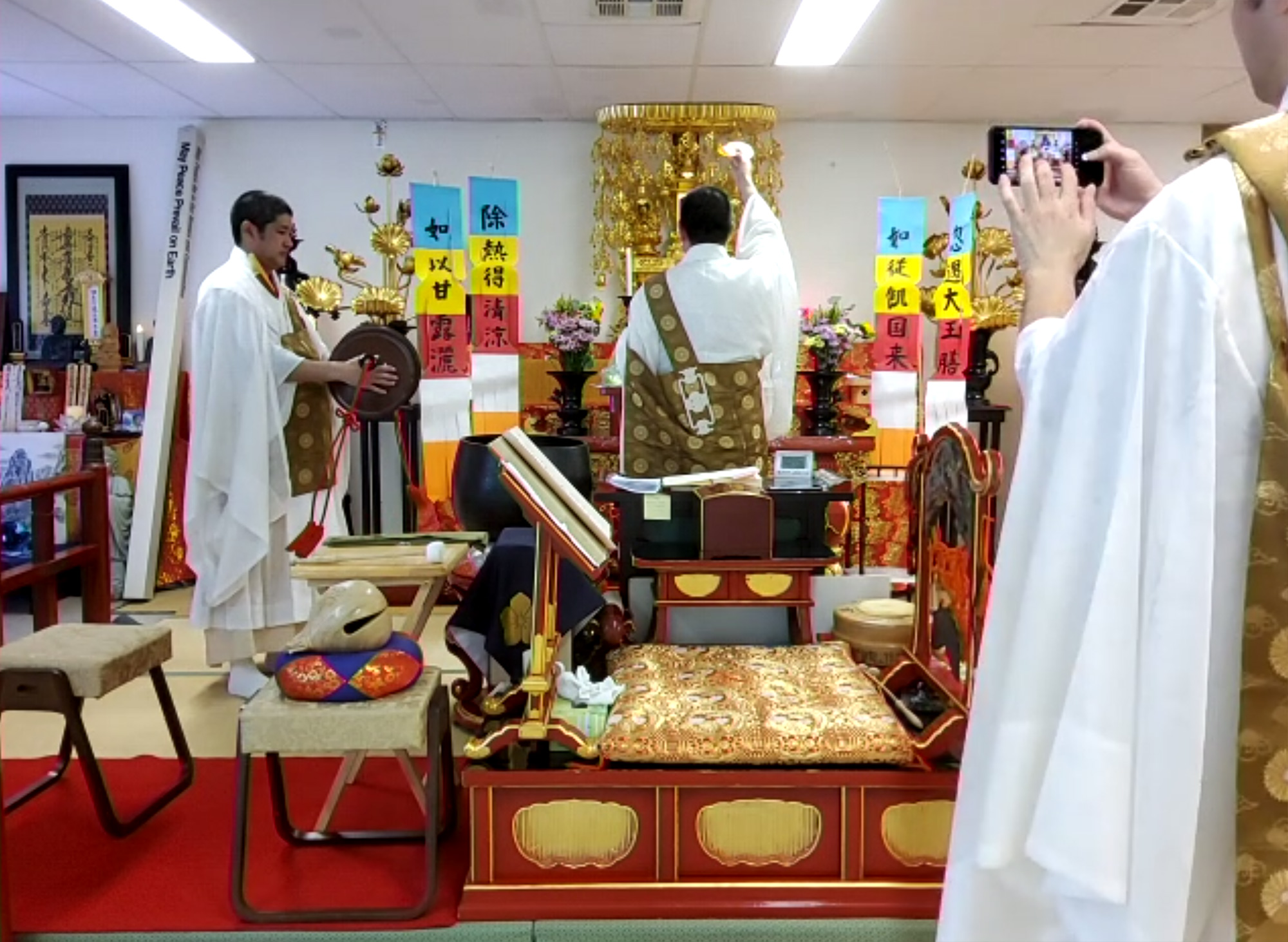
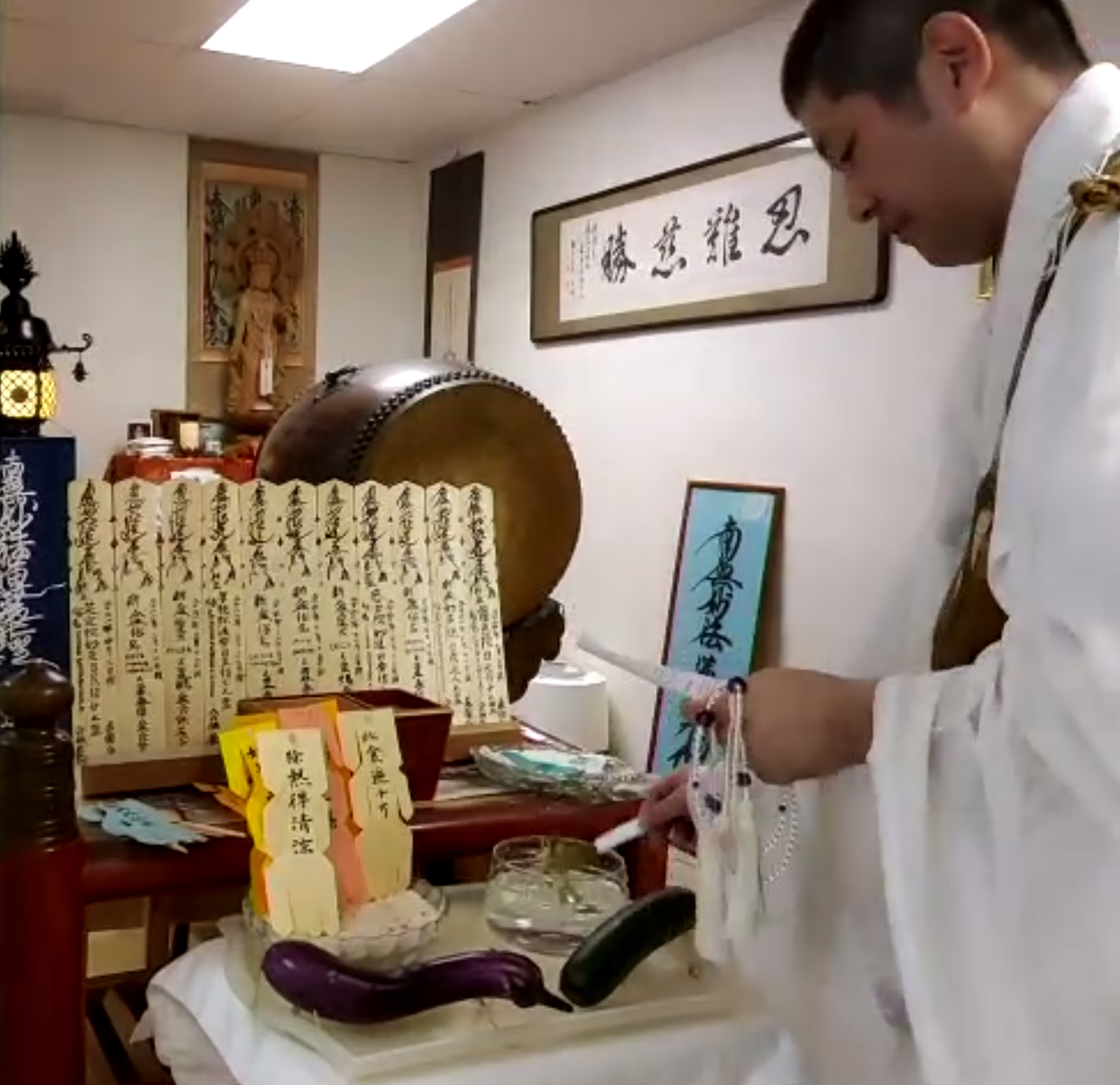
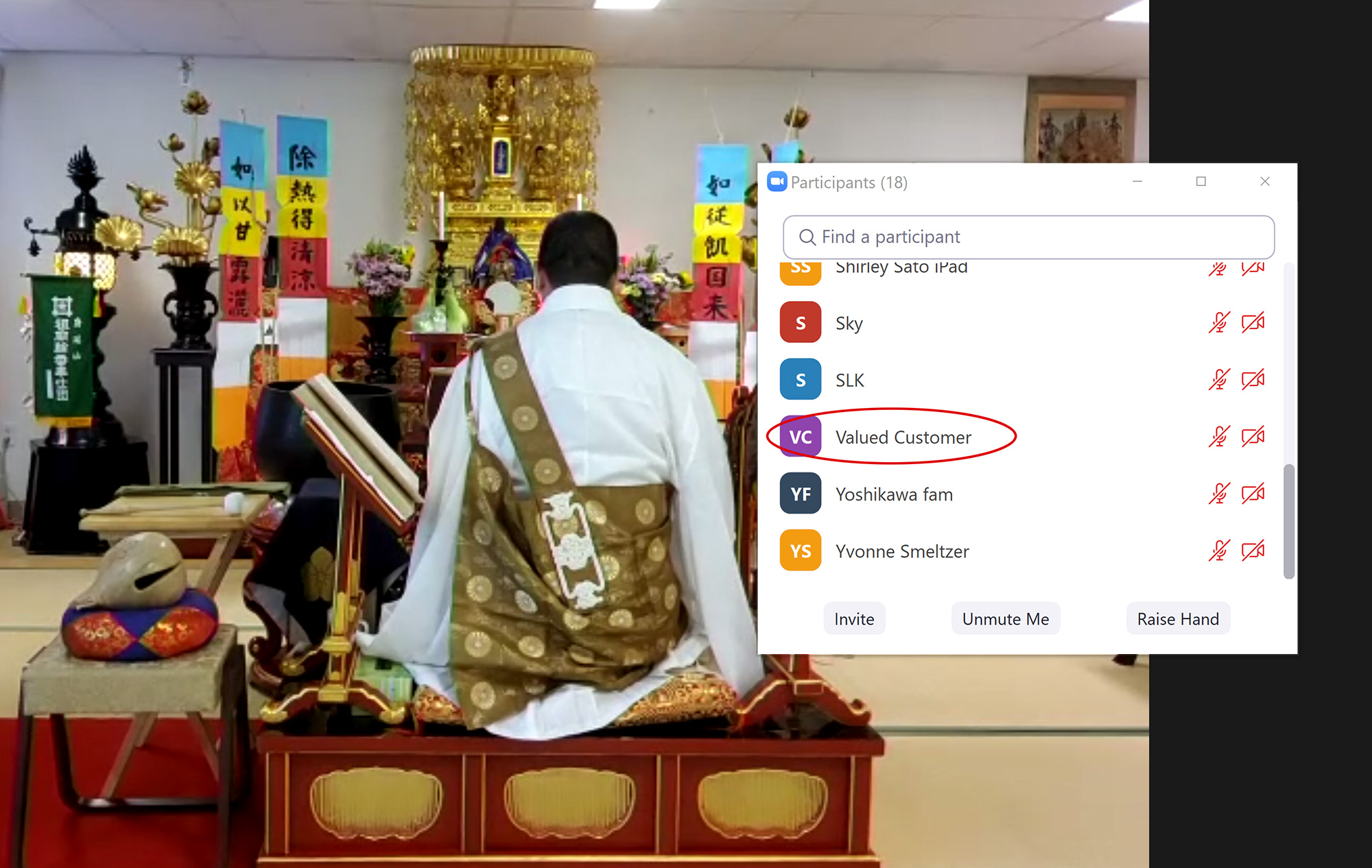
Rev. Shoda Kanai playing all of the instruments in his orchestral arrangementRev. Shoda Kanai feeding the hungry spirits. The tobas — paper stupas — are for people for whom this was there first Obon. Among those tobas is one for Rev. Ryusho Jeffus.Included among the 18 participants in the Zoom service was this Valued Customer.
Nearly ten years had passed since Nichiren had proclaimed his new gospel, and these years had been full of adventures and dangers. The threats and perils heaped upon him, as well as the disasters which filled the people with terror, seemed to him not mere chance, but the necessary consequence of the conflict between the blindness of the people and the compassionate cure proposed by him. All this – the causes and effects, the present calamities and the future destiny – gave him new assurance that every prophecy in the [Lotus Sutra] would certainly be fulfilled. The thing which most strongly confirmed his faith in the [Lotus Sutra] and his enthusiasm for it was the discovery that every phrase of the vows of perseverance, as set forth in the chapter on “Perseverance” [chapter 13], had been, and was being, realized, step by step, in his own life. The ardent spirit of the vows found its closest counterpart and echo in his fiery personality and perilous career.
See what the Scripture tells us! Buddha’s disciples, beholding the amazing vision of the Heavenly Shrine, and hearing the encouraging exhortation, take together the vows of fidelity and endurance.
O Exalted One! be little anxious for us! After Thy great decease, In the evil ages full of fears and dangers, We shall proclaim the supreme Scripture.
This was what Nichiren had done, and he was now suffering for it.
There will then surely be malignant men, And they will deride us and abuse us, Lay upon us with weapons and sticks.
All these things we shall bear with endurance and perseverance. Does this not mean, Nichiren thought, the laymen, the rulers, and the people, who antagonize the Truth because of their dislike for righteousness? Did they not threaten him with sword and fire?
Again:
In the Latter Days there will be monks, Who, being malicious and crooked in mind, Will pretend to have attained what is not really attained, And their minds will be full of vain pride.
Were not the monks always the instigators of the persecutions? Traitors to Buddha, companions of devils, worshippers of strange deities, men of vain pride these are Nichiren’s bitter enemies. Is not the prophecy being fulfilled by them? Further:
There will be those who dwell in forests (āraṇyaka), Living in tranquility and wearing the regular robes; They pretend to practice the true monastic life, And despise all other men.
They will preach to laymen, Simply for the sake of fame and profit; And yet they will be revered by the people, As if they were endowed with the six supernormal powers. …
Are not all abbots and bishops men of this kind? Observe how some of them pretend to be Arahants and are believed by the people!
In the evil days of the ages full of turbulence There will be many fears and dangers; There will be men possessed by devils, And they will abuse and insult us.
By revering Buddha and putting confidence in him, And by wearing the armor of forbearance, We shall endure all these perils, For the sake of proclaiming this Scripture.
We shall never be fearful in sacrificing our bodily life, But always regard the true Way as the highest cause; And thus we shall, throughout all coming days, Stand for the cause committed to us by Buddha.
O Exalted One! Thou may’st be assured, Even when the vicious monks of the turbulent ages, Being ignorant of the sermons preached by Buddha, According to his tactful method, Shall revile and rebuke us; And we be repeatedly driven out of our abodes, And kept away from our sanctuaries. Even then, we shall endure all these injuries, By ourselves to Buddha’s decree.
In whatsoever cities or villages, There may be any who would seek the Truth, Thither we shall surely go And preach the Truth entrusted to us by Thee.
We are Thy messengers, O Exalted One! We have nothing to fear from any people, We shall proclaim the Truth, to deserve Thy commission. Thou may’st be assured and rest secure.
Now we take these vows in Thy presence, And in the presence of all Buddhas Who have come from the ten quarters. May’st Thou, O Buddha, know our intention and determination!
Nichiren saw all this being fulfilled in himself but had to anticipate yet more persecutions. In later years he referred most earnestly to the passage which tells how the preachers of the true religion should be repeatedly expelled from their dwellings, because it was his actual experience. Thus, he found all his career foretold in the [Lotus Sutra], and deemed that he was faithfully observing the vows of perseverance. “The Twenty Stanzas of Perseverance” was his favorite expression, which he was proud to embody in his life.
He formulated these reflections and hopes in an essay, and in its conclusion his convictions are vividly set forth:
“It is said in the chapter in the Scripture on Perseverance (chapter 13) that, in the fifth five hundred years of the religion, there would appear opponents of the Truth, of three kinds. The present time is just in this period of the fifth five centuries, and I see clearly the existence of the three kinds of opponents. … It is said in the fourth fascicle of the Scripture: Even in the life-time of the Tathāgata, there are manifold animosities shown toward this Scripture; how much more will it be so after his passing away?” Again, in the fifth fascicle: “All over the world, the people find it so difficult to believe that they antagonize (the Truth).” Further on: “We shall not care for bodily life, but do our best for the sake of the incomparable Way” and similarly, in the sixth fascicle: “We shall sacrifice even our life.” … From what we see in these passages it is evident that we are not entitled to be propagators of the Lotus of Truth, unless we call forth the hatred of the three kinds of opponents. One who does so is the propagator of the Truth, and yet he is destined to lose life on this account.”
We can here see clearly how Nichiren was prepared for any perils, and how ready to encounter even greater dangers, leaving his fate to the destiny of the true Buddhist as prophesied in the Scripture. To him dangers and persecutions were the very signs of his being the genuine believer of the Truth.
Chapter 3 Nichiren's Public Appearance And Persecution