All posts by John Hughes

The First 500-Year Period of the Age of the Semblance Dharma

During the Ch’ên and Sui dynasties, roughly between 450 years and 500 years or so after the introduction of Buddhism to Later Han China, there lived a monk called Chih-i. Later called Grand Master T’ien-t’ai, he refuted the false teachings of three Southern and seven Northern schools, and he advocated the theology stating that the Lotus Sūtra ranks first among all the holy sūtras, the Nirvana Sūtra second, and the Flower Garland Sūtra third. This is the first 500-year period of the Age of the Semblance Dharma, which is referred to as the period of wide reading and discussions in the Sūtra of the Great Assembly.

Senji-shō, Selecting the Right time: A Tract by Nichiren, the Buddha’s Disciple, Writings of Nichiren Shōnin, Doctrine 1, Page 199

Daily Dharma – July 18, 2021

Please remember that the service to your lord itself is practicing the teaching of the Lotus Sutra. Interpreting the scriptural statement in the Lotus Sutra, Grand Master T’ien-t’ai, therefore, states in his Great Concentration and Insight: “All the activities and daily work of the people in the secular world do not contradict the truth preached by the Buddha.” Please contemplate the spirit of this scriptural statement again and again.

Nichiren wrote this passage in his Response to a Follower (Dannotsu Bō Gohenji). In our frustration with this world of conflict, we may think it best to remove ourselves from those who are increasing the delusions of others. In this letter, Nichiren reminds us that the relationships we have in our lives are important. Service to others does not necessarily mean giving them what they ask for. It means wishing that they lose their delusions and nourishing the Buddha nature within them.

The Daily Dharma is produced by the Lexington Nichiren Buddhist Community. To subscribe to the daily emails, visit zenzaizenzai.com

Day 10

Day 10 concludes Chapter 6, Assurance of Future Buddhahood, and opens Chapter 7, The Parable of a Magic City.


Having last month considered a Buddha called Great-Universal-Wisdom-Excellence, we consider the period before Great-Universal-Wisdom-Excellence became a Buddha.

The Buddha said to the bhikṣus:

“The duration of the life of Great-Universal-Wisdom-Excellence Buddha was five hundred and forty billion nayuta kalpas. [Before he attained Buddhahood,] he sat at the place of enlightenment and defeated the army of Mara. He wished to attain Anuttara-samyak-saṃbodhi, but could not because the Dharma of the Buddhas had not yet come into his mind. He sat cross-legged without moving his mind and body for one to ten small kalpas. During all that time the Dharma of the Buddhas did not come into his mind.

“[Before he sat at the place of enlightenment,] the Trāyastriṃs̒a Gods prepared him a lion-like seat a yojana high under the Bodhi tree so that he might be able to attain Anuttara-samyak-saṃbodhi on that seat. When he sat on that seat, the Brahman-heavenly-kings rained heavenly flowers on the area extending a hundred yojanas in all directions from that seat. From time to time withered flowers were blown away by fragrant winds and new flowers were rained down. [The Brahman-heavenly-kings] continued this offering to him for fully ten small kalpas. [After he attained Buddhahood also,] they continued raining flowers until he passed away.

“[When he sat on that seat,] the four heavenly-kings beat heavenly drums, and the other gods made heavenly music and offered it to him. They continued these offerings also for fully ten small kalpas. [After he attained Buddhahood also,] they continued these offerings until he passed away.

See Ten Epithets of the Buddha

Ten Epithets of the Buddha

After the death of the Buddha, Buddhists thought, to the extent they understood the Buddha’s personality to be in conformity with his actual existence, that his body had to express perfection. The Dīgha-Nikāya lists ten epithets of the Buddha:

“Thus the World-Honored One is called Arhat, Fully Enlightened One, One Endowed with Knowledge and Action, Sugata, Lokavid, Supreme among Beings, Tamer of People, Teacher of People and Deities, Buddha, World-Honored One. He has realized and teaches concerning this world, including the heavens, the Māra realms, and the Brahma heavens, samaṇas, brahmans, heavenly beings, and human beings. He preaches the Dhamma which is good at the beginning, good in the middle, and good at the end, endowed with words and meaning, explaining the pure brahma conduct that is perfect, without fault. How good it is to see such a man of truth!”
(Dīgha-Nikāya, i, 87-88)

These are the basis of the expanded form of the Tathāgata’s ten epithets known in later times:

  1. Tathāgata (not included in the Dīgha-Nikāya): one who has come from Thusness, one who has attained the Truth.
  2. Arhat: one who has quelled all the defilements, one who is worthy of receiving the offerings of humankind and deities.
  3. Samyak-saṃbuddha: one who is fully enlightened, one who has penetrated all truths and knows all that there is to be known.
  4. Vidyā-caraṇa-sampanna: one who is endowed with wisdom (the three transcendental knowledges) and practice (physical, oral, mental).
  5. Sugata: one who has truly crossed to the other shore of liberation, who will never again sink into the sea of saṃsāra of the defilements.
  6. Lokavid: one who knows all about worldly existence.
  7. Anuttara: the supreme among human beings.
  8. Puruṣa-damya-sārathi: “the tamer of people,” one who teaches beings and causes them to enter the way of practice.
  9. Śāstā devamanuṣyāṇām: a teacher of people and deities by means of the Right Dharma.
  10. Buddha-bhagavat: “Buddha” is one who knows and sees the ultimate truth of all characteristics, and who has attained supreme and perfect enlightenment. “Bhagavat” is one who, possessing all merits, benefits beings everywhere, and is honored by the world.
Source elements of the Lotus Sutra, p 267-268

Nichiren: The Buddhist Prophet – Chapter 3, Part 2

His warning and the first exile

Chapter 3
Download Chapter 3

Out of pity, not only for the people stricken by these calamities, but on account of the superstitious practices in which they took refuge, Nichiren pondered in his mind the question, What are the causes of these evils, and how can they be averted?

In attacking the problem, Nichiren’s thought naturally turned to the unique authority of the Lotus [Sutra], in contrast to the syncretistic practices of the prevailing Buddhism. Yet he was not satisfied until he had made a further investigation of the sacred books and found various prophecies concerning calamities which should befall the people who degraded the true Buddhist religion by resorting to superstitions. He retired, for this investigation, to a monastery furnished with a good library. There he wrote and rewrote his ideas, which finally took shape in an essay entitled “Risshō Ankoku Ron,” which means “The Establishment of Righteousness and the Security of the Country.”

In this essay Nichiren fearlessly pointed out the degeneracy of the people and the foolishness of the rulers. The heaviest responsibility for the miseries of the time he ascribed to Amita-Buddhism, by which both the government and the people were led astray from righteousness. Moreover, he gave a prophetic warning to the nation that, if it did not turn at once to the unique Truth, the country would experience more disastrous calamities, especially a foreign invasion and a rebellion. His vehement expression runs as follows:

“Of all the misfortunes but one remains that we have not yet experienced, the misfortune of foreign invasion. … When I consider thee Scriptural prophecies and then look at the world around me, I am bound to confess that both the gods and the minds of the people are confused. You see the fulfilment of the prophecy in the past; dare we say that the remaining prophecies will fail of their fulfilment?”

(This prediction foreign invasion was based on statements in several Buddhist books, and its realization in the following years immensely strengthened Nichiren’s faith.)

This warning was followed by an admonition to the nation to be converted to Nichiren’s religion, based on the sermon of the [Lotus Sutra]. The vehement prophet would not be satisfied unless all other forms of Buddhism were suppressed and their leaders severely punished. Thus he concludes:

“Woe unto them! They have missed the entrance into the gate that leads to the true Buddhism and have fallen into the prison-house of the false teachings. They are fettered, entangled, bewildered. Whither will their blind wanderings lead them?

“Ye men of little faith, turn your minds and trust yourselves at once to the unique Truth of the Righteous Way! Then ye shall see that the three realms of existence are (in reality) the Kingdom of Buddha, which is in no way subject to decay; and that the worlds in the ten directions are all Lands of Treasures, which are never to be destroyed. The Kingdom is changeless, and the Lands eternal. Then how shall your bodies be otherwise than secure and your minds serene in enlightenment?”

Not only were these words preached to the masses on the streets and in the parks, but the written document was presented to the government authorities (in the seventh month of 1260). The government was shocked, the ecclesiastical dignitaries were enraged, and instigation from behind the scenes stirred up a mob which attacked Nichiren’s hermitage and burnt it down. Nichiren escaped the peril through the darkness of the night, and fleeing out of Kamakura, went on a missionary journey in adjacent provinces. There, more converts were made, and among them not a few of the warrior class, the local chiefs who were not under the direct control of the Dictator. The suspicion in which the government held Nichiren increased, and when he came back to Kamakura in the following year, he was officially arrested, and finally sentenced to banishment and sent to the desolate shore of the peninsula Izu (in the fifth month of 1261).

In this place of exile, Nichiren found bare shelter with a fisherman and his wife amid threatening dangers. How deeply he felt his obligations to these simple and faithful converts is shown in the letters written to them later, wherein they are likened to Nichiren’s parents, perhaps in a former life. His hardest trials did not last long. More converts were made, and Nichiren’s message found a sincere response in the unprejudiced hearts of the country folk. Yet he was an exile; he had been repeatedly attacked and had some narrow escapes from death; his future showed no bright prospects, and his hope of converting the nation as a whole seemed to be very remote, if not totally vain. His thought turned to the question whether his mission would be fulfilled, and he re-examined the [Lotus Sutra] with reference to this problem.


NICHIREN: THE BUDDHIST PROPHET

Table of Contents


Listening to a Perfect Teaching

The Great Concentration and Insight states:

“What does it mean to listen to a perfect teaching? It means that one’s ephemeral body would instantly be transformed into that of the everlasting Dharma Body, one’s evil passions into unsurpassed wisdom, and one’s evil karma into emancipation. As it is observable, there are three names to this, but only one thing to which it refers. In short, three aspects have been connected with one phenomenon. In fact, since these three concepts all concern one entity, there should be no differences among them. Should one approach the epitome of the Dharma Body, then one also nears the utmost of wisdom and emancipation. Should one’s wisdom be pure and just, then it follows that one’s Dharma Body and emancipation would also be thus. Should one’s emancipation be free and flowing, then it can be assumed that one’s Dharma Body and wisdom would also be thus. In this way, parallels not only exist between the three bodies and the three evils, but in all phenomena. For this reason, all phenomena are intertwined with notions of Buddhist dharma, such that nothing is missing. This manner of viewing things is what is meant by ‘listening to a perfect teaching.’ ”

This interpretation represents a guide to the opening and merging of sōtai seed.

Shimon Butsujō-gi, Listening to the Once Buddha Vehicle Teachings for the First Time, Writings of Nichiren Shōnin, Doctrine 2, Page 246-247

Daily Dharma – July 17, 2021

Do not doubt him even at a moment’s thought!
The Pure Saint World-Voice-Perceiver is reliable
When you suffer, and when you are confronted
With the calamity of death.

The Buddha sings these verses in Chapter Twenty-Five of the Lotus Sūtra. The calamity of death is something we all will face eventually, whether it our own or that of those we love. The other calamities in our lives are relatively minor losses which can prepare us for this great calamity. The Bodhisattva World-Voice-Perceiver is the embodiment of Compassion: the desire to benefit all beings. When we learn to use all of the suffering in our lives, especially the calamity of death, as a way to remove our delusions and benefit others, then we can see the world with the eyes of the Buddha and know the joy he declares is at the core of our being.

The Daily Dharma is produced by the Lexington Nichiren Buddhist Community. To subscribe to the daily emails, visit zenzaizenzai.com

Day 9

Day 9 covers Chapter 5, The Simile of Herbs, and introduces Chapter 6, Assurance of Future Buddhahood.

Having last month repeated in gāthās the Buddha’s reticence on revealing the reality of all things, we consider the rain cloud of the Dharma.

Kāśyapa, know this!
Suppose a large cloud rose in the sky,
And covered everything on the earth.
The cloud was so merciful
That it was about to send a rainfall.
Lightning flashed,
And thunder crashed in the distance,
Causing people to rejoice.

The cloud covered the sun,
And cooled the earth.
It hung down
As low as if we could reach it.

Now the rain came down
To all the quarters of the earth.
The rainwater was immeasurable.
It soaked all the earth.
There were many plants
In the retired and quiet places
Of the mountains, rivers and ravines.

They were herbs, cereal-plants, young rice-plants,
Vegetables, sugar canes, and other grasses;
Fruit-trees including vines,
And other trees, tall and short.
They were sufficiently watered by the rain.
So were all the dry lands.

The herbs and trees grew thick by the rain.
All the grasses and trees in thickets and forests
Were watered variously according to their species
By the rain water of the same taste
Coming down from the [same] cloud.

All the trees grew differently
According to their species.
They became superior or middle or inferior
Or tall or short trees.

The roots, trunks, branches, leaves,
Flowers and fruits of the various trees
Were given a fine and glossy luster
By the same rain.

Although watered by the same rain,
Some of them were tall, while others not,
Because they were different
In their entities, appearances and natures.

See Correspondences for the Simile of the Herbs

Correspondences for the Simile of the Herbs

According to Tendai’s “Branches of the Lotus Sutra,” the parables are divided into two portions, the exposition and the explanation of correspondences.

Correspondences for the Simile of the Herbs

Just as the great cloud rises, the Tathāgata appears in the world.

Just as the great cloud everywhere covers the three-thousand-great-thousandfold world, the Tathāgata universally extends his great call over the world of gods, men, and asuras.

Just as the cloud pours down its rain equally at the same time, the Tathāgata sounds forth these words:

“I am the Tathāgata, the Worshipful, the All Wise, the Perfectly Enlightened in Conduct, the Well Departed, the Understander of the World, the Peerless Leader, the Controller, the Teacher of Gods and Men, the Buddha, the World-honored One. Those who have not yet been saved I cause to be saved; those who have not yet been set free to be set free; those who have not yet been comforted to be comforted; those who have not yet obtained nirvana to obtain nirvana. I know the present world and the world to come as they really are, I am the All Knowing, the All Seeing, the Knower of the Way, the Opener of the Way, the Preacher of the Way. Come to me, all you gods, men and asuras, to hear the Law.”

The mountains, rivers and streams, valleys, and land of the three-thousand-great-thousandfold world represent the uncountable thousands of millions of varieties of living beings who go where the Buddha is and hear his teachings. Just as there are plants, trees, thickets, forests, and medicinal herbs, of various and numerous kinds, with names and colors all different, the natural powers of living beings are keen or dull, zealous or indifferent; the Buddha therefore preaches the Dharma to them in various ways unstintingly, causing them to rejoice and joyfully gain good profit. Just as the dense cloud pours down its rain equally at the same time, and its moisture fertilizes every tree, big or little, according to its superior, middle, or lower capacity, and from the rain of one cloud, each according to the nature of its kind acquires its development, opening its blossoms and bearing its fruit, all the living beings, having heard the Dharma, are comforted in the present life and will afterward be reborn in happy states, made joyful by the truth and also enabled to hear the Dharma. Having heard the Dharma, they are freed from hindrances, and according to their capacity in all the laws, they gradually enter the way.

Just as these trees and plants are produced in one soil and moistened by the same rain, the Dharma preached by the Tathāgata is of one form and flavor, that is to say, deliverance, abandonment, extinction, and finally the attainment of perfect knowledge.

Just as what the trees and plants receive is different, if there are living beings who hear the Dharma of the Tathāgata and keep, read, recite, and practice it as he preaches, they cannot know the merits they have achieved. Why? Only the Tathāgata knows the seed, the form, the embodiment, and the nature of all these living things, what things they are reflecting over, what things they are thinking, what things practicing, how reflecting, how thinking, how practicing, by what laws reflecting, by what laws thinking, by what laws practicing, and by what laws attaining to what laws. Only the Tathāgata in reality sees, clearly and without hindrance, the stages in which all living beings are.

Just as those plants, trees, thickets, forests, medicinal herbs, and others do not know their own natures, superior, middle, or inferior, the Tathāgata knows the Dharma of one form and one taste, that is to say, deliverance, abandonment, extinction, final nirvana of eternal tranquility, ending in return to the void. The Buddha, knowing this and observing the dispositions of all living beings, supports and protects them. Therefore, he does not immediately declare to them the complete and perfect wisdom.

Source elements of the Lotus Sutra, p 336-337

Nichiren: The Buddhist Prophet – Chapter 3

His proclamation of his new faith

Chapter 3
Download Chapter 3

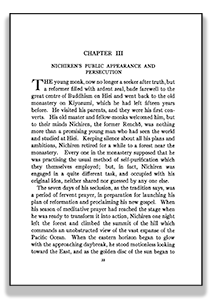
The young monk, now no longer a seeker after truth, but a reformer filled with ardent zeal, bade farewell to the great center of Buddhism on Hiei and went back to the old monastery on Kiyozumi, which he had left fifteen years before. He visited his parents, and they were his first converts. His old master and fellow monks welcomed him, but to their minds Nichiren, the former Renchō, was nothing more than a promising young man who had seen the world and studied at Hiei. Keeping silence about all his plans and ambitions, Nichiren retired for a while to a forest near the monastery. Everyone in the monastery supposed that he was practicing the usual method of self-purification, which they themselves employed; but, in fact, Nichiren was engaged in a quite different task, and occupied with his original idea, neither shared nor guessed by anyone else.

The seven days of his seclusion, as the tradition says, was a period of fervent prayer, in preparation for launching his plan of reformation and proclaiming his new gospel. When his season of meditative prayer had reached the stage when he was ready to transform it into action, Nichiren one night left the forest and climbed the summit of the hill which commands an unobstructed view of the vast expanse of the Pacific Ocean. When the eastern horizon began to glow with the approaching daybreak, he stood motionless looking toward the East, and as the golden disc of the sun began to break through the haze over the vast expanse of waters, a loud voice, a resounding cry, broke from his lips. It was “Namu Myōhō-renge-kyō” “Adoration be to the Lotus of the Perfect Truth!” This was Nichiren’s proclamation of his gospel to heaven and earth, making the all-illumining sun his witness. It happened early in the morning of the twenty-eighth day of the fourth lunar month 1253. (See explanation of dates here.)

The proclamation of the Lotus of Truth, with the sun as witness, was, indeed, the first step in translating into action the ideal symbolized in his name, the Sun-Lotus. After this unique proclamation, Nichiren came back among human beings, and at noon of the same day, in an assembly hall facing south, he preached his new doctrine, and denounced the prevailing forms of Buddhism, to an audience composed of his old master and fellow monks, and many others. There was none who was not offended by his bold proclamation and fierce attack. Murmurs grew to cries of protest; and when the sermon had been finished, everyone assumed that the poor megalomaniac was mad. The feudal chief ruling that part of the country was so incensed that he would not be satisfied with anything short of the death of the preposterous monk. This lord, who was Nichiren’s mortal foe throughout the subsequent years of his mission, was watching to attack Nichiren, who was now driven out of his old monastery. His master, the abbot, pitied his former pupil, and gave instruction to two elder disciples to take Nichiren to a hidden trail for escape. It was in the dusk of evening that Nichiren made his escape in this way. The sun, which at its rising had beheld Nichiren’s proclamation, the sun which at noon had witnessed Nichiren’s sermon, set as the hunted prophet made his way through the darkness of a wooded trail; only the evening glow was in the sky. What must his thoughts have been? What prospect could he have cherished in his mind for his future career and for the destiny of his gospel?

The expelled prophet now went on missionary journeys in the neighboring provinces, and finally settled down in Kamakura, the seat of the Dictatorial government. While he was studying further the religious and social conditions of the time and looking for an opportunity to appear again in public, the city of Kamakura was the scene of many frightful events. There were rumors of plots against the Hōjōs, and family strife arose among them; in addition to these things, storms, inundations, earthquakes, famines, comets, followed one another in swift succession. The people were panic-stricken, and the government could only resort to the offerings at Shinto sanctuaries and to the Buddhist rites of the Shingon mysteries. Nichiren himself describes the conditions as follows [in the “Risshō Ankoku Ron”]:

“We have seen many signs in heaven and in earth; a famine, a plague – the whole country is filled with misery! Horses and cows are dying on the roadsides, and so are men; and there is no one to bury them. One half of the population is stricken, and there is no house that has entirely escaped.

“Hence many minds are turning to religion. Others, again, in accordance with the doctrines of the Secret Shingon, use copious sprinkling of holy water from the five vases. … Some write the names of the seven gods of luck on pieces of paper and affix them by the hundreds to the door-posts of their houses, whilst others do the same with the pictures of the five Great Powerful and the various (Shinto) gods of Heaven and Earth. … But let men do what they will, the famine and the plague still rage; there are beggars on every hand, arid the unburied corpses line the roads.”


NICHIREN: THE BUDDHIST PROPHET

Table of Contents