All posts by John Hughes

Daily Dharma – Feb. 2, 2021

Mañjuśrī! A Bodhisattva-mahāsattva who performs this fourth set of [peaceful] practices after my extinction, will be able to expound the Dharma flawlessly. Bhikṣus, bhikṣuṇīs, upāsakas, upāsikās, kings, princes, ministers, common people, brāhmaṇas and householders will make offerings to him, honor him, respect him, and praise him. The gods in the sky will always serve him in order to hear the Dharma from him. When someone comes to his abode located in a village, in a city, in a retired place or in a forest, and wishes to ask him a question, the gods will protect him day and night for the sake of the Dharma so that the hearer may rejoice because this sūtra was, is, and will be protected by the supernatural powers of the past, present and future Buddhas.

The Buddha gives this explanation to Mañjuśrī Bodhisattva in Chapter Fourteen of the Lotus Sūtra. The fourth set of peaceful practices is not blaming those who do not hear the Lotus Sūtra and resolving to save them when one becomes perfectly enlightened. Rather than becoming upset with those who do not accept this teaching, it is useful to know that we are not alone in wanting to save them, and that by reducing our own delusions we increase our capacity to benefit others.

The Daily Dharma is produced by the Lexington Nichiren Buddhist Community. To subscribe to the daily emails, visit zenzaizenzai.com

Day 14

Day 14 covers all of Chapter 9, The Assurance of Future Buddhahood of the Śrāvakas Who Have Something More to Learn and the Śrāvakas Who Have Nothing More to Learn, and opens Chapter 10, The Teacher of the Dharma.

Having last month opened today’s portion of Chapter 10, The Teacher of the Dharma, we consider fate of good men or women who keep, read, recite, expound and copy even a phrase of the Sūtra of the Lotus Flower of the Wonderful Dharma.

“Medicine-King! If anyone asks you who will become a Buddha in his future life, answer that such a person as previously stated will! Why is that? The good men or women who keep, read, recite, expound and copy even a phrase of the Sūtra of the Lotus Flower of the Wonderful Dharma, and offer flowers, incense, necklaces, incense powder, incense applicable to the skin, incense to burn, canopies, banners, streamers, garments and music to a copy of this sūtra, or just join their hands together respectfully towards it, should be respected by all the people of the world. All the people of the world should make the same offerings to them as they do to me. Know this! These good men or women are great Bodhisattvas. They should be considered to have appeared in this world by their vow to expound the Sūtra of the Lotus Flower of the Wonderful Dharma out of their compassion towards all living beings, although they already attained Anuttara-samyak-saṃbodhi [in their previous existence]. Needless to say, those who keep all the passages of this sūtra and make various offerings to this sūtra [are great Bodhisattvas]. Medicine King, know this! They should be considered to have given up the rewards of their pure karmas and appeared in the evil world after my extinction in order to expound this sūtra out of their compassion towards all living beings. The good men or women who expound even a phrase of the Sūtra of the Lotus Flower of the Wonderful Dharma even to one person even in secret after my extinction, know this, are my messengers. They are dispatched by me. They do my work. It is needless to say this of those who expound this sūtra to many people in a great multitude.

“Medicine-King! An evil man who speaks ill of me in my presence with evil intent for as long as a kalpa is not as sinful as the person who reproaches laymen or monks with even a single word of abuse for their reading and reciting the Sūtra of the Lotus Flower of the Wonderful Dharma.

“Medicine-King! Anyone who reads and recites the Sūtra of the Lotus Flower of the Wonderful Dharma, know this, will be adorned just as I am. I will shoulder him. Wherever he may be, bow to him! Join your hands together towards him with all your heart, respect him, make offerings to him, honor him, and praise him! Offer him flowers, incense, necklaces, incense powder, incense applicable to the skin, incense to burn, canopies, banners, streamers, garments, food and various kinds of music! Make him the best offerings that you can obtain in the world of men! Strew the treasures of heaven to him! Offer him heaps of the treasures of heaven! Why is that? It is because, while he is expounding the Dharma with joy, if you hear it even for a moment, you will immediately be able to attain Anuttara-samyak-saṃbodhi.”

See Sixteen Practices of the Lotus Sutra

Sixteen Practices of the Lotus Sutra
[I]n Chapter 10 there are several variations of the formula for five practices and many more throughout the Sutra, usually with five or six different practices being listed. By my count, at least sixteen such practices are cited in the Sutra, though never all in one place. Not all of them are entirely different perhaps, but they are different enough to be represented by different Chinese characters in Kumarajiva’s translation and therefore in my English translation.

Here are the sixteen practices with regard to the Sutra: to hear, receive, embrace or uphold, read, recite, study, memorize or learn by heart, remember it correctly, understand its meaning, explain it, teach it for the sake of others, copy it, honor it, make offerings to it, put it into practice, and practice the Sutra as taught or preached. What I want to portray with this list is that the Dharma Flower Sutra is richer and much more complex than standard formulas sometimes suggest. The reduction of the sixteen to a standard five is a useful device for aiding our learning – nothing more. By using a variety of such lists, even in the same chapter, we are being taught, I believe, to be flexible and open-minded when reading or studying the Dharma Flower Sutra.

Whether the list of such practices be five or seven or sixteen, these are practices that can be done by anyone, including you and me, and they can be done just about anywhere. They certainly are not the end of Buddhist practice, but they can be used as skillful means, as useful and important steps in the direction of the life of a true Dharma teacher or bodhisattva.

The Stories of the Lotus Sutra, p130

Ten States of Experience

In the [ Profound Meaning of the Lotus Sutra ] Chih-i points out a further correspondence between this [24:18] verse in the Mūlamadhyamakakārika and the multifarious characteristics of beings in the various realms of existence. Chih-i divided the realms of existence into ten interpenetrating realms or destinies: hell, preta, beast, asura, man, gods, śrāvaka, pratyekabuddha, bodhisattva, and buddha. These are not ten separate distinct worlds, but rather experiences or states of existence in one reality.

It may be more accurate to refer to these ten “destinies” as ten states of experience: hellish, to be full of insatiable appetite, brutish, combative, human, divine, ‘śrāvaka-like, pratyekabuddha-like, bodhisattva-like, and buddha-like. When one suffers the inevitable results of his or her misdeeds, one experiences the realm of hell. When one blindly follows sensual desires in a futile attempt to satisfy fleshly appetites, one experiences the realm of the preta. When one blindly follows one’s passions, one experiences the realm of beasts. When one fights with one’s fellow human being, one experiences the combative realm of the asura. When one joyfully listens to the music of Bach, one can experience the delightful realm of the gods. When one hears the teaching of the Buddha, one experiences the realm of the śrāvaka. When one performs an altruistic deed, one experiences the realm of the bodhisattva. When one has an insight into the true nature of reality, one experiences the realm of the Buddha. Chih-i’s claim that these realms are “interpenetrating” or “mutually inclusive” means that each sentient being experiences them all in accordance with its actions.

Also, each being has ten “suchlike,” or “such-as-it-is”, characteristics: appearance, nature, essence, power, activity, causes, conditions, results, retribution, and “ultimate identity of beginning and end.”

Foundations of T'ien T'ai Philosophy, p 6

The Seed of Buddhahood Planted at the Beginning

It is stated in the Words and Phrases of the Lotus Sūtra, fascicle 9, “The seed of Buddhahood was planted by this Buddha-Bodhisattva at the beginning, and it was nurtured by this Buddha-Bodhisattva;” and in the Profound Meaning of the Lotus Sūtra, fascicle 6, “The Buddha appears in the actual world with form and figure to guide the people. How can those in whom He had planted the seed of Buddhahood not come to receive His guidance? As streams of many rivers all go into the ocean, people who have established a relationship with the Buddha can have the good fortune of encountering the Buddha in this life.”

As stated above, the Profound Meaning of the Lotus Sūtra, fascicle 6, preaches, “Properly speaking, all living beings will awaken aspiration for Buddhahood and proceed to it without falling back to a lower spiritual stage by following this Buddha.”

Ichidai Goji Keizu, Genealogical Chart of the Buddha’s Lifetime Teachings in Five Periods, Writings of Nichiren Shōnin, Doctrine 3, Page 248-249

Daily Dharma – Feb. 1, 2021

I am now joyful and fearless.
I have laid aside all expedient teachings.
I will expound only unsurpassed enlightenment
To Bodhisattvas.

The Buddha sings these verses in Chapter Two of the Lotus Sūtra. When the Buddha says he only teaches Bodhisattvas, he does not mean that he holds his highest teaching back from anybody. For us to be able to hear what the Buddha teaches, we must awaken our image of ourselves as Bodhisattvas who chose to come into this world of conflict and delusion. If we try to use the Buddha’s teaching to gratify our own delusions, we will only create more suffering. It is only when we set aside our habits of fear and doubt that we can gain wisdom through practicing the Wonderful Dharma.

The Daily Dharma is produced by the Lexington Nichiren Buddhist Community. To subscribe to the daily emails, visit zenzaizenzai.com

Day 13

Day 13 covers all of Chapter 8, The Assurance of Future Buddhahood of the Five Hundred Disciples.

Having last month considered the prediction for the twelve hundred Arhats, we consider the Parable of the Priceless Gem.

Thereupon the five hundred Arhats, having been assured by the Buddha of their future Buddhahood, felt like dancing with joy, stood up from their seats, came to the Buddha, worshipped him at his feet with their heads, and reproached themselves for their faults, saying:

“World-Honored One! We thought that we had already attained perfect extinction. Now we know that we were like men of no wisdom because we were satisfied with the wisdom of the Lesser Vehicle although we had already been qualified to obtain the wisdom of the Tathāgata.

“World-Honored One! Suppose a man visited his good friend. He was treated to drink, and fell asleep drunk. His friend had to go out on official business. He fastened a priceless gem inside the garment of the man as a gift to him, and went out. The drunken man did not notice what his friend had given him. After a while he got up, and went to another country. He had great difficulty in getting food and clothing. He satisfied himself with what little he had earned. Some time later the good friend happened to see him. He said, ‘Alas, man! Why have you had such difficulty in getting food and clothing? T fastened a priceless gem inside your garment on a certain day of a certain month of a certain year so that you might live peacefully and satisfy your five desires. The gem is still there, and you do not notice it. You are working hard, and worrying about your livelihood. What a fool you are! Trade that gem for what you want! You will not be short of anything you want.’

“You, the Buddha, are like his friend. We thought that we had attained extinction when we attained Arhatship because we forgot that we had been taught to aspire for the knowledge of all things by you when you were a Bodhisattva just as the man who had difficulty in earning his livelihood satisfied himself with what little he had earned. You, the World-Honored One, saw that the aspiration for the knowledge of all things was still latent in our minds; therefore, you awakened us, saying, ‘Bhikṣus! What you had attained was not perfect extinction. I caused you to plant the good root of Buddhahood a long time ago. [You have forgotten this; therefore,] I expounded the teaching of Nirvāṇa as an expedient. You thought that you had attained true extinction when you attained the Nirvāṇa [ which I taught you as an expedient].’

“World-Honored One! Now we see that we are Bodhisattvas in reality, and that we are assured of our future attainment of Anuttara-samyak-saṃbodhi. Therefore, we have the greatest joy that we have ever had.”

See The Jewel in the Robe

The Jewel in the Robe

Taking interpretation of this parable [of the jewel in the robe] further, the idea of being given a great treasure is not only an individual matter, but something that can be applied to human beings as a whole. The treasure is the earth, the natural environment and resources that we have inherited. Human beings have been given not only buddha-nature, but all of nature itself. The Buddha (the reality of the world) is basically generous and supportive of human life. We have inherited an incredibly rich earth. With it we are given an enormous opportunity to do good. The question is, will we recognize and appreciate how valuable this treasure is, and, if we do, how will we use this treasure given to us?

Perhaps humanity as a whole is like the poor man in the parable – still stumbling around without realizing that we have such a treasure. Perhaps humanity as a whole needs to wake up to see not only the wonderful treasure that is in us but also the wonderful treasure that is all around us.

The Stories of the Lotus Sutra, p107-108

Four Great Vows and Four Vows

20210131-nba-setsubun-service

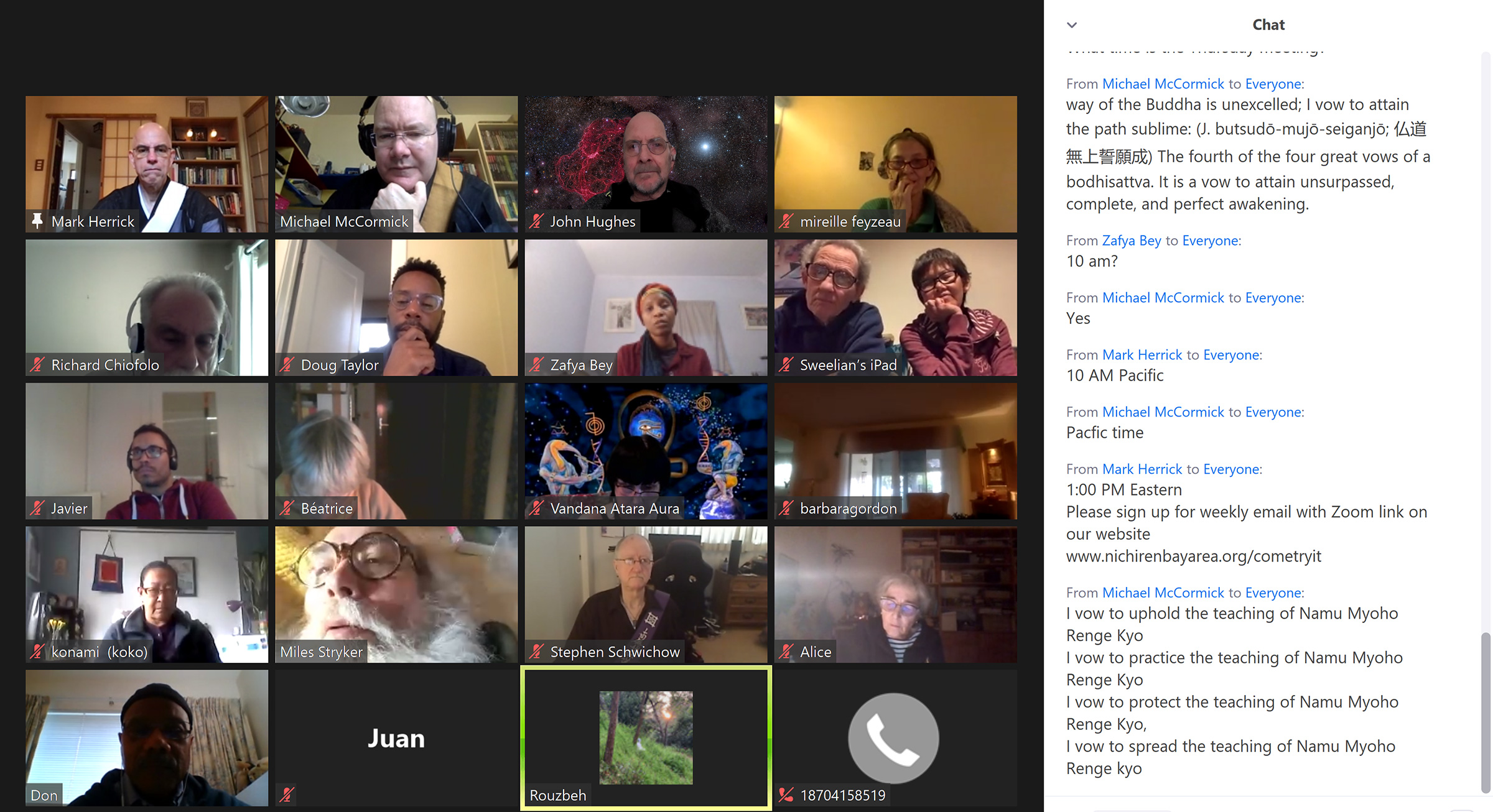
Today I attended the Sunday Nichiren Buddhist Sangha of the Bay Area service, which included a discussion of The Four Great Vows and Four Vows contained in the blue Nichiren-Shu Service Book.

The discussion was sort of my idea and my principal reason for discussing the Four Great Vows was what I find the odd translation of the second vow:

Our defilements are inexhaustible; I vow to quench them all.

I just don’t see the need to add “Our” here. I prefer the Tiantai version and the discussion of the vows contained in “A Guide to the Tiantai Fourfold Teachings” written in the 10th century by the Korean Buddhist Monk Chegwan.

The Four Great Bodhisattva Vows

  1. There are those who have not yet transcended [the stream of birth and death]. I must carry them over.

    Beings are numberless;
    I vow to save them all.

    This vow is based on the fact of the noble truth of suffering.

  2. There are those who are not yet free [from delusion]. I must liberate them.

    Defilements are inexhaustible;
    I vow to end them all.

    This vow is based on the fact of the noble truth of the accumulation [of the causes of suffering].

  3. There are those who are not yet settled [in practicing the thirty-seven conditions leading to enlightenment]. I must assure them.

    The teachings are innumerable;
    I vow to master them all.

    This vow is based on the fact of the noble truth of the path [to enlightenment, the fourth noble truth].

  4. There are those who have not yet attained nirvana. I must bring them to nirvana.

    The path to buddhahood is unsurpassed;
    I vow to attain it.

    This vow is based on the fact of the noble truth of cessation [of suffering, the third noble truth].

The second part of the discussion covered the Four Vows, which appear following the Four Great Vows in the blue Nichiren-Shu Service Book. The Four Great Vows are on page 78, the Four Vows on 79.

While the Nichiren Buddhist Sangha of the Bay Area services include the Four Great Vows, the Nichiren Buddhist Kannon Temple services held by Rev. Shoda Kanai in Las Vegas always use the Four Vows.

Four Vows
I vow to uphold the teaching of Namu Myoho Renge Kyo
I vow to practice the teaching of Namu Myoho Renge Kyo
I vow to protect the teaching of Namu Myoho Renge Kyo
I vow to spread the teaching of Namu Myoho Renge Kyo

It was very interesting to hear several interpretations of just what we mean by “the teaching of Namu Myoho Renge Kyo,” and especially what it means to uphold and to practice “the teaching of Namu Myoho Renge Kyo.” This is a place where it would have been nice to have a recording to fall back on.

Using Chih-i’s Three Truths to Interpret the Four Noble Truths

Chih-i in the [Great Concentration and Insight] and [ Profound Meaning of the Lotus Sutra ] explicitly identifies the four phrases of [the Mūlamadhyamakakārika] verse as corresponding to the four ways of interpreting the four noble truths. The four noble truths are, briefly, the four basic Buddhist truths of all is suffering, the cause of suffering, the extinction of suffering, and the path, which are common to all Buddhist systems. The four ways of interpreting the four noble truths are as arising-and-perishing, as neither arising nor perishing, as immeasurable, and as spontaneous.

Chih-i writes:

In the Mūlamadhyamakakārika verse [24: 18], “All things which arise through conditioned co-arising” refers to [the viewpoint of] “arising and perishing.” “I explain as emptiness” refers to “neither arising nor perishing.” “Again, it is a conventional designation” refers to “the immeasurable.” “Again, it is the meaning of the Middle Path” refers to “the spontaneous.”

This categorization of four ways of interpreting the four noble truths is original with Chih-i, though Chih-i claims that it is based on the “Chapter on Noble Activity” in the Mahāparinirvāṇa Sūtra. The Mahāparinirvāṇa Sūtra does discuss the four noble truths in detail, expounding on the eight kinds of suffering, various causes of suffering, and so forth, but this four-fold classification should be attributed to Chih-i. This fourfold classification does not posit four kinds of four noble truths, because there is only one “four noble truths,” but refers to four ways of viewing, or interpreting, the four noble truths:

  1. The four noble truths as arising and perishing. This is the standpoint which emphasizes the constant flux of phenomena. All things are constantly arising and instantly perishing in an interdependent web of causes and conditions. From this point of view, as Chih-i says, “Suffering consists of passing through the three stages [of birth, change, and annihilation], the cause of suffering consists of flowing through the four [defiled] mental states, the path consists of conquering and eliminating [the defilements], and extinction consists of extinguishing Being and returning to non-Being” (T. 46, 5b15-16). In Chih-i’s words, this is the realm of “change” (T. 46, 5b18). This is the viewpoint expressed in the first phrase of the verse: “All things which arise through conditioned co-arising.”
  2. The four noble truths as neither arising nor perishing. This is the standpoint which emphasizes that all is empty (T. 46, 5b19). There is no real coming into Being nor the extinguishing of Being, because there is no substantial Being. Suffering has no real existence, and by extension there is no real cause of suffering. There are no real defilements to extinguish nor to eliminate on the path. All conditioned things, by definition, lack an eternal, unchanging, self-existent Being. What, then, can ever truly arise or perish? This is the viewpoint expressed in the second phrase of the verse: “I explain as emptiness.”
  3. The four noble truths as immeasurable . This is the standpoint which emphasizes that, although all things lack substantial Being, there are immeasurable aspects to temporary conventional existence. As Chih-i points out, there are immeasurable sufferings in only one realm of existence (such as that of man), how much more so in all of the different realms of existence (from hell to Buddha) together. These immeasurable sufferings have innumerable causes, including “greed, anger, ignorance, and the various [defiled activities of] mind, body, and speech” (T. 46, 5c3). So also there must be innumerable features to the path, such as scholastic analysis, mystical insight, clumsy and skillful means, ways which are crooked or straight, long or short, teachings which are provisional or complete. Finally, there are immeasurable features of extinction, because there are innumerable delusions and defilements to extinguish.

    Chih-i is quick to point out that all this is from the standpoint of “conventional speech,” and that ultimately there are no distinctions because ultimately all are empty of substantial Being. Nevertheless, “it is not a mistake nor a confusion to make these [innumerable] distinctions” (T. 46, 5c9-10), as long as one realizes that one is speaking conventionally. This is the viewpoint expressed in the third phrase of the verse: “Again, it is a conventional designation.”

  4. The four noble truths as spontaneous. This is the expression of ultimate reality which is beyond conceptualization and verbal distinctions. There is no difference between suffering, its cause, its extinction, and the path. All is One. This is the viewpoint expressed in the fourth phrase of the verse: “Again, it is the meaning of the Middle Path.”
Foundations of T'ien T'ai Philosophy, p 8-10