
Even before the Lotus Sutra the Buddha intended his disciples to actively engage in teaching and transmitting the teachings. The difference in the Lotus Sutra is that now there is nothing being held back. The Buddha has broken down all the barriers and finally agreed to reveal the fundamental truth of all Buddhas. It is to this that Many Treasures Buddha responds based upon his vow. When we teach others about the Lotus Sutra we call Many Treasures Buddha to be witness to the truth we are sharing. You could say the magnet to attract Many Treasures Buddha is to teach others about the Lotus Sutra.
Lecture on the Lotus SutraAll posts by John Hughes
The Lord Buddha of this Sahā World
According to the shakumon section of the Lotus Sūtra, the people in this Sahā World have been closely related to Śākyamuni Buddha since dust-particle kalpa ago without any relations to other Buddhas such as the Buddha of Infinite Life. Chapter 7 on the “Parable of A Magic City,” of the Lotus Sūtra states: “Those who listened to the teachers then have always been beside those Buddhas. … Destiny has made them meet the preaching of the Lotus Sūtra now.” This statement tells us that we, the people in this Sahā World, have never been in Pure Lands of fifteen other Buddhas such as the Buddha of Infinite Life in the universe. Grand Master T’ien-t’ai states in his Words and Phrases of the Lotus Sūtra:
“An old interpretation considers the Buddha of Infinite Life as the rich father in the parable of the father and son. However, this is incorrect, and today we do not consider the Buddha of Infinite Life as the wealthy father. The Western Pure Land of the Buddha of Infinite Life and this Sahā World of Śākyamuni Buddha each has a different Buddha and karmic relations. The Buddha of Infinite Life is not the Lord Buddha of this Sahā World, so he was never born to and died in this world. He never guided us in this world. There are no relationships formed between the Buddha of Infinite Life and us like that of a father and son. There are no words in the Lotus Sūtra which state that the Buddha of Infinite Life is our lord, teacher or parent. If you really want to encounter the Buddha, you need to contemplate this with your eyes closed.”
Grand Master Miao-lê explains this in his Annotations on the Words and Phrases of the Lotus Sūtra: “Śākyamuni Buddha and the Buddha of Infinite Life have completely different karmic relationships to the people in their past lives, and the worlds they guided are completely different. By birth and in growing up, the Buddha of Infinite Life and the people in this Sahā World have no father-son relationship.” From these statements of T’ien-t’ai and Miao-lê, I would think the Buddha of Infinite Life and other Buddhas in the world all over the universe are like stepfathers whereas Śākyamuni Buddha is a compassionate, real father. T’ien-t’ai wrote many works interpreting the Lotus Sūtra; however, we should know this interpretation of his to be fundamental, and consider Śākyamuni Buddha as the lord of this Sahā World.
Gochū Shujō Gosho, People in the World Letter, Writings of Nichiren Shōnin, Doctrine 2, Page 202
Daily Dharma – Jan. 31, 2021
Thereupon the Buddha said to the great multitude including Bodhisattvas and others, “Good men! Understand my sincere and infallible words by faith!”
With these words, the Buddha prepares those gathered to hear him teach in Chapter Sixteen of the Lotus Sūtra. “Understanding by faith” can be a difficult idea for those of us who believe faith is opposed to understanding; that it means believing something even though we do not understand it. The Buddha does not ask us to set aside our curiosity or our comprehension to practice his highest teaching. But he does say that it takes more than understanding to reach the wisdom he attained. As we apprehend more of what the Buddha teaches us, our confidence in him grows. As we set aside our doubts about the benefits of the Buddha Dharma, we increase our ability to see the world for what it is.
The Daily Dharma is produced by the Lexington Nichiren Buddhist Community. To subscribe to the daily emails, visit zenzaizenzai.com
Day 12
Day 12 concludes Chapter 7, The Parable of the Magic City, and completes the Third Volume of the Sutra of the Lotus Flower of the Wonderful Dharma.
Having last month considered the teachings of Great-Universal-Wisdom-Excellence Buddha, we consider what happened next to the sixteen princes.
The sixteen princes renounced the world,
And became śramaṇeras.
They begged the Buddha to expound the teaching
Of the Great Vehicle, saying:
“We and our attendants wish to attain
The enlightenment of the Buddha.
May we have the purest eyes of wisdom
Just as yours!”Knowing the wishes of the [princes who were] young boys
And the practices they performed in their previous existence,
The Buddha taught them the six paramitas
And many supernatural things
With innumerable stories of previous lives
And with various parables and similes.The gāthās of the Sūtra of the Lotus Flower of the Wonderful Dharma
Were sung [by the Buddha] to expound the true teaching,
That is, [to expound] the Way which Bodhisattvas should practice.
The gāthās were as many as there are sands in the River Ganges.Having expounded this sūtra, the Buddha entered a quiet room,
And practiced dhyāna-concentration.
Concentrating his mind, he sat at the same place
For eighty-four thousand kalpas.Seeing him still in dhyāna,
The śramaṇeras wished to expound
The unsurpassed wisdom of the Buddha
To many hundreds of millions of living beings.They each sat on a seat of the Dharma
And expounded this sūtra of the Great Vehicle.
Also after the peaceful extinction of that Buddha,
They proclaimed this sūtra, and helped propagate it.They each saved
Six hundred billions of living beings,
That is, as many living beings
As there are sands in the River Ganges.
‘A perfectly integrated threefold truth’
Foundations of T'ien T'ai Philosophy, p 6-7The objects of our experience have a temporary reality. We do experience something. Nevertheless, the world which we experience is empty of an eternal, unchanging, svabhāba-like substance. Lest one lapse into a mistaken nihilism, one must realize the Middle Path. One must realize the emptiness of phenomenal reality simultaneously with the temporal, provisional reality of these empty objects. This Middle Path, however, must not be grasped as an eternal, transcendental Reality; it is, rather, manifested in and through and is identical with temporal phenomenal reality, which is again in turn empty of an unchanging substance. The circle is complete in itself, what Chih-i calls “a perfectly integrated threefold truth.”
This concept is summarized by Chih-i in his Fa hua hsüan I [ Profound Meaning of the Lotus Sutra ]:
The “perfect threefold truth” means that it is not only the Middle Path which completely includes the Buddha-Dharma, but also the real and the mundane [truths]. This threefold truth is perfectly integrated; one-in-three and three-in-one.
In other words, the real truth, the mundane truth, and the Middle Path are three ways of expressing the threefold aspects of a single integrated reality. This concept of the threefold truth plays a central role in Chih-i’s Tien-t’ai philosophy and provides the structure for his interpretation of the Buddha-dharma.
Making the World a Better Place
Nichiren Shonin’s teaching for practicing the Buddhism of the Lotus Sutra allows us to awaken to the infinite awareness of the Buddha’s awakening. By making the concepts, practices, and foundation of Buddhism accessible to all people without changing their essential meaning, Nichiren Buddhism has clarified that awakening is possible for all people, not just monks, nuns, and hermits. In this process, we not only make ourselves better people, we improve our society and the world as a whole.
Lotus SeedsA Pebble Changed to a Precious Stone
On the palm of a man named Mahānāma a pebble changed to a precious stone. King Konzoku is said to have been able to transform sand into gold. The Lotus Sūtra enables even insentient beings such as grass and trees to attain Buddhahood, not to speak of sentient beings that possess minds such as humans. The Lotus Sūtra enables the Two Vehicles whose seed of Buddhahood has been burned to attain Buddhahood, how much more so with people whose seed of Buddhahood is still alive! Moreover, the Lotus Sūtra enables even the icchantika who has no religious belief to attain Buddhahood, how much more it will lead those with religious faith.
Ueno-dono Gohenji, Reply to Lord Ueno, Writings of Nichiren Shōnin, Volume 7, Followers II, Page 33
Daily Dharma – Jan. 30, 2021
You, the World-Honored One, saw that the aspiration for the knowledge of all things was still latent in our minds; therefore, you awakened us, saying, ‘Bhikṣus! What you had attained was not perfect extinction. I caused you to plant the good root of Buddhahood a long time ago.’
Five hundred of the Buddha’s monks give this explanation in Chapter Eight of the Lotus Sūtra. In the story, the Buddha has just assured them of reaching the same enlightenment he found. These monks had worked diligently for many years to rid themselves of suffering, and taught many other beings to become Bodhisattvas and reach the Buddha’s enlightenment, thinking they were not capable of reaching this wisdom. Not believing we are capable of something obscures the capability we have. When the Buddha proclaims that he leads all beings, he reminds us of this capacity and inspires us make efforts to bring all beings, including ourselves, to his joy.
The Daily Dharma is produced by the Lexington Nichiren Buddhist Community. To subscribe to the daily emails, visit zenzaizenzai.com
Day 11
Day 11 continues Chapter 7, The Parable of the Magic City
Having last month concluded today’s portion of Chapter 7, The Parable of the Magic City, we return to the top and we consider what happened when Great-Universal-Wisdom-Excellence Buddha attained Anuttara-samyak-saṃbodhi.The Buddha said to the bhikṣus:
“When Great-Universal-Wisdom-Excellence Buddha attained Anuttara-samyak-saṃbodhi, five hundred billion Buddha-worlds in each of the ten quarters quaked in the six ways, and all those worlds, including those intercepted from the brilliant rays of light of the sun and the moon by the neighboring worlds, were illumined [by great rays of light], and the living beings of those worlds were able to see each other for the first time. They said to each other, ‘How did you appear so suddenly?’ The palaces of the gods of those worlds, including the palace of Brahmans, also quaked in the six ways. The great rays of light which illumined all those worlds were brighter than the rays of light emitted by those gods.“The palaces of the Brahman-heavenly[-kings] of the five hundred billion worlds in the east were illumined twice as brightly as ever. The Brahman-heavenly-kings [of those worlds] each thought, ‘My palace has never been illumined so brightly before. Why is that?’ They visited each other and discussed the reason. There was a great Brahman-heavenly-king called All-Saving among them. He said to the other Brahmans in gāthās:
Why are our palaces illumined
More brightly than ever?
Let us find [the place]
[From where this light has come].
Did a god of great virtue or a Buddha
Appear somewhere in the universe?
This great light illumines
The worlds of the ten quarters.“Thereupon the Brahman-heavenly-kings of the five hundred billion worlds went to the west, carrying flower-plates filled with heavenly flowers, in order to find [the place from where the light had come]. Their palaces also moved as they went. They [reached the Well-Composed World and] saw that GreatUniversal-Wisdom-Excellence Tathāgata was sitting on the lionlike seat under the Bodhi-tree at the place of enlightenment, surrounded respectfully by gods, dragon-kings, gandharvas, kiṃnaras, mahoragas, men and nonhuman beings. They also saw that the sixteen princes were begging the Buddha to turn the wheel of the Dharma. Thereupon the Brahman-heavenlykings worshipped the Buddha with their heads, walked around him a hundred thousand times, and strewed heavenly flowers to him. The strewn flowers were heaped up to the height of Mt. Sumeru. The Brahman-heavenly-kings offered flowers also to the ten-yojana-tall Bodhi-tree of the Buddha. Having offered flowers, they offered their palaces to the Buddha, saying, ‘We offer these palaces to you. Receive them and benefit us out of your compassion towards us!’ In the presence of the Buddha, they simultaneously praised him in gāthās with all their hearts:
You, the World-Honored One, are exceptional.
It is difficult to meet you.
You have innumerable merits.
You are saving all living beings.As the great teacher of gods and men,
You are benefiting all living beings
Of the worlds of the ten quarters
Out of your compassion towards them.We have come here from five hundred billion worlds.
We gave up the pleasure
Of deep dhyāna-concentration
Because we wished to make offerings to you.
Our palaces are beautifully adorned
Because we accumulated merits in our previous existence.
We offer [these palaces] to you.
Receive them out of your compassion towards us!“Thereupon the Brahman-heavenly-kings, having praised the Buddha with these gāthās, said, ‘World-Honored One! Turn the wheel of the Dharma and save all living beings! Open the Way to Nirvāṇa!’ They simultaneously said in a gāthā with all their hearts:
Hero of the World,
Most Honorable Biped!
Expound the Dharma!
Save the suffering beings
By the power of your great compassion!“Thereupon Great-Universal-Wisdom-Excellence Tathāgata gave his tacit consent to their appeal.
Simultaneous Aspects of One Reality
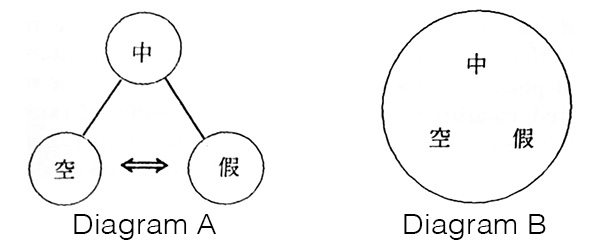
Foundations of T'ien T'ai Philosophy, p 6Chih-i interpreted reality as a threefold truth, a single unity with three integrated aspects, and often supported his view by quoting this verse from the Mūlamadhyamakakārikā. The threefold truth is an integrated unity with three aspects. First, emptiness (śūnyatā), or absence of substantial Being, often identified with the ultimate truth (paramārthasatya). Second, conventional existence, the temporary existence of the phenomenal world as co-arising, often identified with the worldly truth (saṃvṛtisatya). Third, the Middle, a simultaneous affirmation of both emptiness and conventional existence as aspects of a single integrated reality.
For Chih-i these three components are not separate from each other but integral parts of a unified reality. They do not form a pyramid of contrasting realities (Diagram A) but are simultaneous aspects of one reality (Diagram B).