Having last month considered whether the Buddha can be accused of lying when he says he’ll enter into nirvana, we repeat in gāthās the incredible length of the Buddha’s lifespan.
Thereupon the World-Honored One, wishing to repeat what he had said, sang in gāthās:
It is many hundreds of thousands
Of billions of trillions
Of asaṃkhyas of kalpas
Since I became the Buddha.
For the past innumerable kalpas
I have always been expounding the Dharma
To many hundreds of millions of living beings
In order to lead them into the Way to Buddhahood.
In order to save the [perverted] people,
I expediently show my Nirvāṇa to them.
In reality I shall never pass away.
I always live here and expound the Dharma.
Although I always live here
With the perverted people
I disappear from their eyes
By my supernatural powers.
When they see me seemingly pass away,
And make offerings to my śarīras,
And adore me, admire me,
And become devout, upright and gentle,
And wish to see me
With all their hearts
At the cost of their lives,
I reappear on Mt. Sacred Eagle
With my Saṃgha,
And say to them:
“I always live here.
I shall never be extinct.
I show my extinction to you expediently
Although I never pass away.
I also expound the unsurpassed Dharma
To the living beings of the other worlds
If they respect me, believe me,
And wish to see me.
You have never heard this
Therefore, you thought that I pass away.”
[The Buddha] preaches his teachings according to the mental capacity of his listeners. This the tactful way of the Buddha’s compassion, coinciding with his words: “Whenever living beings come to me, I behold with a Buddha’s eyes all the faculties, keen or dull, of their faith.”
The words “faculties of their faith” refer to the five organs (pañcendriāni, go-kon) that lead man to good conduct — the sense of belief (śraddhendriya, shin-kon), sense of endeavor (vīryendriya, shōjin-kon), sense of memory (smrtīndriya, nen-kon), sense of meditation (samādhīndriya, jōkon), and sense of wisdom (prajñendriya, e-kon). All five are fundamental to our religious lives.
“Sense of belief” means the mind of faith. … [A] religion, unlike intellectual learning, does not enable a believer to have the power to save others as well as himself if he understands it only in theory. When he believes from the depths of his heart, his belief produces power. His faith cannot be said to be true until he attains such a mental state.
“Sense of endeavor” means the spirit of endeavoring purely and incessantly. Faith alone is not enough. Our religious lives cannot be true unless we maintain our faith purely and constantly endeavor so that our religious spirit does not weaken or lose its power.
“Sense of memory” indicates the mind that always focuses upon the Buddha. Practically speaking, of course, it is impossible for us to completely forget the Buddha for even a moment. When a student devotes himself to his studies or when an adult is entirely absorbed in his work, he must concentrate on one object. Doing so accords with the way to buddhahood. While devoting ourselves to a particular object, we reflect, “I am caused to live by the Buddha.” When we complete a difficult task and feel relieved, we thank the Buddha, saying, “How lucky I am! I am protected by the Buddha.” When an evil thought flashes across our mind or we suddenly feel angry, we instantly examine ourselves, thinking, “Is this the way to buddhahood?” The mind that thus keeps the Buddha in mind at all times is “sense of memory.”
“Sense of meditation” implies a determined mind. Once we have faith in a religion, we are never agitated by anything, whatever may happen. We bear patiently all persecution and temptation, and we continue to believe only in one religion. We must constantly maintain such firm determination, never becoming discouraged. We cannot be said to be real people of religion unless we have such a mental attitude.
“Sense of wisdom” means the wisdom that people of religion must maintain. As frequently mentioned in this book, this is not a self-centered wisdom but the true wisdom that we obtain when we perfectly free ourselves from ego and illusion. So long as we have this wisdom, we will not take the wrong way. We can say the same thing of our belief in religion itself, not to mention our daily lives. If we are attached to a selfish, small desire, we are apt to stray toward a mistaken religion. However earnestly we may believe in it, endeavoring to practice its teaching, keeping it in mind, and devoting ourselves to it, we cannot be saved because of its basically wrong teaching, and we sink farther and farther into the world of illusion. There are many instances around us of people following such a course. Although “sense of wisdom” is mentioned as the last of the five organs leading man to good conduct, it should be first in the order in which we enter a religious life.
Buddhism speaks of the four skillful means of a bodhisattva. The first skillful means is making the three kinds of offerings: material gifts, the gift of the Dharma, and the gift of non-fear. When you offer good things to people, they have sympathy with you, they regard you favorably, and their hearts are open. Giving someone a book on the Dharma, or a CD of some beautiful music that can help them relax – this is the practice of giving, dana. But the offerings of a bodhisattva should not be only material things or Dharma teachings. The best, most precious gift we can give someone is the gift of non-fear, abhaya.
People live in fear of death; they are afraid of losing their selfhood, their identity, of disappearing and becoming nonexistent. So when you offer the kind of teaching, practice, and insight that helps someone touch their ultimate dimension and get free of the fear of being and nonbeing, that is the greatest gift you can offer them.
The second skillful means of the bodhisattva is to practice loving speech. You can be very firm and uncompromising, but you can still use loving speech. You don’t have to shout or become hostile to get your idea across. Loving speech can convey your feeling and idea to the other person in a way they are able to hear it and take it in more fully. The third skillful means is to always act to benefit others. You do whatever you can to help the other person in any situation. That is the action of the bodhisattva. The fourth skillful means is the practice of “doing the same thing.” This has to do with the bodhisattva’s ability to take on the appropriate form in order to be able to approach others and help them. You look like them, dress like them, do exactly what they do, you become one of them so that they will trust and accept you and have the opportunity to learn the path of understanding and love. These are the four skillful means by which the bodhisattva embraces and serves living beings.
Grand Master Chang-an states in his Annotations on the Nirvana Sūtra, “The one body of the Buddha is equipped with the three virtues of the lord, master and parent.”
The Lotus Sūtra, chapter 3 on “A Parable” preaches:
“This triple world (realms of desires, form and non-form) entirely belongs to Me (the World Honored One, the most venerable in the triple world, whose domain consists of 25 regions in the triple world or the six lower realms of the dharma world—four continents, lower four realms, six heavens in the realm of desire, Great Brahma Heaven, four meditation heavens in the realm of form, four heavens in the realm of non-form, the non-thought heaven, and heaven of not returning). The people in them are all My children (children of Dharma-nature who established the bond with Śākyamuni Buddha in the eternal past; the Words and Phrases of the Lotus Sūtra, fascicle 5, explains this, “All people are equally equipped with the same Buddha nature, so they are equal children of the Buddha”). Nevertheless, this world is full of troubles and difficulties. I alone can save all living beings.” The Profound Meaning of the Lotus Sūtra, fascicle 6, explains this, “Properly speaking, all living beings will awaken aspiration for Buddhahood by following this Buddha, and proceed to Buddhahood following the Buddha without falling back to a lower spiritual stage.
Thus it is Śākyamuni Buddha alone who is equipped with the three virtues of the lord, master and parent.
Ichidai Goji Keizu, Genealogical Chart of the Buddha’s Lifetime Teachings in Five Periods, Writings of Nichiren Shōnin, Doctrine 3, Page 245-246
If anyone speaks ill of you, or threatens you
With swords, sticks, tile-pieces or stones
While you are expounding this sūtra,
Think of me, and be patient!
The Buddha sings these verses to Medicine-King Bodhisattva in Chapter Ten of the Lotus Sūtra. By patience, the Buddha does not mean to toughen ourselves and allow others to harm us. The patience he speaks of allows to increase our capacity to handle the mental suffering that comes when others abuse us. If we keep in mind that nothing anyone does can remove the seed of Buddha nature that is within them, and remember that this seed is within all beings, we can treat even those who mean us harm with respect and compassion, rather than contempt and derision.
The Daily Dharma is produced by the Lexington Nichiren Buddhist Community. To subscribe to the daily emails, visit zenzaizenzai.com
Day 20 completes Chapter 15, The Appearance of Bodhisattvas from Underground, and concludes the Fifth Volume of the Sutra of the Lotus Flower of the Wonderful Dharma.
Having last month repeated in gāthās the Buddha’s explanation of this great multitude of Bodhisattvas who appeared from underground, we consider Maitreya Bodhisattva’s objection to this explanation.
Thereupon Maitreya Bodhisattva-mahāsattva and the innumerable Bodhisattvas in the congregation doubted the Buddha’s words which they had never heard before. They thought:
‘How did the World-Honored One teach these great, innumerable, asaṃkhya Bodhisattvas, and qualify them to attain Anuttara-samyak-saṃbodhi in such a short time?’
[Maitreya Bodhisattva] said to the Buddha:
“World-Honored One! When you, the Tathāgata, were a crown prince, you left the palace of the Śākyas, sat at the place of enlightenment not far from the City of Gaya, and attained Anuttara-samyak-saṃbodhi. It is only forty and odd years since then.
“World-Honored One! How did you do these great deeds of the Buddha in such a short time? Did you teach these great, innumerable Bodhisattvas, and qualify them to attain Anuttara-samyak-saṃbodhi by your powers or by your merits?
“World-Honored One! No one can count the number of these great Bodhisattvas even if he goes on counting them for thousands of billions of kalpas. They have already planted roots of good, practiced the way, and performed brahma practices under innumerable Buddhas from the remotest past.
“World-Honored One! It is difficult for anyone in the world to believe this. It is as difficult as to believe a handsome, black-haired man twenty-five years old who points to men a hundred years old and says, ‘They are my sons,’ or as to believe men a hundred years old who point to a young man and say, ‘This is our father. He brought us up.’ You are like the young man. It is not long since you attained enlightenment. But it is many thousands of billions of kalpas since the great multitude of these Bodhisattvas began to practice the Way strenuously in order to attain the enlightenment of the Buddha. During that time they entered into, stayed in, and came out of many hundreds of thousands of billions of samadhis, and obtained great supernatural powers. They performed brahma practices for a long time. They learned good teachings one by one, and obtained the ability to answer questions skillfully. They are regarded as the treasures of the world of men by all the people of the world because they are rare. Today you say that, after you attained the enlightenment of the Buddha, you caused them to aspire for enlightenment, taught them, and led them into the Way to Anuttara-samyak-saṃbodhi.
“World-Honored One! You did these deeds of great merit although it is not long since you attained Buddhahood. We believe that your words given according to the capacities of all living beings are infallible, and that we understand all that you know. But the beginners in Bodhisattvahood after your extinction, if they hear these words of yours, will not receive them by faith but commit the sin of violating the Dharma. Therefore, World-Honored One! Explain all this so that we may be able to remove our doubts and that the good men in the future may have no doubts when they hear these words of yours!”
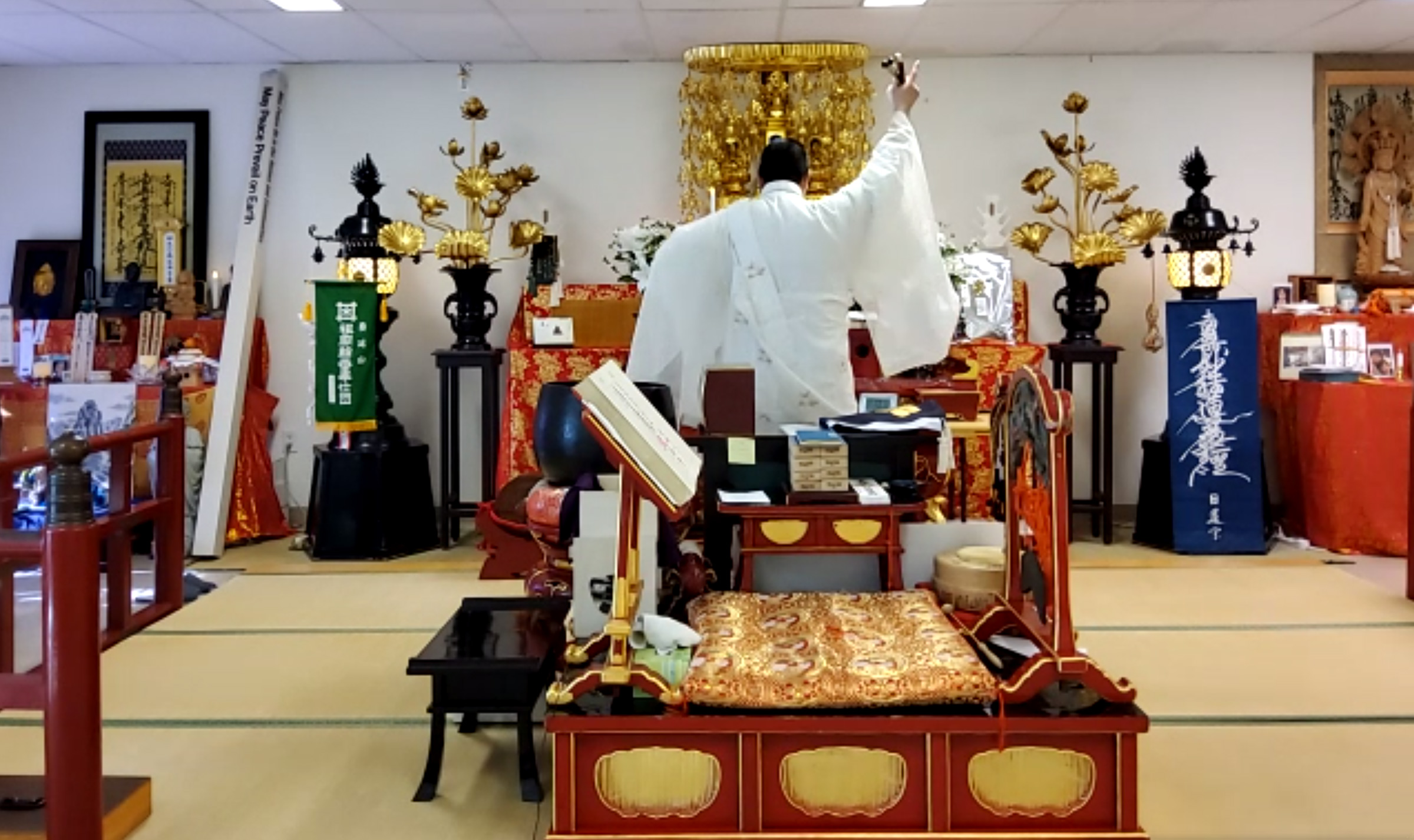
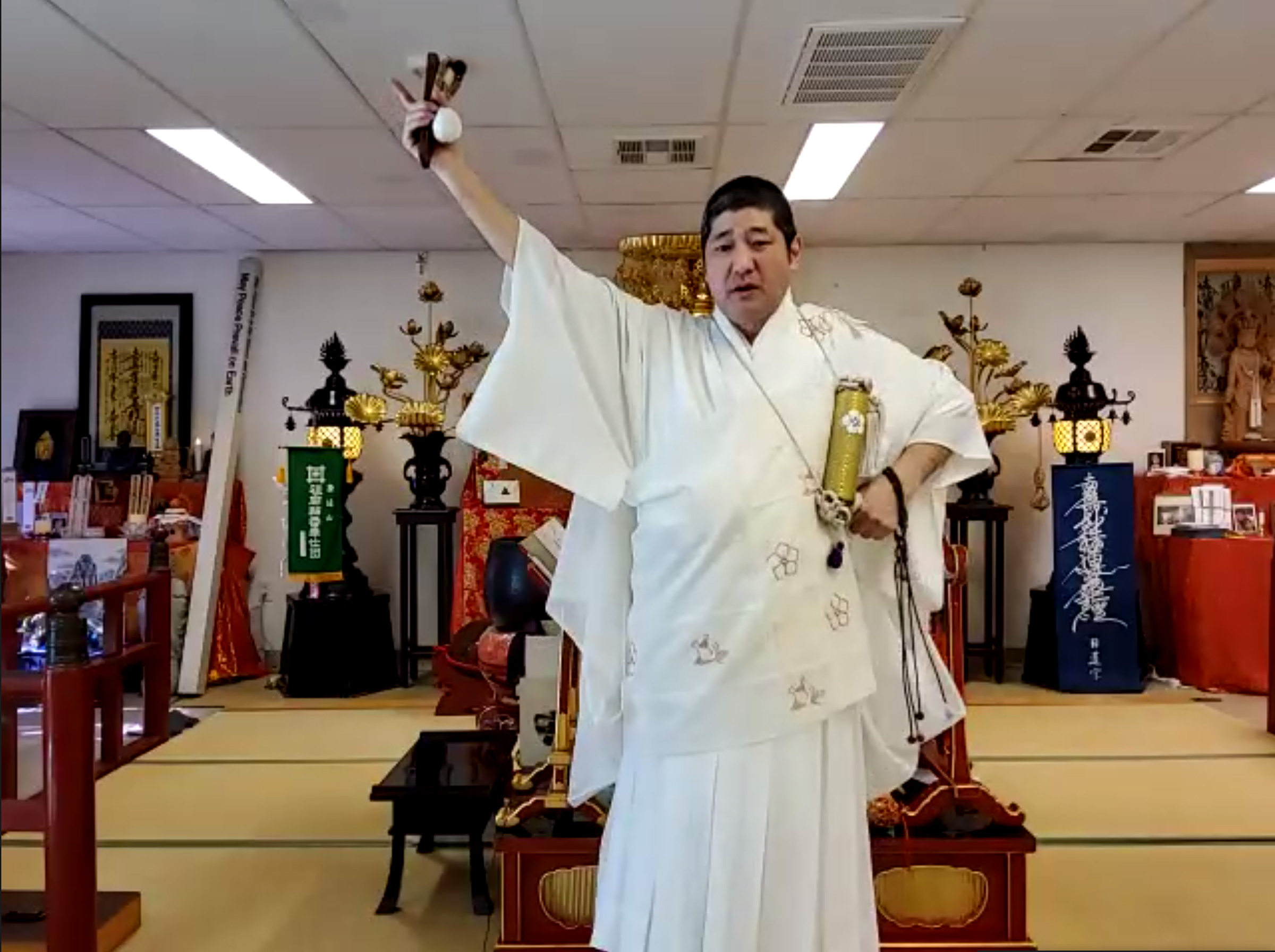
Rev. Shoda Kanai purifies the altar in preparation for the monthly Kito Blessing.Rev. Shoda Kanai blesses the dozen guests during his monthly Zoom Kito blessing
At 10:30am Sunday I joined the Nichiren Buddhist Kannon Temple of Nevada Kito Blessing Zoom service. Why a Kito blessing two days after the New Year Kito blessing? Rev. Shoda Kanai explained that the New Year’s blessing removes the lingering debris from the previous year and today’s service prepares for the month ahead.
In explaining the purpose of his blessing he offered an analogy of clogged shower drain. While showering, you find yourself standing in water and realize that the drain is clogged with hair. (Have to imagine this since my hair and the Rev. Shoda Kanai’s hair are cut too short to actually do this.)
Here’s my elaboration: Imagine the shower is your daily practice of sutra recitation and chanting Namu Myoho Renge Kyo, washing away the defilements of daily living. The clogged drain hampers your efforts, leaving you standing in dirty water. Clearing the drain restores the effectiveness of your daily practice.
Or as Rev. Igarashi has explained: In much the way you have to empty a tea cup in order to receive more tea, the Kaji Kito ceremony scoops away some of the bad karma in order to make room for good.
The Kito Blessing service is different in other ways.
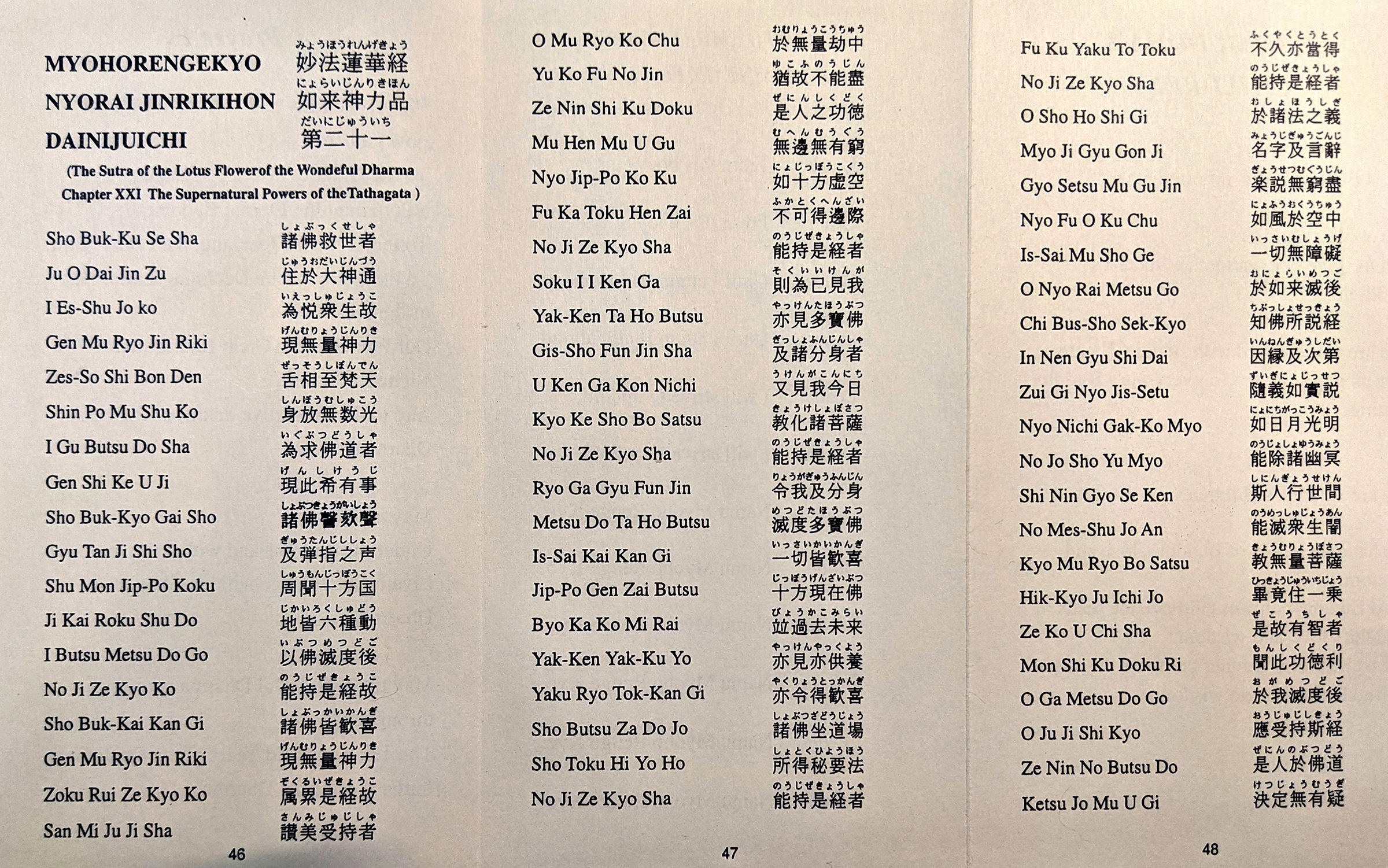
Instead of reciting portions of Chapter 2, Hoben Pon, and Chapter 16, Ji Ga Ge, we instead recite the gāthās from Chapter 21, The Supernatural Powers of the Tathagata.
Pages 46-48 from the blue Dharma book.
Here’s the same portion in Murano’s translation:
The Buddhas, the World-Saviors, have
Great supernatural powers.
They display their immeasurable, supernatural powers
In order to cause all living beings to rejoice.
The tips of their tongues reach the Heaven of Brahman.
Innumerable rays of light are emitted from their bodies.
For those who are seeking the enlightenment of the Buddha
The Buddhas do these things rarely to be seen.
The sound of coughing of the Buddhas
And the sound of their finger-snapping
Reverberate over the worlds of the ten quarters,
And the ground [of those worlds] quakes in the six ways.
The Buddhas joyfully display
Their immeasurable, supernatural powers
Because [the Bodhisattvas from underground]
[Vow to] keep this sūtra after my extinction.
Even if I praise for innumerable kalpas
The keeper of this sūtra,
To whom it is to be transmitted,
I cannot praise him highly enough.
His merits are as limitless,
As infinite, as boundless
As the skies of the worlds
Of the ten quarters.
Anyone who keeps this sūtra
Will be able to see me. He also will be able to see
Many-Treasures Buddha,
[The Buddhas of] my replicas,
And the Bodhisattvas whom I have taught today.
Anyone who keeps this sūtra will be able to cause me to rejoice.
He also will be able to bring joy
To [the Buddhas of] my replicas
And also to Many-Treasures Buddha who once passed away.
He also will be able to see
The present, past and future Buddhas
Of the worlds of the ten quarters,
Make offerings to them, and cause them to rejoice.
The Buddhas sat at the place of enlightenment,
And obtained the hidden core.
Anyone who keeps this sūtra will be able
To obtain the same before long.
Anyone who keeps this sūtra
Will be able to expound
The meanings of the teachings,
And the names and words [of this sūtra].
Their eloquence will be as boundless
And as unhindered as the wind in the sky.
Anyone who understands why the Buddhas expound [many] sūtras,
Who knows the position [of this sūtra in the series of sūtras],
And who expounds it after my extinction
According to its true meaning,
Will be able to eliminate the darkness
Of the living beings of the world where he walks about,
Just as the light of the sun and the moon
Eliminates all darkness.
He will be able to cause innumerable Bodhisattvas
To dwell finally in the One Vehicle.
Therefore, the man of wisdom
Who hears the benefits of these merits
And who keeps this sūtra after my extinction,
Will be able to attain
The enlightenment of the Buddha
Definitely and doubtlessly.
All of this does an effective job of setting the stage for the actual purification blessing.
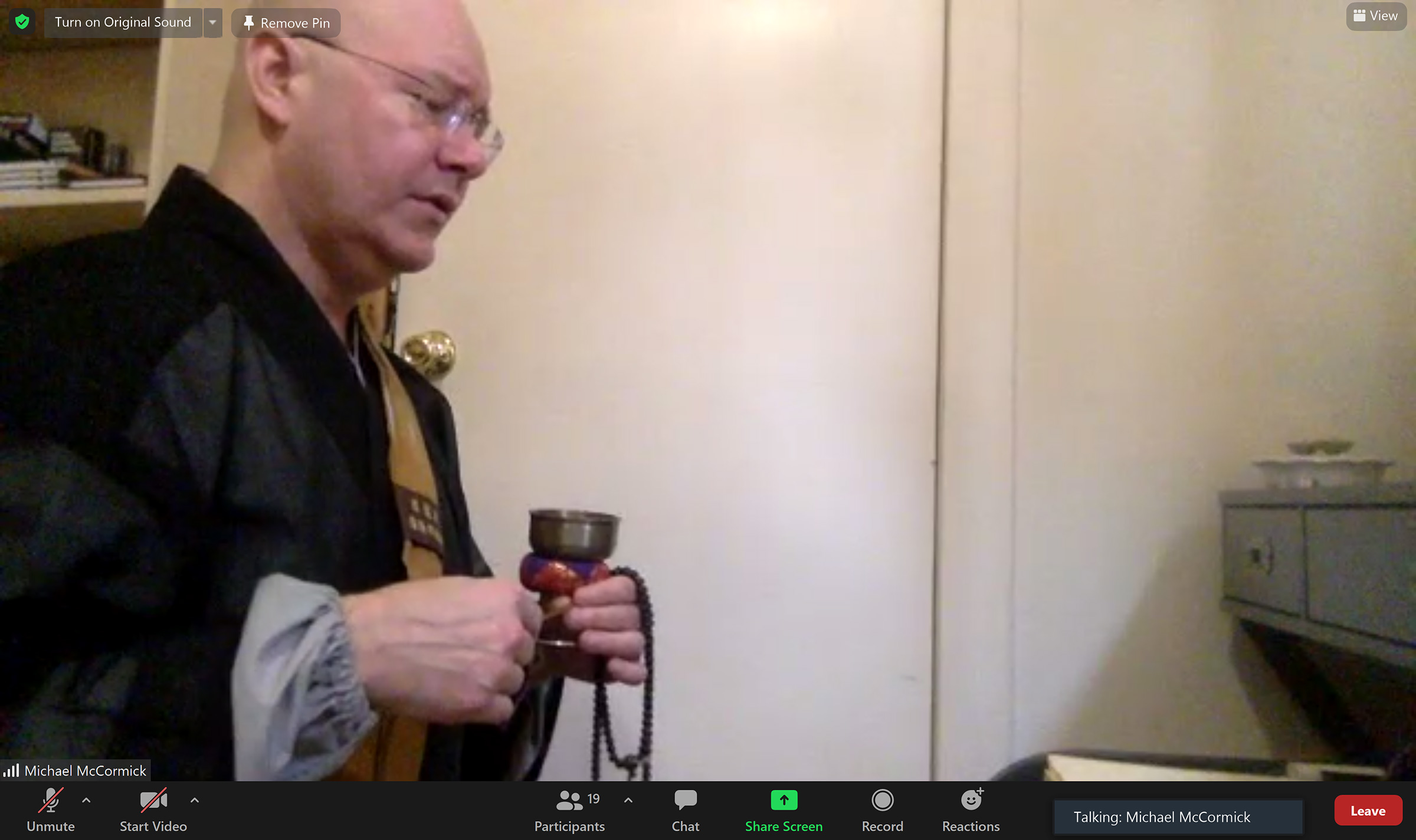
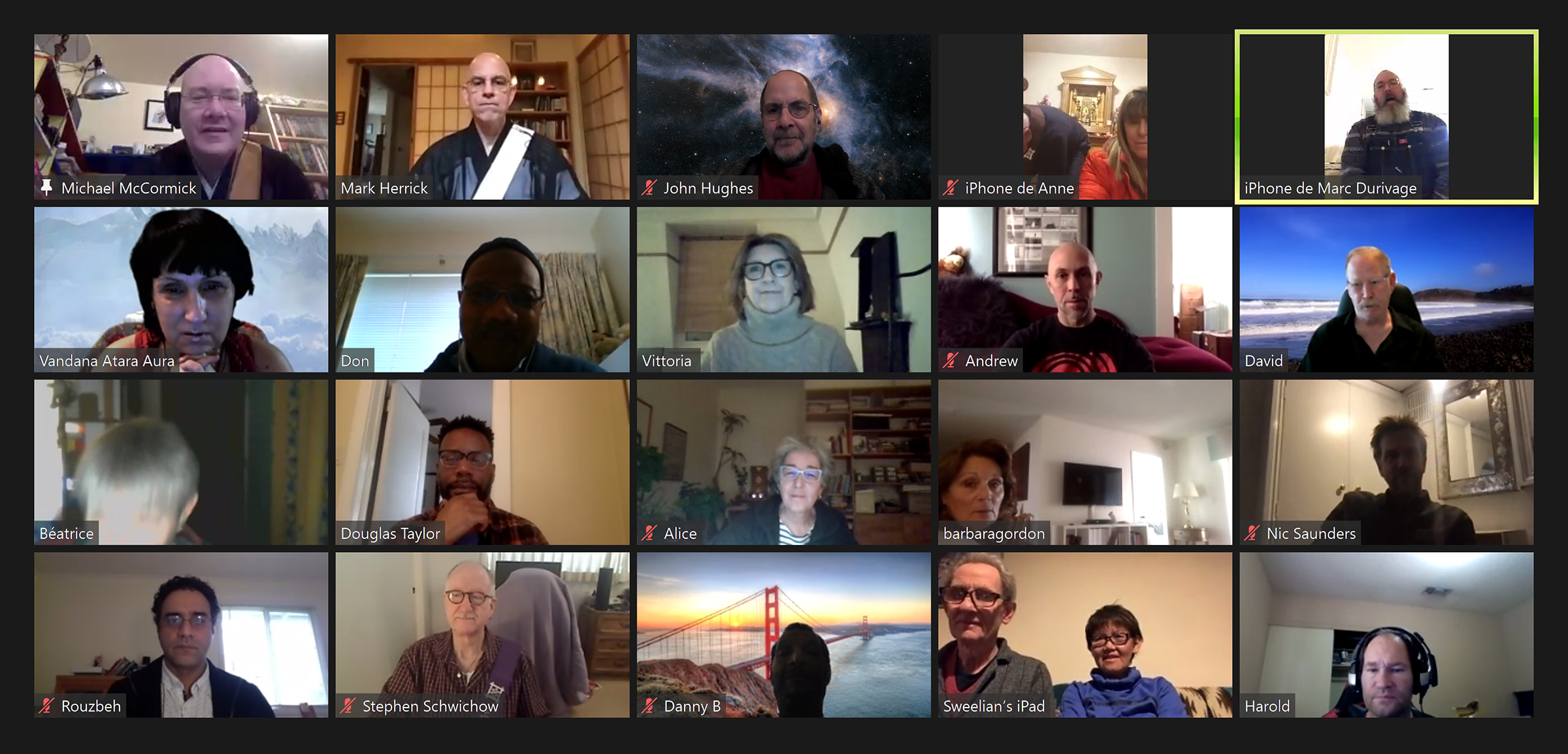
At 12:30pm I joined the Nichiren Buddhist Sangha of the San Francisco Bay Area for their weekly service. Rev. Ryuei McCormick sings shomyo opening the service
The Zoom service included participants from the Czech Republic, France and England and across the United States, including Orlando, Florida; New York City; Chandler, Arizona; Portland, Oregon; and throughout the greater San Francisco Bay Area.
Here’s a recording of the Shami Ryugan Herrick’s lecture on Chapter 3 of the Lotus Sutra and subsequent discussion.
Now the Lotus Sutra describes Avalokiteśvara’s marvelous power to redeem:
Even if someone whose thoughts are malicious Should push one into a great pit of fire, By virtue of the constant mindfulness of Sound-Observer The pit of fire would turn into a pool.
How can we understand this verse? Even if we are pushed into a pit of fire, when we know how to be mindful, how to practice the recollection of the powerful energy of Avalokiteśvara, the fire will be transformed into a cool lotus pond.
The word “fire” in this verse represents anger. Not only individuals are subject to the afflictions of anger and fear – they also occur on the levels of communities, societies, and nations. Sometimes an entire country can be plunged into a pit of fire. The September 11 attacks in New York and Washington, D.C., triggered a huge sea of anger, despair, and fear, and the whole United States was in danger of plunging into that pit of fire. Many Americans were looking at their televisions, listening to the inflammatory rhetoric of the politicians, and desiring revenge and retaliation. They were not able to stop and cultivate the mindfulness to look deeply into the situation in the weeks and months after the devastating event.
Yet not all Americans participated in this upwelling of anger, fear, and despair. I was in New York at the time, with friends, and we shared the insight that we cannot respond effectively to anger with anger. Violence should not be used to counter violence; we must practice looking deeply to see the situation clearly and act with wisdom and compassion. Many people contacted me in the days immediately after the attacks, people who were practicing in order to help the nation remain calm. An angry, violent reaction could trigger a war. I began a fast, and invited friends in Europe, America, and elsewhere to join me in the fast in order to practice calming and looking deeply. I contacted congresspeople, politicians, and others, including Ambassador Andrew Young (who sat with me during interviews), who shared the view that we should not attack out of anger. Over 2,000 people attended the talk I gave at the Riverside Church soon after the attacks, and over a thousand were turned away for lack of space.
Some politicians publicly expressed the desire to support this view, but in the political climate of retaliation, they felt unable to do so. And there were many others who shared this view but did not have enough courage to speak out. The wisdom was there, the compassion was there, but the environment was not favorable for the expression of that wisdom and compassion. Yet not all Americans shared the viewpoint of the president or supported the government’s retaliatory action. We must always remember, especially in times of great turmoil or suppression, that we have more friends with us than we may think.
The message of Buddhism is very clear – all violence is injustice. Escalation of anger and violence leads only to more anger and violence, and in the end to total destruction. Violence and hatred can only be neutralized by compassion and loving kindness. When you find yourself in a difficult situation, when you are about to fall into a pit of fire, if you know how to practice mindfulness of compassion and invoke the embodiment of compassion, Avalokiteśvara, then you will be able to stop, calm yourself, and look more deeply and clearly into your situation. Anger and the desire for retaliation and revenge will subside and you will be able to find the better way to respond. Understanding that we inter-are, and that any violence done to another is ultimately violence done to ourselves, we practice mindfulness of compassion so as not to cause more suffering to ourselves, our own people, or those on the so-called other side.
The ocean of fire, the pit of suffering, fear, and anger is a reality. The suffering and despair of the world is enormous, and the desire to punish those who harm us, to retaliate out of our fear and anger, is very strong in us. All of this causes the pit of fire to grow larger and it threatens to consume us all. We can turn the ocean of fire into a cool lake by practicing mindfulness of love and invoking the messenger of love, Avalokiteśvara. As the Lotus Sutra tells us, the bodhisattva of compassion has many aspects and can manifest in many forms and with many names. This bodhisattva is the universal gateway to the path of compassion and reconciliation, and through mindfulness of love, understanding, and compassion the ocean of fire is transformed into a cool, refreshing lotus pond.
If the concept of the Eternal Buddha (enlightened since the infinite past) had not been expounded in the Lotus Sūtra, then all the Buddhas throughout the past, present and future would have been mere momentary Buddhas, due to the principle of impermanence. It would be as futile as having no sun or moon even though there are many stars in the sky, or as plants trying to grow in the ground without soil. This conclusion has been based on your recognition, however, of the supremacy of the Lotus Sūtra, which teaches the concept of the Eternal Buddha and enlightenment of all people of the Two Vehicles (of śrāvaka and pratyekabuddha).
Shōjō Daijō Fumbetsu-shō, The Differences between Hinayāna and Mahāyāna Teachings, Writings of Nichiren Shōnin, Doctrine 2, Page 194
Although the time is ripe for the Lotus Sutra to convert everyone, teachers who propagate it are ordinary teachers while their disciples are wicked and sickened by the three poisons of greed, anger and ignorance. They avoid teachers who preach the True Dharma, befriending teachers who preach false Dharma. Is it not natural then that he who practices the Lotus Sutra, the true teaching of the Buddha, and his disciples and followers and lay followers are persecuted more severely than the three kinds of enemies?
Nichiren wrote this passage in his Treatise on the True Way of Practicing the Teaching of the Buddha (Nyosetsu Shugyō-shō). In our efforts to uphold and practice the Wonderful Dharma of the Lotus Sūtra, we may be surprised to be the targets of anger or aggression from others, especially from others who also practice the Dharma with us. These difficulties will be opportunities for us to practice wisdom and nourish our compassion. We can learn to recognize others’ delusions within our own minds and remain focused on ridding ourselves of the three poisons, rather than attempting to change someone else’s behavior. In this way we become an example for how to live, and allow the Ever-Present Buddha Śākyamuni to work within our hearts.
The Daily Dharma is produced by the Lexington Nichiren Buddhist Community. To subscribe to the daily emails, visit zenzaizenzai.com