All posts by John Hughes

Day 28

Day 28 covers all of Chapter 24, Wonderful-Voice Bodhisattva, and concludes the Seventh Volume of the Sutra of the Lotus Flower of the Wonderful Dharma.

Having last month learned about the root of good Wonderful-Voice Bodhisattva planted, we consider Wonderful-Voice Bodhisattva’s power of transformation.

“Flower-Virtue! Now you see Wonderful-Voice Bodhisattva here and nowhere else. But formerly he transformed himself into various living beings and expounded this sūtra to others in various places. He became King Brahman, King Sakra, Freedom God, Great-Freedom God, a great general in heaven, Vaisravana Heavenly-King, a wheel-turning-holy-king, the king of a small country, a rich man, a householder, a prime minister, a brahmana, a bhikṣu, a bhikṣunī, an upāsakā, an upāsikā, the wife of a rich man, that of a householder, that of a prime minister, that of a brahmana, a boy, a girl, a god, a dragon, a yakṣa, a gandharva, an asura, a garuda, a kiṃnara, a mahoraga, a human being or a nonhuman being. [After he transformed himself into one or another of these living beings,] he expounded this sūtra, and saved the hellish denizens, hungry spirits, animals, and all the other living beings in the places of difficulties. When he entered an imperial harem, he became a woman and expounded this sūtra.

“Flower-Virtue! This Wonderful-Voice Bodhisattva protects all living beings in this Sahā-World. He transforms himself into one or another of these various living beings in this Sahā World and expounds this sūtra to all living beings without reducing his supernatural powers, [his power of] transformation, and his wisdom. He illumines this Sahā World with the many [rays of light] of his wisdom, and causes all living beings to know what they should know. He also does the same in the innumerable worlds of the ten quarters, that is, in as many worlds as, there are sands in the River Ganges. He takes the shape of a Śrāvaka and expounds the Dharma to those who are to be saved by a Śrāvaka. He takes the shape of a Pratyekabuddha and expounds the Dharma to those who are to be saved by a Pratyekabuddha. He takes the shape of another Bodhisattva and expounds the Dharma to those who are to be saved by that Bodhisattva. He takes the shape of a Buddha and expounds the Dharma to those who are to be saved by a Buddha. He takes these various shapes according to the capacities of those who are to be saved. He shows his extinction to those who are to be saved by his extinction. Flower-Virtue! Such are the great supernatural powers and the power of wisdom obtained by Wonderful-Voice Bodhisattva-mahāsattva.”
See Our Extraordinary Ability to Serve Others

Our Extraordinary Ability to Serve Others

In [Chapter 23] of the Sutra, about the previous lives of Medicine King Bodhisattva, it is said that Seen with Joy by All the Living Bodhisattva attained a concentration that enabled him to take on any form. It was gaining the ability to take on any form that led this bodhisattva to sacrifice his body to the Buddha of his world. But in Chapter 23 we are not told what the name of this concentration means. Here, in Chapter 24, we can see more clearly what this ability to take on any form is about. It is an extraordinary ability to serve others.

Then the Buddha tells Flower Virtue that while he can see only one body of Wonderful Voice Bodhisattva, this bodhisattva appears in many different bodies, everywhere teaching this Sutra for the sake of the living. He appears as the king Brahma, as Indra, Ishvara or Maha-Ishvara, or as a great general of heaven. Sometimes he appears as Vaishravana, or as a holy wheel-rolling king, or as a lesser king; or he appears as an elder, an ordinary citizen, a high official, a brahman, or a monk, nun, layman, or laywoman; or he appears as the wife of an elder or householder, the wife of a high official, or the wife of a brahman, or as a boy or girl; or he appears as a god, a dragon, satyr, centaur, ashura, griffin, chimera, python, human or nonhuman being, and so on. He can help those who are in a purgatory, or are hungry spirits or animals, and all who are in difficult circumstances. And for the sake of those in the king’s harem he transforms himself into a woman and teaches this Sutra.

For those who need the form of a shravaka, a pratyekabuddha, or a bodhisattva to be liberated, he appears in the form of a shravaka, pratyekabuddha, or bodhisattva and teaches the Dharma. For those who need the form of a buddha to be liberated, he appears in the form of a buddha and teaches the Dharma. According to what is needed for liberation, he appears in various forms. Even if it is appropriate to enter extinction for the sake of liberation, he shows himself as one who enters extinction. (LS 367—68)

This variety of forms is remarkably inclusive. While clearly advocating and emphasizing the importance of the bodhisattva way, the Dharma Flower Sutra wants its hearers and readers to understand that appearing in the form of a bodhisattva is only one way among many, any of which can be effective. This variety of forms can be seen as an expression of the emphasis found in the first few chapters of the Sutra on the variety of skillful means. But here, in a sense, the message is even more direct. If, it says, you are “the wife of a brahman,” or “a boy or girl,” or anyone else, you too can be a bodhisattva, you can be Wonderful Voice Bodhisattva!

The Stories of the Lotus Sutra, p263-264

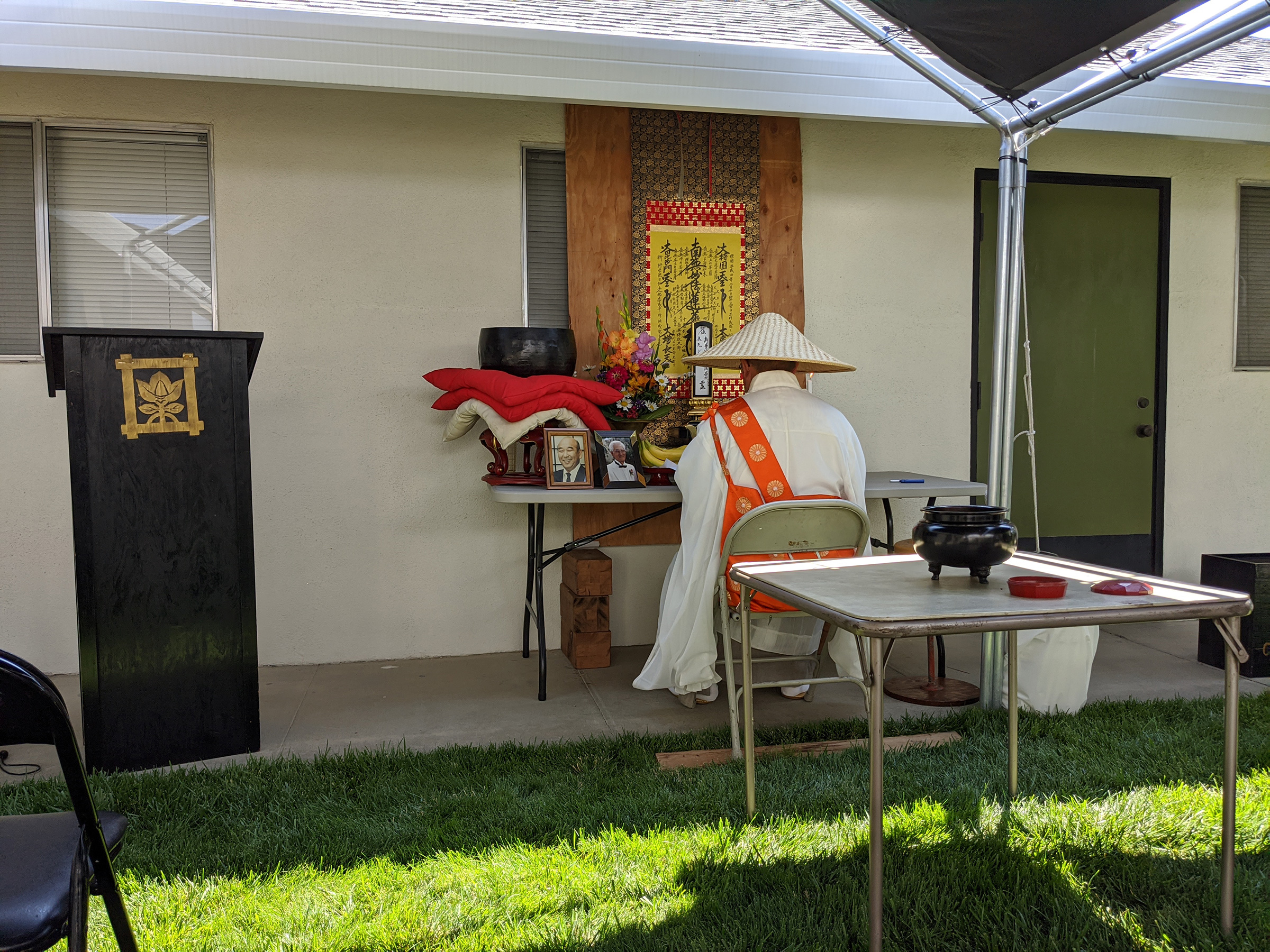
Outdoor Service

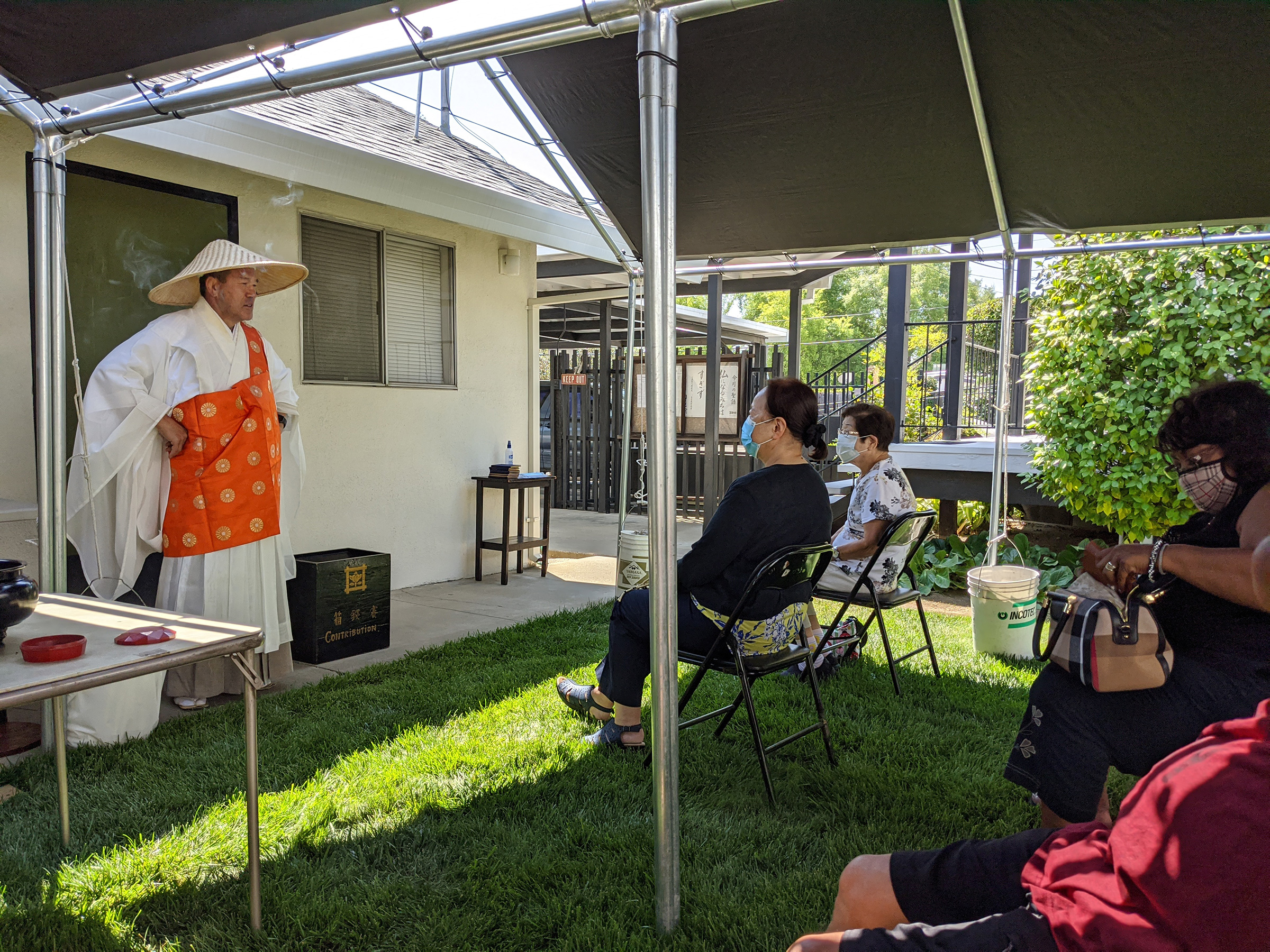
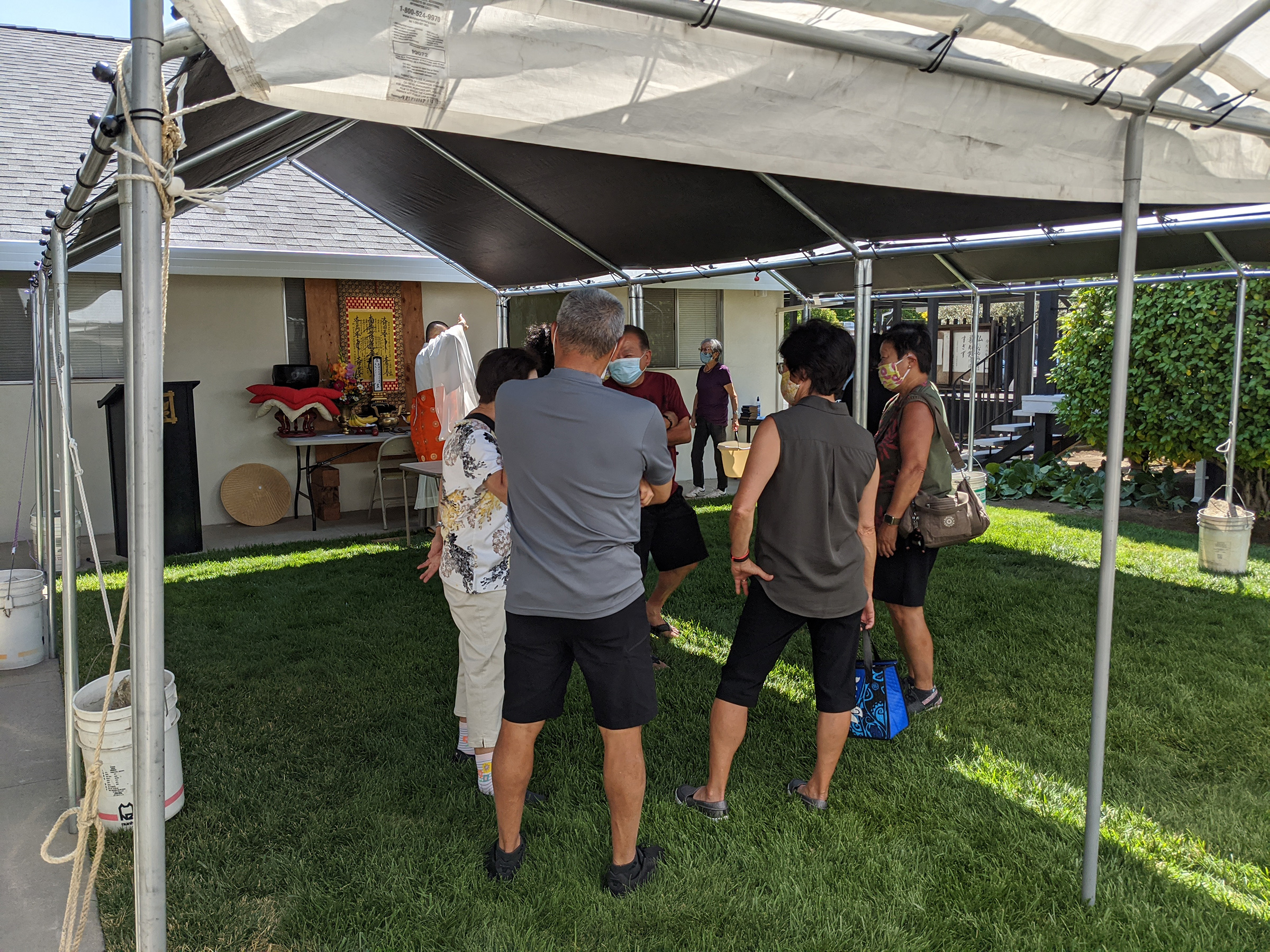
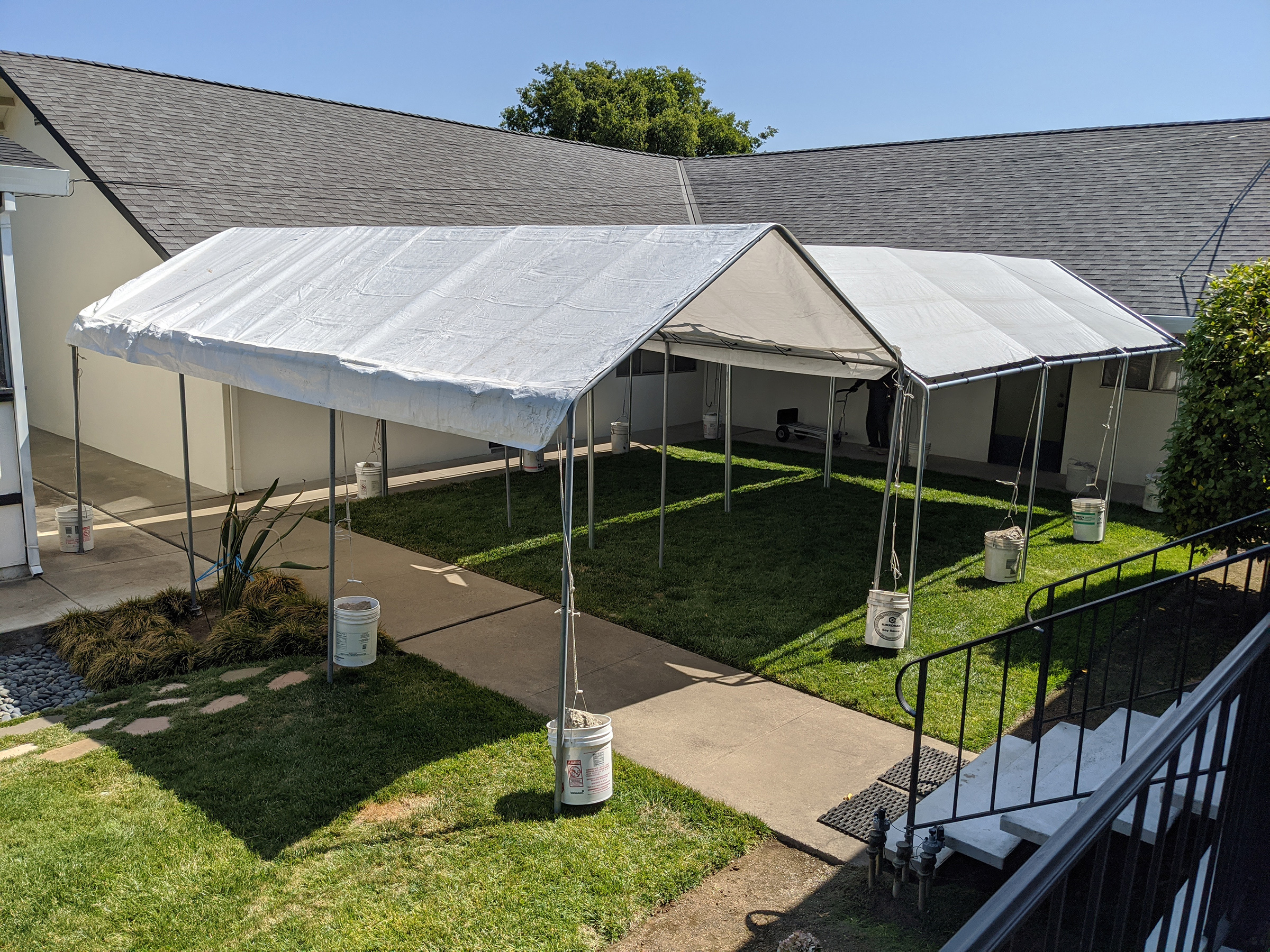
California recently prohibited all indoor religious services and so the Sacramento Nichiren Buddhist Church set up outside in a grassy area between the Social Hall and the Temple.

Three 20 by 10 feet canopies were erected on Saturday. These canopies are normally used during the Summer Food Festival.


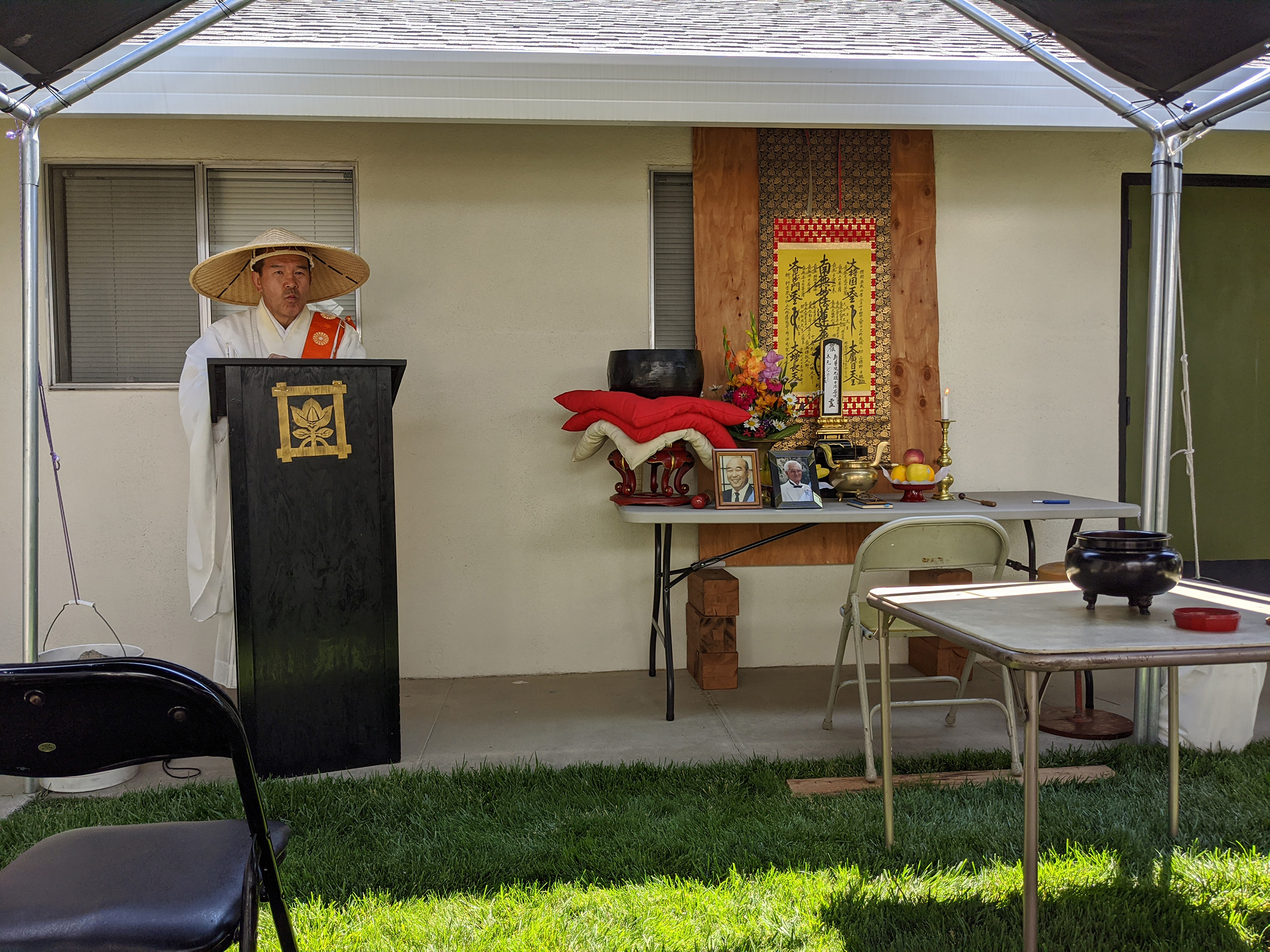
Rev. Igarashi stands at podium next to makeshift altar. The podium originally belonged to the San Francisco Nichiren Buddhist Church, where Rev. Igarashi worked before moving to Sacramento in 1989. The Mandala Gohonzon was presented to Rev. Igarashi after the completion of his third Aragyo session, the 100-day ascetic practice. Rev. Igarashi has completed five of the Aragyo sessions.


Rev. Igarashi at the altar.


Rev. Igarashi chats with masked, socially-distant parishioners under the canopies.

A group of masked-parishioners chat after the service.

Having the service outside was workable, but it was quite warm at times – could have used a litttle more breeze – and the traffic on the nearby street made Rev. Igarashi’s Dharma talk difficult to hear at times.

The Bodhisattva’s Illness

Recently I completed reading The Vimalakirti Sutra as translated by Burton Watson. I was reading this as part of Rev. Ryuei McCormick’s Buddhist Study Program. This also plays into reading I’ve been doing on T’ien-t’ai’s teaching and, in particular, how it constrasts with the Madhyamika.

As with all of my quotes here, the purpose is to file these away for future reference. I’ve never been famous for my retention of what I read, and at 68 years of age I’m not getting any better.

Today’s quote is about illness, from pages 64-66.

INQUIRING ABOUT THE ILLNESS

At that time the Buddha said to Manjushri, “You must go visit Vimalakirti and inquire about his illness.”

Manjushri replied to the Buddha, “World-Honored One, that eminent man is very difficult to confront. He is profoundly enlightened in the true nature of reality and skilled at preaching the essentials of the Law. His eloquence never falters, his wisdom is free of impediments. He understands all the rules of bodhisattva conduct, and nothing in the secret storehouse of the Buddhas is beyond his grasp. He has overcome the host of devils and disports himself with transcendental powers. In wisdom and expedient means he has mastered all there is to know. Nevertheless, in obedience to the Buddha’s august command, I will go visit him and inquire about his illness.” …

“Layman, this illness of yours – can you endure it? Is the treatment perhaps not making it worse rather than better? The World-Honored One countless times has made solicitous inquiries concerning you. Layman, what is the cause of this illness? Has it been with you long? And how can it be cured?”

Vimalakirti replied, “This illness of mine is born of ignorance and feelings of attachment. Because all living beings are sick, therefore I am sick. If all living beings are relieved of sickness, then my sickness will be mended. Why? Because the bodhisattva for the sake of living beings enters the realm of birth and death, and because he is in the realm of birth and death he suffers illness. If living beings can gain release from illness, then the bodhisattva will no longer be ill.

“It is like the case of a rich man who has only one child. If the child falls ill, then the father and mother too will be ill, but if the child’s illness is cured, the father and mother too will be cured. The bodhisattva is like this, for he loves living beings as though they were his children. If living beings are sick, the bodhisattva will be sick, but if living beings are cured, the bodhisattva too will be cured. You ask what cause this illness arises from – the illness of the bodhisattva arises from his great compassion.”

This certainly resonates with this day of COVID-19.

Prayers for Rev. Ryusho Jeffus

20200726_myoshoji_service
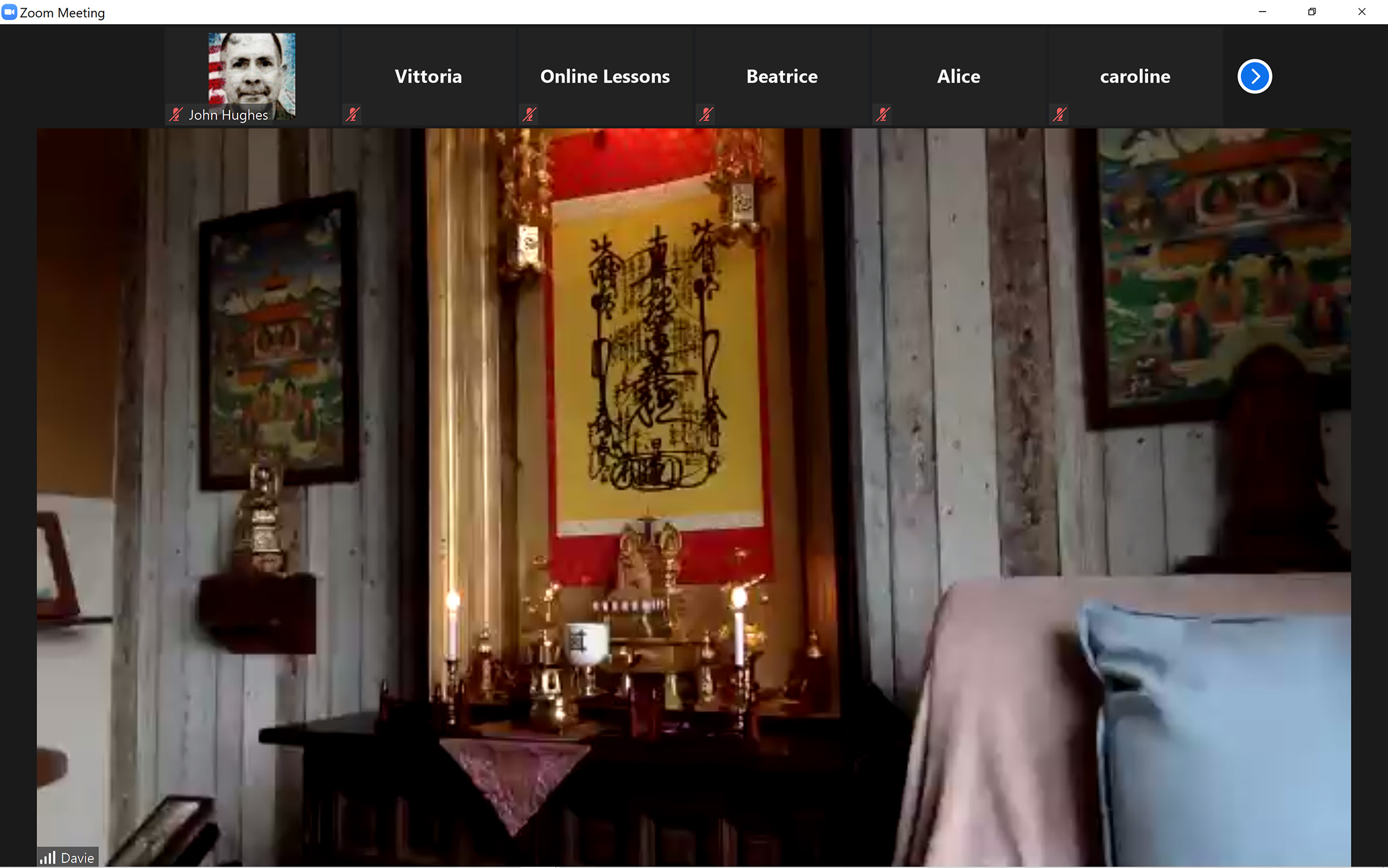
With Rev. Ryusho Jeffus in hospital, Davie Byden-Oakes took over from England to offer a Sunday service.

Members of Rev. Ryusho Jeffus’ online Sangha gathered today to hold a service and offer prayers for Ryusho, who has been in hospital since Friday. Ryusho communicated with my wife to say his news from the doctors “was not good” and that he was receiving palliative care at the Syracuse VA Medical Center for extreme pain and difficulty breathing. Nothing has been heard since. Davie Byden-Oakes, who led Sunday’s service from England, said he had received a brief note from Ryusho saying he was in hospital and receiving palliative care.

20200726_Myoshoji_Service_Attendees
Attendees of Myoshoji online service led by Davie Byden-Oakes in England

Daily Dharma – July 26, 2020

When he keeps this sūtra, He will be able to reach a rare stage. He will be joyfully loved and respected By all living beings.

The Buddha sings these verses in Chapter Nineteen of the Lotus Sūtra. He describes those who put this sūtra in their lives, and dedicate their existence to liberating all beings from ignorance and delusion. When the Buddha became enlightened, he realized all beings can become enlightened. When we work for the benefit of all beings, we find the Buddha’s mind and bring harmony into our lives and the world.

The Daily Dharma is produced by the Lexington Nichiren Buddhist Community. To subscribe to the daily emails, visit zenzaizenzai.com

Day 27

Day 27 concludes Chapter 23, The Previous Life of Medicine-King Bodhisattva.

Having last month concluded today’s portion of Chapter 23, we return to the top and Gladly-Seen-By-All-Beings Bodhisattva’s observation of the Buddha, ‘World-Honored One! You do not change, do you?’

“Having sung this gāthā, Gladly-Seen-By-All-Beings Bodhisattva said to the Buddha, ‘World-Honored One! You do not change, do you?’

“Sun-Moon-Pure-Bright-Virtue Buddha said to Gladly-Seen-By-All-Beings Bodhisattva, ‘Good man! The time of my Nirvana is near at hand. The time of my extinction is coming. Prepare me a comfortable couch! I shall enter into Parinirvana tonight.’ “Then he instructed Gladly-Seen-By-All-Beings Bodhisattva, saying, ‘Good man! I will transmit all my teachings to you. [I also will transmit] to you all the Bodhisattvas and all my great disciples. [I also will transmit] to you my teachings for Anuttara-samyak-saṃbodhi. I also will transmit to you the one thousand Sumeru worlds made of the seven treasures, the jeweled trees, the jeweled platforms, and the gods attending on me. I also will transmit to you the śarīras to be left after my extinction. Distribute my śarīras far and wide and make offerings to them! Erect thousands of stupas [to enshrine them]!’

“Having given these instructions to Gladly-Seen-By-All-Beings Bodhisattva, Sun-Moon-Pure-Bright-Virtue Buddha entered into Nirvana in the last watch of that night. Having seen the extinction of the Buddha, Gladly-Seen-By-All-Beings Bodhisattva was overcome with sorrow. He adored the Buddha all the more. He made a pyre of the candana grown on this shore of the sea, offered it to the body of the Buddha, and burned it. After it burned up, he collected the śarīras. He made eighty-four thousand stupas of treasures[, and put the śarīras therein]. He erected eighty-four thousand stupas[, and enshrined the urns therein]. The stupas were higher than the Third Dhyana-Heaven. They were adorned with yastis. Many streamers and canopies were hanging down [from the stupas]. Many jeweled bells also were fixed [on the stupas].

The Daily Dharma from March 28, 2020, offers this:

Having sung this gāthā, Gladly-Seen-By-All-Beings Bodhisattva said to the Buddha, ‘World-Honored One! You do not change, do you?’

This description of the life of Gladly-Seen-By-All-Beings Bodhisattva comes from Chapter Twenty-Three of the Lotus Sūtra. In a previous existence, this Bodhisattva had given up his body and his life for the sake of teaching the Wonderful Dharma. He was then reborn into a world in which the Buddha he served previously was still alive and benefitting all beings. Recognizing this unchanging aspect of the Buddha despite his changing appearances helps us see into our own capacity for enlightenment.

The Daily Dharma is produced by the Lexington Nichiren Buddhist Community. To subscribe to the daily emails, visit zenzaizenzai.com

The Awakening of Faith in the Mahāyāna

The secret to my constant flow of quotes from books I read is an app on my phone called Office Lens. This is a Microsoft product that integrates with One Drive. Using Office Lens I can take a picture of a block of text and have the app save an editable version of the text in a Word file. Best of all, the image is included so that occasional OCR failures can be fixed.

Not every book I read merits extensive quotes. My Office Lens folder is cluttered with quotes I’ve set aside but never uploaded here. Since they don’t do me any good there, I’m working my way through the odds and ends.

Today’s example is The Awakening of Faith, which is attributed to Aśvaghoṣa. The Awakening of Faith is described as a “comprehensive summary of the essentials of Mahāyāna Buddhism.” While there is a great deal of substance here, I only set aside two things I felt merited saving for use later.

First is the full title of the work, The Awakening of Faith in the Mahāyāna.

It should be noted that the term “Mahāyāna” here is not used in the usual sense of the word, that is, Mahāyāna versus Hinayāna. According to the definition given in the discussion immediately following, Mahāyāna designates Suchness or the Absolute. The title of the text, the Awakening of Faith in the Mahāyāna, should therefore be understood as the “Awakening of Faith in the Absolute,” not in Mahāyāna Buddhism as distinguished from Hinayāna Buddhism.

I wonder whether this applies in more instances where the Great Vehicle is discussed.

The second concerns how one is to look at the Reality of Dependent Origination.

“Because these two aspects are mutually inclusive”: Reality is conceived as the intersection of the Absolute order and the phenomenal order; therefore, it contains in itself both the Absolute and the phenomenal order at once. The Absolute order is thought to be transcendental and yet is conceived as not being outside of the phenomenal order. Again the phenomenal order is thought to be temporal and yet is conceived as not being outside of the Absolute order. In other words, they are ontologically identical; they are two aspects of one and the same Reality. Perhaps the most famous and simplest statement of the relationship between the Absolute and the phenomenal order can be found in the sayings of Nāgārjuna (second century A.D.), e.g., “There is no difference whatsoever between nirvāṇa (Absolute) and saṃsāra (phenomena); there is no difference whatsoever between saṃsāra and nirvāṇa.”

This is a recurring discussion. I recently finished T’ien-t’ai Buddhism and Early Mādhyamika, which is almost entirely devoted where Nāgārjuna and T’ien-t’ai intersect and diverge. I’ve lots of quotes that I’ll need to eventually add here.

Finally, I have this excellent summary of what it means to be a Buddhist.

On Mount Chunwang in Henan province there was a monk [Chan Master Daolin] who practiced meditation sitting in a tall pine tree day after day. His practice was so effortless and spontaneous that birds formed their nests next to his meditation Site. People gave him the nickname “Bird Nest Master” and frequented his treehouse to seek his guidance. …

One day the great Tang poet Bo Juyi (772-846), who was then a regional magistrate, visited Daolin at his treehouse. Bo Juyi asked Daolin, “Master, your residence looks so high on the tree. Isn’t it dangerous?”

The master said, “Magistrate, yours is far more dangerous than mine.”

Bo continued, “But, Master, I, your humble disciple, rule over all the rivers, mountains, and lands in this region. Why am I in a danger?

“Fire and firewood destroying each other,” replied the Master, “that’s how your mind ‘s thoughts operate, and you cannot quiet them. Is that not truly dangerous?”

Bo paused and then asked again, “Master, please instruct me in the cardinal teaching of Buddhism.”

Daolin said, “Abstain from all bad deeds, and practice all good deeds.”

“Even a three-year-old child knows that,” said Bo with dissatisfaction.

Daolin told Bo, “A three-year-old child may know it, but even an eighty-year-old man cannot put it into practice.”

Bo Juyi bowed low at the master’s feet.

Teaching to Our Hearts

Chapter 16 of the Lotus Sutra begins with the serious three times and more request by the congregation for the Buddha to tell how it is that he could have taught the Bodhisattvas who appeared from beneath the ground. They ask this three times and once more after promising three times and more that they will understand the teaching by faith. So the teaching will proceed but comprehension will not be possible through intellect but only if we approach understanding through faith. The Buddha will not be teaching to the rational. He will not be teaching to the intellectual or mentally gifted. He will only be teaching to our hearts and to our experiences based upon faith.

Lecture on the Lotus Sutra

The Secret Dharma

The secret dharma (five characters of Myō, Hō, Ren, Ge, and Kyō), the essence of the Lotus Sūtra, that such great sages as Kāśyapa, Ānanda, Nāgārjuna and Vasubandhu of the Age of the True Dharma and Grand Masters T’ien-t’ai and Dengyō of the Age of the Semblance Dharma knew in mind but did not yet propagate outwardly, is clearly stated in the Lotus Sūtra. It is also clear, however, that this secret dharma is not explained at all in any commentary or annotation. Sages with an inborn capacity of perception should know the dharma by looking at the sūtra themselves. Wise persons should meet virtuous teachers, receive the dharma and believe it. Those with serious sins will distrust and hold in contempt such teachers and will not believe the dharma, but if they wish to listen to it even for a moment, I am willing to tell you about it.

Soya Nyūdō-dono-gari Gosho, A Letter to Lay Priest Lord Soya, Writings of Nichiren Shōnin, Doctrine 3, Pages 169.