
Buddhism for Today, p343Having finished preaching chapter 21, Sakyamuni Buddha rose from his Law seat and, through his supernatural power, laid his right hand on the heads of the innumerable bodhisattva-mahasattvas and spoke thus: “I, for incalculable hundreds of thousands of myriads of koṭis of asaṃkhyeyas of kalpas, have practiced this rare Law of Perfect Enlightenment. Now I entrust it to you. Do you wholeheartedly promulgate this Law and make it increase and prosper far and wide.”
To lay one’s hand on another’s head or to pat someone on the head is to praise him, according to Japanese custom. In the West it is usually a gesture of affection. In India, however, such an action means to put one’s trust in another, as if to say, “I leave it to you. Do your best.” It is said that Sūryasoma, who taught the Lotus Sutra to his favorite disciple, Kumārajīva, laid his hand on Kumārajīva’s head and said to him, “Reverently propagate this sutra.”
The Buddha’s action of laying his right hand on the heads of the innumerable bodhisattvas through his supernatural power represents his placing deep trust in them. They must have been deeply moved by the Buddha’s action.
All posts by John Hughes
The Originally Enlightened Buddha of the Perfect Teaching Abides in This World
Two Buddhas, p189“The originally enlightened buddha of the perfect teaching abides in this world,” Nichiren wrote. “If one abandons this land, to what other land should one aspire? Wherever the practitioner of the Lotus Sūtra dwells should be considered the pure land.” Based on such thinking, Nichiren opposed the idea, extremely common in his time, of shunning this world as wicked and impure and aspiring to birth in the pure land of a buddha or bodhisattva after death. Because the various sūtras preached before the Lotus do not teach the perfect interpenetration of the buddha realm and the nine deluded realms, Nichiren asserted, the superior realms of buddhas and bodhisattvas that they mention, such as Amitābha’s Sukhāvati realm or Maitreya’s Tusita heaven, are merely provisional names; the “Lifespan” chapter of the Lotus reveals that the true pure land is to be realized here in the present, Sahā world.
Planting the Seed of Buddhahood with the Daimoku
Scholars today … are confused with the time and capacity of people to understand and believe the teaching. As a result, some scholars spread the Hinayāna teaching, others preach the provisional Mahāyāna doctrines, while still others expound the One Vehicle doctrine of the Lotus Sūtra. They do not seem to understand the reason why the seed of Buddhahood should be planted with the five characters of the daimoku.
Soya Nyūdō-dono-gari Gosho, A Letter to Lay Priest Lord Soya, Writings of Nichiren Shōnin, Doctrine 3, Pages 151.
Daily Dharma – March 10, 2020
Only I see clearly and without hindrance that they are at various stages [of enlightenment]. I know this, but they do not know just as the trees and grasses including herbs in the thickets and forests do not know whether they are superior or middle or inferior.
The Buddha makes this declaration in Chapter Five of the Lotus Sūtra, as he explains the simile of herbs. This is a good reminder for us on the Bodhisattva path of how important it is to have respect for all beings. We can believe we know whether someone else is less enlightened than we are, or even more enlightened than we are. But for Bodhisattvas, this belief is irrelevant. Only the Buddha knows who is where on the path. We do not need to know. We just need to find ways to benefit others, no matter how close they may be to enlightenment.
The Daily Dharma is produced by the Lexington Nichiren Buddhist Community. To subscribe to the daily emails, visit zenzaizenzai.com
Day 25
Day 25 covers all of Chapter 20, Never-Despising Bodhisattva, and opens Chapter 21, The Supernatural Powers of the Tathāgatas.

Having last month considered the declaration of the Bodhisattvas who had sprung up from underground and the response of the Buddha, we conclude today’s portion of Chapter 21, The Supernatural Powers of the Tathāgatas with reaction of the gods in the skies of the worlds of the ten quarters.
At that time the gods in the skies [of the worlds of the ten quarters] said loudly:
“There is a world called Sahā beyond a distance of many hundreds of thousands of billions of asaṃkhyas of worlds. In that world lives a Buddha called Śākyamuni. He is now expounding to Bodhisattva-mahāsattvas a sūtra of the Great Vehicle, called the ‘Lotus Flower of the Wonderful Dharma, the Dharma for Bodhisattvas, the Dharma Upheld by the Buddhas.’ Rejoice from the bottom of your hearts! Bow and make offerings to Śākyamuni Buddha!”
Having heard their voice from the skies, the living beings of those worlds joined their hands together towards the Sahā World, and said, “Namah Sakyamunaye Buddhaya, namah Sakyamunaye Buddhaya.” Then they strewed various flowers, various kinds of incense, various necklaces, streamers, canopies, personal ornaments, treasures, and other wonderful things to the Sahā-World from afar.
The strewn things came from the worlds of the ten quarters like gathering clouds and changed into a jeweled awning over the Sahā-World. The awning extended over the Buddhas staying in this world. At that time the worlds of the ten quarters became passable through each other without hindrance as if they had been a single Buddha-world.
A True and Peerless Teaching
Buddhism for Today, p333-334There are indeed many different speeds in the process of the attainment of enlightenment. The difference in people’s capacity to understand the Buddha’s teachings exists only in the area encompassed by “this shore” (shigan), the world of birth and death. But people become buddhas equally when they reach “that shore” (higan), the realm of nirvana. Therefore, there is no essential difference in their capacity to understand the Buddha’s teachings. This is the teaching of mirai-ki’itsu, “man’s capacity to understand the Buddha’s teachings is one in the future.” The Buddhist term fugen-daie, “all creatures universally see the great assembly of the Buddha surrounded by many other buddhas,” indicates the idea that the Buddha has the divine power to lead all living beings equally to the realm of nirvana in the future.
The expression “all the gods in the sky sang with exalted voices” means that all living beings in the sahā-world received inspiration from all the gods. Such an expression is not limited to Buddhism. The phrase “a voice was heard from heaven” appears in Christian writings, and the words “I hear heaven’s voice” are often used in the teachings of Confucius and Mencius. These words imply that people receive revelations from heaven, that is, that they perceive the truth of faith as if an inspiration had flashed across their minds.
What did all the living beings in the sahā-world receive by inspiration from the exalted voices of all the gods in the sky? They realized that in the sahā-world, Sakyamuni Buddha preached the teaching called the Lotus Flower of the Wonderful Law, the Law by which bodhisattvas are instructed and which the buddhas watch over and keep in mind. This is a true and peerless teaching, which causes all beings in the universe to live, bestows harmony on them, and brings about their peace of mind. This realization means that although the sahā-world is now a realm of suffering, it will surely become the most sacred land of the universe in the future, when all teaching and learning will be united into one in the Buddha’s teachings.
About That Photo
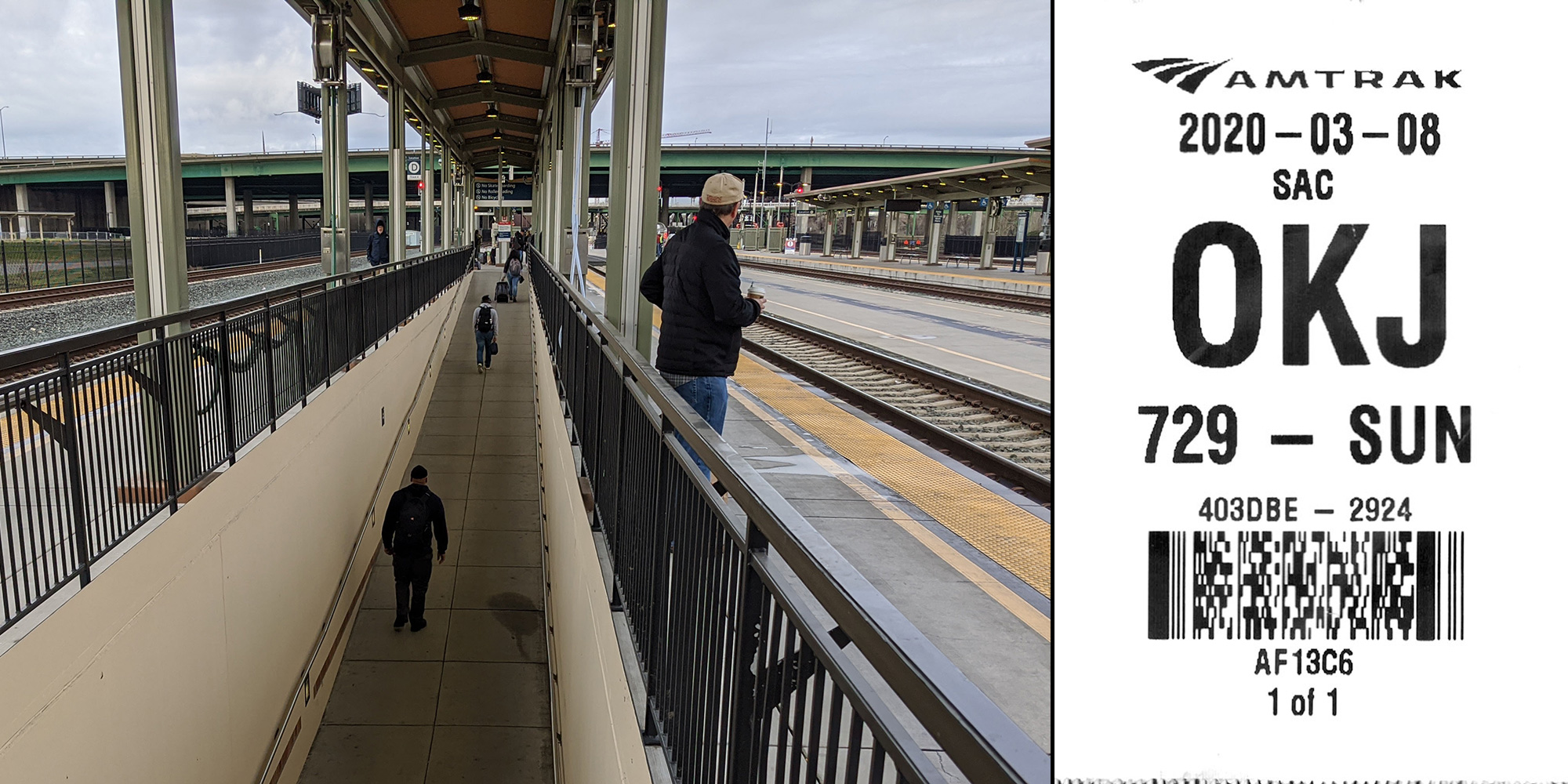
On Sunday, March 3, I got up early, did my regular morning service and then drove to the Sacramento Amtrak station downtown to catch the 9 am Capitol Corridor train to Oakland.
Normally, I attend services at the Sacramento Nichiren Buddhist Church on the second Sunday of the month, but with no service scheduled this month I decided to attend the Nichiren Buddhist Sangha of the San Francisco Bay Area service at the home of Mark Ryugan Herrick in Piedmont.
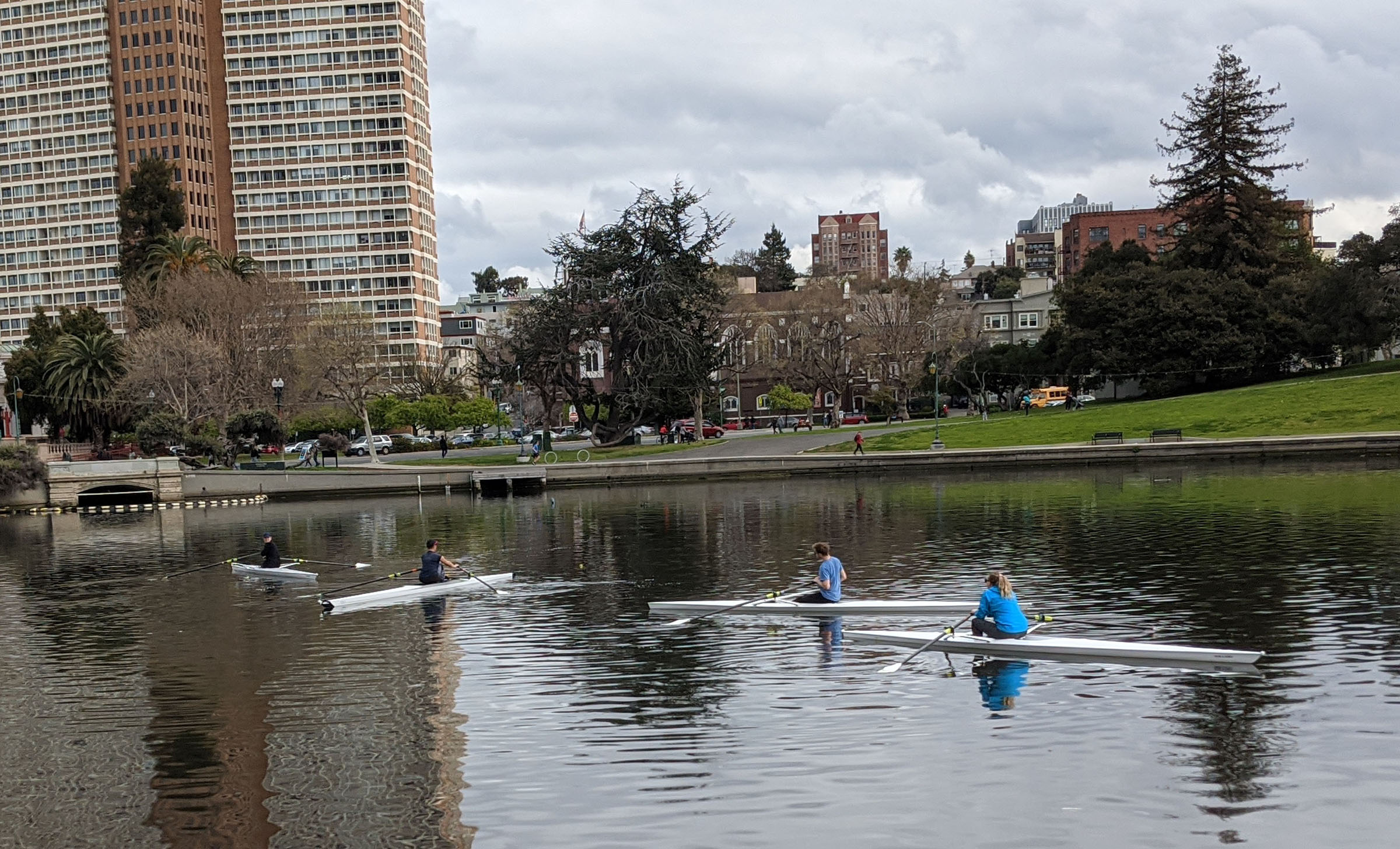
It is a little more than 3 miles from the Oakland Jack London Square Amtrak station to Greenbank Avenue in Piedmont. From the Second Street station, I walk to Jackson Street and then to Lake Merritt. I walk around Lake Merritt to Grand Avenue and then continue up the hill to Greenbank Avenue. The only physical difficulty is my bladder. At 68 I’m prone to extra trips to the potty, especially after drinking tea on the two-hour train trip. Anyway, thank you, Safeway, for providing public toilets.
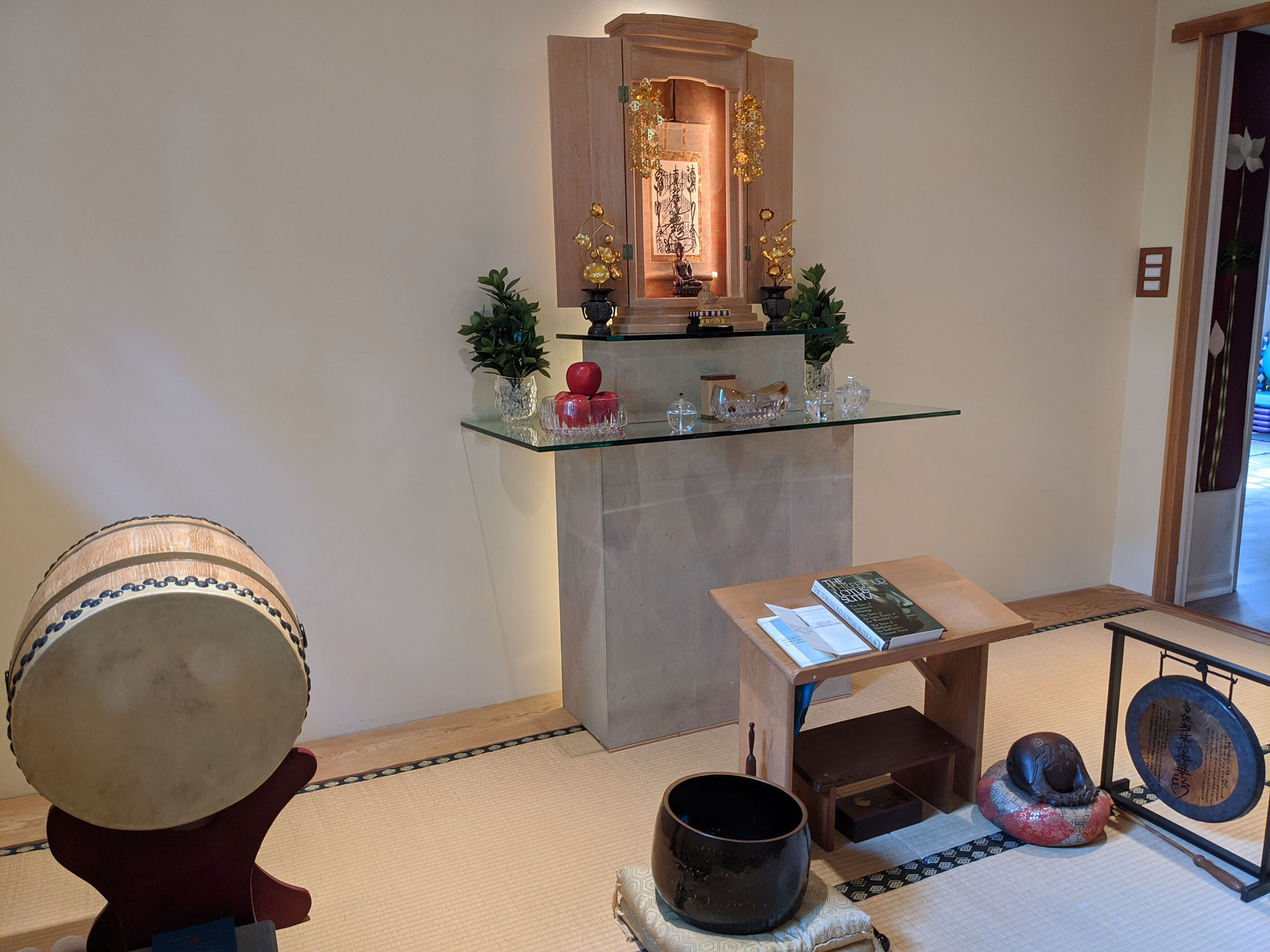
The train trip and the walk get me to Herrick’s house some time after noon. Services are scheduled to begin at 12:30 pm, with a lecture by Michael Ryuei McCormick Shonin following. In addition to Ryuei and Ryugan and me, there were two other men who attended. I was told fear of the Corona Virus was keeping a couple of regulars away. The quarters are tight and vigorous chanting could fill the air with pathogens. This will be the last service at Herrick’s house until the virus scare has passed.
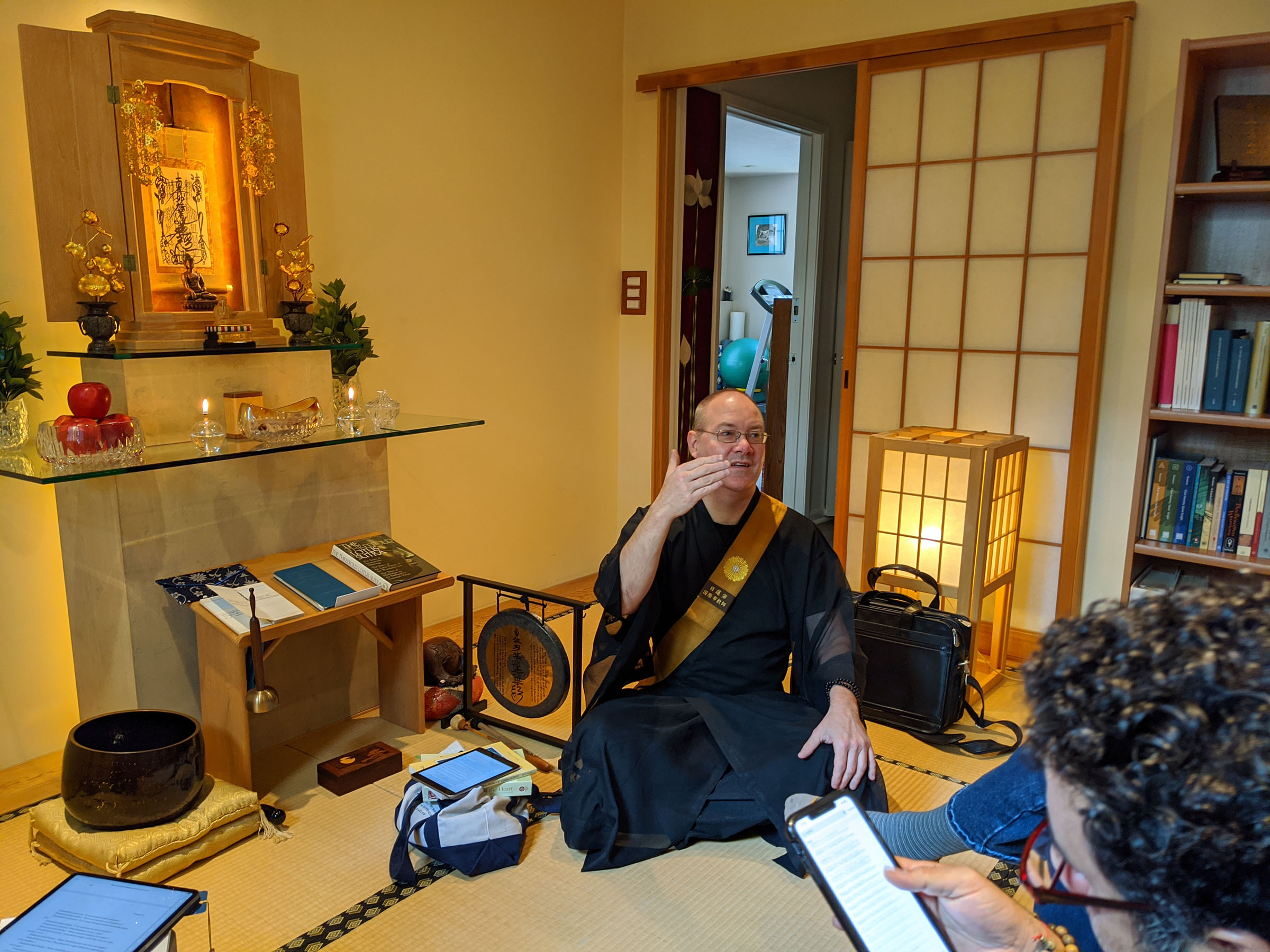
Ryuei Shonin’s lectures are part of his Buddhist Study Program. You can read more about that here. Today’s topic was Chapter 5 of The Vimalakirti Sutra.
The Burton Watson translation opens Chapter 5:
INQUIRING ABOUT THE ILLNESS
At that time the Buddha said to Manjushri, “You must go visit Vimalakirti and inquire about his illness.”
Manjushri replied to the Buddha, “World-Honored One, that eminent man is very difficult to confront. He is profoundly enlightened in the true nature of reality and skilled at preaching the essentials of the Law. His eloquence never falters, his wisdom is free of impediments. He understands all the rules of bodhisattva conduct, and nothing in the secret storehouse of the Buddhas is beyond his grasp. He has overcome the host of devils and disports himself with transcendental powers. In wisdom and expedient means he has mastered all there is to know. Nevertheless, in obedience to the Buddha’s august command, I will go visit him and inquire about his illness.” (Page 34)
Of particular interest for me was Vimalakirti’s explanation of his own illness in response to Manjushri:
“Layman, this illness of yours—can you endure it? Is the treatment perhaps not making it worse rather than better? The World-Honored One countless times has made solicitous inquiries concerning you. Layman, what is the cause of this illness? Has it been with you long? And how can it be cured?”
Vimalakirti replied, “This illness of mine is born of ignorance and feelings of attachment. Because all living beings are sick, therefore I am sick. If all living beings are relieved of sickness, then my sickness will be mended. Why? Because the bodhisattva for the sake of living beings enters the realm of birth and death, and because he is in the realm of birth and death he suffers illness. If living beings can gain release from illness, then the bodhisattva will no longer be ill.
“It is like the case of a rich man who has only one child. If the child falls ill, then the father and mother too will be ill, but if the child’s illness is cured, the father and mother too will be cured. The bodhisattva is like this, for he loves living beings as though they were his children. If living beings are sick, the bodhisattva will be sick, but if living beings are cured, the bodhisattva too will be cured. You ask what cause this illness arises from – the illness of the bodhisattva arises from his great compassion.” (Page 35-36)
Which brings us to the topic of this blog post: This photo.
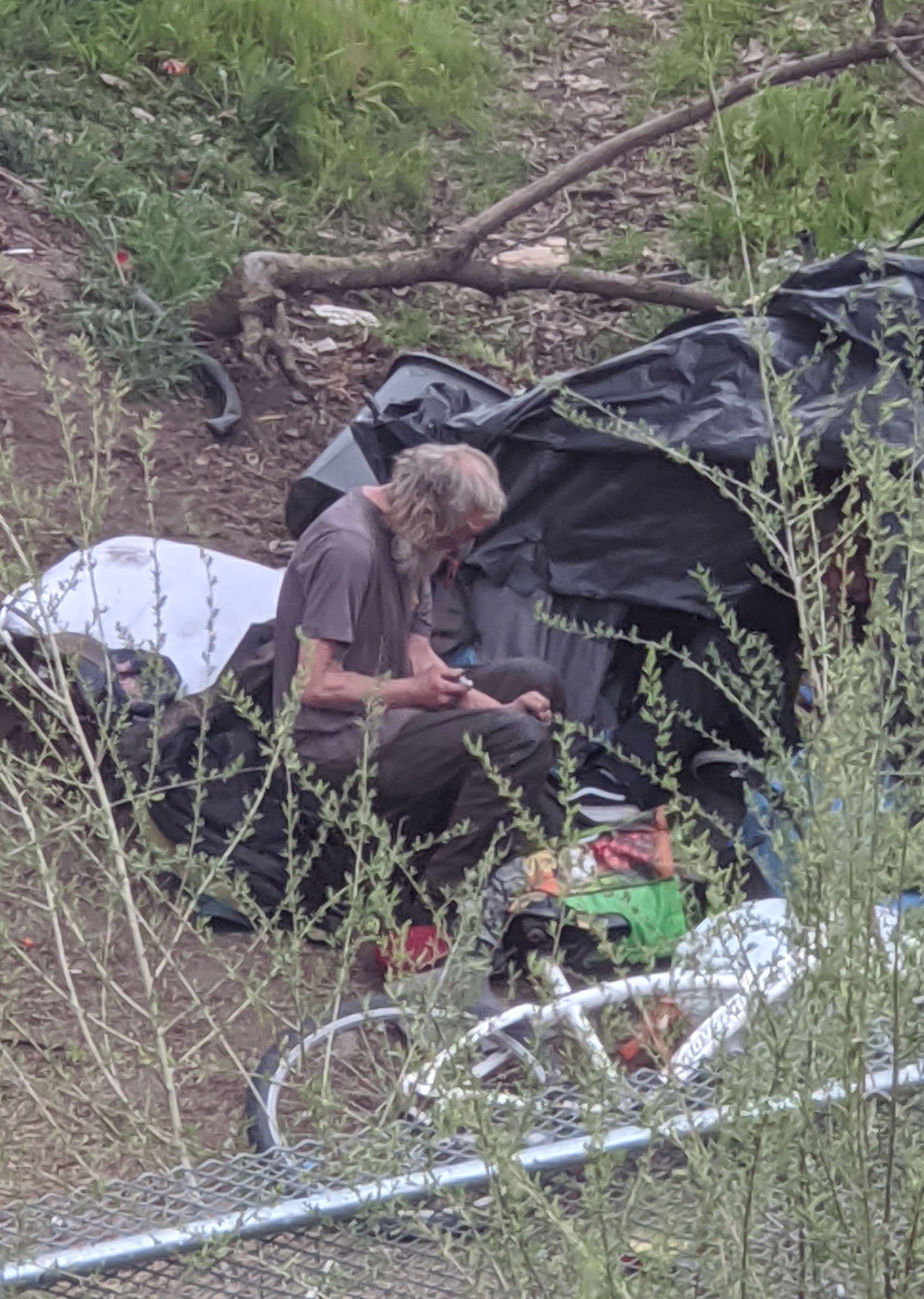
The service concluded at 2:30 pm and I caught a Lyft ride back to the Jack London Square station in time to get a seat on the 3 pm Capitol Corridor train for Sacramento. The ride was relaxing and uneventful until congestion in the Sacramento station caused our train to come to a halt across the Sacramento River in West Sacramento.
Looking out the window I saw a man climb our of his tarp shelter and proceed to inject something into his left arm. I took a photo and posted it on Instagram on my @jomariworks account.
When I eventually arrived home I did my regular evening service and my daily 32 Days of the Lotus Sutra posts. I then did a quick post of the photo and the first Bodhisattva Vow.
And so here I am today attempting to put that photo into the context of the Bodhisattva compassion shown in Vimalakirti’s illness.
If nothing else, this offers graphic illustration of the difficulty of the Bodhisattva path.
The Joy of the Dharma
Two Buddhas, p189By devotion to the Lotus Sūtra and to its daimoku practice, Nichiren taught, one manifests the reality of ichinen sanzen — or more simply stated, the Buddha’s enlightened state — within oneself, opening a ground of experience that is joyful and meaningful, independent of whether one’s immediate circumstances are favorable or not. Nichiren called this the “joy of the dharma.” In the Lotus Sūtra’s language, even in a world “ravaged by fire and torn with anxiety and distress” one can, so to speak, experience the gardens, palaces, and heavenly music of the buddha realm.
Leading the People in the Right Direction
It is I, Nichiren, alone who can rectify the false views of other schools and lead the people in the right direction.
The Nirvana Sūtra states that if a good monk sees others destroying Buddhism and ignores them without accusing them of their sins and chasing them out of their residences, he is an enemy of Buddhism. Grand Master Chang-an explains this passage in the Nirvana Sūtra: “A man who destroys Buddhism is an enemy of Buddhism. One who does not have compassion does not blame such a man, and instead pretends to be friendly to him. Such a man is his enemy. One who blames a destroyer of Buddhism and removes his evil mind is a man of kindness.”
Shingon Shoshū Imoku, Differences between the Lotus Sect and Other Sects Such as the True Word Sect, Writings of Nichiren Shōnin, Doctrine 2, Page 122
Daily Dharma – March 9, 2020
I see all living beings equally.
I have no partiality for them.
There is not ‘this one’ or ‘that one’ to me.
I transcend love and hatred.
The Buddha makes this declaration in Chapter Five of the Lotus Sūtra. He compares himself to a rain shower that waters all plants equally. He uses this example to show us how we should approach all living beings. Our respect for them and wish that they become enlightened cannot depend on whatever personal feelings we have towards them.
The Daily Dharma is produced by the Lexington Nichiren Buddhist Community. To subscribe to the daily emails, visit zenzaizenzai.com