I now expound this Sūtra of the Lotus Flower of the Wonderful Dharma with great joy. This sūtra leads all living beings to the knowledge of all things. I did not expound it before because, if I had done so, many people in the world would have hated it and few would have believed it.
The Buddha makes this declaration to Mañjuśrī Bodhisattva in Chapter Fourteen of the Lotus Sūtra. It can be difficult to imagine anyone hating the Buddha’s teachings. We sometimes notice that the true opposite of affection and devotion is not enmity and distrust. It is indifference. When we hear the Buddha’s teaching and do not make it part of our lives, it is because we are so attached to our peculiar ignorance and misery that we are afraid to live any other way. The Buddha shows us that it is possible to exist in harmony with the world rather than in conflict. It is only when we practice his teachings that we can believe them.
The Daily Dharma is produced by the Lexington Nichiren Buddhist Community. To subscribe to the daily emails, visit zenzaizenzai.com
Having last month considered in gāthās World-Voice-Perceiver Bodhisattva supernatural powers, we conclude Chapter 25, The Universal Gate of World-Voice-Perceiver Bodhisattva.
World-Voice-Perceiver will save
All living beings from misfortunes
And from innumerable sufferings of the world
By the wonderful power of his wisdom.
He has these supernatural powers.
He employs various expedients with his wisdom.
In the ten quarters there is no ksetra
In which he does not appear at all.
Hell, the region of hungry spirits, and the region of animals,
That is the [three) evil regions will be eliminated.
The sufferings of birth, old age, disease and death
Will gradually be eliminated.
He sees the truth of all things and their purity.
He sees all things with his great wisdom.
He sees all things with loving-kindness and compassion.
Think of him constantly! Look up at him constantly!
All darkness is dispelled by the light of his wisdom
As spotless and as pure as the light of the sun.
The light destroys the dangers of wind and fire,
And illumines the whole world brightly.
His precepts out of his loving-kindness brace us up as thunderbolts.
His wishes out of his compassion are as wonderful as large clouds.
He pours the rain of the Dharma as sweet as nectar,
And extinguishes the fire of illusions.
Suppose you are in a law-court for a suit,
Or on a battlefield, and are seized with fear.
If you think of the power of World-Voice-Perceiver,
All your enemies will flee away.
His wonderful voice [comes from] his perceiving the voice of the world.
It is like the voice of Brahman, like the sound of a tidal wave.
It excels all the other voices of the world.
Therefore, think of him constantly!
Do not doubt him even at a moment’s thought!
The Pure Saint World-Voice-Perceiver is reliable
When you suffer, and when you are confronted
With the calamity of death.
By all these merits, he sees
All living beings with his compassionate eyes.
The ocean of his accumulated merits is boundless.
Therefore, bow before him!
Thereupon Earth-Holding Bodhisattva rose from his seat, proceeded to the Buddha, and said to him:
“World-Honored One! Those who hear of his supernatural powers by which he opened the universal gate without hindrance, and which are expounded in this chapter of World-Voice-Perceiver Bodhisattva, know this, will be able to obtain not a few merits.”
When the Buddha expounded this chapter of the Universal Gate, the eighty-four thousand living beings in the congregation began to aspire for the unparalleled Anuttara-samyak-saṃbodhi.
Of the twenty-eight chapters of the Lotus Sutra, there is none that has been more misinterpreted than this one. Having been interpreted superficially and literally, it has been regarded as teaching an easygoing faith: anyone who calls upon the Bodhisattva Regarder of the Cries of the World will be delivered instantly from all his sufferings.
To be sure, the first half of this chapter deals for the most part with the supernatural power of this bodhisattva, declaring that if living beings keep in mind and revere the Bodhisattva Regarder of the Cries of the World, they will be freed from the seven dangers of fire, water, wind, sword, demon, torture, and robbery. If they continue to revere the bodhisattva, they will be delivered from the four human sufferings of birth, old age, sickness, and death. If they revere the bodhisattva still more, they will be emancipated from the three poisons of desire, anger, and foolishness, and they will be able to obtain the kind of children they desire.
When ordinary people read chapter 25 with a shallow understanding, it is only to be expected that they will fall into an easygoing faith. Such a misinterpretation of this chapter comes from their insufficient understanding of the teachings preached in the rest of the Lotus Sutra. If they could truly understand at least chapter 16, “Revelation of the [Eternal] Life of the Tathāgata,” they could not misunderstand chapter 25 in this way.
A marginal, often persecuted figure with only a small following, Nichiren himself had to abandon expectations that this goal would be achieved soon. Nonetheless, he introduced into the tradition of Lotus Sūtra interpretation what might be called a millennial element, a prophecy or vision of an ideal world based on the spread of exclusive faith in the Lotus Sūtra. Especially since the modern period, that vision has undergone multiple reinterpretations from a range of social and political perspectives. Nichiren’s ideal of manifesting the buddha land in the present world gives his doctrine an explicitly social dimension that sets it apart from other Buddhist teachings of his day. It is also the aspect of his teaching that speaks most powerfully to the “this-worldly” orientation of today’s Buddhist modernism.
I had a fun epiphany this morning while doing Gonyo. No, not the manifestation of Christ to the Gentiles as represented by the Magi, but a sudden, intuitive perception of or insight into the reality or essential meaning of something, usually initiated by some simple, homely, or commonplace occurrence or experience. Is there a Buddhist term for epiphany?
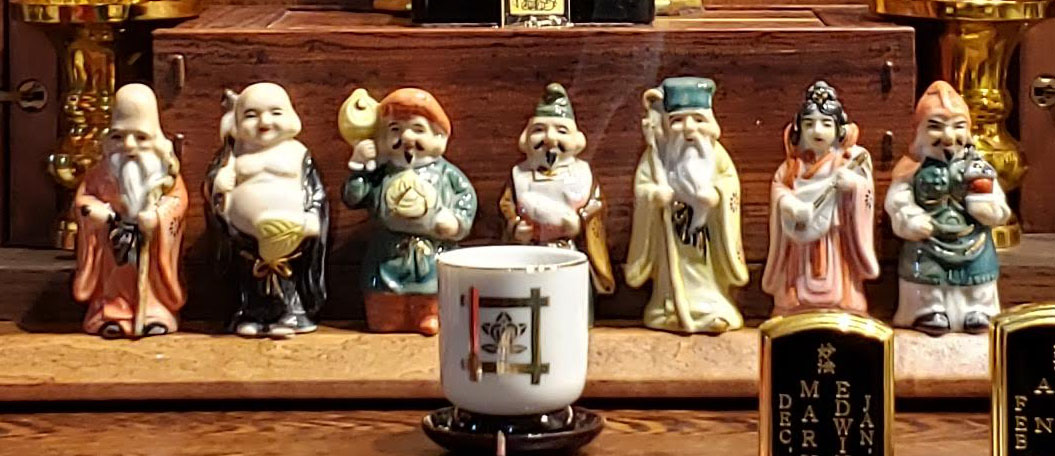
Anyway, this revelation involved the Seven Happy Gods on my altar. I discussed the addition of these gods to my practice back in July during my 21-Day Staycation Retreat Encouraged by Universal Sage. Read about it here. What is important to this story is the encouragement Rev. Kenjo Igarashi gave me before he performed an eye-opening for the gods.
“He cautioned, I would need to make them part of my practice. He said the figurines had been eye-opened before but the effect had withered. Basically they had starved to death.”
So, ever since I’ve added the Seven Happy Gods to my daily practice. Each morning and evening I devote a portion of my Daimoku to each god, reciting the god’s name and which virtue the god represents and chanting three Daimoku.
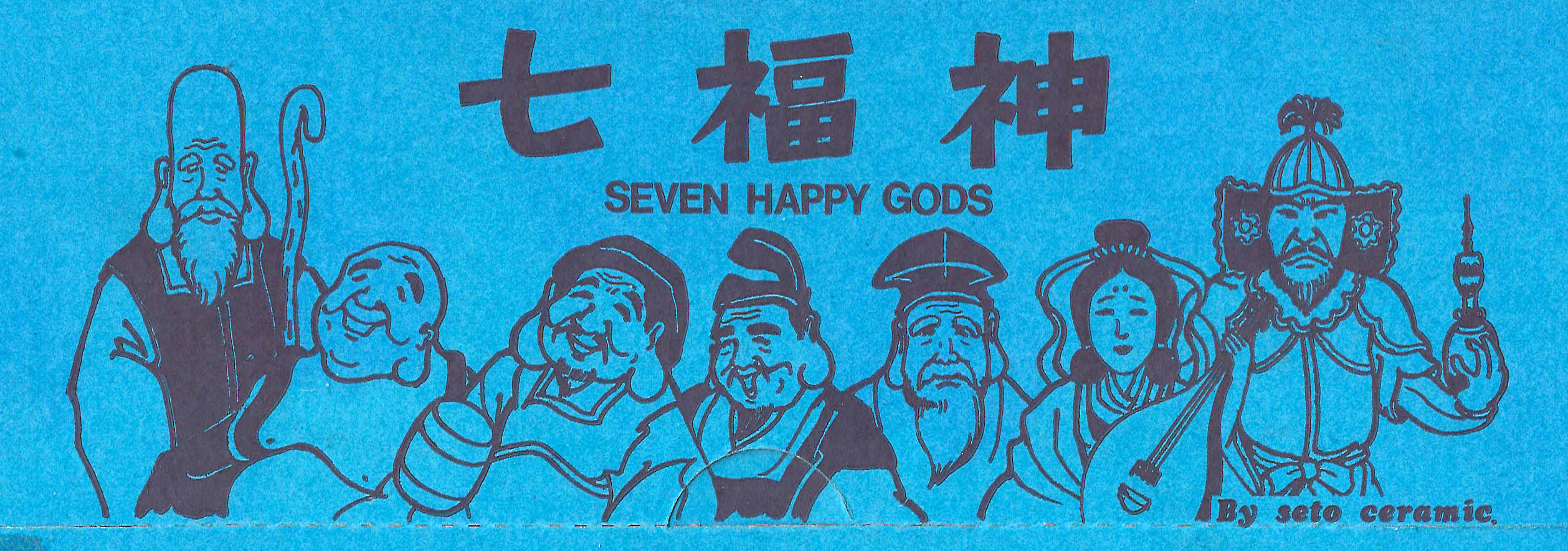
When I first placed the gods on my altar I had them in this order:
I chose this order because that was how they appeared on the cover of their box.
I bring this up because the order plays an important part in all of this.
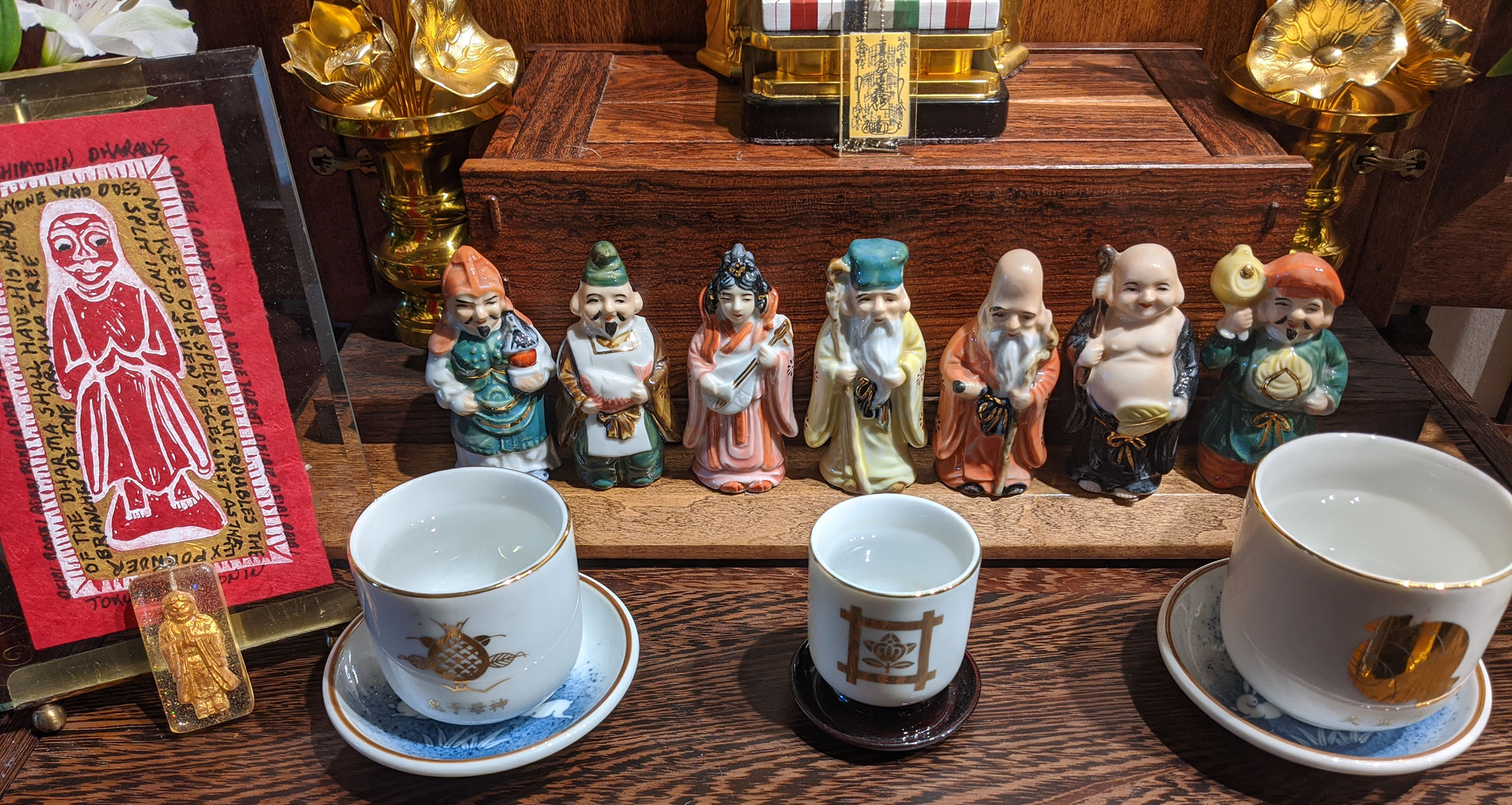
This order changed in November of last year. I saw water cups with symbols for Daikoku and Kishimojin available at Gasshodo.com. I figured adding these would be another way of involving the gods in my practice.
When I got the cups it necessitated rearranging things. I moved Kishimojin to the left and Daikoku to the right since that is how they appear on the altar of the Sacramento Nichiren Buddhist Church. I chose Bishamon to be the first god because he appears in the upper-left corner of the Gohonzon. It was only after I had finished arranging that I realized this must have been the order they were designed to follow. The central god, Jurōjin, is the only one in yellow attire. The two gods with orange hats are on the ends. Next are gods with green clothing and on either side of Jurōjin are gods in matching color clothing. (Is this coral or pink?)
Now, finally, we can get to the epiphany. Thanks for hanging in there.
With seven gods I’ve given each one a day of the week and in the morning I recite some details about that day’s god before offering my morning prayer to the Sanjubanshin, the 30 Guardians of the Lotus Sutra.
But seven is also the number of characters in the Daimoku. And when I considered each character and each god’s attribute, I discovered I had the essential arrangement.
Namu — Dignity and Honesty
With dignified and honest reverence, I devote myself.
Wonderful — Joy
Joyfully realizing how wonderful this all is.
Dharma — Wisdom
Realizing the wisdom of the Dharma
Lotus — Longevity
Longevity, the key of the Lotus Sutra: the Eternal, every-present nature of Śākyamuni Buddha
Flower — Happiness
Happiness flowering daily
Sutra — Fortune
Boundless Fortune flowing from this sutra.
Namu Myō Hō Ren Ge Kyō
Dignity, Honesty, Joy, Wisdom, Longevity, Happiness and Fortune
“Śākyamuni Buddha then took a bit of soil, put it on a fingernail, and asked Bodhisattva Kāśyapa which had more soil: the fingernail or the entire worlds throughout the universe? Bodhisattva Kāśyapa answered that it was clear that the soil on a fingernail could not compare in amount with that in all the worlds all over the universe. The Buddha then preached: “People who commit the four major sins or the five rebellious sins, and those who cut off the root of merit to become an icchantika, and who do not believe in this sūtra are as vast in amount as the soil in the entire worlds in the whole universe. On the contrary, those who do not commit the five rebellious sins, do not become an icchantika, do not cut off the root of merit, and uphold this Nirvana Sūtra are as scarce as the amount of soil on a fingernail.”
According to this passage in the Nirvana Sūtra, which is supplementary to the Lotus Sūtra, those who do not believe in the Lotus Sūtra are as numerous as the amount of soil in all the worlds throughout the universe while those who believe in it, like Nichiren, are as rare as the amount of soil on a fingernail in Japan today.
Shingon Shoshū Imoku, Differences between the Lotus Sect and Other Sects Such as the True Word Sect, Writings of Nichiren Shōnin, Doctrine 2, Page 122-123
My words are true.
Believe me with all your hearts!
I have been teaching them
Since the remotest past.
The Buddha sings these verses to Maitreya Bodhisattva and others gathered to hear him teach in Chapter Fifteen of the Lotus Sūtra. Maitreya had never seen any of the other Bodhisattvas who sprang up from underground in this chapter, despite his memory of previous lives and other worlds. The Buddha explains that the beings who had just appeared are also his disciples and have come to spread this Wonderful Dharma in our world. Nichiren teaches that when he realized that he was an incarnation of Superior-Practice, the leader of the Bodhisattvas from underground, then all of us who follow Nichiren and continue to keep the Lotus Sūtra are the followers of Superior-Practice. We do not need to wait for someone to come to our world and lead us. The world does not need anyone other than those already here to teach the Dharma. We are the Bodhisattvas from underground.
The Daily Dharma is produced by the Lexington Nichiren Buddhist Community. To subscribe to the daily emails, visit zenzaizenzai.com
Day 28 covers all of Chapter 24, Wonderful-Voice Bodhisattva, and concludes the Seventh Volume of the Sutra of the Lotus Flower of the Wonderful Dharma.
Having last month witnessed what happened when the Buddha illumined one hundred and eight billion nayuta Buddha-worlds in the eastern realm, we consider Pure-Flower-Star-King-Wisdom Buddha’s advice to Wonderful-Voice Bodhisattva.
When he was illumined by the light of Śākyamuni Buddha, he said to the Pure-Flower-Star-King-Wisdom Buddha:
“World-Honored One! I wish to visit the Sahā-World, bow to Śākyamuni Buddha, attend on him, and make offerings to him. I also wish to see Mañjuśrī Bodhisattva, who is the Son of the King of the Dharma. [I also wish to see] Medicine-King Bodhisattva, Brave-In-Giving Bodhisattva, Star-King-Flower Bodhisattva, Superior-Practice-Intent Bodhisattva, Adornment-King Bodhisattva, and Medicine-Superior Bodhisattva.”
Thereupon Pure-Flower-Star-King-Wisdom Buddha said to Wonderful-Voice Bodhisattva:
“Do not despise that world! Do not consider it to be inferior [to our world]! Good Man! The Sahā-World is not even. It is full of mud, stones, mountains’ and impurities. The Buddha [of that world] is short in stature! So are the Bodhisattvas [of that world]. You are forty-two thousand yojanas tall. I am six million an eight hundred thousand yojanas tall. You are the most handsome. You have thousands of millions of marks of merits, and your light is wonderful. Do not despise that world when you go there! Do not consider that the Buddha and Bodhisattvas of that world are inferior [to us]! Do not consider that that world is inferior [to ours]!”
What is meant by the statement that in comparison with the Buddha King Wisdom of the Pure Flower Constellation and the Bodhisattva Wonder Sound, the body of Sakyamuni Buddha is short and small and all the bodhisattvas are small of stature, not emitting rays of light from their bodies? This figure of speech points out the gulf between ideal and actuality. The domain where the Buddha King Wisdom of the Pure Flower Constellation dwells is an ideal world situated in the heavens. For this reason the bodies of the buddhas and the bodhisattvas in that domain are extraordinarily large and of a wonderful brightness.
On the other hand, what is the actuality? There is nothing impressive about it when compared with the ideal. The actuality appears to be far smaller, lower, and plainer than the ideal. A person who has perfected his character in such an actual world is far more sacred than an ideal form in the heavens, even if his body is small and has no apparent brightness. There is nothing more sacred than the attainment of the mental state of the Buddha in the actual world, where obstructions are often thrown up by evil-minded people. The Buddha King Wisdom of the Pure Flower Constellation preached this earnestly to the Bodhisattva Wonder Sound.
[F]or Nichiren, the immanence of the buddha land was not merely a truth to be realized subjectively, in the practice of individuals; it would actually become manifest in the outer world as faith in the Lotus Sūtra spread. We have already seen how he saw the disasters of his age as stemming fundamentally from rejection of the Lotus Sūtra in favor of inferior, provisional teachings no longer suited to the age. Conversely, he taught that — because people and their environments are inseparable — spreading faith in the Lotus Sūtra would transform this world into an ideal buddha realm. He famously argued this claim in his treatise Risshō anokoku ron, written early in his career, and maintained it throughout life. This was the conviction that underlay his aggressive proselytizing and that prompted him to risk his life in repeated confrontations with the authorities.