
All posts by John Hughes

Day 31

Day 31 covers Chapter 27, King Wonderful-Adornment as the Previous Life of a Bodhisattva.

Having last month met Cloud-Thunderpeal-Star-King-Flower-Wisdom Buddha and King Wonderful-Adornment and his wife and two sons, we hear the sons request to go to become followers of Cloud-Thunderpeal-Star-King-Flower-Wisdom Buddha and the mother’s instruction to show their father some wonders.

“Thereupon that Buddha expounded the Sūtra of the Lotus Flower of the Wonderful Dharma, wishing to lead King Wonderful-Adornment also out of his compassion towards all living beings. The two sons, Pure-Store and Pure-Eyes, came to their mother, joined their ten fingers and palms together, and said, ‘Mother! Go to Cloud-Thunderpeal-Star-King-Flower-Wisdom Buddha! We also will go to attend on him, approach him, make offerings to him, and bow to him because he is expounding the Sūtra of the Lotus Flower of the Wonderful Dharma to all gods and men. Hear and receive [the sūtra]!’

“The mother said to them, ‘[Yes, I will. But] your father believes in heresy. He is deeply attached to the teachings of brahmanas. Go and tell him to allow us to go [to that Buddha]! ‘

“Pure-Store and Pure-Eyes joined their ten fingers and palms together, and said to their mother, ‘We were born in this family attached to wrong views although we are sons of the King of the Dharma.’

“The mother said to them, ‘Show some wonders to your father out of your compassion towards him! If he sees [the wonders], he will have his mind purified and allow us to go to that Buddha.’
See Leading Others to the Teachings of the Buddha

Leading Others to the Teachings of the Buddha

Let us now consider the important points of this story. First, we must think of the true meaning of the two sons’ showing their father many kinds of supernatural deeds. This does not mean that they became able to display supernatural deeds by means of the Buddha’s teachings, nor that they stimulated their father’s curiosity by showing him such deeds. Their performing various supernatural deeds means that they completely changed their character and their daily lives by studying and believing the Buddha’s teachings. Their showing their father supernatural deeds thus means nothing but the fact that before their father they proved the true value of the Buddha’s teachings by their deeds and led him to be aroused to the aspiration for Perfect Enlightenment.

When we lead others to the teachings of the Buddha, none will follow us only through hearing us praise the teachings. We must clearly show them the reason that the Buddha’s teachings are worshipful. It is important for us to explain the content of the teachings. We must elucidate the teachings to others’ satisfaction according to their level of understanding, sometimes simply, sometimes theoretically, sometimes by using parables, and sometimes in the light of modern science.

Buddhism for Today, p400-401

Social Distancing

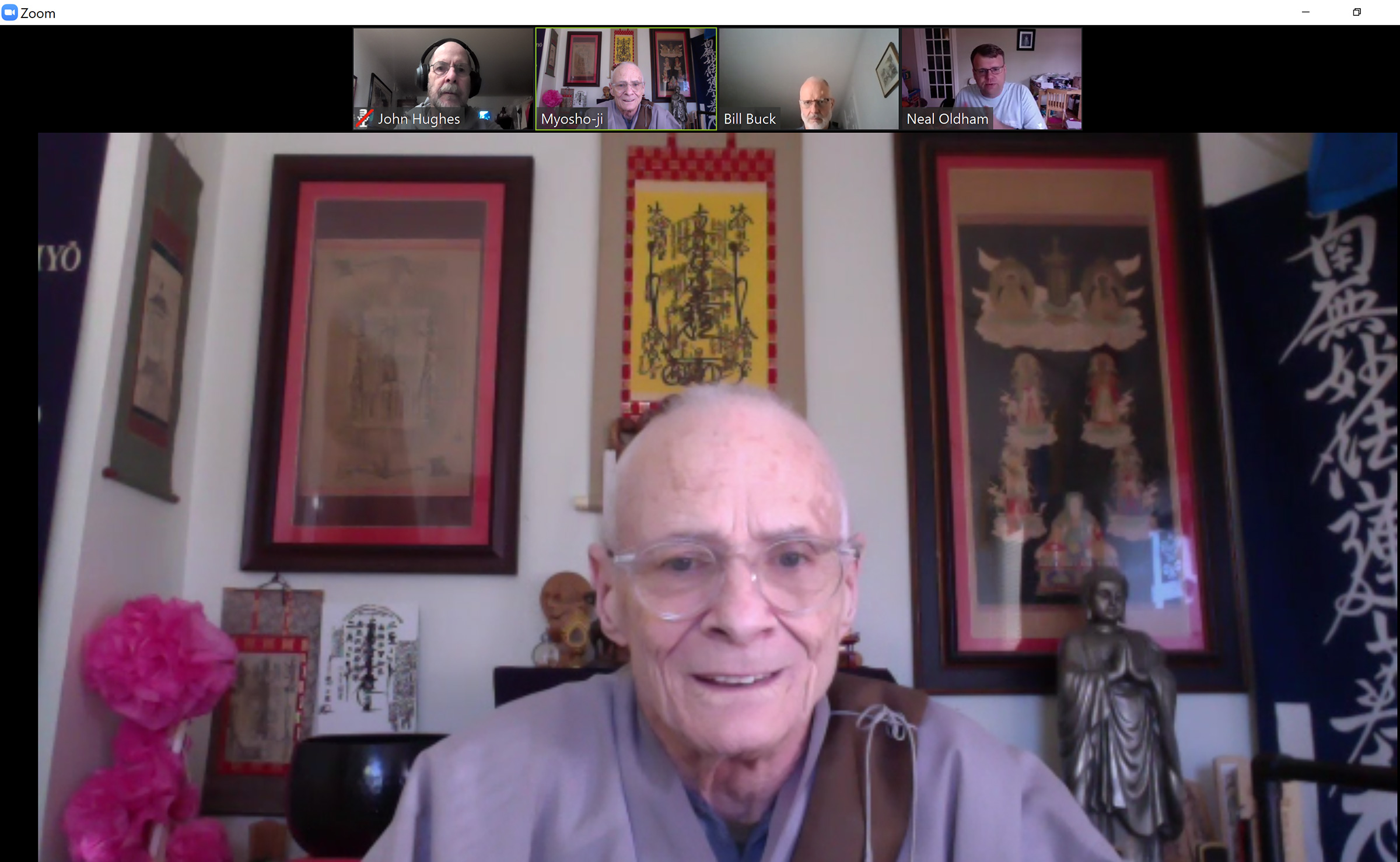
Zoom capture of service

The COVID-19 precautions are keeping me home and canceling the Sacramento Nichiren Buddhist Church services but that doesn’t impede my virtual sangha. Today I joined Rev. Ryusho Jeffus’ Myoshoji service. Ryusho Shonin is in Syracuse, New York, and the other two attendees joined from different parts of North Carolina, where Ryusho once had a physical temple. The Myoshoji services often include Nichiren Shu practitioners from several European countries.

Virtuous Attributes Contained Within The Daimoku

The “six perfections” systematize the practices required of Mahāyāna bodhisattvas to achieve buddhahood: giving, good conduct, perseverance, effort, meditation, and wisdom, in the Kubo and Yuyama translation. Traditionally, each perfection was said to require a hundred eons to complete, one eon being explained, for example, as the time required for a heavenly goddess to wear away great Mount Sumeru, the axis mundi, if she brushes it lightly with her sleeve once every hundred years. Such was the vast effort that Śākyamuni was said to have expended over staggering lengths of time in order to become the Buddha; the perfections represent his “causes” or “causal practices” and form the model for bodhisattva practice more generally. The wisdom, virtue, and power that he attained in consequence are his “resulting merits” or “effects.” Nichiren’s claim here is that all the practices and meritorious acts performed by Śākyamuni over countless lifetimes to become the Buddha, as well as the enlightenment and virtuous attributes he attained in consequence, are wholly contained within the daimoku and are spontaneously transferred to the practitioner in the act of chanting it.

Two Buddhas, p197

Followers of the Character ‘Kyō’ of the Lotus Sūtra

Speaking of all the phenomena embraced in the five Chinese characters of Myō, Hō, Ren, Ge, and Kyō, the character Kyō is the king of all sūtras because it contains all the Buddhist sūtras in this single character. During 50 years or so after the Buddha appeared in this world, He preached the 80,000 Holy Teachings. In the period when the human life span was 100 years, He passed away at midnight on February 15 at the age of 80. During the summer season of 90 days, from April 8 to July 15, 1,000 arhats assembled in a place to write down what the Buddha had expounded during His lifetime and to compile the scriptures. Afterwards, during the Age of the True Dharma, the first 1,000 years after the extinction of the Buddha, the Buddhist scriptures spread throughout India, but they were not yet introduced to China. Then in the 15th year of the Age of the Semblance Dharma, during the reign of Emperor Hsiao-ming of Later Han China (67 A.D.), the Buddhist scriptures were brought to China for the first time. By the time of Emperor Hsüan-tsung of the T’ang dynasty (730), the number of translators who came from India amounted to 176 and the total of sūtras, precepts, and discourses they brought numbered as many as 1,076 in 5,048 fascicles and 480 satchels. These scriptures are all followers of the character “kyō” of the Lotus Sūtra.

Hokke Daimoku Shō, Treatise on the Daimoku of the Lotus Sūtra, Writings of Nichiren Shōnin, Faith and Practice, Volume 4, Page 39-40

Daily Dharma – March 15, 2020

Make offerings to World-Voice-Perceiver Bodhisattva with all your hearts! This World-Voice-Perceiver Bodhisattva-mahāsattva gives fearlessness [to those who are] in fearful emergencies. Therefore, he is called the ‘Giver of Fearlessness’ in this Sahā-World.

The Buddha gives this description of World-Voice-Perceiver Bodhisattva (Kannon, Kanzeon, Avalokitesvara) to Endless-Intent Bodhisattva in Chapter Twenty-Five of the Lotus Sūtra. World-Voice-Perceiver is the embodiment of compassion. When we make offerings to compassion, we show how much we value it. In this world of conflict, we are taught to value aggression and violence rather than compassion. Those who do not dominate others are judged as targets for domination. If we clear away the delusion of our self-importance, and see other beings as worthy of happiness just as we are, we find ways for everyone to benefit together.

The Daily Dharma is produced by the Lexington Nichiren Buddhist Community. To subscribe to the daily emails, visit zenzaizenzai.com

Day 30

Day 30 covers all of Chapter 26, Dhāraṇīs


Having last month received Medicine-King Bodhisattva’s dhārāni spells, we receive Brave-In-Giving Bodhisattva’s dhārāni spells.

Thereupon Brave-In-Giving Bodhisattva said to the Buddha:

“World-Honored One! I also will utter dhārānis in order to protect the person who reads, recites and keeps the Sūtra of the Lotus Flower of the Wonderful Dharma. If he keeps these dhārānis, this teacher of the Dharma will not have his weak points taken advantage of by any yakṣa, rākṣasa, pūtana, kṛtya, kumbhāṇḍa or hungry spirit.”

Then he uttered spells before the Buddha:

“Zarei (1), makazarei (2), ukki (3), mokki (4), arei (5), arahatei (6), netsureitei (7), netsureitahatei (8), ichini (9), ichini (10), shichini(11), netsureichini (12), netsurichihachi (13).”

[He said to the Buddha:]

“World-Honored One! These dhārānis, these divine spells, have already been uttered by as many Buddhas as there are sands in the River Ganges. Those Buddhas uttered them with joy. Those who attack and abuse this teacher of the Dharma should be considered to have attacked and abused those Buddhas.”

See Mystic Syllables

Mystic Syllables

This chapter declares how with mystic syllables nonhuman beings representing the spiritual world, who are deeply moved by the teachings of the Lotus Sutra, vow to protect the teachings and their preachers.

First two bodhisattvas, Medicine King and Courageous Giver, vow to guard and protect the preachers of the Lotus Sutra. Their vows are only to be expected, for these two bodhisattvas are the disciples and messengers of the Buddha. Next two Brahma heavenly kings, the Divine King Vaiśravaṇa and the Divine King Domain Holder, vow to protect the sutra. The vows of these two non-Buddhist divine kings signify that the Buddha’s teachings comprehend all other teachings and infuse religious life into them.

Following this, ten female rākṣasas and the Mother of Demon Sons vow to protect the Lotus Sutra. These female demons with one voice declared before the Buddha that if anyone harassed the preachers of the sutra, they would protect the preachers and rid them of such persecution. Their declaration bears witness to the fact that the Buddha-mind is found even in these demons. Conversely, the teachings of the Lotus Sutra can be said to have the power to enable even these demons to become buddhas.

Buddhism for Today, p389

The All-Encompassing Lotus Sutra

Nichiren grounded his reasoning in his understanding that the Lotus Sūtra, and specifically its title, is all-encompassing. In a famous passage, he explained that simply by upholding the daimoku, one can gain the merit of the entire bodhisattva path: “The Sūtra of Immeasurable Meanings states: ‘Even if one is not able to practice the six perfections, they will spontaneously be fulfilled.’ The Lotus Sūtra states, ‘They wish to hear the all-encompassing way. …’ The heart of these passages is that Śākyamuni’s causal practices and their resulting merits are inherent in the five characters myō-hō-ren-ge-kyō. When we embrace these five characters, he will spontaneously transfer to us the merits of his causes and effects.”

Two Buddhas, p196-197

The Second Seal of the Law

Various terms were used at different times to indicate the meaning of the second seal of the Law: in Sanskrit, anatman (devoid of self) in primitive Buddhist scriptures and shunyata (void, emptiness) in Mahayana texts; and in Chinese, by the Zen Buddhists, wu (not). But all of these terms mean the absence of any fixed self or permanent nature, not utter nonexistence. The second seal of the Law expresses the ultimate goal of Buddhism as the attainment of the state in which realization of the impermanence and transience of all things liberates human beings from attachments of all kinds and enables them to act free and unhindered in accordance with the Law.
Basic Buddhist Concepts