All posts by John Hughes

Daily Dharma – March 20, 2020

I do not deceive
Those who believe me and rely on me.
I am not greedy or jealous
Because I have eliminated all evils.
Therefore, in the worlds of the ten quarters,
I am fearless.

The Buddha proclaims these verses to his disciple Śāriputra in Chapter Two of the Lotus Sutra. In this world of conflict, people believe that they must constantly strive to show that they are better than everyone else. Acquiring more material goods or a higher rank or position supposedly proves superiority. And if there is an encounter with someone who is better, that person must be brought down. What people do not realize that the source of greed and jealousy is fear. Like the Buddha, we too can eliminate our fears when we are satisfied with what we have and regard superior beings as a source of benefit.

The Daily Dharma is produced by the Lexington Nichiren Buddhist Community. To subscribe to the daily emails, visit zenzaizenzai.com

Returning to a Good Friend

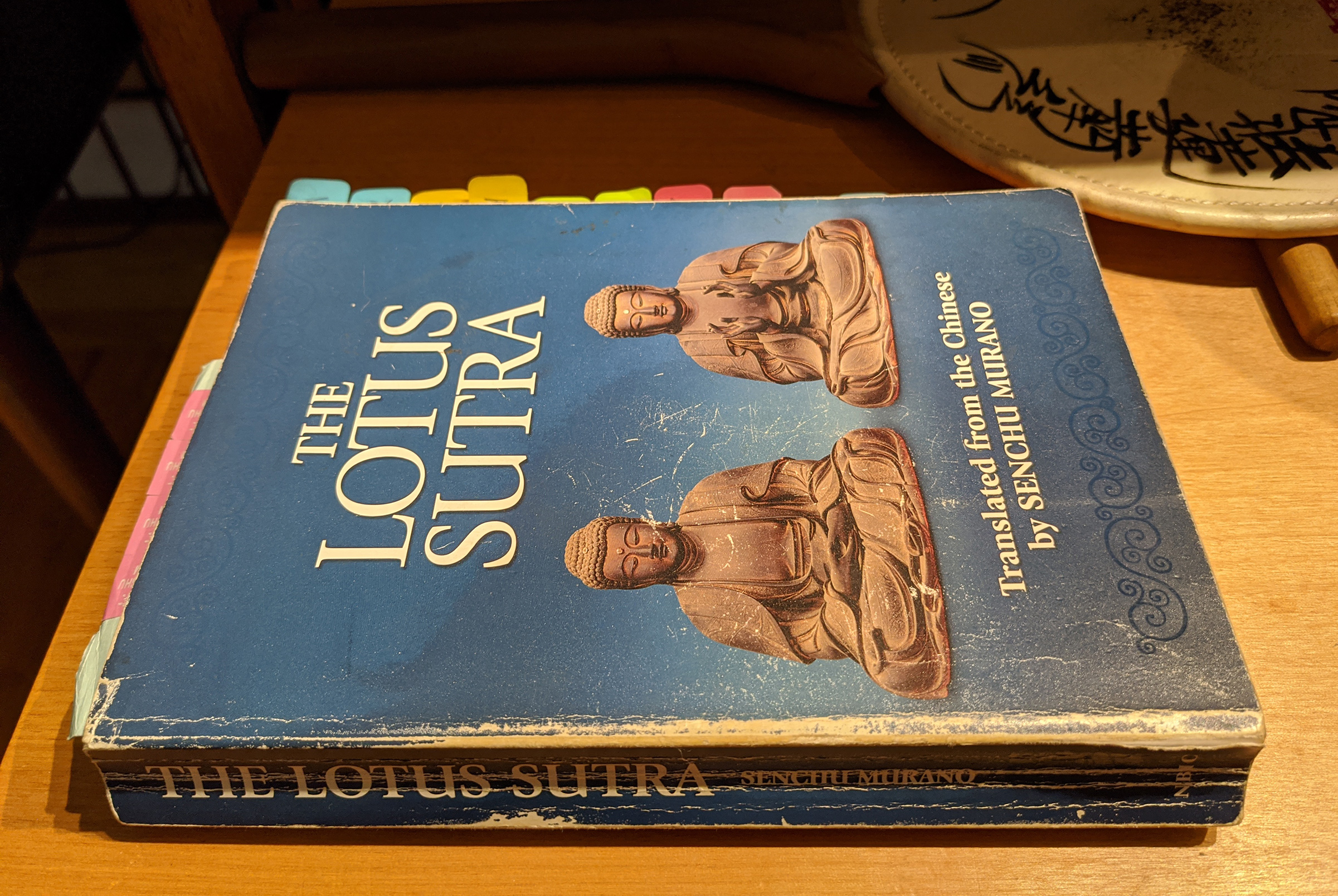
Lotus Sutra by Senchu Murano

For this evening’s service I welcomed an old friend, my Senchu Murano translation of the Lotus Sutra. For the past 10 cycles through my 32 Days of the Lotus Sutra practice I have been working my way through all of the English translations of Kumarajiva’s Chinese translation of the Lotus Sutra, beginning with “The Scripture of the Lotus Blossom of the Fine Dharma,” the translation of the Lotus Sutra made by Leon Hurvitz, and concluding with Burton Watson’s translation for Soka Gakkai. I suspect that Rissho Kosei-kai’s translation, “The Threefold Lotus Sutra: A Modern Translation for Contemporary Readers,” which was published in 2019, will become the modern standard. The Nichiren Shu Buddhist Sangha of the San Francisco Bay Area intends to use this translation rather than Murano’s for its service booklet. Personally, I’m not convinced that the translators’ aggressive effort to remove gender bias is beneficial. I wrote about this in a January blog post.

In any event, on this 51st cycle through the Lotus Sutra, I’m very happy to return to Murano’s translation.

Day 1

Day 1 covers the first half of Chapter 1, Introductory


Having last month considered the additional practices of the Bodhisattvas that Maitreya sees, we considered the final practices of those Bodhisattvas that Maitreya sees.

I also see some Bodhisattvas
Offering delicious food and drink
And hundreds of kinds of medicines
To the Buddha and the Sangha.

Some offer garments and beautiful robes
Worth tens of millions
Or beyond monetary value
To the Buddha and the Sangha.

Some offer thousands of billions
Of jeweled houses made of candana
And wonderful bedding
To the Buddha and the Sangha.

Some offer pure gardens and forests
Abounding in flowers and fruits,
And furnished with rivers, springs,
and pools for bathing,
To the Buddha and the Saṃgha.

I see those Bodhisattvas
Making offerings of those wonderful things
Joyfully and untiringly
In order to attain unsurpassed enlightenment.

Some Bodhisattvas expound
The truth of tranquil extinction,
And with various expedients,
Teach innumerable living beings.

I also see some Bodhisattvas
Who attained the following truth:
“The nature of things is not dual.
It is [formless] like the sky.”

I also see some sons of the Buddha
Having no attachment in their minds.
They seek unsurpassed enlightenment
With this wonderful wisdom.

Mañjuśrī!
Some Bodhisattvas make offerings
To the śarīras of a Buddha
After his extinction.

I also see some sons of the Buddha
Adorning the world of the Buddha
With as many stupa-mausoleums
As there are sands in the River Ganges.

Those stupas of treasures are
Lofty and wonderful.
They are five thousand yojanas high,
And two thousand yojanas wide and deep.

Each of the stupa-mausoleums has
One thousand pairs of banners and streamers.
It also has curtains adorned with gems.
It also has jeweled bells ringing.

Gods, dragons, men, and nonhuman beings
Constantly offer incense, flowers, and music
[To the stupa-mausoleums].

Mañjuśrī!
Those sons of the Buddha
Adorn the stupa-mausoleums
And offer the adornments
To the śarīras [of the Buddha].

The worlds [of the Buddha] naturally become
As wonderful and as beautiful
As the [flowers] of the kingly tree
In full bloom on the top of Mt. Sumeru.
The multitude of this congregation and I
Can see the various wonderful things
Of those worlds
By the ray of light of the Buddha [of this world].

The Introduction to the Lotus Sutra explains the omens that confounded Maitreya:

In Chapter 1, Introduction, the congregation waited anxiously for this definitive sermon, the way to which had already been prepared by the Sutra of Innumerable Teachings. But Sakyamuni did not begin immediately. First, he preached the opening sutra … . Then he entered into its deep meditation. His body and mind became motionless. The assembled gods rained mandarava flowers upon him. The world quaked in six ways. The assembled beings looked on in astonishment and joined their hands together in supplication. Finally the Buddha emitted a ray of light from the white curl between his eyebrows (the so-called “third eye”) and illuminated all the eighteen thousand worlds to the east, from their lowest hells up to their highest heavens.

These are called the “Six Omens Shown in This World.” In order, they are “Preaching,” “Entering into Samadhi,” “Raining Flowers,” “Quaking,” “Delighting,” and “Emitting a Ray of Light.”

Introduction to the Lotus Sutra

Expiating His Past Errors

Nichiren … read the story of Sadāparibhūta [Never-Despising Bodhisattva] in a way that reflected — and perhaps inspired — his understanding of his own ordeals as a form of redemptive suffering. The prose portion of the “Sadāparibhūta” chapter says that those who mocked the bodhisattva suffered for a thousand eons in the Avici hell, but after expiating this offense, they were again able to meet him and were led by him to attain “the highest, complete enlightenment.” The verse section, however, suggests that the bodhisattva himself had “expiated his past errors” by patiently bearing the insults and mistreatment he received in the course of his practice. Nichiren focused on this second reading, encouraging his followers, and himself as well, by explaining that hardship encountered for the Lotus Sūtra’s sake would eradicate one’s past slanders against the dharma. “The bodhisattva Sadāparibhūta was not reviled and disparaged, and assailed with sticks and stones, for no reason,” Nichiren suggested. “It would appear that he had probably slandered the true dharma in the past. The phrase ‘having expiated his past errors’ seems to mean that because he met persecution, he was able to eradicate his sins from prior lifetimes.”

Two Buddhas, p209-210

Finding Śākyamuni Buddha and the Lotus Sūtra

I still remember vividly how you accompanied me to Tatsunokuchi holding a horse by the bridle and breaking into tears when I was about to be beheaded there. I will never forget this no matter how many lifetimes come and go. If by chance you should fall into hell, I will refuse the invitation of Śākyamuni Buddha to become a Buddha. Instead I will go to hell with you. If we both entered hell, how could it be possible that we would not find Śākyamuni Buddha and the Lotus Sūtra there? This can be no more possible than a moon shining in the dark sky, cold water being poured into hot water, a fire burning in ice, or darkness embracing the sun.

Sushun Tennō Gosho, The ‘Emperor Sushun’ Letter, Writings of Nichiren Shōnin, Faith and Practice, Volume 4, Page 122

Daily Dharma – March 19, 2020

I have expounded many sūtras. I am now expounding this sūtra. I also will expound many sūtras in the future. The total number of the sūtras will amount to many thousands of billions. This Sūtra of the Lotus Flower of the Wonderful Dharma is the most difficult to believe and the most difficult to understand.

The Buddha declares these lines to Medicine-King Bodhisattva in Chapter Ten of the Lotus Sūtra. At the beginning of this Sūtra, the Buddha held back from teaching because he thought people might not be ready to hear it. He also said that the Dharma he teaches cannot be understood by reasoning. We need both faith and understanding to practice the Wonderful Dharma. The Buddha also reminds us to appreciate how difficult faith and understanding are, both for ourselves and others.

The Daily Dharma is produced by the Lexington Nichiren Buddhist Community. To subscribe to the daily emails, visit zenzaizenzai.com

Another Innumerable Day Before Day 1

For today’s journey through The Sutra of Innumerable Meanings, I offer Nikkyō Niwano’s discussion of the 10 Merits gained by the practicer of this sutra:

This [Ten Merits] chapter expounds the merit one can gain, the virtuous deeds he can accomplish, and the service he can render to society if he understands the teachings preached in this sutra. Some people say that religion should not bring merit to its believers, but this is a specious argument. It would be, rather, a wonder if one did not gain merit when he truly understood a correct religion, believed in it deeply, and practiced it. Needless to say, there are varying degrees of merit according to one’s degree of understanding and the speed of the actual manifestation of merit. In any case, it is natural for one to gain merit through his religion when he has faith in it.

As mentioned earlier, the teachings of the Buddha are the truth of the universe, which of course includes human beings. It is no wonder, and certainly no miracle, that if one lives according to the truth, his life works out well. This is like the fact that if we switch on the television set and tune in exactly to the wavelength beamed from a particular television station, a vivid image appears on the screen and a clear voice is heard.

If no image appears on the television screen, however often we try to tune in the channel, the television set is useless. It will be put away in some storeroom, where it will be covered with dust. Numerous religions have sprung up throughout history, but some of them have gradually lost their power and finally have become distant from the people. This is because they have forgotten the merit to be gained by believers, or because they have preached only the merit to be gained after death – that one will go to heaven or be reborn in paradise.

The true teachings of the Buddha, however, do not preach an intangible merit that one cannot realize until after death. The merit preached by the Buddha appears clearly in our lives in this world. In addition to ourselves, it is a merit that exerts an influence upon all of society and upon all people. If we disregard this merit and make light of it, it is as if we deliberately shut out the light of the Buddha’s teachings with a black curtain. Such an attitude is due to the shallow understanding peculiar to people today.

We should abandon such shallow thinking and bathe ourselves in the light of the Buddha by drawing aside the curtain. This is the true hope of the Buddha and the sole purpose of his appearance in this world.

Buddhism for Today, p13-14

An Exemplar of Practice for the Latter Age

Nichiren took Sadāparibhūta [Never-Despising Bodhisattva] as a personal model and strongly identified with him. First, there were obvious parallels in their practice. “Sadāparibhūta was a practitioner at the initial stage of rejoicing,” Nichiren wrote, “while I am an ordinary person at the level of verbal identity. He sowed the seeds of buddhahood with twenty-four characters, while I do so with just five characters [Myō-hō-ren-ge-kyō]. The age differs, but the buddhahood realized is exactly the same.” This passage suggests that Nichiren saw Sadāparibhūta, like himself, as someone at the initial stages of practice who was carrying out shakubuku, planting the seeds of buddhahood in the minds of people who had never before received them. He saw other similarities as well. Both Nichiren and Sadāparibhūta lived long after the passing of the respective buddhas of their age, in an era of decline when there was much hostility. And both persevered in the face of emnity, enabling their persecutors to form a “reverse connection” (J. gyakuen) with the Lotus Sūtra. In short, Sadāparibhūta was for Nichiren an exemplar of practice for the latter age, and in this sense, he wrote, “The heart of the practice of the Lotus Sūtra is found in the ‘Sadāparibhūta’ chapter.”

Two Buddhas, p208-209

All For the Sake of the Lotus Sūtra

Fortunately, I have already been born to the human world without being misled by an evil teacher. For the sake of the Lotus Sūtra, I was sentenced to banishment to Izu, but regrettably I have not been executed yet. Hoping that such a thing will happen so that I will be executed for the sake of the Lotus Sūtra, I have exerted myself to write strongly worded letters to various people.

I am almost fifty years old, and do not know how many more years I will be able to live. I pray that I may sacrifice my body, which otherwise will be thrown away in a wild field, for the sake of the One Vehicle teaching of the Lotus Sūtra; that I may follow the examples of Young Ascetic in the Snow Mountains, who was willing to sacrifice his own life in search of the dharma, and Medicine King Bodhisattva, who burned his own arm in order to offer light to the Lotus Sūtra; and that I may live up to Kings Sen’yo and Virtuous, defenders of the True Dharma, leaving my name in future lives so that the future Buddha will mention my name when He preaches the Lotus-Nirvana Sūtras. Namu Myōhō Renge Kyō!

Kingo-dono Go-hunji, A Reply to Lord Ōta Jōmyō, Writings of Nichiren Shōnin, Doctrine 1, Page 158-159

Daily Dharma – March 18, 2020

A man of shallow faith pretends to have right faith and is contemptuous towards other followers, so as to harm the faith of others. Leave such people alone. By the intention of the King of the Brahma Heaven, Indra and other deities, I believe that such a time will certainly come when all the people of Japan will simultaneously believe in the Lotus Sutra. I am sure that many people will then say, “I have believed in this sutra all along.”

Nichiren wrote this passage in a Reply to Lord Ueno (Ueno-dono Gohenji). In Nichiren’s life, he tolerated the contempt of many who refused his call to set aside expedient teachings and take up the Wonderful Dharma of the Lotus Sūtra. Despite repeated attempts to reach these people, and after enduring his home being burned down, attacks with swords, a mock execution and numerous exiles, he retired to a hermitage on Mt. Minobu to spend the last days of his life. As the Buddha showed no contempt towards his cousin Devadatta, Nichiren showed no contempt towards his persecutors. When we find others who despise us for our practice, we have the example of these two men. They both took the long view towards enlightenment, and did not let themselves be wounded by the follies of human nature.

The Daily Dharma is produced by the Lexington Nichiren Buddhist Community. To subscribe to the daily emails, visit zenzaizenzai.com